REVIEW 3 major objections 4 minor 17 references
UniGD: A Unified Generative-Discriminative Framework for Industrial Retrieval
T0 review · 3 major / 4 minor · reviewed 2026-08-06 · deepseek-v4-flash
Pith's one-line read A single model can both retrieve candidate ads and score their relevance, and doing so raised ad revenue by 5.78% while cutting inference latency from 13.00 ms to 8.70 ms in live A/B tests.
desk verdict Worth reviewing, but the public-benchmark evidence is shaky unless the authors clear up how PQ centroids can serve an additive reconstruction. read the letter →
The pith
A machine-rendered reading of the paper's core claim, the machinery that carries it, and where it could break.
The reading
What carries the argument
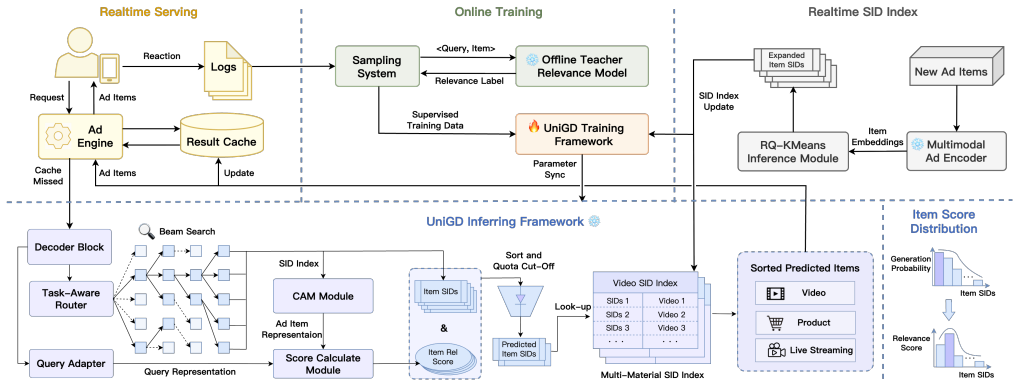
The load-bearing mechanism is CAM: an ad's SID tokens $s_t(a)$ select one frozen codeword per level, and the ad-side representation is $u^{\mathrm{CAM}}_a=\sum_{t=1}^{T}C_t[s_t(a)]$. This turns any SID into a dense vector by codebook lookups, so a newly indexed ad is relevance-scoreable without running an ad-side encoder. CAGE is the supporting mechanism: during joint training it removes the component of the discriminative gradient that opposes the generative gradient (when their cosine similarity is negative), preserving generation while keeping non-conflicting discriminative signal.
What would settle it
On the human-labeled industrial test set, compute the final quantization residual $\rho_T(a)=v_a-u^{\mathrm{CAM}}_a$ per ad and correlate its norm with relevance-score error for new ads; a strong correlation, or a material AUC gain when $\rho_T(a)$ is added back into the scoring head, would show the codebook approximation is the limiting factor. Directly A/B testing scoring with $u^{\mathrm{CAM}}_a$ versus the full multimodal embedding $v_a$ would settle whether CAM is load-bearing.
Extended reading notes
Core claim
UniGD claims that one decoder-only model can both generate a relevant ad's hierarchical semantic identifier $s(a)=(s_1(a),\dots,s_T(a))$ and output an explicit relevance score $r(q,a)$. The generative loss is the autoregressive likelihood $p(s(a)|q)=\prod_{t=1}^{T}p(s_t(a)\mid q,s_{<t}(a))$; the discriminative loss is pointwise squared error plus pairwise margin on $r(q,a)$. A three-stage schedule pretrains generation, warms up discrimination with the backbone frozen, then jointly trains under CAGE. The evidence: Recall@10 improves 8.44% and 3.19% over the strongest reproduced GR baselines, and online A/B tests report +5.78% ad revenue, +24.6% new-ad impressions, and latency cut from 13.00 m
Load-bearing premise
The claim rests on the assumption that summing the selected SID codewords, $u^{\mathrm{CAM}}_a=\sum_t C_t[s_t(a)]$, preserves enough ad semantics for relevance that the discarded quantization residual $\rho_T(a)$ can be ignored, especially for new and long-tail ads.
Editorial extensions
If this is right
- GR plus a separate relevance model can be replaced by one model, removing a serving stage and cutting latency by about a third (13.00 ms to 8.70 ms in the reported A/B test).
- Explicit relevance supervision reshapes the generative model itself, not just a downstream reranker; the reported Recall@1 gains of more than 22 absolute points on NQ320K and MS300K indicate top-rank placement improves markedly.
- Codebook-anchored representations make relevance estimation available for every indexed ad immediately, which matters most where new ads make up large traffic shares (36.9% of daily traffic in the paper's deployment).
- Material-specific SID spaces and codebooks let a single backbone serve heterogeneous ad types without cross-type semantic dilution, as shown by the HAM ablation.
- The same unified objective should apply to other retrieval domains with strict relevance constraints, such as recommendation and general information retrieval.
Reading between the lines
- The large Recall@1 jump suggests the discriminative objective may act partly as a prefix reranker; testing whether gains come from correcting early SID tokens or final-token discrimination would locate the supervision.
- Because CAM reuses frozen codebooks and discards $\rho_T(a)$, the cold-start ceiling is set by codebook quality; an extension would refine codebooks online or add a residual-aware confidence term and measure new-ad AUC.
- CAGE's asymmetric priority toward generation is a design choice; reversing the priority or making the adaptation strength $\kappa$ a learned function could change the trade-off between recall and relevance.
- The +24.6% new-ad impression gain is a natural test of the cold-start hypothesis: an A/B test that buckets new ads by quantization residual magnitude could show whether the gain tracks representation quality.
Editorial analysis
A structured set of objections, weighed in public.
Referee Report
Summary. The paper proposes UniGD, a unified generative-discriminative framework for industrial search advertising. It shares a decoder-only backbone between autoregressive SID-based retrieval and explicit pointwise/pairwise relevance scoring, introducing three components: CAGE to coordinate conflicting gradients, CAM to anchor ad representations in frozen hierarchical codebooks, and HAM to model heterogeneous ad material types. The authors report online A/B results on Kuaishou (revenue +5.78%, latency reduced from 13.0 ms to 8.7 ms) and public benchmark results on NQ320K and MS300K, where UniGD purportedly improves Recall@10 over the strongest reproduced GR baseline by 8.44% and 3.19%, respectively. The paper positions these results as evidence that a jointly trained generative–discriminative model can replace the cascaded GR plus external relevance model.
Significance. If the reported results hold, this is a practically important contribution: removing the separately deployed relevance model while improving relevance estimation and retrieval quality would be a meaningful step for industrial search advertising. The framework is clearly described, and the ablations in Table 2 support the individual contributions of CAM, HAM, and CAGE. The online A/B experiment is substantial and directly relevant to deployment. However, the public-benchmark evidence is weakened by an apparent mismatch between the proposed residual-quantization CAM and the implementation detail of reusing DDRO's product-quantization centroids, and by the absence of any statistical detail beyond a claimed paired t-test. Because the public benchmarks are the only externally checkable quantitative evidence, these issues are load-bearing for the paper's central claim. I credit the authors for reproducing the baselines and for providing a concrete serving architecture, but the current manuscript does not yet establish the claimed generality.
major comments (3)
- [Experiments, Implementation Details; Methodology, Eqs. (9)-(11)] The implementation states: 'we adopt the PQ-based SIDs of DDRO with T=24. We reuse the frozen PQ centroids from DDRO as CAM codebooks.' This conflicts with the definition of CAM in Eqs. (8)-(10), which is residual quantization: each codebook C_t is full-dimensional, the token at level t is selected using the residual rho_{t-1}, and the reconstruction is the sum of codewords. Standard product quantization, as used by DDRO, partitions the vector into subspaces, assigns each subspace independently, and reconstructs by concatenating sub-vectors. If the reused centroids are standard PQ centroids, Eq. (10) is not their reconstruction operator and Eq. (9) does not reproduce their assignment rule. Summing codewords with disjoint support can be algebraically equivalent to concatenation, but the selection criterion is not the residual criterion of Eq. (9). The paper provides no codebook dimensions
- [Experiments, Evaluation Metrics; Tables 1-3] The only statistical support for the headline claims is the sentence 'significance is assessed against the strongest reproduced baseline using a two-tailed paired t-test over per-query values (p<0.05).' No sample size, t-statistic, standard deviation, or confidence interval is reported for any of the Recall/MRR differences, and the relevance metrics in Table 4 also have no variance estimates. For retrieval metrics that are highly skewed at the per-query level, a t-test without diagnostics is not a substitute for confidence intervals or bootstrap/permutation tests. The paper should report the number of test queries, standard errors, and ideally confidence intervals for the main comparisons in Tables 1 and 2, including the ablations. As written, 'statistically significant' is not verifiable by the reader and the magnitude of the claimed improvements cannot be assessed against noise.
- [Experiments, Ablation Study; Table 2] The CAM ablation is not fully specified. In the NQ320K rows, 'w/o CAM' drops Recall@1 from 72.33 to 45.52, but the paper does not state what ad-side representation is used in that variant. If 'w/o CAM' falls back to a learned ad embedding, the comparison is not a clean ablation of the semantic anchoring mechanism; it also changes the number of trainable parameters and the information available to the relevance scorer. The industrial 'w/o CAM' row is similarly unclear in terms of what replaces the codebook-anchored representation. Please specify the alternative ad-side representation, its parameter count, and how the SID tokens are still used (if at all) in the discriminative scorer.
minor comments (4)
- [Introduction / Abstract] The abstract says latency is reduced by '33%' while Table 3 reports 33.1%; please make the numbers consistent. Also, the abstract states NQ320K and MS300K Recall@10 gains of 8.44% and 3.19%, but the text should clarify that these are relative gains over the strongest reproduced baseline, not absolute percentage-point gains.
- [Figure 3] The caption does not state which dataset the training curves are from. Since the paper reports both industrial and public-benchmark training, please clarify whether Figure 3 corresponds to the industrial setting or to NQ320K, and describe the validation metric.
- [Eq. (13)] In the c<0 branch, the notation g_disc is used after g_disc^\perp has been defined in Eq. (12). Please make explicit that the gradient being scaled by beta(c) is the orthogonal projection g_disc^\perp, not the original g_disc, or redefine the symbols accordingly.
- [Implementation Details] The paper does not release code or provide codebook sizes (e.g., |V_t| for the public benchmarks). Given that the public-benchmark comparison depends on reusing DDRO's identifiers, reporting at least the vocabulary sizes and the conversion from DDRO's PQ centroids to the CAM codebooks is essential for reproducibility. A public code link would also strengthen the paper.
Circularity Check
No significant circularity: UniGD's core claims are supported by external benchmarks, human labels, and frozen external codebooks rather than by construction.
full rationale
The paper's derivation chain is not circular. The discriminative objective (Eqs. 5–7) is supervised by human annotations or an offline relevance model, which are independent of the generative SID likelihood and the reported retrieval metrics. The CAM module (Eqs. 8–11) uses frozen codebooks learned offline by RQ-KMeans on ad representations; on public benchmarks it reuses DDRO's externally published PQ centroids as fixed inputs, not as parameters fitted to NQ320K/MS300K Recall@10 or to online A/B metrics. The baseline DDRO(PQ) uses the same centroids, so the reported Recall@10 gains are not explained by the codebook choice; they are produced by the additional discriminative supervision and joint training. CAGE is a standard gradient-projection mechanism and does not smuggle in the conclusion. No load-bearing self-citation is present: references to DDRO and other GR methods are external prior work. The only substantive concern is a correctness/implementation question about whether DDRO's PQ centroids can be additively combined as in Eq. 10; that is an engineering risk, not a circularity. Therefore no step reduces, by construction, to its own input.
Assumptions & free parameters
free parameters (7)
- CAGE gradient scale eta =
100
- CAGE adaptation strength kappa =
0.5
- pairwise loss weight lambda =
0.5
- ranking margin gamma =
0.2
- SID level count T =
24 public, 3 for products, 4 for video/live-stream
- beam width =
100 public, 32 industrial
- frozen codebook centroids =
learned offline via RQ-KMeans or reused from DDRO
assumptions (5)
- domain assumption RQ-KMeans residual quantization of multimodal representations yields SIDs whose selected codebook vectors sum to a sufficiently informative ad representation for relevance.
- domain assumption Normalized relevance targets y_i are available at scale for large query-ad candidate sets and are reliable.
- ad hoc to paper Frozen codebooks learned by DDRO's PQ on public benchmarks transfer to NQ320K and MS300K relevance tasks.
- domain assumption Material type m is known at train and serving time, and material-specific codebooks and SID vocabularies improve shared semantics.
- domain assumption Mean pooling of query-token hidden states preserves enough query information for relevance scoring.
Cite this review
Pith. "Pith review of UniGD: A Unified Generative-Discriminative Framework for Industrial Retrieval." pith.science (2026). https://pith.science/paper/ENBOG2DC
@misc{pith2026260803150,
  author       = {Pith},
  title        = {Pith review of: UniGD: A Unified Generative-Discriminative Framework for Industrial Retrieval},
  year         = {2026},
  howpublished = {\url{https://pith.science/paper/ENBOG2DC}},
  note         = {Machine review of arXiv:2608.03150}
}
read the original abstract
Generative retrieval (GR) is a promising paradigm for industrial search advertising, yet its deployment is constrained by strict relevance and latency requirements. Existing systems cascade GR with an independent relevance model, decoupling the generative likelihood objective from query-ad relevance discrimination, which compromises effectiveness and increases serving costs. We propose a Unified Generative-Discriminative framework (UniGD) that integrates retrieval and relevance scoring within a single model. To mitigate gradient interference in joint optimization, UniGD introduces Conflict-Aware Gradient Enhancement (CAGE) to adaptively coordinate the two objectives. UniGD further designs a Codebook-Anchored Representation Module (CAM) that anchors item representations to frozen hierarchical codebooks distilled from a multimodal pretrained model, thereby endowing them with rich and generalizable semantic priors. For heterogeneous short-video, product, and live-stream ads, UniGD proposes Heterogeneous Ad-material Modeling (HAM), which captures cross-type semantic commonality over a shared backbone while preserving type-specific modeling capacity. Online AB tests on Kuaishou search advertising platform show that UniGD raises ad revenue by 5.78%, reduces inference latency by 33%, and improves discriminative relevance estimation. On NQ320K and MS300K, UniGD improves Recall@10 over the strongest reproduced GR baseline by 8.44% and 3.19%, respectively.
Figures


Reference graph
Works this paper leans on
-
[5]
OneSug: The Unified End-to-End Generative Framework for E-commerce Query Suggestion. arXiv:2506.06913. Karpukhin,V.;Oğuz,B.;Min,S.;Lewis,P.;Wu,L.;Edunov, S.; Chen, D.; and Yih, W.-t
-
[8]
InCompanion Proceedings of the ACM Web Conference 2025, 413–421
Gener- ative Retrieval and Alignment Model: A New Paradigm for E-commerce Retrieval. InCompanion Proceedings of the ACM Web Conference 2025, 413–421. Qu, Y.; Ding, Y.; Liu, J.; Liu, K.; Ren, R.; Zhao, W. X.; Dong, D.; Wu, H.; and Wang, H
work page 2025
-
[11]
InProceedings of the ACM Web Conference 2026, 1–11
GRank: Towards Target-Aware and Stream- linedIndustrialRetrievalwithaGenerate-RankFramework. InProceedings of the ACM Web Conference 2026, 1–11. Tang, Y.; Zhang, R.; Guo, J.; de Rijke, M.; Chen, W.; and Cheng, X
work page 2026
-
[13]
Generative Recom- mendation for Large-Scale Advertising. arXiv:2602.22732. Zeng, H.; Luo, C.; Jin, B.; Sarwar, S. M.; Wei, T.; and Za- mani, H
-
[14]
RepBERT: Contextualized Text Embeddings for First-Stage Retrieval
RepBERT: Contextualized Text Embeddings for First-Stage Retrieval. arXiv:2006.15498. Zhang, L.; Song, K.; Lee, Y. Q.; Guo, W.; Wang, H.; Li, Y.; Guo, H.; Liu, Y.; Lian, D.; and Chen, E
work page Pith review arXiv 2006
-
[15]
Killing Two Birds with One Stone: Unifying Retrieval and Ranking with a Single Generative Recommendation Model. arXiv:2504.16454. Zheng, Z.; Wang, Z.; Yang, F.; Fan, J.; Zhang, T.; Wang, Y.; and Wang, X
-
[16]
EGA-V2: An End-to-end Generative Framework for Industrial Advertising. arXiv:2505.17549. Zhou,Y.;Dou,Z.;andWen,J.-R.2023. EnhancingGenera- tive Retrieval with Reinforcement Learning from Relevance Feedback. InProceedings of the 2023 Conference on Em- pirical Methods in Natural Language Processing (EMNLP), 12481–12490. Zhou, Y.; Yao, J.; Dou, Z.; Tu, Y.; W...
arXiv 2023
-
[17]
Ultron: An Ultimate Retriever on Corpus with a Model-based Indexer. arXiv:2208.09257. Zhuang, S.; Ren, H.; Shou, L.; Pei, J.; Gong, M.; Zuccon, G.;andJiang,D.2022. BridgingtheGapBetweenIndexing and Retrieval for Differentiable Search Index with Query Generation. arXiv:2206.10128
arXiv 2022
Show all 17 references
-
[37]
Transformer Memory as a Differentiable Search Index
Tay,Y.;Tran,V.;Dehghani,M.;Ni,J.;Bahri,D.;Mehta,H.; Qin,Z.;Hui,K.;Zhao,Z.;Gupta,J.;etal.2022. Transformer Memory as a Differentiable Search Index. InAdvances in Neural Information Processing Systems, volume 35, 21831– 21843. van den Oord, A.; Vinyals, O.; and Kavukcuoglu, K
2022
-
[39]
OnePiece:Bringing Context Engineering and Reasoning to Industrial Cascade Ranking System
Dai,S.;Tang,J.;Wu,J.;Wang,K.;Zhu,Y.;Chen,B.;Hong, B.;Zhao,Y.;Fu,C.;Wu,K.;etal.2025. OnePiece:Bringing Context Engineering and Reasoning to Industrial Cascade Ranking System. arXiv:2509.18091. Deng, J.; Wang, S.; Cai, K.; Ren, L.; Hu, Q.; Ding, W.; Luo, Q.;andZhou,G.2025. OneRe...
2025
-
[1995]
InPro- ceedings of the Third Text REtrieval Conference (TREC-3), 109–126
Okapi at TREC-3. InPro- ceedings of the Third Text REtrieval Conference (TREC-3), 109–126. Sun, W.; Yan, L.; Chen, Z.; Wang, S.; Zhu, H.; Ren, P.; Chen,Z.;Yin,D.;deRijke,M.;andRen,Z.2023. Learning to Tokenize for Generative Retrieval. InAdvances in Neural Information Processin...
2023
-
[2016]
arXiv:1611.09268
MS MARCO: A Human Generated Machine Reading Comprehension Dataset. arXiv:1611.09268. Bevilacqua, M.; Ottaviano, G.; Lewis, P.; Yih, W.-t.; Riedel, S.; and Petroni, F
-
[2020]
InProceedings of the 2020 Conference on Empirical Methods in Natural Lan- guage Processing, 6769–6781
Dense Passage Retrieval for Open-Domain Question Answering. InProceedings of the 2020 Conference on Empirical Methods in Natural Lan- guage Processing, 6769–6781. Kwiatkowski, T.; Palomaki, J.; Redfield, O.; Collins, M.; Parikh, A.; Alberti, C.; Epstein, D.; Polosukhin, I.; De...
2020 arXiv
-
[2022]
InFindings oftheAssociationforComputationalLinguistics:ACL2022, 1864–1874
Sentence-T5: Scalable Sentence EncodersfromPre-trainedText-to-TextModels. InFindings oftheAssociationforComputationalLinguistics:ACL2022, 1864–1874. Nogueira,R.;andLin,J.2019.Fromdoc2querytodocTTTT- Tquery.Online preprint. Pang, M.; Yuan, C.; He, X.; Fang, Z.; Xie, D.; Qu, F.;...
2019
-
[2023]
arXiv:2305.18290
Direct Preference Optimiza- tion: Your Language Model is Secretly a Reward Model. arXiv:2305.18290. Raffel, C.; Shazeer, N.; Roberts, A.; Lee, K.; Narang, S.; Matena, M.; Zhou, Y.; Li, W.; and Liu, P. J
-
[2025]
arXiv:2509.03236
OneSearch: A Preliminary Exploration of the Unified End-to-End Genera- tiveFrameworkforE-commerceSearch. arXiv:2509.03236. Cheng, J.; Dou, Z.; Zhu, Y.; and Li, X
-
[2026]
arXiv:2602.08575
RankGR: Rank- Enhanced Generative Retrieval with Listwise Direct Prefer- ence Optimization in Recommendation. arXiv:2602.08575. Guo, X.; Chen, B.; Wang, S.; Yang, Y.; Lei, C.; Ding, Y.; and Li, H
Reviewed August 6, 2026 · model on record in the stance chip above.
Discussion (0). Sign in to comment.