REVIEW 4 major objections 5 minor 32 references
Diversity is Not Ambiguity: Toward Accurate and Efficient Ambiguity Detection for Open-Domain QA
T0 review · 4 major / 5 minor · reviewed 2026-08-06 · deepseek-v4-flash
Pith's one-line read The paper argues that a query is ambiguous when its valid answers cannot all be true under one interpretation, and that detecting this logical conflict is both more accurate and cheaper than treating answer diversity as the signal for ambig
desk verdict Logical-conflict framing of ambiguity is a genuine step forward; the evaluation is self-referential and the NLI signal is weakest exactly where the definition matters, but the core idea and engineering are solid enough for serious review. read the letter →
The pith
A machine-rendered reading of the paper's core claim, the machinery that carries it, and where it could break.
The reading
What carries the argument
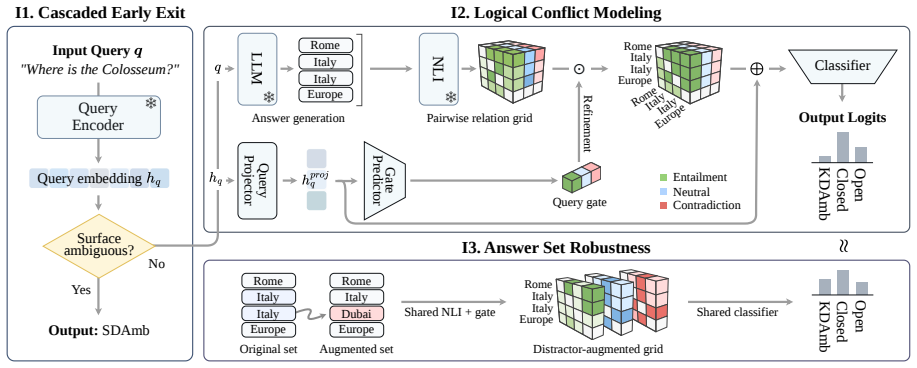
The load-bearing object is the pairwise relation grid $S \in \mathbb{R}^{k \times k \times 3}$, built from $k=10$ generated candidate answers, where each cell holds a frozen natural-language-inference model's probabilities for entailment, neutral, and contradiction. A query-conditioned gate rescales the three channels before the grid is flattened and concatenated with the query embedding for classification, letting the interpretation of the grid depend on query intent. An invariance loss, computed on a distractor-augmented answer set, forces the classifier to ignore pointwise contradictions introduced by hallucinated answers, while an early-exit encoder removes surface-detectable cases befor
What would settle it
Take a controlled set of answer pairs with known ground-truth relations, such as "Tbilisi is the capital of Georgia" versus "Atlanta is the capital of Georgia" (must be contradiction) and "The Colosseum is in Rome" versus "The Colosseum is in Italy" (must be entailment or neutral). If the contradiction channel fails on either type for the frozen NLI model, the distinction between knowledge-dependent ambiguity and closed unambiguity loses its signal. Alternatively, replace the NLI model with an oracle that has entity-level knowledge and check whether the four-way F1 gap to the frozen checkpoint
Extended reading notes
Core claim
Logically, a query is ambiguous just when two of its valid answers cannot both be true under any single interpretation; otherwise it is unambiguous. The paper's concrete claim is that this definition can be operationalized: generate candidate answers, score every ordered pair with a natural-language-inference model, and read the pattern of contradiction cells. Genuine ambiguity produces distributed contradictions across the grid, while a hallucinated distractor produces only isolated row- or column-wise conflicts, and ARCHIVE uses this contrast to separate knowledge-dependent ambiguity from closed unambiguity. The four-class taxonomy the paper introduces—surface-detectable ambiguous, knowled
Load-bearing premise
The pipeline's core premise is that the frozen natural-language-inference model reliably recognizes genuine contradictions between candidate answers, because the query gate only rescales the model's existing signals and cannot supply entity-level knowledge the model lacks.
Editorial extensions
If this is right
- QA systems should stop treating answer entropy or frequency as an ambiguity signal, since compatible answer sets with many distinct entries will no longer count as ambiguous.
- Clarification policies can be keyed to the relation grid: ask a clarifying question only when the grid shows distributed contradictions, and otherwise answer directly even if the answer set is heterogeneous.
- Malformed or underspecified queries can be resolved without any large-language-model call by the early-exit encoder, making ambiguity-detection cost proportional to the fraction of genuinely knowledge-dependent cases.
- Benchmarks should annotate answer compatibility rather than answer multiplicity; under the conflict criterion, 206 queries previously labeled ambiguous in AmbigNQ are re-labeled unambiguous.
- The four-class taxonomy gives each query exactly one label, removing the overlapping-category problem of prior ambiguity taxonomies.
Reading between the lines
- A behavioral test of the definition itself: the paper merges answers that can appear together in one response (e.g., band and vocalist for "Who sings...?"), but users might still prefer a clarifying question over a combined list. An interaction study comparing list answers with clarification would show whether logical conflict is the right normative criterion or just a useful engineering signal.
- The reported 16 times speedup is measured on QUIREQA, where roughly one third of queries are surface-detectable ambiguous; on a search-log distribution with few malformed queries, the early-exit stage would save much less, so the latency comparison should be re-measured per query mix.
- The invariance objective suggests a stress test: inject distractors of increasing plausibility into the candidate set and measure prediction stability, which would quantify how far the robustness extends beyond the single synthetic distractor used in training.
- Because conflict is read from generated candidates, the ceiling is set by whether the generator covers the true interpretation space; combining the conflict module with retrieval-augmented candidate generation would be a direct way to test whether the 206 relabeled AmbigNQ queries are genuinely unambiguous or just under-generated.
Editorial analysis
A structured set of objections, weighed in public.
Referee Report
Summary. The paper proposes ARCHIVE, a framework for open-domain QA ambiguity detection that replaces answer-diversity heuristics with a logical-conflict criterion: a query is ambiguous when its valid answers cannot all be true under a single interpretation. The authors introduce a four-class taxonomy (surface-detectable ambiguity, knowledge-dependent ambiguity, closed unambiguity, open unambiguity) and construct QuireQA, a 4,703-query benchmark with labels assigned under this taxonomy. ARCHIVE combines a lightweight early-exit encoder for surface-detectable cases with a module that generates candidate answers, builds a pairwise NLI relation grid, and classifies the query using a query-conditioned refinement and an invariance objective. Experiments report higher F1 than nine baselines on QuireQA and on AmbigTriviaQA, with lower latency. The paper includes extensive appendices on data construction, prompts, hyperparameters, ablations, and context-quality sensitivity.
Significance. If the logical-conflict account is correct, the paper offers a useful reconceptualization of ambiguity detection: it distinguishes incompatible interpretations from benign answer diversity, and it demonstrates a meaningful efficiency gain through cascaded early exit. The manuscript is unusually transparent: it provides the full data-construction protocol, prompt templates, hyperparameter sweeps, ablations for every module, and an out-of-distribution evaluation set. It also deliberately ships a frozen, external NLI checkpoint for the core conflict signal, which is a concrete step toward reproducibility. However, the evaluation is substantially self-referential: QuireQA is labeled by the authors under the proposed taxonomy, and AmbigTriviaQA is also author-constructed. The reported gains over diversity heuristics should therefore be read as evidence of internal consistency with the proposed criterion rather than as an independent validation of that criterion. The NLI-based contradiction signal also has a known weakness for exactly the entity-level, knowledge-dependent cases that distinguish the framework from prior work.
major comments (4)
- [§3.2, Appendix B, Appendix C] The main benchmark QuireQA is labeled by the authors using the paper's own logical-conflict definition, and the OOD set AmbigTriviaQA is also generated and filtered by the authors (GPT-4o plus manual review). The pipeline therefore measures how well ARCHIVE predicts labels created under the very criterion it proposes. This is not a purely empirical question about an external ground truth. The 206 relabelings of AmbigNQ are, by construction, adjustments to fit that criterion. A fairer evaluation would include labels from annotators who are blind to the proposed taxonomy, or an existing benchmark whose labels were not created under this framework. As written, the central claim 'logical conflict is the right criterion' is supported only by agreement with the authors' own operationalization.
- [§4.2, Limitations (final paragraph), Table 5] The contradiction signal that separates KDAmb from Closed/Open is produced by a frozen textual NLI model. The paper itself acknowledges: 'our task often requires entity-level knowledge... When the NLI model lacks this knowledge, it may assign weak contradiction scores', and the query gate 'rescales existing signals rather than introducing new knowledge.' Since KDAmb is the class where logical conflict is supposed to outperform diversity heuristics, the low per-class KDAmb F1 (61.86 LLaMA, 65.89 Qwen, Table 5) is cause for concern. Please report KDAmb performance separately for the AmbER-derived entity-disambiguation subset, and show the distribution of contradiction-channel scores for true KDAmb vs. Closed/Open examples. If the grid is neutral-dominated for AmbER queries, the classifier is likely relying on query embeddings and the gate rather than on the claimed conflict mechanism.
- [Tables 3, 4] Multiple baselines report F1-unamb = 0.00 (e.g., Frequency on both backbones; Ambig-Aware with LLaMA-2-7B). This means those baselines simply predict every query as ambiguous, so the reported improvements in F1-unamb—'up to 21.6%'—are measured against degenerate predictors. At minimum, report a collapsed-baseline diagnostic, e.g., accuracy/MCC, or tune and validate the baseline thresholds on the same validation split used for ARCHIVE. Also, Table 6's 'best competitor' (CoT w/ taxonomy) uses 12 LLM calls versus 3.34 for ARCHIVE, so the '16× faster' claim should clarify whether the comparison is latency-matched or call-matched; the current table appears to compare an LLM-heavy baseline with a cascaded system by design.
- [§5.2, Appendix G] The taxonomy utility experiment compares ARCHIVE with three prior taxonomies, but the response-quality references are pseudo-references generated from gold disambiguations using an adaptation of Kim et al. (2024), and the CQ scoring is only applied to KDAmb queries. This creates a bias in favor of the proposed taxonomy, because KDAmb is defined by the authors' conflict criterion and the pseudo-references are tailored to that definition. The conclusion that 'defining ambiguity by logical conflict improves taxonomy utility' is therefore not as clean as Table 3 suggests. A neutral evaluation would use human judgments of clarifying-question quality or references constructed independently of all taxonomies.
minor comments (5)
- [Table 6] The numeric formatting is hard to read: entries such as 'Direct10.44' and 'CoT w/ taxonomy12.13' run the LLM-call count and latency together. Please add clear column separators or whitespace.
- [Abstract and Introduction] There are repeated spacing issues in the glyphs 'ARCHIVEachieves' and 'ARCHIVEand', and the abstract says 'ARCHIVEachieves' as one word. A final proofreading pass is needed.
- [§4.2] The expression 'softmax_{r in {E,N,C}} (log(S_{i,j}+epsilon) ⊙ g)' is mathematically ambiguous because S_{i,j} is a distribution, not logits. Clarify that the operation applies a log transform followed by a channel-wise temperature and renormalization.
- [Figure 2] The figure caption does not specify what 'highest-accuracy baseline' refers to (mean F1 across both backbones?), and the 16× factor is not visible from the plot. Consider adding an explicit latency annotation.
- [Appendix B.2] The annotation reliability section reports 88% agreement on 150 queries, but does not report per-class agreement or the distribution of disagreements. Given the centrality of KDAmb label assignment, per-class kappa would be informative.
Circularity Check
Self-definitional evaluation in the taxonomy-utility experiment; core detection results retain non-tautological grounding.
-
self definitional
[Section 3.2 / Appendix B.2; used in the taxonomy-utility experiment (Section 5.2, Table 3)]
"We therefore construct QUIREQA, a benchmark of factoid and non-factoid queries from four sources, re-annotated under our four-class taxonomy. ... All labels and annotations are produced by the authors, who are fluent in English. The authors apply the four-class taxonomy to every query."
The Q1 claim that 'defining ambiguity by logical conflict improves taxonomy utility' is evaluated by computing F1 on QUIREQA labels, which were generated by the authors applying the very four-class taxonomy being proposed. In the Section 5.2 prompt scaffold, the proposed taxonomy's class descriptions are inserted and the labels are the same classes, so the proposed taxonomy is definitionally aligned with the gold labels. Competing taxonomies (Zhang et al., Tang et al., Tanjim et al.) are scored against labels derived from a different criterion. The reported advantage of the proposed taxonomy is therefore largely a measure of self-consistency with the annotation scheme, not independent validation of logical conflict. This is a self-definitional evaluation for Q1; it does not by itself inval
full rationale
The paper's central definition of ambiguity as logical conflict is stipulated rather than derived, and the ARCHIVE model is a supervised detector trained on labels; its held-out predictions are not identical to a fitted quantity. Independent grounding exists: the NLI model is a frozen external checkpoint, the base queries come from published datasets, and AmbigTriviaQA is generated via GPT-4o/manual review rather than the logical-conflict criterion. The acknowledged limitation that entity-level KDAmb conflicts may receive weak NLI contradiction scores, together with the much lower KDAmb F1 than other classes, shows the core conflict signal is not trivially recoverable. The main circularity concern is confined to the Q1 taxonomy-utility experiment, where the gold labels are themselves produced from the proposed taxonomy; this raises the score to 4 but does not reduce the main detection claims to tautology.
Assumptions & free parameters
free parameters (5)
- k (candidate answer set size) =
10
- early-exit threshold tau =
validation-tuned, mean ~0.26 (range 0.175-0.325)
- lambda_inv (invariance loss weight) =
1.0
- LLM sampling temperatures =
0.7 for answers, 0.8 for distractors
- number of LLM calls per query =
5
assumptions (4)
- ad hoc to paper A query is ambiguous iff its valid answers cannot all be true under a single interpretation.
- domain assumption The frozen NLI model's contradiction judgements approximate genuine logical conflict among answer statements.
- domain assumption LLM-generated candidate answers (k=10 after deduplication) cover the space of valid interpretations of the query.
- domain assumption QUIREQA annotations, including relabeling decisions, are correct ground truth for ambiguity.
Cite this review
Pith. "Pith review of Diversity is Not Ambiguity: Toward Accurate and Efficient Ambiguity Detection for Open-Domain QA." pith.science (2026). https://pith.science/paper/FGGAYNP2
@misc{pith2026260803177,
  author       = {Pith},
  title        = {Pith review of: Diversity is Not Ambiguity: Toward Accurate and Efficient Ambiguity Detection for Open-Domain QA},
  year         = {2026},
  howpublished = {\url{https://pith.science/paper/FGGAYNP2}},
  note         = {Machine review of arXiv:2608.03177}
}
abstract
How can question answering (QA) systems determine whether a query is ambiguous? Ambiguity detection is essential in open-domain QA, as misclassification leads to answering the wrong interpretation or unnecessary clarification. However, existing methods conflate answer diversity with ambiguity, leading to inaccurate predictions. They also process queries uniformly, resulting in wasteful computation. We propose ARCHIVE (Ambiguity Recognition via Cascaded Hypothesis Inspection and Conflict Verification), an accurate and efficient framework that detects ambiguity via logical conflict: a query is ambiguous when its valid answers cannot all be true under a single interpretation. ARCHIVE combines a lightweight early-exit encoder for surface-detectable cases with a conflict reasoning module that models logical relations among answers, reinforced by an invariance objective for robustness to noisy answer sets. We present QuireQA, a 4,703-query benchmark spanning factoid, non-factoid, and ill-formed queries. Experiments show ARCHIVE outperforms competitors, improving F1-amb by up to 10.4% and F1-unamb by up to 21.6%, while operating 16$\times$ faster than the best competitor.
Figures


Figures from the paper (5 more)


Reference graph
Works this paper leans on
-
[1]
Provide one plausible answer that directly addresses the query
-
[2]
If the query requires factual information, provide an answer that is broadly correct and verifiable; do not invent unsupported details
-
[3]
for human-written instructions with open- ended and closed-form unambiguous queries. We annotate 3,299 oracle context passages from En- glish Wikipedia for 680 queries. Table 9 shows rep- resentative examples from each source and class. B.1 Data Format Each sample in QUIREQA contains a query, a tax- onomy label, and, where applicable, valid interpre- tati...
work page 2020
-
[4]
Keep the answer concise: one sentence or a short list is preferred
-
[5]
Return only valid JSON: {"answer": "..."}. Query:{query} Answer: • Meaningless noise.Queries consisting entirely of non-alphanumeric symbols, keyboard se- quences (e.g., asdfghjkl;’#), consonant clus- ters (e.g., fffrff), or vowel runs (e.g., iuuui) that render the string unintelligible. • Structural incompleteness.Queries with trun- cated syntax or missi...
work page 2020
-
[6]
Do not attempt to enumerate all possible valid answers
-
[9]
The query must be genuinely ambiguous across the provided interpretations and must not include disambiguating descriptors
-
[10]
Use the associated properties to choose a plausible query relation that can apply to multiple interpretations
Show all 32 references
-
[12]
query":
Return only valid JSON: {"query": "...", "interpretations": [{"qid": "...", "wikipedia_title": "...", "clarification": "...", "answers": ["..."]}]}. Input format.For each ambiguous entity group: Entity name:{name} Interpretations, one per entity sharing the surface name: Entit...
-
[13]
Add only the minimal descriptor needed to identify the intended referent, such as an occupation, work type, nationality, or domain
-
[14]
Use the associated properties to choose a plausible query relation for the target referent
-
[15]
Each answer must be extractable from the corresponding context passage
-
[16]
query":
Return only valid JSON: {"query": "...", "label": "closed unambiguous", "answers": ["..."]}. Input format. Shared surface name:{name} Target referent:{title of Wikipedia article} Context:{first 3 sentences from Wikipedia article} Associated properties:{property name} – {top-5 ...
2023
-
[18]
Identify all plausible candidate answers supported by the context
-
[19]
If the context supports multiple dates, locations, entities, or facets, extract each as a separate candidate answer
-
[23]
The context does not provide
Do not include meta-commentary such as “The context does not provide...” or “I cannot deter- mine...”. Question:{question} Context:{context} Answers: Context-free Task:You will receive a question. Produce a JSON list of candidate answers. Rules
-
[24]
Identify all plausible candidate answers using world knowledge
-
[25]
For list-type queries, give each item as a separate candidate answer
-
[26]
Each answer must be a short, independent, declarative sentence
-
[27]
answers": [
Return only valid JSON: {"answers": ["...", "...", ...]}
-
[28]
The answers list must contain at least one string
-
[29]
This is subjective
Do not include meta-commentary such as “This is subjective...” or “I cannot determine...”. Question:{question} Answers: validation split to maximize the early-exit module’s binary SDAmb-detection F1. Panel (a) shows that 4-way macro-F1 remains stable across a broad mid- dle ra...
-
[30]
Partial answer: Omit a required component from a multi-part valid answer
-
[31]
Role swap or misattribution: Reassign entities from the context to incorrect roles or relationships
-
[32]
distractors
Controlled perturbation: Modify a date, number, name, or attribute appearing in the context or valid answers. Constraints. • Do not introduce real-world entities, items, or facts absent from the provided information. • Do not generate paraphrases, close synonyms, or valid subs...
1987
-
[33]
Surface-detectable ambiguity: The query is ambiguous, incomplete, malformed, or underspecified in a way that is detectable from the query text alone, without external knowledge
-
[34]
Knowledge-dependent ambiguity: The query is well-formed, but recognizing its multiple legitimate interpretations requires external or world knowledge
-
[35]
No clarification is needed
Closed unambiguity: The query is clear and has a single definitive answer. No clarification is needed
-
[36]
A desk can be organized by
Open unambiguity: The query is clear and allows diverse but compatible valid answers, such as advice, examples, or lists. No clarification is needed. TaskQuery:{query} Context:{context, if available} Rationale: Classification: Table 27: Frequency and entropy heuristics prompt....
2025
-
[2019]
The conflict modeling module keeps the encoder frozen and trains only lightweight heads for 200 epochs us- ing AdamW (learning rate 10−4, weight decay 0.01)
with learning rate 2×10⁻⁴, weight de- cay 0.01, and gradient clipping 1.0. The conflict modeling module keeps the encoder frozen and trains only lightweight heads for 200 epochs us- ing AdamW (learning rate 10−4, weight decay 0.01). We use batch size 16 for both modules, retai...
2018
-
[2020]
for factoid queries derived from Natural Questions (Kwiatkowski and 17 others, 2019) with crowdsourced disambiguations; AmbER (Chen et al., 2021) for Wikipedia-grounded entity disam- biguation queries; and Dolly-15K (Conover et al.,
2019
-
[2023]
InProceedings of the 61st Annual Meet- ing of the Association for Computational Linguistics (Volume 1: Long Papers), pages 7669–7683, Toronto, Canada
Answering ambiguous questions via iterative prompting. InProceedings of the 61st Annual Meet- ing of the Association for Computational Linguistics (Volume 1: Long Papers), pages 7669–7683, Toronto, Canada. Association for Computational Linguistics. Anfu Tang, Laure Soulier, an...
2025 arXiv
Reviewed August 6, 2026 · model on record in the stance chip above.
Discussion (0). Sign in to comment.