REVIEW 5 major objections 5 minor 25 references
FedRings: A Scalable and Topology-Aware Federated Learning Framework for LEO Satellite Constellations
T0 review · 5 major / 5 minor · reviewed 2026-08-05 · deepseek-v4-flash
Pith's one-line read FedRings claims that federated learning can run efficiently on LEO satellite constellations by organizing satellites into orbital rings, routing sparse incrementally aggregated model updates along predicted communication windows, and compen
desk verdict A plausible topology-aware FL framework for LEO, but the evaluation is too thin to back the 'consistently outperforms' claim, and the 'fully decentralized' story has a central-coordination hole. read the letter →
The pith
A machine-rendered reading of the paper's core claim, the machinery that carries it, and where it could break.
The reading
What carries the argument
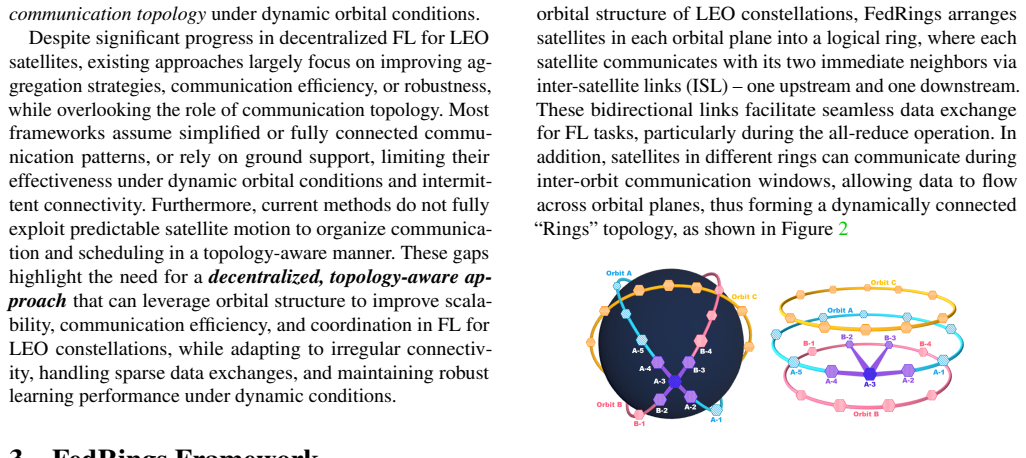
The central mechanism is a multi-ring communication topology derived from orbital planes, driven by two supporting objects. The Communication Opportunity Matrix (COM) is a time-dependent adjacency matrix built from the precomputed TimeTable; it says which inter-satellite links are active at any moment, supplies edge weights for Dijkstra and Yen's k-shortest-path routing, and classifies neighbors as high- or low-quality for compensation. The second object is Adaptive Sparse Incremental Aggregation (ASIA), which combines incremental in-ring aggregation, Top-Q sparsification, and a globally synchronized mask so each transmission carries a fixed number of non-zero parameters. Together they conve
What would settle it
A concrete test: deliberately corrupt the TimeTable by mispredicting a fraction of contact windows (for example, shifting 10% of windows by 30 seconds or adding a small phasing error) and measure communication success rate and final test accuracy; if performance collapses, the precomputed schedule is the load-bearing assumption. A second check: stop refreshing the global sparsification mask and cut off the coordinating node for a training stretch; if convergence degrades sharply, the claimed decentralization does not survive its own synchronization mechanism.
Extended reading notes
Core claim
On the paper's own terms, the discovery is that the regular motion of LEO constellations turns an apparent obstacle into an organizing principle: because satellites in the same orbital plane stay in fixed relation to their neighbors, each plane can be treated as a ring and model updates can be aggregated incrementally as they circulate. A precomputed TimeTable of communication windows defines when intra- and inter-plane links exist; from it, FedRings builds a time-varying Communication Opportunity Matrix and uses ranked alternative paths so packets can switch routes when links degrade. To keep traffic small, the adaptive sparse incremental aggregation scheme transmits a fixed-size set of top
Load-bearing premise
The load-bearing premise is that a precomputed TimeTable accurately predicts every communication window between satellites, and that some coordinating node or ground station can periodically refresh and distribute the global sparsification mask; the paper claims fully decentralized operation, but both of these dependencies are central to how routing and compression work.
Editorial extensions
If this is right
- Training can proceed without a central parameter server at every round: updates circulate and merge locally along each ring, so each node only talks to its two immediate neighbors.
- Communication cost per transmission stays bounded as the constellation grows, because ASIA sends a fixed-size set of top gradients and the rest of the update stays local.
- Link loss does not stall training: missing updates are reconstructed from stored parameters of stable neighbors, keeping the aggregation going.
- Aligning exchange with the TimeTable's predicted windows (COM) is the main source of the reported accuracy gain; removing COM slows convergence and lowers final accuracy on all three datasets.
- The approach scales to larger constellations, with convergence slowing only slightly when both the number of satellites per plane and the number of planes increase.
Reading between the lines
- Editorial extension: the 'fully decentralized' framing is softened by the paper's own design detail that a coordinating node or ground station periodically distributes the global sparsification mask; the claimed robustness partially depends on that node remaining reachable.
- Editorial extension: the TimeTable is generated by a satellite simulator, so real-world deployment would require the predicted communication windows to survive orbital drift, drag, and station-keeping; the reported gains are conditional on that prediction accuracy.
- Editorial extension: the compensation fallback for low-quality neighbors substitutes the current aggregated state, and for high-quality neighbors substitutes stored parameters, so under non-IID data or concept drift the reconstruction could inject stale, biased gradients; the evaluation assumes IID data.
- Editorial extension: the paper itself notes the absence of built-in security mechanisms as future work; without authentication or Byzantine-robust aggregation, a compromised satellite could inject arbitrary updates into the ring and affect the global model.
Editorial analysis
A structured set of objections, weighed in public.
Referee Report
Summary. FedRings proposes a decentralized federated learning framework for LEO satellite constellations that organizes satellites into ring-based logical topologies, uses a spatio-temporal routing strategy driven by a precomputed TimeTable, adopts adaptive sparse incremental aggregation (ASIA) with a global sparsification mask, and includes a historical compensation mechanism for missing updates. The paper evaluates FedRings on EuroSAT, So2Sat, and DeepGlobe using DenseNet-121, comparing against FedAvg-D and DSGD, and claims faster convergence, lower communication overhead, and scalability.
Significance. The problem is relevant: LEO constellations impose intermittent links, short contact windows, and dynamic topology, and existing FL schemes often ignore orbital structure. The ring-based, topology-aware design is a plausible and potentially useful direction, and the paper makes a genuine attempt to couple routing with learning. The paper also identifies a concrete mechanism (ASIA) to reduce per-link transmission size. However, the evidence presented is not yet sufficient to support the strong claims of consistent superiority and full decentralization. The comparison is limited to two simple baselines, the accuracy results lack statistical support, and there is an internal contradiction between the claimed absence of central control and the global mask synchronization requirement. If the identified issues are addressed, the framework could be a meaningful contribution to satellite FL.
major comments (5)
- [§3.3.1 and §3.3.2] The claimed 'fully decentralized' design is contradicted by the global sparsification mask. §3.3.1 states 'the global mask must be synchronized across all nodes in FedRings. A coordinating node updates and distributes the mask every few rounds,' and §3.3.2 repeats that 'a coordinating node or ground station can manage and distribute the mask.' This conflicts with §3.2.1's 'No central control is needed' and the 'fully decentralized' characterization in §4.6. A coordinating node/ground station is a single point of failure and a hidden central dependency. No experiment exercises this dependency (e.g., coordinator failure or TimeTable perturbation). Either redesign ASIA to operate without a global mask, or explicitly acknowledge the coordinator and evaluate its impact on robustness and scalability.
- [Abstract / §4.1] The abstract claims FedRings 'consistently outperforms existing methods in realistic settings,' but the only baselines are FedAvg-D and DSGD, which are described in §4.1 as 'relatively simple and basic.' None of the 12 algorithms surveyed in §2 or listed in Table 2 is evaluated. The strong comparative claim is therefore unsupported. The experiments establish a comparison to two non-sparsified, non-topology-aware baselines at best. Please rephrase the claims to match the actual experimental scope, or add comparisons with available/open-source methods from the surveyed literature.
- [Algorithm 3] Algorithm 3 contains a control-flow error that makes the historical compensation mechanism incorrect as written. The 'else' block intended for missing updates is nested inside the 'if u_j ≠ /0' branch. As a result, (i) missing updates (u_j = /0) are never compensated, and (ii) a received update from a low-quality neighbor triggers the inner 'else', setting w_comp = w_agg and then w_agg = w_agg + w_comp, which doubles the aggregate. This contradicts the textual description in §3.4 and corrupts the aggregation. The pseudocode must be corrected so that missing updates are handled in a top-level else, and received updates from low-quality neighbors are simply added.
- [§4.2 and §4] Figures 6–8 show accuracy curves without error bars or multiple-seed results. The claim of 'consistent' superiority and the observed small differences (e.g., 'over 5%' on So2Sat) cannot be assessed for statistical significance. Additionally, §4 states that all datasets are 'assumed to be independent and identically distributed,' yet §4.2 describes So2Sat as a 'complex non-IID scenario.' This is an internal contradiction. Please report mean/std over at least 3–5 seeds and clarify the data partition used (IID vs. non-IID).
- [§4.3] The communication-overhead advantage of ASIA is a direct, by-design consequence: FedAvg-D and DSGD transmit full model updates, while FedRings transmits only Top-Q sparse updates along an incremental ring. The comparison therefore does not demonstrate a general efficiency improvement over sparsified incremental methods. To make the claim informative, the paper should compare against another sparsification scheme (e.g., top-k gradient sparsification without the global mask, or the centralized Sparse Incremental Aggregation of [12]) at matched compression levels, or at least report an accuracy-vs-bytes curve to show the trade-off.
minor comments (5)
- [Algorithm 2] Lines 3–4 duplicate the initialization of N_high and N_low. Remove the repeated assignments.
- [Algorithm 3] Even apart from the logic error, the indentation is ambiguous. Rewrite with explicit begin/end blocks or a clearer structured layout so the intended control flow is unambiguous.
- [§4.6] The heading 'Comparison with State of the Art' is misleading: Table 2 is a qualitative related-work summary, not an experimental comparison. Rename it (e.g., 'Qualitative Comparison with Existing Approaches') and note that no quantitative comparison was performed.
- [§4] The notation 'Walker(t=6/p=90/f=1)' is confusing. If t is the number of planes and p = n×t, the paper should define n, t, and p explicitly and consistently; currently 'p' appears to be both the total satellite count and the walker parameter.
- [References and typos] Reference [6] is formatted as 'et al. Helber' and should be corrected to list the authors. Figure 4's caption reads 'base on COM' instead of 'based on COM'.
Circularity Check
No circular derivation found: the claimed communication savings are a designed property of ASIA, not a prediction from fitted inputs; the main weakness is an internal decentralization contradiction, not circularity.
full rationale
The paper's derivation chain is not circular. FedRings takes two external inputs: a precomputed STK TimeTable (Section 3.2, Eq. 1) and standard satellite image datasets (EuroSAT/So2Sat/DeepGlobe). The COM is initialized from the TimeTable and updated locally; routing is Dijkstra/Yen on that graph. No quantity to be predicted (test accuracy or overhead) is used to define the TimeTable, COM, or routing, so there is no self-definitional loop. ASIA's fixed-size Top-Q sparsification is introduced as a design constraint (Section 3.3.2: 'each transmission carries a fixed number of non-zero gradient parameters'), and the measured communication volume is an accounting of that constraint, not a fitted prediction. Comparing against full-model FedAvg-D and DSGD makes the comparison easy, but it does not convert a design property into a circular argument. There are no load-bearing self-citations: the references are all external work, and no uniqueness theorem or prior ansatz by the same authors is invoked. The issue that could be mistaken for circularity is an internal contradiction rather than a circular step: Section 3.2.1 states 'No central control is needed', while Section 3.3.1 says 'the global mask must be synchronized across all nodes in FedRings. A coordinating node updates and distributes the mask every few rounds', and Section 3.3.2 allows 'a coordinating node or ground station' to manage the mask. No experiment removes the coordinator or perturbs the TimeTable. This undermines the 'fully decentralized' claim and is a robustness/scalability gap, but it is not a case where a result equals its input by construction. Therefore the circularity score is 0.
Assumptions & free parameters
free parameters (4)
- Top-Q sparsification ratio Q =
unreported
- High-quality neighbor threshold =
80% success over last 5 rounds
- Downgrade/upgrade criteria for neighbor quality =
three consecutive failures to downgrade; upgrade on improved stability
- Global mask update period =
'every few rounds' (unquantified)
assumptions (5)
- domain assumption Walker Star constellation geometry: satellites in each orbital plane form a logical ring with intra-orbit neighbor links; inter-orbit links connect rings.
- domain assumption The pre-simulated STK TimeTable accurately predicts all present and future communication windows and edge weights.
- domain assumption A coordinating node or ground station can periodically synchronize the global sparsification mask.
- domain assumption The three satellite datasets (EuroSAT, So2Sat, DeepGlobe) are independent and identically distributed across satellites.
- domain assumption Sparse incremental aggregation along a ring with a periodic global mask preserves model convergence.
Cite this review
Pith. "Pith review of FedRings: A Scalable and Topology-Aware Federated Learning Framework for LEO Satellite Constellations." pith.science (2026). https://pith.science/paper/47MAWMQZ
@misc{pith2026260803436,
  author       = {Pith},
  title        = {Pith review of: FedRings: A Scalable and Topology-Aware Federated Learning Framework for LEO Satellite Constellations},
  year         = {2026},
  howpublished = {\url{https://pith.science/paper/47MAWMQZ}},
  note         = {Machine review of arXiv:2608.03436}
}
read the original abstract
Federated learning over low Earth orbit (LEO) satellite networks is limited by frequent link changes, short contact times, and a highly dynamic topology, making centralized or synchronized training inefficient and hard to scale. To address this, we propose FedRings, a decentralized framework that organizes satellites into ring-based communication structures. It uses a spatio-temporal routing strategy with link-aware communication scheduling to align model exchange with actual visibility windows and time-varying connectivity patterns in LEO. Model updates are propagated along the ring using adaptive sparse incremental aggregation, which reduces communication overhead by progressively combining and compressing updates. To handle communication interruptions, a historical compensation mechanism maintains training continuity. By combining topology-aware routing, communication scheduling, and efficient aggregation, FedRings enables stable and efficient learning in dynamic LEO networks while reducing communication cost, and experiments show it consistently outperforms existing methods in realistic settings.
Figures


Figures from the paper (5 more)




Reference graph
Works this paper leans on
-
[12]
Sparse Incremental Aggregation in Satellite Federated Learning
Nasrin Razmi, Sourav Mukherjee, Bho Matthiesen, Armin Dekorsy, and Petar Popovski. Sparse Incremen- tal Aggregation in Satellite Federated Learning.arXiv preprint arXiv:2501.11385, 2025
work page Pith review arXiv 2025
-
[1]
Deepglobe 2018: A challenge to parse the earth through satellite images
Ilke Demir, Krzysztof Koperski, David Lindenbaum, Guan Pang, Jing Huang, Saikat Basu, Forest Hughes, Devis Tuia, and Ramesh Raskar. Deepglobe 2018: A challenge to parse the earth through satellite images. In The IEEE Conference on Computer Vision and Pattern Recognition (CVPR) Workshops, June 2018
work page 2018
-
[2]
Shiva Raj Pokhrel Dev Gurung. sat-QFL: Secure Quan- tum Federated Learning for Low Orbit Satellites.arXiv preprint arXiv:2509.16504, 2025
arXiv 2025
-
[3]
Mohamed Elmahallawy and Asma Jodeiri Akbarfam. Decentralized Trust for Space AI: Blockchain-Based Federated Learning Across Multi-Vendor LEO Satellite Networks.arXiv preprint arXiv:2512.08882, 2025
arXiv 2025
-
[4]
Mohamed Elmahallawy and Tie Luo. AsyncFLEO: Asynchronous Federated Learning for LEO Satellite Constellations with High-Altitude Platforms. InIEEE International Conference on Big Data, pages 5478–
-
[5]
FedHAP: Fast Federated Learning for LEO Constellations Using Col- laborative HAPs
Mohamed Elmahallawy and Tie Luo. FedHAP: Fast Federated Learning for LEO Constellations Using Col- laborative HAPs. InInternational Conference on Wire- less Communications and Signal Processing (WCSP), pages 888–893. IEEE, 2022
work page 2022
-
[6]
et al. Helber. Eurosat: A novel dataset and deep learning benchmark for land use and land cover classification. ArXiv preprint arXiv:1709.00029, 2017. [Accessed 20- 11-2024]
arXiv 2017
-
[7]
Daixun Li, Weiying Xie, Yunsong Li, and Leyuan Fang. FedFusion: Manifold Driven Federated Learning for Multi-Satellite and Multi-Modality Fusion.IEEE Trans- actions on Geoscience and Remote Sensing, 2023
work page 2023
Show all 25 references
-
[8]
HiSatFL: A Hierarchical Federated Learning Framework for Satel- lite Networks with Cross-Domain Privacy Adaptation
Ling Li, Lidong Zhu, and Weibang Li. HiSatFL: A Hierarchical Federated Learning Framework for Satel- lite Networks with Cross-Domain Privacy Adaptation. Electronics, 14(16), 2025
2025
-
[9]
FedSN: A General Federated Learn- ing Framework over LEO Satellite Networks.arXiv preprint arXiv:2311.01483, 2023
Zheng Lin, Zhe Chen, Zihan Fang, Xianhao Chen, Xiong Wang, and Yue Gao. FedSN: A General Federated Learn- ing Framework over LEO Satellite Networks.arXiv preprint arXiv:2311.01483, 2023
2023 arXiv
-
[10]
A Semi-Supervised Federated Learning Framework with Hierarchical Clus- tering Aggregation for Heterogeneous Satellite Net- works.arXiv preprint arXiv:2507.22339, 2025
Zhuocheng Liu, Zhishu Shen, Qiushi Zheng, Tiehua Zhang, Zheng Lei, and Jiong Jin. A Semi-Supervised Federated Learning Framework with Hierarchical Clus- tering Aggregation for Heterogeneous Satellite Net- works.arXiv preprint arXiv:2507.22339, 2025
2025 arXiv
-
[11]
Ground-Assisted Federated Learning in LEO Satellite Constellations.IEEE Wireless Commu- nications Letters, 11(4):717–721, 2022
Nasrin Razmi, Bho Matthiesen, Armin Dekorsy, and Petar Popovski. Ground-Assisted Federated Learning in LEO Satellite Constellations.IEEE Wireless Commu- nications Letters, 11(4):717–721, 2022
2022
-
[13]
Yuanming Shi, Li Zeng, Jingyang Zhu, Yong Zhou, Chunxiao Jiang, and Khaled B. Letaief. Satellite Feder- ated Edge Learning: Architecture Design and Conver- gence Analysis.Transactions on Wireless Communica- tions, 23:15212–15229, 2024
2024
-
[14]
FedSpace: An Efficient Federated Learning Frame- work at Satellites and Ground Stations.arXiv preprint arXiv:2202.01267, 2022
Jinhyun So, Kevin Hsieh, Behnaz Arzani, Shadi Noghabi, Salman Avestimehr, and Ranveer Chandra. FedSpace: An Efficient Federated Learning Frame- work at Satellites and Ground Stations.arXiv preprint arXiv:2202.01267, 2022
2022 arXiv
-
[15]
DSFL: Decentralized Satellite Federated Learning for Energy- Aware LEO Constellation Computing
Chenrui Wu, Yifei Zhu, and Fangxin Wang. DSFL: Decentralized Satellite Federated Learning for Energy- Aware LEO Constellation Computing. InIEEE Interna- tional Conference on Satellite Computing, pages 25–30. IEEE, 2022
2022
-
[16]
FedGSM: Efficient Federated Learning for LEO Constellations with Gra- dient Staleness Mitigation
Lingling Wu and Jingjing Zhang. FedGSM: Efficient Federated Learning for LEO Constellations with Gra- dient Staleness Mitigation. InInternational Workshop on Signal Processing Advances in Wireless Communica- tions (SPAWC), pages 356–360. IEEE, 2023
2023
-
[17]
Multi-Round Decentralized Dataset Distillation with Federated Learning for Low Earth Orbit Satellite Communication.Future Generation Computer Systems, 164:107570, 2025
Jianlong Xu, Mengqing Jin, Jinze Xiao, Dianming Lin, and Yuelong Liu. Multi-Round Decentralized Dataset Distillation with Federated Learning for Low Earth Orbit Satellite Communication.Future Generation Computer Systems, 164:107570, 2025
2025
-
[18]
RAFL: Reputation-Aware Federated Learning with Hierarchi- cal Aggregation in LEO Satellite Networks.Journal of Systems Architecture, 168:103565, 2025
Xiuli Xu, Yanping Li, and Laifeng Lu. RAFL: Reputation-Aware Federated Learning with Hierarchi- cal Aggregation in LEO Satellite Networks.Journal of Systems Architecture, 168:103565, 2025
2025
-
[19]
Connection-Density- Aware Satellite-Ground Federated Learning via Asyn- chronous Dynamic Aggregation.Future Generation Computer Systems, 155:312–323, 2024
Zhuo Xu, Mengqing Jin, Jian Lin, Yuelong Liu, Jian- long Xu, Zhi Xiong, and Hao Cai. Connection-Density- Aware Satellite-Ground Federated Learning via Asyn- chronous Dynamic Aggregation.Future Generation Computer Systems, 155:312–323, 2024
2024
-
[20]
DFedSat: Communication-Efficient and Robust Decen- tralized Federated Learning for LEO Satellite Constella- tions.arXiv preprint arXiv:2407.05850, 2024
Minghao Yang, Jingjing Zhang, and Shengyun Liu. DFedSat: Communication-Efficient and Robust Decen- tralized Federated Learning for LEO Satellite Constella- tions.arXiv preprint arXiv:2407.05850, 2024. 13
2024 arXiv
-
[21]
FedLEO: An Offloading-Assisted Decen- tralized Federated Learning Framework for Low Earth Orbit Satellite Networks.IEEE Transactions on Mobile Computing, 2023
Zhiwei Zhai, Qiong Wu, Shuai Yu, Rui Li, Fei Zhang, and Xu Chen. FedLEO: An Offloading-Assisted Decen- tralized Federated Learning Framework for Low Earth Orbit Satellite Networks.IEEE Transactions on Mobile Computing, 2023
2023
-
[22]
FedUR: Fed- erated Learning Optimization through Adaptive Central- ized Learning Optimizers.IEEE Transactions on Signal Processing, 2023
Hengrun Zhang, Kai Zeng, and Shuai Lin. FedUR: Fed- erated Learning Optimization through Adaptive Central- ized Learning Optimizers.IEEE Transactions on Signal Processing, 2023
2023
-
[23]
ALANINE: A Novel Decentralized Personalized Fed- erated Learning for Heterogeneous LEO Satellite Con- stellation.IEEE Transactions on Mobile Computing, 24(08):6945–6960, 2025
Liang Zhao, Shenglin Geng, Xiongyan Tang, Ammar Hawbani, Yunhe Sun, Lexi Xu, and Daniele Tarchi. ALANINE: A Novel Decentralized Personalized Fed- erated Learning for Heterogeneous LEO Satellite Con- stellation.IEEE Transactions on Mobile Computing, 24(08):6945–6960, 2025
2025
-
[24]
New: So2sat lcz42, 2019
Xiaoxiang Zhu, Jingliang Hu, Chunping Qiu, Yilei Shi, Hossein Bagheri, Jian Kang, Hao Li, Lichao Mou, Guicheng Zhang, Matthias Häberle, Shiyao Han, Yuan- sheng Hua, Rong Huang, Lloyd Hughes, Yao Sun, Michael Schmitt, and Yuanyuan Wang. New: So2sat lcz42, 2019
2019
-
[25]
Towards Satellite Non-IID Imagery: A Spectral Clustering- Assisted Federated Learning Approach.arXiv preprint arXiv:2410.13602, 2024
Luyao Zou, Yu Min Park, Chu Myaet Thwal, Yan Kyaw Tun, Zhu Han, and Choong Seon Hong. Towards Satellite Non-IID Imagery: A Spectral Clustering- Assisted Federated Learning Approach.arXiv preprint arXiv:2410.13602, 2024. 14
2024 arXiv
Reviewed August 5, 2026 · model on record in the stance chip above.
Discussion (0). Continue with ORCID to comment.