REVIEW 4 major objections 5 minor 19 references
Efficient Multilingual Neural Machine Translation via Corpus-Driven Vocabulary Pruning: An English-Arabic Case Study
T0 review · 4 major / 5 minor · reviewed 2026-08-05 · deepseek-v4-flash
Pith's one-line read The paper claims that pruning a multilingual translation model's vocabulary to the tokens a single language pair actually uses, then fine-tuning, can match or beat a dedicated bilingual model while cutting memory by roughly 60%.
desk verdict A useful efficiency case study, but the 'lossless' claim is untested: no full-vocabulary fine-tuned control, and some headline numbers are approximated, not measured. read the letter →
The pith
A machine-rendered reading of the paper's core claim, the machinery that carries it, and where it could break.
The reading
What carries the argument
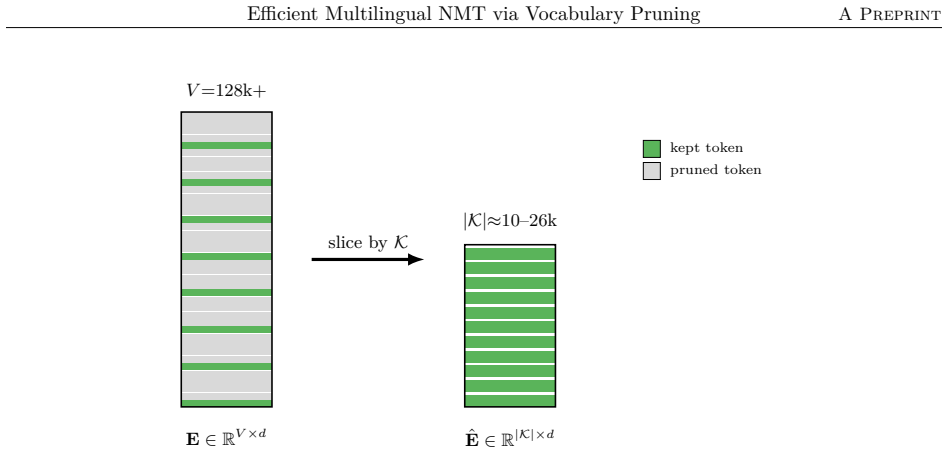
The load-bearing mechanism is a deterministic five-stage vocabulary pruning pipeline: (1) collect all token IDs appearing in ~150,000 sampled parallel sentences; (2) add mandatory special and language-tag tokens to form the keep-set K; (3) slice the embedding matrix E and output head W at their original size before any resize; (4) resize the embeddings to |K| and write the sliced weights back; (5) wrap the original tokenizer with a remapping layer that translates between external token IDs and the new internal indices. The paper's argument for why this works is that the kept rows remain semantically intact and the fine-tuning phase recalibrates the language-model head to the new, smaller cat
What would settle it
Run the same pruning–fine-tuning pipeline with the kept embedding rows replaced by random vectors of the same dimension; if the model reaches the same BLEU and COMET scores, the pretrained embedding rows were not what carried the claimed multilingual knowledge. A second check: apply the method to a low-resource language pair with a distant script and look for a quality collapse or a much smaller memory saving.
Extended reading notes
Core claim
The central claim is that corpus-driven vocabulary pruning followed by targeted fine-tuning can compress a large multilingual NMT model to a language-pair-specific model that matches or exceeds a dedicated bilingual system while using ~60% less memory. The discovery is stated as a hypothesis that the multilingual competence of models like M2M100, NLLB-200, and mBART-50 is carried mainly by structural shared parameters (attention, feed-forward, and the surviving embedding rows) rather than by the full joint vocabulary. In support, the paper reports that trimmed-only models lose little (NLLB trimmed BLEU 26.43 vs zero-shot 26.82) and that fine-tuning recovers and improves quality, with pruned
Load-bearing premise
The load-bearing premise is that the knowledge a model needs to translate a language pair lives mostly in shared transformer weights, not in the many unused vocabulary rows; if that fails, cutting the vocabulary destroys what fine-tuning needs.
Editorial extensions
If this is right
- A ~60% memory cut on the embedding and output layers is achievable without retraining from scratch, just by pruning and fine-tuning, across three different architectures and tokenizers.
- Pruned multilingual models can be competitive with, or semantically better than, dedicated bilingual models on a morphologically rich, non-Latin language pair, so the memory savings do not have to be paid for in translation adequacy.
- Fine-tuning on a narrow formal domain trades away out-of-domain generalization (on FLORES-200, trimmed-only NLLB-200 beats its fine-tuned MultiUN version), so training-data composition determines whether pruning helps or hurts robustness.
- Because pruning alone preserves most zero-shot quality, the framework can serve as a cheap first stage before deciding whether and on what data to fine-tune.
- The remaining quality loss concentrates in citations, names, and abbreviations, pointing to entity-aware extensions as the next bottleneck rather than the pruning procedure itself.
Reading between the lines
- If the underlying hypothesis generalizes, the same slicing recipe should work for other language pairs and even larger models (1.2B+), because the memory bottleneck is purely the vocabulary dimension; a testable next step is applying it to a distant-script low-resource pair and checking whether the 60% savings hold.
- The paper's result implies that much of the value of huge multilingual vocabularies is architectural: the shared vocabulary acts mainly as a routing and indexing layer, and per-pair specialization can be done by deletion plus adaptation, suggesting a design where a single pretrained backbone is pruned on demand for any language pair.
- A practical consequence the authors only hint at: the same pruning wrapper could be used to serve many language pairs from one checkpoint on one GPU by swapping small vocabulary slices instead of loading full models.
- The strong COMET lead over a BLEU-better bilingual baseline suggests evaluation suites that rely on n-gram overlap may understate the quality of pruned multilingual systems on Arabic.
Editorial analysis
A structured set of objections, weighed in public.
Referee Report
Summary. The paper proposes a two-stage framework for compressing multilingual NMT models: corpus-driven vocabulary pruning (keeping only tokens observed in the target language-pair corpus, plus mandatory special tokens and language tags) followed by targeted fine-tuning on the language pair. The framework is evaluated on English→Arabic with M2M100, NLLB-200, and mBART-50, using MultiUN and hybrid MultiUN+OPUS-100 training data. The authors report a reduction in vocabulary from roughly 128k to 10k–26k tokens, claim about 60% memory savings, and report that a pruned and fine-tuned M2M100 reaches 42.04 BLEU / 0.8730 COMET, compared with 44.59 BLEU / 0.7911 COMET for a dedicated OPUS-MT bilingual baseline. The paper also includes bootstrap confidence intervals for the headline BLEU/chrF++/TER results, segment-level error analyses, and an out-of-domain FLORES evaluation.
Significance. If the claims hold, this is a practically valuable contribution: it addresses a real bottleneck in multilingual model deployment and does so with a simple, architecture-agnostic procedure. The paper's strengths include a clearly specified deterministic pruning pipeline, an evaluation on a morphologically rich language pair, a meaningful range of multilingual architectures, and bootstrap uncertainty quantification for the main surface metrics. The authors are also transparent about some limitations (single language pair, OOV sensitivity, trade-off between in-domain and out-of-domain performance). However, the central 'without any loss in performance' claim is currently unsupported because the experimental design lacks the necessary control: no full-vocabulary model is fine-tuned with the same data and protocol. The reported 60% memory saving also appears inconsistent with the stated vocabulary reduction. The paper is promising but needs additional experiments and corrected accounting.
major comments (4)
- [§4.2.2, Table 1] The central claim that pruning is lossless (abstract: 'without any loss in performance'; §4.2.2: 'the fine-tuning step recovers and improves translation quality') is not tested against the necessary control. No full-vocabulary M2M100, NLLB, or mBART checkpoint is fine-tuned on the same 200k MultiUN split with the same training protocol. The observed 42.04 BLEU / 0.8730 COMET for the pruned M2M100 could therefore be almost entirely an effect of supervised fine-tuning, and the BLEU gap to OPUS-MT-en-ar could reflect the latter not being domain-adapted. Add unpruned-plus-fine-tuned checkpoints under identical training conditions. This directly tests the Section 3 hypothesis that multilingual knowledge survives vocabulary removal because it resides in structural parameters.
- [§3.1, Fig. 2, abstract] The numerical claim of 'about 60% memory saving' is inconsistent with the reported vocabulary reduction. Reducing a 128k-token vocabulary to 10k–26k tokens is an 80–92% reduction in the number of embedding rows, not 60%. If the 60% figure refers to total model memory, GPU memory after gradient checkpointing, or some other denominator, that must be defined and the per-component savings reported. As written, the arithmetic undercuts the quantitative headline of the paper.
- [Table 1] Several fine-tuned rows (M2M100*, mBART-50*, NLLB-200* on MultiUN+OPUS-100, and M2M100 on OPUS-100) are not measured systems but 'approximations based on M2M100 dataset scaling trends.' These approximations are used to support a stated contribution: the robustness of the hybrid data strategy (§4.2.2 and the hybrid-vs-formal discussion). The approximation procedure is not described. Either run the actual experiments or clearly frame these rows as extrapolations, and do not base comparative conclusions on them. The corresponding out-of-domain Table 2 entries also need a clear provenance.
- [§4.3, Table 3] The abstract and §4.3 describe M2M100 as 'significantly' outperforming OPUS-MT on COMET (0.8730 vs 0.7911), but Table 3 explicitly states that bootstrapped COMET CIs are not produced by compute_ci.py. COMET is a learned neural metric and is not deterministic at the segment level in the same way as surface metrics; significance on COMET needs its own uncertainty quantification. Without it, the strong COMET-based claim is not supported.
minor comments (5)
- [Abstract] Typo: 'OPUS-MTen-ar' should be 'OPUS-MT-en-ar'.
- [References] The Gaido et al. entry contains 'machien translation' (should be 'machine translation'). The Palomino reference is missing a venue and year.
- [Table 1] The mBART-50 original baseline values are marked with '~' and appear to coincide exactly with the trimmed-only row. If these are approximate or copied, state this explicitly.
- [Table 2] COMET is not computed for the out-of-domain evaluation. Given the paper's own argument that BLEU can mislead for Arabic, reporting COMET on FLORES would substantially strengthen the out-of-domain robustness claim.
- [Limitations] The Limitations section is honest about single-pair validation and OOV sensitivity. It should also explicitly acknowledge the missing full-vocabulary fine-tune control as a limitation of the current experimental design.
Circularity Check
No circularity: pruning and fine-tuning are evaluated on held-out data with no fitted parameter called a prediction.
full rationale
The paper's derivation chain is empirical rather than definitional. The keep-set K is constructed from the training corpus (K = C ∪ M), and no element of the evaluation (BLEU, chrF++, TER, COMET on held-out MultiUN and FLORES-200) is used to define K. The central comparison—pruned+fine-tuned versus zero-shot and bilingual baselines—is a held-out measurement, not a fitted quantity. There are no load-bearing self-citations, no imported uniqueness theorems, and no ansatz smuggled in via prior work by the same authors. The main concerns are experimental-design and reporting issues rather than circularity: the absence of an unpruned-but-fine-tuned control means the 'without any loss in performance' claim is not directly tested, and the asterisked entries in Table 1 are approximations based on M2M100 scaling trends rather than measured values. These affect evidential strength but do not make any result equivalent to its inputs by construction.
Assumptions & free parameters
free parameters (3)
- Approximated hybrid fine-tuning scores =
M2M100*: 39.55 BLEU, mBART-50*: 37.48, NLLB-200*: 35.47
- Sampled sentence pairs for token collection N =
150,000
- Fine-tuning epochs and peak learning rate =
5 epochs, lr=2e-5
assumptions (4)
- ad hoc to paper Bulk of multilingual knowledge resides in structural shared parameters, not the exhaustive joint vocabulary
- domain assumption Cross-lingual representations from multilingual pretraining transfer to bilingual fine-tuning
- domain assumption A 150,000-pair sample gives comprehensive vocabulary coverage for the target pair
- domain assumption Remapping token IDs while preserving the relative order of kept tokens does not corrupt the surviving embedding coordinates
Cite this review
Pith. "Pith review of Efficient Multilingual Neural Machine Translation via Corpus-Driven Vocabulary Pruning: An English-Arabic Case Study." pith.science (2026). https://pith.science/paper/VNNUH3EO
@misc{pith2026260803480,
  author       = {Pith},
  title        = {Pith review of: Efficient Multilingual Neural Machine Translation via Corpus-Driven Vocabulary Pruning: An English-Arabic Case Study},
  year         = {2026},
  howpublished = {\url{https://pith.science/paper/VNNUH3EO}},
  note         = {Machine review of arXiv:2608.03480}
}
read the original abstract
The adoption of large pre-trained multilingual models for neural machine translation (MNMT) faces a major challenge: excessive memory and computational consumption due to overly large vocabularies and embedding layers. Although existing compression methods like pruning, quantization and knowledge distillation reduce parameter redundancy, they mainly preserve the structure of the original vocabulary, thereby leaving a major source of inefficiency unresolved. We propose in this paper a general optimization framework that combines a vocabulary pruning method with a targeted fine-tuning protocol for MNMT models. We evaluate the proposed framework using three models (M2M100, NLLB-200, mBART-50) on the English-Arabic language pair. Our approach reduces the vocabulary size from over 128,000 to approximately 10,000 tokens, enabling a 60% memory saving without any loss in performance. Results show that optimized multilingual models can match or exceed the performance of dedicated bilingual baselines. In particular, the pruned and fine-tuned M2M100 model achieves a competitive BLEU score of 42.04 (against 44.59 for the OPUS-MTen- ar bilingual model) while it significantly outperforms it on the COMET metric (0.8730 vs 0.7911) revealing superior semantic adequacy and fluency.
Figures

Reference graph
Works this paper leans on
-
[1]
Multi-way, multilingual neural machine translation with a shared attention mechanism
Orhan Firat, Kyunghyun Cho, and Yoshua Bengio. Multi-way, multilingual neural machine translation with a shared attention mechanism. Inarxiv preprint arxiv:1601.01073,
-
[5]
Alireza Mohammadshahi, Vassilina Nikoulina, Alexandre Berard, Caroline Brun, James Henderson, and Laurent Besacier. What do compressed multilingual machine translation models forget? InFindings of the Association for Computational Linguistics: EMNLP 2022, pages 4308–4329,
work page 2022
-
[6]
Fully quantized transformer for machine translation
Gabriele Prato, Ella Charlaix, and Mehdi Rezagholizadeh. Fully quantized transformer for machine translation. InFindings of the Association for Computational Linguistics: EMNLP 2020, pages 1–14,
work page 2020
-
[8]
Zeeshan Khan, Kartheek Akella, Vinay P. Namboodiri, and C. V. Jawahar. More parameters? no thanks! In Findings of the Association for Computational Linguistics: ACL-IJCNLP 2021, pages 96–102,
work page 2021
-
[9]
Reducing transformer depth on demand with structured dropout.arxiv preprint arxiv: 1909.11556,
Angela Fan, Edouard Grave, and Armand Joulain. Reducing transformer depth on demand with structured dropout.arxiv preprint arxiv: 1909.11556,
arXiv 1909
-
[10]
Graphs whose all maximal induced forests are of the same order
David Peer, Sebastian Stabiger, Stefan Engl, and Antonio Rodrigues-Sanchez. Greedy layer pruning: speeding up transformer models for natural language processing.arxiv preprint arxiv:2105.14339,
-
[14]
11 Efficient Multilingual NMT via Vocabulary PruningA Preprint Alonso Palomino. Selected-layer codec compression for compact speech translation models: an iswslt english-chinese submission. pages 40–46. Gurvan L’Hostis, David Grangier, and Michael Auli. Vocabulary selection strategies for neural machine translation.arxiv preprint arxiv:1610.00072,
-
[15]
An efficient multilingual language model compression through vocabulary trimming
Asahi Ushio, Yi Zhou, and Jose Camacho-Collados. An efficient multilingual language model compression through vocabulary trimming. InFindings of the Association for Computational Linguistics: EMNLP 2023, pages 14725–14739,
work page 2023
Show all 19 references
-
[19]
Statistical significance tests for machine translation evaluation
Philipp Koehn. Statistical significance tests for machine translation evaluation. InProceedings of the 2004 Conference on Empirical Methods in Natural Language Processing, pages 388–395,
2004
-
[2006]
Farinha, and Alon Lavie
Ricardo Rei, Craig Stewart, Ana C. Farinha, and Alon Lavie. COMET: A neural framework for mt evaluation. InProceedings of the 2020 Conference on Empirical Methods in Natural Language Processing, pages 2685–2702,
2020
-
[2012]
8-bit optimizers via block-wise quantization
Tim Dettmers, Mike Lewis, Sam Shleifer, and Luke Zettlemoyer. 8-bit optimizers via block-wise quantization. Inarxiv preprint arxiv:2110.02861,
-
[2015]
Yoon Kim and Alexander M. Rush. Sequence-level knowledge distillation. InProceedings of the 2016 Conference on Empirical Methods in Natural Language Processing, pages 1317–1327,
2016
-
[2016]
Multilingual neural machine translation with knowledge distillation
Xu Tan, Yi Ren, Di He, Tao Qin, Zhou Zhao, and Tie-Yan Liu. Multilingual neural machine translation with knowledge distillation. Inarxiv preprint arxiv: 1902.10461,
1902 arXiv
-
[2019]
Losing heads in the lottery: Pruning transformer attention in neural machine translation
Maximiliana Behnke and Kenneth Heafield. Losing heads in the lottery: Pruning transformer attention in neural machine translation. InProceedings of the 2020 Conference on Empirical Methods in Natural Language Processing, pages 2664–2674,
2020
-
[2020]
Multilingual translation with extensible multilingual pretraining and finetuning.arxiv preprint arxiv:2008.00401,
Yuqing Tang, Chau Tran, Xian Li, Peng-Jen Chen, Naman Goyal, Vishrav Chaudary, Jiatao Gu, and Angela Fan. Multilingual translation with extensible multilingual pretraining and finetuning.arxiv preprint arxiv:2008.00401,
2008 arXiv
-
[2021]
Costa-Jussa, James Cross, Onur çrlrbi, Maha Elbayad, Kenneth Heafield, Kevin Heffernan, and Elah an others Kalbassi
Martha R. Costa-Jussa, James Cross, Onur çrlrbi, Maha Elbayad, Kenneth Heafield, Kevin Heffernan, and Elah an others Kalbassi. No language left behind: Scaling human-centered machine translation.arxiv preprint arxiv:2207.04672,
-
[2022]
Q8bert: Quantized 8-bit bert.arxiv preprint arxiv:1910.06188,
Ofir Zafrir, Guy Boudoukh, Peter Izsak, and Moshe Wasserblat. Q8bert: Quantized 8-bit bert.arxiv preprint arxiv:1910.06188,
1910 arXiv
-
[2025]
Distilling the knowledge in a neural network.arxiv preprint arxiv:1503.02531,
Geoffrey Hinton, Oriol Vinyals, and Jeff Dean. Distilling the knowledge in a neural network.arxiv preprint arxiv:1503.02531,
-
[2026]
Massively multilingual neural machine translation in the wild: Findings and challenges.arxiv preprint arxiv:1907.05019,
Naveen Arivazhagan, Ankur Bapna, Orhan Firat, Dmitry Lepikhin, Melvin Johnson, Maxim Krikun, Mia Xu Chen, Yuan Cao, George Foster, Colin Cherry, Wolfgang Macherey, Zhifeng Chen, and Yonghui Wu. Massively multilingual neural machine translation in the wild: Findings and challen...
1907 arXiv
Reviewed August 5, 2026 · model on record in the stance chip above.
Discussion (0). Sign in to comment.