REVIEW 3 major objections 5 minor 56 references
Spin-Chirality-Driven Bulk Photovoltaic Effect in van der Waals Magnet CrSBr
T0 review · 3 major / 5 minor · reviewed 2026-08-05 · deepseek-v4-flash
Pith's one-line read Vector spin chirality in a canted antiferromagnet drives a switchable, time-reversal-even bulk photovoltaic effect.
desk verdict A clean, novel symmetry mechanism for i-type BPVE via spin chirality, with convincing DFT support in CrSBr; the main caveat is the simplified modeling of the field-induced canted state, which is addressable rather than fatal. read the letter →
The pith
A machine-rendered reading of the paper's core claim, the machinery that carries it, and where it could break.
The reading
What carries the argument
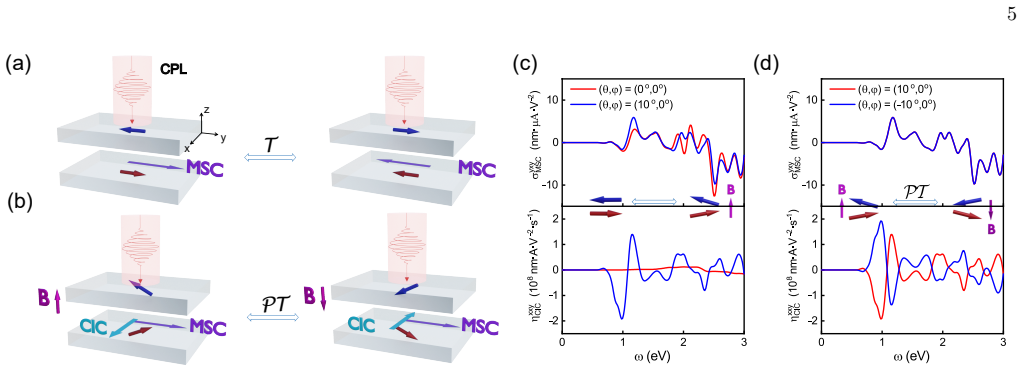
The central object is the vector spin chirality κ = S_A × S_B, the cross product of the moments in the two CrSBr layers. In the centrosymmetric bilayer, the creation of κ by spin canting breaks the combined PT symmetry, converting the material's magnetic point group from one that forbids i-type photocurrents to one that allows selected chiral shift and injection tensor components. The argument then runs through the second-order photoconductivity tensors σ(i) and η(i), computed from first principles, whose symmetry-allowed components (e.g., σ^yyy_CSC, η^xxy_CIC) carry the current and whose k-resolved analysis identifies the deep-valence-band optical channel responsible for the response.
What would settle it
Measure the in-plane photocurrents of bilayer CrSBr under y-polarized light as the field along z is swept through ±0.3 T: the claim requires the y-axis chiral current to switch sign with field reversal while the x-axis magnetic injection current stays put, and requires zero y-channel current in zero field; any other pattern falsifies the mechanism.
Extended reading notes
Core claim
Using symmetry classification and first-principles calculations on bilayer CrSBr in a canted antiferromagnetic state, the paper establishes that vector spin chirality κ = S_A × S_B acts as a generator of an i-type (time-reversal-even) magnetic bulk photovoltaic effect. This effect consists of a chiral shift current (CSC) under linearly polarized light and a chiral injection current (CIC) under circularly polarized light, both absent in the pristine collinear PT-symmetric antiferromagnet and both activated when spin canting breaks PT symmetry. In addition to showing that the current magnitudes are comparable to conventional shift currents, the paper demonstrates three control features: on/off
Load-bearing premise
The predictions assume that the spin-canting angle of bilayer CrSBr can be treated as a well-defined external control parameter set by the magnetic field, with no spin-flop transitions, domains, or non-rigid spin rearrangements intervening.
Editorial extensions
If this is right
- With about 0.3 T producing a 10° canting, bilayer CrSBr should show chiral shift and injection currents of the same order as conventional shift currents while the un-canted state shows none.
- Reversing the magnetic field reverses the spin-canting direction and hence the sign of the chiral currents, while leaving intrinsic c-type currents (MIC, MSC) unchanged; this PT-based rule is a clean experimental fingerprint.
- Sweeping the field from 0 to about 2 T tunes the canting angle and modulates the currents nonmonotonically, with maximum intensity around 45°, giving a magnetic-field-controlled optical switch.
- Under linearly polarized light, the intrinsic MIC and chiral CSC flow along orthogonal directions, so a multiterminal device can measure them separately and confirm the effect without ambiguity.
- The low-frequency response is carried by an optical transition channel from deeper valence bands, so the effect will not be captured by band-edge-only models or by the nesting channel that dominates chiral second-harmonic generation in the same material.
Reading between the lines
- Editor's extension: No external field is needed in materials where noncollinear order is intrinsic; the same CSC/CIC mechanism should make spin spirals and skyrmion lattices produce chiral photocurrents whose sign encodes the handedness of the magnetic texture.
- Editor's extension: Because the computed currents scale with spin-orbit coupling strength, chemical substitution or heterostructure engineering of SOC in the CrSX family should provide a second knob, beyond field angle, for designing the chiral photocurrent magnitude.
- Editor's extension: The orthogonal-current geometry suggests a simple photocurrent-based magnetometer: measuring the ratio of the y- and x-channel currents under y-polarized light would provide a direct optical readout of the canting angle and hence the local magnetic field.
- Editor's extension: The deep-valence-band channel's dominance may be generic for PT-broken magnetic bilayers, implying that full-band calculations, not low-energy models, are needed to predict chiral photocurrents in similar van der Waals magnets.
Editorial analysis
A structured set of objections, weighed in public.
Referee Report
Summary. The paper proposes a new subclass of bulk photovoltaic effect (BPVE) driven by vector spin chirality κ, termed chiral shift current (CSC) and chiral injection current (CIC). These are classified as i-type (time-reversal-even) but of magnetic origin, in contrast to conventional c-type magnetic BPVE. Using bilayer CrSBr as a prototype, the authors combine a magnetic point-group analysis with first-principles PBE+U+SOC calculations. They show that the pristine PT-symmetric AFM state supports only c-type MIC and MSC, while a canted AFM state with κ ≠ 0 breaks PT symmetry and activates CSC/CIC with the predicted nonzero tensor components. They report field-switchable on/off behavior, reversal of photocurrent direction on reversing the canting direction, continuous intensity modulation with canting angle, and identify SOC, interlayer coupling, and an unusual deep-valence-band channel as controlling factors.
Significance. If the central claims hold, this would establish a genuinely new mechanism for i-type BPVE arising from noncollinear magnetism, with symmetry-based switching properties that are distinct from both conventional shift currents and previously studied c-type magnetic BPVE. The paper's strengths include a clean symmetry classification (Tables I–III), a consistent first-principles verification of the nonzero tensor components and their switching rules, and a plausible experimental protocol using the orthogonal directions of MIC and CSC under y-polarized light. The calculation pipeline (Wannier interpolation, 400×400 k-mesh, standard shift/injection-current formulas) is appropriate and reproducible in principle. However, the quantitative magnitude claims and the central tunability story rest on an assumption about how an applied magnetic field realizes the assumed rigid spin-canting states, which is not demonstrated in the manuscript.
major comments (3)
- [CSC and CIC in BL CrSBr, paragraph beginning 'We took the out-of-plane canting state...'] The central claims of on/off switching and continuous modulation assume that a small applied field B along z realizes the rigid spin configuration (θ, φ) = (10°, 0°) and more generally the sequence in Table III up to θ=90°. No self-consistent Zeeman calculation, spin model, or energy minimization is presented; the '0.3 T for 10°' statement is qualitative and not derived. If field-induced spin-flop, non-uniform canting, or domain formation occurs, the magnetic point group would differ and the predicted zero/nonzero tensor components and their reversals would not apply. This is load-bearing for the 'exceptional tunability' claim. Please either compute the field-dependent magnetic ground state (e.g., with a classical spin model fitted to CrSBr parameters) or explicitly reframe the results as predictions for an idealized rigid-canting model and temper the experimental protocol claims.
- [Fig. 5 and Discussion, intensity modulation claim] The continuous intensity modulation of σ_yyy_CSC and η_xxy_CIC as a function of θ is computed by manually rotating all spins at fixed θ. In reality, the equilibrium canting angle under an external field is determined by the competition between Zeeman energy, exchange, and anisotropy, and the angle–field relation B(θ) is not necessarily monotone or single-valued. The claim that the photocurrent can be 'continuously and dynamically modulated by an external magnetic field' therefore goes beyond what the calculations show. The computed θ-dependence is a valid model response, but the mapping to B should be treated as an assumption or supported by a microscopic model.
- [Methods and Fig. 2(a), magnitude comparison] The statement that CSC/CIC magnitudes are 'comparable to' conventional NSC in other 2D magnets is based on PBE+U independent-particle optics without excitonic effects. CrSBr is known to have strong excitonic physics, and the 0.98 eV resonance analyzed here is close to exciton-dominated spectral regions. The symmetry and switching conclusions are unaffected, but the quantitative magnitude comparison should be qualified, or a BSE/GW-level check for at least one representative peak should be provided if the magnitude claim is retained.
minor comments (5)
- [Table III caption] The sentence 'The notations of MPGs follow the direction sequence of x, y and z' is opaque. Please spell out an example, e.g., m'2'm' means the m' plane is perpendicular to x and the m' plane to z.
- [Fig. 2(d)] The caption says 'all independent in-plane tensor components' but the main text only discusses σ_yyy_CSC and η_xyy_MIC. Please identify each component in the panel or in the caption.
- [Reference [17]] The DOI string '10.1038/s41563-026-02593-8' appears to contain an extra hyphen or an unusual volume marker. Please verify the bibliographic data.
- [Eq. (1) and surrounding text] The phrase 'the last two indices' when stating abc=acb could be misread as a=b; it means interchange the second and third Cartesian indices. Consider writing 'abc is symmetric under b↔c'.
- [General presentation] The term 'time-reversal-even magnetic BPVE' in the abstract may confuse readers because the i-type nature is defined by PT symmetry, not by T alone. A brief clarification in the introduction would help.
Circularity Check
No significant circularity: the first-principles photocurrents are not equivalent to their inputs; only minor non-load-bearing self-citations appear.
full rationale
The central derivation is self-contained. The paper begins from the standard decomposition of rectification currents (Eq. 1) and computes the i-type shift/injection photoconductivities from first-principles Wannier-interpolated wavefunctions for explicitly prescribed spin-canted CrSBr magnetic configurations. The predicted CSC and CIC components are not fitted to any experimental photocurrent or to the claimed effect; they emerge from the calculated band structure and from symmetry analysis (Table III), and the numerical results (Figs. 2-5) confirm the nonzero components. The only self-referential elements are the authors' own computational implementation (refs. 44-46) and a comparison with their prior SHG study (ref. 30); neither feeds the target result into the photocurrent calculation. The statement that a canting angle of 10 degrees corresponds to B approximately 0.3 T is a physical modeling input, not a fitted or derived prediction; while it may carry empirical uncertainty (e.g., spin-flop or domain effects), it is not a circularity. Therefore no step of the derivation reduces to its own input by construction.
Assumptions & free parameters
free parameters (3)
- Hubbard U_eff on Cr 3d =
3 eV
- Broadening width for optical response =
0.05 eV
- Spin-canting angle θ =
varied 0°-90°, representative 10°
assumptions (5)
- domain assumption The microscopic shift-current and injection-current formulas in Eq. (1) and SI Section IB correctly describe second-order photocurrents in 2D magnets with SOC.
- domain assumption The crystal and magnetic symmetries of BL CrSBr, and the magnetic point groups listed in Table III, accurately describe the canted AFM state.
- ad hoc to paper The spin-canting angle θ, once fixed, is the sole order parameter for PT-breaking; the electronic structure at that fixed spin configuration represents the experimental field-induced state.
- domain assumption PBE+U (U=3 eV) and DFT-D3 give a sufficiently accurate ground state for computing BPVE spectra.
- standard math The i-type/c-type classification in Tables I and II is exhaustive; no other symmetry-breaking mechanism contributes to the photocurrents at the same order.
Cite this review
Pith. "Pith review of Spin-Chirality-Driven Bulk Photovoltaic Effect in van der Waals Magnet CrSBr." pith.science (2026). https://pith.science/paper/MIJEDB6R
@misc{pith2026260803492,
  author       = {Pith},
  title        = {Pith review of: Spin-Chirality-Driven Bulk Photovoltaic Effect in van der Waals Magnet CrSBr},
  year         = {2026},
  howpublished = {\url{https://pith.science/paper/MIJEDB6R}},
  note         = {Machine review of arXiv:2608.03492}
}
read the original abstract
The bulk photovoltaic effect (BPVE) can be greatly enriched in magnetic materials. Here, we establish vector spin chirality as a tunable knob for generating an unconventional time-reversal-even magnetic BPVE, comprising the chiral shift current (CSC) and chiral injection current (CIC). Using bilayer antiferromagnetic (AFM) CrSBr as a prototype, we theoretically demonstrate the emergence of CSC and CIC. Compared with conventional photovoltaic currents arising from noncentrosymmetric crystal structures or collinear magnetic orderings, CSC and CIC not only possess comparable magnitudes but also exhibit exceptional tunability. Specifically, they can be switched on and off by magnetic-field-induced spin canting, reversed in direction upon canting-direction reversal, and continuously modulated in intensity via canting-angle variation. Furthermore, we reveal an unusual optical transition channel governing both currents in CrSBr. Our work establishes an unconventional magnetic BPVE with remarkable controllability, paving the way for applications in optoelectronics and magnetic sensing in noncollinear magnets.
Figures


Figures from the paper (2 more)


Reference graph
Works this paper leans on
-
[1]
J. Sipe and A. Shkrebtii, Second-order optical response in semiconductors, Phys. Rev. B61, 5337 (2000)
work page 2000
-
[2]
H. Wang and X. Qian, Ferroicity-driven nonlinear pho- tocurrent switching in time-reversal invariant ferroic ma- terials, Sci. Adv.5, eaav9743 (2019)
work page 2019
-
[3]
M.-M. Yang, D. J. Kim, and M. Alexe, Flexo- photovoltaic effect, Science360, 904 (2018)
work page 2018
-
[4]
J. E. Spanier, V. M. Fridkin, A. M. Rappe, A. R. Ak- bashev, A. Polemi, Y. Qi, Z. Gu, S. M. Young, C. J. Hawley, D. Imbrenda,et al., Power conversion efficiency exceeding the Shockley–Queisser limit in a ferroelectric insulator, Nat. Photonics10, 611 (2016)
work page 2016
-
[5]
S. M. Young and A. M. Rappe, First principles calcu- lation of the shift current photovoltaic effect in ferro- electrics, Phys. Rev. Lett.109, 116601 (2012)
work page 2012
-
[6]
S. M. Young, F. Zheng, and A. M. Rappe, First-principles calculation of the bulk photovoltaic effect in bismuth fer- rite, Phys. Rev. Lett.109, 236601 (2012)
work page 2012
-
[7]
L. Z. Tan and A. M. Rappe, Enhancement of the bulk photovoltaic effect in topological insulators, Phys. Rev. Lett.116, 237402 (2016)
work page 2016
-
[8]
Rangel, B
T. Rangel, B. M. Fregoso, B. S. Mendoza, T. Mori- moto, J. E. Moore, and J. B. Neaton, Large bulk photo- voltaic effect and spontaneous polarization of single-layer monochalcogenides, Phys. Rev. Lett.119, 067402 (2017)
2017
Show all 56 references
-
[9]
A. M. Cook, B. M. Fregoso, F. De Juan, S. Coh, and J. E. Moore, Design principles for shift current photovoltaics, Nat. Commun.8, 14176 (2017)
2017
-
[10]
Jiang, L
X. Jiang, L. Kang, J. Wang, and B. Huang, Giant bulk electrophotovoltaic effect in heteronodal-line sys- tems, Phys. Rev. Lett.130, 256902 (2023)
2023
-
[11]
Nakamura, S
M. Nakamura, S. Horiuchi, F. Kagawa, N. Ogawa, T. Ku- rumaji, Y. Tokura, and M. Kawasaki, Shift current pho- tovoltaic effect in a ferroelectric charge-transfer complex, Nat. Commun.8, 281 (2017)
2017
-
[12]
L. Z. Tan, F. Zheng, S. M. Young, F. Wang, S. Liu, and A. M. Rappe, Shift current bulk photovoltaic effect in po- lar materials—hybrid and oxide perovskites and beyond, npj Comput. Mater.2, 1 (2016)
2016
-
[13]
Z. Qian, J. Zhou, H. Wang, and S. Liu, Shift current response in elemental two-dimensional ferroelectrics, npj Comput. Mater.9, 67 (2023)
2023
-
[14]
L. Yang, L. Li, Z.-M. Yu, M. Wu, and Y. Yao, Two- dimensional topological ferroelectric metal with giant shift current, Phys. Rev. Lett.133, 186801 (2024)
2024
-
[15]
Y. Gao, M. Yang, W. Zou, J. Zhou, and C. Zhang, Band- edge mixture engineered giant and switchable shift cur- rent generation, Nano Lett.24, 12560 (2024)
2024
-
[16]
N. Zou, H. Li, M. Ye, H. Chen, M. Sun, R. Guo, Y. Liu, B.-L. Gu, W. Duan, Y. Xu,et al., Nonlinear optical ef- fects enhanced by deep band crossings, Phys. Rev. Lett. 135, 226901 (2025)
2025
-
[17]
Donget al., Layer photovoltaic effect in a two- dimensional antiferromagnet with parity-time symmetry, Nat
Y. Donget al., Layer photovoltaic effect in a two- dimensional antiferromagnet with parity-time symmetry, Nat. Mater. 10.1038/s41563-026-02593-8 (2026)
2026 doi
-
[18]
Asada, K
S. Asada, K. Shinokita, K. Watanabe, T. Taniguchi, and K. Matsuda, Nonlinear photovoltaic effects in monolayer semiconductor and layered magnetic material hetero- interface with P-and T-symmetry broken system, Nat. Commun.16, 4827 (2025)
2025
-
[19]
Watanabe and Y
H. Watanabe and Y. Yanase, Chiral photocurrent in parity-violating magnet and enhanced response in topo- logical antiferromagnet, Phys. Rev. X11, 011001 (2021)
2021
-
[20]
Zhanget al., Switchable magnetic bulk photovoltaic effect in the two-dimensional magnet CrI 3, Nat
Y. Zhanget al., Switchable magnetic bulk photovoltaic effect in the two-dimensional magnet CrI 3, Nat. Com- mun.10, 3783 (2019)
2019
-
[21]
Wang and X
H. Wang and X. Qian, Electrically and magnetically switchable nonlinear photocurrent inPT-symmetric magnetic topological quantum materials, npj Comput. Mater.6, 199 (2020)
2020
-
[22]
R. Fei, W. Song, and L. Yang, Giant photogalvanic ef- fect and second-harmonic generation in magnetic axion insulators, Phys. Rev. B102, 035440 (2020)
2020
-
[23]
Zhang, P
C. Zhang, P. Guo, and J. Zhou, Tailoring bulk photo- voltaic effects in magnetic sliding ferroelectric materials, Nano Lett.22, 9297 (2022)
2022
-
[24]
Q. Xue, X. Mu, Y. Sun, and J. Zhou, Valley contrast- ing bulk photovoltaic effect in a PT-symmetric MnPSe 3 monolayer, Phys. Rev. B107, 245404 (2023)
2023
-
[25]
H. Pi, S. Zhang, and H. Weng, Magnetic bulk pho- tovoltaic effect as a probe of magnetic structures of EuSn2As2, Quantum Front.2, 6 (2023)
2023
-
[26]
Wang and L
H. Wang and L. Yang, Manipulating photogalvanic ef- fects in two-dimensional multiferroic breathing kagome materials, J. Phys. Chem. Lett15, 8689 (2024)
2024
-
[27]
F. R. Lux, F. Freimuth, S. Bl¨ ugel, and Y. Mokrousov, Chiral hall effect in noncollinear magnets from a cyclic co- homology approach, Phys. Rev. Lett.124, 096602 (2020). 10
2020
-
[28]
J. Kipp, K. Samanta, F. R. Lux, M. Merte, D. Go, J.- P. Hanke, M. Redies, F. Freimuth, S. Bl¨ ugel, M. Leˇ zai´ c, et al., The chiral hall effect in canted ferromagnets and antiferromagnets, Commun. Phys.4, 99 (2021)
2021
-
[29]
Merte, F
M. Merte, F. Freimuth, D. Go, T. Adamantopoulos, F. Lux, L. Plucinski, O. Gomonay, S. Bl¨ ugel, and Y. Mokrousov, Photocurrents, inverse faraday effect, and photospin hall effect in Mn 2Au, APL Mater.11(2023)
2023
-
[30]
D. Wu, Y. Xu, M. Ye, and W. Duan, Spin-chirality-driven second-harmonic generation in two-dimensional magnet CrSBr, Sci. Adv.11, eadu6562 (2025)
2025
-
[31]
Zhang, H
C. Zhang, H. Pi, and J. Zhou, Bulk photovoltaic effects in helimagnets, Phys. Rev. B110, L041104 (2024)
2024
-
[32]
E. J. Telford, A. H. Dismukes, K. Lee, M. Cheng, A. Wi- eteska, A. K. Bartholomew, Y.-S. Chen, X. Xu, A. N. Pasupathy, X. Zhu,et al., Layered antiferromagnetism induces large negative magnetoresistance in the van der waals semiconductor CrSBr, Adv. Mater.32, 2003240 (2020)
2020
-
[33]
K. Lee, A. H. Dismukes, E. J. Telford, R. A. Wiscons, J. Wang, X. Xu, C. Nuckolls, C. R. Dean, X. Roy, and X. Zhu, Magnetic order and symmetry in the 2D semi- conductor CrSBr, Nano Lett.21, 3511 (2021)
2021
-
[34]
N. P. Wilson, K. Lee, J. Cenker, K. Xie, A. H. Dismukes, E. J. Telford, J. Fonseca, S. Sivakumar, C. Dean, T. Cao, et al., Interlayer electronic coupling on demand in a 2D magnetic semiconductor, Nat. Mater.20, 1657 (2021)
2021
-
[35]
Cenker, S
J. Cenker, S. Sivakumar, K. Xie, A. Miller, P. Thijssen, Z. Liu, A. Dismukes, J. Fonseca, E. Anderson, X. Zhu, et al., Reversible strain-induced magnetic phase transi- tion in a van der waals magnet, Nat. Nanotechnol.17, 256 (2022)
2022
-
[36]
Y. J. Bae, J. Wang, A. Scheie, J. Xu, D. G. Chica, G. M. Diederich, J. Cenker, M. E. Ziebel, Y. Bai, H. Ren,et al., Exciton-coupled coherent magnons in a 2D semiconduc- tor, Nature609, 282 (2022)
2022
-
[37]
C. Ye, C. Wang, Q. Wu, S. Liu, J. Zhou, G. Wang, A. Soll, Z. Sofer, M. Yue, X. Liu,et al., Layer-dependent interlayer antiferromagnetic spin reorientation in air- stable semiconductor CrSBr, ACS nano16, 11876 (2022)
2022
-
[38]
G. M. Diederich, J. Cenker, Y. Ren, J. Fonseca, D. G. Chica, Y. J. Bae, X. Zhu, X. Roy, T. Cao, D. Xiao, et al., Tunable interaction between excitons and hy- bridized magnons in a layered semiconductor, Nat. Nan- otechnol.18, 23 (2023)
2023
-
[39]
G. M. Diederich, M. Nguyen, J. Cenker, J. Fonseca, S. Pumulo, Y. J. Bae, D. G. Chica, X. Roy, X. Zhu, D. Xiao,et al., Exciton dressing by extreme nonlinear magnons in a layered semiconductor, Nat. Nanotechnol. 20, 617 (2025)
2025
-
[40]
Dirnberger, J
F. Dirnberger, J. Quan, R. Bushati, G. M. Diederich, M. Florian, J. Klein, K. Mosina, Z. Sofer, X. Xu, A. Kamra,et al., Magneto-optics in a van der waals mag- net tuned by self-hybridized polaritons, Nature620, 533 (2023)
2023
-
[41]
Tabataba-Vakili, H
F. Tabataba-Vakili, H. P. Nguyen, A. Rupp, K. Mosina, A. Papavasileiou, K. Watanabe, T. Taniguchi, P. Maletinsky, M. M. Glazov, Z. Sofer,et al., Doping- control of excitons and magnetism in few-layer CrSBr, Nat. Commun.15, 4735 (2024)
2024
-
[42]
Klein, B
J. Klein, B. Pingault, M. Florian, M.-C. Heißenb¨ uttel, A. Steinhoff, Z. Song, K. Torres, F. Dirnberger, J. B. Curtis, M. Weile,et al., The bulk van der waals layered magnet CrSBr is a quasi-1D material, ACS Nano17, 5316 (2023)
2023
-
[43]
M. E. Ziebel, M. L. Feuer, J. Cox, X. Zhu, C. R. Dean, and X. Roy, Crsbr: an air-stable, two-dimensional mag- netic semiconductor, Nano Lett.24, 4319 (2024)
2024
-
[44]
C. Wang, X. Liu, L. Kang, B.-L. Gu, Y. Xu, and W. Duan, First-principles calculation of nonlinear opti- cal responses by Wannier interpolation, Phys. Rev. B96, 115147 (2017)
2017
-
[45]
H. Chen, M. Ye, N. Zou, B.-L. Gu, Y. Xu, and W. Duan, Basic formulation and first-principles implementation of nonlinear magneto-optical effects, Phys. Rev. B105, 075123 (2022)
2022
-
[46]
D. Wu, M. Ye, H. Chen, Y. Xu, and W. Duan, Giant and controllable nonlinear magneto-optical effects in two- dimensional magnets, npj Comput. Mater.10, 79 (2024)
2024
-
[47]
spin-chirality-driven bulk photovoltaic effect in van der waals magnet CrSBr
Supporting information for “spin-chirality-driven bulk photovoltaic effect in van der waals magnet CrSBr” (2026)
2026
-
[48]
Holder, D
T. Holder, D. Kaplan, and B. Yan, Consequences of time- reversal-symmetry breaking in the light-matter interac- tion: Berry curvature, quantum metric, and diabatic mo- tion, Phys. Rev. Res.2, 033100 (2020)
2020
-
[49]
L. Ye, W. Zhou, D. Huang, X. Jiang, Q. Guo, X. Cao, S. Yan, X. Wang, D. Jia, D. Jiang,et al., Manipulation of nonlinear optical responses in layered ferroelectric nio- bium oxide dihalides, Nat. Commun.14, 5911 (2023)
2023
-
[50]
Mennel, V
L. Mennel, V. Smejkal, L. Linhart, J. Burgd¨ orfer, F. Li- bisch, and T. Mueller, Band nesting in two-dimensional crystals: An exceptionally sensitive probe of strain, Nano Lett.20, 4242 (2020)
2020
-
[51]
Carvalho, R
A. Carvalho, R. Ribeiro, and A. C. Neto, Band nesting and the optical response of two-dimensional semiconduct- ing transition metal dichalcogenides, Phys. Rev. B88, 115205 (2013)
2013
-
[52]
Kresse and J
G. Kresse and J. Furthm¨ uller, Efficient iterative schemes for ab initio total-energy calculations using a plane-wave basis set, Phys. Rev. B54, 11169 (1996)
1996
-
[53]
Kresse and D
G. Kresse and D. Joubert, From ultrasoft pseudopoten- tials to the projector augmented-wave method, Phys. Rev. B59, 1758 (1999)
1999
-
[54]
J. P. Perdew, K. Burke, and M. Ernzerhof, Generalized gradient approximation made simple, Phys. Rev. Lett. 77, 3865 (1996)
1996
-
[55]
Grimme, J
S. Grimme, J. Antony, S. Ehrlich, and H. Krieg, A con- sistent and accurate ab initio parametrization of density functional dispersion correction (DFT-D) for the 94 ele- ments H-Pu, J. Chem. Phys.132, 154104 (2010)
2010
-
[56]
A. A. Mostofi, J. R. Yates, G. Pizzi, Y.-S. Lee, I. Souza, D. Vanderbilt, and N. Marzari, An updated version of Wannier90: A tool for obtaining maximally-localised Wannier functions, Comput. Phys. Commun.185, 2309 (2014)
2014
Reviewed August 5, 2026 · model on record in the stance chip above.
Discussion (0). Continue with ORCID to comment.