REVIEW 3 major objections 4 minor 46 references
Detecting Pose Estimation Failures via Keypoint Self-Consistency
T0 review · 3 major / 4 minor · reviewed 2026-08-05 · deepseek-v4-flash
Pith's one-line read This paper claims that keypoint-based 6D pose estimation failures can be detected from geometric self-consistency of predicted 2D keypoints, beating conformal keypoint prediction and confidence thresholding on LINEMOD Occluded.
desk verdict A clean, modest failure-detection paper for keypoint pose estimation; the geometric features help, but the abstract oversells them relative to a simple logistic regression on keypoint confidence alone. read the letter →
The pith
A machine-rendered reading of the paper's core claim, the machinery that carries it, and where it could break.
The reading
What carries the argument
The load-bearing object is the feature vector built from 'self-consistency' of keypoint predictions. For each pose estimate, the paper computes (i) pairwise 2D distances between predicted keypoints scaled by estimated depth, (ii) per-keypoint distances between image predictions and reprojections of the 3D keypoints under the estimated pose, (iii) inverse keypoint confidence, and optionally (iv) render- and mask-consistency terms. These features are fed to a logistic regression whose decision boundary separates correct poses (rotation error ≤ τ) from failures (rotation error > τ). The mechanism works because independent keypoint predictions that stray from the object's fixed 3D geometry produ
What would settle it
Run the reported reverse cross-validation with folds separated by object instance or camera viewpoint instead of random splits. If the AUROC advantage over conformal keypoint prediction collapses, then the method's success depends on the calibration fold being statistically exchangeable with deployment data, which is the paper's load-bearing assumption.
Extended reading notes
Core claim
The paper's central claim is that pose estimation failures can be identified by measuring how well predicted 2D keypoints agree with each other and with the known 3D structure of the object, rather than by relying on per-keypoint confidence alone. The proposed Meta Pose detector concatenates scaled pairwise distances among predicted image keypoints, distances between predicted and PnP-reprojected keypoints, per-keypoint inverse confidence, and in the full variant render- and mask-consistency terms. A logistic regression on these features outputs a well-calibrated failure probability. The paper reports consistent gains over both baselines across all eight LINEMOD Occluded objects and both rot
Load-bearing premise
The method's performance depends on a small labeled calibration set drawn from the deployment domain being representative of the poses the system will see, and on the relationship between keypoint geometry and pose failure staying close enough to linear for a logistic regression to capture it.
Editorial extensions
If this is right
- A failure probability is available for every pose estimate at negligible extra cost, so downstream systems can reject or re-estimate flagged poses.
- Because a 20% calibration fold suffices, practitioners can build a failure detector from a small labeled set from the target domain without retraining the keypoint model.
- Render-free detection matches full render/mask features, so reliable failure detection does not require a renderer or segmentation model in the standard pipeline.
- The reported calibration curves stay close to the diagonal, allowing the failure probability to be used as a meaningful confidence score for triggering re-estimation.
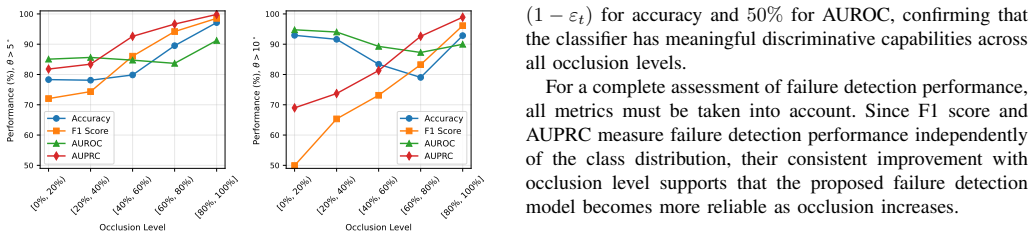
- The gains extend across all eight LINEMOD Occluded objects and both rotation thresholds, with the clearest separation for symmetric objects and highly occluded scenes.
Reading between the lines
- A natural extension the paper leaves open is to use the same self-consistency features as a training signal: a keypoint detector regularized to produce mutually consistent keypoint sets might reduce pose failures directly, not just detect them.
- The conformal baseline is implemented with three scalar statistics from sampled poses; a conformal detector that feeds richer geometric information from the prediction sets could narrow the reported gap.
- The single-dataset evaluation means the strongest test of the claim is transfer: training the logistic regression on different objects or a different keypoint backbone and checking whether the AUROC advantage survives, which the paper notes remains open.
Editorial analysis
A structured set of objections, weighed in public.
Referee Report
Summary. The paper proposes Meta Pose, a lightweight failure-detection framework for keypoint-based 6D pose estimation. It constructs hand-crafted features from predicted 2D keypoints, including depth-scaled pairwise distances, reprojection distances under the estimated pose, per-keypoint confidence scores, and (in the full variant) render- and mask-consistency features. A logistic regression classifier is trained on these features to predict whether the rotation error exceeds thresholds of 5° or 10°. Evaluation on LINEMOD Occluded uses a reverse 5-fold cross-validation protocol, with one fold for training the classifier and the remainder for testing. The paper reports consistent improvements in AUROC/AUPRC over maximum keypoint confidence thresholding and conformal keypoint prediction, and argues that the render-free variant is preferable because render-based features add little while increasing runtime.
Significance. If the results hold, the paper offers a practical, low-cost failure detector that requires only a small labeled calibration set, produces calibrated probabilities, and runs at modest overhead. The evaluation is in many ways careful: reverse cross-validation, multiple threshold-agnostic and threshold-dependent metrics, per-object results, calibration curves, sample-efficiency and occlusion analyses, and a feature ablation. The code release is a further strength. However, the incremental value of the geometric features over a logistic regression on keypoint confidence alone is modest, and the paper omits standard reprojection-error baselines. The contribution's magnitude is therefore not yet fully established.
major comments (3)
- [Section V, Table I and Table II] The main comparison omits the natural confidence-only baseline: a logistic regression trained on the per-keypoint uncertainty vector u (Eq. 8). Table II shows that u alone achieves AUROC 79.81 (θ>5°) and 88.47 (θ>10°), while the full render-free Meta Pose achieves 83.04 and 90.50. Thus most of the improvement over the max-confidence baseline appears to come from replacing max-aggregation with a trained classifier on all confidence scores, not from the geometric features. Add this baseline to Table I, report its standard deviations, and temper the abstract's claim that geometric self-consistency is the key to outperforming confidence-based approaches, or demonstrate that the 3.2/2.0 point gain is statistically significant.
- [Section IV-C, Table II] No comparison is made to a simple PnP reprojection-error or RANSAC-inlier threshold baseline. The feature d_repr (Eq. 4) is exactly the per-keypoint reprojection error; Table II shows it alone reaches AUROC 78.45 (θ>5°) and 88.76 (θ>10°). A scalar mean/max reprojection-error threshold is a standard practice and should be included. Without such a baseline, the paper does not isolate the value of the trained classifier over a classical geometric consistency check, which is central to the claim that the proposed features and logistic regression provide a practical advance.
- [Table I, Max Keypoint Confidence Thresholding] All metrics for this baseline are reported with ±0.00 standard deviation. Under the reverse cross-validation protocol, the test set changes per fold and the threshold t* (defined in Section IV-A) must be re-selected on the training fold, so nonzero variation is expected. The paper must state how this baseline's threshold was chosen. If the threshold was tuned on the full test set, the comparison is not apples-to-apples. Re-run the baseline under the same per-fold protocol or explicitly justify the zero variance.
minor comments (4)
- [Eq. (8)] The notation is garbled: 'u= (1−s) s∈s ∈[0,1]^{|V|}' should read something like 'u = (1 - s_i)_{i=1}^{|V|}, where s ∈ [0,1]^{|V|}'.
- [Section I] The introduction states 'Section VI concludes with an ablation study,' but Section VI is the ablation study and Section VII is the conclusion. Please correct the outline.
- [Table III] The runtime table appears to have a formatting/unit error: the 'Runtime (ms / image)' column lists values such as '3301.0×', which look like relative multipliers, while the text mentions 374 ms per image. Clarify the units and the relationship between the two columns.
- [Eq. (10)] The tolerance δ=2 is used throughout without a sensitivity analysis or justification. Since the coverage ratio depends on δ, a brief discussion of the choice would strengthen the evaluation.
Circularity Check
No significant circularity
full rationale
The derivation chain is self-contained and empirical. Features (Eqs. 3-11) are computed from estimated keypoints, estimated poses, renderings, and masks, without access to the ground-truth rotation; the failure label is defined independently by the ground-truth rotation error at threshold tau (Eq. 2). A logistic regression is trained on one fold and evaluated on held-out folds (Section IV-B), so the predicted failure probability is not a fitted constant or a renamed input. The render-free Meta Pose includes the confidence vector u, but the ablation (Table II) transparently reports a u-only AUROC of 79.81 vs 83.04 for the full render-free feature set at theta>5, so the marginal contribution of geometric features is disclosed rather than hidden. Self-citations [29,30] appear only as related-work context for meta classification and are not load-bearing for the pose-failure-detection claim. The Section VII caveat that validation is limited to LINEMOD Occluded affects external generality, not circularity. No equation reduces to its own input, and no fitted parameter is presented as a prediction.
Assumptions & free parameters
free parameters (2)
- logistic regression weights and bias =
learned from one 20% calibration fold; individual values not reported
- coverage tolerance δ for render mask coverage ratio =
2 pixels
assumptions (6)
- standard math Pinhole camera model and Perspective-n-Point projection as in Eq. (1)
- domain assumption Keypoint confidence scores s from the detector represent meaningful localization uncertainty
- domain assumption The 5 folds of LINEMOD Occluded test images are independent and representative due to uniform view distribution
- domain assumption The 3D object model and camera intrinsics are available and fixed
- domain assumption For Full variant: SAM segmentation approximates the true object silhouette
- domain assumption For render features: the keypoint detector performs similarly on rendered and real images
Cite this review
Pith. "Pith review of Detecting Pose Estimation Failures via Keypoint Self-Consistency." pith.science (2026). https://pith.science/paper/HPKXPVWF
@misc{pith2026260803516,
  author       = {Pith},
  title        = {Pith review of: Detecting Pose Estimation Failures via Keypoint Self-Consistency},
  year         = {2026},
  howpublished = {\url{https://pith.science/paper/HPKXPVWF}},
  note         = {Machine review of arXiv:2608.03516}
}
read the original abstract
One common approach to pose estimation involves predicting object keypoints in an image, followed by using Perspective-n-Point algorithms to compute the object's rotation and translation relative to the camera. While rotations preserve object shapes, this property is often neglected in keypoint-based pose estimation methods, where keypoints are typically predicted independently from each other. As imprecise keypoint predictions negatively affects pose estimation accuracy, it also limits its reliability in downstream tasks. In this work, we explore whether such inaccurate pose estimates can be identified by simply examining spatial locations between 2D keypoints. We propose a set of hand-crafted geometric features that capture the self-consistency of keypoint predictions, including pairwise distances, reprojection consistency, as well as render and mask consistency. Despite its simplicity, a logistic regression classifier trained on these features reliably detects pose estimation failures, outperforming confidence-based approaches like conformal keypoint predictions that rely solely on keypoint uncertainty.
Figures


Figures from the paper (5 more)


Reference graph
Works this paper leans on
-
[1]
BOP: Benchmark for 6D object pose estimation,
T. Hoda ˇn, F. Michel, E. Brachmann, W. Kehl, A. Glent Buch, D. Kraft, B. Drost, J. Vidal, S. Ihrke, X. Zabulis, C. Sahin, F. Manhardt, F. Tombari, T.-K. Kim, J. Matas, and C. Rother, “BOP: Benchmark for 6D object pose estimation,”European Conference on Computer Vision (ECCV), 2018. 1, 5, 6, 8, 9
work page 2018
-
[2]
Megapose: 6d pose estimation of novel objects via render & compare,
Y . Labb ´e, L. Manuelli, A. Mousavian, S. Tyree, S. Birchfield, J. Tremblay, J. Carpentier, M. Aubry, D. Fox, and J. Sivic, “Megapose: 6d pose estimation of novel objects via render & compare,” inProceedings of the 6th Conference on Robot Learning (CoRL), vol. 205, 2023, pp. 355–366. [Online]. Available: https://proceedings.mlr.press/v205/labbe23a.html 1
work page 2023
-
[3]
Foun- dationPose: Unified 6D pose estimation and tracking of novel objects,
B. Wen, W. Yang, J. Kautz, and S. Birchfield, “Foun- dationPose: Unified 6D pose estimation and tracking of novel objects,” inIEEE/CVF Conference on Computer Vision and Pattern Recognition (CVPR), 2024
work page 2024
-
[4]
Any6d: Model-free 6d pose estimation of novel objects,
T. Leeet al., “Any6d: Model-free 6d pose estimation of novel objects,” inProceedings of the IEEE/CVF Conference on Computer Vision and Pattern Recognition (CVPR), 2025, pp. 11 633–11 643. 1
work page 2025
-
[5]
Posenet: A convolutional network for real-time 6-dof camera re- localization,
A. Kendall, M. Grimes, and R. Cipolla, “Posenet: A convolutional network for real-time 6-dof camera re- localization,” inProceedings of the IEEE international conference on computer vision, 2015, pp. 2938–2946. 1, 2
work page 2015
-
[6]
Posecnn: A convolutional neural network for 6d ob- ject pose estimation in cluttered scenes,
Y . Xiang, T. Schmidt, V . Narayanan, and D. Fox, “Posecnn: A convolutional neural network for 6d ob- ject pose estimation in cluttered scenes,”arXiv preprint arXiv:1711.00199, 2017. 1, 2
arXiv 2017
-
[7]
6-dof object pose from semantic keypoints,
G. Pavlakos, X. Zhou, A. Chan, K. G. Derpanis, and K. Daniilidis, “6-dof object pose from semantic keypoints,” in2017 IEEE international conference on robotics and automation (ICRA). IEEE, 2017, pp. 2011–
work page 2017
-
[8]
Pvnet: Pixel-wise voting network for 6dof pose estimation,
S. Peng, Y . Liu, Q. Huang, X. Zhou, and H. Bao, “Pvnet: Pixel-wise voting network for 6dof pose estimation,” in Proceedings of the IEEE/CVF conference on computer vision and pattern recognition, 2019, pp. 4561–4570. 2
work page 2019
Show all 46 references
-
[9]
End- to-end learnable geometric vision by backpropagating pnp optimization,
B. Chen, A. Parra, J. Cao, N. Li, and T.-J. Chin, “End- to-end learnable geometric vision by backpropagating pnp optimization,” inProceedings of the IEEE/CVF Conference on Computer Vision and Pattern Recognition (CVPR), June 2020
2020
-
[10]
Semantic keypoint-based pose estimation from single rgb frames,
K. Schmeckpeper, P. R. Osteen, Y . Wang, G. Pavlakos, K. Chaney, W. Jordan, X. Zhou, K. G. Derpa- nis, and K. Daniilidis, “Semantic keypoint-based pose estimation from single rgb frames,”arXiv preprint arXiv:2204.05864, 2022. 1, 2, 5, 8
2022 arXiv
-
[11]
Object pose estimation with statistical guarantees: Conformal keypoint detection and geometric uncertainty propagation,
H. Yang and M. Pavone, “Object pose estimation with statistical guarantees: Conformal keypoint detection and geometric uncertainty propagation,” inProceedings of the IEEE/CVF Conference on Computer Vision and Pattern Recognition, 2023, pp. 8947–8958. 1, 3, 5, 6
2023
-
[12]
Making deep heatmaps robust to partial occlusions for 3d object pose estimation,
M. Oberweger, M. Rad, and V . Lepetit, “Making deep heatmaps robust to partial occlusions for 3d object pose estimation,” inProceedings of the European conference on computer vision (ECCV), 2018, pp. 119–134. 1, 2
2018
-
[13]
GDR-Net: Geometry-guided direct regression network for monocu- lar 6d object pose estimation,
G. Wang, F. Manhardt, F. Tombari, and X. Ji, “GDR-Net: Geometry-guided direct regression network for monocu- lar 6d object pose estimation,” inIEEE/CVF Conference on Computer Vision and Pattern Recognition (CVPR), June 2021, pp. 16 611–16 621. 2
2021
-
[14]
On the continuity of rotation representations in neural networks,
Y . Zhou, C. Barnes, J. Lu, J. Yang, and H. Li, “On the continuity of rotation representations in neural networks,” inIEEE/CVF Conference on Computer Vision and Pat- tern Recognition (CVPR), 2019. 2
2019
-
[15]
Cosy- pose: Consistent multi-view multi-object 6d pose esti- mation,
Y . Labb´e, J. Carpentier, M. Aubry, and J. Sivic, “Cosy- pose: Consistent multi-view multi-object 6d pose esti- mation,” inEuropean Conference on Computer Vision (ECCV), 2020. 2
2020
-
[16]
A review of solutions for perspective-n- point problem in camera pose estimation,
X. X. Lu, “A review of solutions for perspective-n- point problem in camera pose estimation,” inJournal of Physics: Conference Series, vol. 1087. IOP Publishing, 2018, p. 052009. 2
2018
-
[17]
Epnp: An accurate o(n) solution to the pnp problem,
V . Lepetit, F. Moreno-Noguer, and P. Fua, “Epnp: An accurate o(n) solution to the pnp problem,” International Journal of Computer Vision, vol. 81, no. 2, p. 155–166, feb 2009. [Online]. Available: https://doi.org/10.1007/s11263-008-0152-6 2
2009 doi
-
[18]
Object recognition from local scale- invariant features,
D. G. Lowe, “Object recognition from local scale- invariant features,” inProceedings of the seventh IEEE international conference on computer vision, vol. 2. IEEE, 1999, pp. 1150–1157. 2
1999
-
[19]
3d object modeling and recognition using local affine- invariant image descriptors and multi-view spatial con- straints,
F. Rothganger, S. Lazebnik, C. Schmid, and J. Ponce, “3d object modeling and recognition using local affine- invariant image descriptors and multi-view spatial con- straints,”International Journal of Computer Vision, vol. 66, no. 3, pp. 231–259, 2006. 2
2006
-
[20]
Bb8: A scalable, accurate, robust to partial occlusion method for predicting the 3d poses of challenging objects without using depth,
M. Rad and V . Lepetit, “Bb8: A scalable, accurate, robust to partial occlusion method for predicting the 3d poses of challenging objects without using depth,” inProceedings of the IEEE international conference on computer vision, 2017, pp. 3828–3836. 2
2017
-
[21]
Ssd-6d: Making rgb-based 3d detection and 6d pose estimation great again,
W. Kehl, F. Manhardt, F. Tombari, S. Ilic, and N. Navab, “Ssd-6d: Making rgb-based 3d detection and 6d pose estimation great again,” inProceedings of the IEEE international conference on computer vision, 2017, pp. 1521–1529
2017
-
[22]
Real-time seamless single shot 6d object pose prediction,
B. Tekin, S. N. Sinha, and P. Fua, “Real-time seamless single shot 6d object pose prediction,” inProceedings of the IEEE conference on computer vision and pattern recognition, 2018, pp. 292–301. 2
2018
-
[23]
Segmentation-driven 6d object pose estimation,
Y . Hu, J. Hugonot, P. Fua, and M. Salzmann, “Segmentation-driven 6d object pose estimation,” inPro- ceedings of the IEEE/CVF conference on computer vision and pattern recognition, 2019, pp. 3385–3394. 2
2019
-
[24]
A baseline for detecting misclassified and out-of-distribution examples in neural networks,
D. Hendrycks and K. Gimpel, “A baseline for detecting misclassified and out-of-distribution examples in neural networks,” inInternational Conference on Learning Rep- 12 resentations (ICLR), 2017. 2, 6
2017
-
[25]
Addressing failure prediction by learning model confidence,
C. Corbi `ere, N. Thome, A. Bar-Hen, M. Cord, and P. P ´erez, “Addressing failure prediction by learning model confidence,”Advances in neural information pro- cessing systems, vol. 32, 2019. 2
2019
-
[26]
Learning confidence for out-of-distribution detection in neural networks,
T. DeVries and G. W. Taylor, “Learning confidence for out-of-distribution detection in neural networks,”arXiv preprint arXiv:1802.04865, 2018. 2
2018 arXiv
-
[27]
Enhancing the reli- ability of out-of-distribution image detection in neural networks,
S. Liang, Y . Li, and R. Srikant, “Enhancing the reli- ability of out-of-distribution image detection in neural networks,”arXiv preprint arXiv:1706.02690, 2017. 2
2017 arXiv
-
[28]
A simple unified framework for detecting out-of-distribution samples and adversarial attacks,
K. Lee, K. Lee, H. Lee, and J. Shin, “A simple unified framework for detecting out-of-distribution samples and adversarial attacks,”Advances in neural information pro- cessing systems, vol. 31, 2018. 2
2018
-
[29]
Prediction error meta classification in semantic segmentation: Detection via aggregated dispersion measures of softmax probabilities,
M. Rottmann, P. Colling, T. P. Hack, R. Chan, F. H ¨uger, P. Schlicht, and H. Gottschalk, “Prediction error meta classification in semantic segmentation: Detection via aggregated dispersion measures of softmax probabilities,” in2020 International Joint Conference on Neural Net...
2020
-
[30]
En- tropy maximization and meta classification for out- of-distribution detection in semantic segmentation,
R. Chan, M. Rottmann, and H. Gottschalk, “En- tropy maximization and meta classification for out- of-distribution detection in semantic segmentation,” in Proceedings of the ieee/cvf international conference on computer vision, 2021, pp. 5128–5137. 2
2021
-
[31]
Towards meaningful un- certainty information for cnn based 6d pose estimates,
J. Richter-Klug and U. Frese, “Towards meaningful un- certainty information for cnn based 6d pose estimates,” inInternational Conference on Computer Vision Systems. Springer, 2019, pp. 408–422. 2
2019
-
[32]
Fast uncertainty quantifi- cation for deep object pose estimation,
G. Shi, Y . Zhu, J. Tremblay, S. Birchfield, F. Ramos, A. Anandkumar, and Y . Zhu, “Fast uncertainty quantifi- cation for deep object pose estimation,” in2021 IEEE International Conference on Robotics and Automation (ICRA). IEEE, 2021, pp. 5200–5207. 2
2021
-
[33]
Uncer- tainty quantification with deep ensembles for 6d object pose estimation,
K. Wursthorn, M. Hillemann, and U. Markus, “Uncer- tainty quantification with deep ensembles for 6d object pose estimation,” inThe Role of Photogrammetry for a Sustainable World, 2024. 2
2024
-
[34]
Learning orientation distributions for object pose estimation,
B. Okorn, M. Xu, M. Hebert, and D. Held, “Learning orientation distributions for object pose estimation,” in 2020 IEEE/RSJ International Conference on Intelligent Robots and Systems (IROS). IEEE, 2020, pp. 1799–
2020
-
[35]
Surfemb: Dense and continuous correspondence distributions for object pose estimation with learnt surface embeddings,
R. L. Haugaard and A. G. Buch, “Surfemb: Dense and continuous correspondence distributions for object pose estimation with learnt surface embeddings,” inProceed- ings of the IEEE/CVF Conference on Computer Vision and Pattern Recognition (CVPR), 2022, pp. 6708–6717. 2
2022
-
[36]
Robust 6d object pose estimation by learning rgb-d features,
M. Tian, L. Pan, M. H. Ang, and G. H. Lee, “Robust 6d object pose estimation by learning rgb-d features,” in 2020 IEEE/RSJ International Conference on Intelligent Robots and Systems (IROS), 2020, pp. 6811–6818. 2
2020
-
[37]
Uncertainty-driven 6d pose estimation of objects and scenes from a single rgb image,
E. Brachmann, F. Michel, A. Krull, M. Y . Yang, S. Gumhold, and C. Rother, “Uncertainty-driven 6d pose estimation of objects and scenes from a single rgb image,” inProceedings of the IEEE Conference on Computer Vision and Pattern Recognition (CVPR), June 2016, pp. 3364–3372
2016
-
[38]
Keypoint-based category-level object pose tracking from an rgb sequence with uncertainty estimation,
Y . Lin, J. Tremblay, S. Tyree, P. A. Vela, and S. Birchfield, “Keypoint-based category-level object pose tracking from an rgb sequence with uncertainty estimation,” in2022 International Conference on Robotics and Automation (ICRA). IEEE Press, 2022, p. 1258–1264. [Online]. Av...
2022
-
[39]
Maskval: Simple but effec- tive uncertainty quantification for 6d pose estimation,
P. Quentin and D. Goehring, “Maskval: Simple but effec- tive uncertainty quantification for 6d pose estimation,” in 2024 IEEE 20th International Conference on Automation Science and Engineering (CASE), 2024, pp. 1928–1934. 3, 4
2024
-
[40]
Tracing back error sources to explain and mitigate pose estimation failures,
L. Schneider, Y . Shi, R. Wolf, C. Brenner, R. Triebel, and R. Rayyes, “Tracing back error sources to explain and mitigate pose estimation failures,”arXiv preprint arXiv:2603.02881, 2026. 3
2026
-
[41]
V ovk, A
V . V ovk, A. Gammerman, and G. Shafer,Algorithmic learning in a random world. Springer, 2005. 3
2005
-
[42]
Inductive confidence machines for regression,
H. Papadopoulos, K. Proedrou, V . V ovk, and A. Gammer- man, “Inductive confidence machines for regression,” in European conference on machine learning. Springer, 2002, pp. 345–356. 3, 5
2002
-
[43]
Uncertainty quantification for visual object pose estimation,
L. Shaikewitz, C. Georgiou, and L. Carlone, “Uncertainty quantification for visual object pose estimation,” 2025. [Online]. Available: https://arxiv.org/abs/2511.21666 3
2025 arXiv
-
[44]
Segment anything,
A. Kirillov, E. Mintun, N. Ravi, H. Mao, C. Rolland, L. Gustafson, T. Xiao, S. Whitehead, A. C. Berg, W.- Y . Loet al., “Segment anything,” inProceedings of the IEEE/CVF International Conference on Computer Vision (ICCV), 2023, pp. 4015–4026. 4
2023
-
[45]
Perspective-n-point (PnP) pose computation — OpenCV 4.13.0,
OpenCV Development Team, “Perspective-n-point (PnP) pose computation — OpenCV 4.13.0,” https://docs. opencv.org/4.13.0/d5/d1f/calib3d solvePnP.html, 2024. 5
2024
-
[46]
Model based training, detection and pose estimation of texture-less 3d objects in heavily cluttered scenes,
S. Hinterstoisser, V . Lepetit, S. Ilic, S. Holzer, G. Bradski, K. Konolige, and N. Navab, “Model based training, detection and pose estimation of texture-less 3d objects in heavily cluttered scenes,” inAsian conference on computer vision. Springer, 2012, pp. 548–562. 5 13
2012
Reviewed August 5, 2026 · model on record in the stance chip above.
Discussion (0). Sign in to comment.