REVIEW 3 major objections 6 minor 89 references
Emergence and Detection of Surface altermagnetism in KV$_2$Se$_2$O
T0 review · 3 major / 6 minor · reviewed 2026-08-15 · deepseek-v4-flash
Pith's one-line read The (001) surface of antiferromagnetic KV2Se2O is a d-wave altermagnet.
desk verdict The surface altermagnetism story for KV2Se2O is qualitatively solid, but the headline NLEE number is tied to a VO termination that the paper's own data show is not generic. read the letter →
The pith
A machine-rendered reading of the paper's core claim, the machinery that carries it, and where it could break.
The reading
What carries the argument
The machinery is the surface magnetic point group 4'm'm: in the bulk the magnetic group preserves inversion and time reversal, eliminating spin splitting and all Edelstein responses, while at the (001) surface inversion and time reversal are broken but a symmetry combining a fourfold real-space rotation with a twofold spin rotation still connects opposite magnetic moments layer by layer, enforcing compensation and d-wave spin splitting. On this symmetry scaffold, the quantitative prediction is carried by a layer-projected semiclassical transport formula, $\chi^{(2)}_{\alpha ij}(\ell) = \chi_0 \sum_n \int d^2k\, (\partial s^\alpha_{n,\ell}/\partial k_i)\, v^j_n\, \delta(\varepsilon_n - E_F)$ with $\chi_0 = e^2\tau^2 a^2/(2\pi)^2\hbar$, evaluated on a slab built from density-functional tight-binding states. The response peaks where spin-orbit coupling creates avoided crossings of opposite-spin V-d surface states with high group velocity, about $0.5\times10^{6}$ m/s.
What would settle it
Measure the electric-field-induced out-of-plane spin density on a VO-terminated (001) surface of KV2Se2O at $\mu=0.2$ eV: if the surface altermagnetism picture is right, the signal must be invariant under reversing the field, must vanish for fields along the (110) and (1-10) diagonals, and must reverse when the magnetic order is reversed. Observing instead the field-odd in-plane pattern of the linear Edelstein effect, or no out-of-plane signal, would falsify the prediction.
Extended reading notes
Core claim
The central claim is that the (001) surface of bulk-antiferromagnetic KV2Se2O realizes emergent surface altermagnetism: despite spin degeneracy in the bulk enforced by combined inversion and time-reversal symmetry, the surface states are spin-split with d-wave symmetry, with nodal directions along the (110) and (1-10) diagonals, so the surface spin polarization alternates in momentum space while the surface remains magnetically compensated. This reconciles the neutron diffraction measurement of bulk antiferromagnetic order with photoemission and tunneling evidence of d-wave spin splitting. The paper's new quantitative prediction is the surface nonlinear Edelstein effect: an in-plane electric field induces an out-of-plane spin density $\delta s_z = \chi^{(2)}_{zxx}(E_x^2 - E_y^2)$, with $\chi^{(2)}_{zxx} \approx 125\, e^2\tau^2 a^2/(2\pi)^2\hbar$ at $\mu=0.2$ eV, localised at the top layer and carrying the same d-wave angular dependence, which makes the surface altermagnetism detectable and separable from the linear in-plane Edelstein response.
Load-bearing premise
The quantitative prediction assumes an ideal, unreconstructed VO-terminated (001) surface where the bulk (0,0,1/2) antiferromagnetic order persists unchanged up to the surface, magnetic domains and terraces are large enough to avoid averaging the signal away, and the density-functional treatment without an added Coulomb-correction term places the V-d surface states at the correct energy.
Editorial extensions
If this is right
- The apparent contradiction between neutron diffraction and photoemission is resolved: the former sees bulk antiferromagnetic order, the latter sees d-wave surface altermagnetism.
- An in-plane electric field induces an out-of-plane spin density quadratic in the field and invariant under field reversal, so it can be cleanly separated from the linear in-plane Edelstein signal.
- A VO-terminated (001) surface at $\mu=0.2$ eV should show a strong peak in $\chi^{(2)}_{zxx}$; a SeK-terminated surface suppresses that peak.
- The surface nonlinear Edelstein response is estimated at roughly 125 $e^2\tau^2 a^2/(2\pi)^2\hbar$, about two orders of magnitude above earlier model estimates, making detection realistic, for example through the inverse spin Hall effect in a normal-metal cap.
- The same surface-altermagnetism mechanism is expected to apply to other stacked Lieb-lattice antiferromagnets, widening the pool of detectable altermagnetic surfaces.
Reading between the lines
- If the response is truly surface-localized and termination-dependent, the nonlinear Edelstein signal could serve as a diagnostic of which surface termination a cleave actually exposes, since only the VO termination gives the $\mu=0.2$ eV peak.
- The field-reversal protocol used to separate $\chi^{(1)}$ from $\chi^{(2)}$ should generalise to other time-reversal-odd surface responses, giving a background-free route to isolate surface altermagnetism in transport measurements.
- Because opposite antiferromagnetic domains contribute with opposite sign, spatial mapping of the induced out-of-plane spin density could image magnetic domain structure at the surface instead of averaging it away.
Signed reviews
Editorial analysis
A structured set of objections, weighed in public.
Referee Report
Summary. The paper uses DFT and Wannier-based surface calculations to argue that in the bulk antiferromagnetic (0,0,1/2) phase of KV2Se2O, the (001) surface exhibits d-wave altermagnetism: despite bulk PT symmetry and Kramers degeneracy, the surface states are spin-split with d-wave symmetry. The authors further compute a layer-resolved nonlinear Edelstein susceptibility and predict χ^(2)_zxx ≈ 125 e²τ²a²/(2π)²ℏ at μ = 0.2 eV on an ideal VO-terminated surface, with the out-of-plane spin response following the d-wave angular dependence and disentangled from the in-plane linear Edelstein response. They argue that this reconciles the ARPES/STM evidence for altermagnetism with the neutron diffraction evidence for bulk antiferromagnetism, and they propose the surface nonlinear Edelstein effect as a key detection signature.
Significance. The symmetry-based argument for surface altermagnetism is rigorous and the DFT/Wannier workflow is standard, so the qualitative conclusion — that a PT-symmetric bulk antiferromagnet can host d-wave spin-split surface states — is robust and of broad interest for the Lieb-lattice family. The layer-resolved nonlinear Edelstein calculation, the explicit discussion of termination and terrace sensitivity, and the separation of linear and nonlinear contributions are valuable strengths. The predicted χ^(2) value is large and falsifiable, and no parameter is fitted to the response itself; τ and μ enter only as an overall scale and a reporting point. However, the central quantitative signature is conditional on an ideal, unreconstructed VO-terminated surface and on the position of V-d surface states in a DFT calculation without Hubbard U, so the advertised quantitative prediction requires careful qualification.
major comments (3)
- [Sec. III B and Figs. 4-5] The central quantitative prediction, χ^(2)_zxx ≈ 125 e²τ²a²/(2π)²ℏ at μ = 0.2 eV, is computed for an ideal, unreconstructed VO-terminated (001) surface in which the bulk (0,0,1/2) antiferromagnetic order is preserved rigidly up to the surface. This assumption is load-bearing: Figs. 4 and 5 show that a SeK-terminated surface removes the V-d surface states near μ = 0.2 eV and suppresses the layer-resolved peak, and the text acknowledges that terrace averaging reduces the signal. The manuscript provides no experimental evidence that the surfaces measured in Refs. [59] and [66] are VO-terminated, that the magnetic order is unmodified at that termination, or that magnetic domains and terraces are large enough to avoid cancellation. The abstract's statement that the results 'fully explain' the experiments is therefore not supported by the evidence presented. I recommend either providing evidence or a strong argument for the VO termination, or substantially rephrasing the claim so that the termination-dependent NLEE signature is explicitly presented as conditional on the ideal-surface assumption.
- [Abstract and Sec. IV] The claim that the calculations 'fully explain the recent seemingly contradicting experimental evidence' overstates what is demonstrated. The manuscript shows that the calculated (001) surface states of the AFM phase have a d-wave spin-splitting pattern qualitatively similar to the measured photoemission data, but it does not compare the calculated spectral function, band positions, or constant-energy maps with the ARPES results of Ref. [59], nor does it analyze the spin-selective STM data of Ref. [66] beyond a qualitative statement. If the authors wish to claim a full explanation, a direct comparison with the experimental spectra (or at least a clear statement of which experimental features are reproduced and which are not) is needed; otherwise the wording should be tempered to 'qualitatively consistent with'.
- [Sec. III C, Eq. (7)] Equation (7) defines tan θ = |δS_oop|/|δS_ip| = χ^(2)_zxx E_0 / χ^(1)_zx, but Table I shows that the even (intraband) linear Edelstein tensor has only in-plane components: for E ∥ x̂, the induced in-plane spin is δs_y = χ^(1)_xy E_0, while χ^(1)_zx = 0. The denominator should be χ^(1)_xy (or the corresponding magnitude of the in-plane linear response). Since Fig. 6b,c reports numerical values of θ, please verify the convention and the numerical implementation; if the calculation actually used χ^(1)_xy, then the displayed equation and notation should be corrected accordingly.
minor comments (6)
- [Throughout] The text contains several typographical errors ('contradicgting', 'conecept', 'anfiterromagnetic', 'repsonse', 'sucebtibility', 'not showned', 'direcitons') that should be corrected before publication.
- [Fig. 2 caption] The figure caption and the main text use inconsistent panel labels: the text refers to Figs. 2a-c, 2d, and 2f-h, while the caption lists (b-d), (e), and (f-h) with overlapping and duplicated entries. Please renumber the panels consistently.
- [Appendix A] The statement 'kinetic energy cutoff of 10^-7 eV for the plane-wave basis' is dimensionally implausible; this is likely a convergence threshold for the total energy rather than a kinetic-energy cutoff. Please clarify.
- [Sec. III B] The sensitivity of the NLEE peak to the DFT treatment of V-d correlations is not discussed; since the peak at μ = 0.2 eV is dominated by V-d surface states, a brief statement of the expected shift under a Hubbard U correction or a U-scan comparison would improve confidence in the quantitative value.
- [Sec. III C] The sentence describing Fig. 6c says θ is plotted as a function of the applied electric field while also fixing E0 = 1000 V/cm; please clarify the field range and the role of E0 in that panel.
- [Sec. III C] The statement that θ reaches 90° at μ = 0.23 eV because the linear response crosses zero should acknowledge that the arctangent of a divergent ratio is discontinuous there; the statement is acceptable but the discontinuity should be noted.
Circularity Check
No significant circularity: the surface-state spectra and nonlinear Edelstein tensor are computed from a DFT/Wannier Hamiltonian with no parameter fitted to the predicted response.
full rationale
The derivation chain is self-contained and does not reduce to its inputs by construction. The bulk (0,0,1/2) antiferromagnetic order is taken from an external neutron-diffraction experiment (Ref. [60]); the surface spectral functions and slab band structures are obtained from a Wannier tight-binding Hamiltonian fitted to the paper's own DFT calculations (Appendix A); and the nonlinear Edelstein susceptibility is evaluated by direct Brillouin-zone integrals over that Hamiltonian via Eqs. (3)-(6), so no free parameter is adjusted to reproduce the predicted chi^(2)_zxx. The d-wave angular dependence of the response follows from the surface magnetic point group 4'm'm derived in Appendix C, and the quoted peak value of about 125 e^2 tau^2 a^2 / (2 pi)^2 hbar is the result of those integrals, not a fit. The paper does cite Ref. [53], by overlapping authors, as the source of the surface-altermagnetism concept, but it independently reproduces and extends the surface-state splitting with its own DFT/Wannier slab calculations, so that citation is not load-bearing. The explicit caveats about VO versus SeK termination and terrace averaging are structural assumptions and acknowledged limitations, not circular steps.
Assumptions & free parameters
free parameters (3)
- Relaxation time tau =
100 fs (range 10-100 fs, assumed)
- Chemical potential mu at which the peak response is quoted =
0.2 eV above E_F
- Interband broadening eta =
1 meV
assumptions (5)
- domain assumption The AFM magnetic structure with propagation vector (0,0,1/2) and magnetic space group P_c 4_2/mcm from neutron diffraction [60] is the correct bulk ground state and persists to the surface.
- domain assumption The (001) surface is an ideal bulk-truncated VO-terminated surface with no reconstruction, relaxation, or moment rearrangement.
- domain assumption GGA-PBEsol without Hubbard U adequately describes the V-d surface states and their energies for the response estimate.
- domain assumption The Boltzmann equation in constant relaxation time approximation with intraband terms only captures the leading Edelstein response.
- standard math Magnetic group theory of surface point group 4'm'm constrains the response tensors as in Tables I and II.
Cite this review
Pith. "Pith review of Emergence and Detection of Surface altermagnetism in KV$_2$Se$_2$O." pith.science (2026). https://pith.science/paper/O7IB6PQQ
@misc{pith2026260803551,
  author       = {Pith},
  title        = {Pith review of: Emergence and Detection of Surface altermagnetism in KV$_2$Se$_2$O},
  year         = {2026},
  howpublished = {\url{https://pith.science/paper/O7IB6PQQ}},
  note         = {Machine review of arXiv:2608.03551}
}
abstract
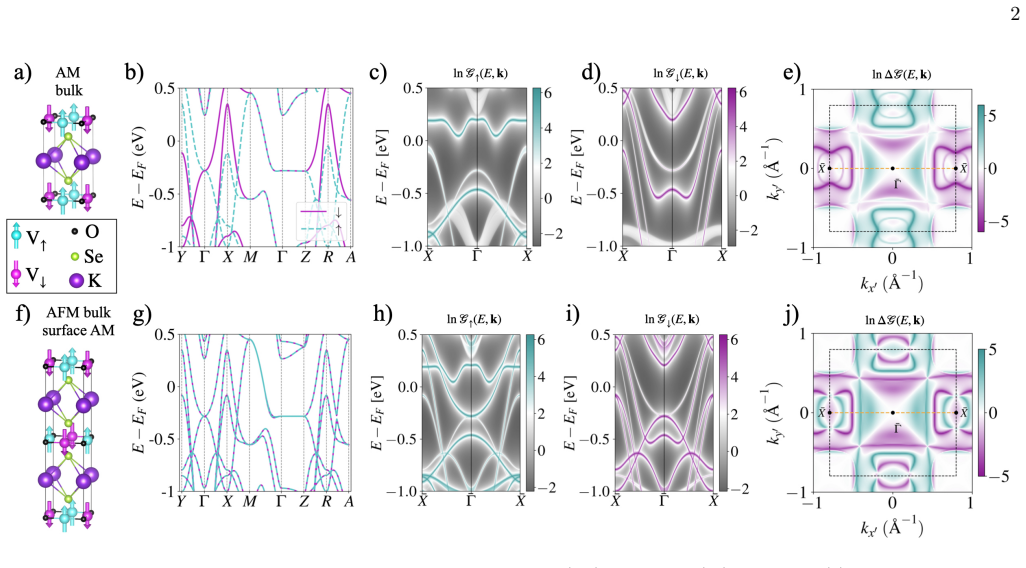
We demonstrate the recent concept of emergent surface altermagnetism through its unique signatures in \KVSO. We show that for bulk antiferromagnetically ordered \KVSO, the (001) surface exhibits $d$-wave altermagnetism. Our results fully explain the recent seemingly contradicgting experimental evidence, independently showing both an antiferromagnetically ordered bulk from neutron diffraction, and $d$-wave spin splitting from photoemission spectroscopy. To fully verify this conecept, we predict, as a key experimental signature, a large nonlinear Edelstein response, which is localized at the surface, and follows the $d$-wave altermagnetic symmetry. These results are not only relevant for the metallic and room-temperature magnet \KVSO, but also for several other Lieb lattice systems. Our work expands the pool of techniques that can be used to detect altermagnetism emerging at the surfaces of antiferromagnets.
Figures


Figures from the paper (2 more)


Reference graph
Works this paper leans on
-
[59]
We also propose the nonlinear Edelstein effect as a key experimental signature of the surface altermagnetism in KV 2Se2O
and spin-selective scanning tunneling microscopy [66] give evidence of altermagnetic splitting. We also propose the nonlinear Edelstein effect as a key experimental signature of the surface altermagnetism in KV 2Se2O. The Edelstein effect refers to the non- equilibrium spin density induced by an applied electric field [67]. The linear Edelstein response i...
-
[66]
G. Yang, C. Li, C. Wang, X. Zhao, Y. Wan, H. Gui, G. Zeng, S. Cao, C. Hu, D. Chen, Y. Liu, Y. Song, F. Liu, L.-H. Hu, L. Jiao, and H. Yuan, Arxiv Preprint , 1 (2026), arXiv:2603.21969
arXiv 2026
-
[1]
L. ˇSmejkal, J. Sinova, and T. Jungwirth, Physical Review X12, 031042 (2022), arXiv:2105.05820
arXiv 2022
-
[2]
In the next section, we will focus on the surface Edelstein effect, which can be exploited to probe the surface altermagnetism in KV 2Se2O
propagation vector, a surface sensi- tive probe like ARPES is expected to show, qualitatively, the same spin splitting pattern as the bulk altermagnetic configuration. In the next section, we will focus on the surface Edelstein effect, which can be exploited to probe the surface altermagnetism in KV 2Se2O. 4 III. SURFACE NONLINEAR EDELSTEIN EFFECT A. Edel...
-
[3]
Jungwirth, R
T. Jungwirth, R. M. Fernandes, E. Fradkin, A. H. Mac- Donald, J. Sinova, and L. ˇSmejkal, Newton1, 100162 (2025)
2025
-
[4]
L. ˇSmejkal, R. Gonz´ alez-Hern´ andez, T. Jungwirth, and J. Sinova, Science Advances6, 10.1126/sciadv.aaz8809 (2020)
-
[5]
I. I. Mazin, K. Koepernik, M. D. Johannes, R. Gonz´ alez- Hern´ andez, and L. ˇSmejkal, Proceedings of the Na- tional Academy of Sciences118, e2108924118 (2021), arXiv:2105.06356
arXiv 2021
-
[6]
K.-H. Ahn, A. Hariki, K.-W. Lee, and J. Kuneˇ s, Physical Review B99, 184432 (2019), arXiv:1902.04436
arXiv 2019
Show all 89 references
-
[7]
ˇSmejkal, J
L. ˇSmejkal, J. Sinova, and T. Jungwirth, Physical Review X12, 040501 (2022), arXiv:2204.10844
2022 arXiv
-
[8]
Gonz´ alez-Hern´ andez, L.ˇSmejkal, K
R. Gonz´ alez-Hern´ andez, L.ˇSmejkal, K. V´ yborn´ y, Y. Ya- hagi, J. Sinova, T. Jungwirth, and J. ˇZelezn´ y, Physical Review Letters126, 127701 (2021), arXiv:2002.07073
2021 arXiv
-
[9]
ˇSmejkal, A
L. ˇSmejkal, A. B. Hellenes, R. Gonz´ alez-Hern´ andez, J. Sinova, and T. Jungwirth, Physical Review X12, 9 011028 (2022), arXiv:2103.12664
2022 arXiv
-
[10]
Samanta, M
K. Samanta, M. Leˇ zai´ c, M. Merte, F. Freimuth, S. Bl¨ ugel, and Y. Mokrousov, Journal of Applied Physics127, 213904 (2020)
2020
-
[11]
L. Bai, W. Feng, S. Liu, L. ˇSmejkal, Y. Mokrousov, and Y. Yao, Advanced Functional Materials34, 1 (2024), arXiv:2406.02123
2024 arXiv
-
[12]
M. Naka, S. Hayami, H. Kusunose, Y. Yanagi, Y. Mo- tome, and H. Seo, Nature Communications10, 4305 (2019), arXiv:1902.02506
2019 arXiv
-
[13]
Y. Zhu, T. Chen, Y. Li, L. Qiao, X. Ma, C. Liu, T. Hu, H. Gao, and W. Ren, Nano Letters24, 472 (2024), arXiv:2308.00234
2024 arXiv
-
[14]
Jaeschke-Ubiergo, V
R. Jaeschke-Ubiergo, V. K. Bharadwaj, T. Jungwirth, L. ˇSmejkal, and J. Sinova, Physical Review B109, 094425 (2024), arXiv:2308.16662
2024 arXiv
-
[15]
Karetta, X
B. Karetta, X. H. Verbeek, R. Jaeschke-Ubiergo, L. ˇSmejkal, and J. Sinova, Physical Review B112, 094454 (2025), arXiv:2505.21293
2025
-
[16]
Jaeschke-Ubiergo, V.-K
R. Jaeschke-Ubiergo, V.-K. Bharadwaj, W. Campos, R. Zarzuela, N. Biniskos, R. M. Fernandes, T. Jung- wirth, J. Sinova, and L. ˇSmejkal, arXiv preprint arXiv:2503.10797 (2025), arXiv:2503.10797
2025 arXiv
-
[17]
Shao, S.-H
D.-F. Shao, S.-H. Zhang, M. Li, C.-B. Eom, and E. Y. Tsymbal, Nature Communications12, 7061 (2021), arXiv:2103.09219
2021 arXiv
-
[18]
L. E. Golub and L. ˇSmejkal, Arxiv Preprint (2025), arXiv:2503.12203
2025 arXiv
-
[19]
Jungwirth, J
T. Jungwirth, J. Sinova, P. Wadley, D. Kriegner, H. Re- ichlova, F. Krizek, H. Ohno, and L. Smejkal, Arxiv Preprint , 1 (2025), arXiv:2508.09748
2025 arXiv
-
[20]
C. Song, H. Bai, Z. Zhou, L. Han, H. Reichlova, J. H. Dil, J. Liu, X. Chen, and F. Pan, Nature Reviews Materials 10.1038/s41578-025-00779-1 (2025)
2025 doi
-
[21]
Krempask´ y, L
J. Krempask´ y, L. ˇSmejkal, S. W. D’Souza, M. Ha- jlaoui, G. Springholz, K. Uhl´ ıˇ rov´ a, F. Alarab, P. C. Constantinou, V. Strocov, D. Usanov, W. R. Pudelko, R. Gonz´ alez-Hern´ andez, A. Birk Hellenes, Z. Jansa, H. Reichlov´ a, Z. ˇSob´ aˇ n, R. D. Gonzalez Betancourt, P....
2024 arXiv
-
[22]
Trama, I
M. Trama, I. Gaiardoni, C. Guarcello, J. I. Facio, A. Maiellaro, F. Romeo, R. Citro, and J. van den Brink, Arxiv Preprint , 1 (2024), arXiv:2410.18036
2024
-
[23]
Osumi, S
T. Osumi, S. Souma, T. Aoyama, K. Yamauchi, A. Honma, K. Nakayama, T. Takahashi, K. Ohgushi, and T. Sato, Physical Review B109, 115102 (2024), arXiv:2308.10117
2024 arXiv
-
[24]
Reimers, L
S. Reimers, L. Odenbreit, L. ˇSmejkal, V. N. Strocov, P. Constantinou, A. B. Hellenes, R. Jaeschke Ubiergo, W. H. Campos, V. K. Bharadwaj, A. Chakraborty, T. Denneulin, W. Shi, R. E. Dunin-Borkowski, S. Das, M. Kl¨ aui, J. Sinova, and M. Jourdan, Nature Communi- cations15, 211...
2024 arXiv
-
[25]
G. Yang, Z. Li, S. Yang, J. Li, H. Zheng, W. Zhu, Z. Pan, Y. Xu, S. Cao, W. Zhao, A. Jana, J. Zhang, M. Ye, Y. Song, L.-H. Hu, L. Yang, J. Fujii, I. Vobornik, M. Shi, H. Yuan, Y. Zhang, Y. Xu, and Y. Liu, Nature Commu- nications16, 1442 (2025), arXiv:2405.12575
2025 arXiv
-
[26]
J. Ding, Z. Jiang, X. Chen, Z. Tao, Z. Liu, T. Li, J. Liu, J. Sun, J. Cheng, J. Liu, Y. Yang, R. Zhang, L. Deng, W. Jing, Y. Huang, Y. Shi, M. Ye, S. Qiao, Y. Wang, Y. Guo, D. Feng, and D. Shen, Physical Review Letters 133, 206401 (2024), arXiv:2405.12687
2024 arXiv
-
[27]
S. S. Lee, S. S. Lee, S. Jung, J. Jung, D. Kim, Y. Lee, B. Seok, J. Kim, B. G. Park, L. ˇSmejkal, C.-J. Kang, and C. Kim, Physical Review Letters132, 036702 (2024), arXiv:2308.11180
2024 arXiv
- [28]
-
[29]
Hariki, A
A. Hariki, A. Dal Din, O. J. Amin, T. Yamaguchi, A. Badura, D. Kriegner, K. W. Edmonds, R. P. Cam- pion, P. Wadley, D. Backes, L. S. I. Veiga, S. S. Dhesi, G. Springholz, L. ˇSmejkal, K. V´ yborn´ y, T. Jungwirth, and J. Kuneˇ s, Physical Review Letters132, 176701 (2024), arXi...
2024 arXiv
-
[30]
O. J. Amin, A. Dal Din, E. Golias, Y. Niu, A. Za- kharov, S. C. Fromage, C. J. B. Fields, S. L. Hey- wood, R. B. Cousins, F. Maccherozzi, J. Krempask´ y, J. H. Dil, D. Kriegner, B. Kiraly, R. P. Campion, A. W. Rushforth, K. W. Edmonds, S. S. Dhesi, L. ˇSmejkal, T. Jungwirth, a...
2024 arXiv
-
[31]
Z. Feng, X. Zhou, L. ˇSmejkal, L. Wu, Z. Zhu, H. Guo, R. Gonz´ alez-Hern´ andez, X. Wang, H. Yan, P. Qin, X. Zhang, H. Wu, H. Chen, Z. Meng, L. Liu, Z. Xia, J. Sinova, T. Jungwirth, and Z. Liu, Nature Electronics 5, 735 (2022), arXiv:2002.08712
2022 arXiv
-
[32]
M. Zeng, M. Zhu, Y.-P. Zhu, X. Liu, X.-M. Ma, Y.-J. Hao, P. Liu, G. Qu, Y. Yang, Z. Jiang, K. Yamagami, M. Arita, X. Zhang, T.-H. Shao, Y. Dai, K. Shimada, Z. Liu, M. Ye, Y. Huang, Q. Liu, and C. Liu, Advanced Science11, 2406529 (2024), arXiv:2405.12679
2024 arXiv
-
[33]
Reichlova, R
H. Reichlova, R. Lopes Seeger, R. Gonz´ alez-Hern´ andez, I. Kounta, R. Schlitz, D. Kriegner, P. Ritzinger, M. Lammel, M. Leivisk¨ a, A. Birk Hellenes, K. Olejn´ ık, V. Petˇ riˇ cek, P. Doleˇ zal, L. Horak, E. Schmoranzerova, A. Badura, S. Bertaina, A. Thomas, V. Baltz, L. Mic...
2024 arXiv
-
[34]
Leivisk¨ a, J
M. Leivisk¨ a, J. Rial, A. Badura, R. L. Seeger, I. Kounta, S. Beckert, D. Kriegner, I. Joumard, E. Schmoranzerov´ a, J. Sinova, O. Gomonay, A. Thomas, S. T. B. Goennen- wein, H. Reichlov´ a, L.ˇSmejkal, L. Michez, T. Jungwirth, and V. Baltz, Arxiv Preprint (2024), arXiv:2401.02275
2024 arXiv
-
[35]
L. Han, X. Fu, R. Peng, X. Cheng, J. Dai, L. Liu, Y. Li, Y. Zhang, W. Zhu, H. Bai, Y. Zhou, S. Liang, C. Chen, Q. Wang, X. Chen, L. Yang, Y. Zhang, C. Song, J. Liu, and F. Pan, Science Advances10, eadn0479 (2024)
2024
-
[36]
Galindez-Ruales, R
E. Galindez-Ruales, R. Gonzalez-Hernandez, C. Schmitt, S. Das, F. Fuhrmann, A. Ross, E. Golias, A. Akashdeep, L. L¨ unenb¨ urger, E. Baek, W. Yang, L.ˇSmejkal, V. Kr- ishna, R. Jaeschke-Ubiergo, J. Sinova, A. Rothschild, C. You, G. Jakob, and M. Kl¨ aui, Advanced Materials 37,...
2025
-
[37]
R. D. Gonzalez Betancourt, J. Zub´ aˇ c, R. Gonzalez- Hernandez, K. Geishendorf, Z. ˇSob´ aˇ n, G. Springholz, K. Olejn´ ık, L.ˇSmejkal, J. Sinova, T. Jungwirth, S. T. B. Goennenwein, A. Thomas, H. Reichlov´ a, J.ˇZelezn´ y, and D. Kriegner, Physical Review Letters130, 036702 ...
2023 arXiv
-
[38]
A. Bose, N. J. Schreiber, R. Jain, D.-F. Shao, H. P. Nair, J. Sun, X. S. Zhang, D. A. Muller, E. Y. Tsym- bal, D. G. Schlom, and D. C. Ralph, Nature Electronics 5, 267 (2022), arXiv:2108.09150
2022 arXiv
-
[39]
H. Bai, L. Han, X. Y. Feng, Y. J. Zhou, R. X. Su, Q. Wang, L. Y. Liao, W. X. Zhu, X. Z. Chen, F. Pan, X. L. Fan, and C. Song, Physical Review Letters128, 197202 (2022), arXiv:2109.05933
2022 arXiv
-
[40]
Karube, T
S. Karube, T. Tanaka, D. Sugawara, N. Kadoguchi, M. Kohda, and J. Nitta, Physical Review Letters129, 137201 (2022), arXiv:2111.07487
2022 arXiv
-
[41]
Y. Liu, H. Bai, Y. Song, Z. Ji, S. Lou, Z. Zhang, C. Song, and Q. Jin, Advanced Optical Materials11, 1 (2023)
2023
-
[42]
Badura, W
A. Badura, W. H. Campos, V. K. Bharadwaj, I. Kounta, L. Michez, M. Petit, J. Rial, M. Leivisk¨ a, V. Baltz, F. Krizek, D. Kriegner, J. ˇZelezn´ y, J. Zemen, S. Telkamp, S. Sailler, M. Lammel, R. Jaeschke-Ubiergo, A. B. Hel- lenes, R. Gonz´ alez-Hern´ andez, J. Sinova, T. Jungw...
2025
-
[43]
Fedchenko, J
O. Fedchenko, J. Min´ ar, A. Akashdeep, S. W. D’Souza, D. Vasilyev, O. Tkach, L. Odenbreit, Q. Nguyen, D. Kut- nyakhov, N. Wind, L. Wenthaus, M. Scholz, K. Ross- nagel, M. Hoesch, M. Aeschlimann, B. Stadtm¨ uller, M. Kl¨ aui, G. Sch¨ onhense, T. Jungwirth, A. B. Hellenes, G. J...
2024 arXiv
-
[44]
Aoyama and K
T. Aoyama and K. Ohgushi, Physical Review Materials 8, L041402 (2024), arXiv:2305.14786
2024 arXiv
-
[45]
ˇSmejkal, A
L. ˇSmejkal, A. Marmodoro, K.-H. Ahn, R. Gonz´ alez- Hern´ andez, I. Turek, S. Mankovsky, H. Ebert, S. W. D’Souza, O. ˇSipr, J. Sinova, and T. Jungwirth, Physical Review Letters131, 256703 (2023), arXiv:2211.13806
2023 arXiv
- [46]
-
[47]
C. T. Liao, Y. C. Wang, Y. C. Tien, S. Y. Huang, and D. Qu, Physical Review Letters133, 56701 (2024)
2024
-
[48]
Z. Liu, M. Ozeki, S. Asai, S. Itoh, and T. Ma- suda, Physical Review Letters133, 156702 (2024), arXiv:2408.16490
2024 arXiv
-
[49]
Q. Sun, J. Guo, D. Wang, D. L. Abernathy, W. Tian, and C. Li, Physical Review Letters135, 186703 (2025)
2025
-
[50]
Hoyer, R
R. Hoyer, R. Jaeschke-Ubiergo, K.-H. H. Ahn, L. ˇSmejkal, and A. Mook, Physical Review B111, L020412 (2025), arXiv:2405.05090
2025 arXiv
-
[51]
Hoyer, P
R. Hoyer, P. P. Stavropoulos, A. Razpopov, R. Valent´ ı, L. ˇSmejkal, and A. Mook, Physical Review B112, 064425 (2025)
2025
-
[52]
Gomonay, V
O. Gomonay, V. P. Kravchuk, R. Jaeschke-Ubiergo, K. V. Yershov, T. Jungwirth, L. ˇSmejkal, J. van den Brink, and J. Sinova, npj Spintronics2, 35 (2024), arXiv:2403.10218
2024 arXiv
-
[53]
Lange, R
C. Lange, R. Jaeschke-ubiergo, A. Chakraborty, H. Ver- beek, L. Smejkal, J. Sinova, and A. Mook, Arxiv Preprint , 1 (2026), arXiv:arXiv:2602.08773v1
2026 arXiv
-
[54]
Z. Zhou, H. Zhao, C. Shen, W. Chen, Z. Liao, T. Feng, and W. Liu, Solid State Sciences168, 108039 (2025)
2025
-
[55]
V. Leeb, P. D’Ornellas, F. de Juan, and A. G. Grushin, arXiv preprint arXiv:2602.10108 (2026), arXiv:2602.10108
2026
-
[56]
K. D. Belashchenko, Arxiv Preprint , 1 (2026), arXiv:2606.11128
2026 arXiv
-
[57]
Weißenhofer and A
M. Weißenhofer and A. Marmodoro, Physical Review B 110, 094427 (2024)
2024
-
[58]
Sasioglu, I
E. Sasioglu, I. Mertig, and S. Lounis, arXiv preprint arXiv:2602.08790 (2026), arXiv:2602.08790
2026 arXiv
-
[60]
If KV 2Se2O orders antiferromagneti- cally with a (0,0, 1
experiments. If KV 2Se2O orders antiferromagneti- cally with a (0,0, 1
-
[61]
Z. Lin, D. Chen, W. Lu, X. Liang, S. Feng, K. Ya- magami, J. Osiecki, M. Leandersson, B. Thiagarajan, J. Liu, C. Felser, and J. Ma, Arxiv Preprint (2024), arXiv:2402.04995
2024 arXiv
-
[62]
Franz, arXiv preprint arXiv:2606.30766 (2026), arXiv:2606.30766
M. Franz, arXiv preprint arXiv:2606.30766 (2026), arXiv:2606.30766
2026 arXiv
-
[63]
Zhang, X
F. Zhang, X. Cheng, Z. Yin, C. Liu, L. Deng, Y. Qiao, Z. Shi, S. Zhang, J. Lin, Z. Liu, M. Ye, Y. Huang, X. Meng, C. Zhang, T. Okuda, K. Shimada, S. Cui, Y. Zhao, G.-H. Cao, S. Qiao, J. Liu, and C. Chen, Nature Physics21, 760 (2025)
2025
-
[64]
Jiang, M
B. Jiang, M. Hu, J. Bai, Z. Song, C. Mu, G. Qu, W. Li, W. Zhu, H. Pi, Z. Wei, Y.-J. Sun, Y. Huang, X. Zheng, Y. Peng, L. He, S. Li, J. Luo, Z. Li, G. Chen, H. Li, H. Weng, and T. Qian, Nature Physics21, 754 (2025)
2025
-
[65]
Y. Sun, Y. Huang, J. Cheng, S. Zhang, Z. Li, H. Luo, X. Ma, W. Yang, J. Yang, D. Chen, K. Sun, M. Gut- mann, S. C. Capelli, F. Shen, J. Hao, L. He, G. Chen, and S. Li, Physical Review B112, 184416 (2025)
2025
-
[67]
Y. Qi, J. Zhao, and H. Zeng, Physical Review B110, 014442 (2024)
2024
-
[68]
A. B. Hellenes, T. Jungwirth, J. Sinova, and L. ˇSmejkal, Arxiv Preprint (2023), arXiv:2309.01607v1
2023 arXiv
-
[69]
C. C. Wei, X. Li, S. Hatt, X. Huai, J. Liu, B. Singh, K. M. Kim, R. M. Fernandes, P. Cardon, L. Zhao, T. T. Tran, B. M. Frandsen, K. S. Burch, F. Liu, and H. Ji, Physical Review Materials9, 24402 (2025)
2025
-
[70]
W. H. Campos, F. C. F. Mbognou, A. B. Hellenes, J. Poata, T. Chen, J. Priessnitz, and L. ˇSmejkal, arXiv preprint arXiv:2603.12223 (2026), arXiv:2603.12223
2026
-
[71]
H. Xu, J. Zhou, H. Wang, and J. Li, Physical Review B 103, 205417 (2021)
2021
-
[72]
V. M. Edelstein, Solid State Communications73, 233 (1990)
1990
-
[73]
Fig- ures 1c,d show the surface spectral functionG σ(E,k) for both spin channelsσ∈{↑,↓}
(see computational details in the Appendix A). Fig- ures 1c,d show the surface spectral functionG σ(E,k) for both spin channelsσ∈{↑,↓}. Figure 1e shows the spin polarized surface spectral function across the Brillouin Zone at the Fermi energy. In this calculation, we have pick...
- [74]
-
[75]
N. A. ´A. Pari, R. Jaeschke-Ubiergo, A. Chakraborty, L. ˇSmejkal, and J. Sinova, Physical Review B112, 024404 (2025), arXiv:2412.10984
2025 arXiv
-
[76]
Li, X.-Y
D. Li, X.-Y. Liu, X.-G. Ye, Z.-C. Pan, W.-Z. Xu, P.-F. Zhu, A.-Q. Wang, K. Watanabe, T. Taniguchi, and Z.-M. Liao, Physical Review B110, L100409 (2024)
2024
-
[77]
such as RbV 2Te2O, La 2O3A2Se2 (with A=Fe,Mn), V2Se2O, UCr 2Si2C, Sr 2CrO2Cr2OAs2, among others [16, 63–65, 78, 79]. Some of these systems have been pre- dicted to be antiferromagnetic in the bulk, which makes them suitable candidates for surface altermagnetism, and the surfac...
-
[78]
I. Baek, S. Han, S. Cheon, and H.-W. Lee, npj Spintronics 3, 6 (2025)
2025
-
[79]
Q. S. Wu, S. N. Zhang, H.-F. F. Song, M. Troyer, and A. A. Soluyanov, Computer Physics Communications 224, 405 (2017), arXiv:1703.07789
2017 arXiv
-
[80]
J. Yang, L. Wei, Y. Li, L. Chen, W. Niu, S. Wang, F. Li, P. Liu, S. Zhou, and Y. Pu, Applied Physics Letters127, 10.1063/5.0278802 (2025)
2025 doi
-
[81]
Jiang, F
C. Jiang, F. Yang, Y. Zhao, J. Yang, P. Yu, H. Liu, Y. Zhang, Z. Jia, X. Cao, L. Tian, J. Yan, Z. Liu, Z. Liu, X.-L. Sheng, C. Xiao, S. A. Yang, S. Dong, and F. Xiu, Physical Review Letters136, 236302 (2026)
2026
-
[82]
Chang, I
P.-H. Chang, I. I. Mazin, and K. D. Belashchenko, Arxiv Preprint , 1 (2025), arXiv:2508.04839
2025 arXiv
-
[83]
Lemoine, A
P. Lemoine, A. Verni` ere, M. Pasturel, G. Venturini, and B. Malaman, Inorganic Chemistry57, 2546 (2018)
2018
-
[84]
H.-Y. Ma, M. Hu, N. Li, J. Liu, W. Yao, J.-F. Jia, and J. Liu, Nature Communications12, 2846 (2021)
2021
-
[85]
Kresse and J
G. Kresse and J. Furthm¨ uller, Computational Mate- 11 rials Science6, 15 (1996), arXiv:0927-0256(96)00008 [10.1016]
1996
-
[86]
Kresse and D
G. Kresse and D. Joubert, Physical Review B59, 1758 (1999), arXiv:0927-0256(96)00008 [10.1016]
1999
-
[87]
P. E. Bl¨ ochl, Physical Review B50, 17953 (1994), arXiv:arXiv:1408.4701v2
1994 arXiv
-
[88]
Marzari and D
N. Marzari and D. Vanderbilt, Physical Review B56, 12847 (1997), arXiv:9707145 [cond-mat]
1997
-
[89]
A. A. Mostofi, J. R. Yates, G. Pizzi, Y. S. Lee, I. Souza, D. Vanderbilt, and N. Marzari, Computer Physics Com- munications185, 2309 (2014), arXiv:0708.0650. Responseχ αi χ(1) even 0χ xy 0 −χxy 0 0 0 0 0 χ(1) odd χxx 0 0 0−χ xx 0 0 0 0 Table I. Symmetry-constra...
2014 arXiv
Reviewed August 15, 2026 · model on record in the stance chip above.
Discussion (0). Continue with ORCID to comment.