REVIEW 3 major objections 4 minor 69 references
Analysis of Moment Closures Using $\varphi$-Divergences for Rarefied Dynamics with Binary Collisions and Their Galerkin Discretizations
T0 review · 3 major / 4 minor · reviewed 2026-08-05 · deepseek-v4-flash
Pith's one-line read This paper establishes that φ-divergence moment closures are valid approximate entropies for the binary-collision Boltzmann equation, by constructing a compatible approximate collision operator that dissipates the approximate entropy exactl
desk verdict Genuinely new closure construction and honest numerical work, but the main well-posedness theorem doesn't cover the states the simulations actually visit. read the letter →
The pith
A machine-rendered reading of the paper's core claim, the machinery that carries it, and where it could break.
The reading
What carries the argument
The constructive identity is φ'_N(P_N(z1,z2)) = φ'_N(z1)+φ'_N(z2), where P_N(z1,z2)=(z1^{1/N}+z2^{1/N}-1)^N is the approximate product used inside the collision integral, for odd N. Together with the renormalization map β_N and the approximate entropy φ_N, this identity lets the weak form of C_N be symmetrized exactly as in Boltzmann's H-theorem: the entropy production integrand becomes a product (a-b)(φ'_N(a)-φ'_N(b)) ≥ 0. That is the mechanism that converts a closure ansatz into an entropy-dissipative approximate collision model.
What would settle it
Run the N=3 or N=5 moment closure on the argon nozzle with a nonconstant polynomial basis and record the minimum of 1+λ(t,x)·m(v)/N along the pseudo-transient path; if it crosses zero in any cell while the source term uses the full operator C, the computed solution has left the set where Theorem 7 establishes local well-posedness.
Extended reading notes
Core claim
The central claim is that φ-divergence moment closures can serve as genuine approximate entropies for the Boltzmann binary collision operator, provided the collision operator is replaced by a compatible surrogate. The surrogate C_N is built from the same algebraic structure as the closure: the renormalization map β_N(g)=M(1+g/N)^N and its entropy φ_N are paired with an approximate product P_N such that φ'_N(P_N(z1,z2)) = φ'_N(z1)+φ'_N(z2). That identity reproduces, for C_N, the exact entropy-dissipation mechanism of the Boltzmann equation. The paper proves C_N has exactly the five collision invariants, commutes with Galilean transformations, dissipates φ_N, agrees with the linearized Boltzma
Load-bearing premise
The well-posedness proof assumes the reconstruction β_N(λ·m)=M(1+λ·m/N)^N stays nonnegative for the state space used, but the proof only establishes that its derivative is nonnegative and positive on an open set, not that 1+λ·m/N>0 pointwise; for nonconstant polynomial bases this is unproven, and the paper's own N=1 nozzle computation produces negative densities, pressures, and temperatures.
Editorial extensions
If this is right
- For every odd N, the approximate collision operator C_N has exactly the same collision invariants as Boltzmann's operator, so the closed moment systems conserve mass, momentum, and energy without introducing spurious extra invariants.
- Because C_N's linearization around the background Maxwellian coincides with the linearized Boltzmann operator, small deviations from equilibrium are treated correctly at first order for all N; C_1 is exactly the linearized operator.
- The weak convergence C_N→C means the approximate operators form a controlled approximation of binary collisions, and the numerical entropy-rate violations shrink as N grows, justifying the use of the full operator in the reported simulations.
- The moment systems are symmetric-dissipative hyperbolic, so the Cauchy problem is locally well-posed and the fully implicit space-time DG discretization is entropy stable, permitting time steps far beyond CFL limits and direct steady-state computation.
- The rigorous entropy-stability guarantee applies to simulations using C_N; simulations with the full operator C are a controlled variational crime whose effect is quantified and decreases with N.
Reading between the lines
- Beyond the paper: the same P_N/φ_N pairing could be applied to other kinetic operators with bilinear product structure, such as BGK-type relaxation or multi-species collision integrals, to manufacture entropy-dissipative surrogates; the mechanism is not obviously restricted to monatomic Maxwellians.
- Beyond the paper: since entropy-rate violations of the full operator are only measured in the spatially homogeneous tests, a natural next check is to monitor ∫φ'_N(f/M)C(f)dv inside the inhomogeneous nozzle and channel simulations; a positive rate at large N would localize where the variational crime matters.
- Beyond the paper: the positivity gap in the well-posedness proof suggests a practical diagnostic—track the minimum of 1+λ·m/N over the velocity basis in each cell during pseudo-transient continuation. If it approaches zero, the computed trajectory has left the region where symmetric-dissipative local well-posedness is proven; enforcing positivity or switching N could restore coverage.
Signed reviews
Editorial analysis
A structured set of objections, weighed in public.
Referee Report
Summary. The paper proposes φ-divergence moment closures for the Boltzmann equation with binary collisions, based on the renormalization β_N(g)=M(1+g/N)^N and an associated approximate collision operator C_N built from the approximate product P_N(z1,z2)=(z1^{1/N}+z2^{1/N}-1)^N. It claims that C_N retains objectivity, has exactly the five collision invariants, dissipates the φ_N entropy, agrees to first order with the linearized Boltzmann operator, and converges weakly to C. It further claims that the resulting moment system is symmetric-dissipative (Theorem 7) and that its space-time DG discretization is entropy-stable (Theorem 8). Numerical experiments on supersonic nozzle flow, channel mass flow, and heat transfer between parallel walls are reported; the simulations use the full physical operator C, not C_N.
Significance. The construction is elegant and, if valid, would give deterministic moment methods with a rigorous entropy structure and local-in-time well-posedness, together with an entropy-stable fully implicit DG scheme. The paper is unusually transparent about the distinction between C_N, for which the dissipation theorems are proved, and the full operator C used in the computations. The linearization agreement with the Boltzmann operator and the weak convergence of C_N to C are nontrivial and valuable, and the validation against DSMC and experimental data is substantial. However, two load-bearing gaps currently prevent the central claim from being accepted as stated: the displayed φ_N is inconsistent with the derivative used in Lemma 2, and the state space U of Theorem 7 does not ensure that the reconstructed distributions are nonnegative.
major comments (3)
- [§3, Eq. (33) and Lemma 2] The displayed formula for φ_N cannot be the antiderivative whose derivative is used in Lemma 2. The functional equation (38) forces φ'_N(z)=N(z^{1/N}-1). Under the natural reading φ_N(z)=z/N( z^{1/N} N/(N+1)-1)+N/(N+1), differentiation gives φ'_N(z)=(z^{1/N}-1)/N, off by a factor N^2; under other readings of the typeset fraction the derivative is likewise not the required one. Since Theorem 4 and all dissipation arguments rely on Lemma 2, this is a load-bearing typo that must be corrected.
- [§4, Theorem 7, Eq. (49)-(50)] The set U={λ∈R^m: λ_1>-N} does not ensure β_N(λ·m)=M(1+λ·m/N)^N is nonnegative. The proof of positive definiteness of A_0 uses only β'_N≥0, not β_N≥0. If the basis m contains any even-degree polynomial (for instance |v|^2), a vector λ with a negative coefficient in that slot belongs to U but makes 1+λ·m/N negative on a set of positive measure; the reconstructed distribution is then negative. Thus Theorem 7 proves well-posedness of a symmetric-dissipative system that is not confined to realizable moments. The paper's own §6.1 reports exactly this phenomenon: the N=1 computation converges to negative densities, pressures, and temperatures. The realizability claim must either be proved under additional constraints or qualified as applying to formal moment trajectories rather than physical distributions.
- [§3, Corollary 1] The stated equilibria of C_N, namely M(1+(a+b·v+c|v|^2)/N)^N, are not nonnegative for c<0 (and more generally whenever the polynomial inside becomes negative). Hence the 'approximate Maxwellian' equilibrium family contains unphysical distribution functions. If φ_N is meant to be a valid approximate entropy for gas dynamics, the equilibrium characterization needs to be restricted to the realizability set; otherwise C_N dissipates φ_N along states that have no kinetic interpretation. This is directly connected to the gap in Theorem 7.
minor comments (4)
- [§3, Theorem 2 and abstract/intro] Theorem 2 establishes rotational invariance relative to the fixed background Maxwellian, not full Galilean invariance under arbitrary boosts. The abstract and introduction should use the more precise wording 'objectivity/rotational invariance about the background' to avoid overclaiming.
- [§4, proof of Theorem 7, Eq. (51)] After replacing ψ by ψ̃=ψ+ce_1, the displayed identity should be 0=ψ̃^T s_N(ψ̃), not 0=ψ^T s_N(ψ). The argument is recoverable, but as written it is a typo that obscures the proof.
- [§6.1, supersonic nozzle] The text says the N=1 pseudo-transient continuation 'reports convergence' to a nonrealizable steady state, while the conclusions say the linear closure 'fails to converge to a steady state.' These statements should be reconciled: it is one thing to converge to an unphysical state, another to fail to converge.
- [§5-§6, Theorem 8 vs. numerical experiments] The entropy-stability theorem is proved for C_N, while all reported computations use C. The paper discloses this 'variational crime' and quantifies it in Section 3, but the abstract and conclusion should not present the computed scheme as unconditionally entropy-stable without repeating this qualification.
Circularity Check
No significant circularity; the approximate-entropy dissipation is an explicitly designed property of the auxiliary operator C_N, and the core results are anchored to the true Boltzmann operator by linearization and weak convergence.
full rationale
The paper's central claim is not circular. The approximate collision operator C_N is explicitly constructed (Definition 2) from the approximate product P_N (Definition 1), and the dissipation of the φ_N-entropy (Theorem 4) is a designed property of that auxiliary operator, not a prediction about the true Boltzmann operator. The paper is transparent about this: 'In the remainder of this work we establish that moment closures based on φ-divergences are approximate entropy functions for kinetic equations with binary collisions' and 'All numerical experiments reported in Section 6 are computed with the full physical binary collision operator C, not with C_N.' The functional equation (38) is an algebraic identity for the chosen P_N, and Theorem 4 is a direct consequence; this is a construction-with-proof, not a hidden equivalence. Theorems 5 and 6 anchor C_N to the true operator through an explicit linearization computation and a dominated-convergence argument, so the auxiliary operator is not free-floating. Theorem 7's symmetric-dissipativity argument uses these theorems together with direct estimates, and the DG entropy-stability proof in Appendix B is self-contained. The numerical validation uses external benchmarks: DSMC, experimental data, the analytical free-molecular limit, and the Sherman–Lees formula. The self-citations ([26], [44], [50]) are non-load-bearing because the relevant definitions, statements, and proofs are reproduced in this paper. The paper itself reports a realizability limitation in Section 6.1: 'With the linear closure N=1, the pseudo-transient continuation reports convergence, yet the resulting steady state is not realizable: a localized pocket of a few nonphysical cells with negative densities, pressures and temperatures.' This is a genuine robustness/correctness concern about the N=1 closure, but it is not a circularity: it concerns positivity of the reconstructed distribution, not an equivalence between inputs and claimed outputs. Accordingly, no circular step is identified, and the score reflects only a minor, non-load-bearing by-construction flavor in the auxiliary operator design.
Assumptions & free parameters
free parameters (4)
- Closure order N =
N = 3 for nozzle, N = 1,3,5 for entropy study, N = 1 for heat-transfer mesh study
- Background Maxwellian M =
Problem-dependent, e.g., unit Maxwellian in the non-dimensional channel model, wall Maxwellians in the nozzle
- Sherman-Lees constants c0, c1 =
c0 = 5.36159, c1 = 1.26286
- Normalized mass-flow cubic fit coefficients =
-0.63488, -0.253103, 0.211179, -0.0114429
assumptions (8)
- domain assumption The power-law collision kernel (5) with lambda in (-3,1] and integrable b yields a well-defined collision operator C on D(C) = L^1_2(R^3).
- domain assumption Darrozès-Guiraud inequality (Lemma 1) controls boundary entropy production for convex combinations of specular and diffuse reflection.
- standard math Minty-Browder theorem guarantees existence and uniqueness of Lagrange multipliers lambda in the reconstruction problem.
- standard math Symmetric-dissipative hyperbolic systems in the sense of Kawashima and Yong are locally well-posed.
- ad hoc to paper The ansatz beta_N(lambda dot m) remains nonnegative for all lambda in U = {lambda_1 > -N}.
- domain assumption A single background Maxwellian M conforms to all boundary conditions, so the boundary entropy estimate holds.
- ad hoc to paper The full collision operator C inherits enough phi_N dissipation from C_N for stable practical computation with finite N.
- domain assumption The channel model linearization in small pressure gradient X_p is consistent to first order while the collision operator is kept nonlinear.
invented entities (3)
-
Approximate product P_N(z1,z2) = (z1^(1/N) + z2^(1/N) - 1)^N
independent evidence
-
Approximate collision operator C_N
independent evidence
-
phi_N divergence family, Eq. (33) as intended
independent evidence
Cite this review
Pith. "Pith review of Analysis of Moment Closures Using $\varphi$-Divergences for Rarefied Dynamics with Binary Collisions and Their Galerkin Discretizations." pith.science (2026). https://pith.science/paper/LJGMW3XK
@misc{pith2026260803640,
  author       = {Pith},
  title        = {Pith review of: Analysis of Moment Closures Using $\varphi$-Divergences for Rarefied Dynamics with Binary Collisions and Their Galerkin Discretizations},
  year         = {2026},
  howpublished = {\url{https://pith.science/paper/LJGMW3XK}},
  note         = {Machine review of arXiv:2608.03640}
}
abstract
This work introduces a robust deterministic framework for approximating solutions of the Boltzmann equation with binary collisions by discretizing their dependence on time, position, and velocity using Galerkin methods. By employing a family of parametric Galerkin closures based on $\varphi$-divergences in velocity space, we derive rigorous hierarchies of moment equations that govern fluid dynamic variables. Addressing the limitation that these closures alone do not guarantee dissipation of a $\varphi$-divergence entropy for the true binary collision operator, we restore this property by formulating a compatible approximate collision operator tailored to each closure. This constructed operator intrinsically retains fundamental physical properties essential for high-fidelity flow simulations, including Galilean invariance, exact conservation of mass, momentum, and energy, and strict dissipation of a $\varphi$-divergence entropy. Furthermore, we show that the resulting closed moment systems are symmetric-dissipative, yielding Cauchy problems that are well-posed locally in time. To translate this mathematical foundation into an efficient computational tool, we discretize the position and time variables with an entropy-stable discontinuous Galerkin (DG) finite element method. The fully implicit, entropy-stable space-time approach enables time steps far beyond typical CFL-limited step sizes and the direct computation of steady states. The robustness and accuracy of the methodology are verified and validated through numerical simulations on the supersonic nozzle flow of argon, mass flow through a channel, and heat transfer between parallel walls, demonstrating agreement with analytical benchmarks, experimental measurements, and stochastic particle simulations.
Figures


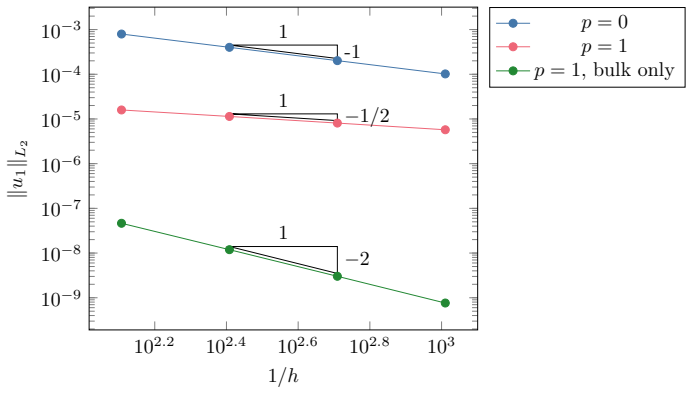
Figures from the paper (4 more)



Reference graph
Works this paper leans on
-
[1]
M. S. Ivanov, S. F. Gimelshein, Computational hypersonic rarefied flows, Annu. Rev. Fluid Mech. 30 (1) (1998) 469–505.doi:10.1146/annurev.fluid.30.1.469
-
[2]
S. Livadiotti, N. H. Crisp, P. C. E. Roberts, et al., A review of gas-surface interaction models for orbital aerodynamics applications, Prog. Aerosp. Sci. 119 (2020) 100675.doi:10.1016/j.paerosci.2020. 100675
-
[3]
G.Karniadakis, A.Beskok, N.Aluru, MicroflowsandNanoflows: FundamentalsandSimulation, Springer Science & Business Media, 2005
work page 2005
-
[4]
M. van de Kerkhof, A. M. Yakunin, V. Kvon, A. Nikipelov, D. Astakhov, P. Krainov, V. Banine, EUV- induced hydrogen plasma and particle release, Radiat. Eff. Defects Solids 177 (5-6) (2022) 486–512. doi:10.1080/10420150.2022.2048657
-
[5]
B. M. Mertens, B. van der Zwan, P. W. H. de Jager, M. Leenders, H. G. C. Werij, J. P. H. Benschop, A. J. J. van Dijsseldonk, Mitigation of surface contamination from resist outgassing in EUV lithography, Microelectron. Eng. 53 (1-4) (2000) 659–662.doi:10.1016/S0167-9317(00)00399-3. 32
-
[6]
S. Chapman, T. G. Cowling, The Mathematical Theory of Non-uniform Gases, Cambridge University Press, 1970
work page 1970
-
[7]
Villani, A review of mathematical topics in collisional kinetic theory, Handb
C. Villani, A review of mathematical topics in collisional kinetic theory, Handb. Math. Fluid Dyn. 1 (2002) 71–305
work page 2002
-
[8]
Grad, Principles of the kinetic theory of gases, in: S
H. Grad, Principles of the kinetic theory of gases, in: S. Flugge (Ed.), Thermodynamik der Gase / Thermodynamics of Gases, Vol. XII, Springer-Verlag, Berlin, 1958, pp. 205–294
work page 1958
Show all 69 references
-
[9]
Cercignani, The Boltzmann Equation and Its Applications, Springer New York, New York, NY, 1988
C. Cercignani, The Boltzmann Equation and Its Applications, Springer New York, New York, NY, 1988
1988
-
[10]
Saint-Raymond, Hydrodynamic Limits of the Boltzmann Equation, no
L. Saint-Raymond, Hydrodynamic Limits of the Boltzmann Equation, no. v. 1971 in Lecture Notes in Mathematics, Springer, 2009
1971
-
[11]
P. L. Bhatnagar, E. P. Gross, M. Krook, A model for collision processes in gases. I. small amplitude processes in charged and neutral one-component systems, Phys. Rev. 94 (3) (1954) 511
1954
-
[12]
E. M. Shakhov, Generalization of the Krook kinetic relaxation equation, Fluid Dyn. 3 (5) (1968) 95–96
1968
-
[13]
Dimarco, L
G. Dimarco, L. Pareschi, Numerical methods for kinetic equations, Acta Numer. 23 (2014) 369–520
2014
-
[14]
Bird, Direct Simulation and the Boltzmann Equation, Phys
G. Bird, Direct Simulation and the Boltzmann Equation, Phys. Fluids 13 (1970) 2676–2681
1970
-
[15]
Wagner, A Convergence Proof for Bird’s Direct Simulation Monte Carlo Method for the Boltzmann Equation, J
W. Wagner, A Convergence Proof for Bird’s Direct Simulation Monte Carlo Method for the Boltzmann Equation, J. Stat. Phys. 66 (1992) 1011–1044
1992
-
[16]
Degond, S
P. Degond, S. Jin, L. Mieussens, A smooth transition model between kinetic and hydrodynamic equa- tions, J. Comput. Phys. 209 (2) (2005) 665–694
2005
-
[17]
Pareschi, G
L. Pareschi, G. Russo, Numerical solution of the Boltzmann equation I. spectrally accurate approxima- tion of the collision operator, SIAM J. Numer. Anal. 37 (4) (2000) 1217–1245
2000
-
[18]
Models Methods Appl
L.Mieussens, DiscretevelocitymodelandimplicitschemefortheBGKequationofrarefiedgasdynamics, Math. Models Methods Appl. Sci. 10 (08) (2000) 1121–1149
2000
-
[19]
Aristov, Direct methods for solving the Boltzmann equation and study of nonequilibrium flows, Vol
V. Aristov, Direct methods for solving the Boltzmann equation and study of nonequilibrium flows, Vol. 60, Springer Science & Business Media, 2001
2001
-
[20]
A. V. Bobylev, The theory of the nonlinear spatially uniform Boltzmann equation for Maxwell molecules, Math. Phys. Rev. 7 (1988) 111–233
1988
-
[21]
Mouhot, L
C. Mouhot, L. Pareschi, Fast algorithms for computing the Boltzmann collision operator, Math. Comput. 75 (256) (2006) 1833–1852
2006
-
[22]
A. V. Bobylev, A. Palczewski, J. Schneider, On approximation of the Boltzmann equation by discrete velocity models, C. R. Acad. Sci. Ser. I Math. 320 (5) (1995) 639–644
1995
-
[23]
S.Brull, L.Mieussens, Localdiscretevelocitygridsfordeterministicrarefiedflowsimulations, J.Comput. Phys. 266 (2014) 22–46
2014
-
[24]
Grad, On the kinetic theory of rarefied gases, Commun
H. Grad, On the kinetic theory of rarefied gases, Commun. Pure Appl. Math. 2 (4) (1949) 331–407
1949
-
[25]
C. D. Levermore, Moment closure hierarchies for kinetic theories, J. Stat. Phys. 83 (1996) 1021–1065
1996
-
[26]
Abdelmalik, E
M. Abdelmalik, E. van Brummelen, Moment closure approximations of the Boltzmann equation based onφ-divergences, J. Stat. Phys. 164 (1) (2016) 77–104.doi:10.1007/s10955-016-1529-5
2016 doi
-
[27]
Torrilhon, Modeling nonequilibrium gas flow based on moment equations, Annu
M. Torrilhon, Modeling nonequilibrium gas flow based on moment equations, Annu. Rev. Fluid Mech. 48 (2016) 429–458
2016
-
[28]
D. E. Keyes, et al., Multiphysics simulations: Challenges and opportunities, Int. J. High Perform. Comput. Appl. 27 (1) (2013) 4–83. 33
2013
-
[29]
W. E, B. Engquist, The heterogeneous multiscale methods, Commun. Math. Sci. 1 (1) (2003) 87–132
2003
-
[30]
Junk, Domain of Definition of Levermore’s Five-Moment System, J
M. Junk, Domain of Definition of Levermore’s Five-Moment System, J. Stat. Phys. 93 (1998) 1143–1167
1998
-
[31]
Bardos, F
C. Bardos, F. Golse, C. D. Levermore, Fluid dynamic limits of kinetic equations. I. formal derivations, J. Stat. Phys. 63 (1-2) (1991) 323–344
1991
-
[32]
Z. Cai, M. Torrilhon, Relaxation rates of the linearized Boltzmann collision operator for hard spheres, Contin. Mech. Thermodyn. 25 (2-4) (2013) 237–255
2013
-
[33]
Kawashima, W.-A
S. Kawashima, W.-A. Yong, Dissipative structure and entropy for hyperbolic systems of balance laws, Arch. Ration. Mech. Anal. 174 (2004) 345–364
2004
-
[34]
Duduchava, S
R. Duduchava, S. Rjasanow, Mapping properties of the Boltzmann Collision Operator, Integral Equ. Oper. Theory 52 (2005) 61–84
2005
-
[35]
M. Junk, A. Unterreiter, Maximum entropy moment systems and Galilean invariance, Contin. Mech. Thermodyn. 14 (2002) 563–576
2002
-
[36]
Dreyer, Maximisation of the entropy in non-equilibrium, J
W. Dreyer, Maximisation of the entropy in non-equilibrium, J. Phys. A: Math. Gen. 20 (18) (1987) 6505
1987
-
[37]
S. Ali, S. Silvey, A General Class of Coefficients of Divergence of One Distribution from Another, J. R. Stat. Soc. Ser. B 28 (1) (1966) pp. 131–142
1966
-
[38]
Csiszár, A class of measures of informativity of observation channels, Period
I. Csiszár, A class of measures of informativity of observation channels, Period. Math. Hung. 2 (1972) 191–213
1972
-
[39]
Majda, Compressible Fluid Flow and Systems of Conservation Laws in Several Space Dimensions, Springer, Berlin, 1984
A. Majda, Compressible Fluid Flow and Systems of Conservation Laws in Several Space Dimensions, Springer, Berlin, 1984
1984
-
[40]
Dreyer, M
W. Dreyer, M. Junk, M. Kunik, On the approximation of the Fokker-Planck equation by moment systems, Nonlinearity 14 (4) (2001) 881
2001
-
[41]
I. M. Gamba, S. Rjasanow, Galerkin–Petrov approach for the Boltzmann equation, J. Comput. Phys. 366 (2018) 341–365
2018
-
[42]
Keßler, S
T. Keßler, S. Rjasanow, Fully conservative spectral Galerkin–Petrov method for the inhomogeneous Boltzmann equation, Kinet. Relat. Models 12 (3) (2019) 507–549
2019
-
[43]
Barth, On discontinuous Galerkin approximations of Boltzmann moment systems with Levermore closure, Comput
T. Barth, On discontinuous Galerkin approximations of Boltzmann moment systems with Levermore closure, Comput. Methods Appl. Mech. Eng. 195 (25-28) (2006) 3311–3330
2006
-
[44]
Abdelmalik, E
M. Abdelmalik, E. van Brummelen, An entropy stable discontinuous Galerkin finite-element moment method for the Boltzmann equation, Comput. Math. Appl. 72 (8) (2016) 1988–1999.doi:10.1016/j. camwa.2016.05.021
2016 doi
-
[45]
T. J. R. Hughes, L. P. Franca, M. Mallet, A new finite element formulation for computational fluid dynamics: I. symmetric forms of the compressible Euler and Navier-Stokes equations and the second law of thermodynamics, Comput. Methods Appl. Mech. Eng. 54 (2) (1986) 223–234
1986
-
[46]
Tadmor, The numerical viscosity of entropy stable schemes for systems of conservation laws
E. Tadmor, The numerical viscosity of entropy stable schemes for systems of conservation laws. I, Math. Comput. 49 (179) (1987) 91–103
1987
-
[47]
E. P. Borges, A possible deformed algebra and calculus inspired in nonextensive thermostatistics, Physica A 340 (1-3) (2004) 95–101
2004
-
[48]
Nivanen, A
L. Nivanen, A. Le Mehaute, Q. A. Wang, Generalized algebra within a nonextensive statistics, Rep. Math. Phys. 52 (3) (2003) 437–444
2003
-
[49]
Di Pietro, A
D. Di Pietro, A. Ern, Mathematical Aspects of Discontinuous Galerkin Methods, Springer, 2012. 34
2012
-
[50]
Abdelmalik, D
M. Abdelmalik, D. van der Woude, E. van Brummelen, Entropy bounds for the space–time discontinuous Galerkin finite element moment method applied to the BGK–Boltzmann equation, Comput. Methods Appl. Mech. Eng. 398 (2022) 115162
2022
-
[51]
Andreussi, E
T. Andreussi, E. Ferrato, V. Giannetti, A review of air-breathing electric propulsion: from mission studies to technology verification, J. Electr. Propuls. 1 (2022) 31
2022
-
[52]
T. He, W. Gao, Z. Zhang, Y. Liu, L. Zhao, Z. Ma, Rarefied gas simulation in the dynamic gas lock of EUV lithography: A comparative study of DSMC, ESBGK, ESBGK-DSMC, and ESFP method, Int. Commun. Heat Mass Transf. 172 (2026) 110219
2026
-
[53]
W. Li, Y. Zhang, J. Zeng, L. Wu, Multiscale simulation of rarefied gas flows in simplified divertor Tokamak test facility particle exhaust, Commun. Comput. Phys. 39 (5) (2026) 1536–1558
2026
-
[54]
D. E. Rothe, Electron-beam studies of viscous flow in supersonic nozzles, AIAA J. 9 (5) (1971) 804–811
1971
-
[55]
I. J. Krafft, Modeling of supersonic plume flow in the viscous rarefied regime using CFD, Master’s thesis, Eindhoven University of Technology (2025)
2025
-
[56]
S. J. Plimpton, S. G. Moore, A. Borner, A. K. Stagg, T. P. Koehler, J. R. Torczynski, M. A. Gallis, Direct simulation Monte Carlo on petaflop supercomputers and beyond, Phys. Fluids 31 (8) (2019) 086101
2019
-
[57]
G. A. Bird, Molecular Gas Dynamics and the Direct Simulation of Gas Flows, Clarendon Press, 1994
1994
-
[58]
Knudsen, Die Gesetze der Molekularströmung und der inneren Reibungsströmung der Gase durch Röhren, Ann
M. Knudsen, Die Gesetze der Molekularströmung und der inneren Reibungsströmung der Gase durch Röhren, Ann. Phys. 333 (1909) 75–130
1909
-
[59]
Cercignani, F
C. Cercignani, F. Sernagiotto, Cylindrical Poiseulle Flow of a Rarefied Gas, Phys. Fluids 9 (1) (1966) 40–44
1966
-
[60]
F. M. Sharipov, V. D. Seleznev, Rarefied gas flow through a long tube at any pressure ratio, J. Vac. Sci. Technol. A 12 (5) (1994) 2933–2935
1994
-
[61]
Sharipov, Rarefied gas flow through a long rectangular channel, J
F. Sharipov, Rarefied gas flow through a long rectangular channel, J. Vac. Sci. Technol. A 17 (5) (1999) 3062–3066
1999
-
[62]
Varoutis, S
S. Varoutis, S. Naris, V. Hauer, C. Day, D. Valougeorgis, Computational and experimental study of gas flows through long channels of various cross sections in the whole range of the Knudsen number, J. Vac. Sci. Technol. A 27 (1) (2008) 89–100
2008
-
[63]
Kunze, R
S. Kunze, R. Groll, B. Besser, J. Thöming, Molecular diameters of rarefied gases, Sci. Rep. 12 (1) (2022) 2057.doi:10.1038/s41598-022-05871-y
2022 doi
-
[64]
Perrier, I
P. Perrier, I. A. Graur, T. Ewart, J. G. Méolans, Mass flow rate measurements in microtubes: From hydrodynamic to near free molecular regime, Phys. Fluids 23 (4) (2011) 042004
2011
-
[65]
Sone, Molecular Gas Dynamics, Birkhäuser Boston, 2007
Y. Sone, Molecular Gas Dynamics, Birkhäuser Boston, 2007
2007
-
[66]
W. M. Trott, J. N. Castañeda, J. R. Torczynski, M. A. Gallis, D. J. Rader, An experimental assembly for precise measurement of thermal accommodation coefficients, Rev. Sci. Instrum. 82 (3) (2011) 035120. doi:10.1063/1.3571269
2011 doi
-
[67]
P. G. Ciarlet, Linear and Nonlinear Functional Analysis with Applications, SIAM, 2013
2013
-
[68]
Königsberger, Analysis 1, 6th Edition, Springer-Verlag, 2004
K. Königsberger, Analysis 1, 6th Edition, Springer-Verlag, 2004
2004
-
[69]
Cercignani, Are There More Than Five Linearly-Independent Collision Invariants for the Boltzmann Equation?, J
C. Cercignani, Are There More Than Five Linearly-Independent Collision Invariants for the Boltzmann Equation?, J. Stat. Phys. 58 (1990) 817–823. 35
1990
Reviewed August 5, 2026 · model on record in the stance chip above.
Discussion (0). Continue with ORCID to comment.