REVIEW 2 major objections 6 minor 56 references
Bimodal non-Gaussian photonic states from a single quantum emitter in a waveguide
T0 review · 2 major / 6 minor · reviewed 2026-08-05 · deepseek-v4-flash
Pith's one-line read A single two-level emitter driven by squeezed vacuum can herald large squeezed cat states, with |α|²=3.5 and stellar rank ≥3, at 15% success probability.
desk verdict A genuinely new single-emitter route to squeezed cat states, but the headline numbers rest on an unvalidated two-mode truncation and need a third-mode check before I would trust them. read the letter →
The pith
A machine-rendered reading of the paper's core claim, the machinery that carries it, and where it could break.
The reading
What carries the argument
The load-bearing object is the joint density matrix of the two dominant output temporal modes, decomposed into even- and odd-parity branches. Squeezed vacuum populates only even Fock states and the emitter interaction conserves total photon number, so the parity of the two output modes is locked together; this is what lets a parity or single-photon measurement on one mode herald a specific non-Gaussian branch in the other. The authors rotate the mode basis with a virtual beam splitter and use the virtual-cavity formalism to compute the states, then certify non-Gaussianity through k-robustness stellar-rank witnesses.
What would settle it
Set up a waveguide-coupled two-level emitter driven by an 8 dB squeezed-vacuum pulse with γτ = 0.25, separate the two dominant output temporal modes with a quantum pulse gate, and perform two-mode homodyne tomography conditioned on single-photon detection in one mode. The central claim would be contradicted if the two modes account for substantially less than 99.7% of the output population, if the joint state's purity is far below 99.5%, or if the heralded mode's Wigner function does not show the three negative lobes and ~99% fidelity to a squeezed odd cat with |α|² ≈ 3.5.
Extended reading notes
Core claim
A single two-level emitter driven by a pulsed squeezed vacuum creates a two-mode output state whose photon-number parities are locked: both modes are even together or odd together. Selecting the output mode basis and detecting one photon in one mode picks the odd branch, which the paper identifies as a squeezed odd Schrödinger cat with |α|² = 3.5, 99.3% fidelity, stellar rank at least 3, and 15% heralding probability; projecting exactly onto one photon gives a similar cat at |α|² = 3.1, 98.7% purity, 99.4% fidelity, and 14% probability. Coherent pulses give deterministic Wigner-negative states, but only within the vacuum/single-photon subspace.
Load-bearing premise
The load-bearing approximation, stated in Section IV, is that the two dominant output modes capture 99.7% of the population and that the joint state can be treated as pure at 99.5% purity; if the discarded 0.3% or the 0.5% impurity breaks the parity correlations, the quoted fidelities and stellar ranks shift.
Editorial extensions
If this is right
- Coherent drive: within the explored parameter range, the deterministic output is a high-purity displaced superposition of |0⟩ and |1⟩, with Wigner negativity volume up to 88% of a single photon's and a core state confined to the two lowest Fock levels.
- Squeezed drive, deterministic path: in the mode basis that maximizes single-mode purity, the output is a squeezed even cat state (purity 0.86), whose even-parity component reaches 99.4% fidelity to an ideal squeezed even cat.
- Squeezed drive, heralded path: a photon-number parity or single-photon detection on the second temporal mode produces a squeezed odd cat with |α|² = 3.5 at 15% probability and 99.3% fidelity, or with |α|² = 3.1 and purity 0.987 under exact |1⟩⟨1| projection at 14% probability.
- Loss and directionality: Wigner negativity of the coherent-pulse output survives until about 50% total coupling efficiency; a beam-splitter arrangement recombining left- and right-moving fields turns a bidirectional waveguide into an effectively chiral one, so the 50% collection limit can be bypassed when the relative phase is stabilized.
Reading between the lines
- The paper leaves open whether the two-mode state itself, rather than a single heralded mode, can be consumed directly as a resource; if its even and odd branches are correlated in the right way, parity measurements on one mode could implement the breeding step of GKP-state preparation without first collapsing to a single mode.
- Because the mode rotation is done numerically as a virtual beam splitter, an experimental implementation could tune the temporal-mode basis in real time; a natural extension is to search over input pulse shapes, not just mode bases, to push the odd-cat branch above 15%.
- The near-overlap between one optimized output mode and the incoming pulse shape suggests a simplified variant: use the transmitted pulse mode directly and rely on photon-number-resolving detection alone, accepting lower Wigner negativity to avoid the quantum pulse gate.
Editorial analysis
A structured set of objections, weighed in public.
Referee Report
Summary. The paper studies non-Gaussian state generation from a single two-level emitter in a waveguide, driven by pulsed coherent or squeezed vacuum inputs. Using the virtual-cavity input-output formalism, the authors identify two dominant output temporal modes, optimize a linear mode rotation, and characterize the resulting two-mode state by purity, Wigner negativity, core-state structure, and stellar-rank witnesses. For coherent pulses they report deterministic Wigner-negative states with core confined to {|0>,|1>} and stellar rank 1. For squeezed vacuum pulses they report a bimodal non-Gaussian state; in a particular rotated-mode basis, projecting one mode onto an odd-parity or single-photon state heralds in the other mode a squeezed odd cat state with size |alpha|^2 = 3.5, squeezing 8 dB, fidelity ~99.3%, stellar rank >=3, and success probability ~15%. The paper also analyzes losses and proposes a beam-splitter arrangement that restores an effective chiral interaction in a bidirectional waveguide.
Significance. If the quantitative claims survive scrutiny, this would be a useful proposal: a deterministic Gaussian drive plus a single two-level nonlinearity, followed by temporal-mode sorting and PNR heralding, could provide high-rate non-Gaussian resources relevant for cat and GKP state preparation. The chiral-recovery beam splitter is a clean and potentially practical idea. The numerical work is described with explicit Hilbert-space dimensions, and the parity decomposition is physically transparent. However, the central fidelity and rank claims rest on a two-mode pure-state approximation whose error is not controlled; this is the main obstacle to accepting the results as stated.
major comments (2)
- [Section IV, Eq. (1)] The parity decomposition assumes the output is confined to v1⊗v2. The statement that n1 and n2 must have the same parity is only true modulo n_rest; since total parity is even, n1+n2 has the parity of n_rest. With only 99.7% of the population in v1,v2 and purity 99.5%, the pure-state approximation discards opposite-parity sectors (even,odd) and (odd,even) that arise when n_rest is odd. A |1><1| projection on mode 2 can then accept these sectors. A Markov bound gives P(n_rest≥1) ≤ ⟨n_rest⟩ ≈ 0.0035; relative to the 14–15% herald probability this is a worst-case conditional contamination of ≈2.5%, larger than the 0.6–0.7% infidelity implied by the claimed fidelities. A third-mode simulation or a rigorous conditional-state error bound is needed.
- [Section IV.B / Table I] The headline results (99.3% fidelity for the θ3 odd component; stellar rank ≥3) are computed in the purified two-mode model. The purity 99.5% of ρ1,2 does not by itself bound the error of the herald-conditioned state, because postselection can amplify small components. The paper should either include the third mode in the simulation or provide an explicit amplitude-level bound. Until then, the quantitative claims are not established.
minor comments (6)
- [Section IV] The phrase "We’ll focus here also on one set of parameters" is informal; also, the approximation "we will therefore approximate it as a pure state" should be accompanied by at least a quantitative statement of the fidelity between ρ1,2 and the adopted pure state.
- [Section V.B, Eq. (5)] The beam-splitter parameters t and r conflict with time t and stellar rank r*; consider renaming them (e.g., η, ξ) to avoid ambiguity.
- [Appendix B] "Scarce matrix" should be "sparse matrix".
- [Table I] The condition F > F*_k ⇒ r* ≥ k+1 is only stated in Appendix B; a one-line reminder in the caption would make the table self-contained.
- [Section V.A] The loss analysis is performed for coherent input, while the heralded squeezed-vacuum protocol is the main resource; the robustness of the latter to loss is not shown. A sentence explaining the intended transferability would be helpful.
- [Abstract] Use "non-Gaussian" consistently; the lowercase "non-gaussian" in the abstract should be corrected.
Circularity Check
No meaningful circularity: the simulation is independent of the claimed outputs, and the squeezed-cat parameters are characterizations rather than inputs. The main caveat is the two-mode pure-state approximation behind the parity-heralded cat claims, which is a robustness gap rather than a circular step.
-
other
[Section IV and Section IV.A, Eq. (1), after the 99.7%-population and 99.5%-purity statements]
"The input squeezed vacuum state is by definition a superposition of even Fock states, and in the absence of loss or noise, the total photon number is conserved. Consequently, the photon numbers in output modes v1 and v2 must have the same parity: an even (odd) photon number in one mode is necessarily accompanied by an even (odd) photon number in the other."
This inference is exact only if the two output modes exhaust the field. The paper itself restricts to v1,v2 carrying 99.7% of the population and approximates the joint state as pure (99.5% purity), so the parity decomposition of Eq. (1) is an additional reduced-model assumption rather than a rigorous conservation-law consequence. The central quantitative predictions—99.3% fidelity to a squeezed odd cat, stellar rank >=3, and the ~14-15% heralding probability—are all evaluated in this truncated pure model. I flag this as a missing-support gap in the derived chain, not as a fitted-parameter or self-citation circularity; a three-mode simulation would be needed to validate the parity herald.
full rationale
No circular derivation is present. The scattering calculations are direct numerical solutions of the input-output/master equation for fixed physical parameters; the squeezed-cat parameters (z, alpha) are characterization/fidelity values found after the simulation, not inputs to the dynamics. The output-mode rotation theta is a physical basis choice (implementable with a QPG), so optimizing it does not smuggle in the result. Stellar-rank bounds come from external k-robustness witnesses [46] applied to the computed states, and the paper is explicit that its core-state search is not proven optimal. The only notable weakness is the two-mode pure-state approximation used for the parity herald; this is an openly stated approximation whose effect on the discrete parity postselection could be non-negligible, but it is a correctness/robustness concern, not circularity. Hence score 2 rather than 0.
Assumptions & free parameters
free parameters (5)
- coherent pulse intensity |alpha|^2 =
0.1 to 2.0; representative 0.5
- coherent pulse duration gamma tau =
0.1 to 2.0; representative 0.5 to 0.6
- squeezing parameter z =
8 dB squeezing at gamma tau = 0.25
- output-mode rotation angle theta =
theta1 = 0.26 pi, theta2 = -0.02 pi, theta3 = 0.09 pi
- target squeezed-cat parameters (z_cat, alpha_cat) =
e.g., z=7 dB, |alpha|^2=1 for even cat; z=8 dB, |alpha|^2=3.5 for odd cat
assumptions (6)
- standard math Rotating-wave and flat-coupling approximations for the TLS-waveguide interaction
- domain assumption Markovian one-dimensional chiral input-output relation a_out = a_in + sqrt(gamma) sigma_-
- domain assumption Virtual cavity formalism of Kiilerich and Molmer accurately describes pulsed scattering with a finite cavity set
- domain assumption The emitter starts and ends in the ground state, so the total field photon number is conserved
- domain assumption Two dominant output temporal modes capture all properties relevant to the claims
- ad hoc to paper Heuristic core-state estimation via the loss function in Appendix B finds a faithful core state
Cite this review
Pith. "Pith review of Bimodal non-Gaussian photonic states from a single quantum emitter in a waveguide." pith.science (2026). https://pith.science/paper/EH5GS6WR
@misc{pith2026260803658,
  author       = {Pith},
  title        = {Pith review of: Bimodal non-Gaussian photonic states from a single quantum emitter in a waveguide},
  year         = {2026},
  howpublished = {\url{https://pith.science/paper/EH5GS6WR}},
  note         = {Machine review of arXiv:2608.03658}
}
abstract
We investigate the generation of deterministic and heralded non-Gaussian states of light, using a single two-level system coupled to a chiral waveguide. We study the case of a single two level system driven by pulsed coherent and squeezed drive in a chiral waveguide. For coherent input pulses, we show that the emitter can deterministically generate Wigner-negative states, albeit of limited rank. Going beyond, using squeezed-vacuum inputs, we show that the interaction produces bimodal non-Gaussian states from which higher-stellar-rank states, including large squeezed cat states, can be experimentally extracted with a substantial success rate. Motivated by experimental implementations, we further analyze the effect of imperfect coupling and of the intrinsic $50\%$ collection limit of symmetric, non-chiral waveguides. Finally, we propose a simple interferometric scheme that recovers an effectively chiral interaction in an otherwise bidirectional waveguide.
Figures


Figures from the paper (3 more)


Reference graph
Works this paper leans on
-
[1]
(b) Wigner negativity volume ofρ 1 normalized to that of a single-photon
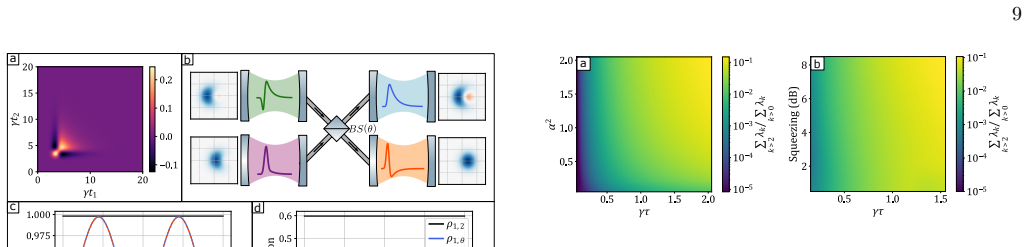
of the first output modeρ 1. (b) Wigner negativity volume ofρ 1 normalized to that of a single-photon. (c) Coherence|ρ core 01 |=| ⟨0|ρcore 1 |1⟩ |of the corresponding core state. (d) Single photon populationρ core 11 =⟨1|ρ core 1 |1⟩of the core state. (e-g) Wigner functions ofρ 1 for three representative values ofα 2 andγτ. The insets shows the density m...
-
[2]
Let’s consider again two 5 orthogonal modes upon the most populated mode basis that we can choose
ofV. Let’s consider again two 5 orthogonal modes upon the most populated mode basis that we can choose. By tracing out the other still popu- lated mode, the reduced state in modev θ i can therefore be written as: ρi,θ =|a| 2ρeven i,θ +|b| 2ρodd i,θ (2) The conditional statesρ even i,θ andρ odd i,θ are not necessarily pure. This is illustrated in Figure 3(...
-
[3]
D. Gottesman, The heisenberg representation of quan- tum computers (1998), arXiv:quant-ph/9807006 [quant- ph]
arXiv 1998
-
[4]
One can then perform tomography on the bimodal output field or implement a heralding protocol. ing another output-mode basis. The blue point shown in Figure 3(a), corresponding toθ 3 = 0.09π, marks a local minimum in the purity ofρ even 1,θ3 (at 0.93), while the pu- rity ofρ odd 1,θ3 remains high (0.98). Figure 3(e) shows the corresponding output states. ...
-
[5]
is not pure enough to guarantee a stellar rankr ∗ >1 with this method. However, we know that all states studied here have a stellar rankr ∗ ≥1, as they all display Wigner negativity. ρeven 1,θ has a stellar rankr ∗ ≥2 for the three different bases. Forθ 1 andθ 3,ρ odd 1,θ has a stellar rankr ∗ ≥3. Conversely,ρ odd 1,θ2 is a nearly pure squeezed single pho...
-
[6]
M. V. Larsen, X. Guo, C. R. Breum, J. S. Neergaard- Nielsen,et al., Science366, 369 (2019), arXiv:1906.08709 [quant-ph]
work page Pith review arXiv 2019
-
[7]
M. V. Larsen, J. E. Bourassa, S. Kocsis, J. F. Tasker, et al., Nature642, 587 (2025)
work page 2025
- [8]
Show all 56 references
-
[9]
S. D. Bartlett, B. C. Sanders, S. L. Braunstein, and K. Nemoto, Phys. Rev. Lett.88, 097904 (2002)
2002
-
[10]
Gottesman, A
D. Gottesman, A. Kitaev, and J. Preskill, Phys. Rev. A 64, 012310 (2001)
2001
-
[11]
Haroche and J.-M
S. Haroche and J.-M. Raimond,Exploring the Quantum: Atoms, Cavities, and Photons(Oxford University Press, 2006)
2006
-
[12]
Honer, R
J. Honer, R. L¨ ow, H. Weimer, T. Pfau,et al., Phys. Rev. Lett.107, 093601 (2011)
2011
-
[13]
M. M. Lund, F. Yang, V. R. Christiansen, D. Kornovan, et al., Physical Review Letters133, 103601 (2024)
2024
-
[14]
Magro, J
V. Magro, J. Vaneecloo, S. Garcia, and A. Ourjoumtsev, Nature Photonics17, 688 (2023)
2023
-
[15]
J. C. Loredo, C. Ant´ on, B. Reznychenko, P. Hilaire,et al., Nature Photonics13, 803 (2019)
2019
-
[16]
Gonz´ alez-Tudela, V
A. Gonz´ alez-Tudela, V. Paulisch, D. E. Chang, H. J. Kimble,et al., Phys. Rev. Lett.115, 163603 (2015)
2015
-
[17]
More generally, squeezed few-photon superposition states have recently been identified as efficient intermediate re- sources for optical cat-state generation [20]
or in driven steady-state configurations [18, 19]. More generally, squeezed few-photon superposition states have recently been identified as efficient intermediate re- sources for optical cat-state generation [20]. Building on these developments, we investigate protocols for g...
2026 arXiv
-
[18]
Paulisch, H
V. Paulisch, H. J. Kimble, J. I. Cirac, and A. Gonz´ alez- Tudela, Phys. Rev. A97, 053831 (2018)
2018
-
[19]
Pasharavesh and M
A. Pasharavesh and M. Bajcsy, New Journal of Physics 26, 113022 (2024)
2024
-
[20]
H. Luo, P. S. Shah, F. Yang, M. Mirhosseini,et al., Dynamic stimulated emission for deterministic addi- tion and subtraction of propagating photons (2025), arXiv:2512.09711 [quant-ph]
2025
-
[21]
Bouchereau, L
Y. Bouchereau, L. Weitzel, V. Thiel, V. Parigi,et al., Temporal modes of quantum states of light scattered by a two-level system (2026), arXiv:2606.29974 [quant-ph]
2026 arXiv
-
[22]
Kleinbeck, H
K. Kleinbeck, H. Busche, N. Stiesdal, S. Hofferberth, et al., Physical Review A107, 013717 (2023)
2023
-
[23]
Quijandr ´ ıa, I
F. Quijandr ´ ıa, I. Strandberg, and G. Johansson, Physical Review Letters121, 263603 (2018)
2018
-
[24]
M. J. Leonhardt and S. Parkins, Physical Review A112, 013715 (2025), arXiv:2408.01698 [quant-ph]
2025 arXiv
-
[25]
Luo and S
H. Luo and S. Mahmoodian, Phys. Rev. Appl.25, 024046 (2026)
2026
-
[26]
Lodahl, S
P. Lodahl, S. Mahmoodian, S. Stobbe, P. Schneeweiss, et al., Nature541, 473 (2017), arXiv:1608.00446 [quant- ph]
2017 arXiv
-
[27]
M. O. Scully and M. S. Zubairy,Quantum Optics(Cam- bridge University Press, 1997)
1997
-
[28]
S. P. Prasad, M. Maffei, P. A. Camati, C. Elouard,et al., Closing Optical Bloch Equations in waveguide QED: Dy- namics, Energetics (2024)
2024
-
[29]
C. W. Gardiner and M. J. Collett, Physical Review A 31, 3761 (1985)
1985
-
[30]
A. H. Kiilerich and K. Mølmer, Physical Review Letters 123, 123604 (2019)
2019
-
[31]
A. H. Kiilerich and K. Mølmer, Physical Review A102, 023717 (2020)
2020
-
[32]
Brecht, A
B. Brecht, A. Eckstein, R. Ricken, V. Quiring,et al., Phys. Rev. A90, 030302(R) (2014)
2014
-
[33]
K. H. Lim, K. T. Laverick, S. S. Jafar, S. P. Prasad,et al., Optimizing wigner negativity in scattering processes us- ing energetic cost functions (2026), arXiv:2606.15101 [quant-ph]
2026 arXiv
-
[34]
Menzies and R
D. Menzies and R. Filip, Phys. Rev. A79, 012313 (2009)
2009
-
[35]
Lachman, I
L. Lachman, I. Straka, J. Hlouˇ sek, M. Jeˇ zek,et al., Phys. Rev. Lett.123, 043601 (2019)
2019
-
[36]
Fiur´ aˇ sek, Opt
J. Fiur´ aˇ sek, Opt. Express30, 30630 (2022)
2022
-
[37]
Chabaud and M
U. Chabaud and M. Walschaers, Phys. Rev. Lett.130, 090602 (2023)
2023
-
[38]
S. Ast, M. Mehmet, and R. Schnabel, Optics Express21, 13572 (2013)
2013
-
[39]
Terrasson, L
A. Terrasson, L. Madsen, J. Grim, and W. Bowen, Bright pulsed squeezed light for quantum-enhanced precision microscopy (2026), arXiv:2601.15565 [quant-ph]
2026
-
[40]
Eckstein, B
A. Eckstein, B. Brecht, and C. Silberhorn, Opt. Express 19, 13770 (2011)
2011
-
[41]
Serino, J
L. Serino, J. Gil-Lopez, M. Stefszky, R. Ricken,et al., PRX Quantum4, 020306 (2023)
2023
-
[42]
V. R. Christiansen and K. Mølmer, Phys. Rev. A113, 013730 (2026)
2026
-
[43]
Konno, W
S. Konno, W. Asavanant, F. Hanamura, H. Na- gayoshi,et al., Science383, 289 (2024), https://www.science.org/doi/pdf/10.1126/science.adk7560
2024 doi
-
[44]
Arcari, I
M. Arcari, I. S¨ ollner, A. Javadi, S. Lindskov Hansen, et al., Phys. Rev. Lett.113, 093603 (2014)
2014
-
[45]
Lahad and O
O. Lahad and O. Firstenberg, Physical Review Letters 119, 113601 (2017)
2017
-
[46]
J. Yang, I. Strandberg, A. Vivas-Via˜ na, A. Gaikwad, et al., npj Quantum Information11, 69 (2025)
2025
-
[47]
Kiryu, Y
S. Kiryu, Y. Chin, M. Takeoka, and K. Fukui, arXiv preprint arXiv:2603.19870 10.48550/arXiv.2603.19870 (2026)
2026 doi
-
[48]
C. Ding, X. Zhang, J. Xiong, Y. Xiao,et al., ACS Pho- tonics12, 4924–4931 (2025)
2025
-
[49]
Eaton, R
M. Eaton, R. Nehra, and O. Pfister, New Journal of Physics21, 113034 (2019)
2019
-
[50]
M. S. Winnel, J. J. Guanzon, D. Singh, and T. C. Ralph, Phys. Rev. Lett.132, 230602 (2024)
2024
-
[51]
Chabaud, G
U. Chabaud, G. Roeland, M. Walschaers, F. Grosshans, et al., PRX Quantum2, 020333 (2021)
2021
-
[52]
Chabaud, D
U. Chabaud, D. Markham, and F. Grosshans, Phys. Rev. Lett.124, 063605 (2020)
2020
-
[53]
Johansson, P
J. Johansson, P. Nation, and F. Nori, Computer Physics Communications183, 1760 (2012)
2012
-
[54]
Lambert, E
N. Lambert, E. Gigu‘ere, P. Menczel, B. Li,et al., Physics Reports1153, 1 (2026)
2026
-
[55]
Kenfack and K
A. Kenfack and K. ˙Zyczkowski, Journal of Optics B: Quantum and Semiclassical Optics6, 396 (2004)
2004
-
[56]
Jozsa, Journal of Modern Optics41, 2315 (1994)
R. Jozsa, Journal of Modern Optics41, 2315 (1994)
1994
Reviewed August 5, 2026 · model on record in the stance chip above.
Discussion (0). Continue with ORCID to comment.