REVIEW 2 major objections 5 minor 192 references
LAEF: A Lead-Agnostic ECG Foundation Model Towards Point-of-Care Diagnostics
T0 review · 2 major / 5 minor · reviewed 2026-08-05 · deepseek-v4-flash
Pith's one-line read This paper claims a 7.1M-parameter ECG model that treats leads as graph nodes can match 12-lead foundation models and outperform zero-padded baselines on 1–2 lead inputs.
desk verdict New lead-agnostic graph architecture with strong reduced-lead results, but the 'on par at 12 leads' claim is contradicted by the paper's own significance markers. read the letter →
The pith
A machine-rendered reading of the paper's core claim, the machinery that carries it, and where it could break.
The reading
What carries the argument
The key machinery is the spatiotemporal ECG graph: each lead is partitioned into S=20 temporal segments, each mapped by a 1D CNN embedder to a node; intra-lead edges form a complete subgraph over all segments of a lead (capturing beat-to-beat and morphological context), while inter-lead edges connect only time-aligned segments across leads (capturing the spatial synchrony of simultaneous cardiac projections). A Graph Attention Network operates on this graph, and because graph construction uses no lead identity, the model scales naturally with the number of active leads, modelling lead absence as missing nodes. Pre-training uses masked node modelling with per-lead codebook prototypes and stoc
What would settle it
Collect a labelled dataset of ECG recordings from actual wearable single-lead or two-lead devices (e.g., smartwatch or handheld recorder) with ground-truth diagnoses, then run LAEF and a zero-padded 12-lead baseline on the same recordings. If LAEF's average AUROC advantage over the zero-padded baseline at L=1 or L=2 shrinks to zero or reverses, the claim that lead-agnostic training transfers to real point-of-care settings is disconfirmed; the paper itself states it could not validate on real point-of-care data.
Extended reading notes
Core claim
The paper's central claim is that treating ECG leads as graph nodes rather than fixed tensor channels makes a single foundation model natively lead-agnostic: any subset of the standard 12 leads can be processed without architectural modification, without zero-padding, and without knowing lead identity. LAEF splits each lead into 20 temporal segments, connects segments within a lead with full intra-lead edges and time-aligned segments across leads with inter-lead edges, and processes the resulting variable-size graph with a Graph Attention Network. During pre-training, random lead subsets are sampled per ECG, acting as a structured information bottleneck that forces the model to infer global
Load-bearing premise
The reduced-lead evaluation assumes that deleting leads from a 12-lead clinical ECG faithfully mimics a point-of-care recording; if real wearable signals differ enough in noise, electrode placement, or bandwidth, the reported 1–2 lead advantage may not transfer.
Editorial extensions
If this is right
- A single pretrained model can serve both full 12-lead clinical diagnostics and 1–2 lead wearable inference, eliminating the need for per-device retraining or 12-lead reconstruction.
- Reduced-lead inference cost scales with active leads: at L=1–2 LAEF reports the best throughput and latency among evaluated models, supporting resource-constrained point-of-care deployment.
- Lead-agnostic pre-training does not sacrifice full-lead performance: LAEF matches baselines over 12× larger at L=12, so lead robustness and clinical utility are not in tension.
- Zero-padding is not merely inefficient; the representation analysis indicates it corrupts reduced-lead inputs for fixed-12-lead models, which is why their AUROC collapses even when their internal representations appear stable.
- Single-lead performance is stable across all 12 standard leads (AUROC range <0.003) while retaining category-specific lead preferences, suggesting the model can be deployed on any single-lead device without knowing which lead is being used.
Reading between the lines
- Because LAEF deliberately omits lead identity, it may generalize to non-standard electrode placements, but it also cannot exploit known clinical priors that certain conditions are best seen in specific leads; a variant with optional lead-conditioned embeddings could combine both properties.
- The paper's reduced-lead evaluation simulates point-of-care inputs by dropping leads from 12-lead clinical ECGs; the authors list validation on real wearable recordings as future work, and that validation would settle whether the +3.2 AUROC advantage survives real-world noise, electrode shifts, and bandwidth differences.
- The lead-importance analysis, which is stable at the population level but structured by category, could be used to choose which single lead a smartwatch or patch should prioritize for a given screening target—for example, inferior ischemia shows elevated relative importance in lead III.
- The graph formulation suggests a direct extension to non-standard or mixed-device configurations, such as combining a smartwatch limb lead with a chest-patch lead, since the model accepts arbitrary lead subsets without identity information.
Editorial analysis
A structured set of objections, weighed in public.
Referee Report
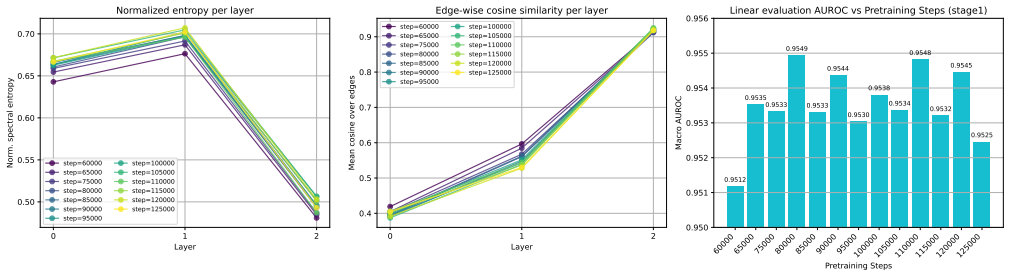
Summary. The paper introduces LAEF, a 7M-parameter lead-agnostic ECG foundation model that represents an ECG of any lead count as a variable-size spatiotemporal graph of per-lead temporal segments. A GAT encoder processes this graph, and the model is pre-trained on 9.2M 12-lead ECGs with masked node modelling and stochastic lead sampling so that reduced-lead inputs are processed natively without zero-padding. The authors evaluate LAEF against seven ECG foundation models on 18 downstream datasets at 12, 2, and 1 lead(s), reporting macro AUROC. They claim that LAEF is on par with much larger specialized 12-lead models at full lead availability and outperforms zero-padded alternatives on 17/18 and 14/18 datasets at one and two leads, respectively, with an average +3.2 AUROC gain. They also present representation-stability (CKA) analyses, a large lead-importance study over 164 conditions, and extensive ablations of the codebook, masking ratio, topology, encoder, and training dynamics.
Significance. If the claims were fully supported, LAEF would be a practically valuable contribution to point-of-care ECG diagnostics, because it directly addresses the fixed-12-lead limitation of existing foundation models. The evaluation is unusually broad: 18 datasets, 7 baselines, paired random-lead seeds, bootstrap significance testing, and detailed ablations. The paper also provides a transparent account of architecture, pretraining stages, hyperparameters, and computational cost, and it explicitly states the limitation that no real point-of-care data were used. The reduced-lead results are strong and the lead-agnostic graph formulation is a plausible mechanism. However, the headline claim of 12-lead parity is not supported by the paper's own significance markers, and the point-of-care wording overstates what simulated lead reduction can show. These issues are fixable by a careful rewrite of the claims, but they affect the central message.
major comments (2)
- [Abstract and §4.1, Table 1/Table 5] The claim that LAEF is "on par" with specialized 12-lead baselines, and the statement in §4.1 that "lead-agnostic pre-training does not sacrifice performance at full lead availability," are contradicted by the paper's own bootstrap markers. In Table 1, an asterisk denotes a score that is not statistically significantly worse than the best. At L=12, LAEF has an asterisk on only 3 of 18 datasets (PTB-XL Sub, CPSC2018, PTB), while on the majority it is below the best score without an asterisk; examples include PTB-XL All (91.5 vs 94.6), Georgia (87.6 vs 92.0), EchoNext (79.7 vs 83.0), SPH (96.3 vs 98.2), and ZZU pECG (88.1 vs 90.8). Thus the paper's own significance procedure indicates a real, often significant, 12-lead performance cost on most datasets. The abstract and §4.1 should be rewritten to quantify this trade-off and to distinguish "broadly competitive in ranking" from "no sacrific
- [§4 Evaluation protocol and Limitations] The reduced-lead experiments simulate point-of-care conditions by dropping leads from clinical 12-lead ECGs and fine-tuning all models on 12 leads only. The manuscript explicitly acknowledges in Limitations that real point-of-care data could not be included and that noise profile, electrode placement, and acquisition bandwidth remain unaddressed. Given this, the abstract's phrase "point-of-care-oriented diagnostics" and "direct point-of-care-oriented diagnostics" is stronger than the evidence. I recommend rephrasing these as "simulated reduced-lead robustness" or adding an explicit caveat in the abstract and conclusions. This is not an internal inconsistency, but it affects how far the headline result can be generalized.
minor comments (5)
- [Abstract] Typo: "with with a single randomly sampled lead" contains a duplicated "with."
- [Figure 4 / Lead importance analysis] The per-lead macro AUROC values are reported as [0.854, 0.857], differing only in the third decimal, and then Z-scored into "relative importance." Please clarify over which dimension the Z-scoring is computed and how such tiny AUROC differences yield stable category-level importance patterns; this would make the analysis easier to interpret.
- [Table 3] The dataset table appears misaligned in the submitted text (e.g., the CODE row and the Unlabelled/Labelled subrows), making it hard to verify which datasets are used for SSL pretraining versus supervised fine-tuning. Please check the table formatting.
- [§8.2 / Table 7] LAEF's memory footprint at L=12 (up to 5858 MB) is much larger than several baselines due to explicit graph indexing; the table caption notes this, but the main text's emphasis on "scales naturally" should mention that the indexing overhead at full lead count is a limitation, even though throughput and latency at L≤2 are good.
- [§4.2] The causal statement that the reduced-lead advantage is "primarily driven by LAEF's lead-agnostic architecture" is supported only by a dissociation between CKA stability and classification AUROC. Since the paper labels this as "suggests," please consider softening the contribution bullet that presents this as a demonstrated mechanism rather than a post-hoc interpretation.
Circularity Check
No significant circularity: LAEF's reduced-lead advantage is established by external benchmark comparison, not by construction; minor self-citations are methodological and non-load-bearing.
full rationale
The paper's central claim is an empirical benchmark result: LAEF is fine-tuned on 12-lead ECGs and evaluated at L=1,2,12 against seven external FMs, on external datasets. The reduced-lead evaluation simulates lead dropout from 12-lead ECGs; it is not a quantity fitted during training. Stochastic lead sampling is a pretraining augmentation, not a downstream fit. The lead-importance analysis is explicitly post-hoc validation ('These category-level associations provide post-hoc validation') and is not used to select model parameters. Self-citations to Coppola et al. 2025 supply a baseline (HuBERT-ECG), datasets (Cardio-Learning), a dev subset (Ribeiro-dev), and an iterative codebook-refinement recipe; all are normal methodological citations, and the core reduced-lead comparison is against independently released models and data. The paper's own limitation statement acknowledges that real point-of-care data could not be included ('Validating LAEF on real point-of-care data... remains an important direction'), which weakens deployment validity but is not circularity. The abstract's 'on par at 12 leads' claim appears contradicted by Table 5's bootstrap asterisks on many datasets, and the lack of asterisks could mean LAEF is significantly worse than the best baseline at L=12 on a majority of datasets; however, this is a correctness/evidence overstatement, not a derivation that reduces to its own inputs. No equation is defined in terms of a fitted target, no prediction is renamed fit, and no uniqueness claim is imported from the authors' prior work. Circularity score is therefore low.
Assumptions & free parameters
free parameters (6)
- p_MASK (lead-wise masking ratio) =
0.40
- S (segments per lead) =
20
- C (stage-1 codebook size) =
50
- C' (stage-2 codebook size) =
500
- p_drop (stage-2 edge dropout) =
0.2
- GAT depth and width =
2 layers, 768 channels
assumptions (3)
- domain assumption Inter-lead redundancy in 12-lead ECGs is sufficient to learn robust global cardiac representations from random lead subsets.
- domain assumption Simulated lead dropout from 12-lead clinical recordings is a valid proxy for point-of-care 1-2 lead acquisition.
- domain assumption The spatiotemporal graph topology (complete intra-lead edges, time-aligned inter-lead edges) captures the clinically relevant ECG dependencies for transfer.
Cite this review
Pith. "Pith review of LAEF: A Lead-Agnostic ECG Foundation Model Towards Point-of-Care Diagnostics." pith.science (2026). https://pith.science/paper/HDMTA3M4
@misc{pith2026260803690,
  author       = {Pith},
  title        = {Pith review of: LAEF: A Lead-Agnostic ECG Foundation Model Towards Point-of-Care Diagnostics},
  year         = {2026},
  howpublished = {\url{https://pith.science/paper/HDMTA3M4}},
  note         = {Machine review of arXiv:2608.03690}
}
abstract
Point-of-care cardiac devices such as smartwatches and handheld ECG recorders typically capture 1--2 leads, yet existing ECG foundation models are architecturally constrained to fixed 12-lead inputs, degrading or failing under these reduced configurations. We introduce LAEF (Lead-Agnostic ECG Foundation), a 7M-parameter ECG foundation model that can natively process any lead subset without zero-padding or architectural modification. LAEF represents ECGs as variable-size spatiotemporal graphs with physiologically motivated intra- and inter-lead connectivity, processed by a Graph Attention Network that scales naturally with active lead count.Pre-trained on 9.2M 12-lead ECGs via masked node modelling with stochastic lead sampling, LAEF learns representations robust to lead configuration. Across 18 downstream datasets, LAEF is on par with specialized 12-lead baselines over 12$\times$ larger at full lead availability. Under direct point-of-care-oriented diagnostics (1--2 leads), it outperforms all zero-padded alternatives on 17 out of 18 datasets with with a single randomly sampled lead and on 14 out of 18 with 2 leads, with an average AUROC gain of +3.2 points. Representation analysis links this advantage to architectural lead-agnosticism, and a lead-importance study across 164 cardiovascular conditions shows population-level performance is stable across single standard input leads while still recovering established clinically lead-condition associations.
Figures


Figures from the paper (8 more)




Reference graph
Works this paper leans on
-
[1]
arXiv preprint arXiv:2403.06659 , year=
Zero-shot ecg classification with multimodal learning and test-time clinical knowledge enhancement , author=. arXiv preprint arXiv:2403.06659 , year=
-
[2]
2026 , eprint=
Benchmarking ECG FMs: A Reality Check Across Clinical Tasks , author=. 2026 , eprint=
2026
-
[3]
Advances in Neural Information Processing Systems , volume=
Neural sheaf diffusion: A topological perspective on heterophily and oversmoothing in gnns , author=. Advances in Neural Information Processing Systems , volume=
-
[4]
arXiv preprint arXiv:2009.03509 , year=
Masked label prediction: Unified message passing model for semi-supervised classification , author=. arXiv preprint arXiv:2009.03509 , year=
arXiv 2009
-
[5]
arXiv preprint arXiv:2410.08559 , year=
Learning general representation of 12-lead electrocardiogram with a joint-embedding predictive architecture , author=. arXiv preprint arXiv:2410.08559 , year=
-
[6]
2020 , eprint=
PairNorm: Tackling Oversmoothing in GNNs , author=. 2020 , eprint=
2020
-
[7]
Nejm ai , volume=
An electrocardiogram foundation model built on over 10 million recordings , author=. Nejm ai , volume=. 2025 , publisher=
2025
-
[8]
arXiv preprint arXiv:1810.00826 , year=
How powerful are graph neural networks? , author=. arXiv preprint arXiv:1810.00826 , year=
Show all 192 references
-
[9]
arXiv preprint arXiv:2210.16156 , year=
Reliability of cka as a similarity measure in deep learning , author=. arXiv preprint arXiv:2210.16156 , year=
-
[10]
IEEE Transactions on Pattern Analysis and Machine Intelligence , volume =
Jin, Ming and Koh, Huan Yee and Wen, Qingsong and Zambon, Daniele and Alippi, Cesare and Webb, Geoffrey I and King, Irwin and Pan, Shirui , title =. IEEE Transactions on Pattern Analysis and Machine Intelligence , volume =. 2024 , month =
2024
-
[11]
Moghaddam, Dorsa E. P. and Muguli, Ananya and Razavi, Mehdi and Aazhang, Behnaam , title =. Intelligent Systems with Applications , volume =. 2024 , month =
2024
-
[12]
arXiv preprint arXiv:2108.07258 , year=
On the opportunities and risks of foundation models , author=. arXiv preprint arXiv:2108.07258 , year=
-
[13]
Proceedings of the AAAI Conference on Artificial Intelligence , volume=
Deeper Insights into Graph Convolutional Networks , author=. Proceedings of the AAAI Conference on Artificial Intelligence , volume=
-
[14]
arXiv preprint arXiv:2507.14151 , year=
Self-DANA: A Resource-Efficient Channel-Adaptive Self-Supervised Approach for ECG Foundation Models , author=. arXiv preprint arXiv:2507.14151 , year=
-
[15]
Conference on Health, Inference, and Learning , pages=
Lead-agnostic self-supervised learning for local and global representations of electrocardiogram , author=. Conference on Health, Inference, and Learning , pages=. 2022 , organization=
2022
-
[16]
Proceedings of the International Workshop on Neural Networks (WIRN 2022) , publisher =
Zeinalipour, Kamyar and Gori, Marco , title =. Proceedings of the International Workshop on Neural Networks (WIRN 2022) , publisher =. 2023 , note =
2022
-
[17]
Nature , volume=
Foundation models for generalist medical artificial intelligence , author=. Nature , volume=. 2023 , publisher=
2023
-
[18]
Circulation , volume=
The electrocardiogram at 100 years: history and future , author=. Circulation , volume=. 2024 , publisher=
2024
-
[19]
Computer Methods and Programs in Biomedicine , volume =
Qiang, Yupeng and Dong, Xunde and Liu, Xiuling and Yang, Yang and Fang, Yihai and Dou, Jianhong , title =. Computer Methods and Programs in Biomedicine , volume =. 2024 , month =
2024
-
[20]
Computer Methods and Programs in Biomedicine , volume=
Fusion of multi-scale feature extraction and adaptive multi-channel graph neural network for 12-lead ECG classification , author=. Computer Methods and Programs in Biomedicine , volume=. 2025 , publisher=
2025
-
[21]
International conference on machine learning , pages=
Similarity of neural network representations revisited , author=. International conference on machine learning , pages=. 2019 , organization=
2019
-
[22]
URL https://arxiv
Correcting biased centered kernel alignment measures in biological and artificial neural networks, 2024 , author=. URL https://arxiv. org/abs/2405.01012 , year=
2024 arXiv
-
[23]
Physiological measurement , volume=
An open access database for the evaluation of heart sound algorithms , author=. Physiological measurement , volume=. 2016 , publisher=
2016
-
[24]
DINOv2: Learning Robust Visual Features without Supervision , year =
Maxime Oquab and Timothée Darcet and Théo Moutakanni and Huy Vo and Marc Szafraniec and Vasil Khalidov and Pierre Fernandez and Daniel Haziza and Francisco Massa and Alaaeldin El-Nouby and Mahmoud Assran and Nicolas Ballas and Wojciech Galuba and Russell Howes and Po-Yao Huang...
-
[25]
A foundational vision transformer improves diagnostic performance for electrocardiograms , volume =
Akhil Vaid and Joy Jiang and Ashwin Sawant and Stamatios Lerakis and Edgar Argulian and Yuri Ahuja and Joshua Lampert and Alexander Charney and Hayit Greenspan and Jagat Narula and Benjamin Glicksberg and Girish N Nadkarni , doi =. A foundational vision transformer improves di...
-
[26]
Scientific Data , volume=
A pediatric ECG database with disease diagnosis covering 11643 children , author=. Scientific Data , volume=. 2025 , publisher=
2025
-
[27]
Foundation model of ECG diagnosis: Diagnostics and explanations of any form and rhythm on ECG , volume =
Yuanyuan Tian and Zhiyuan Li and Yanrui Jin and Mengxiao Wang and Xiaoyang Wei and Liqun Zhao and Yunqing Liu and Jinlei Liu and Chengliang Liu , doi =. Foundation model of ECG diagnosis: Diagnostics and explanations of any form and rhythm on ECG , volume =. Cell Reports Medic...
-
[28]
A survey of the impact of self-supervised pretraining for diagnostic tasks in medical X-ray, CT, MRI, and ultrasound , volume =
Blake VanBerlo and Jesse Hoey and Alexander Wong , doi =. A survey of the impact of self-supervised pretraining for diagnostic tasks in medical X-ray, CT, MRI, and ultrasound , volume =. BMC Medical Imaging , month =
-
[29]
Chaunzwa and Simon Bernatz and Ahmed Hosny and Raymond H
Suraj Pai and Dennis Bontempi and Ibrahim Hadzic and Vasco Prudente and Mateo Sokač and Tafadzwa L. Chaunzwa and Simon Bernatz and Ahmed Hosny and Raymond H. Mak and Nicolai J. Birkbak and Hugo J. W. L. Aerts , doi =. Foundation model for cancer imaging biomarkers , volume =. ...
-
[30]
DiRA: Discriminative, Restorative, and Adversarial Learning for Self-supervised Medical Image Analysis , year =
Fatemeh Haghighi and Mahammad Reza Hosseinzadeh Taher and Michael B Gotway and JIanming Liang , booktitle =. DiRA: Discriminative, Restorative, and Adversarial Learning for Self-supervised Medical Image Analysis , year =
-
[31]
Fischer and Fabian J
Till Richter and Mojtaba Bahrami and Yufan Xia and David S. Fischer and Fabian J. Theis , doi =. Delineating the effective use of self-supervised learning in single-cell genomics , volume =. Nature Machine Intelligence , month =
-
[32]
Big Self-Supervised Models Advance Medical Image Classifications , year =
Shekoofeh Azizi and Basil Mustafa and Fiona Ryan and Zachary Beaver and Jan Freyberg and Jonathan Deaton and Aaron Loh and Alan Karthikesalingam and Simon Kornblith and Ting Chen and Vivek Natarajan and Mohammad Norouzi , booktitle =. Big Self-Supervised Models Advance Medical...
-
[33]
Deep Clustering for Unsupervised Learning of Visual Features , year =
Mathilde Caron and Piotr Bojanowski and Armand Joulin and Matthijs Douze , booktitle =. Deep Clustering for Unsupervised Learning of Visual Features , year =
-
[34]
Quantifying Attention Flow in Transformers , year =
Samira Abnar and Willem Zuidema , city =. Quantifying Attention Flow in Transformers , year =. doi:10.18653/v1/2020.acl-main.385 , booktitle =
2020 doi
-
[35]
Lead-agnostic self-supervised learning for local and global representations of electrocardiograms , year =
Jungwoo Oh and Hyunseung Chung and Joon-myoung Kwon and Dong-gyun Hong and Edward Choi , booktitle =. Lead-agnostic self-supervised learning for local and global representations of electrocardiograms , year =
-
[36]
Dani Kiyasseh and Tingting Zhu and David A. Clifton. , booktitle =. Clocs: Contrastive learning of cardiac signals across space, time, and patients , year =
-
[37]
arXiv preprint arXiv:2502.10707 , year=
Reading your heart: Learning ecg words and sentences via pre-training ecg language model , author=. arXiv preprint arXiv:2502.10707 , year=
-
[38]
ECG for high-throughput screening of multiple diseases: Proof-of-concept using multi-diagnosis deep learning from population-based datasets , year =
Weijie Sun and Sunil Vasu Kalmady and Amir Salimi and Nariman Sepehrvand and Eric Ly and Abram Hindle and Russell Greiner and Padma Kaul , month =. ECG for high-throughput screening of multiple diseases: Proof-of-concept using multi-diagnosis deep learning from population-base...
-
[39]
European conference on computer vision , pages=
Contrastive multiview coding , author=. European conference on computer vision , pages=. 2020 , organization=
2020
-
[40]
Proceedings of the 28th ACM SIGKDD conference on knowledge discovery and data mining , pages=
Graphmae: Self-supervised masked graph autoencoders , author=. Proceedings of the 28th ACM SIGKDD conference on knowledge discovery and data mining , pages=
-
[41]
2025 , doi =
Coppola, Edoardo and Savardi, Mattia and Massussi, Mauro and Adamo, Marianna and Metra, Marco and Signoroni, Alberto , title =. 2025 , doi =. https://www.medrxiv.org/content/early/2025/07/31/2024.11.14.24317328.full.pdf , journal =
2025
-
[42]
A joint cross-dimensional contrastive learning framework for 12-lead ECGs and its heterogeneous deployment on SoC , volume =
Wenhan Liu and Huaicheng Zhang and Sheng Chang and Hao Wang and Jin He and Qijun Huang , doi =. A joint cross-dimensional contrastive learning framework for 12-lead ECGs and its heterogeneous deployment on SoC , volume =. Computers in Biology and Medicine , month =
-
[43]
Dense lead contrast for self-supervised representation learning of multilead electrocardiograms , volume =
Wenhan Liu and Zhoutong Li and Huaicheng Zhang and Sheng Chang and Hao Wang and Jin He and Qijun Huang , doi =. Dense lead contrast for self-supervised representation learning of multilead electrocardiograms , volume =. Information Sciences , month =
-
[44]
HMM-Based Audio Keyword Generation , year =
Min Xu and Ling-Yu Duan and Jianfei Cai and Liang-Tien Chia and Changsheng Xu and Qi Tian , doi =. HMM-Based Audio Keyword Generation , year =
-
[45]
BERT: Pre-training of Deep Bidirectional Transformers for Language Understanding , year =
Jacob Devlin and Ming-Wei Chang and Kenton Lee and Kristina Toutanova , city =. BERT: Pre-training of Deep Bidirectional Transformers for Language Understanding , year =. doi:10.18653/v1/N19-1423 , booktitle =
-
[46]
UMAP: Uniform Manifold Approximation and Projection , volume =
Leland McInnes and John Healy and Nathaniel Saul and Lukas Großberger , doi =. UMAP: Uniform Manifold Approximation and Projection , volume =. Journal of Open Source Software , month =
-
[47]
wav2vec 2.0: A Framework for Self-Supervised Learning of Speech Representations , volume =
Alexi Baevski and Yuhao Zhou and Abdelrahman Mohamed and Michael Auli , journal =. wav2vec 2.0: A Framework for Self-Supervised Learning of Speech Representations , volume =
-
[48]
Reducing Barriers to Self-Supervised Learning: HuBERT Pre-training with Academic Compute , year =
William Chen and Xuankai Chang and Yifan Peng and Zhaoheng Ni and Soumi Maiti and Shinji Watanabe , city =. Reducing Barriers to Self-Supervised Learning: HuBERT Pre-training with Academic Compute , year =. doi:10.21437/Interspeech.2023-1176 , booktitle =
2023 doi
-
[49]
A Wide and Deep Transformer Neural Network for 12-Lead ECG Classification , year =
Annamalai Natarajan and Yale Chang and Sara Mariani and Asif Rahman and Gregory Boverman and Shruti Vij and Jonathan Rubin , doi =. A Wide and Deep Transformer Neural Network for 12-Lead ECG Classification , year =. Computing in Cardiology , month =
-
[50]
AF Classification from a Short Single Lead ECG Recording: the Physionet Computing in Cardiology Challenge 2017 , year =
Gari Clifford and Chengyu Liu and Benjamin Moody and Li-wei Lehman and Ikaro Silva and Qiao Li and Alistair Johnson and Roger Mark , doi =. AF Classification from a Short Single Lead ECG Recording: the Physionet Computing in Cardiology Challenge 2017 , year =
2017
-
[51]
Van Leeuwen , doi =
Nik Vaessen and David A. Van Leeuwen , doi =. Fine-Tuning Wav2Vec2 for Speaker Recognition , year =. ICASSP 2022 - 2022 IEEE International Conference on Acoustics, Speech and Signal Processing (ICASSP) , month =
2022
-
[52]
HuBERT: Self-Supervised Speech Representation Learning by Masked Prediction of Hidden Units , volume =
Wei-Ning Hsu and Benjamin Bolte and Yao-Hung Hubert Tsai and Kushal Lakhotia and Ruslan Salakhutdinov and Abdelrahman Mohamed , doi =. HuBERT: Self-Supervised Speech Representation Learning by Masked Prediction of Hidden Units , volume =. IEEE/ACM Transactions on Audio, Speech...
-
[53]
Calinski and J
T. Calinski and J. Harabasz , doi =. A dendrite method for cluster analysis , volume =. Communications in Statistics - Theory and Methods , pages =
-
[54]
Davies and Donald W
David L. Davies and Donald W. Bouldin , doi =. A Cluster Separation Measure , volume =. IEEE Transactions on Pattern Analysis and Machine Intelligence , month =
-
[55]
Thorndike , doi =
Robert L. Thorndike , doi =. Who belongs in the family? , volume =. Psychometrika , month =
-
[56]
Deep Learning for ECG Analysis: Benchmarks and Insights from PTB-XL , volume =
Nils Strodthoff and Patrick Wagner and Tobias Schaeffter and Wojciech Samek , doi =. Deep Learning for ECG Analysis: Benchmarks and Insights from PTB-XL , volume =. IEEE Journal of Biomedical and Health Informatics , month =
-
[57]
Self-supervised representation learning from 12-lead ECG data , volume =
Temesgen Mehari and Nils Strodthoff , doi =. Self-supervised representation learning from 12-lead ECG data , volume =. Computers in Biology and Medicine , month =
-
[58]
Reducing Transformer Depth on Demand with Structured Dropout , url =
Angela Fan and Edouard Grave and Armand Joulin , booktitle =. Reducing Transformer Depth on Demand with Structured Dropout , url =
-
[59]
Hinton and Nitish Srivastava and Alex Krizhevsky and Ilya Sutskever and Ruslan R
Geoffrey E. Hinton and Nitish Srivastava and Alex Krizhevsky and Ilya Sutskever and Ruslan R. Salakhutdinov , issue =. Improving neural networks by preventing co-adaptation of feature detectors , year =. Journal of Machine Learning Research , month =
-
[60]
A Simple Weight Decay Can Improve Generalization , volume =
Anders Krogh and John A Hertz , journal =. A Simple Weight Decay Can Improve Generalization , volume =
-
[61]
k-means++: the advantages of careful seeding , year =
David Arthur and Sergej Vassilvitskii , booktitle =. k-means++: the advantages of careful seeding , year =
-
[62]
Kingma and Jimmy Ba , month =
Diederik P. Kingma and Jimmy Ba , month =. Adam: A Method for Stochastic Optimization , year =
-
[63]
Scikit-learn: Machine Learning in Python , volume =
Fabian Pedregosa and Gael Varoquax and Alexandre Gramfort and Vincent Michel and Bertrand Thirion and Olivier Grisel and Mathieu Blondel and Peter Prettenhofer and Ron Weiss and Vincent Dubourg and Jake Vanderplas and Alexandre Passos and David Cournapeau and Matthieu Brucher ...
-
[64]
ECG signal feature extraction trends in methods and applications , volume =
Anupreet Kaur Singh and Sridhar Krishnan , doi =. ECG signal feature extraction trends in methods and applications , volume =. BioMedical Engineering OnLine , month =
-
[65]
ECG signals classification using MFCC coefficients and ANN classifier , year =
Mohamed Boussaa and Issam Atouf and Mohamed Atibi and Abdellatif Bennis , doi =. ECG signals classification using MFCC coefficients and ANN classifier , year =. 2016 International Conference on Electrical and Information Technologies (ICEIT) , month =
2016
-
[66]
Least Squares Quantization in PCM , volume =
Stuart P LLoyd , issue =. Least Squares Quantization in PCM , volume =. IEEE TRANSACTIONS ON INFORMATION THEORY , month =
-
[67]
PyTorch: An Imperative Style, High-Performance Deep Learning Library , volume =
Adam Paszke and Sam Gross and Francisco Massa and Adam Lerer and James Bradbury and Gregory Chanan and Trevor Killeen and Zeming Lin and Natalia Gimelshein and Luca Antiga and Alban Desmaison and Andreas Köpf and Edward Yang and Zach DeVito and Martin Raison and Alykhan Tejani...
-
[68]
Gomez and Lukasz Kaiser and Illia Polosukhin , journal =
Ashish Vaswani and Noam Shazeer and Niki Parmar and Jakob Uszkoreit and Llion Jones and Aidan N. Gomez and Lukasz Kaiser and Illia Polosukhin , journal =. Attention Is All You Need , year =
-
[69]
Spatiotemporal self-supervised representation learning from multi-lead ECG signals , volume =
Rui Hu and Jie Chen and Li Zhou , doi =. Spatiotemporal self-supervised representation learning from multi-lead ECG signals , volume =. Biomedical Signal Processing and Control , month =
-
[70]
Yhdego and Fatemeh Khadem and Fatemeh Afghah , month =
Seokmin Choi and Sajad Mousavi and Phillip Si and Haben G. Yhdego and Fatemeh Khadem and Fatemeh Afghah , month =. ECGBERT: Understanding Hidden Language of ECGs with Self-Supervised Representation Learning , year =
-
[71]
Practical Lessons on 12-Lead ECG Classification: Meta-Analysis of Methods From PhysioNet/Computing in Cardiology Challenge 2020 , volume =
Shenda Hong and Wenrui Zhang and Chenxi Sun and Yuxi Zhou and Hongyan Li , doi =. Practical Lessons on 12-Lead ECG Classification: Meta-Analysis of Methods From PhysioNet/Computing in Cardiology Challenge 2020 , volume =. Frontiers in Physiology , month =
2020
-
[72]
MIMIC-IV-ECG: Diagnostic Electrocardiogram Matched Subset , year =
Brian Gow and Tom Pollard and Larry A Nathanson and Alistair Johnson and Benjamin Moody and Chrystinne Fernandes and Nathaniel Greenbaum and Jonathan W Waks and Parastou Eslami and Tanner Carbonati and Ashish Chaudhari and Elizabeth Herbst and Dana Moukheiber and Seth Berkowit...
-
[73]
An Open Access Database for Evaluating the Algorithms of Electrocardiogram Rhythm and Morphology Abnormality Detection , volume =
Feifei Liu and Chengyu Liu and Lina Zhao and Xiangyu Zhang and Xiaoling Wu and Xiaoyan Xu and Yulin Liu and Caiyun Ma and Shoushui Wei and Zhiqiang He and Jianqing Li and Eddie Ng Yin Kwee , doi =. An Open Access Database for Evaluating the Algorithms of Electrocardiogram Rhyt...
-
[74]
Classification of 12-lead ECGs: the PhysioNet/Computing in Cardiology Challenge 2020 , volume =
Erick A Perez Alday and Annie Gu and Amit J Shah and Chad Robichaux and An-Kwok Ian Wong and Chengyu Liu and Feifei Liu and Ali Bahrami Rad and Andoni Elola and Salman Seyedi and Qiao Li and Ashish Sharma and Gari D Clifford and Matthew A Reyna , doi =. Classification of 12-le...
2020
-
[75]
Will Two Do? Varying Dimensions in Electrocardiography: The PhysioNet/Computing in Cardiology Challenge 2021 , year =
Matthew A Reyna and Nadi Sadr and Erick A Perez Alday and Annie Gu and Amit J Shah and Chad Robichaux and Ali Bahrami Rad and Andoni Elola and Salman Seyedi and Sardar Ansari and Hamid Ghanbari and Qiao Li and Ashish Sharma and Gari D Clifford , doi =. Will Two Do? Varying Dim...
2021
-
[76]
Wearables, telemedicine, and artificial intelligence in arrhythmias and heart failure: Proceedings of the European Society of Cardiology Cardiovascular Round Table , volume =
Christophe Leclercq and Henning Witt and Gerhard Hindricks and Rodolphe P Katra and Dave Albert and Andrea Belliger and Martin R Cowie and Thomas Deneke and Paul Friedman and Mehdiyar Haschemi and Trudie Lobban and Isabelle Lordereau and Michael V McConnell and Leonardo Rapall...
-
[77]
Electrocardiogram-based deep learning improves outcome prediction following cardiac resynchronization therapy , volume =
Philippe C Wouters and Rutger R van de Leur and Melle B Vessies and Antonius M W van Stipdonk and Mohammed A Ghossein and Rutger J Hassink and Pieter A Doevendans and Pim van der Harst and Alexander H Maass and Frits W Prinzen and Kevin Vernooy and Mathias Meine and René van E...
-
[78]
Nature Communications , volume=
Practical intelligent diagnostic algorithm for wearable 12-lead ECG via self-supervised learning on large-scale dataset , author=. Nature Communications , volume=. 2023 , publisher=
2023
-
[79]
Two-year death prediction models among patients with Chagas Disease using machine learning-based methods , volume =
Ariela Mota Ferreira and Laércio Ives Santos and Ester Cerdeira Sabino and Antonio Luiz Pinho Ribeiro and Léa Campos de Oliveira-da Silva and Renata Fiúza Damasceno and Marcos Flávio Silveira Vasconcelos D’Angelo and Maria do Carmo Pereira Nunes and Desirée Sant´Ana Haikal , d...
-
[80]
Guiding Masked Representation Learning to Capture Spatio-Temporal Relationship of Electrocardiogram , year =
Yeongyeon Na and Minje Park and Yunwon Tae and Sunghoon Joo , booktitle =. Guiding Masked Representation Learning to Capture Spatio-Temporal Relationship of Electrocardiogram , year =
-
[81]
Longitudinal study of patients with chronic Chagas cardiomyopathy in Brazil (SaMi-Trop project): a cohort profile , volume =
Clareci Silva Cardoso and Ester Cerdeira Sabino and Claudia Di Lorenzo Oliveira and Lea Campos de Oliveira and Ariela Mota Ferreira and Edécio Cunha-Neto and Ana Luiza Bierrenbach and João Eduardo Ferreira and Desirée Sant'Ana Haikal and Arthur L Reingold and Antonio Luiz P Ri...
-
[82]
A large-scale multi-label 12-lead electrocardiogram database with standardized diagnostic statements , volume =
Hui Liu and Dan Chen and Da Chen and Xiyu Zhang and Huijie Li and Lipan Bian and Minglei Shu and Yinglong Wang , doi =. A large-scale multi-label 12-lead electrocardiogram database with standardized diagnostic statements , volume =. Scientific Data , month =
-
[83]
Optimal Multi-Stage Arrhythmia Classification Approach , volume =
Jianwei Zheng and Huimin Chu and Daniele Struppa and Jianming Zhang and Sir Magdi Yacoub and Hesham El-Askary and Anthony Chang and Louis Ehwerhemuepha and Islam Abudayyeh and Alexander Barrett and Guohua Fu and Hai Yao and Dongbo Li and Hangyuan Guo and Cyril Rakovski , doi =...
-
[84]
A 12-lead electrocardiogram database for arrhythmia research covering more than 10,000 patients , volume =
Jianwei Zheng and Jianming Zhang and Sidy Danioko and Hai Yao and Hangyuan Guo and Cyril Rakovski , doi =. A 12-lead electrocardiogram database for arrhythmia research covering more than 10,000 patients , volume =. Scientific Data , month =
-
[85]
Goldberger and Luis A
Ary L. Goldberger and Luis A. N. Amaral and Leon Glass and Jeffrey M. Hausdorff and Plamen Ch. Ivanov and Roger G. Mark and Joseph E. Mietus and George B. Moody and Chung-Kang Peng and H. Eugene Stanley , doi =. PhysioBank, PhysioToolkit, and PhysioNet: Components of a New Res...
-
[86]
Lunze and Wojciech Samek and Tobias Schaeffter , doi =
Patrick Wagner and Nils Strodthoff and Ralf-Dieter Bousseljot and Dieter Kreiseler and Fatima I. Lunze and Wojciech Samek and Tobias Schaeffter , doi =. PTB-XL, a large publicly available electrocardiography dataset , volume =. Scientific Data , month =
-
[87]
Bousseljot and D
R. Bousseljot and D. Kreiseler and A. Schnabel , doi =. Nutzung der EKG-Signaldatenbank CARDIODAT der PTB über das Internet , year =. Biomedizinische Technik/Biomedical Engineering , month =
-
[88]
Ribeiro and Manoel Horta Ribeiro and Gabriela M
Antônio H. Ribeiro and Manoel Horta Ribeiro and Gabriela M. M. Paixão and Derick M. Oliveira and Paulo R. Gomes and Jéssica A. Canazart and Milton P. S. Ferreira and Carl R. Andersson and Peter W. Macfarlane and Wagner Meira and Thomas B. Schön and Antonio Luiz P. Ribeiro , do...
-
[89]
Emerging Properties in Self-Supervised Vision Transformers , year =
Mathilde Caron and Hugo Touvron and Ishan Misra and Hervé Jégou and Julien Mairal and Piotr Bojanowski and Armand Joulin , booktitle =. Emerging Properties in Self-Supervised Vision Transformers , year =
-
[90]
Liu , journal =
Colin Raffel and Noam Shazeer and Adam Roberts and Katherine Lee and Sharan Narang and Michael Matena and Yanqi Zhou and Wei Li and Peter J. Liu , journal =. Exploring the Limits of Transfer Learning with a Unified Text-to-Text Transformer , year =
-
[91]
RoBERTa: A Robustly Optimized BERT Pretraining Approach , year =
Yinhan Liu and Myle Ott and Naman Goyal and Jingfei Du and Mandar Joshi and Danqi Chen and Omer Levy and Mike Lewis and Luke Zettlemoyer and Veselin Stoyanov , booktitle =. RoBERTa: A Robustly Optimized BERT Pretraining Approach , year =
-
[92]
OpenAI and Josh Achiam and Steven Adler and Sandhini Agarwal and Lama Ahmad and Ilge Akkaya and Florencia Leoni Aleman and Diogo Almeida and Janko Altenschmidt and Sam Altman and Shyamal Anadkat and Red Avila and Igor Babuschkin and Suchir Balaji and Valerie Balcom and Paul Ba...
-
[93]
Hudson and Ehsan Adeli and Russ Altman and Simran Arora and Sydney von Arx and Michael S
Rishi Bommasani and Drew A. Hudson and Ehsan Adeli and Russ Altman and Simran Arora and Sydney von Arx and Michael S. Bernstein and Jeannette Bohg and Antoine Bosselut and Emma Brunskill and Erik Brynjolfsson and Shyamal Buch and Dallas Card and Rodrigo Castellon and Niladri C...
-
[94]
Howell and Greg S
Michael D. Howell and Greg S. Corrado and Karen B. DeSalvo , doi =. Three Epochs of Artificial Intelligence in Health Care , volume =. JAMA , month =
-
[95]
Finlayson and Adarsh Subbaswamy and Karandeep Singh and John Bowers and Annabel Kupke and Jonathan Zittrain and Isaac S
Samuel G. Finlayson and Adarsh Subbaswamy and Karandeep Singh and John Bowers and Annabel Kupke and Jonathan Zittrain and Isaac S. Kohane and Suchi Saria , doi =. The Clinician and Dataset Shift in Artificial Intelligence , volume =. New England Journal of Medicine , month =
-
[96]
Krumholz and Jure Leskovec and Eric J
Michael Moor and Oishi Banerjee and Zahra Shakeri Hossein Abad and Harlan M. Krumholz and Jure Leskovec and Eric J. Topol and Pranav Rajpurkar , doi =. Foundation models for generalist medical artificial intelligence , volume =. Nature , month =
-
[97]
Adewole and Hammed A
Nehemiah Musa and Abdulsalam Ya’u Gital and Nahla Aljojo and Haruna Chiroma and Kayode S. Adewole and Hammed A. Mojeed and Nasir Faruk and Abubakar Abdulkarim and Ifada Emmanuel and Yusuf Y. Folawiyo and James A. Ogunmodede and Abdukareem A. Oloyede and Lukman A. Olawoyin and ...
-
[98]
Deep learning for predicting rehospitalization in acute heart failure: Model foundation and external validation , year =
Mi‐Na Kim and Yong Seok Lee and Youngmin Park and Ayoung Jung and Hanjee So and Joonwoong Park and Jin‐Joo Park and Dong‐Joo Choi and So‐Ree Kim and Seong‐Mi Park , doi =. Deep learning for predicting rehospitalization in acute heart failure: Model foundation and external vali...
-
[99]
John and Ryuichiro Yagi and Max Homilius and Genki Ichihara and Yoshinori Katsumata and Hanna K
Shinichi Goto and Divyarajsinhji Solanki and Jenine E. John and Ryuichiro Yagi and Max Homilius and Genki Ichihara and Yoshinori Katsumata and Hanna K. Gaggin and Yuji Itabashi and Calum A. MacRae and Rahul C. Deo , doi =. Multinational Federated Learning Approach to Train ECG...
-
[100]
Development and validation of machine learning algorithms based on electrocardiograms for cardiovascular diagnoses at the population level , volume =
Sunil Vasu Kalmady and Amir Salimi and Weijie Sun and Nariman Sepehrvand and Yousef Nademi and Kevin Bainey and Justin Ezekowitz and Abram Hindle and Finlay McAlister and Russel Greiner and Roopinder Sandhu and Padma Kaul , doi =. Development and validation of machine learning...
-
[101]
Machine learning-based heart disease diagnosis: A systematic literature review , volume =
Md Manjurul Ahsan and Zahed Siddique , doi =. Machine learning-based heart disease diagnosis: A systematic literature review , volume =. Artificial Intelligence in Medicine , month =
-
[102]
Friedman , doi =
Paul A. Friedman , doi =. The Electrocardiogram at 100 Years: History and Future , volume =. Circulation , month =
-
[103]
Fariha and Satesh Kumar and Sahil Zaveri and Abdulqadir J
Muhammad Ali Muzammil and Saman Javid and Azra Khan Afridi and Rupini Siddineni and Mariam Shahabi and Muhammad Haseeb and F.N.U. Fariha and Satesh Kumar and Sahil Zaveri and Abdulqadir J. Nashwan , doi =. Artificial intelligence-enhanced electrocardiography for accurate diagn...
-
[104]
van de Vegte and Ruben N
Yordi J. van de Vegte and Ruben N. Eppinga and M. Yldau van der Ende and Yanick P. Hagemeijer and Yuvaraj Mahendran and Elias Salfati and Albert V. Smith and Vanessa Y. Tan and Dan E. Arking and Ioanna Ntalla and Emil V. Appel and Claudia Schurmann and Jennifer A. Brody and Ri...
-
[105]
Smilowitz and Jeffrey S
Nathaniel R. Smilowitz and Jeffrey S. Berger , doi =. Perioperative Cardiovascular Risk Assessment and Management for Noncardiac Surgery , volume =. JAMA , month =
-
[106]
Tom B. Brown and Benjamin Mann and Nick Ryder and Melanie Subbiah and Jared Kaplan and Prafulla Dhariwal and Arvind Neelakantan and Pranav Shyam and Girish Sastry and Amanda Askell and Sandhini Agarwal and Ariel Herbert-Voss and Gretchen Krueger and Tom Henighan and Rewon Chil...
-
[107]
ECG-QA: A Comprehensive Question Answering Dataset Combined With Electrocardiogram , year =
Jungwoo Oh and Gyubok Lee and Seongsu Bae and Joon-myoung Kwon and Edward Choi , month =. ECG-QA: A Comprehensive Question Answering Dataset Combined With Electrocardiogram , year =
-
[108]
Towards Quantitative Precision for ECG Analysis: Leveraging State Space Models, Self-Supervision and Patient Metadata , volume =
Temesgen Mehari and Nils Strodthoff , doi =. Towards Quantitative Precision for ECG Analysis: Leveraging State Space Models, Self-Supervision and Patient Metadata , volume =. IEEE Journal of Biomedical and Health Informatics , month =
-
[109]
Kai Zhang and Rong Zhou and Eashan Adhikarla and Zhiling Yan and Yixin Liu and Jun Yu and Zhengliang Liu and Xun Chen and Brian D. Davison and Hui Ren and Jing Huang and Chen Chen and Yuyin Zhou and Sunyang Fu and Wei Liu and Tianming Liu and Xiang Li and Yong Chen and Lifang ...
-
[110]
Kunz and Matthew C
Eugene Vorontsov and Alican Bozkurt and Adam Casson and George Shaikovski and Michal Zelechowski and Kristen Severson and Eric Zimmermann and James Hall and Neil Tenenholtz and Nicolo Fusi and Ellen Yang and Philippe Mathieu and Alexander van Eck and Donghun Lee and Julian Vir...
-
[111]
Wright and Ari Robicsek and Brian Piening and Carlo Bifulco and Sheng Wang and Hoifung Poon , doi =
Hanwen Xu and Naoto Usuyama and Jaspreet Bagga and Sheng Zhang and Rajesh Rao and Tristan Naumann and Cliff Wong and Zelalem Gero and Javier González and Yu Gu and Yanbo Xu and Mu Wei and Wenhui Wang and Shuming Ma and Furu Wei and Jianwei Yang and Chunyuan Li and Jianfeng Gao...
-
[112]
Langlotz and Andrew Y
Ekin Tiu and Ellie Talius and Pujan Patel and Curtis P. Langlotz and Andrew Y. Ng and Pranav Rajpurkar , doi =. Expert-level detection of pathologies from unannotated chest X-ray images via self-supervised learning , volume =. Nature Biomedical Engineering , month =
-
[113]
Vision–language foundation model for echocardiogram interpretation , volume =
Matthew Christensen and Milos Vukadinovic and Neal Yuan and David Ouyang , doi =. Vision–language foundation model for echocardiogram interpretation , volume =. Nature Medicine , month =
-
[114]
Segment anything in medical images , volume =
Jun Ma and Yuting He and Feifei Li and Lin Han and Chenyu You and Bo Wang , doi =. Segment anything in medical images , volume =. Nature Communications , month =
-
[115]
Overcoming data scarcity in biomedical imaging with a foundational multi-task model , volume =
Raphael Schäfer and Till Nicke and Henning Höfener and Annkristin Lange and Dorit Merhof and Friedrich Feuerhake and Volkmar Schulz and Johannes Lotz and Fabian Kiessling , doi =. Overcoming data scarcity in biomedical imaging with a foundational multi-task model , volume =. N...
-
[116]
Lu and Bowen Chen and Drew F
Ming Y. Lu and Bowen Chen and Drew F. K. Williamson and Richard J. Chen and Ivy Liang and Tong Ding and Guillaume Jaume and Igor Odintsov and Long Phi Le and Georg Gerber and Anil V. Parwani and Andrew Zhang and Faisal Mahmood , doi =. A visual-language foundation model for co...
-
[117]
Knowledge-enhanced visual-language pre-training on chest radiology images , volume =
Xiaoman Zhang and Chaoyi Wu and Ya Zhang and Weidi Xie and Yanfeng Wang , doi =. Knowledge-enhanced visual-language pre-training on chest radiology images , volume =. Nature Communications , month =
-
[118]
Alec Radford and Karthik Narasimhan and Tim Salimans and Ilya Sutskever , title =
-
[119]
Improving ECG Classification Using Generative Adversarial Networks , volume =
Tomer Golany and Gal Lavee and Shai Tejman Yarden and Kira Radinsky , doi =. Improving ECG Classification Using Generative Adversarial Networks , volume =. Proceedings of the AAAI Conference on Artificial Intelligence , month =
-
[120]
Electrocardiogram generation with a bidirectional LSTM-CNN generative adversarial network , volume =
Fei Zhu and Fei Ye and Yuchen Fu and Quan Liu and Bairong Shen , doi =. Electrocardiogram generation with a bidirectional LSTM-CNN generative adversarial network , volume =. Scientific Reports , month =
-
[121]
Hyland and Gunnar Rätsch , month =
Cristóbal Esteban and Stephanie L. Hyland and Gunnar Rätsch , month =. Real-valued (Medical) Time Series Generation with Recurrent Conditional GANs , year =
-
[122]
Generation of 12-Lead Electrocardiogram with Subject-Specific, Image-Derived Characteristics Using a Conditional Variational Autoencoder , year =
Yuling Sang and Marcel Beetz and Vicente Grau , doi =. Generation of 12-Lead Electrocardiogram with Subject-Specific, Image-Derived Characteristics Using a Conditional Variational Autoencoder , year =. 2022 IEEE 19th International Symposium on Biomedical Imaging (ISBI) , month =
2022
-
[123]
John and Ryuichiro Yagi and Max Homilius and Genki Ichihara and Yoshinori Katsumata and Hanna K
Shinichi Goto and Divyarajsinhji Solanki and Jenine E. John and Ryuichiro Yagi and Max Homilius and Genki Ichihara and Yoshinori Katsumata and Hanna K. Gaggin and Yuji Itabashi and Calum A. MacRae and Rahul C. Deo , doi =. Circulation , title =
-
[124]
Prevost , month =
Edmond Adib and Fatemeh Afghah and John J. Prevost , month =. Synthetic ECG Signal Generation Using Generative Neural Networks , year =
-
[125]
ECG signal generation based on conditional generative models , volume =
Yong Xia and Wenyi Wang and Kuanquan Wang , doi =. ECG signal generation based on conditional generative models , volume =. Biomedical Signal Processing and Control , month =
-
[126]
Diffusion-based conditional ECG generation with structured state space models , volume =
Juan Miguel Lopez Alcaraz and Nils Strodthoff , doi =. Diffusion-based conditional ECG generation with structured state space models , volume =. Computers in Biology and Medicine , month =
-
[127]
Generating electrocardiogram signals by deep learning , volume =
Naren Wulan and Wei Wang and Pengzhong Sun and Kuanquan Wang and Yong Xia and Henggui Zhang , doi =. Generating electrocardiogram signals by deep learning , volume =. Neurocomputing , month =
-
[128]
Knowledge-Based Systems , volume=
ElectroCardioGuard: Preventing patient misidentification in electrocardiogram databases through neural networks , author=. Knowledge-Based Systems , volume=. 2023 , publisher=
2023
-
[129]
Kihyuk Sohn and Xinchen Yan and Honglak Lee , title =
-
[130]
An Introduction to Variational Autoencoders , volume =
Diederik P Kingma Google and Max Welling and Boston -Delft , doi =. An Introduction to Variational Autoencoders , volume =. Foundations and Trends R in Machine Learning , pages =
-
[131]
Claude E Shannon , title =
-
[132]
K-means++: The advantages of careful seeding , volume =
David Arthur and Sergei Vassilvitskii , booktitle =. K-means++: The advantages of careful seeding , volume =
-
[133]
Journal of Machine Learning Research , title =
Fabian Pedregosa and Gael Varoquaux and Alexandre Gramfort and Vincent Michel and Bertrand Thirion and Olivier Grisel and Mathieu Blondel and Peter Prettenhofer and Ron Weiss and Vincent Dubourg and Jake Vanderplas and Alexandre Passos and David Cournapeau and Matthieu Brucher...
-
[134]
Chameleon: Mixed-Modal Early-Fusion Foundation Models , url =
Chameleon Team , month =. Chameleon: Mixed-Modal Early-Fusion Foundation Models , url =
-
[135]
DINOv2: Learning Robust Visual Features without Supervision , url =
Maxime Oquab and Timothée Darcet and Théo Moutakanni and Huy Vo and Marc Szafraniec and Vasil Khalidov and Pierre Fernandez and Daniel Haziza and Francisco Massa and Alaaeldin El-Nouby and Mahmoud Assran and Nicolas Ballas and Wojciech Galuba and Russell Howes and Po-Yao Huang...
-
[136]
Decoupled Weight Decay Regularization , url =
Ilya Loshchilov and Frank Hutter , month =. Decoupled Weight Decay Regularization , url =
-
[137]
Ting Chen and Simon Kornblith and Mohammad Norouzi and Geoffrey Hinton , title =
-
[138]
Self-Supervised Learning: Generative or Contrastive , volume =
Xiao Liu and Fanjin Zhang and Zhenyu Hou and Li Mian and Zhaoyu Wang and Jing Zhang and Jie Tang , doi =. Self-Supervised Learning: Generative or Contrastive , volume =. IEEE Transactions on Knowledge and Data Engineering , keywords =
-
[139]
IEEE TRANSACTIONS ON INFORMATION THEORY , title =
Stuart P Lloyd , issue =. IEEE TRANSACTIONS ON INFORMATION THEORY , title =
-
[140]
Deep Double Descent: Where Bigger Models and More Data Hurt , url =
Preetum Nakkiran and Gal Kaplun and Yamini Bansal and Tristan Yang and Boaz Barak and Ilya Sutskever , month =. Deep Double Descent: Where Bigger Models and More Data Hurt , url =
-
[141]
Reducing Barriers to Self-Supervised Learning: HuBERT Pre-training with Academic Compute , url =
William Chen and Xuankai Chang and Yifan Peng and Zhaoheng Ni and Soumi Maiti and Shinji Watanabe , month =. Reducing Barriers to Self-Supervised Learning: HuBERT Pre-training with Academic Compute , url =
-
[142]
The Mythos of Model Interpretability , year =
Zachary Lipton , month =. The Mythos of Model Interpretability , year =
-
[143]
Lungren , doi =
Shih Cheng Huang and Anuj Pareek and Saeed Seyyedi and Imon Banerjee and Matthew P. Lungren , doi =. Fusion of medical imaging and electronic health records using deep learning: a systematic review and implementation guidelines , volume =. npj Digital Medicine , month =
-
[144]
Masked Autoencoders Are Scalable Vision Learners , url =
Kaiming He and Xinlei Chen and Saining Xie and Yanghao Li and Piotr Dollár and Ross Girshick , booktitle =. Masked Autoencoders Are Scalable Vision Learners , url =
-
[145]
Gomez and Lukasz Kaiser and Illia Polosukhin , month =
Ashish Vaswani and Noam Shazeer and Niki Parmar and Jakob Uszkoreit and Llion Jones and Aidan N. Gomez and Lukasz Kaiser and Illia Polosukhin , month =. Attention Is All You Need , url =
-
[146]
Hinton and Nitish Srivastava and Alex Krizhevsky and Ilya Sutskever and Ruslan R
Geoffrey E. Hinton and Nitish Srivastava and Alex Krizhevsky and Ilya Sutskever and Ruslan R. Salakhutdinov , month =. Improving neural networks by preventing co-adaptation of feature detectors , url =
-
[147]
An Image is Worth 16x16 Words: Transformers for Image Recognition at Scale , url =
Alexey Dosovitskiy and Lucas Beyer and Alexander Kolesnikov and Dirk Weissenborn and Xiaohua Zhai and Thomas Unterthiner and Mostafa Dehghani and Matthias Minderer and Georg Heigold and Sylvain Gelly and Jakob Uszkoreit and Neil Houlsby , month =. An Image is Worth 16x16 Words...
-
[148]
Amit Kaushal and Russ Altman and Curt Langlotz , title =
-
[149]
BLIP: Bootstrapping Language-Image Pre-training for Unified Vision-Language Understanding and Generation , url =
Junnan Li and Dongxu Li and Caiming Xiong and Steven Hoi , month =. BLIP: Bootstrapping Language-Image Pre-training for Unified Vision-Language Understanding and Generation , url =
-
[150]
Learning Transferable Visual Models From Natural Language Supervision , url =
Alec Radford and Jong Wook Kim and Chris Hallacy and Aditya Ramesh and Gabriel Goh and Sandhini Agarwal and Girish Sastry and Amanda Askell and Pamela Mishkin and Jack Clark and Gretchen Krueger and Ilya Sutskever , month =. Learning Transferable Visual Models From Natural Lan...
-
[151]
Beyond Supervised Learning for Pervasive Healthcare , volume =
Xiao Gu and Fani Deligianni and Jinpei Han and Xiangyu Liu and Wei Chen and Guang Zhong Yang and Benny Lo , doi =. Beyond Supervised Learning for Pervasive Healthcare , volume =. IEEE Reviews in Biomedical Engineering , keywords =
-
[152]
Scaling Laws and Compute-Optimal Training Beyond Fixed Training Durations , url =
Alexander Hägele and Elie Bakouch and Atli Kosson and Loubna Ben Allal and Leandro Von Werra and Martin Jaggi , month =. Scaling Laws and Compute-Optimal Training Beyond Fixed Training Durations , url =
-
[153]
Big Transfer (BiT): General Visual Representation Learning , url =
Alexander Kolesnikov and Lucas Beyer and Xiaohua Zhai and Joan Puigcerver and Jessica Yung and Sylvain Gelly and Neil Houlsby , month =. Big Transfer (BiT): General Visual Representation Learning , url =
-
[154]
Learning Factored Representations in a Deep Mixture of Experts , url =
David Eigen and Marc'Aurelio Ranzato and Ilya Sutskever , month =. Learning Factored Representations in a Deep Mixture of Experts , url =
-
[155]
Swin Transformer: Hierarchical Vision Transformer using Shifted Windows , url =
Ze Liu and Yutong Lin and Yue Cao and Han Hu and Yixuan Wei and Zheng Zhang and Stephen Lin and Baining Guo , month =. Swin Transformer: Hierarchical Vision Transformer using Shifted Windows , url =
-
[156]
Representation Learning with Contrastive Predictive Coding , url =
Aaron van den Oord and Yazhe Li and Oriol Vinyals , month =. Representation Learning with Contrastive Predictive Coding , url =
-
[157]
Language Models are Unsupervised Multitask Learners , volume =
Alec Radford and Jeffrey Wu and Rewon Child and David Luan and Dario Amodei and Ilya Sutskever , issue =. Language Models are Unsupervised Multitask Learners , volume =. OpenAI blog , pages =
-
[158]
Florian Bordes and Richard Yuanzhe Pang and Anurag Ajay and Alexander C. Li and Adrien Bardes and Suzanne Petryk and Oscar Mañas and Zhiqiu Lin and Anas Mahmoud and Bargav Jayaraman and Mark Ibrahim and Melissa Hall and Yunyang Xiong and Jonathan Lebensold and Candace Ross and...
-
[159]
Mixture-of-Experts Meets Instruction Tuning:A Winning Combination for Large Language Models , url =
Sheng Shen and Le Hou and Yanqi Zhou and Nan Du and Shayne Longpre and Jason Wei and Hyung Won Chung and Barret Zoph and William Fedus and Xinyun Chen and Tu Vu and Yuexin Wu and Wuyang Chen and Albert Webson and Yunxuan Li and Vincent Zhao and Hongkun Yu and Kurt Keutzer and ...
-
[160]
Lipton , month =
Divyansh Kaushik and Eduard Hovy and Zachary C. Lipton , month =. Learning the Difference that Makes a Difference with Counterfactually-Augmented Data , url =
-
[161]
Empirical investigation of multi-source cross-validation in clinical machine learning , url =
Tuija Leinonen and David Wong and Ali Wahab and Ramesh Nadarajah and Matti Kaisti and Antti Airola , month =. Empirical investigation of multi-source cross-validation in clinical machine learning , url =
-
[162]
Le and Yunhsuan Sung and Zhen Li and Tom Duerig , month =
Chao Jia and Yinfei Yang and Ye Xia and Yi-Ting Chen and Zarana Parekh and Hieu Pham and Quoc V. Le and Yunhsuan Sung and Zhen Li and Tom Duerig , month =. Scaling Up Visual and Vision-Language Representation Learning With Noisy Text Supervision , url =
-
[163]
On Pretraining Data Diversity for Self-Supervised Learning , url =
Hasan Abed Al Kader Hammoud and Tuhin Das and Fabio Pizzati and Philip Torr and Adel Bibi and Bernard Ghanem , month =. On Pretraining Data Diversity for Self-Supervised Learning , url =
-
[164]
Switch Transformers: Scaling to Trillion Parameter Models with Simple and Efficient Sparsity , url =
William Fedus and Barret Zoph and Noam Shazeer , month =. Switch Transformers: Scaling to Trillion Parameter Models with Simple and Efficient Sparsity , url =
-
[165]
Tianchi Arrhythmia Competition , url =
-
[166]
JAMA cardiology , volume=
Artificial Intelligence--Enabled Prediction of Heart Failure Risk From Single-Lead Electrocardiograms , author=. JAMA cardiology , volume=. 2025 , publisher=
2025
-
[167]
Diagnostic performance of single-lead electrocardiograms from a smartwatch and a smartring for cardiac arrhythmia detection , journal =
Andre. Diagnostic performance of single-lead electrocardiograms from a smartwatch and a smartring for cardiac arrhythmia detection , journal =. 2025 , issn =. doi:https://doi.org/10.1016/j.hroo.2025.03.019 , url =
2025 doi
-
[168]
arXiv preprint arXiv:2512.02180 , year=
CLEF: Clinically-Guided Contrastive Learning for Electrocardiogram Foundation Models , author=. arXiv preprint arXiv:2512.02180 , year=
-
[169]
arXiv preprint arXiv:2312.05409 , year=
Large-scale training of foundation models for wearable biosignals , author=. arXiv preprint arXiv:2312.05409 , year=
-
[170]
arXiv preprint arXiv:2509.19397 , year=
Self-Alignment Learning to Improve Myocardial Infarction Detection from Single-Lead ECG , author=. arXiv preprint arXiv:2509.19397 , year=
-
[171]
European heart journal , volume=
Reconstruction of the Frank vectorcardiogram from standard electrocardiographic leads: diagnostic comparison of different methods , author=. European heart journal , volume=. 1990 , publisher=
1990
-
[172]
Journal of electrocardiology , volume=
Minimal lead sets for reconstruction of 12-lead electrocardiograms , author=. Journal of electrocardiology , volume=. 2000 , publisher=
2000
-
[173]
NPJ Digital Medicine , volume=
AI-enhanced reconstruction of the 12-lead electrocardiogram via 3-leads with accurate clinical assessment , author=. NPJ Digital Medicine , volume=. 2024 , publisher=
2024
-
[174]
stat , volume=
Graph attention networks , author=. stat , volume=
-
[175]
Pacific-Rim Conference on Multimedia , pages=
HMM-based audio keyword generation , author=. Pacific-Rim Conference on Multimedia , pages=. 2004 , organization=
2004
-
[176]
arXiv preprint arXiv:2410.19877 , year=
Foundation models in electrocardiogram: A review , author=. arXiv preprint arXiv:2410.19877 , year=
-
[177]
Advances in Neural Information Processing Systems , volume=
A neural collapse perspective on feature evolution in graph neural networks , author=. Advances in Neural Information Processing Systems , volume=
-
[178]
arXiv preprint arXiv:1907.10903 , year=
Dropedge: Towards deep graph convolutional networks on node classification , author=. arXiv preprint arXiv:1907.10903 , year=
1907 arXiv
-
[179]
arXiv preprint arXiv:2105.14491 , year=
How attentive are graph attention networks? , author=. arXiv preprint arXiv:2105.14491 , year=
-
[180]
NeurIPS 2022 Workshop on Symmetry and Geometry in Neural Representations , year=
Sheaf attention networks , author=. NeurIPS 2022 Workshop on Symmetry and Geometry in Neural Representations , year=
2022
-
[181]
Proceedings of the AAAI conference on artificial intelligence , volume=
Measuring and relieving the over-smoothing problem for graph neural networks from the topological view , author=. Proceedings of the AAAI conference on artificial intelligence , volume=
-
[182]
JAMIA open , volume=
Ecg-fm: An open electrocardiogram foundation model , author=. JAMIA open , volume=. 2025 , publisher=
2025
-
[183]
arXiv preprint arXiv:2012.00110 , year=
Representing and denoising wearable ECG recordings , author=. arXiv preprint arXiv:2012.00110 , year=
2012 arXiv
-
[184]
Sensors , volume=
Adaptive motion artifact reduction in wearable ECG measurements using impedance pneumography signal , author=. Sensors , volume=. 2022 , publisher=
2022
-
[185]
Nature , volume=
Detecting structural heart disease from electrocardiograms using AI , author=. Nature , volume=. 2025 , publisher=
2025
-
[186]
Communications Medicine , volume=
Overcoming data scarcity in life-threatening arrhythmia detection through transfer learning , author=. Communications Medicine , volume=. 2025 , publisher=
2025
-
[187]
Archives of Computational Methods in Engineering , pages=
A systematic review on machine learning intelligent systems for heart disease diagnosis , author=. Archives of Computational Methods in Engineering , pages=. 2025 , publisher=
2025
-
[188]
IEEE Access , year=
A Comprehensive Review of Machine Learning, and Deep Learning in Wearable IoT Devices , author=. IEEE Access , year=
-
[189]
arXiv preprint arXiv:2509.25095 , year=
Benchmarking ECG Foundational Models: A Reality Check Across Clinical Tasks , author=. arXiv preprint arXiv:2509.25095 , year=
-
[190]
Proceedings of the IEEE/CVF International Conference on Computer Vision , pages=
Denoising diffusion autoencoders are unified self-supervised learners , author=. Proceedings of the IEEE/CVF International Conference on Computer Vision , pages=
-
[191]
Proceedings of the 2020 Conference on Empirical Methods in Natural Language Processing (EMNLP) , pages=
Don’t use English dev: On the zero-shot cross-lingual evaluation of contextual embeddings , author=. Proceedings of the 2020 Conference on Empirical Methods in Natural Language Processing (EMNLP) , pages=
2020
-
[192]
International conference on machine learning , pages=
Contrastive multi-view representation learning on graphs , author=. International conference on machine learning , pages=. 2020 , organization=
2020
Reviewed August 5, 2026 · model on record in the stance chip above.
Discussion (0). Sign in to comment.