REVIEW 1 major objections 5 minor 18 references
Fidelity-Based Robustness Margins for Finite-Time Quantum Control
T0 review · 1 major / 5 minor · reviewed 2026-08-05 · deepseek-v4-flash
Pith's one-line read The paper certifies a finite perturbation radius for quantum gate controls: the fidelity gap divided by a Lipschitz bound is a safe step, and repeating it gives a proven lower bound on the distance to the first threshold crossing.
desk verdict The certificate math is sound and the recentered continuation is a real extension; the only soft spot is that the reported numerical margins are not rigorous floating-point certificates, though the authors are mostly upfront about that. read the letter →
The pith
A machine-rendered reading of the paper's core claim, the machinery that carries it, and where it could break.
The reading
What carries the argument
The central object is the threshold-dependent Lipschitz constant L_hatH = B_T C_hatH, where B_T = sqrt((1-F_T^2)/N) and C_hatH bounds the supremum over the safe interval of the sum of perturbed propagator Frobenius norms. The bound is obtained by decomposing the trace-amplitude fidelity derivative into Hermitian and skew-Hermitian parts of the propagator factors, cancelling the Hermitian contribution, and bounding the remainder with Lemma 2; this gives a local sensitivity inequality that is converted into a global Lipschitz bound on the connected safe component. The certified step r_nu = (F_nu - F_T)/L_hatH is the mechanism of Algorithm 1: recentering at each new point makes the certificate
What would settle it
Pick one of the 61 controllers, compute the certified margin M for the H2 structure, and evaluate the actual fidelity at parameter offset M - 10^-6. If the fidelity falls below F_T, the certificate is violated. Equivalently, numerically maximize f(mu) = sum_k ||partial-tilde-U(k)/partial-mu||_F over the safe interval; any value exceeding C_hatH refutes the uniform-bound premise.
Extended reading notes
Core claim
Given a nominal controller with fidelity F greater than the threshold F_T, the paper proves that for any parameter value nu in the connected safe interval, the step r_nu = (F_nu - F_T)/L_hatH is a certified safe radius: every parameter value within r_nu of nu has fidelity at least F_T, and strictly inside it stays within the safe component. The Lipschitz constant L_hatH = B_T C_hatH comes from bounding the derivative of the trace-amplitude gate fidelity by sqrt((1-F_T^2)/N) times a structure-dependent constant C_hatH that bounds the sum of the perturbed propagator Frobenius norms. C_hatH is explicit for affine scalar structures: t_f||H_0||_F for drift uncertainty and Delta||f_m||_1||H_m||_F
Load-bearing premise
The whole certificate rests on the constant C_hatH being a true upper bound on the sum of perturbed propagator norms everywhere in the connected safe interval; if that uniform bound fails at even one interior point, the certified radius can be too large.
Editorial extensions
If this is right
- For any controller meeting F_T < F_mu0, the certificate gives a proven safe interval around the nominal parameter without exhaustive search over perturbation directions for a single scalar structure.
- Iterating the recentered step yields a certified lower bound on the distance to the first threshold crossing in each direction, usable for post-design certification of gates.
- The derivative bound vanishes at unit fidelity, so near-perfect gates inherit an O(epsilon^-1/2) scaling of the log-sensitivity of fidelity error, matching static-field observations; the margin itself remains finite and threshold-dependent.
- Because L_hatH depends only on the threshold and the perturbation structure, not on the current point, the algorithm can be run with only local fidelity evaluations.
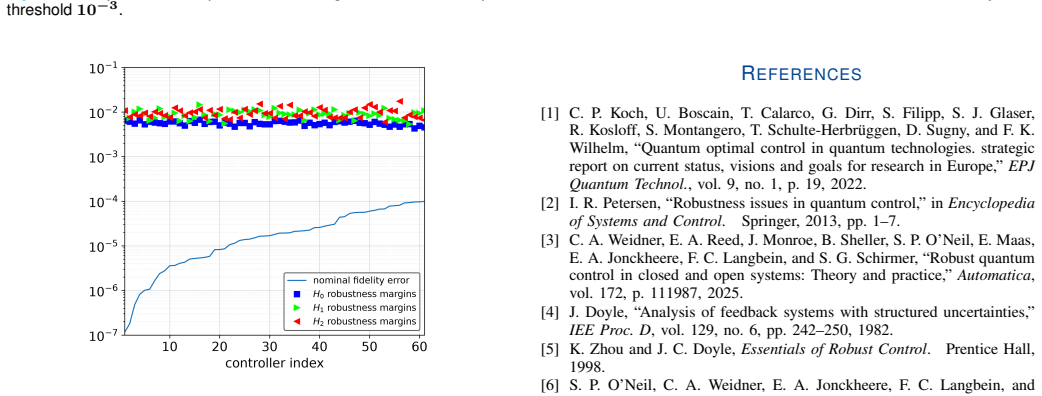
- Margins for drift versus control Hamiltonians rank controllers differently: the drift margin anticorrelates with nominal sensitivity while control-structure margins do not, so finite margins carry off-nominal information not present in nominal fidelity or local sensitivity.
Reading between the lines
- Since each step in the case study is certified and the post-hoc bracket between the reported margin and an upper witness is tight, the iteration likely reaches near the true boundary for many controllers; a testable extension is to use the directional statuses to produce two-sided brackets without extra bisection.
- The same recentering argument could be adapted to simultaneous scalar parameters by cycling coordinates or replacing the interval Lipschitz constant with a gradient-norm bound over a rectangle, but the paper explicitly leaves multiparameter extensions open.
- The structure-dependent ranking suggests margin-aware synthesis: optimizing the certified margin as part of the controller objective might select controllers that nominal fidelity alone would rank differently; that goes beyond what the paper demonstrates.
- The reported anti-correlation between nominal drift sensitivity magnitude and finite drift margin implies local differential sensitivity can be misleading as a robustness proxy; checking this on other spin-chain lengths or gate targets would be a cheap falsifiable follow-up.
Editorial analysis
A structured set of objections, weighed in public.
Referee Report
Summary. The paper considers finite-dimensional closed quantum systems under piecewise-constant coherent control and develops a scalar-parameter robustness margin for trace-amplitude gate fidelity. It derives a differential sensitivity bound (Theorem 1) from the skew-Hermitian nature of propagated perturbations and a Hermitian/skew-Hermitian decomposition, then converts the bound into a threshold-dependent Lipschitz constant on the connected safe component (Lemmas 3–4). The central result, Theorem 2, gives a certified radius r_nu = (F_nu - F_T)/L_hatH around any recentering point nu, and Algorithm 1 iterates this step to move toward the first threshold crossing. A three-qubit gate-control study with 61 controllers compares margins for drift and two control-Hamiltonian uncertainty structures. The main mathematical steps are checkable and the exact-arithmetic certificate is genuine; the principal weakness is the gap between the exact-arithmetic certificate and the floating-point numerical implementation used for the reported margins.
Significance. If the result is taken at face value, the paper provides a useful post-design certification tool: the Lipschitz constant is derived from the declared perturbation structure and the fidelity threshold, with no fitted parameters, and Theorem 2 gives an explicit, constructive safe-step certificate. The proof of the uniform bound f(mu) <= C_hatH, which a reader might initially treat as an assumption, is indeed supplied by Lemma 3 together with the affine structure of Eq. (4). The paper also ships reproducible code and data (Zenodo release), which raises confidence in the numerical experiments. The main mathematical contribution, a structure-specific fidelity-threshold margin with iterative recentering, is sound. The numerical certification gap, discussed below, tempers but does not invalidate the central theorem.
major comments (1)
- [Algorithm 1 and Section VI] The word 'certified' is load-bearing for the numerical margins reported in Section VI, but Algorithm 1 is certified only in exact arithmetic. The update nu+ = nu +/- (F_nu - F_T)/L_hatH uses Theorem 2 with the current fidelity F_nu, and the theorem requires F_nu to be exact. In the implementation, F_nu is a floating-point evaluation, and the bisection branch (Algorithm 1, lines 8–11) is only a numerical safeguard: it cannot detect or correct a case where a rounded-up F_nu causes the certified step to overshoot the true safe radius. The paper is partially transparent about this ('floating-point evaluations of analytically certified lower bounds'), but the abstract and conclusion continue to describe the margins and steps as 'certified' without this qualification. Please either implement the algorithm with interval/validated arithmetic for the reported numbers, or consistently state that t
minor comments (5)
- [Section V(b)] After centering, the notation for the perturbation structure is inconsistent: the text defines hat H_mu = hat H_mu - N^{-1}(Tr hat H_mu)I, and later writes 'Writing H_m = Hm - N^{-1}(Tr H_m)I' without the hat. This should be made uniform to avoid confusion between the original and centered structures.
- [Lemma 4 proof] The phrase 'the lower half of Lemma 4' is unclear: Lemma 4 states a two-sided Lipschitz inequality. Presumably the intended use is the lower bound |F_b - F_a| <= L |b-a|, which in the proof yields F_gamma(lambda) >= F_nu - L lambda |mu_1-nu|. Please rephrase.
- [Eq. (12)] The definition of B_T is written as B_T = sqrt((1-F_T^2)/N), but the derivation in Theorem 1 gives B_T = sqrt(1-F_T^2)/N. The square root covers only 1-F_T^2, not the division by N. Please check the typography in this displayed equation; the subsequent algebra appears correct.
- [Algorithm 1] The threshold status 'UNSET' is used but never explained. If it is just an internal flag, that is fine; still, a one-line clarification would help reproducibility.
- [Table I] The correlations are reported descriptively without confidence intervals or significance tests. Since the sample size is only 61, the reader cannot assess sampling variability. Adding a bootstrap interval or at least an explicit disclaimer that the entries are descriptive would be appropriate.
Circularity Check
No significant circularity: the Lipschitz certificate is derived from the structure constant C_hatH and fidelity values, not fitted; self-citations are auxiliary lemmas.
full rationale
The derivation chain is self-contained. The sensitivity formula (10) is written out explicitly and the derivative representation (8) is standard; the citation to [7] is a reference for the usual form of the derivative, not a load-bearing external uniqueness result. The uniform bound f(mu) <= C_hatH, which is the structurally weakest premise, is actually proven for the affine structure (4): for each interval dH^(k)/dmu = alpha^(k) Hhat_mu, so Lemma 3 gives f(mu) <= Delta sum |alpha^(k)| ||Hhat_mu||_F = C_hatH independent of mu; the trace-centering step changes only a global phase and cannot loosen the bound. Lemma 4 and Theorem 2 then follow in exact arithmetic: the radius (F_nu - F_T)/L_hatH is a consequence of the Lipschitz inequality, not an independently fitted parameter. Algorithm 1's repeated steps are covered by Theorem 2 at each iteration, and the numerical safeguard does not substitute a fitted quantity for a prediction. The only caveat, that reported floating-point values are not rigorously certified interval evaluations, concerns numerical certification rather than circularity. No equation is equivalent by construction to its input.
Assumptions & free parameters
assumptions (3)
- domain assumption For the considered affine structured perturbations, the sum of propagator-derivative norms f(mu) is uniformly bounded by a structure-determined constant C_hatH on the entire connected safe component.
- domain assumption The absolute-value fidelity is differentiable on the safe set where F_mu > F_T (equivalently nonzero trace overlap), and the sensitivity bound is valid throughout I.
- domain assumption The nominal controller and perturbed propagators are generated by Hermitian Hamiltonians, which guarantees unitarity and the Frobenius-norm invariance used throughout Lemmas 1-4.
Cite this review
Pith. "Pith review of Fidelity-Based Robustness Margins for Finite-Time Quantum Control." pith.science (2026). https://pith.science/paper/ZRZKVSNS
@misc{pith2026260803698,
  author       = {Pith},
  title        = {Pith review of: Fidelity-Based Robustness Margins for Finite-Time Quantum Control},
  year         = {2026},
  howpublished = {\url{https://pith.science/paper/ZRZKVSNS}},
  note         = {Machine review of arXiv:2608.03698}
}
read the original abstract
We develop a structure-specific fidelity-threshold robustness margin for finite-dimensional closed quantum systems under piecewise-constant coherent control. A scalar physical parameter may perturb the drift, a control Hamiltonian, or another declared Hamiltonian component across the control horizon. A differential sensitivity bound for trace-amplitude gate fidelity yields a threshold-dependent Lipschitz constant on the connected safe parameter component and hence a certified finite perturbation radius. Recentering this certificate produces an iterative one-dimensional method that takes certified safe steps toward the first fidelity-threshold boundary in either parameter direction. A three-qubit gate-control example shows that these finite margins vary by up to a factor of three across controllers of comparable nominal fidelity and contain structure-dependent information not captured by nominal differential sensitivity alone.
Figures


Reference graph
Works this paper leans on
-
[1]
C. P. Koch, U. Boscain, T. Calarco, G. Dirr, S. Filipp, S. J. Glaser, R. Kosloff, S. Montangero, T. Schulte-Herbr ¨uggen, D. Sugny, and F. K. Wilhelm, “Quantum optimal control in quantum technologies. strategic report on current status, visions and goals for research in Europe,”EPJ Quantum Technol., vol. 9, no. 1, p. 19, 2022
work page 2022
-
[2]
Robustness issues in quantum control,
I. R. Petersen, “Robustness issues in quantum control,” inEncyclopedia of Systems and Control. Springer, 2013, pp. 1–7
work page 2013
-
[3]
Robust quantum control in closed and open systems: Theory and practice,
C. A. Weidner, E. A. Reed, J. Monroe, B. Sheller, S. P. O’Neil, E. Maas, E. A. Jonckheere, F. C. Langbein, and S. G. Schirmer, “Robust quantum control in closed and open systems: Theory and practice,”Automatica, vol. 172, p. 111987, 2025
work page 2025
-
[4]
Analysis of feedback systems with structured uncertainties,
J. Doyle, “Analysis of feedback systems with structured uncertainties,” IEE Proc. D, vol. 129, no. 6, pp. 242–250, 1982
work page 1982
- [5]
-
[6]
Robustness of dynamic quantum control: Differential sensitivity bounds,
S. P. O’Neil, C. A. Weidner, E. A. Jonckheere, F. C. Langbein, and S. G. Schirmer, “Robustness of dynamic quantum control: Differential sensitivity bounds,”AVS Quantum Sci., vol. 6, no. 3, p. 032001, 2024
work page 2024
-
[7]
Sensitivity bounds for quantum control and time-domain performance guarantees,
S. P. O’Neil, E. A. Jonckheere, and S. Schirmer, “Sensitivity bounds for quantum control and time-domain performance guarantees,”IEEE Control Syst. Lett., vol. 8, pp. 169–174, 2024
work page 2024
-
[8]
Distance bounds on quantum dynamics,
D. A. Lidar, P. Zanardi, and K. Khodjasteh, “Distance bounds on quantum dynamics,”Phys. Rev. A, vol. 78, p. 012308, 2008
work page 2008
Show all 18 references
-
[9]
Robustness of quantum algorithms against coherent control errors,
J. Berberich, D. Fink, and C. Holm, “Robustness of quantum algorithms against coherent control errors,”Phys. Rev. A, vol. 109, p. 012417, 2024
2024
-
[10]
Robustness of quantum algorithms: Worst-case fidelity bounds and implications for design,
J. Berberich, T. Fellner, R. L. Kosut, and C. Holm, “Robustness of quantum algorithms: Worst-case fidelity bounds and implications for design,” 2026. [Online]. Available: https://arxiv.org/abs/2509.08481
2026
-
[11]
A fundamental bound for robust quantum gate control,
R. L. Kosut, D. A. Lidar, and H. Rabitz, “A fundamental bound for robust quantum gate control,” 2025. [Online]. Available: https://arxiv.org/abs/2507.01215
2025 arXiv
-
[12]
Universally robust quantum control,
P. M. Poggi, G. De Chiara, S. Campbell, and A. Kiely, “Universally robust quantum control,”Phys. Rev. Lett., vol. 132, no. 19, p. 193801, 2024
2024
-
[13]
Robust and optimal control of open quantum systems,
Z.-J. Chen, H. Huang, L. Sun, Q.-X. Jie, J. Zhou, Z. Hua, Y . Xu, W. Wang, G.-C. Guo, C.-L. Zou, L. Sun, and X.-B. Zou, “Robust and optimal control of open quantum systems,”Sci. Adv., vol. 11, no. 9, p. eadr0875, 2025
2025
-
[14]
Optimal control of coupled spin dynamics: Design of NMR pulse sequences by gradient ascent algorithms,
N. Khaneja, T. Reiss, C. Kehlet, T. Schulte-Herbr ¨uggen, and S. J. Glaser, “Optimal control of coupled spin dynamics: Design of NMR pulse sequences by gradient ascent algorithms,”J. Magn. Reson., vol. 172, no. 2, pp. 296–305, 2005
2005
-
[15]
Geometric interpre- tation of sensitivity to structured uncertainties in spintronic networks,
S. P. O’Neil, E. A. Jonckheere, and S. Schirmer, “Geometric interpre- tation of sensitivity to structured uncertainties in spintronic networks,” IEEE Control Syst. Lett., vol. 9, pp. 192–197, 2025
2025
-
[16]
Time-domain sensitivity of the tracking error,
S. O’Neil, S. Schirmer, F. C. Langbein, C. A. Weidner, and E. A. Jonckheere, “Time-domain sensitivity of the tracking error,”IEEE Trans. Autom. Control, vol. 69, no. 4, pp. 2340–2351, 2024
2024
-
[17]
Robust quantum gates for open systems via optimal control: Markovian versus non- Markovian dynamics,
F. F. Floether, P. de Fouqui `eres, and S. G. Schirmer, “Robust quantum gates for open systems via optimal control: Markovian versus non- Markovian dynamics,”New J. Phys., vol. 14, no. 7, p. 073023, 2012
2012
-
[18]
Fidelity-based quantum robustness margins,
F. C. Langbein, S. P. O’Neil, S. Schirmer, C. A. Weidner, and E. A. Jon- ckheere, “Fidelity-based quantum robustness margins,” Zenodo, 2026, ver. 1.0.2, doi: 10.5281/zenodo.21776873. Available: https://qyber.black/ spinnet/code-quantum-robustness-margins
2026 doi
Reviewed August 5, 2026 · model on record in the stance chip above.
Discussion (0). Sign in to comment.