REVIEW 2 major objections 4 minor 95 references
This paper claims that inclusive robot-mediated wellbeing assessment for children with DLD or forced-migration backgrounds requires human oversight, community co-design, intersectional bias testing, curated content, and careful robot embodi
Reviewed by Pith at T0; open to challenge. T0 means a machine referee read the full paper against a public rubric. the ladder, T0–T4 →
Focus groups with 14 stakeholders yielded design considerations and ethical recommendations for using social robots to assess wellbeing in children with communication barriers.
T0 review reviewed 2026-08-05 challenge →
load-bearing objection A careful stakeholder study with genuinely useful themes, but the recommendations overreach the 14-adult sample; treat as provisional design guidance. the 2 major comments →
Designing Social Robots for Inclusive Child Wellbeing Assessment: Insights from Communities Supporting Developmental Language Disorder and Forced Migration
The pith
A machine-rendered reading of the paper's core claim, the machinery that carries it, and where it could break.
The reading
Core claim
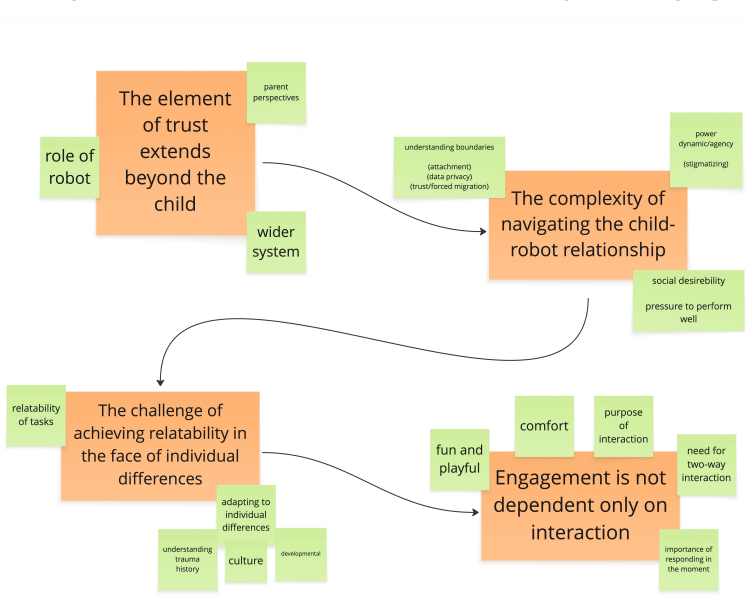
The central claim is that inclusive robot-mediated wellbeing assessment depends less on the specific activities than on how the robot is framed, how the interaction unfolds, how individual differences are accommodated, and how much agency the child has. Stakeholders did not reject robots; they saw them as playful tools that can lower pressure and elicit disclosures, but insisted they must complement rather than replace humans, especially at points of interpretation and disclosure. The paper's contribution is the resulting set of design recommendations: preserve human oversight; co-design and validate with the communities concerned; test components for intersectional bias; constrain generated
What carries the argument
The design probes are five (later six) candidate child–robot interaction activities—Getting to Know You, Structured Storytelling or Picture Description, Gesture Game, Turn-Taking, Emotion Expression and Understanding, plus a Story-based Self-disclosure Task for the forced-migration groups. These probes operationalise three domains (language and communication, social and non-verbal interaction, emotional understanding and expression) and give stakeholders a concrete object to react to. The argument is carried by reflexive thematic analysis of the focus-group discussions, with independent coding and combined cross-analysis producing the four overarching themes. The paper's mechanism is qualita
Load-bearing premise
The paper assumes that 14 parents and professionals—only two DLD parents and no forced-migration parents—responding to slide-based activity descriptions online can represent the experiences and needs of the two diverse child populations, without hearing from children themselves.
What would settle it
Observe live child–robot sessions with 8–11-year-olds from DLD and forced-migration backgrounds using these activities; if children show no difference in engagement or disclosure between curated and open-generated content, or if the co-designed adaptations fail to reduce distress or bias in automated scoring, the recommendations' empirical grounding would be weakened. A bias audit that finds current models no longer misclassify disability- and migration-related language would also remove the paper's central motivation for human oversight.
If this is right
- Future robot-mediated wellbeing assessments for children with DLD or forced-migration backgrounds should keep a human in the loop for interpreting affect, responding to disclosures, and managing distress.
- Content for storytelling, picture description, and emotion discussions should come from curated, reviewed banks rather than open-vocabulary generation, to avoid culturally loaded or trauma-triggering material.
- Robot teams should run routine intersectional bias tests on any language models or classifiers, with validation data drawn from the target communities rather than from typically developing or WEIRD samples.
- Robot embodiment and framing should avoid racially or militarily marked defaults and should not place the robot in an authority role.
- Design should cultivate child agency—letting the child choose activities, guide the robot, and experience no 'right answers'—while avoiding insincere praise.
Where Pith is reading between the lines
- If adopted as prerequisites, these recommendations imply that fully autonomous robot-led assessment is unlikely to be appropriate for these populations; the human-in-the-loop requirement may limit the scalability benefits often claimed for automated screening.
- The novel Story-based Self-disclosure Task has not been tested with children; a plausible next step is to validate whether third-person narrative identification yields reliable wellbeing signals across cultural groups.
- The four overarching themes may transfer to other children with communication differences, such as autistic children or AAC users, but the population-specific content safeguards would need to be re-derived because trauma triggers and communication barriers differ.
- Because no children participated, a direct test of the recommendations would be to run the activities with children from both populations and compare engagement, disclosure quality, and distress against adult-proxy expectations.
Editorial analysis
A structured set of objections, weighed in public.
Referee Report
Summary. The paper reports a qualitative, participatory-design study of considerations for robot-mediated wellbeing assessment for children aged 8–11 years with DLD or forced migration backgrounds. The authors developed five candidate child–robot interaction activities as design probes, then ran four online focus groups with 14 participants: two DLD parents, five DLD professionals, and seven professionals supporting children from forced migration backgrounds. Using reflexive thematic analysis, they identified four overarching themes (robot role/capabilities, interactional dynamics, individual differences, child agency) and population-specific insights for each community, and distilled five design recommendations (human oversight, community co-design, intersectional bias testing, curated content, and careful embodiment/framing). The paper is positioned as contributing early-phase design guidance rather than validated intervention outcomes.
Significance. If taken as design guidance for future development, the paper makes a useful contribution to an understudied area of child–robot interaction: assessment rather than intervention. Its strengths include a detailed, transparent account of the iterative activity design, dual independent coding with reflexive discussion, reporting of the full focus-group protocol and slide deck in appendices, and a thoughtful framing of design recommendations through epistemic justice and AI-bias literature. The concrete recommendations, especially the emphasis on community validation and intersectional bias testing, are actionable and clearly linked to participant concerns and prior work. The main value lies in shifting attention from feasibility of robot-mediated assessment to the design conditions under which such assessment could be inclusive and ethically acceptable for diverse communication needs.
major comments (2)
- [§3.2.1, §3.2.2, Abstract, §5.3, §6] The sample composition and the evidence basis for the recommendations need more explicit qualification. The DLD-parent ‘focus group’ comprised only two parents; the forced-migration groups comprised only professionals (no parents, by design) and no children participated anywhere. All groups were conducted online with slide-based materials, and a NAO was shown on camera only in the forced-migration sessions. This is an acceptable exploratory stakeholder-consultation design, but the abstract and §5.3 present the four themes and five recommendations as design guidance for the two target child populations. The paper should explicitly state that these are stakeholder-identified considerations and adult-proxy perspectives, not validated against children’s responses or real robot exposure. Section 6’s one-line future-work note is not enough; recommend adding a dedicated limitations paragraph an
- [§4.3, final paragraph] The text states that ‘The inclusion of parental perspectives within the subtheme “The perception of failure should be avoided” was primarily derived from discussions concerning children with forced migration backgrounds.’ Since the forced-migration focus groups included only professionals and no parents, this wording is confusing and internally inconsistent. It should be rephrased to refer to perspectives about parents or family-related concerns, not parental perspectives.
minor comments (4)
- [§3.3.3] The forced-migration transcripts were translated from Swedish to English by a bilingual researcher without AI tools; this is good practice, but the manuscript should note that translation may still introduce nuance loss, especially for emotionally laden discussion.
- [§4.1.3] Typo: ‘experiencess’ should be ‘experiences’.
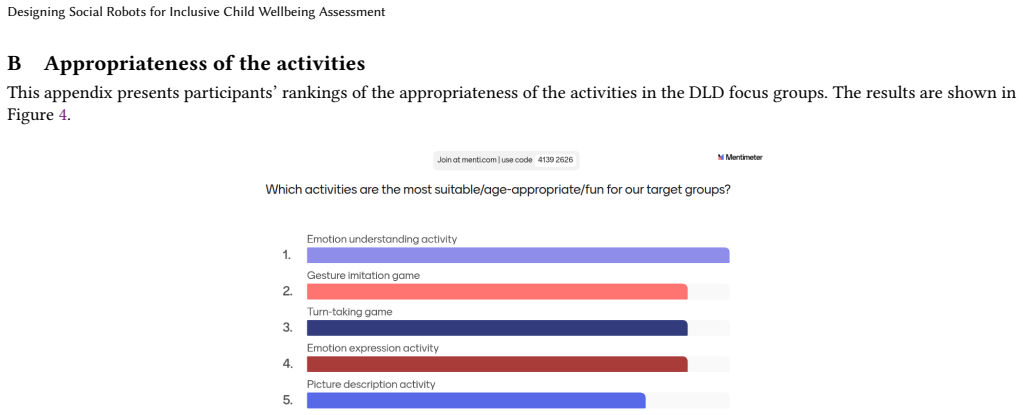
- [Appendix B] Figure 4 shows participants’ rankings of activity appropriateness, but the text never discusses or interprets these rankings. Either integrate this information into the results or remove the figure to avoid presenting unused data.
- [§3.2.2] The DLD and forced-migration procedures report different online platforms (Teams vs. Zoom), which is understandable, but the paper could briefly note whether this affected the interaction or facilitation.
Circularity Check
No significant circularity: themes and recommendations are derived directly from focus group data, not from fitted inputs or self-citation chains.
full rationale
The paper's derivation chain is: candidate activities are used as design probes → focus group discussions with parents/professionals → reflexive thematic analysis of transcripts → four overarching themes → five design recommendations. Each step is qualitative and data-driven; no parameter is fitted to a subset of data and then relabeled as a prediction, and no equation or formal model is constructed. Self-citations (e.g., Abbasi et al. 2022, 2025; [21]) are used to motivate the activity designs and to cite prior feasibility work, but they are not load-bearing for the findings. The themes (robot role, interactional nuances, individual differences, child agency) are reported as constructed from participant contributions, with direct quotes and subthemes traced to the data. The five recommendations are explicitly synthesized from participant themes and from external ethical/technical literature (e.g., epistemic justice, LLM bias), not from the authors' prior results. The limitation that the sample contains only 2 DLD parents and no forced-migration parents or children is a generalizability and proxy-validity concern, not circularity: the analysis does not assume the conclusion it derives. The paper itself acknowledges in Section 6 that future work should move beyond stakeholder perspectives. No circular step meeting the required evidentiary standard was found.
Axiom & Free-Parameter Ledger
axioms (2)
- domain assumption Focus group participants' perspectives are representative of the target communities' needs.
- domain assumption The candidate activities serve as valid design probes that elicit relevant reflections about robot-mediated wellbeing assessment.
Cite this review
Pith. "Pith review of Designing Social Robots for Inclusive Child Wellbeing Assessment: Insights from Communities Supporting Developmental Language Disorder and Forced Migration." pith.science (2026). https://pith.science/paper/2DADVBUI
@misc{pith2026260803820,
  author       = {Pith},
  title        = {Pith review of: Designing Social Robots for Inclusive Child Wellbeing Assessment: Insights from Communities Supporting Developmental Language Disorder and Forced Migration},
  year         = {2026},
  howpublished = {\url{https://pith.science/paper/2DADVBUI}},
  note         = {Machine review of arXiv:2608.03820}
}
read the original abstract
Assessing children's wellbeing and mental health can be particularly challenging for children experiencing communication barriers, such as children with Developmental Language Disorder (DLD) and children with forced migration backgrounds. During the assessment process, traditional self-report questionnaires place substantial demands on language comprehension and verbal expression. In this context, social robots have emerged as a promising tool for supporting wellbeing assessment without solely relying on self-report questionnaires, yet limited research has examined how such interactions can be designed to be inclusive, appropriate, and ethically acceptable for children with diverse communication needs. To address this gap, we created candidate child--robot interaction activities as design probes and conducted focus groups with parents and professionals supporting children with DLD and children with forced migration backgrounds. Through thematic analysis, we identified considerations relating to robot role and capabilities, interactional dynamics, individual differences, and child agency, alongside population-specific considerations shaped by children's communication needs and lived experiences. Based on these findings, we derive a set of ethical and inclusive design recommendations for robot-mediated wellbeing assessment. By foregrounding these considerations and recommendations, this work contributes design guidance for inclusive robot-mediated wellbeing assessments for children with diverse communication needs.
Figures





Reference graph
Works this paper leans on
-
[1]
Nida Itrat Abbasi, Fethiye Irmak Dogan, Guy Laban, Joanna Anderson, Tamsin Ford, Peter B. Jones, and Hatice Gunes. 2025. Robot-Led Vision Language Model Wellbeing Assessment of Children. In2025 34th IEEE International Conference on Robot and Human Interactive Communication (RO-MAN). 59–64. doi:10.1109/RO- MAN63969.2025.11217833
arXiv 2025
-
[2]
Nida Itrat Abbasi, Guy Laban, Tamsin Ford, Peter B. Jones, and Hatice Gunes. 2025. A Longitudinal Study of Child Wellbeing Assessment via Online Interactions with a Social Robot.J. Hum.-Robot Interact.14, 3, Article 51 (May 2025), 35 pages. doi:10.1145/3722123
-
[4]
Nida Itrat Abbasi, Micol Spitale, Joanna Anderson, Tamsin Ford, Peter B. Jones, and Hatice Gunes. 2022. Can Robots Help in the Evaluation of Mental Wellbeing in Children? An Empirical Study. In2022 31st IEEE International Conference on Robot and Human Interactive Communication (RO-MAN). 1459–1466. doi:10.1109/ RO-MAN53752.2022.9900843
arXiv 2022
-
[5]
Jones, and Hatice Gunes
Nida Itrat Abbasi, Micol Spitale, Joanna Anderson, Tamsin Ford, Peter B. Jones, and Hatice Gunes. 2022. Computational Audio Modelling for Robot-Assisted Assessment of Children’s Mental Wellbeing. InSocial Robotics, Filippo Cav- allo, John-John Cabibihan, Laura Fiorini, Alessandra Sorrentino, Hongsheng He, Xiaorui Liu, Yoshio Matsumoto, and Shuzhi Sam Ge (...
2022
-
[6]
Nida Itrat Abbasi, Micol Spitale, Joanna Anderson, Tamsin Ford, Peter B Jones, and Hatice Gunes. 2024. Analysing children’s responses from multiple modalities during robot-assisted assessment of mental wellbeing.International Journal of Social Robotics16, 5 (2024), 999–1046
2024
-
[7]
Abubakar Abid, Maheen Farooqi, and James Zou. 2021. Persistent Anti-Muslim Bias in Large Language Models. InProceedings of the 2021 AAAI/ACM Conference on AI, Ethics, and Society (AIES ’21). Association for Computing Machinery, New York, NY, USA, 298–306. doi:10.1145/3461702.3462624
arXiv 2021
-
[8]
Muneeb Imtiaz Ahmad, Omar Mubin, and Joanne Orlando. 2017. Adaptive social robot for sustaining social engagement during long-term children–robot interaction.International Journal of Human–Computer Interaction33, 12 (2017), 943–962
2017
-
[9]
Safinah Ali, Ayat Abodayeh, Zahra Dhuliawala, Cynthia Breazeal, and Hae Won Park. 2025. Towards Inclusive Co-Creative Child-Robot Interaction: Can Social Robots Support Neurodivergent Children’s Creativity?. In2025 20th ACM/IEEE International Conference on Human-Robot Interaction (HRI). 321–330. doi:10.1109/ HRI61500.2025.10974006
arXiv 2025
-
[10]
2025.Personalising Human-Robot Interactions in Social Contexts
Antonio Andriella, Carme Torras, and Guillem Alenyà. 2025.Personalising Human-Robot Interactions in Social Contexts. Springer
2025
-
[11]
Adrian Angold, Elizabeth J Costello, Stephen C Messer, and Andrew Pickles
-
[12]
Steven R Asher and Heidi Gazelle. 1999. Loneliness, peer relations, and language disorder in childhood.Topics in Language Disorders19, 2 (1999), 16–33
1999
-
[13]
Shaul Ashkenazi, Rawan Srour-Zreik, Gabriel Skantze, Jane Stuart-Smith, and Mary Ellen Foster. 2026. Participatory Design for Human-Robot Interaction with Syrian Refugees and Asylum Seekers. InSocial Robotics + AI, Mariacarla Staffa, John-John Cabibihan, Bruno Siciliano, Shuzhi Sam Ge, Leon Bodenhagen, Adriana Tapus, Silvia Rossi, Filippo Cavallo, Laura F...
2026
-
[14]
Xue, Peter S
Mohammad Atari, Mona J. Xue, Peter S. Park, Damián E. Blasi, and Joseph Henrich. 2023. Which Humans? Preprint. Department of Human Evolutionary Biology, Harvard University
2023
-
[15]
Minja Axelsson, Indu P. Bodala, and Hatice Gunes. 2021. Participatory Design of a Robotic Mental Well-being Coach. In2021 30th IEEE International Conference on Robot and Human Interactive Communication (RO-MAN). 1081–1088. doi:10. 1109/RO-MAN50785.2021.9515356
arXiv 2021
-
[16]
Minja Axelsson, Jiaee Cheong, Rune Nyrup, and Hatice Gunes. 2025. Who Owns The Robot?: Four Ethical and Socio-technical Questions about Wellbeing Robots in the Real World through Community Engagement. InProceedings of the AAAI/ACM Conference on AI, Ethics, and Society, Vol. 8. 249–264
2025
-
[17]
oh, sorry, i think i interrupted you
Minja Axelsson, Micol Spitale, and Hatice Gunes. 2024. " oh, sorry, i think i interrupted you": Designing repair strategies for robotic longitudinal well- being coaching. InProceedings of the 2024 ACM/IEEE International Conference on Human-Robot Interaction. 13–22
2024
-
[18]
Asher Ben-Arieh, Ferran Casas, Ivar Frønes, Jill E Korbin, et al. 2014. Multifaceted concept of child well-being.Handbook of child well-being1, 1 (2014), 1–27
2014
-
[19]
Bethel, Zachary Henkel, Kristen Stives, David C
Cindy L. Bethel, Zachary Henkel, Kristen Stives, David C. May, Deborah K. Eakin, Melinda Pilkinton, Alexis Jones, and Megan Stubbs-Richardson. 2016. Using robots to interview children about bullying: Lessons learned from an exploratory study. In2016 25th IEEE International Symposium on Robot and Human Interactive Communication (RO-MAN). 712–717. doi:10.11...
-
[20]
Cindy L. Bethel, Matthew R. Stevenson, and Brian Scassellati. 2011. Secret- sharing: Interactions between a child, robot, and adult. In2011 IEEE International Conference on Systems, Man, and Cybernetics. 2489–2494. doi:10.1109/ICSMC. 2011.6084051
arXiv 2011
-
[21]
Cross, Friederike Eyssel, Tamsin Ford, Jenny L
Jacqueline Borgstedt, Ricarda Wullenkord, Fethiye Irmak Doğan, Alva Marke- lius, Yue Lou, Emma Geijer-Simpson, Emily S. Cross, Friederike Eyssel, Tamsin Ford, Jenny L. Gibson, Hatice Gunes, Georgina Warner, and Ginevra Castellano
-
[22]
Kayvan Bozorgmehr, Martin McKee, Natasha Azzopardi-Muscat, Jozef Bartovic, Ines Campos-Matos, Tsvetelina-Ivanova Gerganova, Ailish Hannigan, Jelena Janković, Daniela Kállayová, Josiah Kaplan, Ilker Kayi, Elias Kondilis, Lene Lund- berg, Isabel De La Mata, Aleksandar Medarević, Jozef Suvada, Kolitha Wick- ramage, and Soorej Jose Puthoopparambil. 2023. Inte...
arXiv 2023
-
[23]
Virginia Braun and Victoria Clarke. 2006. Using Thematic Analysis in Psy- chology.Qualitative Research in Psychology3, 2 (2006), 77–101. doi:10.1191/ 1478088706qp063oa
2006
-
[24]
Virginia Braun and Victoria Clarke. 2019. Reflecting on Reflexive Thematic Analysis.Qualitative Research in Sport, Exercise and Health11, 4 (2019), 589–597. doi:10.1080/2159676X.2019.1628806
arXiv 2019
-
[25]
Virginia Braun and Victoria Clarke. 2021. One Size Fits All? What Counts as Quality Practice in (Reflexive) Thematic Analysis?Qualitative Research in Psychology18, 3 (2021), 328–352. doi:10.1080/14780887.2020.1769238
arXiv 2021
-
[26]
Paul Bremner, Oya Celiktutan, and Hatice Gunes. 2016. Personality perception of robot avatar tele-operators. In2016 11th ACM/IEEE International Conference on Human-Robot Interaction (HRI). 141–148. doi:10.1109/HRI.2016.7451745
arXiv 2016
-
[27]
Vicky Charisi, Selma Šabanović, Angelo Cangelosi, and Randy Gomez. 2021. Designing and Developing Better Robots for Children: A Fundamental Human Rights Perspective. InCompanion of the 2021 ACM/IEEE International Conference on Human-Robot Interaction (HRI ’21 Companion). Association for Computing Machinery, New York, NY, USA, 712–714. doi:10.1145/3434074.3444875
arXiv 2021
-
[28]
Bruce F Chorpita, Letitia Yim, Catherine Moffitt, Lori A Umemoto, and Sarah E Francis. 2000. Assessment of symptoms of DSM-IV anxiety and depression in children: a revised child anxiety and depression scale.Behaviour Research and Therapy38, 8 (2000), 835–855. doi:10.1016/S0005-7967(99)00130-8
-
[29]
Conijn, Niels Smits, and Esther E
Judith M. Conijn, Niels Smits, and Esther E. Hartman. 2020. Determining at What Age Children Provide Sound Self-Reports: An Illustration of the Validity-Index Approach.Assessment27, 7 (Oct. 2020), 1604–1618. doi:10.1177/ 1073191119832655
2020
-
[30]
Elizabeth H Connors, Kathryn Moffa, Taneisha Carter, John Crocker, Jill H Bohnenkamp, Nancy A Lever, and Sharon A Hoover. 2022. Advancing mental health screening in schools: Innovative, field-tested practices and observed trends during a 15-month learning collaborative.Psychology in the Schools59, 6 (2022), 1135–1157
work page 2022
-
[31]
Jung, Nicola Dell, Deborah Estrin, and James A
Andrea Cuadra, Maria Wang, Lynn Andrea Stein, Malte F. Jung, Nicola Dell, Deborah Estrin, and James A. Landay. 2024. The Illusion of Empathy? Notes on Displays of Emotion in Human-Computer Interaction. InProceedings of the 2024 CHI Conference on Human Factors in Computing Systems (CHI ’24). Association for Computing Machinery, New York, NY, USA, 18 pages....
doi:10.1145/3613904 2024
-
[32]
Jessica Deighton, Tim Croudace, Peter Fonagy, Jeb Brown, Praveetha Patalay, and Miranda Wolpert. 2014. Measuring mental health and wellbeing outcomes for children and adolescents to inform practice and policy: a review of child self-report measures.Child and adolescent psychiatry and mental health8, 1 (2014), 14
work page 2014
-
[33]
Fethiye Irmak Doğan, Alva Markelius, and Hatice Gunes. 2026. Designing Social Robots with Ethical, User-Adaptive Explainability in the Era of Foundation Models. InCompanion Proceedings of the 21st ACM/IEEE International Conference on Human-Robot Interaction(Edinburgh, Scotland, UK)(HRI Companion ’26). Association for Computing Machinery, New York, NY, USA...
-
[34]
Iris Duinmeijer, Sanne Peet, Lonneke Janssen, Annette Scheper, Margo Zwitserlood-Nijenhuis, Wendy Bliekendaal, Marijke Zoons, and Britt Hakvoort
-
[35]
Patricia Eadie, Laura Conway, Birgit Hallenstein, Fiona Mensah, Cristina McKean, and Sheena Reilly. 2018. Quality of life in children with developmental language disorder.International Journal of Language & Communication Disorders53, 4 (2018), 799–810. arXiv:https://onlinelibrary.wiley.com/doi/pdf/10.1111/1460- 6984.12385 doi:10.1111/1460-6984.12385
arXiv 2018
-
[36]
Marina Escobar-Planas, Vicky Charisi, and Emilia Gomez. 2022. "That Robot Played with Us!" Children’s Perceptions of a Robot after a Child-Robot Group Interaction.Proc. ACM Hum.-Comput. Interact.6, CSCW2, Article 393 (Nov. 2022), 23 pages. doi:10.1145/3555118
-
[37]
Mina Fazel and Theresa S Betancourt. 2018. Preventive mental health interven- tions for refugee children and adolescents in high-income settings.The Lancet Child & Adolescent Health2, 2 (2018), 121–132
work page 2018
-
[38]
Mina Fazel, Ruth V Reed, Catherine Panter-Brick, and Alan Stein. 2012. Mental health of displaced and refugee children resettled in high-income countries: risk and protective factors.The Lancet379, 9812 (2012), 266–282. doi:10.1016/S0140- 6736(11)60051-2
doi:10.1016/s0140- 2012
-
[39]
Terrence Fong, Illah Nourbakhsh, and Kerstin Dautenhahn. 2003. A survey of socially interactive robots.Robotics and Autonomous Systems42, 3 (2003), 143–166. doi:10.1016/S0921-8890(02)00372-X Socially Interactive Robots
-
[40]
Jenny Gibson and Umar Toseeb. 2024.Developmental Language Disorder and Social-Emotional Development: An Introduction to Theories, Concepts, and Research. Oxford University Press (OUP)
work page 2024
-
[41]
Robert Goodman. 1997. The Strengths and Difficulties Questionnaire: a research note.Journal of child psychology and psychiatry38, 5 (1997), 581–586
work page 1997
-
[42]
Beaumont, Maria Hoogstrate, and Jessica L
Chloe Haidenhofer, Laurianne Sitbon, Chris P. Beaumont, Maria Hoogstrate, and Jessica L. Korte. 2024. From Research Participant to Co-researcher: Chloe’s Story on Co-designing Inclusive Technologies with People with Intellectual Disability. InProceedings of the 26th International ACM SIGACCESS Conference on Computers and Accessibility (ASSETS ’24). Associ...
- [43]
-
[44]
Aike C Horstmann and Nicole C Krämer. 2020. Expectations vs. actual behavior of a social robot: An experimental investigation of the effects of a social robot’s interaction skill level and its expected future role on people’s evaluations.PloS one15, 8 (2020), e0238133
work page 2020
-
[45]
Jin Huang, Fethiye Irmak Doğan, and Hatice Gunes. 2026. Reimagining Social Robots as Recommender Systems: Foundations, Framework, and Applications. InProceedings of the 21st ACM/IEEE International Conference on Human-Robot Interaction(Edinburgh, Scotland, UK)(HRI ’26). Association for Computing Ma- chinery, New York, NY, USA, 406–416. doi:10.1145/3757279.3785610
-
[46]
Andrew Hundt, Rumaisa Azeem, Masoumeh Mansouri, and Martim Brandão
-
[47]
Kory-Westlund and Cynthia Breazeal
Jacqueline M. Kory-Westlund and Cynthia Breazeal. 2019. Exploring the Effects of a Social Robot’s Speech Entrainment and Backstory on Young Children’s Emotion, Rapport, Relationship, and Learning.Frontiers in Robotics and AI Volume 6 - 2019 (2019). doi:10.3389/frobt.2019.00054
arXiv 2019
-
[48]
Penny Levickis, Emma Sciberras, Cristina McKean, Laura Conway, Angela Pezic, Fiona K Mensah, Edith L Bavin, Lesley Bretherton, Patricia Eadie, Margot Prior, et al. 2018. Language and social-emotional and behavioural wellbeing from 4 to 7 years: A community-based study.European child & adolescent psychiatry27, 7 (2018), 849–859
work page 2018
-
[49]
Yue Lou, Emma Geijer-Simpson, Georgina Warner, Anna Pérez-Aronsson, Elin Inge, and Ginevra Castellano. 2026. Children’s Perspectives on Robot Futures: A Speculative Participatory Approach to Child Wellbeing. InCompanion Proceed- ings of the 21st ACM/IEEE International Conference on Human-Robot Interaction (Edinburgh, Scotland, UK)(HRI Companion ’26). Asso...
-
[50]
LLM-Driven Robots Risk Enacting Discrimination, Violence, and Unlawful Actions.International Journal of Social Robotics17 (2025), 2663–2711. doi:10. 1007/s12369-025-01301-x
work page 2025
-
[51]
Leena Mathur, Micol Spitale, Hao Xi, Jieyun Li, and Maja J Matarić. 2021. Modeling User Empathy Elicited by a Robot Storyteller. In2021 9th Interna- tional Conference on Affective Computing and Intelligent Interaction (ACII). 1–8. doi:10.1109/ACII52823.2021.9597416
arXiv 2021
-
[52]
Nora McDonald, Sarita Schoenebeck, and Andrea Forte. 2019. Reliability and Inter-Rater Reliability in Qualitative Research: Norms and Guidelines for CSCW and HCI Practice.Proceedings of the ACM on Human-Computer Interaction3, CSCW, Article 72 (2019), 23 pages. doi:10.1145/3359174
doi:10.1145/3359174 2019
-
[53]
Mei, Sonia Fereidooni, and Aylin Caliskan
Katelyn X. Mei, Sonia Fereidooni, and Aylin Caliskan. 2023. Bias Against 93 Stigmatized Groups in Masked Language Models and Downstream Sentiment Classification Tasks. InProceedings of the 2023 ACM Conference on Fairness, Ac- countability, and Transparency (FAccT ’23). Association for Computing Machinery, New York, NY, USA. doi:10.1145/3593013.3594109
arXiv 2023
-
[54]
Alva Markelius, Julie Bailey, Jenny L. Gibson, and Hatice Gunes. 2025. Stake- holder Perspectives on Whether and How Social Robots Can Support Mediation and Advocacy for Higher Education Students with Disabilities.arXiv preprint arXiv:2503.16499. arXiv:2503.16499
work page internal anchor Pith review Pith/arXiv arXiv 2025
-
[55]
Karen Nakamura. 2019. My Algorithms Have Determined You’re Not Human: AI-ML, Reverse Turing-Tests, and the Disability Experience. InProceedings of the 21st International ACM SIGACCESS Conference on Computers and Accessibility (ASSETS ’19). Association for Computing Machinery, New York, NY, USA, 1–2. doi:10.1145/3308561.3353812
-
[56]
2023.Devel- opmental Language Disorder
National Institute on Deafness and Other Communication Disorders. 2023.Devel- opmental Language Disorder. https://www.nidcd.nih.gov/health/developmental- language-disorder
work page 2023
-
[57]
Jacopo Nudo, Mario Edoardo Pandolfo, Edoardo Loru, Mattia Samory, Matteo Cinelli, and Walter Quattrociocchi. 2026. Generative Exaggeration in LLM Social Agents: Consistency, Bias, and Toxicity.Online Social Networks and Media(2026)
work page 2026
-
[58]
Xinjun Miao, Ines Ziyou Yin, Han Zhang, and Kin Wai Michael Siu. 2025. Par- ticipatory Research Methods and Tools for Promoting Children’s Psychological Well-Being: A Systematic Review.Applied Research in Quality of Life20 (2025), 1629–1664. doi:10.1007/s11482-025-10490-6
-
[59]
Anastasia K. Ostrowski, Raechel Walker, Madhurima Das, Maria Yang, Cynthia Breazeal, Hae Won Park, and Aditi Verma. 2022. Ethics, Equity, & Justice in Human-Robot Interaction: A Review and Future Directions. In2022 31st IEEE International Conference on Robot and Human Interactive Communication (RO- MAN). IEEE
work page 2022
-
[60]
Dimitris Pnevmatikos and Panagiota Christodoulou. [n. d.]. Anchors or relational risks? Educator and psychologist narratives of attachment in child–robot relationships.British Journal of Educational Psychologyn/a, n/a ([n. d.]). arXiv:https://bpspsychub.onlinelibrary.wiley.com/doi/pdf/10.1111/bjep.70078 doi:10.1111/bjep.70078
-
[61]
Elizabeth L Pollard and Patrice D Lee. 2003. Child well-being: A systematic review of the literature.Social indicators research61, 1 (2003), 59–78
work page 2003
-
[62]
Dotun Olutunbi, Riccardo Polvara, Tom Davies, Jenny Hamilton, Niko Kar- gas, and Francesco Del Duchetto. 2026. Who Leads the Story? Comparing Autonomous vs. Adult-Supported Child-Robot Interactions. InProceedings of the 21st ACM/IEEE International Conference on Human-Robot Interaction(Edinburgh, Scotland, UK)(HRI ’26). Association for Computing Machinery,...
-
[63]
Elinor Poole-Dayan, Deb Roy, and Jad Kabbara. 2026. LLM Targeted Underper- formance Disproportionately Impacts Vulnerable Users. InProceedings of the AAAI Conference on Artificial Intelligence, Vol. 40. 39116–39124. doi:10.1609/aaai. v40i46.41259
doi:10.1609/aaai 2026
-
[64]
Nazerke Rakhymbayeva and Anara Sandygulova. 2026. Building Inclusive HRI: Early Insights on Ethical AI for Neurodiverse Children. InCompanion Proceed- ings of the 21st ACM/IEEE International Conference on Human-Robot Interaction (Edinburgh, Scotland, UK)(HRI Companion ’26). Association for Computing Machinery, New York, NY, USA, 1094–1098. doi:10.1145/377...
-
[65]
Samira Rasouli, Garima Gupta, Elizabeth Nilsen, and Kerstin Dautenhahn. 2022. Potential Applications of Social Robots in Robot-Assisted Interventions for Social Anxiety.International Journal of Social Robotics14, 5 (july 2022), 1–32. doi:10. 1007/s12369-021-00851-0
work page 2022
-
[66]
Panayiota Polycarpou, Anna Andreeva, Andri Ioannou, and Panayiotis Zaphiris
-
[67]
Ulrike Ravens-Sieberer, Angela Gosch, Luis Rajmil, Michael Erhart, Jeanet Bruil, Wolfgang Duer, Pascal Auquier, Mick Power, Thomas Abel, Ladislav Czemy, et al. 2005. KIDSCREEN-52 quality-of-life measure for children and adolescents. Expert review of pharmacoeconomics & outcomes research5, 3 (2005), 353–364
work page 2005
-
[68]
Anne W. Riley. 2004. Evidence That School-Age Children Can Self-Report on Their Health.Ambulatory Pediatrics4, 4 (2004), 371–376. doi:10.1367/A03-178R.1
-
[69]
Florian Scharpf, Elisa Kaltenbach, Angela Nickerson, and Tobias Hecker. 2021. A systematic review of socio-ecological factors contributing to risk and protection of the mental health of refugee children and adolescents.Clinical Psychology Review83 (Feb. 2021), 101930. doi:10.1016/j.cpr.2020.101930
-
[70]
Gabriel Skantze, Martin Johansson, and Jonas Beskow. 2015. Exploring Turn- taking Cues in Multi-party Human-robot Discussions about Objects. InPro- ceedings of the 2015 ACM on International Conference on Multimodal Interaction (Seattle, Washington, USA)(ICMI ’15). Association for Computing Machinery, New York, NY, USA, 67–74. doi:10.1145/2818346.2820749
arXiv 2015
-
[71]
Ulrike Ravens-Sieberer and Monika Bullinger. 1998. Assessing health-related quality of life in chronically ill children with the German KINDL: first psychome- tric and content analytical results.Quality of life research7, 5 (1998), 399–407
work page 1998
-
[72]
Robert Sparrow. 2020. Robotics Has a Race Problem.Science, Technology, & Human Values45, 3 (2020), 538–560. doi:10.1177/0162243919862862
-
[73]
Stamatis, Guy Laban, Angelica Lim, and Hatice Gunes
Micol Spitale, Minja Axelsson, Sooyeon Jeong, Paige Tuttösí, Caitlin A. Stamatis, Guy Laban, Angelica Lim, and Hatice Gunes. 2026. Past, Present, and Future: A Survey of the Evolution of Affective Robotics for Well-Being.IEEE Transactions on Affective Computing17, 2 (2026), 1923–1939. doi:10.1109/TAFFC.2025.3567740
- [74]
-
[75]
Laetitia Tanqueray, Tobiaz Paulsson, Mengyu Zhong, Stefan Larsson, and Ginevra Castellano. 2022. Gender fairness in social robotics: exploring a future care of peripartum depression. In2022 17th ACM/IEEE International Conference on Human-Robot Interaction (HRI). IEEE, 598–607
work page 2022
-
[76]
Emma Soneson, Mina Fazel, Puneetha S. Goli, and Simon R. White. 2025. Are Adolescents Sensitive About Sensitive Data? Exploring Student Concerns About Privacy, Confidentiality, and Data Use in Health Research.Journal of Adolescent Health76, 6 (2025), 1008–1017. doi:10.1016/j.jadohealth.2025.03.004
-
[77]
2017.Education Uprooted: For Every Migrant, Refugee and Displaced Child, Education
UNICEF. 2017.Education Uprooted: For Every Migrant, Refugee and Displaced Child, Education. Technical Report. UNICEF. https://www.unicef.org/reports/ education-uprooted
work page 2017
-
[78]
Caroline L Van Straten, Jochen Peter, and Rinaldo Kühne. 2020. Child–robot relationship formation: A narrative review of empirical research.International Journal of Social Robotics12, 2 (2020), 325–344
2020
-
[79]
Claudia Wild, Sabine Kampmüller, Petra Krenn-Maritz, and Veronika Dobler. 2026. Trauma Care: Teaching Recovery Technique (TRT) to Children and Adolescent Refugees: A Systematic Review on Effectiveness.Journal of Child & Adolescent Trauma(March 2026). doi:10.1007/s40653-026-00851-0
-
[80]
Elmira Yadollahi, Fethiye Irmak Dogan, Yujing Zhang, Beatriz Nogueira, Tiago Guerreiro, Shelly Levy Tzedek, and Iolanda Leite. 2025. Expectations, Expla- nations, and Embodiment: Attempts at Robot Failure Recovery.arXiv preprint arXiv:2504.07266(2025)
Pith/arXiv arXiv 2025
-
[81]
Tozadore, Sanna Kuoppamäki, and Arzu Guneysu
Daniel C. Tozadore, Sanna Kuoppamäki, and Arzu Guneysu. 2023. Teacher’s Perception on Social Robots to Promote the Integration of Children with Migra- tion Background. InProceedings of the International Conference on Human-Agent Interaction (HAI ’23). Association for Computing Machinery, New York, NY, USA, 392–394. doi:10.1145/3623809.3623937
This paper was first reviewed by deepseek-v4-flash on August 5, 2026.
discussion (0)
Sign in with ORCID, Apple, or X to comment. Anyone can read and Pith papers without signing in.