REVIEW 4 major objections 5 minor 34 references
LiteMVS: Efficient Multi-View Stereo with Foundation Distillation and Expert Aggregation
T0 review · 4 major / 5 minor · reviewed 2026-08-05 · deepseek-v4-flash
Pith's one-line read LiteMVS claims that injecting semantic descriptors and foundation-model pseudo-labels into a plane-sweep cost volume yields more accurate depth and 3D reconstruction at roughly 75 ms per frame.
desk verdict LiteMVS is a sensible architecture with a real training-data confound in its SOTA comparison; worth review, not yet trustworthy. read the letter →
The pith
A machine-rendered reading of the paper's core claim, the machinery that carries it, and where it could break.
The reading
What carries the argument
The load-bearing object is the semantic-augmented 4D cost volume: per-pixel semantic descriptors from a lightweight segmentation encoder (MobileSAM lineage) are broadcast along the depth dimension and concatenated with warped multi-view features and geometric metadata, so every depth hypothesis carries both matching evidence and monocular boundary/structure cues. A Mixture-of-Experts MLP then aggregates the volume, with a gating network letting experts specialize across depth regimes, and pseudo-label losses transfer foundation-model priors at no extra inference cost.
What would settle it
Re-run SimpleRecon, DoubleTake, and LiteMVS under one shared keyframe schedule, mesh mask, and GPU, then recompute the depth and reconstruction tables; if the re-run baselines match or exceed LiteMVS's reported numbers, the central accuracy claim is an artifact of the comparison protocol.
Extended reading notes
Core claim
LiteMVS claims that an efficient multi-view stereo network does not have to choose between geometric consistency and monocular priors. It augments a standard plane-sweep feature volume with semantic descriptors from a lightweight segmentation encoder, replaces the shared cost-aggregation MLP with a Mixture-of-Experts (MoE) formulation so different experts specialize across depth ranges, and adds output-level distillation: relative-depth pseudo-labels from Depth Anything V2 and surface-normal pseudo-labels from StableNormal supervise training without changing inference. The combined system yields sharper boundaries and lower depth error than SimpleRecon and DoubleTake on ScanNetv2 and 7-Scene
Load-bearing premise
The load-bearing premise is that all methods were compared under the same protocol—same keyframes, mesh masks, hardware, and input views—since Table 1 reports some previous results from [12] or from each method's own keyframes; if the protocol is not identical, the reported accuracy advantages are not attributable to the architecture.
Editorial extensions
If this is right
- Lightweight 2D-CNN-based MVS can reach reconstruction quality previously associated with heavier volumetric refinement, at real-time update rates.
- Distilling relative depth and surface-normal pseudo-labels from foundation models is a low-cost way to import monocular priors into task-specific networks.
- Letting multiple expert MLPs specialize across depth ranges improves accuracy over a single shared MLP, with gains saturating around three experts.
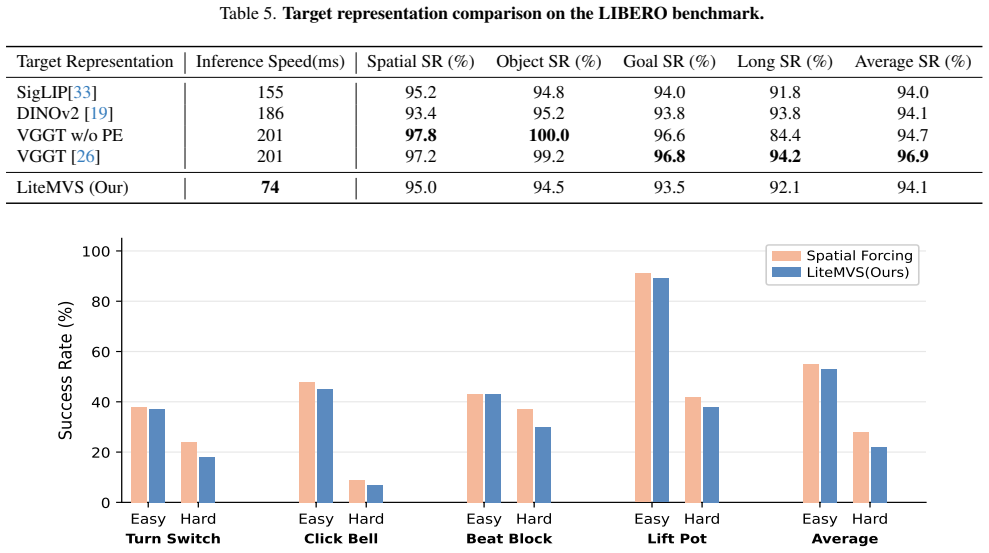
- Geometry-aware MVS features can serve as efficient visual targets for embodied manipulation policies, matching heavier 3D backbones on LIBERO at about one-third the inference cost.
- Using segmentation cues as auxiliary guidance rather than a trained head keeps the semantic prior optional at inference time.
Reading between the lines
- The authors' own limitation list — reflective surfaces, transparent objects, low-texture regions — maps cleanly onto the failure modes that appearance matching and monocular priors share; if semantic cues are doing the claimed work, per-region error analysis should show the largest gains exactly there. That is a testable prediction the paper does not make.
- The MoE saturation at three experts suggests the mechanism may be interpreted as a soft split of the depth range rather than a capacity increase; plotting gate weights against true depth would confirm the specialization directly.
- The same pseudo-label distillation recipe could extend to other geometry outputs, such as optical flow or 4D tracking, since the paper demonstrates it only for static-scene depth and normals.
- Because Table 1 mixes previously reported numbers with per-method keyframes, the cleanest way to test the accuracy claim is a single-keyframe re-run of all baselines on identical hardware.
Editorial analysis
A structured set of objections, weighed in public.
Referee Report
Summary. The paper introduces LiteMVS, a lightweight multi-view stereo depth estimator that augments a plane-sweep cost volume with semantic descriptors from MobileSAM, aggregates cost features with a Mixture-of-Experts (MoE) MLP, and distills relative-depth and surface-normal pseudo-labels from Depth Anything V2 and StableNormal during training. The authors report lower depth errors than SimpleRecon and DoubleTake on ScanNetv2 and 7-Scenes, improved 3D reconstruction F-score, and competitive per-frame latency, as well as downstream manipulation results on LIBERO and RoboTwin 2.0. The central claim is that combining monocular semantic/structural priors with efficient MVS improves the accuracy-efficiency trade-off without adding inference cost.
Significance. If the results hold, the paper offers a practical recipe for injecting foundation-model priors into lightweight MVS while keeping inference cost unchanged, since the distilled pseudo-labels are used only as training supervision. The architecture is clearly motivated, and the evaluation spans depth, reconstruction, and embodied downstream tasks. I agree with the reader that there is no circularity: pseudo-labels are training signals, and all reported metrics are against ground-truth depth/meshes. The benchmark claims are falsifiable, and the ablations that are actually run generally support the stated components. However, the headline comparative claims are currently conditional on an uncontrolled training-data protocol and on a missing distillation ablation, so the significance is not yet established at the level claimed.
major comments (4)
- [Section 4, Tables 1–2] The headline comparisons are confounded by training data. Section 4 states LiteMVS is trained on 'a combination of ScanNetv2 and ScanNet++', while Table 1's caption says prior results were 'taken from [12], or evaluated for each method using their keyframes'; there is no statement that SimpleRecon or DoubleTake were retrained on the same ScanNet++-augmented split. Since ScanNet++ is larger and higher-fidelity, the reported margins (e.g., Abs Rel 0.0311 vs 0.0369 for DoubleTake; F-score 0.715 vs 0.714) may reflect a data advantage rather than an architectural one. Please retrain all baselines on the identical data split, or report a ScanNet-only comparison, and state the full evaluation protocol. Reporting multiple-seed error bars would also help for the near-tie F-score difference.
- [Section 5.3, Table 3] The claimed contribution of pseudo-label distillation is not ablated. Section 5.3 is titled 'Effect of Vision Foundation Model Distillation', but its text and Table 4 vary the number of MoE experts; the Table 3 row 'Ours w/oLM onoKD' is malformed and unexplained. A clean experiment removing L_rel and L_norm (Eqs. 3–5) is required to support the paper's third contribution and the claim that distillation adds 'no extra inference cost'. Please fix the row label and add the missing distillation ablation.
- [Section 3.5, Eq. (5)] The primary supervision term L_simple is not defined in the paper; the text defers it to a supplementary that is not included. The values of lambda_rel, lambda_norm, and lambda_grad are also omitted. Without the full SimpleRecon loss and hyperparameters, Eq. (5) is not reproducible, and the contribution of the new distillation losses cannot be quantitatively assessed. Please include the full loss formulation and all hyperparameter values in the main text or an appendix.
- [Section 4.2, Table 2, Fig. 1] Fig. 1(b) claims LiteMVS achieves the 'fastest inference speed', but Table 2 reports update latency 72 ms for SimpleRecon vs 75 ms for LiteMVS. This is a factual inconsistency in a headline claim. Please correct the figure/caption to say 'competitive' latency, or revise the comparison to be consistent with the reported numbers.
minor comments (5)
- [Table 3] Typos: 'Sematic' should be 'Semantic'; 'w/oLM onoKD' is likely intended as 'w/o KD' (without knowledge distillation).
- [Sections 5.3 and 5.4] Both sections contain nearly identical sentences: 'We further ablate the proposed MoE-based cost aggregation module by varying the number of experts.' This duplication should be removed, and the distillation ablation placed in Section 5.3.
- [Introduction, references] The citation '[9, 25? ? ? ?]' contains placeholder question marks and should be fixed. Also, 'Simplerecon' in Table 1 should be 'SimpleRecon'.
- [Table 2 caption] The abbreviations 'Comp', 'Acc', and 'Recall' are not defined in the caption. Please define them or refer to the TransformerFusion protocol explicitly.
- [Figure 1] 'Poindcloud' should be 'Point cloud'; the caption and text should avoid overstating the speed comparison (see major comment 4).
Circularity Check
No circularity found; LiteMVS's derivation is self-contained and validated against external ground truth with component-level ablations.
full rationale
LiteMVS's central claim is that injecting semantic descriptors (MobileSAM), using MoE aggregation, and distilling relative depth/normal pseudo-labels from foundation models (Depth Anything V2, StableNormal) improves depth estimation and 3D reconstruction. The pseudo-labels are used only as auxiliary training supervision (Eqs. 3–5); all reported metrics in Tables 1 and 2 are computed against ScanNetv2 and 7-Scenes ground truth using standard depth and mesh-reconstruction protocols, not against the distilled pseudo-labels. Therefore, no 'prediction' reduces to a fitted input or to a self-defined target. The ablation study (Table 3) explicitly isolates each component, including 'Ours w/o LMonoKD' for distillation, showing measurable, non-tautological contributions. The loss builds on SimpleRecon [20] as an external baseline, and all cited foundation models and datasets are independent of the authors; there is no load-bearing self-citation. The only notable concern is that Table 1 takes baseline numbers from prior papers without retraining on the ScanNet++-augmented split, but this is a fairness/protocol issue rather than circularity. No equation-level equivalence, ansatz-smuggling, or uniqueness import is present.
Assumptions & free parameters
free parameters (4)
- lambda_rel, lambda_norm =
not stated
- lambda_grad =
not stated
- K (number of MoE experts) =
3
- depth hypothesis count and range =
not stated
assumptions (5)
- domain assumption Camera intrinsics, relative poses, and depth-hypothesis grids are known and correct.
- domain assumption The depth hypothesis range and density cover scene depths in ScanNetv2 and 7-Scenes.
- domain assumption MobileSAM semantic descriptors provide structure cues beyond appearance matching.
- domain assumption Depth Anything V2 and StableNormal pseudo-labels are accurate enough to supervise the student on indoor scans.
- standard math Differentiable homography warping and the depth-to-normal operator N() are standard differentiable operations.
Cite this review
Pith. "Pith review of LiteMVS: Efficient Multi-View Stereo with Foundation Distillation and Expert Aggregation." pith.science (2026). https://pith.science/paper/37AYUKRS
@misc{pith2026260803851,
  author       = {Pith},
  title        = {Pith review of: LiteMVS: Efficient Multi-View Stereo with Foundation Distillation and Expert Aggregation},
  year         = {2026},
  howpublished = {\url{https://pith.science/paper/37AYUKRS}},
  note         = {Machine review of arXiv:2608.03851}
}
read the original abstract
Real-time 3D perception is crucial for robotics, augmented reality, and embodied intelligence applications. Existing multi-view stereo (MVS) methods primarily rely on geometric correspondences, which often fail in textureless or repetitive regions, while monocular depth models leverage strong image-level priors but lack robust multi-view geometric constraints. More importantly, in robotics and embodied manipulation scenarios, high-quality 3D geometry is not only essential for static reconstruction, but also serves as a critical foundation for learning temporally consistent 4D representations. To obtain visual representations with stronger structural awareness and greater potential for spatiotemporal extension, we present LiteMVS, a lightweight multi-view depth estimation model that integrates plane-sweep geometric reasoning with strong monocular semantic and structural priors. The central idea of LiteMVS is to efficiently inject high-level monocular knowledge, obtained from lightweight segmentation models and large-scale vision foundation models, into a multi-view stereo framework. In particular, LiteMVS enriches the cost volume with semantic descriptors and employs a Mixture-of-Experts (MoE) formulation to enable adaptive geometric aggregation across depth hypotheses. Moreover, geometric priors distilled from vision foundation models further strengthen monocular guidance without increasing inference cost. Through this design, LiteMVS not only improves depth estimation and 3D reconstruction quality in static scenes, but also provides a more reliable geometric foundation for subsequent temporal modeling and 4D representation learning. Experiments on ScanNetv2 and 7-Scenes demonstrate that LiteMVS achieves high-quality depth prediction and 3D reconstruction while maintaining competitive efficiency.
Figures


Figures from the paper (2 more)

Reference graph
Works this paper leans on
-
[12]
Dpsnet: End-to-end deep plane sweep stereo.arXiv preprint arXiv:1905.00538, 2019
Sunghoon Im, Hae-Gon Jeon, Stephen Lin, and In So Kweon. Dpsnet: End-to-end deep plane sweep stereo.arXiv preprint arXiv:1905.00538, 2019. 6
arXiv 1905
- [1]
-
[2]
Aljaz Bozic, Pablo Palafox, Justus Thies, Angela Dai, and Matthias Nießner. Transformerfusion: Monocular rgb scene reconstruction using transformers.Advances in Neural In- formation Processing Systems, 34:1403–1414, 2021. 5, 7
work page 2021
-
[3]
Chenjie Cao, Xinlin Ren, and Yanwei Fu. Mvsformer++: Revealing the devil in transformer’s details for multi-view stereo.arXiv preprint arXiv:2401.11673, 2024. 2, 3
arXiv 2024
-
[4]
Tianxing Chen, Zanxin Chen, Baijun Chen, Zijian Cai, Yibin Liu, Zixuan Li, Qiwei Liang, Xianliang Lin, Yiheng Ge, Zhenyu Gu, et al. Robotwin 2.0: A scalable data gen- erator and benchmark with strong domain randomization for robust bimanual robotic manipulation.arXiv preprint arXiv:2506.18088, 2025. 8
arXiv 2025
-
[5]
Scannet: Richly-annotated 3d reconstructions of indoor scenes
Angela Dai, Angel X Chang, Manolis Savva, Maciej Hal- ber, Thomas Funkhouser, and Matthias Nießner. Scannet: Richly-annotated 3d reconstructions of indoor scenes. In Proceedings of the IEEE conference on computer vision and pattern recognition, pages 5828–5839, 2017. 5
2017
-
[6]
Deep- videomvs: Multi-view stereo on video with recurrent spatio- temporal fusion
Arda Duzceker, Silvano Galliani, Christoph V ogel, Pablo Speciale, Mihai Dusmanu, and Marc Pollefeys. Deep- videomvs: Multi-view stereo on video with recurrent spatio- temporal fusion. InProceedings of the IEEE/CVF Confer- ence on Computer Vision and Pattern Recognition, pages 15324–15333, 2021. 5, 6, 7
work page 2021
-
[7]
David Eigen and Rob Fergus. Predicting depth, surface nor- mals and semantic labels with a common multi-scale con- volutional architecture. InProceedings of the IEEE inter- national conference on computer vision, pages 2650–2658,
Show all 34 references
-
[8]
Depth map prediction from a single image using a multi-scale deep net- work.Advances in neural information processing systems, 27, 2014
David Eigen, Christian Puhrsch, and Rob Fergus. Depth map prediction from a single image using a multi-scale deep net- work.Advances in neural information processing systems, 27, 2014. 5
2014
-
[9]
Rpr-net: A point cloud-based rotation-aware large scale place recognition network
Zhaoxin Fan, Zhenbo Song, Wenping Zhang, Hongyan Liu, Jun He, and Xiaoyong Du. Rpr-net: A point cloud-based rotation-aware large scale place recognition network. In European Conference on Computer Vision, pages 709–725. Springer, 2022. 2
2022
-
[10]
Multi-view stereo: A tutorial.Foundations and trends® in Computer Graphics and Vision, 9(1-2):1–148, 2015
Yasutaka Furukawa, Carlos Hern ´andez, et al. Multi-view stereo: A tutorial.Foundations and trends® in Computer Graphics and Vision, 9(1-2):1–148, 2015. 2, 3
2015
-
[11]
Multi-view stereo by temporal nonparametric fusion
Yuxin Hou, Juho Kannala, and Arno Solin. Multi-view stereo by temporal nonparametric fusion. InProceedings of the IEEE/CVF International Conference on Computer Vi- sion, pages 2651–2660, 2019. 6
2019
-
[13]
Mvsanywhere: Zero-shot multi-view stereo
Sergio Izquierdo, Mohamed Sayed, Michael Firman, Guillermo Garcia-Hernando, Daniyar Turmukhambetov, Javier Civera, Oisin Mac Aodha, Gabriel Brostow, and Jamie Watson. Mvsanywhere: Zero-shot multi-view stereo. In Proceedings of the Computer Vision and Pattern Recognition Confer...
2025
-
[14]
Fine-tuning vision-language-action models: Optimizing speed and suc- cess.arXiv preprint arXiv:2502.19645, 2025
Moo Jin Kim, Chelsea Finn, and Percy Liang. Fine-tuning vision-language-action models: Optimizing speed and suc- cess.arXiv preprint arXiv:2502.19645, 2025. 7
2025 arXiv
-
[15]
Segment any- thing
Alexander Kirillov, Eric Mintun, Nikhila Ravi, Hanzi Mao, Chloe Rolland, Laura Gustafson, Tete Xiao, Spencer White- head, Alexander C Berg, Wan-Yen Lo, et al. Segment any- thing. InProceedings of the IEEE/CVF international confer- ence on computer vision, pages 4015–4026, 2023. 2
2023
-
[16]
Spatial forcing: Implicit spatial representation align- ment for vision-language-action model.arXiv preprint arXiv:2510.12276, 2025
Fuhao Li, Wenxuan Song, Han Zhao, Jingbo Wang, Pengxiang Ding, Donglin Wang, Long Zeng, and Haoang Li. Spatial forcing: Implicit spatial representation align- ment for vision-language-action model.arXiv preprint arXiv:2510.12276, 2025. 7, 8
2025
-
[17]
Libero: Benchmarking knowl- edge transfer for lifelong robot learning.Advances in Neural Information Processing Systems, 36:44776–44791, 2023
Bo Liu, Yifeng Zhu, Chongkai Gao, Yihao Feng, Qiang Liu, Yuke Zhu, and Peter Stone. Libero: Benchmarking knowl- edge transfer for lifelong robot learning.Advances in Neural Information Processing Systems, 36:44776–44791, 2023. 7
2023
-
[18]
Mixture of ex- perts: a literature survey.Artificial Intelligence Review, 42 (2):275–293, 2014
Saeed Masoudnia and Reza Ebrahimpour. Mixture of ex- perts: a literature survey.Artificial Intelligence Review, 42 (2):275–293, 2014. 2
2014
-
[19]
Dinov2: Learning robust visual features without supervision
Maxime Oquab, Timoth ´ee Darcet, Th ´eo Moutakanni, Huy V o, Marc Szafraniec, Vasil Khalidov, Pierre Fernandez, Daniel Haziza, Francisco Massa, Alaaeldin El-Nouby, et al. Dinov2: Learning robust visual features without supervision. arXiv preprint arXiv:2304.07193, 2023. 7, 8
2023 arXiv
-
[20]
Simplere- con: 3d reconstruction without 3d convolutions
Mohamed Sayed, John Gibson, Jamie Watson, Victor Prisacariu, Michael Firman, and Cl´ement Godard. Simplere- con: 3d reconstruction without 3d convolutions. InEuropean Conference on Computer Vision, pages 1–19. Springer, 2022. 2, 3, 4, 5, 6, 7
2022
-
[21]
Doubletake: Geometry guided depth estimation
Mohamed Sayed, Filippo Aleotti, Jamie Watson, Zawar Qureshi, Guillermo Garcia-Hernando, Gabriel Brostow, Sara Vicente, and Michael Firman. Doubletake: Geometry guided depth estimation. InEuropean conference on computer vi- sion, pages 121–138. Springer, 2024. 2, 3, 6, 7
2024
-
[22]
Scene co- ordinate regression forests for camera relocalization in rgb-d images
Jamie Shotton, Ben Glocker, Christopher Zach, Shahram Izadi, Antonio Criminisi, and Andrew Fitzgibbon. Scene co- ordinate regression forests for camera relocalization in rgb-d images. InProceedings of the IEEE conference on computer vision and pattern recognition, pages 2930–2...
2013
-
[23]
V ortx: V olumetric 3d reconstruction with trans- formers for voxelwise view selection and fusion
Noah Stier, Alexander Rich, Pradeep Sen, and Tobias H¨ollerer. V ortx: V olumetric 3d reconstruction with trans- formers for voxelwise view selection and fusion. In2021 In- ternational Conference on 3D Vision (3DV), pages 320–330. IEEE, 2021. 7
2021
-
[24]
Neuralrecon: Real-time coherent 3d re- construction from monocular video
Jiaming Sun, Yiming Xie, Linghao Chen, Xiaowei Zhou, and Hujun Bao. Neuralrecon: Real-time coherent 3d re- construction from monocular video. InProceedings of the IEEE/CVF conference on computer vision and pattern recognition, pages 15598–15607, 2021. 7
2021
-
[25]
Depth from motion for smartphone ar.ACM Transactions on Graphics (ToG), 37(6):1–19, 2018
Julien Valentin, Adarsh Kowdle, Jonathan T Barron, Neal Wadhwa, Max Dzitsiuk, Michael Schoenberg, Vivek Verma, Ambrus Csaszar, Eric Turner, Ivan Dryanovski, et al. Depth from motion for smartphone ar.ACM Transactions on Graphics (ToG), 37(6):1–19, 2018. 2
2018
-
[26]
Vggt: Vi- sual geometry grounded transformer
Jianyuan Wang, Minghao Chen, Nikita Karaev, Andrea Vedaldi, Christian Rupprecht, and David Novotny. Vggt: Vi- sual geometry grounded transformer. InProceedings of the Computer Vision and Pattern Recognition Conference, pages 5294–5306, 2025. 7, 8
2025
-
[27]
Mvdepthnet: Real-time multiview depth estimation neural network
Kaixuan Wang and Shaojie Shen. Mvdepthnet: Real-time multiview depth estimation neural network. In2018 Interna- tional conference on 3d vision (3DV), pages 248–257. IEEE,
-
[28]
Depth anything: Unleashing the power of large-scale unlabeled data
Lihe Yang, Bingyi Kang, Zilong Huang, Xiaogang Xu, Jiashi Feng, and Hengshuang Zhao. Depth anything: Unleashing the power of large-scale unlabeled data. InProceedings of the IEEE/CVF conference on computer vision and pattern recognition, pages 10371–10381, 2024. 3
2024
-
[29]
Depth any- thing v2.Advances in Neural Information Processing Sys- tems, 37:21875–21911, 2024
Lihe Yang, Bingyi Kang, Zilong Huang, Zhen Zhao, Xiao- gang Xu, Jiashi Feng, and Hengshuang Zhao. Depth any- thing v2.Advances in Neural Information Processing Sys- tems, 37:21875–21911, 2024. 2, 3, 5
2024
-
[30]
Mvsnet: Depth inference for unstructured multi-view stereo
Yao Yao, Zixin Luo, Shiwei Li, Tian Fang, and Long Quan. Mvsnet: Depth inference for unstructured multi-view stereo. InProceedings of the European conference on computer vi- sion (ECCV), pages 767–783, 2018. 2, 3
2018
-
[31]
Stablenormal: Reducing diffusion variance for stable and sharp normal.ACM Transactions on Graphics (TOG), 43(6):1–18, 2024
Chongjie Ye, Lingteng Qiu, Xiaodong Gu, Qi Zuo, Yushuang Wu, Zilong Dong, Liefeng Bo, Yuliang Xiu, and Xiaoguang Han. Stablenormal: Reducing diffusion variance for stable and sharp normal.ACM Transactions on Graphics (TOG), 43(6):1–18, 2024. 2, 5
2024
-
[32]
Scannet++: A high-fidelity dataset of 3d in- door scenes
Chandan Yeshwanth, Yueh-Cheng Liu, Matthias Nießner, and Angela Dai. Scannet++: A high-fidelity dataset of 3d in- door scenes. InProceedings of the IEEE/CVF International Conference on Computer Vision, pages 12–22, 2023. 5
2023
-
[33]
Sigmoid loss for language image pre-training
Xiaohua Zhai, Basil Mustafa, Alexander Kolesnikov, and Lucas Beyer. Sigmoid loss for language image pre-training. InProceedings of the IEEE/CVF international conference on computer vision, pages 11975–11986, 2023. 7, 8
2023
-
[34]
Mobilesamv2: Faster segment anything to everything.arXiv preprint arXiv:2312.09579, 2023
Chaoning Zhang, Dongshen Han, Sheng Zheng, Jinwoo Choi, Tae-Ho Kim, and Choong Seon Hong. Mobilesamv2: Faster segment anything to everything.arXiv preprint arXiv:2312.09579, 2023. 2
2023 arXiv
Reviewed August 5, 2026 · model on record in the stance chip above.
Discussion (0). Sign in to comment.