REVIEW 2 major objections 3 minor 123 references
Agogic: Performance-Timed Music Tokens for LLM-Native Text-to-Symbolic-Music Generation
T0 review · 2 major / 3 minor · reviewed 2026-08-15 · deepseek-v4-flash
Pith's one-line read Holding backbone, data, budget, and decoding fixed, this paper shows that the token representation, not model scale, sets the distributional fidelity of text-to-music generation: a 0.8B performance-resolution model beats a 27B beat-grid…
desk verdict Strong controlled study, but the scale headline is over-reached; the representation effect is real, the 'beats 27B' claim needs a convergence-matched baseline. read the letter →
The pith
A machine-rendered reading of the paper's core claim, the machinery that carries it, and where it could break.
The reading
What carries the argument
The load-bearing instrument is the controlled swap combined with ceiling-anchored evaluation. Seven tokenizations—performance-resolution (PMT and PerTok), beat-grid (Beat-TSD, REMI, MIDI-Like), grouped (Structured), and text (ABC)—are trained under identical backbone, data, budget, and decoding, with every texture metric divided by each representation's own model-free round-trip ceiling so that what a format can express is separated from what the model learns to use. The representation itself, PMT, serializes each note as an interpretable parameter tuple: pitch, duration, velocity on 32 levels, and inter-onset time-shift on a fixed 10 ms lattice, with track and program tokens emitted only at instrument changes, yielding about 4 tokens per note. That fixed-lattice time-shift is the single variable that the swap isolates, because beat-grid tokenizers place onsets on a tempo-relative grid whose step is coarser and tempo-dependent.
What would settle it
Train the 27B beat-grid arm (or any large beat-grid model) to convergence under the same protocol and recompute FMD on the same 100 frozen captions; if a converged large beat-grid model reaches FMD at or below PMT's 159 at 0.8B, the claim that representation Pareto-dominates scale for distributional fidelity is overturned. A listener-level falsifier is the pre-registered forced-choice human study: a null result on block A (PMT vs. Beat-TSD at matched backbone) would bound the claim to the distributional level, which the paper already accepts.
Extended reading notes
Core claim
The paper's central claim is that when backbone, data, budget, and decoding are fixed, the symbolic representation chosen for music determines distributional fidelity more than model size does. Its evidence is a controlled swap in which only the tokenization changes. A performance-resolution representation—PMT, a 609-symbol vocabulary of pitch, duration, velocity, 10 ms time-shift, track, and program tokens at about four tokens per note—produces Fréchet Music Distance 159 at 0.8B, versus 272–286 for REMI, Beat-TSD, and MIDI-Like beat grids, with non-overlapping bootstrap intervals; scaling the backbone 34× leaves the gap roughly constant. The claim is deliberately scoped: the gap is distributional, survives coarse-quantizing onsets to the beat grids' own resolution, and is reproduced on a 26M from-scratch backbone, so the authors attribute it to the representation class, not to pretraining or vocabulary luck. They do not claim it is audible; the human listening study is pre-registered and still running.
Load-bearing premise
The comparison treats 10,000 training steps at effective batch 16 as a fair shared budget for a 0.8B and a 27B model; if the large beat-grid model is simply far from converged at that budget, the headline '0.8B beats 27B' could be an artifact of under-training the large arm, and the paper's well-converged 26M from-scratch control does not directly test a fully trained large beat-grid model.
Editorial extensions
If this is right
- A 0.8B performance-resolution model can replace a 27B beat-grid model for distributional fidelity, cutting compute 34× at the same quality level on this axis.
- The representation gap is a property of the performance-resolution class, not one vocabulary: PerTok shows the same low-FMD corner and the 26M from-scratch backbone reproduces the ordering.
- The effect is not a finer-lattice artifact: snapping PMT onsets to a 60 ms grid still leaves it about 67 FMD points ahead of both beat grids.
- Caption adherence is weak but separable: a decode-time constraint doubles instrument-F1 and correct-key rates with no distributional cost, suggesting conditioning and fidelity are orthogonal axes.
- ABC's compactness does not convert into generation quality: its low token count comes with the lowest round-trip ceiling and the worst FMD in the grid.
Reading between the lines
- If representation is the binding variable in music, the same controlled-swap lens should be applied to other structured artifacts an LLM is trained to emit (vector graphics, 3D scenes, character rigs), where tokenization choices are currently entangled with the model recipe.
- One testable extension is whether the 10 ms timing resolution itself is the active ingredient or whether coarser sub-grid lattices (20 ms, 50 ms) retain most of the benefit; the paper's own ablation predicts a sharp drop at 20 ms, which could be probed directly.
- The imprinting diagnostic suggests that evaluations should report distance to each domain's own real reference rather than absolute texture statistics; otherwise a model that ignores the caption can look good on its home distribution.
- A human-study null result would not touch the distributional claim but would usefully bound when micro-timing matters, while a positive result would extend the claim from distributional statistics to perception.
Signed reviews
Editorial analysis
A structured set of objections, weighed in public.
Referee Report
Summary. The paper introduces PMT, a performance-timed symbolic music tokenizer (609 symbols; 10 ms timing, 32-level velocity, multi-track program structure), and evaluates it through a controlled representation swap over Qwen3.5 backbones from 0.8B to 27B, holding data, training budget, and decoding fixed across seven tokenization families. The central claim is that representation, not model size, is the binding variable for distributional fidelity as measured by Frechet Music Distance (FMD): PMT reaches FMD 152-159 across scales while beat-grid tokenizers sit at 272-286, with non-overlapping bootstrap confidence intervals. The paper includes extensive controls, including an embedder swap to CLaMP-3, coarse-quantization of onsets, a from-scratch 26M backbone, a second performance-resolution tokenizer (PerTok), ceiling-anchored evaluation, and an imprinting diagnostic showing that published text-to-MIDI systems are near-invariant to captions. It also releases two corpora, checkpoints, and a benchmark harness, and explicitly limits perceptual claims pending a pre-registered human study.
Significance. If the central claim holds, this is a strong and valuable result: it would establish an isolated representation effect in a domain where representation choices are usually entangled with backbone, data, and recipe, and it provides reusable datasets and a controlled benchmark for future work. The paper's strengths include unusually careful controls: velocity is held at 32 levels so the swap isolates timing quantization; the CLaMP-3 embedder swap and the reference swap test the headline FMD; the coarse-quantization control (Table 17) separates representability from learned timing; and the from-scratch 26M MAESTRO reproduction reduces pretraining-prior concerns. The round-trip exactness proof (Proposition 1) and the bootstrap intervals are also good. The main weakness is that the scaling argument underpinning the 'representation, not model size' claim is measured at a single matched budget that likely under-trains the large arms.
major comments (2)
- [Scaling Behavior / Implementation details] The central Pareto claim ('representation, not model size, is the binding variable for distributional fidelity') is measured at a single matched budget of 10k steps, about 1.9 epochs, with effective batch 16. At 0.8B this budget may be near convergence, but a 27B model is far from converged at 1.9 epochs, so the flat FMD-versus-scale slopes and the '0.8B beats 27B' headline cannot distinguish representation dominance from undertraining of the large beat-grid arms. The paper's own 26M from-scratch MAESTRO control is well-converged and does reproduce the ordering, but it is a 26M model; it does not test whether a converged 27B beat-grid model would close the roughly 125-point FMD gap (PMT 159 versus REMI 272). The body carefully restricts the claim to 'no closing trend within range' (Appendix K, Figure 13), but the abstract states the stronger '34x parameter increase does not overturn the ordering' and 'representation, not model size.' To support the headline claim, please train at least one large beat-grid arm to a convergence criterion (or a compute-matched budget with convergence diagnostics such as held-out loss plateaus for each arm), or explicitly soften the abstract and conclusion to the within-range statement. This is load-bearing because the scaling behavior is the main evidence for the central claim.
- [Abstract / Conclusion] There is a mismatch between the evidence and the abstract's causal phrasing. The manuscript's own scaling analysis concludes that the defensible statement is 'there is no closing trend within range' and explicitly declines to extrapolate a crossover from a flat fit over 1.5 decades. However, the abstract says 'representation, not model size, is the binding variable' and 'a 34x parameter increase does not overturn the ordering.' The latter is a statement about the measured points, while the former is a broader causal claim about what sets the ceiling. Since the matched-budget design cannot rule out convergence effects at the large end, the causal wording goes beyond what the controlled data establish. Please either add the convergence check requested above or rephrase the abstract and conclusion to match the within-range claim, which is already carefully worded in the body.
minor comments (3)
- [Abstract] The abstract contains missing spaces in the extracted text (for example, 'Buildingatext-to-musiclanguagemodelbeginswithachoice usually made by default'); the camera-ready version should be checked for such spacing errors throughout.
- [Tables 1, 2, 24] The naming of MIDI-Like, MIDI-LLM, and MIDILM is confusing because three similar names appear close together. The footnote helps, but consider renaming the MidiTok-based arm (for example, 'MIDI-TSD') to reduce reader load and avoid typographical mix-ups in later tables.
- [Evaluations / FMD caveats] Appendix E's analysis of the decode-budget and length bias of FMD is important and clearly reported; a one- or two-sentence version of the 'longer is worse under FMD only because it is longer' finding should be moved into the main text where FMD is first introduced, since readers may otherwise interpret the 900-token budget as a neutral protocol choice.
Circularity Check
No significant circularity: the central representation-vs-scale claim is a controlled empirical measurement against external CLaMP-2 embeddings, not a derivation that reduces to its own inputs.
full rationale
The paper's central claim, that performance-resolution tokenization dominates model scale for distributional fidelity, rests on a controlled swap: the same Qwen3.5 backbone, data, budget, and decoding are held fixed while only the tokenization changes, and FMD is computed against external, pretrained CLaMP-2 embeddings. The PMT design parameters (10 ms lattice, 32 velocity bins) are supported by model-free round-trip measurements and by trained-model ablations that degrade when timing or velocity is coarsened, rather than by fitting the target FMD numbers. The from-scratch 26M transformer and the second performance-resolution tokenizer (PerTok) provide independent corroboration. No fitted parameter is later renamed as a prediction, no load-bearing assumption is justified only by a self-citation, and no uniqueness claim is imported from the authors' prior work. The self-citations (Chen et al. 2026a–j) appear in related-work and analogy contexts and do not carry the argument. The matched-budget scaling protocol, which gives 10k steps for both 0.8B and 27B arms, is a possible correctness risk about convergence, but it is an experimental design choice, not a circular reduction: the paper explicitly limits the scaling statement to 'no closing trend within range' and reports the 26M well-converged control as additional evidence. Since the headline FMD gap is measured against an external reference with non-overlapping bootstrap intervals and survives embedder and reference swaps, the derivation is self-contained and no circular step can be exhibited.
Assumptions & free parameters
free parameters (3)
- tau (time-shift and duration lattice) =
10ms
- velocity bins =
32
- matched-budget training and decoding protocol =
10k steps, batch 16, lr 8e-5, block 1024, T=0.95, top-k 60, decode budget 900 tokens
assumptions (4)
- domain assumption CLaMP-2 Frechet Music Distance is a valid and representation-fair measure of distributional fidelity.
- domain assumption Matched-budget training at 10k steps is a fair basis for comparing models of different sizes.
- domain assumption The fixed 500-piece folk-heavy reference and 100 frozen-test captions are sufficient to rank representations.
- domain assumption Machine-generated captions from Qwen3-Omni are adequate text supervision.
Cite this review
Pith. "Pith review of Agogic: Performance-Timed Music Tokens for LLM-Native Text-to-Symbolic-Music Generation." pith.science (2026). https://pith.science/paper/MVFXOD6H
@misc{pith2026260803999,
  author       = {Pith},
  title        = {Pith review of: Agogic: Performance-Timed Music Tokens for LLM-Native Text-to-Symbolic-Music Generation},
  year         = {2026},
  howpublished = {\url{https://pith.science/paper/MVFXOD6H}},
  note         = {Machine review of arXiv:2608.03999}
}
read the original abstract
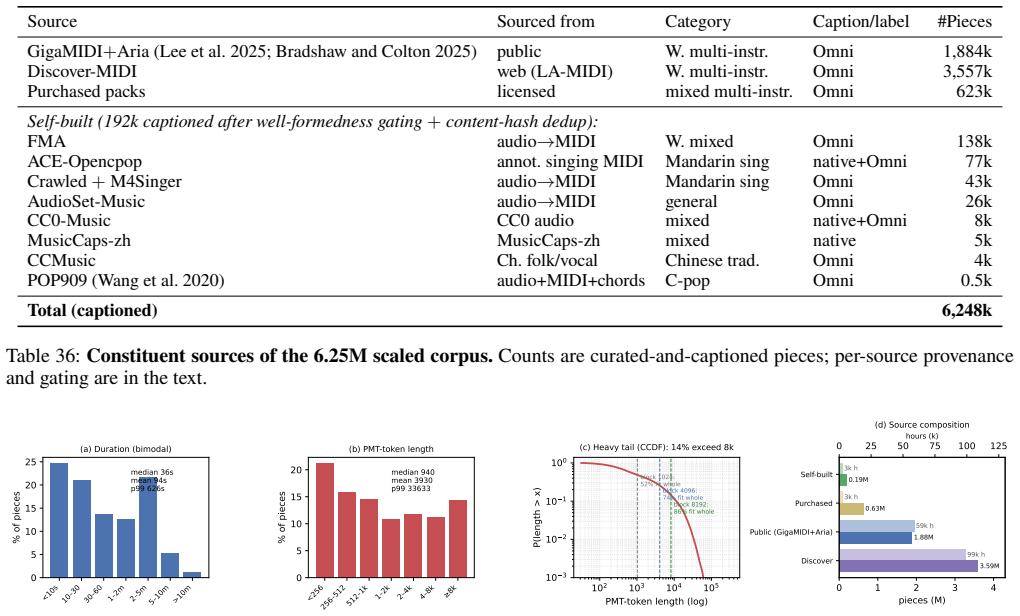
Text-to-music language models begin with a choice usually made by default: how to tokenize music. Normally entangled with backbone, data, and recipe, its effect has never been measured in isolation. We fix pretrained Qwen3.5 (0.8B-27B), data, budget, and decoding, and swap only the representation across seven tokenizations, anchoring texture metrics to each representation's model-free ceiling. The ordering is clean and surprising: representation, not model size, is the binding variable for distributional fidelity. Scaling the backbone 34x barely moves Frechet Music Distance (FMD), whereas switching representation halves it. PMT, a performance-resolution stream we release (10 ms timing, per-note velocity, multi-track texture; 609 symbols), reaches FMD 159 at 0.8B against 272-286 for beat grids (1.7-1.8x lower, up to 2.8x elsewhere; non-overlapping bootstrap CIs), so a 0.8B performance-resolution model beats a 27B beat grid. It reappears on a 26M from-scratch backbone and a second performance-resolution tokenizer: a property of the class, not one lucky vocabulary. Nor is it a finer-lattice artifact: snapping PMT's onsets to the beat grids' resolution still leaves it 67-129 FMD ahead of both (n=500). The effect is distributional; whether it is audible is a separate question, left open by our probe, with a human study pre-registered. Native caption adherence is weak but separable: a lightweight decode-time constraint doubles instrument-F1 (.28 to .60) and Correct-Key (.16 to .35) at no distributional cost. We release the harness, 25+ checkpoints, two corpora (86.6k aligned across caption/MIDI/ABC/audio; 6.25M captioned, the largest for music), and an imprinting diagnostic: published text-to-MIDI systems reproduce their training distribution near-invariant to the caption (72% vs. 71% chord-time on disjoint domains). The field's next representation claim can now be measured, not asserted.
Figures


Figures from the paper (27 more)








Reference graph
Works this paper leans on
-
[1]
Machine Vision and Applications , volume=
Ultraman: ultra-fast and high-resolution texture generation for 3D human reconstruction from a single image , author=. Machine Vision and Applications , volume=. 2026 , publisher=
2026
-
[2]
NeurIPS Workshop on AI for Music , year=
MIDI-LLM: Adapting Large Language Models for Text-to-MIDI Music Generation , author=. NeurIPS Workshop on AI for Music , year=
-
[3]
ISMIR , year=
Symphony Generation with Permutation Invariant Language Model , author=. ISMIR , year=
-
[4]
ICASSP 2026-2026 IEEE International Conference on Acoustics, Speech and Signal Processing (ICASSP) , pages=
MuseTok: Symbolic Music Tokenization for Generation and Semantic Understanding , author=. ICASSP 2026-2026 IEEE International Conference on Acoustics, Speech and Signal Processing (ICASSP) , pages=. 2026 , organization=
2026
-
[5]
Qu, Xingwei and Ma, Yinghao and Zhou, Ziya and others , booktitle=
-
[6]
AAAI Workshop on Creative AI Across Modalities , year=
Exploring the Efficacy of Pre-trained Checkpoints in Text-to-Music Generation Task , author=. AAAI Workshop on Creative AI Across Modalities , year=
-
[7]
Proceedings of the IEEE conference on computer vision and pattern recognition , pages=
Visually Indicated Sounds , author=. Proceedings of the IEEE conference on computer vision and pattern recognition , pages=
-
[8]
2026 , eprint=
One Video, One World: Turning Monocular Video into Physical 4D Scenes , author=. 2026 , eprint=
2026
Show all 123 references
-
[9]
arXiv preprint arXiv:2005.00341 , year=
Jukebox: A Generative Model for Music , author=. arXiv preprint arXiv:2005.00341 , year=
2005 arXiv
-
[10]
ICASSP 2023-2023 IEEE International Conference on Acoustics, Speech and Signal Processing (ICASSP) , pages=
Large-scale Contrastive Language-Audio Pretraining with Feature Fusion and Keyword-to-Caption Augmentation , author=. ICASSP 2023-2023 IEEE International Conference on Acoustics, Speech and Signal Processing (ICASSP) , pages=. 2023 , organization=
2023
-
[11]
2021 , publisher=
Zeghidour, Neil and Luebs, Alejandro and Omran, Ahmed and Skoglund, Jan and Tagliasacchi, Marco , journal=. 2021 , publisher=
2021
-
[12]
arXiv preprint arXiv:1809.04281 , year=
Music transformer , author=. arXiv preprint arXiv:1809.04281 , year=
-
[13]
Proceedings of the 54th annual meeting of the association for computational linguistics (volume 1: long papers) , pages=
Neural Machine Translation of Rare Words with Subword Units , author=. Proceedings of the 54th annual meeting of the association for computational linguistics (volume 1: long papers) , pages=
-
[14]
Wu, Shangda and Zhancheng, Guo and Yuan, Ruibin and others , booktitle=
-
[15]
2026 , eprint=
Engine-Native Editable 3D World Reconstruction with Objects and Lighting , author=. 2026 , eprint=
2026
-
[16]
2022 , publisher=
Kong, Qiuqiang and Li, Bochen and Chen, Jitong and Wang, Yuxuan , journal=. 2022 , publisher=
2022
-
[17]
arXiv preprint arXiv:2410.17584 , year=
Exploring Tokenization Methods for Multitrack Sheet Music Generation , author=. arXiv preprint arXiv:2410.17584 , year=
-
[18]
Kilgour, Kevin and Zuluaga, Mauricio and Roblek, Dominik and Sharifi, Matthew , booktitle=. Fr
-
[19]
2022 , publisher=
Xue, Linting and Barua, Aditya and Constant, Noah and Al-Rfou, Rami and Narang, Sharan and Kale, Mihir and Roberts, Adam and Raffel, Colin , journal=. 2022 , publisher=
2022
-
[20]
Xing, Ximing and Hu, Juncheng and Xue, Ziteng and Zhang, Jing and Li, Buyu and Wang, Sheng and Xu, Dong and Yu, Qian , journal=
-
[21]
2026 , eprint=
From Frames to Sequences: Temporally Consistent Human-Centric Dense Prediction , author=. 2026 , eprint=
2026
-
[22]
IW -Bench: Evaluating Large Multimodal Models for Converting Image-to-Web
Guo, Hongcheng and Zhang, Wei and Chen, Junhao and Gu, Yaonan and Yang, Jian and Du, Junjia and Cao, Shaosheng and Hui, Binyuan and Liu, Tianyu and Ma, Jianxin and Zhou, Chang and Li, Zhoujun. IW -Bench: Evaluating Large Multimodal Models for Converting Image-to-Web. Findings ...
2025 doi
-
[23]
Deng, Qixin and Yang, Qikai and Yuan, Ruibin and others , journal=
-
[24]
NeurIPS Workshop on Machine Learning for Audio , year=
The Song Describer Dataset: A Corpus of Audio Captions for Music-and-Language Evaluation , author=. NeurIPS Workshop on Machine Learning for Audio , year=
-
[25]
Proceedings of the 2024 Joint International Conference on Computational Linguistics, Language Resources and Evaluation (LREC-COLING 2024) , pages=
MMAD: Multi-modal movie audio description , author=. Proceedings of the 2024 Joint International Conference on Computational Linguistics, Language Resources and Evaluation (LREC-COLING 2024) , pages=
2024
-
[26]
International Conference on Artificial Neural Networks , pages=
Towards energy-efficient sentiment classification with spiking neural networks , author=. International Conference on Artificial Neural Networks , pages=. 2023 , organization=
2023
-
[27]
ICLR , year=
Music Transformer: Generating Music with Long-Term Structure , author=. ICLR , year=
-
[28]
Enabling Factorized Piano Music Modeling and Generation with the
Hawthorne, Curtis and Stasyuk, Andriy and Roberts, Adam and others , booktitle=. Enabling Factorized Piano Music Modeling and Generation with the
-
[29]
International Conference on Learning Representations , volume=
Whole-Song Hierarchical Generation of Symbolic Music Using Cascaded Diffusion Models , author=. International Conference on Learning Representations , volume=
-
[30]
ICASSP 2023-2023 IEEE International Conference on Acoustics, Speech and Signal Processing (ICASSP) , pages=
Multitrack Music Transformer , author=. ICASSP 2023-2023 IEEE International Conference on Acoustics, Speech and Signal Processing (ICASSP) , pages=. 2023 , organization=
2023
-
[31]
Advances in neural information processing systems , volume=
Simple and Controllable Music Generation , author=. Advances in neural information processing systems , volume=
-
[32]
arXiv preprint arXiv:2412.07948 , year=
Frechet Music Distance: A Metric for Generative Symbolic Music Evaluation , author=. arXiv preprint arXiv:2412.07948 , year=
-
[33]
2023 IEEE/CVF Conference on Computer Vision and Pattern Recognition (CVPR) , pages=
Physics-Driven Diffusion Models for Impact Sound Synthesis from Videos , author=. 2023 IEEE/CVF Conference on Computer Vision and Pattern Recognition (CVPR) , pages=. 2023 , organization=
2023
-
[34]
Proceedings of the IEEE/CVF Conference on Computer Vision and Pattern Recognition (CVPR) , month =
Sun, Mingze and Zeng, Cheng and Pei, Jiansong and Chen, Junhao and Song, Chaoyue and Wang, Shaohui and Chang, Tianyuan and Huang, Bin and Zeng, Zijiao and Huang, Ruqi , title =. Proceedings of the IEEE/CVF Conference on Computer Vision and Pattern Recognition (CVPR) , month =....
2026
-
[35]
Findings of the Association for Computational Linguistics: ACL-IJCNLP 2021 , pages=
MusicBERT: Symbolic Music Understanding with Large-Scale Pre-Training , author=. Findings of the Association for Computational Linguistics: ACL-IJCNLP 2021 , pages=
2021
-
[36]
arXiv preprint arXiv:2607.20253 , year=
Pushing the Frontier of Full-Song Generation: Hierarchical Autoregressive Planning Meets Flow-Matching Rendering , author=. arXiv preprint arXiv:2607.20253 , year=
-
[37]
Learning-Based Methods for Comparing Sequences, with Applications to Audio-to-
Raffel, Colin , year=. Learning-Based Methods for Comparing Sequences, with Applications to Audio-to-
-
[38]
Chu, Yunfei and Xu, Jin and Zhou, Xiaohuan and Yang, Qian and Zhang, Shiliang and Yan, Zhijie and Zhou, Chang and Zhou, Jingren , journal=
-
[39]
Proceedings of the 2024 Conference of the North American Chapter of the Association for Computational Linguistics: Human Language Technologies (Volume 1: Long Papers) , pages=
Mustango: Toward Controllable Text-to-Music Generation , author=. Proceedings of the 2024 Conference of the North American Chapter of the Association for Computational Linguistics: Human Language Technologies (Volume 1: Long Papers) , pages=
2024
-
[40]
Cutting Music Source Separation Some
Manilow, Ethan and Wichern, Gordon and Seetharaman, Prem and Le Roux, Jonathan , booktitle=. Cutting Music Source Separation Some. 2019 , organization=
2019
-
[41]
Proceedings of the IEEE/CVF Conference on Computer Vision and Pattern Recognition (CVPR) , month =
Chen, Junhao and Gao, Kejun and Cui, Yuehan and Sun, Mingze and Chen, Mingjin and Wang, Shaohui and Long, Xiaoxiao and Ma, Fei and Tian, Qi and Zhao, Hao and Huang, Ruqi , title =. Proceedings of the IEEE/CVF Conference on Computer Vision and Pattern Recognition (CVPR) , month...
2026
-
[42]
arXiv preprint arXiv:2308.13736 , year=
A Comprehensive Survey for Evaluation Methodologies of AI-Generated Music , author=. arXiv preprint arXiv:2308.13736 , year=
-
[43]
LLM s P ark: A Benchmark for Evaluating Large Language Models in Strategic Gaming Contexts
Chen, Junhao and Sun, Jingbo and Li, Xiang and Xin, Haidong and Xue, Yuhao and Xu, Yibin and Zhao, Hao. LLM s P ark: A Benchmark for Evaluating Large Language Models in Strategic Gaming Contexts. Findings of the Association for Computational Linguistics: EMNLP 2025. 2025. doi:...
2025 doi
-
[44]
2026 , eprint=
Bunraku: Turning a Single Illustration into an Editable Live2D Character , author=. 2026 , eprint=
2026
-
[45]
arXiv preprint arXiv:2603.00576 , year=
Efficient Long-Sequence Diffusion Modeling for Symbolic Music Generation , author=. arXiv preprint arXiv:2603.00576 , year=
-
[46]
NeurIPS Workshop , year=
Bai, Jisheng and others , title=. NeurIPS Workshop , year=
-
[47]
Strepetov, Petr and Kovalev, Dmitrii , booktitle=
-
[48]
Advances in Neural Information Processing Systems , volume=
Yu, Lili and Simig, D. Advances in Neural Information Processing Systems , volume=
-
[49]
Wu, Shangda and Li, Xiaobing and Yu, Feng and Sun, Maosong , booktitle=
-
[50]
Proceedings of the 2023 Conference on Empirical Methods in Natural Language Processing: System Demonstrations , pages=
ZhuJiu: A Multi-dimensional, Multi-faceted Chinese Benchmark for Large Language Models , author=. Proceedings of the 2023 Conference on Empirical Methods in Natural Language Processing: System Demonstrations , pages=
2023
-
[51]
Li, Shuyu and Choi, Dooho and Sung, Yunsick , booktitle=
-
[52]
Music Understanding
Liu, Shansong and Hussain, Atin Sakkeer and Sun, Chenshuo and Shan, Ying , booktitle=. Music Understanding. 2024 , organization=
2024
-
[53]
Neural Computing and Applications , volume=
On the Evaluation of Generative Models in Music , author=. Neural Computing and Applications , volume=. 2020 , publisher=
2020
-
[54]
arXiv preprint arXiv:2311.13562 , year=
Soulstyler: Using large language model to guide image style transfer for target object , author=. arXiv preprint arXiv:2311.13562 , year=
-
[55]
arXiv preprint arXiv:2408.14340 , year=
Foundation Models for Music: A Survey , author=. arXiv preprint arXiv:2408.14340 , year=
-
[56]
Team, SII-OpenMOSS and Yu, Donghua and Chen, Mingshu and others , journal=
-
[57]
Proceedings of the IEEE/CVF Conference on Computer Vision and Pattern Recognition (CVPR) , month =
Chen, Mingjin and Chen, Junhao and Fan, Zhaoxin and Lee, Yujian and Dang, Zichen and Wang, Lili and Cui, Yawen and Chau, Lap-Pui and Wang, Yi , title =. Proceedings of the IEEE/CVF Conference on Computer Vision and Pattern Recognition (CVPR) , month =. 2026 , pages =
2026
-
[58]
Ens, Jeff and Pasquier, Philippe , journal=
-
[59]
Proceedings of the 64th Annual Meeting of the Association for Computational Linguistics (Volume 1: Long Papers) , pages=
Amadeus: Autoregressive Model with Bidirectional Attribute Modelling for Symbolic Music , author=. Proceedings of the 64th Annual Meeting of the Association for Computational Linguistics (Volume 1: Long Papers) , pages=
-
[60]
BMVC , year=
Taming Visually Guided Sound Generation , author=. BMVC , year=
-
[61]
ISMIR , year=
Impact of Time and Note Duration Tokenizations on Deep Learning Symbolic Music Modeling , author=. ISMIR , year=
-
[62]
Xie, Tianxin and Lei, Wentao and Jiang, Kai and others , journal=
-
[63]
arXiv preprint arXiv:2605.13431 , year=
Text2Score: Generating Sheet Music From Textual Prompts , author=. arXiv preprint arXiv:2605.13431 , year=
-
[64]
ISMIR , year=
PerTok: Expressive Encoding and Modeling of Symbolic Musical Ideas and Variations , author=. ISMIR , year=
-
[65]
The Fourteenth International Conference on Learning Representations , year=
DanceTogether: Generating Interactive Multi-Person Video without Identity Drifting , author=. The Fourteenth International Conference on Learning Representations , year=
-
[66]
and Borsos, Zalán and others , journal=
Agostinelli, Andrea and Denk, Timo I. and Borsos, Zalán and others , journal=
-
[67]
Proceedings of the AAAI Conference on Artificial Intelligence , pages=
Compound Word Transformer: Learning to Compose Full-Song Music over Dynamic Directed Hypergraphs , author=. Proceedings of the AAAI Conference on Artificial Intelligence , pages=
-
[68]
Kreuk, Felix and Synnaeve, Gabriel and Polyak, Adam and others , booktitle=
-
[69]
IEEE Transactions on Multimedia , volume=
Theme Transformer: Symbolic Music Generation with Theme-Conditioned Transformer , author=. IEEE Transactions on Multimedia , volume=. 2022 , publisher=
2022
-
[70]
Doh, SeungHeon and Choi, Keunwoo and Lee, Jongpil and Nam, Juhan , booktitle=
-
[71]
2026 , publisher=
Zhang, Yiming and Gu, Yicheng and Zeng, Yanhong and Xing, Zhening and Wang, Yuancheng and Wu, Zhizheng and Liu, Bin and Chen, Kai , journal=. 2026 , publisher=
2026
-
[72]
Gardner, Josh and Durand, Simon and Stoller, Daniel and Bittner, Rachel M , booktitle=
-
[73]
2026 , note=
Magenta RealTime 2: An Open-Weights Live Music Model , author=. 2026 , note=
2026
-
[74]
arXiv preprint arXiv:2510.05881 , year=
Segment-Factorized Full-Song Generation on Symbolic Piano Music , author=. arXiv preprint arXiv:2510.05881 , year=
-
[75]
arXiv:2508.04651 , year=
Live Music Models , author=. arXiv:2508.04651 , year=
-
[76]
Proceedings of the AAAI Conference on Artificial Intelligence , volume=
text2midi: Generating Symbolic Music from Captions , author=. Proceedings of the AAAI Conference on Artificial Intelligence , volume=
-
[77]
2025 , publisher=
Bai, Jisheng and Liu, Haohe and Wang, Mou and Shi, Dongyuan and Wang, Wenwu and Plumbley, Mark D and Gan, Woon-Seng and Chen, Jianfeng , journal=. 2025 , publisher=
2025
-
[78]
Proceedings of the 28th ACM international conference on multimedia , pages=
Pop Music Transformer: Beat-based Modeling and Generation of Expressive Pop Piano Compositions , author=. Proceedings of the 28th ACM international conference on multimedia , pages=
-
[79]
P air C oder: Pair Programming-Inspired Two-Agent Collaboration for Code Generation
Chen, Junhao and Li, Xiang and Xu, Yibin and Cui, Yuehan and Weng, Fangsheng and Zhao, Hao and Ma, Fei and Tian, Qi. P air C oder: Pair Programming-Inspired Two-Agent Collaboration for Code Generation. Findings of the A ssociation for C omputational L inguistics: ACL 2026. 202...
2026 doi
-
[80]
Wang, Ziyu and Chen, Ke and Jiang, Junyan and Zhang, Yiyi and Xu, Maoran and Dai, Shuqi and Gu, Xianbin and Xia, Gus , booktitle=
-
[81]
Building the
Ens, Jeffrey and Pasquier, Philippe , booktitle=. Building the
-
[82]
arXiv preprint arXiv:2306.00110 , year=
MuseCoco: Generating Symbolic Music from Text , author=. arXiv preprint arXiv:2306.00110 , year=
-
[83]
Advances in neural information processing systems , volume=
Museformer: Transformer with Fine- and Coarse-Grained Attention for Music Generation , author=. Advances in neural information processing systems , volume=
-
[84]
arXiv preprint arXiv:2306.08620 , year=
Anticipatory Music Transformer , author=. arXiv preprint arXiv:2306.08620 , year=
-
[85]
2020 , organization=
Gan, Chuang and Huang, Deng and Chen, Peihao and Tenenbaum, Joshua B and Torralba, Antonio , booktitle=. 2020 , organization=
2020
-
[86]
ICASSP 2026-2026 IEEE International Conference on Acoustics, Speech and Signal Processing (ICASSP) , pages=
Pianoroll-Event: A Novel Score Representation for Symbolic Music , author=. ICASSP 2026-2026 IEEE International Conference on Acoustics, Speech and Signal Processing (ICASSP) , pages=. 2026 , organization=
2026
-
[87]
Lee, Keon Ju Maverick and Ens, Jeff and Adkins, Sara and Sarmento, Pedro and Barthet, Mathieu and Pasquier, Philippe , journal=. The. 2025 , publisher=
2025
-
[88]
Qian, Lekai and Gu, Haoyu and Zhao, Jingwei and Wang, Ziyu , journal=
-
[89]
2023 , organization=
Clarke, Samuel and Gao, Ruohan and Wang, Mason and Rau, Mark and Xu, Julia and Wang, Jui-Hsien and James, Doug L and Wu, Jiajun , booktitle=. 2023 , organization=
2023
-
[90]
Bradshaw, Louis and Colton, Simon , booktitle=. Aria-
-
[91]
Xu, Zhan and Zhou, Yang and Kalogerakis, Evangelos and Landreth, Chris and Singh, Karan , journal=
-
[92]
Proceedings of the IEEE/CVF Conference on Computer Vision and Pattern Recognition (CVPR) , month =
Sun, Mingze and Chen, Junhao and Dong, Junting and Chen, Yurun and Jiang, Xinyu and Mao, Shiwei and Jiang, Puhua and Wang, Jingbo and Dai, Bo and Huang, Ruqi , title =. Proceedings of the IEEE/CVF Conference on Computer Vision and Pattern Recognition (CVPR) , month =. 2025 , pages =
2025
-
[93]
Composer's Assistant 2: Interactive Multi-Track
Malandro, Martin E , booktitle=. Composer's Assistant 2: Interactive Multi-Track
-
[94]
2023 , publisher=
Wu, Ronghuan and Su, Wanchao and Ma, Kede and Liao, Jing , journal=. 2023 , publisher=
2023
-
[95]
ICASSP 2025-2025 IEEE International Conference on Acoustics, Speech and Signal Processing (ICASSP) , pages=
Stable Audio Open , author=. ICASSP 2025-2025 IEEE International Conference on Acoustics, Speech and Signal Processing (ICASSP) , pages=. 2025 , organization=
2025
-
[96]
Neural Computing and Applications , volume=
This Time with Feeling: Learning Expressive Musical Performance , author=. Neural Computing and Applications , volume=. 2020 , publisher=
2020
-
[97]
Transactions on Machine Learning Research , year=
High Fidelity Neural Audio Compression , author=. Transactions on Machine Learning Research , year=
-
[98]
2024 , publisher=
Liu, Haohe and Yuan, Yi and Liu, Xubo and others , journal=. 2024 , publisher=
2024
-
[99]
HaCohen, Yoav and Brazowski, Benny and Chiprut, Nisan and others , journal=
-
[100]
Yuan, Ruibin and Lin, Hanfeng and Wang, Yi and others , booktitle=
-
[101]
IJCAI , year=
NotaGen: Advancing Musicality in Symbolic Music Generation with Large Language Model Training Paradigms , author=. IJCAI , year=
-
[102]
ICASSP 2026-2026 IEEE International Conference on Acoustics, Speech and Signal Processing (ICASSP) , pages=
Time-Shifted Token Scheduling for Symbolic Music Generation , author=. ICASSP 2026-2026 IEEE International Conference on Acoustics, Speech and Signal Processing (ICASSP) , pages=. 2026 , organization=
2026
-
[103]
arXiv preprint arXiv:2607.11699 , year=
Qwen-Music Technical Report , author=. arXiv preprint arXiv:2607.11699 , year=
-
[104]
Proceedings of the 31st International Conference on Computational Linguistics , pages=
Idea23d: Collaborative lmm agents enable 3d model generation from interleaved multimodal inputs , author=. Proceedings of the 31st International Conference on Computational Linguistics , pages=
-
[105]
arXiv preprint arXiv:2605.15831 , year=
Modeling Music as a Time-Frequency Image: A 2D Tokenizer for Music Generation , author=. arXiv preprint arXiv:2605.15831 , year=
-
[106]
Fangsheng Weng and Junhao Chen and Xiang Li and Jie Qin and Hanzhong Guo and ShaochunHao and Xiaoguang Han , booktitle=. Garment. 2026 , url=
2026
-
[107]
Li, Yizhi and Yuan, Ruibin and Zhang, Ge and others , booktitle=
-
[108]
ISMIR , year=
Symbolic Music Representations for Classification Tasks: A Systematic Evaluation , author=. ISMIR , year=
-
[109]
2026 , eprint=
PairCoder++: Pair Programming as a Universal Paradigm for Verified Code-Driven Multimodal and Structured-Artifact Generation , author=. 2026 , eprint=
2026
-
[110]
Kang, Chenfei and Lu, Peiling and Yu, Botao and Tan, Xu and Ye, Wei and Zhang, Shikun and Bian, Jiang , journal=
-
[111]
ISMIR , year=
MidiCaps: A Large-scale MIDI Dataset with Text Captions , author=. ISMIR , year=
-
[112]
Poole, Ben and Jain, Ajay and Barron, Jonathan T and Mildenhall, Ben , booktitle=
-
[113]
arXiv preprint arXiv:2407.20955 , year=
Emotion-driven Piano Music Generation via Two-stage Disentanglement and Functional Representation , author=. arXiv preprint arXiv:2407.20955 , year=
-
[114]
arXiv preprint arXiv:2505.09388 , year=
Qwen3 Technical Report , author=. arXiv preprint arXiv:2505.09388 , year=
-
[115]
Yao, Mingyang and Feng, Zhaoxiang , journal=
-
[116]
Generating Symbolic Music from Natural Language Prompts using an
Xu, Weihan and McAuley, Julian and Berg-Kirkpatrick, Taylor and Dubnov, Shlomo and Dong, Hao-Wen , booktitle=. Generating Symbolic Music from Natural Language Prompts using an
-
[117]
ISMIR Late-Breaking Demo , year=
MidiTok: A Python Package for MIDI File Tokenization , author=. ISMIR Late-Breaking Demo , year=
-
[118]
International Conference on Learning Representations , volume=
YuE: Scaling Open Foundation Models for Long-Form Music Generation , author=. International Conference on Learning Representations , volume=
-
[119]
Luo, Simian and Yan, Chuanhao and Hu, Chenxu and Zhao, Hang , journal=
-
[120]
2026 , eprint=
Feedforward 3D Editing Learns from Semantic-Part Transformation , author=. 2026 , eprint=
2026
-
[121]
2026 , eprint=
A First Exploration of Neuromorphic OT-CFM for Multi-Speaker VSR , author=. 2026 , eprint=
2026
-
[122]
2025 , organization=
Roy, Abhinaba and Liu, Renhang and Lu, Tongyu and Herremans, Dorien , booktitle=. 2025 , organization=
2025
-
[123]
The Eleventh International Conference on Learning Representations , year=
FIGARO: Controllable Music Generation using Learned and Expert Features , author=. The Eleventh International Conference on Learning Representations , year=
Reviewed August 15, 2026 · model on record in the stance chip above.
Discussion (0). Continue with ORCID to comment.