REVIEW 4 major objections 5 minor 82 references
Generating eccentricity from envelope stripping in the Radius Valley
T0 review · 4 major / 5 minor · reviewed 2026-08-15 · deepseek-v4-flash
Pith's one-line read The stripped envelope of a close-in planet can remain as a gas torus, excite eccentricities of order 0.1 through Lindblad resonances, and widen the period ratios of neighbouring planet pairs.
desk verdict A genuinely new mechanism for the radius-valley eccentricity signal, built on transparent angular momentum accounting, but the torus-persistence assumption is asserted rather than demonstrated and the numerical calibration has a factor-of-ten slip. read the letter →
The pith
A machine-rendered reading of the paper's core claim, the machinery that carries it, and where it could break.
The reading
What carries the argument
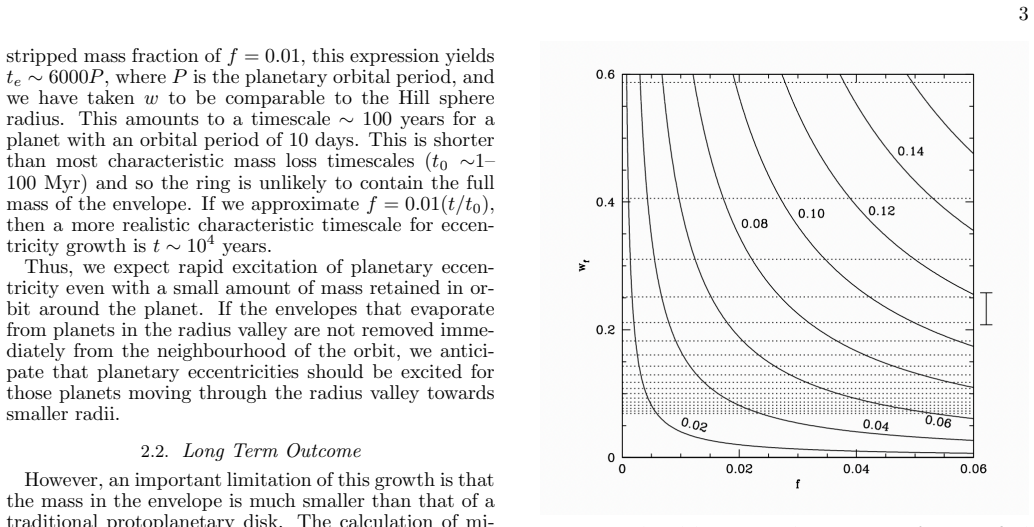
The central object is a tenuous, long-lived gaseous torus just outside the planet's orbit, with a width comparable to the planet's Hill sphere, formed from the stripped envelope. The dynamical engine is the excitation of outer eccentric Lindblad resonances: torques there launch waves that carry angular momentum from the planet into the gas, while saturated corotation resonances fail to damp the planet's eccentricity. The main working expression is the pumping timescale $1/t_e = G(p)\, f\, (M_p/M_*)^2\, (1 + a_p/w)^4\, \Omega$, where the saturation parameter $p \sim 2.465\,(M_p/10\,M_\oplus)^{-5/27}(\alpha/0.01)^{-1/9}(e_p/0.01)$ decides whether eccentricity grows (p > 0.157). Angular-momentum conservation between planet, torus and outer planet then gives the final period-ratio shift $P'_2/P_1 \sim (P_2/P_1)\,[1 + (3/2)(M_1/M_2)\, e_1^2/(P_2/P_1)^{1/3}]$.
What would settle it
A decisive test would be to measure eccentricities of a large, well-characterised sample of planets in and just below the radius valley: if high-precision radial-velocity or transit-duration data show e < 0.01 for these planets, or show no systematic 5-10% period-ratio excess for gap-straddling pairs when the sample is enlarged with K2 and TESS radii, the mechanism as described would be ruled out.
Extended reading notes
Core claim
On the paper's own terms, the discovery is a new dynamical channel for the radius valley: envelope stripping itself explains the elevated eccentricities seen for planets with radii near 1.75-1.93 R⊕. The stripped envelope forms a gas torus outside the planet; outer eccentric Lindblad resonances in that torus extract angular momentum and raise e_p, with the saturated-resonance calculation yielding $e_p \sim 0.056\,(f/0.01)^{1/2}(w_f/0.3)^{1/2}$ and values above 0.1 for mass-loss fractions above about 5%. Because the torque decays as the torus is pushed outward, the process self-limits at a period-ratio expansion near 2.3. In multi-planet systems the gas is not the final sink of angular momentum but a mediator, and the resulting period-ratio shift of a few to about 10% matches the Kepler gap-straddling pairs.
Load-bearing premise
The load-bearing premise is that in most mass-losing systems the stripped envelope remains as a coherent gas torus for many dynamical timescales instead of being quickly blown away, and the paper does not quantify how often that happens.
Editorial extensions
If this is right
- Planets that have recently lost a few percent of their mass should show orbital eccentricities near 0.1, and these should persist because most valley planets have tidal circularisation times longer than a gigayear.
- Multi-planet systems with an inner planet being stripped should have their inner pair period ratio widened by roughly 5-10%, with the expansion saturating near a period ratio of about 2.3 as the torus-planet coupling weakens.
- The inner members of gap-straddling pairs should be radius-biased high compared to the general sub-Neptune population, matching the Kepler observation that they resemble stripped cores.
- The difference between sub-Neptune pairs and super-Earth pairs in period-ratio spacing implies that only a fraction of planets below the radius gap are produced by this stripping channel, so the mechanism is not required to act on every small planet.
Reading between the lines
- Beyond the paper, a testable extension is that the period-ratio shift should scale with the inner-to-outer planet mass ratio $M_1/M_2$, so systems with a heavier inner planet should show more widening; transit-timing mass measurements could look for this.
- Beyond the paper, if torus retention is the controlling condition, valley planets around magnetically active stars with strong winds should show lower eccentricities than those around quiet stars, a correlation not yet examined.
- Beyond the paper, the angular-momentum transfer should also give the outer member of a gap-straddling pair a modest eccentricity as it absorbs angular momentum from the torus; measuring outer-planet eccentricities would separate this mechanism from pure tidal damping.
- Beyond the paper, the model predicts eccentricity excitation confined to the mass-loss episode, so future radial-velocity samples should find elevated eccentricities concentrated near the valley radius rather than spread across all small-planet radii.
Signed reviews
Editorial analysis
A structured set of objections, weighed in public.
Referee Report
Summary. The paper proposes that when a super-Earth loses its gaseous envelope, the stripped gas can remain in the system as a torus exterior to the planet. Lindblad resonances then transfer angular momentum from the planetary orbit to the torus, pumping the planet's eccentricity; in multi-planet systems the same torus can mediate angular-momentum transfer to an outer planet and widen the period ratio. The author derives a parameter-light angular-momentum scaling (e ~ sqrt(f w_f)), estimates that a few percent envelope mass fraction can produce eccentricities of order 0.1, and presents a Kepler-based comparison in which pairs straddling the radius valley have period ratios shifted by roughly 5-10% relative to pairs that both lie above the valley. The paper argues that the observed eccentricity excess near the radius gap and the pair widening are evidence that stripped gas remained in the system long enough to interact gravitationally.
Significance. If the mechanism operates, it provides a physical link between envelope stripping and dynamical excitation, with an explicit and falsifiable prediction: planets in or near the radius valley should have elevated eccentricities, and gap-straddling pairs should be wider. A notable strength is the explicit angular-momentum bookkeeping in Eqs. (4) and (6), which does not fit parameters to the target observations; the Kepler control samples are also a reasonable first test. The significance is presently conditional: the central results all depend on the unquantified persistence of a coherent gas torus, and several technical inconsistencies in the quantitative estimates need correction before the derived magnitudes can be accepted.
major comments (4)
- [§2.1, Eq. (2)] Equation (2) does not follow from Eq. (1) with the stated Hill-sphere aspect ratio. For M_p = 10 M_Earth, M_* = M_Sun, e_p = 0.01, and alpha = 0.01, taking h/r = (M_p/(3M_*))^(1/3) gives p ~ 0.24, about an order of magnitude below the quoted 2.465; the quoted coefficient instead corresponds to e_p ~ 0.1 while Eq. (2) is written with e_p/0.01. This is not purely cosmetic, because p then lies only slightly above the p > 0.157 excitation threshold, and the value G(p) = 1.3 used in Eq. (3) is evaluated at p = 2.465. The authors should correct the coefficient or state a different assumed h/r, then recompute G(p) and the eccentricity-growth timescale t_e.
- [§2.1] The mechanism requires the stripped envelope to persist as a coherent exterior torus for the angular-momentum exchange timescale, but the statement that "in many, possibly most, of the mass-losing systems, the gas stripped from the planet remains present in the system for many dynamical timescales" is asserted without quantitative support. The cited examples (WASP-12b, GJ436) are hot Jupiters with mass-loss rates orders of magnitude above those expected for the super-Earths that populate the radius valley. If the torus is removed on a dynamical timescale, none of the subsequent predictions follow. The authors should provide at least an order-of-magnitude estimate of torus lifetime for the relevant parameter regime (e.g., against stellar-wind ram pressure, radiation pressure, and magnetic stresses), or explicitly treat the retention fraction as an unknown parameter and propagate it into the predicted GSP/OPP contrast.
- [Appendix A, Eqs. (A4)-(A7)] Equation (A4) is inconsistent with the angular-momentum balance written in Eqs. (A1) and (A3): the term representing the initial envelope mass, -f(M1/M2), is missing from the constant term. The expression in Eq. (6) of the main text is the solution of the corrected equation, so the printed A4 appears to be a typographical error. More importantly, Eq. (A7) and the stated minimum e1^2 > 2f(P2/P1)^(1/3) do not follow from the corrected equation; a first-order solution gives a finite-f correction proportional to f(1-x0)/x0^2 with x0 = (P2/P1)^(1/6), which vanishes as x0 approaches unity, rather than the -2f term in A7. This affects the accessible-region curves in Fig. 5 and the inferred mass-loss fractions in Section 4. The authors should re-derive the finite-f expansions and update the affected discussion.
- [§4.1, Fig. 3] The empirical support for the pair-widening claim is weaker than the abstract implies. The GSP/OPP difference rests on a KS probability of p = 0.018 (2.3 sigma), and the "5-10%" shift is a visual characterization of the cumulative distributions rather than a fitted quantity. In addition, the radius-valley window was calibrated by moving the strip to identify the most empty gap, so the significance estimate does not account for this data-driven choice. Because the expected shift is diluted if the torus-retention fraction is below unity, the Kepler comparison should be made against a model with a retention fraction rather than a pure shift of the entire distribution.
minor comments (5)
- [§2.1, Eq. (3)] The function G(p) is not defined; the authors should give the saturation formula from Goldreich & Sari (2003) or otherwise specify how G(p) is evaluated for values other than p = 2.465.
- [§2.2] There is a typographical error in "This will stall ,the outward evolution" and "seperated" should be "separated".
- [Figure 2] The core masses in the text are written as "5.5, 8.5 and 13M_sun"; these should be Earth masses (M_Earth) to be consistent with the model context.
- [§4.1] The statement that in-gap pairs show a larger shift and imply mass-loss fractions closer to 10% is based on only 13 IGP systems; this should be labeled as tentative.
- [Fig. 3 caption] The dotted red histogram (GSP distribution divided by 1.05) is not described in the main text; it would help to point the reader to this comparison explicitly.
Circularity Check
No circularity: the eccentricity and period-ratio results are derived from conserved angular momentum with stated physical inputs, and the Kepler comparison is an independent empirical test.
full rationale
The paper's derivation chain is self-contained conditional on its stated assumptions. Equation (3) adapts the published Lindblad-resonance pumping rate (Goldreich & Tremaine 1980; Goldreich & Sari 2003) with explicit inputs f, w, alpha, M_p, M_*, and e_p. Equation (4) is an angular-momentum bookkeeping relation for a planet that loses mass fraction f into an exterior torus that migrates to offset w_f; both f and w_f are stated model inputs, not quantities fitted to the eccentricity or period-ratio data. The Kepler test in Section 4.1 compares the period-ratio distributions of independently defined 'gap-straddling pairs' (GSP) and 'outer pairs-in-a-pod' (OPP); the quoted ~5-10% shift and KS probability p=0.018 are an empirical comparison, and the model parameters are not fit to that sample. The only self-citations appear as contextual planet-incidence statistics (Zink et al. 2019) and a secondary secular-damping remark in Appendix A (Hansen & Murray 2015); neither carries the load of the eccentricity-excitation or period-ratio derivation. The assertion in Section 2.1 that stripped gas 'remains present in the system for many dynamical timescales' is an explicit physical precondition, not a derived consequence, so the concern about torus persistence is a robustness question about an input assumption rather than circularity. No equation or prediction reduces by construction to fitted data or to a self-citation chain.
Assumptions & free parameters
free parameters (5)
- envelope mass fraction f =
0.01-0.1 (few percent)
- torque stall offset w_f =
~0.3 a_p (m=5 resonance)
- disk viscosity alpha =
0.01
- tidal quality factor Q_p =
10^3 (rocky), 10^4 (sub-Neptune)
- radius valley strip location =
1.81-2.06 R_Earth at P=10 days, slope (P/10d)^-0.11
assumptions (5)
- domain assumption Stripped gas remains as a coherent exterior torus for many dynamical timescales
- domain assumption Protoplanetary disk resonance torque formulae apply to a narrow, low-mass torus
- domain assumption Torus sits exterior to the planet, so outer Lindblad resonances dominate and pump eccentricity
- ad hoc to paper The torus equilibrium position in a two-planet system is the geometric mean of the planetary semi-major axes (a_t^2 = a1 a2')
- standard math Keplerian dynamics and angular momentum conservation
Cite this review
Pith. "Pith review of Generating eccentricity from envelope stripping in the Radius Valley." pith.science (2026). https://pith.science/paper/TIS6WCWQ
@misc{pith2026260804231,
  author       = {Pith},
  title        = {Pith review of: Generating eccentricity from envelope stripping in the Radius Valley},
  year         = {2026},
  howpublished = {\url{https://pith.science/paper/TIS6WCWQ}},
  note         = {Machine review of arXiv:2608.04231}
}
read the original abstract
We demonstrate that the stripping of planetary envelopes can result in the excitation of planetary orbital eccentricity if the stripped gas remains in the system long enough to interact gravitationally and absorb angular momentum from the planetary orbit. We estimate that envelope mass fractions of a few percent can excite eccentricities of order 0.1 for single planets. This process can potentially explain the elevated eccentricities observed for planets whose radii lie in, or near, the radius valley. In multiple planet systems, the stripped gas can mediate angular momentum exchange between neighbouring planets, causing the separation to expand. Using data from the Kepler satellite, we find that planet pairs, whose members straddle the radius valley, do appear to be systematically wider than those in which both members are sub-Neptunes. These results support the idea that planets in, or just below, the radius valley are the stripped cores of planets that have lost mass, because the elevated eccentricities represent evidence that the gas remained in the system long enough to absorb additional angular momentum from the planet.
Figures


Figures from the paper (2 more)


Reference graph
Works this paper leans on
-
[1]
The California-Kepler Survey. III. A Gap in the Radius Distribution of Small Planets. , keywords =. doi:10.3847/1538-3881/aa80eb , archivePrefix =. 1703.10375 , primaryClass =
-
[2]
Kepler Planets: A Tale of Evaporation. , keywords =. doi:10.1088/0004-637X/775/2/105 , archivePrefix =. 1303.3899 , primaryClass =
-
[3]
Understanding the Mass-Radius Relation for Sub-neptunes: Radius as a Proxy for Composition. , keywords =. doi:10.1088/0004-637X/792/1/1 , archivePrefix =. 1311.0329 , primaryClass =
-
[4]
How formation time-scales affect the period dependence of the transition between rocky super-Earths and gaseous sub-Neptunesand implications for _. , keywords =. doi:10.1093/mnras/sty1707 , archivePrefix =. 1610.09390 , primaryClass =
-
[5]
The California-Kepler Survey. II. Precise Physical Properties of 2025 Kepler Planets and Their Host Stars. , keywords =. doi:10.3847/1538-3881/aa80e7 , archivePrefix =. 1703.10402 , primaryClass =
work page Pith review arXiv 2025
-
[6]
The California-Kepler Survey. I. High-resolution Spectroscopy of 1305 Stars Hosting Kepler Transiting Planets. , keywords =. doi:10.3847/1538-3881/aa80de , archivePrefix =. 1703.10400 , primaryClass =
-
[7]
Planet Occurrence within 0.25 AU of Solar-type Stars from Kepler. , keywords =. doi:10.1088/0067-0049/201/2/15 , archivePrefix =. 1103.2541 , primaryClass =
-
[8]
The Occurrence and Mass Distribution of Close-in Super-Earths, Neptunes, and Jupiters. Science , keywords =. doi:10.1126/science.1194854 , archivePrefix =. 1011.0143 , primaryClass =
Show all 82 references
-
[9]
Occurrence, mass distribution and orbital properties of super-Earths and Neptune-mass planets
The HARPS search for southern extra-solar planets XXXIV. Occurrence, mass distribution and orbital properties of super-Earths and Neptune-mass planets. arXiv e-prints , keywords =. doi:10.48550/arXiv.1109.2497 , archivePrefix =. 1109.2497 , primaryClass =
-
[10]
, keywords =
Fast Rise of ``Neptune-size'' Planets (4-8 R _ ) from P -0.5ex 10 to -0.5ex 250 Days Statistics of Kepler Planet Candidates up to -0.5ex 0.75 AU. , keywords =. doi:10.1088/0004-637X/778/1/53 , archivePrefix =. 1212.4853 , primaryClass =
-
[11]
, keywords =
The False Positive Rate of Kepler and the Occurrence of Planets. , keywords =. doi:10.1088/0004-637X/766/2/81 , archivePrefix =. 1301.0842 , primaryClass =
-
[12]
, keywords =
Atmospheric Escape From Hot Jupiters. , keywords =. doi:10.1088/0004-637X/693/1/23 , archivePrefix =. 0811.0006 , primaryClass =
-
[13]
, keywords =
Hot planetary winds near a star: dynamics, wind-wind interactions, and observational signatures. , keywords =. doi:10.1093/mnras/stw3307 , archivePrefix =. 1604.08532 , primaryClass =
-
[14]
, keywords =
Stellar Wind Confinement of Evaporating Exoplanet Atmospheres and Its Signatures in 1083 nm Observations. , keywords =. doi:10.3847/1538-4357/ac46ce , archivePrefix =. 2107.07534 , primaryClass =
-
[15]
, keywords =
Eccentricity Evolution for Planets in Gaseous Disks. , keywords =. doi:10.1086/346202 , archivePrefix =. astro-ph/0202462 , primaryClass =
- [16]
-
[17]
, keywords =
Debris rings from extrasolar irregular satellites. , keywords =. doi:10.1093/mnras/stad1091 , archivePrefix =. 2304.13753 , primaryClass =
-
[18]
, keywords =
Dynamical Evolution of Closely Packed Multiple Planetary Systems Subject to Atmospheric Mass Loss. , keywords =. doi:10.3847/1538-3881/acc070 , archivePrefix =. 2303.00397 , primaryClass =
-
[19]
, keywords =
Super-Earth Atmospheres: Self-consistent Gas Accretion and Retention. , keywords =. doi:10.3847/0004-637X/825/1/29 , archivePrefix =. 1512.07925 , primaryClass =
-
[20]
, keywords =
Sculpting the valley in the radius distribution of small exoplanets as a by-product of planet formation: the core-powered mass-loss mechanism. , keywords =. doi:10.1093/mnras/stz1230 , archivePrefix =. 1811.03202 , primaryClass =
-
[21]
Science , keywords =
Kepler Planet-Detection Mission: Introduction and First Results. Science , keywords =. doi:10.1126/science.1185402 , adsurl =
-
[22]
, keywords =
Tidal Evolution of Close-in Extrasolar Planets. , keywords =. doi:10.1086/529187 , archivePrefix =. 0802.1543 , primaryClass =
-
[23]
, keywords =
A dynamical history of the inner Neptunian satellites. , keywords =. doi:10.1016/0019-1035(92)90155-Z , adsurl =
-
[24]
, year = 2000, month = jun, volume =
Significant dissipation of tidal energy in the deep ocean inferred from satellite altimeter data. , year = 2000, month = jun, volume =. doi:10.1038/35015531 , adsurl =
2000 doi
-
[25]
, keywords =
Topographically generated internal waves in the open ocean. , keywords =. doi:10.1029/JC080i003p00320 , adsurl =
-
[26]
, keywords =
First numerical ephemerides of the Martian moons. , keywords =. doi:10.1051/0004-6361:20065466 , adsurl =
-
[27]
, year = 1966, month = jan, volume =
Q in the Solar System. , year = 1966, month = jan, volume =. doi:10.1016/0019-1035(66)90051-0 , adsurl =
1966 doi
-
[28]
Geophysical Journal International , keywords =
Constraints on energy dissipation in the Earth's body tide from satellite tracking and altimetry. Geophysical Journal International , keywords =. doi:10.1046/j.0956-540X.2001.00356.x , adsurl =
2001 arXiv
-
[29]
, keywords =
Energetics of global ocean tides from Geosat altimetry. , keywords =. doi:10.1029/91JC01059 , adsurl =
-
[30]
, keywords =
Tidal acceleration of the Moon. , keywords =. doi:10.1029/GL005i011p00943 , adsurl =
-
[31]
, keywords =
Kepler Planet Masses and Eccentricities from TTV Analysis. , keywords =. doi:10.3847/1538-3881/aa71ef , archivePrefix =. 1611.03516 , primaryClass =
-
[32]
The Exoplanet Population Observation Simulator. I. The Inner Edges of Planetary Systems. , keywords =. doi:10.3847/1538-3881/aac5ea , archivePrefix =. 1805.08211 , primaryClass =
-
[33]
, keywords =
Accounting for incompleteness due to transit multiplicity in Kepler planet occurrence rates. , keywords =. doi:10.1093/mnras/sty3463 , archivePrefix =. 1901.00196 , primaryClass =
1901 arXiv
-
[34]
, keywords =
The Mass-Radius Relation for 65 Exoplanets Smaller than 4 Earth Radii. , keywords =. doi:10.1088/2041-8205/783/1/L6 , archivePrefix =. 1312.0936 , primaryClass =
-
[35]
, keywords =
Secure Mass Measurements from Transit Timing: 10 Kepler Exoplanets between 3 and 8 M _ with Diverse Densities and Incident Fluxes. , keywords =. doi:10.3847/0004-637X/820/1/39 , archivePrefix =. 1512.02003 , primaryClass =
-
[36]
, keywords =
Planetary Population Synthesis Coupled with Atmospheric Escape: A Statistical View of Evaporation. , keywords =. doi:10.1088/0004-637X/795/1/65 , archivePrefix =. 1409.2879 , primaryClass =
-
[37]
, keywords =
Evolutionary Models of Super-Earths and Mini-Neptunes Incorporating Cooling and Mass Loss. , keywords =. doi:10.1088/0004-637X/808/2/150 , archivePrefix =. 1505.02784 , primaryClass =
-
[38]
, keywords =
Evolutionary Analysis of Gaseous Sub-Neptune-mass Planets with MESA. , keywords =. doi:10.3847/0004-637X/831/2/180 , archivePrefix =. 1603.06596 , primaryClass =
-
[39]
, keywords =
An asteroseismic view of the radius valley: stripped cores, not born rocky. , keywords =. doi:10.1093/mnras/sty1783 , archivePrefix =. 1710.05398 , primaryClass =
-
[40]
Hints from formation and evolution models
The nature of the radius valley. Hints from formation and evolution models. , keywords =. doi:10.1051/0004-6361/202039141 , archivePrefix =. 2008.05513 , primaryClass =
2008 arXiv
- [41]
- [42]
-
[43]
, keywords =
Morphology of Hydrodynamic Winds: A Study of Planetary Winds in Stellar Environments. , keywords =. doi:10.3847/1538-4357/ab05b8 , archivePrefix =. 1811.09276 , primaryClass =
-
[44]
, keywords =
New Perspectives on the Exoplanet Radius Gap from a Mathematica Tool and Visualized Water Equation of State. , keywords =. doi:10.3847/1538-4357/ac3137 , archivePrefix =. 2201.02125 , primaryClass =
-
[45]
The Gaia-Kepler Stellar Properties Catalog. II. Planet Radius Demographics as a Function of Stellar Mass and Age. , keywords =. doi:10.3847/1538-3881/aba18a , archivePrefix =. 2005.14671 , primaryClass =
2005 arXiv
-
[46]
, keywords =
Atmosphere Origins for Exoplanet Sub-Neptunes. , keywords =. doi:10.3847/1538-4357/ab6ffb , archivePrefix =. 2001.09269 , primaryClass =
2001 arXiv
-
[47]
, keywords =
Planetary Torques as the Viscosity of Protoplanetary Disks. , keywords =. doi:10.1086/320572 , archivePrefix =. astro-ph/0010576 , primaryClass =
-
[48]
, keywords =
Planet Migration and Gap Formation by Tidally Induced Shocks. , keywords =. doi:10.1086/340228 , archivePrefix =. astro-ph/0110540 , primaryClass =
-
[49]
Proceedings of the National Academy of Science , keywords =
Planets larger than Neptune have elevated eccentricities. Proceedings of the National Academy of Science , keywords =. doi:10.1073/pnas.2405295122 , archivePrefix =. 2507.07840 , primaryClass =
-
[50]
The California-Kepler Survey. V. Peas in a Pod: Planets in a Kepler Multi-planet System Are Similar in Size and Regularly Spaced. , keywords =. doi:10.3847/1538-3881/aa9ff6 , archivePrefix =. 1706.06204 , primaryClass =
- [51]
-
[52]
, year = 1997, month = apr, volume =
Protoplanet Migration by Nebula Tides. , year = 1997, month = apr, volume =. doi:10.1006/icar.1996.5647 , adsurl =
1997
-
[53]
, keywords =
Formation and Structure of Low-density exo-Neptunes. , keywords =. doi:10.1088/0004-637X/738/1/59 , archivePrefix =. 1106.2807 , primaryClass =
-
[54]
, keywords =
Irradiated Ocean Planets Bridge Super-Earth and Sub-Neptune Populations. , keywords =. doi:10.3847/2041-8213/ab9530 , archivePrefix =. 2002.05243 , primaryClass =
2002 arXiv
-
[55]
Proceedings of the National Academy of Science , keywords =
Growth model interpretation of planet size distribution. Proceedings of the National Academy of Science , keywords =. doi:10.1073/pnas.1812905116 , archivePrefix =. 1906.04253 , primaryClass =
1906 arXiv
-
[56]
, keywords =
Atmospheres of Protoplanetary Cores: Critical Mass for Nucleated Instability. , keywords =. doi:10.1086/505695 , archivePrefix =. astro-ph/0405507 , primaryClass =
-
[57]
, keywords =
In Situ Accretion of Hydrogen-rich Atmospheres on Short-period Super-Earths: Implications for the Kepler-11 Planets. , keywords =. doi:10.1088/0004-637X/753/1/66 , archivePrefix =. 1204.5302 , primaryClass =
-
[58]
, keywords =
A giant comet-like cloud of hydrogen escaping the warm Neptune-mass exoplanet GJ 436b. , keywords =. doi:10.1038/nature14501 , archivePrefix =. 1506.07541 , primaryClass =
-
[59]
, year = 2003, month = mar, volume =
An extended upper atmosphere around the extrasolar planet HD209458b. , year = 2003, month = mar, volume =. doi:10.1038/nature01448 , adsurl =
2003 doi
-
[60]
, keywords =
Hydrogen escaping from a pair of exoplanets smaller than Neptune. , keywords =. doi:10.1038/s41586-024-08490-x , adsurl =
-
[61]
, keywords =
Temporal variations in the evaporating atmosphere of the exoplanet HD 189733b. , keywords =. doi:10.1051/0004-6361/201219363 , archivePrefix =. 1206.6274 , primaryClass =
-
[62]
, keywords =
The long egress of GJ 436b's giant exosphere. , keywords =. doi:10.1051/0004-6361/201731340 , archivePrefix =. 1709.04686 , primaryClass =
-
[63]
, keywords =
Classification of magnetized star-planet interactions: bow shocks, tails, and inspiraling flows. , keywords =. doi:10.1051/0004-6361/201425593 , archivePrefix =. 1503.03551 , primaryClass =
-
[64]
The Dynamics of Stellar Coronae Harboring Hot Jupiters. I. A Time-dependent Magnetohydrodynamic Simulation of the Interplanetary Environment in the HD 189733 Planetary System. , keywords =. doi:10.1088/0004-637X/733/1/67 , archivePrefix =. 1101.4825 , primaryClass =
-
[65]
, keywords =
Near-ultraviolet Absorption, Chromospheric Activity, and Star-Planet Interactions in the WASP-12 system. , keywords =. doi:10.1088/0004-637X/760/1/79 , archivePrefix =. 1301.1860 , primaryClass =
-
[66]
, keywords =
Absorbing Gas around the WASP-12 Planetary System. , keywords =. doi:10.1088/2041-8205/766/2/L20 , archivePrefix =. 1303.3375 , primaryClass =
-
[67]
, keywords =
Generation of a circumstellar gas disc by hot Jupiter WASP-12b. , keywords =. doi:10.1093/mnras/sty1164 , archivePrefix =. 1805.00596 , primaryClass =
-
[68]
, keywords =
Saturation of the Corotation Resonance in a Gaseous Disk. , keywords =. doi:10.1086/368178 , archivePrefix =. astro-ph/0208363 , primaryClass =
- [69]
- [70]
-
[71]
, keywords =
The Distribution of Planet Radius in Kepler Multiplanet Systems Depends on Gap Complexity. , keywords =. doi:10.3847/2041-8213/ad73db , archivePrefix =. 2406.12239 , primaryClass =
-
[72]
, keywords =
An Information Theoretic Framework for Classifying Exoplanetary System Architectures. , keywords =. doi:10.3847/1538-3881/ab8e3c , archivePrefix =. 2003.11098 , primaryClass =
2003 arXiv
-
[73]
, keywords =
Orbital evolution of binaries in circumbinary discs. , keywords =. doi:10.1093/mnras/stad1131 , archivePrefix =. 2302.01785 , primaryClass =
-
[74]
The California-Kepler Survey. VII. Precise Planet Radii Leveraging Gaia DR2 Reveal the Stellar Mass Dependence of the Planet Radius Gap. , keywords =. doi:10.3847/1538-3881/aae828 , archivePrefix =. 1805.01453 , primaryClass =
-
[75]
The California-Kepler Survey. X. The Radius Gap as a Function of Stellar Mass, Metallicity, and Age. , keywords =. doi:10.3847/1538-3881/ac51e3 , archivePrefix =. 2201.10020 , primaryClass =
-
[76]
, keywords =
Some dynamical aspects of the accretion of Uranus and Neptune: The exchange of orbital angular momentum with planetesimals. , keywords =. doi:10.1016/0019-1035(84)90101-5 , adsurl =
-
[77]
, keywords =
A deep radius valley revealed by Kepler short cadence observations. , keywords =. doi:10.1093/mnras/stac3802 , archivePrefix =. 2301.04062 , primaryClass =
-
[78]
, keywords =
Secular effects of tidal damping in compact planetary systems. , keywords =. doi:10.1093/mnras/stv049 , archivePrefix =. 1405.2342 , primaryClass =
-
[79]
, year = 1995, month = nov, volume =
A Jupiter-mass companion to a solar-type star. , year = 1995, month = nov, volume =. doi:10.1038/378355a0 , adsurl =
1995 doi
-
[80]
, keywords =
Tidal evolution in close binary systems. , keywords =
-
[81]
, keywords =
Calibration of Equilibrium Tide Theory for Extrasolar Planet Systems. , keywords =. doi:10.1088/0004-637X/723/1/285 , archivePrefix =. 1009.3027 , primaryClass =
-
[82]
Planetary Candidates Observed by Kepler. VIII. A Fully Automated Catalog with Measured Completeness and Reliability Based on Data Release 25. , keywords =. doi:10.3847/1538-4365/aab4f9 , archivePrefix =. 1710.06758 , primaryClass =
Reviewed August 15, 2026 · model on record in the stance chip above.
Discussion (0). Continue with ORCID to comment.