REVIEW 4 major objections 6 minor 46 references
SAFECAST: Robust Failure Detection for VLA Policies with Contrast-Set Training and Calibration
T0 review · 4 major / 6 minor · reviewed 2026-08-08 · deepseek-v4-flash
Pith's one-line read SAFECAST claims that augmenting hidden-state risk probe training and conformal calibration with visual and language contrast-set rollouts makes failure detection for vision-language-action policies more reliable under deployment-time…
desk verdict Core idea is plausible and the simulation evidence is strong, but the real-world evaluation may be confounded and the abstract oversells significance. read the letter →
The pith
A machine-rendered reading of the paper's core claim, the machinery that carries it, and where it could break.
The reading
What carries the argument
The mechanism is a hidden-state risk probe paired with functional conformal prediction: at each timestep a lightweight MLP maps the pre-final-layer hidden state of the frozen policy to a scalar failure score, and functional conformal prediction converts the score sequence into a time-varying threshold $\delta_t = \mu_t + q_\alpha$ calibrated on successful rollouts. SAFECAST intervenes on the data feeding both components, replacing the source-only pools with $\mathcal{D}_{\text{aug}} = \mathcal{D}_{\text{src}} \cup \mathcal{D}_{\text{CS}}$, where $\mathcal{D}_{\text{CS}}$ contains re-executed contrast-set rollouts under visual, language, and joint perturbations, filtered by a DTW-based active rejection procedure to reduce near-duplicates. This changes both the learned failure-score function and the threshold location, aligning the risk trajectories seen in calibration with those seen under deployment shift.
What would settle it
Collect a deployment evaluation set whose shifts are deliberately outside the contrast-set family used for training and calibration—for example, contrast sets built from distractor objects and paraphrases, but deployment featuring camera repositioning and novel spatial layouts—and compare SAFECAST's ROC-AUC or F1 against SAFE; if the gain disappears or reverses, the representativeness assumption is violated.
Extended reading notes
Core claim
The central claim is that calibration mismatch, not probe capacity, is the main bottleneck for hidden-state failure detection under deployment shift, and that mismatch can be reduced by exposing the probe and the conformal thresholds to perturbed rollouts that approximate the shifts expected at deployment. SAFECAST re-executes the frozen VLA policy under contrast-set perturbations to obtain new hidden-state risk trajectories, pools them with source rollouts, and uses the augmented pool for both probe training and functional conformal calibration. Across π0 and OpenVLA, on real DROID/Franka rollouts and LIBERO simulation, these augmented configurations improve failure detection F1 and ROC-AUC relative to the SAFE baseline, with joint visual-language contrast sets giving the strongest robustness. In the sim-to-real variant, a probe trained in LIBERO and calibrated on real contrast-set rollouts outperforms a probe trained and calibrated only on the smaller real-world dataset.
Load-bearing premise
The load-bearing premise is that the contrast-set perturbations made from source rollouts resemble the shifts the robot will actually meet at deployment; if deployment shifts fall outside that perturbation family, the calibration advantage shrinks and detection performance can degrade.
Editorial extensions
If this is right
- Failure detectors for VLA policies should be trained and calibrated on perturbed rollouts rather than only source rollouts whenever deployment-time shift is expected.
- Joint visual-language contrast sets yield stronger robustness than visual-only or language-only augmentation, so shift coverage should span multiple modalities.
- Simulation-trained probes with real contrast-set calibration can substitute for larger real-world data collection when real rollouts are scarce.
- The improvement persists across a sweep of conformal significance levels $\alpha$, so the gain is not confined to a single risk tolerance or operating point.
Reading between the lines
- Beyond the paper: using the detector's own uncertainty to propose new perturbations online could let contrast sets adapt to failures as they appear; this is testable by comparing fixed contrast pools with adaptive ones in the same evaluation suite.
- Beyond the paper: the anti-goal stress tests suggest a cheap overfitting check for VLA policies—checking whether a negated instruction changes behavior—which the paper flags as future benchmark work.
- Beyond the paper: the sim-to-real result implies the bottleneck is calibration alignment rather than probe capacity; one could test this by measuring how the gap to a real-only probe closes as the number of real contrast-set rollouts grows.
Editorial analysis
A structured set of objections, weighed in public.
Referee Report
Summary. SAFECAST proposes to improve hidden-state failure detection for vision-language-action (VLA) policies under deployment-time distribution shift by augmenting both probe training and functional-conformal calibration with contrast-set rollouts (visual perturbations, language paraphrases, and their combination). The authors compare SAFE against three SAFECAST variants (train-augmentation only, calibration-augmentation only, and both) on LIBERO simulation with two base policies (π0 and OpenVLA) and on a real Franka/DROID setup with two checkpoints (π0 and π0-FAST), reporting F1 and ROC-AUC averaged over conformal significance levels α and 30 seeds. They report statistically significant improvements in most settings, a benefit of joint visual-language contrast sets, and a sim-to-real transfer result in which a simulation-trained probe calibrated on real contrast-set rollouts outperforms a real-only probe.
Significance. If the claims hold, SAFECAST is a practical, low-overhead intervention that strengthens runtime failure detection under distribution shift, which matters for safe deployment of VLA policies. The experimental methodology is a clear strength: 30 seeds, seed-paired t-tests, full alpha sweeps in the appendices, and controlled source/calibration/evaluation splits in simulation. The appendices also provide unusually thorough perturbation-family ablations and precision–recall diagnostics. However, the paper's headline significance claim is broader than the statistical evidence supports, and the real-world evaluation may be confounded by overlap between the contrast-set pool and the evaluation distribution. The significance of the work is therefore conditional on addressing these points.
major comments (4)
- [Abstract; §5.2; Table 6] The abstract states that SAFECAST 'statistically significantly improves' failure detection in both real-world DROID and LIBERO simulation experiments, but Table 6 shows that this is not true for all headline comparisons after the authors' own Bonferroni correction (m = 12, threshold 0.00417). In particular, Sim-OpenVLA SAFECAST vs. SAFE has p = 0.0256, Sim-OpenVLA SAFECAST_TRAINAUG has p = 0.4093, and Real-π0 SAFECAST_TRAINAUG has p = 0.8753. Please qualify the significance claim to the specific settings where it holds, or present a corrected multiple-testing analysis that justifies the abstract's wording.
- [§5.1; Appendix A.2; Table 3] The real-world DROID evaluation may be confounded because the evaluation distribution D_eval overlaps with the contrast-set pool D_CS. Section 5.1 says evaluation rollouts contain 'stronger shifts including novel objects, new tasks, clutter, lighting variation, and altered robot initial states,' and Table 3 lists real-robot contrast-set perturbations including 'Visual distractors/clutter,' 'Language paraphrases/negations,' and 'Novel objects/tasks.' The paper never states that different task instances, object sets, or paraphrase templates were used in D_eval versus D_CS, nor that the perturbation operators were applied disjointly. If D_eval and D_CS are drawn from the same perturbation families, the reported ROC-AUC gains over SAFE may reflect in-distribution calibration on eval-like rollouts rather than robustness to truly held-out deployment shift. Please either document explicit disjointness of D_eval from D_CS (e.g., separate objects, tasks, paraphrase templates, or perturbation operators), or re-analyze the real-world results on perturbation families that were never used in contrast-set construction.
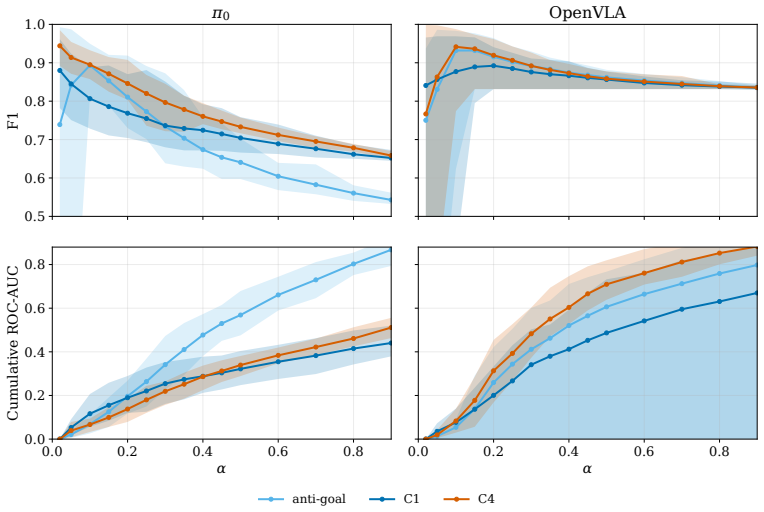
- [§5.3; Table 11] The claim that joint visual-language contrast sets produce 'the strongest OOD failure detection robustness' is not supported by the ROC-AUC metric for π0. Table 11 reports α-marginal cumulative ROC-AUC for π0 as 0.469 (visual only), 0.441 (language only), and 0.282 (visual + language), so the joint setting is substantially worse than either single modality on this metric. The main text reports only the F1-based Figure 4 and does not mention this discrepancy. Please report both metrics in the main text and either reconcile the difference (e.g., via the class-imbalance discussion in Appendix F.11) or soften the claim to be metric- and policy-specific.
- [§5.4; Table 12] The sim-to-real transfer result is a central finding but is reported without significance testing or variance estimates. Table 12 gives α-marginal F1 and ROC-AUC for 'Real-only probe and calibration' (0.478/0.228) versus 'Sim-trained probe + real CS calibration' (0.523/0.410), and Figure 5 shows curves without confidence bands. Given the small real-world rollout counts in Table 2 (e.g., π0 train: 17 successes/27 failures; calibration: 14/28), please provide seed-paired tests or confidence intervals for this comparison, and state whether the improvement is statistically significant.
minor comments (6)
- [§3 heading] The heading 'Task Definiton' contains a typo; it should be 'Task Definition.'
- [Appendix F.11] The sentence 'Anti-goal Perturbations Do Not Improve Failure Detection but they are really, really funny' is informal and out of place in a scientific paper; please remove or rewrite it in a neutral register.
- [Figure 20 caption] The caption reads 'Pecision–recall curves'; 'Pecision' should be 'Precision.'
- [§5.1; Tables 8 and 10] The term 'Cumulative ROC-AUC' is used in the appendix tables and figures but is not defined in the main text. Please clarify how cumulative ROC-AUC is computed from the TPR–FPR curves and how it differs from the standard ROC-AUC defined in §5.1.
- [Appendix B.3] The DTW rejection threshold τ_DTW = 0.02 is fixed with no sensitivity analysis. Since this threshold controls the diversity of the contrast-set training pool, please provide an ablation over τ_DTW or justify the chosen value.
- [Appendix A.2] The language contrast-set construction uses three paraphrases per task as a budget choice, but no ablation is reported on the number of paraphrases. Please add a sentence justifying this budget or a small ablation.
Circularity Check
No significant circularity: SAFECAST's claims are empirical comparisons against external baselines, and no fitted quantity or self-citation chain forces the reported gains.
full rationale
The paper's central claim is an empirical result: contrast-set-augmented probe training and functional-conformal calibration improve failure-detection ROC-AUC relative to the SAFE baseline on DROID and LIBERO-Plus evaluations. The derivation chain is data-driven rather than algebraic or definitional. The probe is a lightweight MLP f_phi trained on hidden states with success/failure labels, and the conformal threshold delta_t = mu_t + q_alpha is computed from calibration nonconformity scores; no equation in Sections 3-4 equates the reported ROC-AUC with the training or calibration inputs by construction. The only potentially load-bearing self-citation is [11] (Anwar, Gupta, Thomason) for the contrast-set idea, but the paper also draws on the external contrast-set literature [47], builds on the external SAFE baseline [3], and evaluates on the external LIBERO-Plus benchmark [20]; the citation is not used to forbid alternatives or to supply a uniqueness theorem. The Limitations section explicitly concedes that the method's success depends on D_CS being representative of deployment shifts and that conformal exchangeability guarantees are not restored, which is an honest statement of an assumption rather than a circular reduction. The closest concern to circularity is that the real-world DROID evaluation perturbations (novel objects, clutter, paraphrases) overlap in kind with the D_CS perturbation families, which could make the real-world evaluation partially in-distribution; however, the paper does not define D_eval as D_CS, the LIBERO evaluation uses the separate pre-existing LIBERO-Plus suite, and this overlap is a validity threat rather than an equation-level reduction. Therefore no circular step is established.
Assumptions & free parameters
free parameters (2)
- DTW active-rejection threshold tau_DTW =
0.02 normalized DTW distance
- Language contrast-set budget =
3 paraphrases per task, 3 episodes per paraphrase
assumptions (4)
- domain assumption Hidden states of the frozen VLA policy carry information predictive of eventual rollout failure.
- ad hoc to paper Contrast-set perturbations constructed from the source distribution are representative of deployment shifts in D_eval.
- standard math Conformal calibration assumes exchangeability between calibration and deployment trajectories.
- domain assumption LLM-generated paraphrases preserve the target object, action, and goal, so success/failure labels remain valid.
Cite this review
Pith. "Pith review of SAFECAST: Robust Failure Detection for VLA Policies with Contrast-Set Training and Calibration." pith.science (2026). https://pith.science/paper/QGGVUFRJ
@misc{pith2026260804246,
  author       = {Pith},
  title        = {Pith review of: SAFECAST: Robust Failure Detection for VLA Policies with Contrast-Set Training and Calibration},
  year         = {2026},
  howpublished = {\url{https://pith.science/paper/QGGVUFRJ}},
  note         = {Machine review of arXiv:2608.04246}
}
read the original abstract
Vision-language-action policies often fail under deployment-time distribution shifts such as clutter, distractor objects, lighting changes, novel objects, altered initial states, and reworded instructions. Hidden-state-based risk probes combined with functional conformal prediction can detect rollout failures, but their reliability depends on calibration data matching deployment conditions. We introduce SAFECAST, which leverages contrast set perturbations to improve hidden-state probe training and calibration for deployment time shift. SAFECAST statistically significantly improves failure detection ROC-AUC scores over a state of the art baseline in both real-world DROID and LIBERO simulation experiments across multiple VLM backbones. We further find that SAFECAST benefits most when both visual and language contrast set perturbations are used to augment data, and that with contrast set perturbations, sim-to-real calibration leads to better probes than using real rollout data only.
Figures


Figures from the paper (17 more)




Reference graph
Works this paper leans on
-
[1]
M. J. Kim, K. Pertsch, S. Karamcheti, T. Xiao, A. Balakrishna, S. Nair, R. Rafailov, E. P. Foster, P. R. Sanketi, Q. Vuong, T. Kollar, B. Burchfiel, R. Tedrake, D. Sadigh, S. Levine, P. Liang, and C. Finn. OpenVLA: An open-source vision-language-action model. InConference on Robot Learning (CoRL), 2024
2024
-
[3]
Q. Gu, Y . Ju, S. Sun, I. Gilitschenski, H. Nishimura, M. Itkina, and F. Shkurti. Safe: Multitask failure detection for vision-language-action models. InNeural Information Processing Systems (NeurIPS), 2025
work page 2025
-
[4]
Brohan, N
A. Brohan, N. Brown, J. Carbajal, Y . Chebotar, J. Dabis, C. Finn, K. Gopalakrishnan, K. Haus- man, A. Herzog, J. Hsu, J. Ibarz, B. Ichter, A. Irpan, T. Jackson, S. Jesmonth, N. J. Joshi, R. Julian, D. Kalashnikov, Y . Kuang, I. Leal, K.-H. Lee, S. Levine, Y . Lu, U. Malla, D. Manju- nath, I. Mordatch, O. Nachum, C. Parada, J. Peralta, E. Perez, K. Pertsc...
2023
- [5]
-
[6]
K. Black, N. Brown, D. Driess, A. Esmail, M. Equi, C. Finn, N. Fusai, L. Groom, K. Haus- man, B. Ichter, S. Jakubczak, T. Jones, L. Ke, S. Levine, A. Li-Bell, M. Mothukuri, S. Nair, K. Pertsch, L. X. Shi, J. Tanner, Q. Vuong, A. Walling, H. Wang, and U. Zhilinsky. pi0: A vision-language-action flow model for general robot control.CoRR, abs/2410.24164, 2024
- [7]
-
[8]
O. M. Team, D. Ghosh, H. Walke, K. Pertsch, K. Black, O. Mees, S. Dasari, J. Hejna, T. Kreiman, C. Xu, et al. Octo: An open-source generalist robot policy.arXiv preprint arXiv:2405.12213, 2024
arXiv 2024
-
[9]
W. Pumacay, I. Singh, J. Duan, R. Krishna, J. Thomason, and D. Fox. THE COLOSSEUM: A Benchmark for Evaluating Generalization for Robotic Manipulation.Robotics: Science and Systems (RSS), 2024
work page 2024
Show all 46 references
-
[10]
X. Li, K. Hsu, J. Gu, K. Pertsch, O. Mees, H. R. Walke, C. Fu, I. Lunawat, I. Sieh, S. Kir- mani, S. Levine, J. Wu, C. Finn, H. Su, Q. Vuong, and T. Xiao. Evaluating real-world robot manipulation policies in simulation.arXiv preprint arXiv:2405.05941, 2024
2024 arXiv
-
[11]
Anwar, R
A. Anwar, R. Gupta, and J. Thomason. Contrast sets for evaluating language-guided robot policies.Conference on Robot Learning (CoRL), 2024. 9
2024
-
[12]
Anwar, R
A. Anwar, R. Gupta, Z. Merchant, S. Ghosh, W. Neiswanger, and J. Thomason. Efficient evaluation of multi-task robot policies with active experiment selection. InConference on Robot Learning (CoRL), 2025
2025
-
[13]
Kress-Gazit, K
H. Kress-Gazit, K. Hashimoto, N. Kuppuswamy, P. Shah, P. Horgan, G. Richardson, S. Feng, and B. Burchfiel. Robot learning as an empirical science: Best practices for policy evaluation. arXiv, 2024
2024
-
[14]
Parekh, N
A. Parekh, N. Vitsakis, A. Suglia, and I. Konstas. Investigating the Role of Instruction Variety and Task Difficulty in Robotic Manipulation Tasks.arXiv preprint arXiv:2407.03967, 2024
2024 arXiv
-
[15]
A. Xie, L. Lee, T. Xiao, and C. Finn. Decomposing the generalization gap in imitation learning for visual robotic manipulation.International Conference on Robotics and Automation (ICRA), 2024
2024
-
[16]
J. Gao, S. Belkhale, S. Dasari, A. Balakrishna, D. Shah, and D. Sadigh. A taxonomy for evaluating generalist robot policies.RA-L, 2025
2025
-
[17]
Mitra, Y
C. Mitra, Y . Luo, R. Saravanan, D. Niu, A. Pai, J. Thomason, T. Darrell, A. Anwar, D. Ra- manan, and R. Herzig. Mechanistic finetuning of vision-language-action models via few-shot demonstrations.arXiv preprint, 2025
2025
-
[18]
Nasiriany, A
S. Nasiriany, A. Maddukuri, L. Zhang, A. Parikh, A. Lo, A. Joshi, A. Mandlekar, and Y . Zhu. RoboCasa: Large-Scale Simulation of Everyday Tasks for Generalist Robots.arXiv preprint arXiv:2406.02523, 2024
2024 arXiv
-
[19]
B. Liu, Y . Zhu, C. Gao, Y . Feng, Q. Liu, Y . Zhu, and P. Stone. Libero: Benchmarking knowl- edge transfer for lifelong robot learning.NeurIPS, 2023
2023
-
[20]
S. Fei, S. Wang, J. Shi, Z. Dai, J. Cai, P. Qian, L. Ji, X. He, S. Zhang, Z. Fei, J. Fu, J. Gong, and X. Qiu. Libero-plus: In-depth robustness analysis of vision-language-action models.arXiv preprint arXiv:2510.13626, 2025
2025 arXiv
-
[21]
T. Yu, D. Quillen, Z. He, R. Julian, K. Hausman, C. Finn, and S. Levine. Meta-world: A benchmark and evaluation for multi-task and meta reinforcement learning. InConference on Robot Learning (CoRL), 2019
2019
-
[22]
Sinha, A
R. Sinha, A. Sharma, S. Banerjee, T. Lew, R. Luo, S. M. Richards, Y . Sun, E. Schmerling, and M. Pavone. A system-level view on out-of-distribution data in robotics.arXiv preprint arXiv:2212.14020, 2022
2022 arXiv
-
[23]
Natarajan, S
R. Natarajan, S. Reddy, S. C. Bose, H. L. Gururaj, F. Flammini, and S. Velmurugan. Fault detection and state estimation in robotic automatic control using machine learning.Array, 19: 100298, 2023
2023
-
[24]
Q. M. Rahman, P. Corke, and F. Dayoub. Run-time monitoring of machine learning for robotic perception: A survey of emerging trends.IEEE Access, 9:20067–20075, 2021
2021
-
[25]
C. Xu, T. K. Nguyen, E. Dixon, C. Rodriguez, P. Miller, R. Lee, P. Shah, R. Ambrus, H. Nishimura, and M. Itkina. Can we detect failures without failure data? uncertainty-aware runtime failure detection for imitation learning policies.arXiv preprint arXiv:2503.08558, 2025
2025 arXiv
-
[26]
H. Liu, Y . Zhang, V . Betala, E. Zhang, J. Liu, C. Ding, and Y . Zhu. Multi-task interactive robot fleet learning with visual world models. InConference on Robot Learning, 2024
2024
-
[27]
Sinha, A
R. Sinha, A. Elhafsi, C. Agia, M. Fouftter, E. Schmerling, and M. Pavone. Real-time anomaly detection and reactive planning with large language models. InRobotics: Science and Systems (RSS), 2024. 10
2024
-
[28]
J. Wong, A. Tung, A. Kurenkov, A. Mandlekar, L. Fei-Fei, S. Savarese, and R. Mart´ın-Mart´ın. Error-aware imitation learning from teleoperation data for mobile manipulation. InConference on Robot Learning, 2022
2022
-
[29]
Majumdar, M
A. Majumdar, M. Sharma, D. Kalashnikov, S. Singh, P. Sermanet, and V . Sindhwani. Predictive red teaming: Breaking policies without breaking robots.arXiv preprint arXiv:2502.06575, 2025
2025 arXiv
-
[30]
C. Agia, R. Sinha, J. Yang, Z. Cao, R. Antonova, M. Pavone, and J. Bohg. Unpacking failure modes of generative policies: Runtime monitoring of consistency and progress. InConference on Robot Learning, pages 689–723. PMLR, 2025
2025
-
[31]
H. Liu, S. Dass, R. Mart ´ın-Mart´ın, and Y . Zhu. Model-based runtime monitoring with interac- tive imitation learning. InIEEE International Conference on Robotics and Automation, pages 4154–4161. IEEE, 2024
2024
-
[32]
Gokmen, D
C. Gokmen, D. Ho, and M. Khansari. Asking for help: Failure prediction in behavioral cloning through value approximation. InInternational Conference on Robotics and Automa- tion (ICRA), 2023
2023
-
[33]
A. Xie, F. Tajwar, A. Sharma, and C. Finn. When to ask for help: Proactive interventions in autonomous reinforcement learning. InNeural Information Processing Systems (NeurIPS), 2022
2022
-
[34]
Sinha, E
R. Sinha, E. Schmerling, and M. Pavone. Closing the loop on runtime monitors with fallback- safe mpc. InConference on Decision and Control, pages 6533–6540. IEEE, 2023
2023
-
[35]
Farid, D
A. Farid, D. Snyder, A. Z. Ren, and A. Majumdar. Failure prediction with statistical guarantees for vision-based robot control. InRobotics: Science and Systems, 2022
2022
-
[36]
Ablett, F
T. Ablett, F. Maric, and J. Kelly. Fighting failures with fire: Failure identification to reduce expert burden in intervention-based learning.arXiv preprint arXiv:2007.00245, 2020
2007 arXiv
-
[37]
Huang, J
Y . Huang, J. Song, Z. Wang, S. Zhao, H. Chen, F. Juefei-Xu, and L. Ma. Look before you leap: An exploratory study of uncertainty measurement for large language models.arXiv preprint arXiv:2307.10236, 2023
2023 arXiv
-
[38]
L. Kuhn, Y . Gal, and S. Farquhar. Semantic uncertainty: Linguistic invariances for uncertainty estimation in natural language generation. InInternational Conference on Learning Represen- tations, 2023
2023
-
[39]
Shorinwa, Z
O. Shorinwa, Z. Mei, J. Lidard, A. Z. Ren, and A. Majumdar. A survey on uncertainty quantifi- cation of large language models: Taxonomy, open research challenges, and future directions. arXiv preprint arXiv:2412.05563, 2024
2024 arXiv
-
[40]
J. Duan, W. Pumacay, N. Kumar, Y . R. Wang, S. Tian, W. Yuan, R. Krishna, D. Fox, A. Man- dlekar, and Y . Guo. Aha: A vision-language-model for detecting and reasoning over failures in robotic manipulation.arXiv preprint arXiv:2410.00371, 2024
-
[41]
Y . Du, K. Konyushkova, M. Denil, A. Raju, J. Landon, F. Hill, N. de Freitas, and S. Cabi. Vision-language models as success detectors. InConference on Lifelong Learning Agents, pages 120–136. PMLR, 2023
2023
-
[42]
Liang, Y
A. Liang, Y . Korkmaz, J. Zhang, M. Hwang, A. Anwar, S. Kaushik, A. Shah, A. S. Huang, L. Zettlemoyer, D. Fox, et al. Robometer: Scaling general-purpose robotic reward models via trajectory comparisons.Robotics: Science and Systems (RSS), 2026
2026
-
[43]
V ovk, A
V . V ovk, A. Gammerman, and G. Shafer.Algorithmic Learning in a Random World. Springer, 2005. 11
2005
-
[44]
A. N. Angelopoulos and S. Bates. A gentle introduction to conformal prediction and distribution-free uncertainty quantification.arXiv preprint arXiv:2107.07511, 2021
2021 arXiv
-
[45]
Diquigiovanni, M
J. Diquigiovanni, M. Fontana, and S. Vantini. The importance of being a band: Finite-sample exact distribution-free prediction sets for functional data.Statistica Sinica, 34:1–41, 2024
2024
-
[46]
Devic, T
S. Devic, T. Srinivasan, J. Thomason, W. Neiswanger, and V . Sharan. From calibration to collaboration: Llm uncertainty quantification should be more human-centered.arXiv preprint arXiv:2506.07461, 2025
2025 arXiv
-
[47]
[ORIGINAL IN- STRUCTION]
M. Gardner, Y . Artzi, V . Basmov, J. Berant, B. Bogin, S. Chen, P. Dasigi, D. Dua, Y . Elazar, A. Gottumukkala, N. Gupta, H. Hajishirzi, G. Ilharco, D. Khashabi, K. Lin, J. Liu, N. F. Liu, P. Mulcaire, Q. Ning, S. Singh, N. A. Smith, S. Subramanian, R. Tsarfaty, E. Wallace, A...
2020
Reviewed August 8, 2026 · model on record in the stance chip above.
Discussion (0). Continue with ORCID to comment.