REVIEW 3 major objections 4 minor 94 references
Compass: Continuously Aligning Social Media Feeds via In-Situ Reflections
T0 review · 3 major / 4 minor · reviewed 2026-08-08 · deepseek-v4-flash
Pith's one-line read By moving preference reflection into the feed and automating realignment, Compass gets users to refine their preferences about 82 times more often and more than doubles the share of feed content they actually wanted.
desk verdict Worth a serious referee: a solid integrated system with a real effect, but the feed-alignment advantage is not cleanly attributed between simulated signals and direct injection. read the letter →
The pith
A machine-rendered reading of the paper's core claim, the machinery that carries it, and where it could break.
The reading
What carries the argument
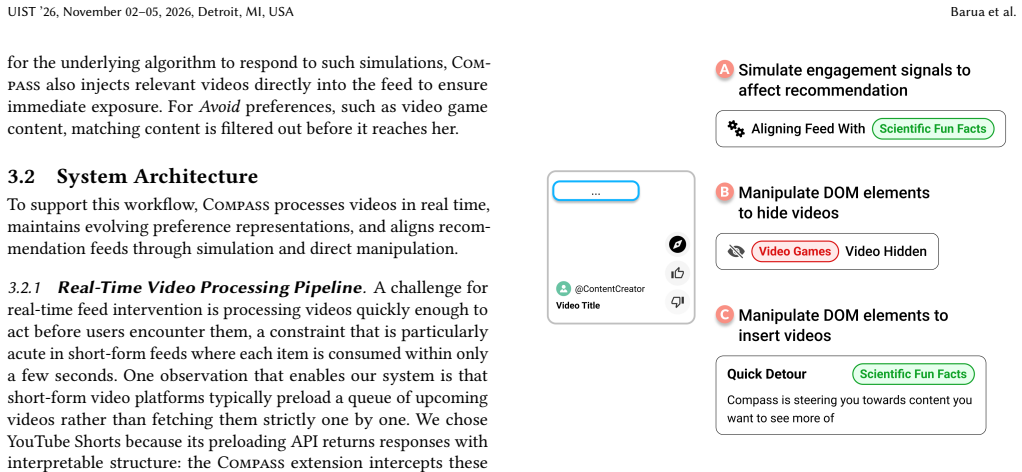
Three components carry the system. First, an in-situ reflection layer intercepts YouTube Shorts' preloaded video queue, runs each upcoming video through a real-time pipeline that combines metadata and three thumbnails into an LLM-generated semantic description, and embeds that description. Second, each user preference is represented as an editable bullet-point rubric plus optional example videos, also embedded; videos whose similarity falls near a threshold are flagged as uncertain and offered to the user as annotation opportunities, following active-learning uncertainty sampling. Third, an alignment engine monitors each preference's match rate over a sliding 48-hour window; when a 'see more' preference falls below a 6% rate, it simulates watching and liking matching videos in a background tab, and while waiting for the recommender to respond it also injects unwatched matching videos into the feed via URL updates and removes 'avoid' videos via DOM deletion. This combination is what the paper credits for the large alignment and refinement differences observed.
What would settle it
A direct mechanism test would isolate simulation from DOM manipulation. Run the same Compass interface in two conditions, one with background-tab simulation enabled and one with it disabled while keeping video insertion and removal active; if 'see more' alignment stays near the reported 49.3% in both conditions, the recommender-steering component is not load-bearing, whereas a drop toward the 20.3% baseline would confirm that simulated engagement is what moves the feed.
Extended reading notes
Core claim
Compass's central claim is that continuous alignment between a recommendation feed and a user's reflective preferences is achievable without replacing the underlying recommender or sacrificing casual browsing. The system surfaces lightweight reflection prompts directly in the feed: it asks users to label videos whose match to a preference is uncertain, suggests new preferences when a user's behavior signals misalignment (for example, disliking a video after watching several like it), and periodically summarizes how preferences have shaped the feed. Each prompt produces a concrete preference revision that the system then acts on through two channels: simulated engagement behaviors meant to steer the recommender, and direct DOM manipulation that inserts matching videos or removes unwanted ones. In the field study, participants using Compass made 11.50 refinements on average compared with 0.14 in the baseline, saw 49.3% of watched videos match their 'see more' preferences compared with 20.3%, and directed 58.7% of watch time to that content compared with 21.0%, while SUS scores (84.1 vs 83.2) and feed diversity were comparable. The paper reads these results as evidence that in-situ reflection plus automated realignment closes the gap between stated and revealed preferences more effectively than requiring users to take initiative.
Load-bearing premise
The weakest load-bearing premise is that YouTube's recommendation algorithm treats simulated watch and like events performed in a background tab the same as real user engagement, and changes future recommendations accordingly. If the recommender ignores or heavily discounts those simulated signals, the measured feed-alignment advantage would have to be attributed to the client-side insertion and removal of videos, and the system's 'steering' mechanism would not be doing the work the paper assigns to it.
Editorial extensions
If this is right
- Users who otherwise would not revisit configuration pages will refine preferences repeatedly if asked in the feed at the right moment: 73 of 92 refinements in the Compass condition happened directly in the feed.
- The same system can raise the share of a feed that matches a 'see more' preference to roughly half, and direct more than half of watch time to it, without measurably reducing content diversity.
- A baseline that offers the same preference language but requires manual triggering produces far less alignment, indicating that the interaction design, not the preference vocabulary, is the key bottleneck.
- Adding this reflection layer does not hurt perceived usability: SUS scores were statistically indistinguishable from the baseline and both fell in the 'excellent' range.
- The real-time matching pipeline reaches or exceeds the LLM-as-judge F1 once two example videos are added, which is what makes in-feed interventions fast enough for short-form video.
Reading between the lines
- An editor's inference: the paper's alignment numbers may overstate the recommender-steering contribution, because the Compass condition also performed 107 direct DOM injections that the baseline never received; a controlled ablation would be needed before attributing the alignment gap to simulation.
- The paper leaves implicit that the 6% match-rate threshold and 48-hour window were chosen through pilot testing; on other platforms with different recommender responsiveness, those parameters would likely need retuning, not just reuse.
- The in-situ reflection pattern could generalize beyond video: any preloading feed with identifiable content units (articles, posts, audio) could prompt users at moments of uncertain relevance, but the latency constraint is stronger for short-form video, so the general mechanism may be easier to deploy in slower media.
- If platforms harden against simulated engagement or block DOM-level rewriting, Compass's steering channel loses its reach; a mobile implementation would have to rely on accessibility APIs, which the paper flags as open work.
Editorial analysis
A structured set of objections, weighed in public.
Referee Report
Summary. The paper presents Compass, a browser extension for YouTube Shorts that elicits users' reflective preferences through lightweight in-situ notifications, represents those preferences as evolving rubrics with example videos, and aligns the feed by simulating engagement signals in a background tab while also directly injecting and removing videos via DOM manipulation. The authors report a 10-day between-subjects field study (N=15) in which Compass participants made significantly more preference refinements (11.50 vs 0.14 per participant, p=.001), saw more content matching their See More preferences (49.3% vs 20.3%, p=.009), and devoted more watch time to that content (58.7% vs 21.0%, p=.001), with comparable SUS scores and feed diversity versus a baseline without continuous support. They also report a technical evaluation on 408 human-labeled preference-video pairs showing that embedding-based matching with LLM-synthesized video representations achieves strong ROC-AUC, with gains from adding example videos.
Significance. If the causal claims hold, Compass makes a valuable contribution to HCI and recommender-systems research: it demonstrates a practical way to embed continuous reflection into an existing short-form video platform, and it articulates two complementary feed-alignment mechanisms (behavioral-signal simulation and client-side feed manipulation) that could generalize beyond YouTube. The paper is unusually complete in its implementation detail: the full prompt suite is given in Appendix C, the field-study instrumentation and timelines are in the appendix, and the technical evaluation uses human labels rather than only system-internal scores. The statistical analysis is careful for the sample size, with participant-level bootstraps and effect sizes. However, the central empirical claim about the mechanism of feed alignment is not fully supported because the outcome metric shares its representational family with the content-selection mechanism, and because the simulation mechanism is never isolated from the direct DOM injections. The paper's own limitation section is honest about sample size and platform scope, but these two unresolved points affect the headline interpretation.
major comments (3)
- [Section 4.2.2 and Appendix A.3, Table 2] The feed-alignment and watch-time measures are not independent of the mechanism that produces the alignment. The measurement classifier is 'Name→LLM + Meta+Frames→LLM' at threshold 0.370, which is the same embedding family and the same LLM-description pipeline that Compass uses to retrieve and inject videos for See More preferences. For an injected video, a match to the preference is true by construction, because the video was selected by high similarity to the same preference embedding. The 49.3% vs 20.3% alignment gap and the 58.7% vs 21.0% watch-time gap therefore partly measure the system's own selection rule rather than an independent property of the feed. The human-labeled evaluation in Section 5 validates the classifier on general pairs, but it does not validate the specific injected videos. Please report these metrics separately for organic versus injected videos, or add a human-rating check on a sample of watched videos.
- [Section 4.2.2, Section 6.2, and Section 3.2.3] The paper's central mechanism claim—that Compass steers YouTube's recommender through simulated behavioral signals—is not isolated from direct client-side manipulation. The text in Section 4.2.2 says the alignment difference is explained by more background simulations 'as well as 107 total direct video injections exclusive to Compass by design,' but the abstract and introduction assert that the advantage was 'largely driven by' proactive simulation. There is no condition, probe, or post-hoc analysis that separates changes in the organic feed caused by simulated watch/like events from changes caused by 107 DOM injections. Given that Section 3.2.3 itself notes that negative feedback on YouTube has limited documented impact, the possibility that YouTube discounts simulated signals is not hypothetical. If the recommender ignores those signals, the contribution reduces to client-side filtering and insertion, and the claimed generality of 'steering an existing engagement-based algorithm with behavioral signals' in Section 6.2 is unsupported. Please add a decomposition analysis (e.g., alignment of organic videos before vs after simulation events within Compass) or a separate technical probe measuring whether simulated events shift subsequent recommendations.
- [Section 4.1.2 and Table 5] The between-subjects comparison relies on alternating assignment with only 15 participants, and the participant table reveals visible baseline differences in self-reported daily usage intensity (e.g., B1 reports 4+ hours/day; B2, B4, and B5 report 2–4 hours/day, while several Compass participants report under 1 hour). If baseline participants are heavier and more habitual users, their lower refinement and alignment rates may partly reflect different usage patterns rather than the absence of in-situ support. The paper discloses the small sample but does not report a baseline-equivalence check on usage frequency or duration. Please add a comparison of these pre-treatment variables and, if feasible, a sensitivity analysis that adjusts for or matches on them.
minor comments (4)
- [Appendix A.3] The phrase 'Name→LLM and Meta+Frames→LLM with zero examples provided' is ambiguous because it concatenates the preference representation and the video representation; please write 'the preference representation Name→LLM with the video representation Meta+Frames→LLM and zero examples.'
- [Table 2 and Section 4.2.2] The Avoid-preference alignment and watch-time comparisons are non-significant and, if anything, directionally favor the baseline (19.0% vs 6.5% alignment; 16.7% vs 6.9% watch-time share). The paper's headline wording 'stronger feed alignment' should be qualified as applying to See More preferences, since the Avoid results do not support a general alignment claim.
- [Section 5.1 and Table 1] The thresholds reported as 'best F1' are selected on the same 408-sample evaluation set used to report ROC-AUC, so the numerical operating points may be optimistic. This does not affect the field-study comparison between conditions, but a sentence clarifying that no held-out threshold selection was performed would improve transparency.
- [Section 4.2.1] The statement that added reflection did not come at the cost of 'the casual nature' relies mainly on comparable SUS scores and qualitative quotes; SUS is a usability measure, not a direct measure of casual browsing experience. Consider reporting a more direct indicator, such as session length or frequency of uninterrupted scrolling, if available.
Circularity Check
No significant circularity; the feed-alignment outcome is independently validated and not reducible to the system's own parameters.
full rationale
I find no circular step in the derivation chain. The central field-study claims are empirical between-subjects comparisons, not quantities derived from fitted parameters. The feed-alignment metric is deliberately constructed to be shared across conditions: Appendix A.3 states that the authors did not use Compass's deployed classifier and instead 'adopt the method from our technical evaluation that best represents both approaches: Name→LLM and Meta+Frames→LLM with zero examples provided,' with the threshold (0.370) chosen during the technical evaluation. That measurement configuration is externally validated on 408 human-labeled preference-video pairs (ROC-AUC 0.842 in Table 1), giving the outcome measure independent grounding despite sharing an embedding family with the system's selection mechanism. The difference in preference-refinement counts (11.50 vs. 0.14) is a direct consequence of the manipulated feature set rather than a fitted prediction, and the paper does not present it as a model output. Self-citations, such as [26] and [75], support related-work observations about example-based preference articulation but are not load-bearing for the core results, and no uniqueness theorem is imported from the authors' prior work. The unresolved attribution between simulated behavioral signals and 107 direct DOM injections is a real internal-validity and mechanism-isolation concern, but it is a confound rather than a circular reduction: the reported alignment advantage would still be an empirical outcome even if caused entirely by injection. Because no equation reduces to an input by construction and no fitted parameter is renamed as a prediction, the paper is not circular in the sense defined here.
Assumptions & free parameters
free parameters (4)
- underrepresentation threshold for triggering feed alignment =
6% of videos in a sliding 48-hour window
- deployed matching similarity threshold range =
0.4 to 0.46
- measurement classifier threshold =
0.370
- uncertain-match threshold near the decision boundary
assumptions (4)
- domain assumption YouTube Shorts preloads upcoming videos and exposes interpretable API responses that a browser extension can intercept to extract video IDs before display.
- domain assumption Simulated watch and like signals executed in a background tab steer YouTube's recommender toward similar content.
- domain assumption LLM-generated semantic descriptions plus text-embedding similarity adequately capture whether a short video matches a user's preference for feed-level measurement.
- domain assumption Participants did not use YouTube outside study sessions except on a different account or incognito mode.
Cite this review
Pith. "Pith review of Compass: Continuously Aligning Social Media Feeds via In-Situ Reflections." pith.science (2026). https://pith.science/paper/HLTBODIH
@misc{pith2026260804274,
  author       = {Pith},
  title        = {Pith review of: Compass: Continuously Aligning Social Media Feeds via In-Situ Reflections},
  year         = {2026},
  howpublished = {\url{https://pith.science/paper/HLTBODIH}},
  note         = {Machine review of arXiv:2608.04274}
}
read the original abstract
Social media recommendation feeds often optimize for users' immediate impulses rather than preferences they would hold after deeper reflection. Some systems address this misalignment by incorporating users' explicit preferences via a configuration page or in-feed controls instead of just behavioral signals. However, users typically have evolving preferences, and their stated preferences and behavior naturally diverge, necessitating continuous reflection and feed realignment. But existing strategies require the user to take initiative and are often effortful; as a result, in practice they are rarely invoked. We present Compass, a system that aligns a user's feed with their reflective preferences by helping users reflect on and articulate their preferences given their behavior. To enable continuous reflection during everyday browsing, Compass surfaces in-situ reflections via lightweight notifications, while feed alignment is achieved by periodically simulating behavioral signals and directly manipulating feed content. We embedded Compass within YouTube Shorts and compared it against a baseline without continuous support through a 10-day field study (N=15). We found that Compass promoted more reflective and purposeful feed consumption, iterative preference adjustment, and stronger feed alignment, without sacrificing the casual nature of feed browsing.
Figures


Figures from the paper (6 more)


Reference graph
Works this paper leans on
-
[1]
Amanda Y Agan, Diag Davenport, Jens Ludwig, and Sendhil Mullainathan. 2023. Automating automaticity: How the context of human choice affects the extent of algorithmic bias. Technical Report. National Bureau of Economic Research
2023
-
[2]
Aaron Bangor, Philip T Kortum, and James T Miller. 2008. An empirical evaluation of the system usability scale.Intl. Journal of Human–Computer Interaction24, 6 (2008), 574–594
2008
-
[3]
I don’t even remember what I read
Amanda Baughan, Mingrui Ray Zhang, Raveena Rao, Kai Lukoff, Anastasia Schaadhardt, Lisa D Butler, and Alexis Hiniker. 2022. “I don’t even remember what I read”: How design influences dissociation on social media. InProceedings of the 2022 CHI conference on human factors in computing systems. 1–13
2022
-
[4]
Rahul Bhargava, Anna Chung, Neil S Gaikwad, Alexis Hope, Dennis Jen, Jasmin Rubinovitz, Belén Saldías-Fuentes, and Ethan Zuckerman. 2019. Gobo: A system for exploring user control of invisible algorithms in social media. InCompanion publication of the 2019 conference on computer supported cooperative work and social computing. 151–155
2019
-
[5]
Nattapat Boonprakong, Benjamin Tag, Jorge Goncalves, and Tilman Dingler
-
[6]
William J Brady, Joshua Conrad Jackson, Björn Lindström, and MJ Crockett. 2023. Algorithm-mediated social learning in online social networks.Trends in cognitive sciences27, 10 (2023), 947–960
2023
-
[7]
William J Brady, Julian A Wills, John T Jost, Joshua A Tucker, and Jay J Van Bavel
-
[8]
Virginia Braun and Victoria Clarke. 2019. Reflecting on reflexive thematic analysis. Qualitative research in sport, exercise and health11, 4 (2019), 589–597
2019
Show all 94 references
-
[9]
John Brooke et al. 1996. SUS-A quick and dirty usability scale.Usability evaluation in industry189, 194 (1996), 4–7
1996
-
[10]
Micah Carroll, Adeline Foote, Kevin Feng, Marcus Williams, Anca Dragan, W Bradley Knox, and Smitha Milli. 2025. CTRL-Rec: Controlling recommender systems with natural language.arXiv preprint arXiv:2510.12742(2025)
2025
-
[11]
Micah D Carroll, Anca Dragan, Stuart Russell, and Dylan Hadfield-Menell. 2022. Estimating and penalizing induced preference shifts in recommender systems. In International Conference on Machine Learning. PMLR, 2686–2708
2022
-
[12]
Eun Kyoung Choe, Bongshin Lee, Matthew Kay, Wanda Pratt, and Julie A Kientz
-
[13]
Frederick Choi and Eshwar Chandrasekharan. 2025. Designing Usable Controls for Customizable Social Media Feeds.arXiv preprint arXiv:2509.19615(2025)
2025
-
[14]
Ananta Chowdhury and Andrea Bunt. 2023. Co-Designing with Early Adoles- cents: Understanding Perceptions of and Design Considerations for Tech-Based Mediation Strategies that Promote Technology Disengagement. InProceedings of the 2023 CHI Conference on Human Factors in Computi...
2023
-
[15]
Emily IM Collins, Anna L Cox, Jon Bird, and Daniel Harrison. 2014. Social networking use and RescueTime: the issue of engagement. InProceedings of the 2014 ACM International Joint Conference on Pervasive and Ubiquitous Computing: Adjunct Publication. 687–690
2014
-
[16]
Sunny Consolvo, Predrag Klasnja, David W McDonald, Daniel Avrahami, Jon Froehlich, Louis LeGrand, Ryan Libby, Keith Mosher, and James A Landay. 2008. Flowers or a robot army? Encouraging awareness & activity with personal, mobile displays. InProceedings of the 10th internation...
2008
-
[17]
Paul Covington, Jay Adams, and Emre Sargin. 2016. Deep neural networks for youtube recommendations. InProceedings of the 10th ACM conference on recommender systems. 191–198
2016
-
[18]
Tom Cunningham, Sana Pandey, Leif Sigerson, Jonathan Stray, Jeff Allen, Bonnie Barrilleaux, Ravi Iyer, Mohit Kothari, Behnam Rezaei, Sanjay Kairam, et al. 2025. Ranking by engagement and non-engagement signals: Learnings from industry. Annals of the New York Academy of Science...
2025
-
[19]
Tom Cunningham, Sana Pandey, Leif Sigerson, Jonathan Stray, Jeff Allen, Bonnie Barrilleaux, Ravi Iyer, Smitha Milli, Mohit Kothari, and Behnam Rezaei. 2024. What we know about using non-engagement signals in content ranking.arXiv preprint arXiv:2402.06831(2024)
2024 arXiv
-
[20]
Algorithms ruin everything
Michael Ann DeVito, Darren Gergle, and Jeremy Birnholtz. 2017. " Algorithms ruin everything" # RIPTwitter, Folk Theories, and Resistance to Algorithmic Change in Social Media. InProceedings of the 2017 CHI conference on human factors in computing systems. 3163–3174
2017
-
[21]
Michael D Ekstrand and Martijn C Willemsen. 2016. Behaviorism is not enough: better recommendations through listening to users. InProceedings of the 10th ACM conference on recommender systems. 221–224
2016
-
[22]
Úlfar Erlingsson, Vasyl Pihur, and Aleksandra Korolova. 2014. Rappor: Random- ized aggregatable privacy-preserving ordinal response. InProceedings of the 2014 ACM SIGSAC conference on computer and communications security. 1054–1067
2014
-
[23]
Motahhare Eslami, Karrie Karahalios, Christian Sandvig, Kristen Vaccaro, Aimee Rickman, Kevin Hamilton, and Alex Kirlik. 2016. First I" like" it, then I hide it: Folk Theories of Social Feeds. InProceedings of the 2016 cHI conference on human factors in computing systems. 2371–2382
2016
-
[24]
I always assumed that I wasn’t really that close to [her]
Motahhare Eslami, Aimee Rickman, Kristen Vaccaro, Amirhossein Aleyasen, Andy Vuong, Karrie Karahalios, Kevin Hamilton, and Christian Sandvig. 2015. " I always assumed that I wasn’t really that close to [her]" Reasoning about invisible algorithms in news feeds. InProceedings of...
2015
-
[25]
Motahhare Eslami, Kristen Vaccaro, Min Kyung Lee, Amit Elazari Bar On, Eric Gilbert, and Karrie Karahalios. 2019. User attitudes towards algorithmic opacity and transparency in online reviewing platforms. InProceedings of the 2019 CHI Conference on Human Factors in Computing S...
2019
-
[26]
KJ Kevin Feng, Xander Koo, Lawrence Tan, Amy Bruckman, David W McDonald, and Amy X Zhang. 2024. Mapping the Design Space of Teachable Social Media Feed Experiences. InProceedings of the 2024 CHI Conference on Human Factors in Computing Systems. 1–20
2024
-
[27]
Casey Fiesler and Brianna Dym. 2020. Moving across lands: Online platform migration in fandom communities.Proceedings of the ACM on Human-Computer Interaction4, CSCW1 (2020), 1–25
2020
-
[28]
Dan Friedman and Adji Bousso Dieng. 2022. The vendi score: A diversity evalua- tion metric for machine learning.arXiv preprint arXiv:2210.02410(2022)
2022 arXiv
-
[29]
Cristos Goodrow. 2021. On YouTube’s recommendation system. YouTube Blog. https://blog.youtube/inside-youtube/on-youtubes-recommendation-system/ Ac- cessed: 2026-03-26
2021
-
[30]
Andrew M Guess, Neil Malhotra, Jennifer Pan, Pablo Barberá, Hunt Allcott, Taylor Brown, Adriana Crespo-Tenorio, Drew Dimmery, Deen Freelon, Matthew Gentzkow, et al. 2023. How do social media feed algorithms affect attitudes and behavior in an election campaign?Science381, 6656...
2023
-
[31]
Aastha Gupta. 2021. Incorporating More Feedback Into News Feed Ranking. Meta Newsroom. https://about.fb.com/news/2021/04/incorporating-more-feedback- into-news-feed-ranking/ Accessed: 2026-03-26
2021
-
[32]
Muhammad Haroon, Magdalena Wojcieszak, Anshuman Chhabra, Xin Liu, Pras- ant Mohapatra, and Zubair Shafiq. 2023. Auditing YouTube’s recommendation system for ideologically congenial, extreme, and problematic recommendations. Proceedings of the national academy of sciences120, 5...
2023
-
[33]
Silas Hsu, Kristen Vaccaro, Yin Yue, Aimee Rickman, and Karrie Karahalios. 2020. Awareness, navigation, and use of feed control settings online. InProceedings of the 2020 CHI Conference on Human Factors in Computing Systems. 1–13
2020
-
[34]
Jack Jamieson and Naomi Yamashita. 2023. Escaping the Walled Garden? User Perspectives of Control in Data Portability for Social Media.Proceedings of the ACM on Human-Computer Interaction7, CSCW2 (2023), 1–27
2023
-
[35]
Shagun Jhaver, Alice Qian Zhang, Quan Ze Chen, Nikhila Natarajan, Ruotong Wang, and Amy X Zhang. 2023. Personalizing content moderation on social media: User perspectives on moderation choices, interface design, and labor. Proceedings of the ACM on Human-Computer Interaction7,...
2023
-
[36]
Chenyan Jia, Michelle S Lam, Minh Chau Mai, Jeffrey T Hancock, and Michael S Bernstein. 2024. Embedding democratic values into social media AIs via societal objective functions.Proceedings of the ACM on Human-Computer Interaction8, CSCW1 (2024), 1–36
2024
-
[37]
2011.Thinking, fast and slow
Daniel Kahneman. 2011.Thinking, fast and slow. macmillan
2011
-
[38]
Jaejeung Kim, Hayoung Jung, Minsam Ko, and Uichin Lee. 2019. Goalkeeper: Exploring interaction lockout mechanisms for regulating smartphone use.Pro- ceedings of the ACM on Interactive, Mobile, Wearable and Ubiquitous Technologies 3, 1 (2019), 1–29
2019
-
[39]
Young-Ho Kim, Jae Ho Jeon, Eun Kyoung Choe, Bongshin Lee, KwonHyun Kim, and Jinwook Seo. 2016. TimeAware: Leveraging framing effects to enhance personal productivity. InProceedings of the 2016 CHI Conference on Human Factors in Computing Systems. 272–283
2016
-
[40]
Jon Kleinberg, Sendhil Mullainathan, and Manish Raghavan. 2024. The challenge of understanding what users want: Inconsistent preferences and engagement optimization.Management science70, 9 (2024), 6336–6355
2024
-
[41]
Akaash Kolluri, Renn Su, Farnaz Jahanbakhsh, Dora Zhao, Tiziano Piccardi, and Michael S Bernstein. 2025. Alexandria: A Library of Pluralistic Values for Realtime Re-Ranking of Social Media Feeds.arXiv preprint arXiv:2505.10839(2025)
2025 arXiv
-
[42]
Deepak Kumar, Yousef AbuHashem, and Zakir Durumeric. 2023. Watch your language: large language models and content moderation.arXiv preprint arXiv:2309.14517(2023)
2023 arXiv
-
[43]
David D Lewis. 1995. A sequential algorithm for training text classifiers: Corri- gendum and additional data. InAcm Sigir Forum, Vol. 29. ACM New York, NY, USA, 13–19
1995
-
[44]
Toby Jia-Jun Li, Amos Azaria, and Brad A Myers. 2017. SUGILITE: creating multimodal smartphone automation by demonstration. InProceedings of the 2017 CHI conference on human factors in computing systems. 6038–6049
2017
-
[45]
Wenqi Li, Jui-Ching Kuo, Manyu Sheng, Pengyi Zhang, and Qunfang Wu. 2025. Beyond Explicit and Implicit: How Users Provide Feedback to Shape Personalized Recommendation Content. InProceedings of the 2025 CHI Conference on Human Factors in Computing Systems. 1–17. Compass: Conti...
2025
-
[46]
Yabing Liu, Krishna P Gummadi, Balachander Krishnamurthy, and Alan Mis- love. 2011. Analyzing facebook privacy settings: user expectations vs. reality. InProceedings of the 2011 ACM SIGCOMM conference on Internet measurement conference. 61–70
2011
-
[47]
Yuhan Liu, Emmy Song, Owen Xingjian Zhang, Jewel Merriman, Lei Zhang, and Andrés Monroy-Hernández. 2025. Understanding decentralized social feed curation on mastodon.Proceedings of the ACM on Human-Computer Interaction 9, 7 (2025), 1–25
2025
-
[48]
Tao Lu, Hongxiao Zheng, Tianying Zhang, Xuhai “Orson” Xu, and Anhong Guo
-
[49]
Kai Lukoff, Ulrik Lyngs, Himanshu Zade, J Vera Liao, James Choi, Kaiyue Fan, Sean A Munson, and Alexis Hiniker. 2021. How the design of youtube influences user sense of agency. InProceedings of the 2021 CHI Conference on Human Factors in Computing Systems. 1–17
2021
-
[50]
Kai Lukoff, Cissy Yu, Julie Kientz, and Alexis Hiniker. 2018. What makes smart- phone use meaningful or meaningless?Proceedings of the ACM on Interactive, Mobile, Wearable and Ubiquitous Technologies2, 1 (2018), 1–26
2018
-
[51]
Omar El Malki, Marianne Aubin Le Quéré, Andrés Monroy-Hernández, and Manoel Horta Ribeiro. 2025. Bonsai: Intentional and personalized social media feeds.arXiv preprint arXiv:2509.10776(2025)
2025
-
[52]
Arunesh Mathur, Jessica Vitak, Arvind Narayanan, and Marshini Chetty. 2018. Characterizing the use of{Browser-Based} blocking extensions to prevent online tracking. InFourteenth symposium on usable privacy and security (SOUPS 2018). 103–116
2018
-
[53]
Meta. 2022. New Ways to Customize Your Facebook Feed. Meta Newsroom. https: //about.fb.com/news/2022/10/new-ways-to-customize-your-facebook-feed/ Ac- cessed: 2026-03-26
2022
-
[54]
Thomas Mildner and Gian-Luca Savino. 2021. Ethical user interfaces: Exploring the effects of dark patterns on facebook. InExtended Abstracts of the 2021 CHI Conference on Human Factors in Computing Systems. 1–7
2021
-
[55]
Carey K Morewedge, Sendhil Mullainathan, Haaya F Naushan, Cass R Sunstein, Jon Kleinberg, Manish Raghavan, and Jens O Ludwig. 2023. Human bias in algorithm design.Nature Human Behaviour7, 11 (2023), 1822–1824
2023
-
[56]
Rosemery O Nelson and Steven C Hayes. 1981. Theoretical explanations for reactivity in self-monitoring.Behavior Modification5, 1 (1981), 3–14
1981
-
[57]
2025.Americans’ Social Media Use 2025
Pew Research Center. 2025.Americans’ Social Media Use 2025. Technical Re- port. Pew Research Center. https://www.pewresearch.org/internet/2025/11/20/ americans-social-media-use-2025/
2025
-
[58]
Tiziano Piccardi, Martin Saveski, Chenyan Jia, Jeffrey Hancock, Jeanne L Tsai, and Michael S Bernstein. 2024. Reranking social media feeds: A practical guide for field experiments.arXiv preprint arXiv:2406.19571(2024)
2024
-
[59]
Lindsay Popowski, Xiyuan Wu, Charlotte Zhu, Tiziano Piccardi, and Michael S Bernstein. 2026. Social Media Feed Elicitation.arXiv preprint arXiv:2602.18594 (2026)
2026
-
[60]
Dorian Quelle and Alexandre Bovet. 2025. Bluesky: Network topology, polariza- tion, and algorithmic curation.PloS one20, 2 (2025), e0318034
2025
-
[61]
Emilee Rader, Kelley Cotter, and Janghee Cho. 2018. Explanations as mechanisms for supporting algorithmic transparency. InProceedings of the 2018 CHI conference on human factors in computing systems. 1–13
2018
-
[62]
Emilee Rader and Rebecca Gray. 2015. Understanding user beliefs about algorith- mic curation in the Facebook news feed. InProceedings of the 33rd annual ACM conference on human factors in computing systems. 173–182
2015
-
[63]
2022.Does This Button Work? Investigat- ing YouTube’s Ineffective User Controls
Becca Ricks and Jesse McCrosky. 2022.Does This Button Work? Investigat- ing YouTube’s Ineffective User Controls. Technical Report. Mozilla Founda- tion. https://assets.mofoprod.net/network/documents/Mozilla-Report-YouTube- User-Controls.pdf
2022
-
[64]
Nicolas Ruiz, Gabriela Molina León, and Hendrik Heuer. 2024. Design frictions on social media: Balancing reduced mindless scrolling and user satisfaction. In Proceedings of Mensch und Computer 2024. 442–447
2024
-
[65]
Paul A Samuelson. 2024. A note on the pure theory of consumer’s behaviour. In The Foundations of Price Theory Vol 4. Routledge, 101–116
2024
-
[66]
Christian Sandvig, Kevin Hamilton, Karrie Karahalios, and Cedric Langbort. 2014. Auditing algorithms: Research methods for detecting discrimination on internet platforms.Data and discrimination: converting critical concerns into productive inquiry22, 2014 (2014), 4349–4357
2014
-
[67]
H Sebastian Seung, Manfred Opper, and Haim Sompolinsky. 1992. Query by committee. InProceedings of the fifth annual workshop on Computational learning theory. 287–294
1992
-
[68]
Hong Shen, Alicia DeVos, Motahhare Eslami, and Kenneth Holstein. 2021. Every- day algorithm auditing: Understanding the power of everyday users in surfacing harmful algorithmic behaviors.Proceedings of the ACM on Human-Computer Interaction5, CSCW2 (2021), 1–29
2021
-
[69]
Jonathan Stray. 2021. Beyond Engagement: Aligning Algorith- mic Recommendations with Prosocial Goals. Partnership on AI. https://partnershiponai.org/beyond-engagement-aligning-algorithmic- recommendations-with-prosocial-goals/ Accessed: 2026
2021
-
[70]
Felicia Fang-Yi Tan, Ashwin Ram, Moritz Alexander Messerschmidt, Hasini Amanda Dissanayake, and Suranga Nanayakkara. 2025. Curious shorts: Curiosity-driven exploration and learning on short-form video platforms. InProceedings of the 2025 CHI Conference on Human Factors in Comp...
2025
-
[71]
Jiakai Tang, Yujie Luo, Xunke Xi, Fei Sun, Xueyang Feng, Sunhao Dai, Chao Yi, Dian Chen, Zhujin Gao, Yang Li, et al. 2025. Interactive Recommendation Agent with Active User Commands.arXiv preprint arXiv:2509.21317(2025)
2025
-
[72]
Kristen Vaccaro, Dylan Huang, Motahhare Eslami, Christian Sandvig, Kevin Hamilton, and Karrie Karahalios. 2018. The illusion of control: Placebo effects of control settings. InProceedings of the 2018 CHI Conference on Human Factors in Computing Systems. 1–13
2018
-
[73]
They’ve Over-Emphasized That One Search
Julie A Vera and Sourojit Ghosh. 2025. " They’ve Over-Emphasized That One Search": Controlling Unwanted Content on TikTok’s For You Page. InProceedings of the 2025 CHI Conference on Human Factors in Computing Systems. 1–8
2025
-
[74]
Karan Vombatkere, Sepehr Mousavi, Savvas Zannettou, Franziska Roesner, and Krishna P Gummadi. 2024. Tiktok and the art of personalization: investigating exploration and exploitation on social media feeds. InProceedings of the ACM Web Conference 2024. 3789–3797
2024
-
[75]
Leijie Wang, Kathryn Yurechko, Pranati Dani, Quan Ze Chen, and Amy X Zhang
-
[76]
Cai Yang, Sepehr Mousavi, Abhisek Dash, Krishna P Gummadi, and Ingmar Weber. 2025. Studying behavioral addiction by combining surveys and digital traces: A case study of TikTok. InProceedings of the International AAAI Conference on Web and Social Media, Vol. 19. 2106–2123
2025
-
[77]
YouTube. 2026. YouTube for Press. https://blog.youtube/press/. Accessed: 2026-03-21
2026
-
[78]
Excellent
Savvas Zannettou, Olivia Nemes-Nemeth, Oshrat Ayalon, Angelica Goetzen, Krishna P Gummadi, Elissa M Redmiles, and Franziska Roesner. 2024. Analyzing user engagement with TikTok’s short format video recommendations using data donations. InProceedings of the 2024 CHI Conference ...
2024
-
[80]
InProceedings of the 2025 CHI Conference on Human Factors in Computing Systems
End user authoring of personalized content classifiers: comparing exam- ple labeling, rule writing, and LLM prompting. InProceedings of the 2025 CHI Conference on Human Factors in Computing Systems. 1–21
2025
-
[85]
{metadata_text} Model: gpt-4.1-nano (metadata only) Based on the following information about a video, generate:
Exactly {settings.KEYWORD_COUNT} keywords for matching this video to user interests. {metadata_text} Model: gpt-4.1-nano (metadata only) Based on the following information about a video, generate:
-
[86]
A concise description of what the video is about
-
[87]
{metadata_text} {metadata_text}expands to a block of Title, Description, Channel, Categories, andTagslines
Exactly {settings.KEYWORD_COUNT} keywords for matching this video to user interests. {metadata_text} {metadata_text}expands to a block of Title, Description, Channel, Categories, andTagslines. Preference description bullets.Authors or revises the bullet-point description of a ...
-
[91]
Use IDs starting from 1
-
[92]
SYSTEM" for all bullets Return the bullet list as a JSON array with format: [{
Set owner to "SYSTEM" for all bullets Return the bullet list as a JSON array with format: [{"id": 1, " owner": "SYSTEM", "text": "..."}] Model: gpt-5.2 (update / regeneration) Preference title provided by user: {preference_name} {examples_section}Update the bullet points to re...
-
[93]
Generate up to 5 bullet points describing this preference
-
[94]
Keep bullets concise (10 words max)
-
[95]
Each bullet must represent a unique aspect of content
-
[96]
You may ADD, EDIT, or DELETE bullets with owner "SYSTEM"
-
[97]
You may NOT modify or remove bullets with owner "USER"
-
[98]
Ads/Promotional
For new bullets, use incrementing IDs starting from {next_id} Current Bullets: {current_bullets_json} Return the updated bullet list as a JSON array. When example videos exist,{examples_section}is a Example videos of preference provided by user:header followed byVideo 1: {desc...
2026
-
[2015]
InProceedings of the 2015 ACM international joint conference on pervasive and ubiquitous computing
SleepTight: low-burden, self-monitoring technology for capturing and reflecting on sleep behaviors. InProceedings of the 2015 ACM international joint conference on pervasive and ubiquitous computing. 121–132
2015
-
[2017]
Proceedings of the National Academy of Sciences114, 28 (2017), 7313–7318
Emotion shapes the diffusion of moralized content in social networks. Proceedings of the National Academy of Sciences114, 28 (2017), 7313–7318
2017
-
[2024]
InProceedings of the 2024 CHI conference on human factors in computing systems
InteractOut: leveraging interaction proxies as input manipulation strategies for reducing smartphone overuse. InProceedings of the 2024 CHI conference on human factors in computing systems. 1–19
2024
-
[2025]
In Proceedings of the 2025 CHI Conference on Human Factors in Computing Systems
How do HCI researchers study cognitive biases? A scoping review. In Proceedings of the 2025 CHI Conference on Human Factors in Computing Systems. 1–20
2025
Reviewed August 8, 2026 · model on record in the stance chip above.
Discussion (0). Continue with ORCID to comment.