REVIEW 3 major objections 5 minor 43 references
A Weighted Upwind Vector Kinetic Lattice Boltzmann Method For Hyperbolic Conservation Laws
T0 review · 3 major / 5 minor · reviewed 2026-08-15 · deepseek-v4-flash
Pith's one-line read A sigmoid-smoothed eigenvalue flux split inside the vector kinetic lattice Boltzmann equilibrium set yields a scheme stable at sign-changing wave speeds and more accurate than both the upwind and centered parent sets.
desk verdict A genuinely new weighted upwind equilibrium set with a sigmoid flux split, but the stability gain over discontinuous upwinding is confounded with added c-diffusion; still referee-worthy. read the letter →
The pith
A machine-rendered reading of the paper's core claim, the machinery that carries it, and where it could break.
The reading
What carries the argument
The load-bearing object is the weighted upwind equilibrium distribution set (22)-(24) together with the sigmoid flux split (25)-(27): a continuous decomposition of the physical flux obtained by expanding the flux in right eigenvectors of the flux Jacobian and weighting each characteristic coefficient by a sigmoid of the corresponding eigenvalue normalized by the largest wave speed. The sigmoid makes the split transition smoothly from centered to fully upwind as a characteristic speed moves away from zero, which is what regularizes the eigenvalue sign-change instability, while the parameter $c$, which controls how much of the conserved vector sits in the equilibria, acts as an additional diffusive stencil whose size is constrained by the monotonicity and entropy argument. The equivalent finite volume rewrite with interface flux $\mathcal{F}_{i+1/2}=(\mathcal{F}^{(+)}_i+\mathcal{F}^{(-)}_{i+1})-c\xi(U_{i+1}-U_i)$ shows that the scheme is conservative and that the additional term is a controllable local Lax-Friedrichs-type diffusion.
What would settle it
Run the weighted upwind scheme on the shallow water hydraulic-flow problem or the Euler sonic-point problem with $c=0.05$, $k=2$, and $\nu=0.9$: if spurious oscillations appear at the rarefaction or the pressure or density becomes negative, the claimed stability advantage over the discontinuous upwind set is not robust. More directly, compute the eigenvalues of $\partial_U f_2^{eq}$ for the shallow water and MHD systems at representative states with $c=0.05$ and $k=2$; if any eigenvalue is negative, the monotonicity condition that justifies the $c$-bound is violated, and the heuristic extension on which the test settings rely is not sound.
Extended reading notes
Core claim
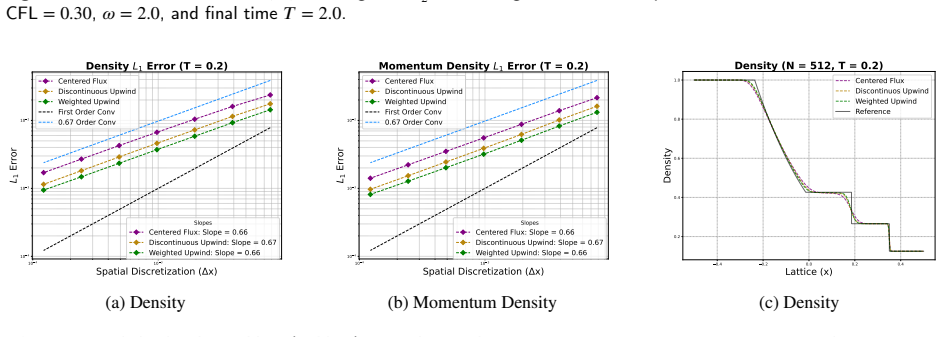
On the paper's own terms, the discovery is a family of equilibrium distribution functions $$ $f_1^{{eq}}$=cU+\frac{1}{\xi}\mathcal{F}^{(+)}(U),\qquad $f_2^{{eq}}$=(1-2c)U-\frac{1}{\xi}\big(\mathcal{F}^{(+)}(U)-\mathcal{F}^{(-)}(U)\big),\qquad $f_3^{{eq}}$=cU-\frac{1}{\xi}\mathcal{F}^{(-)}(U), $$ in which the partial fluxes come from a continuous eigendecomposition-based splitting with coefficient $\alpha(\lambda/|\lambda_{\max}|;k)=1/(1+e^{-k\lambda/\max_j|\lambda_j|})$. The parameter $c$ adds a diffusive stencil acting directly on the conserved variables, visible in the equivalent finite difference update (46), and must be nonnegative for that stencil to be well posed; the monotonicity criterion of Definition 1 gives the bound $0\le c\le \tfrac{1}{2}(1-\nu)$ under the stated restrictions of homogeneous degree-one fluxes, a constant Jacobian, and $k\to\infty$. The sigmoid splitting interpolates between the centered flux equilibrium set and the discontinuous upwind set, so the weighted set reduces to the centered set as an eigenvalue approaches zero and to the discontinuous upwind set as $k\to\infty$. Numerical tests on shallow water, Euler, and ideal MHD problems show that this interpolation suppresses the sign-change instabilities of the discontinuous upwind set, improves resolution relative to the centered set, and preserves second-order convergence on smooth problems.
Load-bearing premise
The load-bearing premise is that the entropy and monotonicity bound $0\le c\le \tfrac{1}{2}(1-\nu)$, proved only for homogeneous degree-one fluxes with a constant Jacobian in the $k\to\infty$ limit, still holds approximately for the nonlinear shallow water, Euler, and ideal MHD systems at the finite value $k=2$ actually used in the numerical experiments.
Editorial extensions
If this is right
- Any hyperbolic system with a real eigendecomposition of its flux Jacobian can be given the same upwind weighted equilibrium construction, so the method is not tied to the particular equations tested.
- On smooth problems the scheme keeps second-order accuracy with $\omega=2$, while the discontinuous upwind set is unstable on the same smooth Euler tests, so the stability gain does not cost formal order.
- In shock problems the weighted set runs at the same CFL number as the centered flux set, whereas the discontinuous upwind set required roughly half the CFL on the one-dimensional MHD shock tube, meaning the added dissipation does not degrade the time-step limit.
- The scheme satisfies a discrete conservation law via telescoping internal fluxes in its finite volume form, which is the property needed for credible shock capturing.
- The bound $0\le c\le \tfrac{1}{2}(1-\nu)$ gives a principled range for the extra diffusion when the assumptions of Theorem 4.4 hold, and the finite volume form identifies $c=\nu/2$ with standard local Lax-Friedrichs diffusion.
Reading between the lines
- The transition width $k$ in the sigmoid is fixed at $k=2$ in all tests; one could make $k$ depend on the local eigenvalue spread or the CFL number, letting the scheme become more upwind in smooth regions and more centered near sign changes.
- Because the finite volume interface flux reduces to a local Lax-Friedrichs flux at eigenvalue sign changes, the weighted upwind construction could be analysed with the existing finite volume stability toolbox, not only with kinetic entropy arguments.
- If the heuristic extension of the $c$-bound to non-homogeneous fluxes fails, a numerical check of entropy decay or of the monotonicity condition on the actual shallow water and MHD states would reveal how much of the stated stability margin is carried by the heuristic rather than the theorem.
- The same sigmoid splitting could be combined with a positivity- and bounds-preserving limiter, which the authors identify as the natural next step, to make the stability gains useful for very strong MHD shocks where negative pressure is the practical failure mode.
Signed reviews
Editorial analysis
A structured set of objections, weighed in public.
Referee Report
Summary. The paper proposes a weighted upwind vector kinetic lattice Boltzmann (WU-VKLB) method for hyperbolic conservation laws. The equilibrium set (22)-(24) is built from the conserved state U and partial fluxes obtained from a smooth sigmoid flux splitting (25)-(27) based on the eigendecomposition of the flux Jacobian; it reduces to the centered and discontinuous upwind sets in limiting cases. The authors derive equivalent finite-difference and finite-volume formulations (Theorems 4.1-4.3), show that the c-term acts as a diffusive stencil and yields an LLF-type numerical flux near zero eigenvalues, and prove an upper bound on c under restrictive assumptions (Theorem 4.4). Numerical tests on shallow water, Euler, and ideal MHD benchmarks report improved stability and accuracy relative to the centered and discontinuous upwind VKLB sets, together with second-order convergence on smooth problems.
Significance. If the claims withstand scrutiny, the method is a useful and fairly general construction: it gives a conservative, eigendecomposition-based upwinding framework for VKLB schemes, with explicit analysis of the added dissipation and demonstrated second-order convergence on smooth problems. The manuscript's algebraic core is clean: the moment constraints (3) and (5) are satisfied by construction, the arithmetic in Theorems 4.2 and 4.3 checks out, and Theorem 4.4 is correct under its stated hypotheses. The numerical test suite is broad (shallow water, Euler, and MHD with divergence cleaning), and the Orszag-Tang runs with c=0 and c=0.05 are a good start toward separating the effect of the diffusion parameter. The main weakness is that the central stability claim, namely that the sigmoid splitting rather than the added c-diffusion suppresses eigenvalue-sign-change instabilities, is not yet cleanly demonstrated, and the parameter bound is used heuristically outside its proven domain.
major comments (3)
- [5.1, 5.2 (Figs. 8-9, 13-14)] The central claim that the continuous sigmoid splitting stabilizes the scheme when eigenvalues change sign is confounded by the added c-diffusion. In the hydraulic-flow, compression-flow, Leblanc, and fixed-sonic-point benchmarks, the weighted upwind set is run with c=0.05 while the discontinuous upwind set has no analogous c-term, and no c=0 control run of the weighted upwind set is reported for these problems. Theorem 4.2 and Eq. (50) show that c introduces a Laplacian stencil and an LLF-type numerical flux with diffusion coefficient c*xi, and c=0.05 is the maximum value allowed by (51) at nu=0.9, so this term is not negligible. The Orszag-Tang comparison with c=0 and c=0.05 (Fig. 16) is helpful but does not isolate the eigenvalue-sign-change behavior. Please add c=0 runs, and if feasible intermediate c values, for the sign-change benchmarks, or otherwise separate the stabilizing effect of the sigmoid splitting from that of the c-diffusion; without this, the paper's emphasized mechanism is not established.
- [4.2, Theorem 4.4] The bound 0 <= c <= (1/2)(1-nu) is proven only for fluxes homogeneous of degree one with constant Jacobian in the limit k -> infinity, yet it is used to set c=0.05 with k=2 in all benchmark systems, including shallow water and MHD where the homogeneity assumption fails, and for the 2D set (41) where no analogous bound is derived. The 'Taylor series type expansion argument' in Section 4.2 is only a heuristic, and the manuscript itself flags this at the end of Theorem 4.4. Because the stability and accuracy claims in Section 5 all depend on this parameter choice, the paper needs either a proof covering non-homogeneous fluxes, finite k, and the 2D set, or a systematic numerical verification that the chosen c remains within a stable and entropy-consistent regime for each system. As written, the theoretical underpinning of the main free parameter is incomplete.
- [5.3, Fig. 15] In the Brio-Wu test the comparison also mixes CFL and c: the discontinuous upwind set is limited to nu=0.45 while the weighted upwind set runs at nu=0.90 with c=0.05, so the reported stability gain at the larger CFL may again be due to c-diffusion rather than the sigmoid splitting. A matched comparison (weighted upwind at c=0 and nu=0.90, or discontinuous upwind with an equivalent added diffusion) would clarify whether the sigmoid contributes independently of the diffusion.
minor comments (5)
- [Throughout] There are several typos and incorrect equation references: 'equations (2)' in Theorem 4.4 should be (27); 'in (4.4)' in Section 5 should be 'Theorem 4.4'; 'weighted upwind set (22)-(22)' in Section 5.3 should be (22)-(24); and 'discontinuos', 'T otal Energy', 'Fintie', 'the the', and 'and and' appear in the text.
- [3.2, Figure 5] The algorithm in Figure 5 says the streaming speed is updated through 'CFL/subcharacteristic constraint,' but for the discontinuous and weighted upwind sets only the CFL constraint is analyzed in Section 3.2; please state explicitly which constraint is used for each equilibrium set.
- [5.1, Figure 8] Figure 8 (hydraulic flow) uses CFL=0.80 while Section 5 states that nu=0.90 unless otherwise noted; since the c-bound (51) is CFL-dependent, please state the CFL in each figure caption and confirm that c=0.05 is within the applicable bound for that nu.
- [4.1] The sentence 'This consistency argument can be applied verbatim to the weighted upwind equilibrium distribution function set (22)-(24) when c=0' is slightly misleading, because the partial fluxes (26) are not identical to the discontinuous ones at finite k; the consistency is standard for any consistent splitting, but the wording should be adjusted.
- [3.1, Eq. (27)] Equation (27) defines alpha using max_j |lambda_j|; when all eigenvalues are zero, this quotient is undefined. For completeness, specify the convention in that degenerate case (for example, alpha=1/2).
Circularity Check
No significant circularity: the WU-VKLB construction, parameter choices, and benchmark comparisons are self-contained, and no prediction reduces to a fitted input or a load-bearing self-citation.
full rationale
The paper's central derivation is self-contained. The weighted upwind equilibrium distribution set (22)-(24) is explicitly defined as a generalization of the centered set (8)-(10) and the discontinuous upwind set (12)-(14), with the sigmoid splitting (25)-(27) supplied as a new construction rather than imported from a circular source. Theorems 4.1-4.3 derive the equivalent finite difference form, the conservative finite volume form, and the LLF-type interpretation of the numerical flux directly from these definitions; these are genuine derivations, not restatements of the scheme's inputs. The entropy bound (51) is derived in Theorem 4.4 under stated assumptions, and the paper transparently labels its extension to non-homogeneous systems as heuristic, which is an acknowledged modeling assumption rather than a circular step. The parameter c=0.05 is selected from the derived bound at nu=0.9 and k=2 is an a priori smoothness choice; neither is fitted to the benchmark outputs, and the accuracy/stability claims are verified against exact solutions, analytic Riemann solutions, and high-resolution Athena reference data. The one self-citation, reference [27], is used only to identify the Brio-Wu and Orszag-Tang benchmarks and is not load-bearing for any theoretical claim. The skeptical concern that the stability gain over the discontinuous upwind set is confounded with the added c-diffusion is an experimental-design caveat, not a circularity: the paper never defines stability as the presence of the c-term, and its stability conclusions are based on independent benchmark behavior. Therefore no circular step meeting the paper's own reduction standard can be exhibited.
Assumptions & free parameters
free parameters (2)
- c (weighting/diffusion coefficient on conserved state U) =
0.05, upper bound of (51) for nu=0.9; proven only for k->infinity, homogeneous degree-one flux, constant Jacobian
- k (sigmoid steepness in flux split (27)) =
2.0
assumptions (5)
- domain assumption Hyperbolicity: the flux Jacobian dF(U) has a complete set of real eigenvalues and eigenvectors for all U (eigenvalue decomposition (15)).
- ad hoc to paper For Theorem 4.4, F is homogeneous of degree one and the Jacobian dF is constant.
- domain assumption Bouchut monotonicity criterion (Definition 1) is a sufficient condition for the kinetic system to admit an H-theorem for systems with a convex entropy.
- domain assumption The classical hyperbolic CFL condition (28)-(29) is sufficient for stability of the discontinuous upwind and weighted upwind distribution sets.
- standard math Theorem 4.1: the general vector lattice Boltzmann scheme is equivalent to the finite difference form (45) for any 0<omega<2.
Cite this review
Pith. "Pith review of A Weighted Upwind Vector Kinetic Lattice Boltzmann Method For Hyperbolic Conservation Laws." pith.science (2026). https://pith.science/paper/FIKHD6P3
@misc{pith2026260804283,
  author       = {Pith},
  title        = {Pith review of: A Weighted Upwind Vector Kinetic Lattice Boltzmann Method For Hyperbolic Conservation Laws},
  year         = {2026},
  howpublished = {\url{https://pith.science/paper/FIKHD6P3}},
  note         = {Machine review of arXiv:2608.04283}
}
read the original abstract
Vector kinetic lattice Boltzmann (VKLB) methods have recently emerged as a promising framework for solving hyperbolic partial differential equation (PDE) systems. VKLB discretizes Boltzmann-type equations using a discrete set of lattice velocities, enforces discrete moment constraints, and carefully defines equilibrium distribution functions. In this work, we introduce novel upwinded equilibrium distribution functions constructed from conservation variables and numerical fluxes derived via continuous flux vector splitting based on the eigendecomposition of the flux Jacobian. This formulation enables the weighted-upwind VKLB equilibrium to be applied broadly to general hyperbolic systems. The method is verified on a set of challenging hyperbolic systems that includes the shallow water, Euler and ideal magnetohydrodynamics (MHD) equations. The proposed method demonstrates improved stability, reduced error norms, and sharper shock resolution across increasingly complex verification and benchmark problems.
Figures


Figures from the paper (14 more)




Reference graph
Works this paper leans on
-
[1]
Onlatticeboltzmannmethodsbasedonvector-kineticmodelsforhyperbolicpartialdifferentialequa- tions
Anandan,M.,RaghuramaRao,S.,2024. Onlatticeboltzmannmethodsbasedonvector-kineticmodelsforhyperbolicpartialdifferentialequa- tions. Computers and Fluids 280, 106348. URL:https://www.sciencedirect.com/science/article/pii/S0045793024001804, doi:https://doi.org/10.1016/j.compfluid.2024.106348
arXiv 2024
-
[2]
Equilibrium boundary conditions for vectorial multi-dimensional lattice Boltzmann schemes
Aregba-Driollet, D., Bellotti, T., 2025. Equilibrium boundary conditions for vectorial multi-dimensional lattice boltzmann schemes. URL: https://arxiv.org/abs/2505.17535,arXiv:2505.17535
work page Pith review arXiv 2025
-
[3]
Discrete kinetic schemes for multidimensional systems of conservation laws
Aregba-Driollet, D., Natalini, R., 2000. Discrete kinetic schemes for multidimensional systems of conservation laws. SIAM Journal on Numerical Analysis 37, 1973–2004. URL:http://www.jstor.org/stable/2587356
-
[4]
A robust and efficient solver based on kinetic schemes for magnetohydrodynamics (mhd) equations
Baty, H., Drui, F., Helluy, P., Franck, E., Klingenberg, C., Thanhäuser, L., 2023. A robust and efficient solver based on kinetic schemes for magnetohydrodynamics (mhd) equations. Applied Mathematics and Computation 440, 127667
work page 2023
-
[5]
Consistency and stability of boundary conditions for a two-velocities lattice Boltzmann scheme
Bellotti, T., 2025. Consistency and stability of boundary conditions for a two-velocities lattice boltzmann scheme. URL:https://arxiv. org/abs/2407.02009,arXiv:2407.02009
work page Pith review arXiv 2025
-
[6]
Bhatnagar,P.L.,Gross,E.P.,Krook,M.,1954.Amodelforcollisionprocessesingases.i.smallamplitudeprocessesinchargedandneutralone- componentsystems. Phys.Rev.94,511–525. URL:https://link.aps.org/doi/10.1103/PhysRev.94.511,doi:10.1103/PhysRev. 94.511
-
[7]
Lattice boltzmann for linear elastodynamics: Periodic problems and dirichlet boundary conditions
Boolakee, O., Geier, M., De Lorenzis, L., 2025. Lattice boltzmann for linear elastodynamics: Periodic problems and dirichlet boundary conditions. ComputerMethodsinAppliedMechanicsandEngineering433,117469. URL:https://www.sciencedirect.com/science/ article/pii/S0045782524007242, doi:https://doi.org/10.1016/j.cma.2024.117469
-
[8]
A novel second-order flux splitting for ideal magnetohydrodynamics
Borah, K., Natarajan, G., Dass, A.K., 2016. A novel second-order flux splitting for ideal magnetohydrodynamics. Journal of Computational Physics 313, 159–180. URL:https://www.sciencedirect.com/science/article/pii/S0021999116001248, doi:https://doi. org/10.1016/j.jcp.2016.02.052
Show all 43 references
-
[9]
Construction of BGK models with a family of kinetic entropies for a given system of conservation laws
Bouchut, F., 1999. Construction of BGK models with a family of kinetic entropies for a given system of conservation laws. Journal of Statistical Physics 95, 113–170. URL:https://doi.org/10.1023/A:1004525427365, doi:10.1023/A:1004525427365
1999 doi
-
[10]
Lattice boltzmann method for fluid flows
Chen, S., Doolen, G.D., 1998. Lattice boltzmann method for fluid flows. Annual Review of Fluid Mechanics 30, 329–364. URL:https://www.annualreviews.org/content/journals/10.1146/annurev.fluid.30.1.329, doi:https://doi.org/10. 1146/annurev.fluid.30.1.329
1998 doi
-
[11]
High-orderfluxsplittingschemesfortheeulerequationsofgasdynamics
Chu,S.,Herty,M.,Toro,E.F.,2025. High-orderfluxsplittingschemesfortheeulerequationsofgasdynamics. URL:https://arxiv.org/ abs/2504.01699,arXiv:2504.01699
2025 arXiv
-
[12]
Therunge-kuttalocalprojectiondiscontinuousgalerkinfiniteelementmethodforconservationlaws
Cockburn,B.,Hou,S.,Shu,C.W.,1990. Therunge-kuttalocalprojectiondiscontinuousgalerkinfiniteelementmethodforconservationlaws. iv: The multidimensional case. Mathematics of Computation 54, 545–581. URL:http://www.jstor.org/stable/2008501
1990
-
[13]
Hyperbolic divergence cleaning for the mhd equations
Dedner, A., Kemm, F., Kröner, D., Munz, C.D., Schnitzer, T., Wesenberg, M., 2002. Hyperbolic divergence cleaning for the mhd equations. Journal of Computational Physics 175, 645–673. URL:https://www.sciencedirect.com/science/article/pii/ S002199910196961X, doi:https://doi.org/...
2002
-
[14]
Lattice kinetic schemes for magnetohydrodynamics
Dellar, P.J., 2002. Lattice kinetic schemes for magnetohydrodynamics. Journal of Computational Physics 179, 95–126. URL:https: //www.sciencedirect.com/science/article/pii/S0021999102970440, doi:https://doi.org/10.1006/jcph.2002.7044
2002
-
[15]
Simulation of strong nonlinear waves with vectorial lattice boltzmann schemes
Dubois, F., 2014. Simulation of strong nonlinear waves with vectorial lattice boltzmann schemes. URL:https://arxiv.org/abs/1401. 0427,arXiv:1401.0427
2014 arXiv
-
[16]
Theory and practice of finite elements
Ern, A., Guermond, J.L., 2004. Theory and practice of finite elements. volume 159. Springer
2004
-
[17]
Principles of Magnetohydrodynamics: With Applications to Laboratory and Astrophysical Plasmas
Goedbloed, J.P.H., Poedts, S., 2004. Principles of Magnetohydrodynamics: With Applications to Laboratory and Astrophysical Plasmas. Cambridge University Press
2004
-
[18]
Second-order invariant domain preserving approximation of the euler equations using convex limiting
Guermond, J.L., Nazarov, M., Popov, B., Tomas, I., 2018. Second-order invariant domain preserving approximation of the euler equations using convex limiting. SIAM Journal on Scientific Computing 40, A3211–A3239
2018
-
[19]
Stability analysis of the vectorial lattice-boltzmann method
Guillon, K., Hélie, R., Helluy, P., 2024. Stability analysis of the vectorial lattice-boltzmann method. URL:https://arxiv.org/abs/ 2402.09813,arXiv:2402.09813
2024
-
[20]
A novel thermal model for the lattice boltzmann method in incompressible limit
He, X., Chen, S., Doolen, G.D., 1998. A novel thermal model for the lattice boltzmann method in incompressible limit. Journal of Computational Physics 146, 282–300. URL:https://www.sciencedirect.com/science/article/pii/S0021999198960570, doi:https://doi.org/10.1006/jcph.1998.6057
1998
-
[21]
Characteristic boundary conditions in the lattice boltzmann method for fluid and gas dynamics
Heubes, D., Bartel, A., Ehrhardt, M., 2014. Characteristic boundary conditions in the lattice boltzmann method for fluid and gas dynamics. Journal of Computational and Applied Mathematics 262, 51–61. URL:https://www.sciencedirect.com/science/article/pii/ S0377042713004743, doi...
2014 doi
-
[22]
Characteristic boundary condition for thermal lattice boltzmann methods
Klass, F., Gabbana, A., Bartel, A., 2024. Characteristic boundary condition for thermal lattice boltzmann methods. Computers I& Mathematics with Applications 157, 195–208. URL:http://dx.doi.org/10.1016/j.camwa.2023.12.033, doi:10.1016/j.camwa. 2023.12.033
2024 doi
-
[23]
The lattice Boltzmann method
Krüger, T., Kusumaatmaja, H., Kuzmin, A., Shardt, O., Silva, G., Viggen, E.M., 2017. The lattice Boltzmann method. volume 10. Springer
2017
-
[24]
Monolithic convex limiting for continuous finite element discretizations of hyperbolic conservation laws
Kuzmin, D., 2020. Monolithic convex limiting for continuous finite element discretizations of hyperbolic conservation laws. Computer Methods in Applied Mechanics and Engineering 361, 112804
2020
-
[25]
Flux-corrected transport: principles, algorithms, and applications
Kuzmin, D., Löhner, R., Turek, S., 2012. Flux-corrected transport: principles, algorithms, and applications. Springer Science & Business Media
2012
-
[26]
Finite volume methods for hyperbolic problems
LeVeque, R.J., 2002. Finite volume methods for hyperbolic problems. volume 31. Cambridge university press
2002
-
[27]
A linearity preserving nodal variation limiting algorithm for continuous galerkin discretization of ideal mhd equations
Mabuza, S., Shadid, J.N., Cyr, E.C., Pawlowski, R.P., Kuzmin, D., 2020. A linearity preserving nodal variation limiting algorithm for continuous galerkin discretization of ideal mhd equations. Journal of Computational Physics 410, 109390. URL:https://www. sciencedirect.com/sci...
2020
-
[28]
Lattice bgk models for navier-stokes equation
Qian, Y.H., D’Humières, D., Lallemand, P., 1992. Lattice bgk models for navier-stokes equation. Europhysics Letters 17, 479. URL: https://doi.org/10.1209/0295-5075/17/6/001, doi:10.1209/0295-5075/17/6/001
1992 doi
-
[29]
Aflux-splittingsolverforshallowwaterequationswithsourceterms
Rebollo,T.C.,Nieto,E.D.F.,Mármol,M.G.,2003. Aflux-splittingsolverforshallowwaterequationswithsourceterms. InternationalJournal for Numerical Methods in Fluids 42, 23–55. URL:https://onlinelibrary.wiley.com/doi/abs/10.1002/fld.436, doi:https: //doi.org/10.1002/fld.436,arXiv:htt...
2003 doi
-
[31]
Lattice boltzmann model for simulating flows with multiple phases and components
Shan, X., Chen, H., 1993. Lattice boltzmann model for simulating flows with multiple phases and components. Phys. Rev. E 47, 1815–1819. URL:https://link.aps.org/doi/10.1103/PhysRevE.47.1815, doi:10.1103/PhysRevE.47.1815
1993 doi
-
[32]
High order weighted essentially nonoscillatory schemes for convection dominated problems
Shu, C.W., 2009. High order weighted essentially nonoscillatory schemes for convection dominated problems. SIAM Review 51, 82–126. URL:https://doi.org/10.1137/070679065, doi:10.1137/070679065,arXiv:https://doi.org/10.1137/070679065
2009 doi
-
[35]
The athena++ adaptive mesh refinement framework: Design and magnetohydro- dynamic solvers
Stone, J.M., Tomida, K., White, C.J., Felker, K.G., 2020. The athena++ adaptive mesh refinement framework: Design and magnetohydro- dynamic solvers. The Astrophysical Journal Supplement Series 249, 4. URL:https://doi.org/10.3847%2F1538-4365%2Fab929b, doi:10.3847/1538-4365/ab929b
2020 doi
-
[36]
The Lattice Boltzmann Equation for Fluid Dynamics and Beyond
Succi, S., 2001. The Lattice Boltzmann Equation for Fluid Dynamics and Beyond. Oxford University Press
2001
-
[37]
On the sonic point glitch
Tang, H., 2005. On the sonic point glitch. Journal of Computational Physics 202, 507–532. URL:https://www.sciencedirect.com/ science/article/pii/S0021999104002967, doi:https://doi.org/10.1016/j.jcp.2004.07.013
2005 doi
-
[38]
Flux splitting schemes for the euler equations
Toro, E., Vázquez-Cendón, M., 2012. Flux splitting schemes for the euler equations. Computers and Fluids 70, 1–12. URL:https: //www.sciencedirect.com/science/article/pii/S0045793012003398, doi:https://doi.org/10.1016/j.compfluid.2012. 08.023
2012 doi
-
[39]
Riemann Solvers and Numerical Methods for Fluid Dynamics: A Practical Introduction
Toro, E.F., 2009. Riemann Solvers and Numerical Methods for Fluid Dynamics: A Practical Introduction. Springer, Berlin and New York
2009
-
[40]
A flux-vector splitting scheme for the shallow water equations extended to high-order on unstructured meshes
Toro, E.F., Castro, C.E., Vanzo, D., Siviglia, A., 2022. A flux-vector splitting scheme for the shallow water equations extended to high-order on unstructured meshes. International Journal for Numerical Methods in Fluids 94, 1679–1705. URL:http://dx.doi.org/10.1002/ fld.5099, ...
2022 doi
-
[41]
Towards the ultimate conservative difference scheme
van Leer, B., 1979. Towards the ultimate conservative difference scheme. v. a second-order sequel to godunov’s method. Journal of Computational Physics 32, 101–136. URL:https://www.sciencedirect.com/science/article/pii/0021999179901451, doi:https://doi.org/10.1016/0021-9991(79)90145-1
1979
-
[42]
Flux-vector splitting for the Euler equations, in: Krause, E
van Leer, B., 1982. Flux-vector splitting for the Euler equations, in: Krause, E. (Ed.), Numerical Methods in Fluid Dynamics. volume 170, pp. 507–512. doi:10.1007/3-540-11948-5_66
1982 doi
-
[43]
A new local and explicit kinetic method for linear and non-linear convection-diffusion problems with finite kinetic speeds: I
Wissocq, G., Abgrall, R., 2024. A new local and explicit kinetic method for linear and non-linear convection-diffusion problems with finite kinetic speeds: I. one-dimensional case. Journal of Computational Physics 518, 113333. URL:https://www.sciencedirect.com/ science/article...
2024
-
[44]
A positive- and bound-preserving vectorial lattice boltzmann method in two dimensions
Wissocq, G., Liu, Y., Abgrall, R., 2024. A positive- and bound-preserving vectorial lattice boltzmann method in two dimensions. URL: https://arxiv.org/abs/2411.15001,arXiv:2411.15001
2024 arXiv
-
[45]
Numerical solutions of euler equations by using a new flux vector splitting scheme
Zha, G., Bilgen, E., 2005. Numerical solutions of euler equations by using a new flux vector splitting scheme. International Journal for Numerical Methods in Fluids 17, 115–144. doi:10.1002/fld.1650170203
2005 doi
-
[46]
A novel flux splitting based on wave-particle splitting for ideal magnetohydrodynamics
Zhang, S., 2024. A novel flux splitting based on wave-particle splitting for ideal magnetohydrodynamics. Computers and Fluids 270, 106142.URL:https://www.sciencedirect.com/science/article/pii/S0045793023003675,doi:https://doi.org/10.1016/ j.compfluid.2023.106142. Michael W. Br...
2024
Reviewed August 15, 2026 · model on record in the stance chip above.
Discussion (0). Continue with ORCID to comment.