REVIEW 4 major objections 5 minor 95 references
Coupled Continuous-Discrete Generation for Scene Text Image Super-Resolution
T0 review · 4 major / 5 minor · reviewed 2026-08-06 · deepseek-v4-flash
Pith's one-line read A single shared multimodal transformer that jointly runs conditional flow matching for the image and absorbing-state discrete diffusion for the text achieves the best recognition and perceptual scores on Chinese scene text…
desk verdict A novel joint continuous-discrete generation framework for STISR with real efficiency gains, but the headline SOTA numbers depend on benchmark splits that need independent verification. read the letter →
The pith
A machine-rendered reading of the paper's core claim, the machinery that carries it, and where it could break.
The reading
What carries the argument
The load-bearing mechanism is a shared multimodal transformer with a joint attention block in the style of MM-DiT: image latent tokens and text tokens are projected into modality-specific streams, concatenated into shared query, key, and value attention at every layer, and then split back, so neither modality passes through a separate fusion module. Two coupled generative processes attach to this backbone. Conditional flow matching treats the high-resolution image latent as the endpoint of a linear interpolation $x_t = (1-t)x_0 + t x_1$ and trains a velocity head to predict the constant velocity $x_1 - x_0$, with a rectified target supplied by an EMA teacher through model-guided training. Absorbing-state discrete diffusion treats text as tokens in a continuous-time Markov chain whose forward process progressively replaces tokens with a mask, and the text head is trained on a simplified negative variational lower bound to predict the clean token from a corrupted sequence using a log-linear noise schedule $\alpha_t = 1 - t$. Synchronized corruption presents image and text at the same timestep in the joint loss, forcing the two heads to cooperate; at inference a four-step Euler ODE for the image alternates with iterative unmasking for the text, keeping already generated tokens fixed.
What would settle it
Re-running the official DiffTSR, MARCONet, and MARCONet++ checkpoints on the exact CTR-TSR test set and the exact 300 RealCE pairs that the authors release, with the same TransOCR evaluator, and checking whether DualTSR's reported ACC and FID margins, including the 12.78-point $\times 4$ ACC gain, survive, would settle the central claim.
Extended reading notes
Core claim
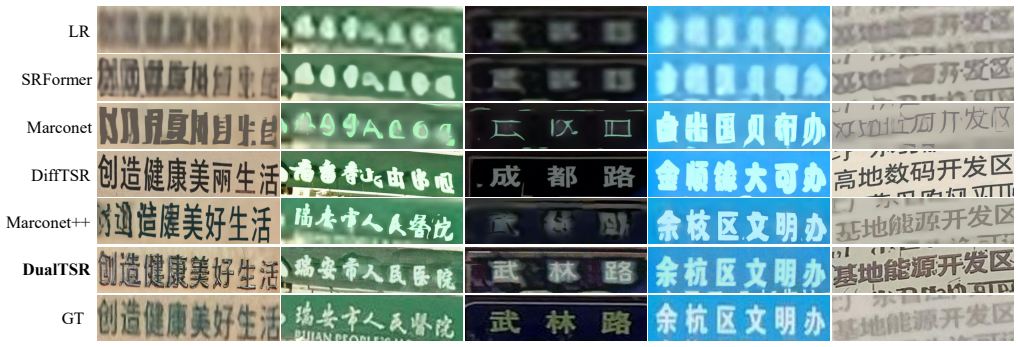
DualTSR's central claim is that scene text image super-resolution is better formulated as coupled continuous-discrete generation than as image restoration steered by an external text prior. The paper learns the conditional joint distribution $p(x_{\mathrm{hr}}, x_{\mathrm{txt}} | x_{\mathrm{lr}})$ with a single multimodal transformer: conditional flow matching generates the high-resolution image latent by integrating a velocity field along a linear interpolation from noise to data, and absorbing-state discrete diffusion reconstructs the character sequence by progressively unmasking tokens. Image and text share the same timestep during synchronized corruption, so the model must recover both modalities at once and each can guide the other; at inference, alternating Euler steps for the image and reverse absorbing transitions for the text let the evolving text hypothesis refine glyph structure while the evolving image improves text prediction. The paper reports that this unified model, without any external OCR prior, achieves the best FID, LPIPS, ACC, and NED among compared methods on CTR-TSR at $\times 2$ and $\times 4$, and the best FID, ACC, and NED with competitive LPIPS on the aligned RealCE subset, while cutting DiffTSR's $\times 4$ inference cost from 1.23B parameters and 13.3 s to 203M parameters and 132 ms.
Load-bearing premise
The comparison hinges on the assumption that the authors' re-implementation of the DiffTSR CTR-TSR construction and their self-curated 300-pair RealCE subset are faithful enough to the original benchmarks that official checkpoints of DiffTSR, MARCONet, and MARCONet++ can be compared fairly against DualTSR.
Editorial extensions
If this is right
- External OCR priors and separate image-text backbones are not necessary for strong scene text super-resolution; the internal text hypothesis generated by the shared transformer supplies the semantic constraint, and the ablation shows recognition accuracy climbing from 49.85% to 53.71% ACC when the joint and modality-specific losses are combined.
- At $\times 4$, generative scene text super-resolution can run inside feed-forward latency (132 ms, four network function evaluations) instead of the 13.3 s reported for DiffTSR, so diffusion-based restoration becomes usable in latency-sensitive settings.
- The text branch is a usable recognition signal on its own, not just a training regularizer: on CTR-TSR at $\times 4$ its internal predictions reach 45.44% ACC versus 26.09% for DiffTSR's dedicated text module, and OCR-on-restored-image ACC reaches 57.65%.
- The perception-distortion trade-off is explicit: PSNR is lower than regression-based baselines, so applications that require pixel-level fidelity rather than perceptual realism and legibility should expect a different operating point.
Reading between the lines
- Beyond the paper: the headline comparison is only as clean as the re-implemented CTR-TSR split and the 300-pair RealCE subset, so the released sample lists deserve independent scrutiny; a distributional overlap check against the original DiffTSR splits would settle how much of the reported margin is benchmark construction rather than model behavior.
- Beyond the paper: the guidance-scale result, where stronger classifier-free guidance monotonically worsens FID and eventually NED, suggests stroke-sensitive tasks need weaker guidance than natural-image synthesis; a testable extension is a modality-specific or time-varying guidance schedule that preserves fine strokes.
- Beyond the paper: because the same backbone both reads and renders text, the coupled continuous-discrete design is a natural template for other joint perception-generation tasks, such as document restoration, deblurring, or multilingual text enhancement, where the recognition stream can regularize the image stream.
Editorial analysis
A structured set of objections, weighed in public.
Referee Report
Summary. The paper proposes DualTSR, a scene text image super-resolution method that couples conditional flow matching for continuous image latents with absorbing-state discrete diffusion for text prediction inside a single multimodal transformer. The training objective combines image flow matching with model guidance, a text NELBO term, and a synchronized joint corruption loss; inference updates image and text states jointly without an external OCR prior. The authors report state-of-the-art FID, LPIPS, ACC, and NED on a re-implemented CTR-TSR benchmark, the best FID/ACC/NED on a self-curated 300-pair RealCE subset, and large efficiency gains over DiffTSR.
Significance. The conceptual contribution—unifying image restoration and text prediction in one shared transformer without an external OCR prior—is timely and the formulation is internally consistent. The two generative objectives are standard, the loss design is supported by the ablation in Table 5, and the efficiency comparison in Table 3 is clearly specified. However, the empirical headline rests on two non-standard benchmarks whose exact composition is not released, so the reported gains cannot currently be independently verified. If the artifacts are released and the numbers hold on the official splits, this would be a solid contribution to STISR.
major comments (4)
- [Appendix A, Section 4] The CTR-TSR benchmark used for the headline SOTA claim is a re-implementation of DiffTSR's private construction pipeline, and official DiffTSR/MARCONet/MARCONet++ checkpoints are evaluated on this re-created split. The paper states in Appendix A that the exact DiffTSR split is not publicly released, and while the filtering/resizing/degradation criteria are listed, no verification is provided that the resulting 64,139/8,690 split matches the original in image identities and degradation draws. Any deviation can shift ACC and FID for the baselines, so the 12.78 pp ACC advantage (Table 3) and the FID comparisons in Table 1 are not independently verifiable. The authors should release the exact sample list and construction code as part of the revision, and provide an overlap or distributional check against the original DiffTSR split if it can be obtained.
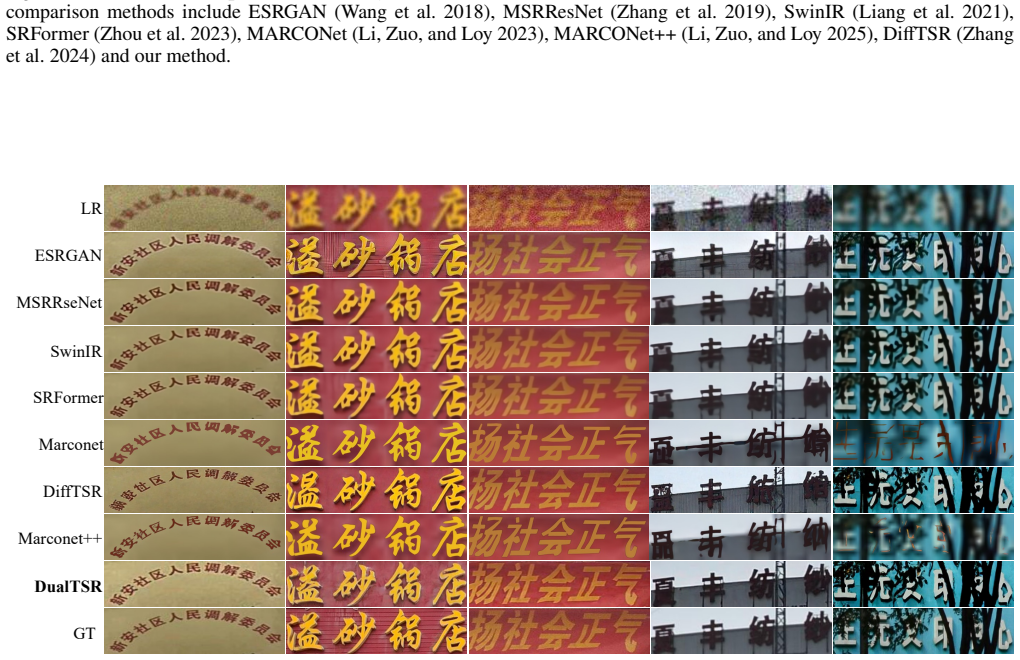
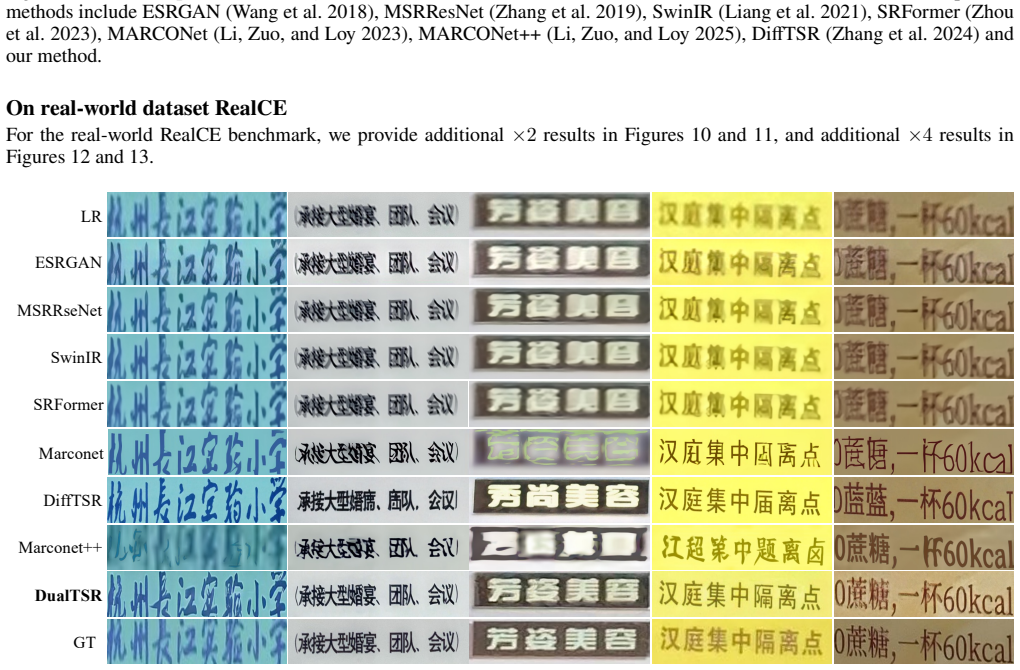
- [Appendix E, Table 2] The RealCE evaluation is performed on a self-curated subset of 300 clean, well-aligned LR-HR pairs with no released sample list. FID computed on 300 images is high-variance, and the reported ACC advantages are small (e.g., Table 2, x4 ACC 62.20% for DualTSR vs. 61.52% for MARCONet), so subset-selection noise could change the ranking. The claim of best FID, ACC, and NED on RealCE is therefore not robustly established. Please release the exact sample list, add bootstrap confidence intervals for the 300-image metrics, and compare the subset with the one used by DiffTSR if it can be obtained.
- [Appendix D, Table 2] For MARCONet++ on RealCE, Appendix D states that when the model fails to detect text, inference raises an error and the LR image is used directly as the model output, and that this issue is especially common in real-world samples. This fallback can substantially deflate MARCONet++'s RealCE numbers and inflate DualTSR's relative advantage. The paper should report the number of fallback cases per benchmark and either exclude them from the comparison or handle them in a way that does not bias the results.
- [Tables 1 and 5] The full loss configuration in Table 5 row (c), trained for 300k iterations at batch size 128, reports FID 9.92 on CTR-TSR x4, whereas the main model in Table 1, trained for 700k iterations at batch size 32, reports FID 16.42 for the same benchmark. ACC/NED also differ (53.71/73.60 vs. 57.65/76.64). Please specify the evaluation protocol used for Table 5 (sampling steps, random seed, evaluation set) so that the discrepancy can be reconciled; as written, the absolute FID values appear inconsistent with the main table.
minor comments (5)
- [Algorithm 2, Section 4] Algorithm 2 has default steps=50, but Section 4 and Table 3 describe a 4-step ODE sampler as the default; please align the pseudocode with the main text.
- [Figure 1] Figure 1 contains two panels labeled '(b)' (DiffTSR and Ours); the second panel should be labeled '(c)'.
- [Section 3, Appendix C] There are several language issues: 'A detailed description can be find at Appendix B' and 'We also provide a effect of sampling on Appendix C' should be corrected.
- [Appendix C] Appendix C selects 4 sampling steps as the default operating point, but Figure 5 indicates FID continues to improve up to about 40 steps; please report the FID/NED values at 4 steps in the figure or table so that the chosen trade-off is quantified.
- [Appendix E] Appendix E says the exact RealCE sample list will be released; if it is available at revision time, include it as supplementary material rather than deferring the release.
Circularity Check
No circular derivation found; the method's losses and metrics are externally grounded. The main caveat is benchmark re-implementation, which is a verifiability issue, not definitional circularity.
full rationale
The training objectives (Eqs. 2, 4-8, 9-12) supervise the flow-matching head with the ground-truth linear velocity u_t = x_1 - x_0 and the discrete-diffusion head with clean text tokens; no predicted output is fed back as its own ground truth. The model-guided rectified target in Eq. 10 uses the EMA teacher of the same network, but this is a self-distillation training technique, and the reported FID, LPIPS, ACC, and NED are computed on generated images with standard metrics and a fixed external TransOCR recognizer, so the headline numbers are not renamed training targets. No uniqueness theorem or prior result by the authors is invoked to forbid alternative designs; the architecture borrows externally standard MM-DiT blocks, flow matching, and absorbing-state diffusion. The only noteworthy caveat is benchmark-level: Section 4 and Appendices A and E state that the exact DiffTSR split is not public, so CTR-TSR is re-implemented and the RealCE evaluation uses a self-curated 300-pair subset whose sample list is not yet released. This is a reproducibility and verification limitation, not a circular reduction: the method's predictive chain does not assume the benchmark results as inputs.
Assumptions & free parameters
free parameters (4)
- Guidance scale w =
1.0
- Inference sampling steps =
4
- Conditional dropout probability psi =
0.1
- Text antithetic timesteps K =
8
assumptions (5)
- standard math Conditional flow matching (Eqs. 1-2) yields a valid generative ODE.
- standard math Absorbing-state discrete diffusion with alpha_t = 1 - t is a correct ELBO for masked token generation (Eq. 4).
- domain assumption The re-implemented CTR-TSR pipeline matches the DiffTSR benchmark distribution closely enough for official checkpoint comparisons.
- domain assumption The self-curated 300-pair RealCE subset is representative enough to support the real-world SOTA claim.
- domain assumption TransOCR is a stable and unbiased evaluator for ACC and NED across all methods.
Cite this review
Pith. "Pith review of Coupled Continuous-Discrete Generation for Scene Text Image Super-Resolution." pith.science (2026). https://pith.science/paper/P6C6ZAJU
@misc{pith2026260804525,
  author       = {Pith},
  title        = {Pith review of: Coupled Continuous-Discrete Generation for Scene Text Image Super-Resolution},
  year         = {2026},
  howpublished = {\url{https://pith.science/paper/P6C6ZAJU}},
  note         = {Machine review of arXiv:2608.04525}
}
read the original abstract
Scene text image super-resolution (STISR) aims to recover visually plausible appearance while preserving character semantics from degraded inputs. Existing STISR systems often rely on externally generated priors or separate image and text models, resulting in error propagation and costly multi-stage inference. We present DualTSR, a unified framework that formulates STISR as coupled continuous-discrete generation. Conditional flow matching restores continuous image latents, while absorbing-state discrete diffusion reconstructs text tokens. Both processes share a multimodal transformer backbone, allowing the evolving image and text states to interact throughout generation without an external OCR prior at inference. On CTR-TSR, DualTSR achieves the best FID, LPIPS, ACC, and NED among the compared methods at both X2 and X4. On an aligned RealCE subset, it obtains the best FID, ACC, and NED with competitive LPIPS. Compared with DiffTSR at X4, DualTSR improves ACC by 12.78 percentage points while reducing the parameter count from 1.23B to 203M and end-to-end latency from 13.3s to 132ms. These results establish DualTSR as an accurate and efficient method for STISR.
Figures


Figures from the paper (10 more)





Reference graph
Works this paper leans on
-
[1]
FirstName LastName , title =
-
[2]
FirstName Alpher , title =
-
[3]
Journal of Foo , volume = 13, number = 1, pages =
FirstName Alpher and FirstName Fotheringham-Smythe , title =. Journal of Foo , volume = 13, number = 1, pages =
-
[4]
Journal of Foo , volume = 14, number = 1, pages =
FirstName Alpher and FirstName Fotheringham-Smythe and FirstName Gamow , title =. Journal of Foo , volume = 14, number = 1, pages =
-
[5]
FirstName Alpher and FirstName Gamow , title =
-
[6]
Text gestalt: Stroke-aware scene text image super-resolution , author=
-
[7]
USER: Unified semantic enhancement with momentum contrast for image-text retrieval , author=
-
[8]
KBS , year=
Multiview adaptive attention pooling for image--text retrieval , author=. KBS , year=
Show all 95 references
-
[9]
Class-Aware Mask-guided feature refinement for scene text recognition , author=
-
[10]
Diffusion in the dark: A diffusion model for low-light text recognition , author=
-
[11]
KBS , year=
Pragmatic degradation learning for scene text image super-resolution with data-training strategy , author=. KBS , year=
-
[12]
CVPR , year=
Text-guided Explorable Image Super-resolution , author=. CVPR , year=
-
[13]
ICML , year=
Cross-view Masked Diffusion Transformers for Person Image Synthesis , author=. ICML , year=
-
[14]
CVPR , year=
A text attention network for spatial deformation robust scene text image super-resolution , author=. CVPR , year=
-
[15]
ICCV , year=
Learning to super-resolve blurry face and text images , author=. ICCV , year=
-
[16]
arXiv preprint arXiv:1909.07113 , year=
Textsr: Content-aware text super-resolution guided by recognition , author=. arXiv preprint arXiv:1909.07113 , year=
1909 arXiv
-
[17]
IEEE Transactions on Computational Imaging , year=
Collaborative deep learning for super-resolving blurry text images , author=. IEEE Transactions on Computational Imaging , year=
-
[18]
ECCV , year=
Scene text image super-resolution in the wild , author=. ECCV , year=
-
[19]
TIP , year=
Text prior guided scene text image super-resolution , author=. TIP , year=
-
[20]
arXiv preprint arXiv:2204.14044 , year=
C3-stisr: Scene text image super-resolution with triple clues , author=. arXiv preprint arXiv:2204.14044 , year=
-
[21]
arXiv preprint arXiv:2308.06743 , year=
Textdiff: Mask-guided residual diffusion models for scene text image super-resolution , author=. arXiv preprint arXiv:2308.06743 , year=
-
[22]
ICASSP , year=
Recognition-Guided Diffusion Model for Scene Text Image Super-Resolution , author=. ICASSP , year=
-
[23]
CVPR , year=
Diffusion-based Blind Text Image Super-Resolution , author=. CVPR , year=
-
[24]
DCDM: Diffusion-Conditioned-Diffusion Model for Scene Text Image Super-Resolution
Singh, Shrey and Keserwani, Prateek and Iwamura, Masakazu and Roy, Partha Pratim. DCDM: Diffusion-Conditioned-Diffusion Model for Scene Text Image Super-Resolution. ECCV. 2024
2024
-
[25]
ICCV , year=
A benchmark for chinese-english scene text image super-resolution , author=. ICCV , year=
-
[26]
CVPR , year=
Contrastive learning for compact single image dehazing , author=. CVPR , year=
-
[27]
TNNLS , year=
A Practical Contrastive Learning Framework for Single-Image Super-Resolution , author=. TNNLS , year=
-
[28]
AAAI , year=
Low-light image enhancement with normalizing flow , author=. AAAI , year=
-
[29]
ICASSP , year=
Burst Perception-Distortion Tradeoff: Analysis and Evaluation , author=. ICASSP , year=
-
[30]
CVPR , year=
Learning generative structure prior for blind text image super-resolution , author=. CVPR , year=
-
[31]
Neurocomputing , year=
TSRGAN: Real-world text image super-resolution based on adversarial learning and triplet attention , author=. Neurocomputing , year=
-
[32]
ICME , year=
Text-attentional conditional generative adversarial network for super-resolution of text images , author=. ICME , year=
-
[33]
ICDAR , year=
Improving text image resolution using a deep generative adversarial network for optical character recognition , author=. ICDAR , year=
-
[34]
arXiv preprint arXiv:1611.02163 , year=
Unrolled generative adversarial networks , author=. arXiv preprint arXiv:1611.02163 , year=
-
[35]
NeurIPS , year=
Classification accuracy score for conditional generative models , author=. NeurIPS , year=
-
[36]
CVPR , year=
NTIRE 2021 learning the super-resolution space challenge , author=. CVPR , year=
2021
-
[37]
CVPR , year=
Deblurring via stochastic refinement , author=. CVPR , year=
-
[38]
NeurIPS , year=
Denoising diffusion probabilistic models , author=. NeurIPS , year=
-
[39]
ICLR , year=
Denoising Diffusion Implicit Models , author=. ICLR , year=
-
[40]
TBC , year=
ACDMSR: Accelerated conditional diffusion models for single image super-resolution , author=. TBC , year=
-
[41]
ICCV , year=
Masked diffusion transformer is a strong image synthesizer , author=. ICCV , year=
-
[42]
arXiv preprint arXiv:2303.14389 , year=
MDTv2: Masked Diffusion Transformer is a Strong Image Synthesizer , author=. arXiv preprint arXiv:2303.14389 , year=
-
[43]
Digital Document Processing: Major Directions and Recent Advances , year=
An introduction to super-resolution text , author=. Digital Document Processing: Major Directions and Recent Advances , year=
-
[44]
CVPR , year=
MarkovGen: Structured Prediction for Efficient Text-to-Image Generation , author=. CVPR , year=
-
[45]
ECCV , year=
Simple baselines for image restoration , author=. ECCV , year=
-
[46]
CVPR , year=
Scene text telescope: Text-focused scene image super-resolution , author=. CVPR , year=
-
[47]
AAAI , year=
Improving scene text image super-resolution via dual prior modulation network , author=. AAAI , year=
-
[48]
Pean: A diffusion-based prior-enhanced attention network for scene text image super-resolution , author=
-
[49]
IJCNN , year=
Scene text image super-resolution via content perceptual loss and criss-cross transformer blocks , author=. IJCNN , year=
-
[50]
WACV , year=
Scene text image super-resolution based on text-conditional diffusion models , author=. WACV , year=
-
[51]
Scalable diffusion models with transformers , author=
-
[52]
arXiv preprint arXiv:2112.15093 , year=
Benchmarking chinese text recognition: Datasets, baselines, and an empirical study , author=. arXiv preprint arXiv:2112.15093 , year=
-
[53]
AAAI , year=
Resdiff: Combining cnn and diffusion model for image super-resolution , author=. AAAI , year=
-
[54]
TNNLS , year=
Diffusion models, image super-resolution, and everything: A survey , author=. TNNLS , year=
-
[55]
ICCV , year=
Designing a practical degradation model for deep blind image super-resolution , author=. ICCV , year=
-
[56]
ICCV , year=
Real-esrgan: Training real-world blind super-resolution with pure synthetic data , author=. ICCV , year=
-
[57]
CVPR , year=
The unreasonable effectiveness of deep features as a perceptual metric , author=. CVPR , year=
-
[58]
Learning from multi-perception features for real-word image super-resolution , author=
-
[59]
NeurIPS , year=
Gans trained by a two time-scale update rule converge to a local nash equilibrium , author=. NeurIPS , year=
-
[60]
FSMNLP , year=
Word transduction for addressing the oov problem in machine translation for similar resource-scarce languages , author=. FSMNLP , year=
-
[61]
Li, Xiaoming and Zuo, Wangmeng and Loy, Chen Change , title =
-
[62]
Cross-view Masked Diffusion Transformers for Person Image Synthesis , author =
-
[63]
arXiv preprint arXiv:2502.12154 , year=
Diffusion models without classifier-free guidance , author=. arXiv preprint arXiv:2502.12154 , year=
-
[64]
ICLR , year=
Flow Matching for Generative Modeling , author=. ICLR , year=
-
[65]
Transactions on Machine Learning Research , year=
Improving and generalizing flow-based generative models with minibatch optimal transport , author=. Transactions on Machine Learning Research , year=
-
[66]
ICML , year=
Scaling Rectified Flow Transformers for High-Resolution Image Synthesis , author=. ICML , year=
-
[67]
NeurIPS , year=
Diffusion-lm improves controllable text generation , author=. NeurIPS , year=
-
[68]
arXiv preprint arXiv:2208.04202 , year=
Analog bits: Generating discrete data using diffusion models with self-conditioning , author=. arXiv preprint arXiv:2208.04202 , year=
-
[69]
arXiv preprint arXiv:2211.15089 , year=
Continuous diffusion for categorical data , author=. arXiv preprint arXiv:2211.15089 , year=
-
[70]
NeurIPS , year=
Latent diffusion for language generation , author=. NeurIPS , year=
-
[71]
NeurIPS , year=
Likelihood-based diffusion language models , author=. NeurIPS , year=
-
[72]
arXiv preprint arXiv:2310.16834 , year=
Discrete diffusion language modeling by estimating the ratios of the data distribution , author=. arXiv preprint arXiv:2310.16834 , year=
-
[73]
NeurIPS , year=
Simple and Effective Masked Diffusion Language Models , author=. NeurIPS , year=
-
[74]
arXiv preprint arXiv:2407.15595 , year=
Discrete flow matching , author=. arXiv preprint arXiv:2407.15595 , year=
-
[75]
2024 , eprint=
Simplified and Generalized Masked Diffusion for Discrete Data , author=. 2024 , eprint=
2024
-
[76]
NeurIPS , year=
Structured denoising diffusion models in discrete state-spaces , author=. NeurIPS , year=
-
[77]
NeurIPS , year=
Concrete score matching: Generalized score matching for discrete data , author=. NeurIPS , year=
-
[78]
Taming Transformers for High-Resolution Image Synthesis , year=
Esser, Patrick and Rombach, Robin and Ommer, Björn , booktitle=. Taming Transformers for High-Resolution Image Synthesis , year=
-
[79]
Variational Diffusion Models , year =
Kingma, Diederik and Salimans, Tim and Poole, Ben and Ho, Jonathan , booktitle =. Variational Diffusion Models , year =
-
[80]
CVPR , year =
Li, Zijie and Li, Henry and Shi, Yichun and Farimani, Amir Barati and Kluger, Yuval and Yang, Linjie and Wang, Peng , title =. CVPR , year =
-
[81]
AAAI , year=
GlyphSR: A Simple Glyph-Aware Framework for Scene Text Image Super-Resolution , author=. AAAI , year=
-
[82]
TPAMI , year=
Enhanced Generative Structure Prior for Chinese Text Image Super-Resolution , author=. TPAMI , year=
-
[83]
AIM 2019 Challenge on Constrained Super-Resolution: Methods and Results , year=
Zhang, Kai and Gu, Shuhang and Timofte, Radu and Hui, Zheng and Wang, Xiumei and Gao, Xinbo and Xiong, Dongliang and Liu, Shuai and Gang, Ruipeng and Nan, Nan and Li, Chenghua and Zou, Xueyi and Kang, Ning and Wang, Zhan and Xu, Hang and Wang, Chaofeng and Li, Zheng and Wang, ...
2019
-
[84]
ECCV Workshops , year=
Wang, Xintao and Yu, Ke and Wu, Shixiang and Gu, Jinjin and Liu, Yihao and Dong, Chao and Qiao, Yu and Loy, Chen Change , title =. ECCV Workshops , year=
-
[85]
ICCV , year=
Swinir: Image restoration using swin transformer , author=. ICCV , year=
-
[86]
ICCV , year=
Srformer: Permuted self-attention for single image super-resolution , author=. ICCV , year=
-
[87]
TPAMI , year=
Aster: An attentional scene text recognizer with flexible rectification , author=. TPAMI , year=
-
[88]
PR , year=
Moran: A multi-object rectified attention network for scene text recognition , author=. PR , year=
-
[89]
TPAMI , year=
An end-to-end trainable neural network for image-based sequence recognition and its application to scene text recognition , author=. TPAMI , year=
-
[90]
ICLR , year=
Decoupled Weight Decay Regularization , author=. ICLR , year=
-
[91]
PR , year=
TextDiff: Enhancing scene text image super-resolution with mask-guided residual diffusion models , author=. PR , year=
-
[92]
arXiv preprint arXiv:1802.03426 , year=
Umap: Uniform manifold approximation and projection for dimension reduction , author=. arXiv preprint arXiv:1802.03426 , year=
-
[93]
NeurIPS , year=
Frieren: Efficient video-to-audio generation network with rectified flow matching , author=. NeurIPS , year=
-
[94]
AAAI , year=
Trocr: Transformer-based optical character recognition with pre-trained models , author=. AAAI , year=
-
[95]
NeurIPS 2021 Workshop on Deep Generative Models and Downstream Applications , year=
Classifier-Free Diffusion Guidance , author=. NeurIPS 2021 Workshop on Deep Generative Models and Downstream Applications , year=
2021
Reviewed August 6, 2026 · model on record in the stance chip above.
Discussion (0). Sign in to comment.