REVIEW 4 major objections 5 minor 34 references
MetaVideoAgent: Automated Video-Agent Evolution for Long-Form Video Understanding
T0 review · 4 major / 5 minor · reviewed 2026-08-06 · deepseek-v4-flash
Pith's one-line read Automatically evolving a video agent for its target domain raises macro accuracy from 38.44% to 51.47% across eight video domains, beating every fixed video agent and direct LLM with fewer tokens and frames per question.
desk verdict A credible first cut at auto-evolving video agents with an honest held-out protocol, but the headline margins rest on single runs without variance bars. read the letter →
The pith
A machine-rendered reading of the paper's core claim, the machinery that carries it, and where it could break.
The reading
What carries the argument
The load-bearing object is the Gold Path: a minimal sufficient evidence chain that the Teacher Video Agent reconstructs from the question, the ground-truth answer, the annotated evidence interval, and the raw media before inspecting the Student's trajectory. It specifies which facts must hold, which channels establish them, and how they entail the answer, and it lets the Teacher find the earliest Student step that can no longer support the correct solution. Around it sits the modular agent representation $A = (S, L, P, W, R)$ — video structuring, evidence localization, perception, working memory, and reasoning — which constrains each code edit to the primary responsible module and only the dependencies needed to preserve interfaces and end-to-end execution. Completing the mechanism are minimal validation tasks, which compress localized failures into independently executable probes so a candidate can be tested cheaply before the full evolution-split comparison.
What would settle it
Run the same four-iteration evolution on VA-EvoBench with the Diagnosis Agent's module attribution scrambled — for example, always blaming the perception module regardless of the Teacher's review — and record held-out macro accuracy. If accuracy still climbs roughly 13 points, diagnostic fidelity is not the cause of the reported gains; if it collapses toward the blind-evolution trajectory, the evidence-grounded diagnosis is confirmed as the load-bearing mechanism.
Extended reading notes
Core claim
The paper's central claim is that code-level evolution of video agents is feasible and beats hand-designed alternatives. Starting from a distribution profile built from five sparsely sampled frames per video plus the associated query set, an initial agent is synthesized; four iterations of execution, review, diagnosis, and constrained code modification then produce an agent that improves all eight distributions of VA-EvoBench and surpasses every fixed video agent and direct multimodal LLM in the comparison. The demonstration rests on two mechanisms the paper introduces: a five-module representation of a video agent, namely video structuring, evidence localization, perception, working memory, and reasoning, which lets each code update be scoped to the primary responsible module plus its necessary dependencies; and an evidence-grounded Gold Path, reconstructed by a Teacher Video Agent from the ground-truth answer and annotated evidence intervals, which audits the Student's trajectory and locates the earliest step that can no longer support the correct answer. The paper's ablations attribute the stability of the process to this diagnostic stack: without review, diagnosis, and targeted research, evolution becomes highly volatile (293.24 pp² update variance versus 15.52 for the full method), while initializing from an existing fixed agent (DVD) improves it further, to 63.03% on Course Lecture.
Load-bearing premise
The method's gains rest on one premise: the Teacher's Gold Path and the Diagnosis Agent's module attributions are accurate enough that editing the blamed module actually repairs the failure — the paper concedes in Appendix J that an incorrect causal attribution yields an unhelpful diagnosis contract, and its own blind-evolution ablation (volatility 293.24 pp² against 15.52 for the full method) shows the gain depends on this fidelity.
Editorial extensions
If this is right
- Evolved agents would become the practical ceiling for video QA on a target domain: MetaVideoAgent's final agents exceed the best fixed design by 6.39 points while using fewer tokens (74.47K vs 102.26K per question) and frames (29.11 vs 42.77) than any fixed video agent compared.
- The gains are not confined to easy distributions: evolution improves every initial agent, including the weakest start (Stage Performance, from 23.30% to 57.28%).
- Evolution can also upgrade a hand-built agent instead of starting from scratch: initializing from an existing fixed design (DVD) raises Course Lecture accuracy by a further 3.37 points, to 63.03%.
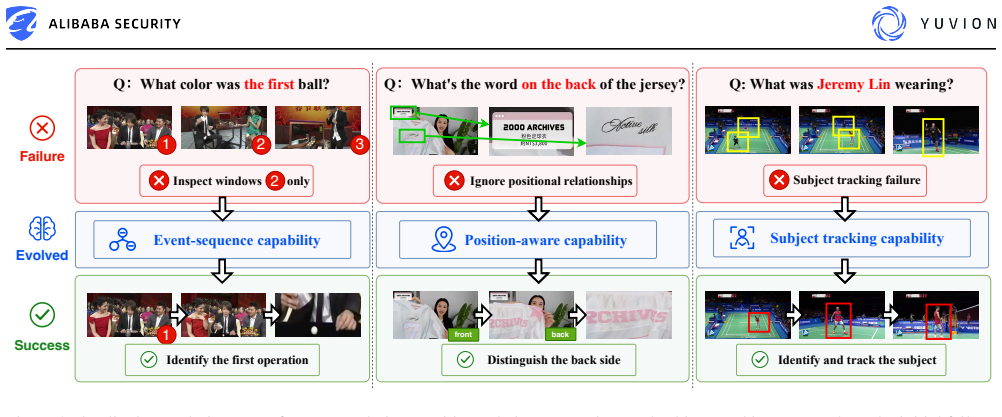
- Learned behaviors transfer to unseen questions within a distribution: the evolved capabilities shown — event ordering, position-relation perception, cross-view subject tracking — are demonstrated on held-out questions that played no role in evolution.
- Most of the gain arrives within the fixed budget: the mean best-so-far held-out accuracy across the eight runs reaches 52.21% (95% CI 48.63–55.78) at full budget, with evolution costing on average 3.54M tokens per distribution.
Reading between the lines
- If the paper is right, the practical bottleneck for adapting an agent to a new video domain shifts from pipeline engineering to producing labeled video-QA examples with annotated evidence intervals; the natural next step the authors do not claim is replacing expert annotations with automatically generated Gold Paths.
- The reusable behaviors the paper documents — event ordering, position-relation perception, cross-view subject tracking — suggest that recurring evidence patterns could be captured as portable module upgrades and shared across distributions, a transfer the paper explicitly does not establish.
- The reported per-question token and frame costs are deployment costs only; evolution itself consumes 3.54M tokens per distribution on average, so a practitioner comparing evolved against fixed agents should amortize that one-time evolution cost into the per-question budget.
Signed reviews
Editorial analysis
A structured set of objections, weighed in public.
Referee Report
Summary. MetaVideoAgent proposes an automated framework that evolves a long-form-video understanding agent for a target distribution. The evolution loop iterates distribution-aware initialization (sparse frame profiling), Teacher review of failed Student trajectories (using ground-truth answers and annotated evidence intervals on an evolution split), cross-trajectory Diagnosis, and responsibility-constrained code modification over a fixed five-module agent representation (structuring, localization, perception, working memory, reasoning). Candidate acceptance is gated by engineering checks, minimal-validation probes, and full evolution-split comparison, while held-out outcomes for archived checkpoints are recorded only by an external evaluator after a fixed K-iteration budget and never enter evolution decisions. The authors also introduce VA-EvoBench, eight author-curated distributions derived from CG-Bench with video-disjoint evolution and held-out splits (356 and 867 questions, respectively). The headline results are a macro-average improvement from 38.44% to 51.47% over four iterations, 12.49 points above the strongest direct MLLM (Gemini 3.1 Pro) and 6.39 points above the best fixed video agent (WorldMM), with the lowest per-question token and frame counts among the compared video agents, at an average evolution cost of 3.54M tokens per distribution.
Significance. The paper's protocol discipline is a genuine strength: held-out outcomes are withheld from diagnosis, promotion, stopping, and rollback; the final agent is frozen after fixed iterations; and Appendix G lays out the annotation-access rules. The appendix pseudocode (Algorithms 1-6), the worked evolution cycles in Sections B.6 and B.7, and the planned code and data release support reproducibility. If the effect is real, the 8-of-8 improvement over the synthesized initial agents is evidence that distribution-level diagnosis can steer code-level agent evolution, and the low deployment cost (74.47K tokens/question versus 102-323K for fixed video agents) is practically meaningful. The main risk is statistical: every headline number is a single run per distribution on splits of 71-135 questions, with non-monotonic trajectories and very high volatility in the ablations (Table 2: 293.24 and 131.43 pp2), so the magnitude of the advantage over direct MLLMs and fixed agents is not yet separated from run-to-run noise. The improvement-over-initialization claim is on firmer ground than the superiority-over-fixed-agents claim.
major comments (4)
- [Section 6.2 and Table 1] The central accuracy figures rest on one run per distribution, and the held-out splits (Table 7) contain only 71-135 questions each (867 total). For a split of 119 questions, a move of five to six questions is several accuracy points, so the reported 6.39-point margin over WorldMM (51.47 vs 45.08) and the 12.49-point margin over Gemini 3.1 Pro are not separated from run-to-run noise by the evidence presented. Moreover, MVA does not beat fixed agents on every distribution: on Product Presentation it reaches 56.31 vs WorldMM 59.22 and Symphony 57.28, and on Dramatic Narrative 40.34 vs DVD 47.06 and WorldMM 45.38. I ask the authors to report Wilson intervals for each per-distribution accuracy, a paired comparison (McNemar or bootstrap) against at least the strongest fixed agent on the common question set, and at least two or three repeated evolution runs for one or two distributions to bound seed variance; the Course Lecture setting is the natural place since the ablation infrastructure already exists.
- [Table 9 and Figure 4] Table 9 shows strongly non-monotonic single-run trajectories (notably Dramatic Narrative 37.82-39.50-38.66-46.22-40.34, and Gameplay 31.76-38.82-29.41-27.06-47.06), and Figure 4 reports a best-so-far held-out mean of 52.21% (95% CI 48.63-55.78) versus the 51.47% final macro accuracy. Because the reported CI is across the eight distributions rather than across repeated runs of one distribution, it cannot tell us whether the final checkpoint differs meaningfully from earlier checkpoints or from the best archived checkpoint. Please re-derive the conclusion using a measure that is robust to this, such as area under the cumulative-budget curve with a cross-run variance estimate, and report the final-checkpoint accuracy as a secondary measure.
- [Appendix C and Table 4] The fixed-agent comparison is confounded by control-model choice. Appendix C assigns Qwen 3.7 Max as the control LLM for all four fixed video agents, while the MVA Student reasoning module uses GLM-5.2, and no direct MLLM baseline in Table 1 uses GLM-5.2. The 6.39-point advantage over fixed video agents therefore mixes agent-design differences with reasoning-model differences. To isolate the contribution of evolution, either run the fixed agents with GLM-5.2 as their planner, or run MVA with Qwen 3.7 Max as the Student, or add a GLM-5.2 direct MLLM row to Table 1. Without one of these controls, the comparison supports that evolution helps, but not the stated margin over fixed designs.
- [Sections 4.3-4.4 and Appendix J] The framework's benefit over blind evolution depends on the accuracy of Teacher Gold Paths and module attribution, and the blind ablation (Table 2, 293.24 pp2 volatility) shows the gain collapses when diagnosis is removed. Yet the paper provides no evidence on attribution accuracy: no human evaluation of a sample of Teacher reviews or diagnosis contracts, and no sensitivity analysis. Please add either a human-rated sample of diagnosis contracts (for example, 50-100 reviews on one distribution, with agreement rates on the attributed module) or a perturbation experiment that corrupts a fraction of module attributions and reports held-out accuracy as a function of corruption. Appendix J's concession that an incorrect causal attribution can yield an unhelpful diagnosis contract is exactly the point that needs empirical bounding.
minor comments (5)
- [Algorithm 6 and Section B.5] The pseudocode and the prose disagree about the probe gate: Algorithm 6 rejects a candidate when Gprobe_k = 0, while Section B.5 states that the probe stage has no separate failure exit and an unimproved result remains actionable feedback for Codegen until PROCEED is reached. Please align the pseudocode with the intended control flow.
- [Table 1] Table 1 would be easier to interpret if the number of answer options and the chance-level baseline were stated, since CG-Bench multiple-choice questions typically have a fixed option count and all comparisons are made against that floor.
- [Section 6.2] The sentence 'It improves all eight distributions and exceeds every fixed video agent' conflates two different claims: improvement over the per-distribution initial agents (supported by Table 8) versus superiority on the macro average (not supported on Product Presentation and Dramatic Narrative, where fixed baselines are numerically higher). Please separate the two claims and, when reporting resource use, state explicitly that the fewest-token and fewest-frame comparisons are among the compared video agents, not the direct MLLMs.
- [Figure 4] The 95% confidence interval in Figure 4 is a between-distribution interval for the mean of eight runs; the caption or text should clarify that it does not quantify run-to-run variance for a single distribution, so that readers do not over-read it as evidence of stability.
- [References] References [31] and [32] appear to describe the same Deep Video Discovery paper listed twice with different years and venues; please deduplicate and consolidate the citations.
Circularity Check
No circularity: the evolution loop is supervised on the evolution split with clean held-out separation, and the self-citations and author-curated benchmark are not load-bearing reductions.
full rationale
The paper's only reported predictions are held-out accuracy numbers, and every evolution decision is restricted to the evolution split: the Student sees only (Vi, qi), the Teacher receives labels and evidence intervals only after execution, and the appendix states that held-out outcomes 'never enter review, diagnosis, candidate generation, promotion, stopping, or rollback.' The final agent AK is the last checkpoint, not a held-out-selected one, so no fitted-input-renamed-as-prediction pattern arises. The Teacher's Gold Path is answer-conditioned by design, but that is a deliberate training-signal choice for diagnosing failures on the evolution split, not a hidden equivalence to the measured held-out gains. The modular decomposition is explicitly marked as not the contribution ('The modular decomposition itself is not our contribution'), so no uniqueness theorem is imported from prior work by the same authors. VA-EvoBench is author-grouped from the external CG-Bench annotations, but the grouping criteria are stated and the split membership is video-disjoint and released as public manifests; an author-constructed benchmark is a validity or generalization concern, not circularity. Self-citations occur only in rhetorical passages such as 'Multimodal intelligence has advanced rapidly [9,10,19,23]' and never carry the load of a theorem, a fitted value, or a forbidden alternative. The disclosed limitations in Appendix J (attribution fidelity, over-specialization, finite splits) and the high volatility in Table 10 are honest empirical caveats, not admissions that the result reduces to its inputs.
Assumptions & free parameters
free parameters (5)
- Evolution iterations K =
4
- Profiling frame count =
5 frames per video
- Minimal-validation set size =
5 tasks in the worked example
- Acceptance gate thresholds =
unspecified
- Model assignment =
GLM-5.2/Qwen 3.7 Max/Codex/Qwen 3.7 Plus
assumptions (4)
- domain assumption Five-module abstraction (structuring, localization, perception, working memory, reasoning) covers the video-agent design space.
- domain assumption CG-Bench ground-truth answers and annotated evidence intervals are accurate and sufficient to build correct Gold Paths.
- domain assumption Teacher review and module attribution are reliable enough that code edits to the blamed module improve the agent.
- domain assumption A code-generation LLM (Codex) can implement diagnosed changes without breaking the agent.
invented entities (1)
-
VA-EvoBench benchmark
Cite this review
Pith. "Pith review of MetaVideoAgent: Automated Video-Agent Evolution for Long-Form Video Understanding." pith.science (2026). https://pith.science/paper/3NJ6AFFG
@misc{pith2026260804587,
  author       = {Pith},
  title        = {Pith review of: MetaVideoAgent: Automated Video-Agent Evolution for Long-Form Video Understanding},
  year         = {2026},
  howpublished = {\url{https://pith.science/paper/3NJ6AFFG}},
  note         = {Machine review of arXiv:2608.04587}
}
read the original abstract
Long-form video understanding requires locating sparse, question-relevant evidence in long, multimodal videos. Real-world video distributions differ in modality-specific information density, content structure, and evidence patterns, causing fixed video-agent designs to incur redundant processing or fail when mismatched. Extending automated agent evolution from text to video is challenging because full long-video execution makes candidate validation expensive, failures propagate across coupled evidence-processing stages, and complex preprocessing, perception tools, and localization strategies make code-level updates difficult to implement reliably. We introduce MetaVideoAgent, a framework that automatically evolves a video agent for a target distribution. It profiles information density and evidence requirements from sparsely sampled frames and associated queries to guide initial design, then compresses localized failures into independently executable minimal validation tasks. It constructs evidence-grounded Gold Paths, audits Student trajectories, aggregates recurring failures across samples, and attributes them to responsible modules. A modular agent representation constrains each update to the primary responsible module and its necessary dependencies. We further introduce VA-EvoBench, covering eight video distributions with separate evolution and held-out splits. With four evolution iterations per distribution, MetaVideoAgent improves every initial agent and raises macro-average accuracy from 38.44% to 51.47%, at an average evolution cost of 3.54M tokens per distribution. The evolved agents outperform the strongest prior fixed-design video agent by 6.39 percentage points while using the fewest tokens and video frames per question among the compared video agents. We will release all code and data to support reproducible research.
Figures


Figures from the paper (6 more)


Reference graph
Works this paper leans on
-
[1]
Anthropic. Claude code. https://github.com/ anthropics/claude- code , 2025. Accessed: 2026-07-29. 2
work page 2025
-
[2]
Cg-bench: Clue-grounded question answering benchmark for long video understanding, 2024
Guo Chen, Yicheng Liu, Yifei Huang, Yuping He, Baoqi Pei, Jilan Xu, Yali Wang, Tong Lu, and Limin Wang. Cg-bench: Clue-grounded question answering benchmark for long video understanding, 2024. 1, 5
work page 2024
-
[3]
GraphVideoAgent: Enhancing long-form video understanding with entity relation graphs
Meng Chu, Yicong Li, and Tat-Seng Chua. GraphVideoAgent: Enhancing long-form video understanding with entity relation graphs. InProceed- ings of the 33rd ACM International Conference on Multimedia, pages 4639–4648, 2025. 10
work page 2025
-
[4]
TC- Pad’e: Trajectory-consistent Pad’e approximation for diffusion acceleration, 2026
Benlei Cui, Shaoxuan He, Bukun Huang, Zhizeng Ye, Yunyun Sun, Longtao Huang, Hui Xue, Yang Yang, Jingqun Tang, Zhou Zhao, and Haiwen Hong. TC- Pad’e: Trajectory-consistent Pad’e approximation for diffusion acceleration, 2026. 3
work page 2026
-
[5]
Diffusion probe: Generated image result prediction using CNN probes, 2026
Benlei Cui, Bukun Huang, Zhizeng Ye, Xuemei Dong, Tuo Chen, Hui Xue, Dingkang Yang, Longtao Huang, Jingqun Tang, and Haiwen Hong. Diffusion probe: Generated image result prediction using CNN probes, 2026
work page 2026
-
[6]
simpleposter: a simple base- line for product poster generation, 2026
Benlei Cui, Fangao Zeng, Weitao Jiang, Yuwen Zhai, Haiwen Hong, Longtao Huang, Hui Xue, Wenxiang Shang, and Pipei Huang. simpleposter: a simple base- line for product poster generation, 2026. 3
work page 2026
-
[7]
Chaoyou Fu, Yuhan Dai, Yongdong Luo, Lei Li, Shuhuai Ren, Renrui Zhang, Zihan Wang, Chenyu Zhou, Yunhang Shen, Mengdan Zhang, Peixian Chen, Yanwei Li, Shaohui Lin, Sirui Zhao, Ke Li, Tong Xu, Xiawu Zheng, Enhong Chen, Rongrong Ji, and Xing Sun. Video-mme: The first-ever comprehensive evalu- ation benchmark of multi-modal llms in video analysis,
-
[8]
Automated design of agentic systems
Shengran Hu, Cong Lu, and Jeff Clune. Automated design of agentic systems. InInternational Conference on Learning Representations, 2025. 2, 3
work page 2025
Show all 34 references
-
[9]
RAMS-Trans: Recurrent attention multi-scale transformer for fine- grained image recognition
Yunqing Hu, Xuan Jin, Yin Zhang, Haiwen Hong, Jingfeng Zhang, Yuan He, and Hui Xue. RAMS-Trans: Recurrent attention multi-scale transformer for fine- grained image recognition. InProceedings of the 29th ACM International Conference on Multimedia, pages 4239–4248. ACM, 2021. 21
2021
-
[10]
Perceive- to-reason: Decoupling perception and reasoning for fine-grained visual reasoning, 2026
Hongxing Li, Xiufeng Huang, Dingming Li, Wenjing Jiang, Zixuan Wang, Haolei Xu, Hanrong Zhang, Hai- wen Hong, Longtao Huang, Hui Xue, Weiming Lu, Jun Xiao, Yueting Zhuang, and Yongliang Shen. Perceive- to-reason: Decoupling perception and reasoning for fine-grained visual reas...
2026
-
[11]
Lenswalk: Agentic video understanding by planning how you see in videos,
Keliang Li, Yansong Li, Hongze Shen, Mengdi Liu, Hong Chang, and Shiguang Shan. Lenswalk: Agentic video understanding by planning how you see in videos,
-
[12]
Videoseek: Long-horizon video agent with tool-guided seeking, 2026
Jingyang Lin, Jialian Wu, Jiang Liu, Ximeng Sun, Ze Wang, Xiaodong Yu, Jiebo Luo, Zicheng Liu, and Emad Barsoum. Videoseek: Long-horizon video agent with tool-guided seeking, 2026. 3, 10
2026
-
[13]
Y . Liu, H. Zhou, Benlei Cui, Wenxiang Shang, and R. Lin. Erase diffusion: Empowering object re- moval through calibrating diffusion pathways. In2025 IEEE/CVF Conference on Computer Vision and Pattern Recognition (CVPR), pages 2418–2427, 2025. 3
2025
-
[14]
VideoMind: A chain-of-LoRA agent for temporal-grounded video reasoning
Ye Liu, Kevin Qinghong Lin, Chang Wen Chen, and Mike Zheng Shou. VideoMind: A chain-of-LoRA agent for temporal-grounded video reasoning. InIn- ternational Conference on Learning Representations,
-
[15]
Seeing, listen- ing, remembering, and reasoning: A multimodal agent with long-term memory
Lin Long, Yichen He, Wentao Ye, Yiyuan Pan, Yuan Lin, Hang Li, Junbo Zhao, and Wei Li. Seeing, listen- ing, remembering, and reasoning: A multimodal agent with long-term memory. InInternational Conference on Learning Representations, 2026. 6, 11
2026
-
[16]
Openai codex
OpenAI. Openai codex. https://github.com/ openai/codex, 2025. Accessed: 2026-07-29. 2
2025
-
[17]
Yuvion VL: A multimodal foundation model for adversarial content and AI safety, 2026
Shikai Qiu, Xiaowen Xu, Benlei Cui, Ting Ma, Xiufeng Huang, Wenjing Jiang, Shaoxuan He, Haolei Xu, Chun- yang Chai, Yujian Li, Yiliang Zhang, Guanghui Wang, Ziheng Wang, Ziwen Xu, Zhaoyu Fan, Jinhao Chen, Ruijie Jian, Hongxing Li, Chuxi Xiao, Xinyue Chen, Wenxuan Liu, Libin Do...
2026
-
[18]
Attentive eraser: Unleashing diffusion model’s object removal potential via self-attention redirection guidance, 2025
Wenhao Sun, Benlei Cui, Xue-Mei Dong, and Jingqun Tang. Attentive eraser: Unleashing diffusion model’s object removal potential via self-attention redirection guidance, 2025. 3
2025
-
[19]
Open- vocabulary object detection with an open corpus
Jiong Wang, Huiming Zhang, Haiwen Hong, Xuan Jin, Yuan He, Hui Xue, and Zhou Zhao. Open- vocabulary object detection with an open corpus. In 2023 IEEE/CVF International Conference on Com- puter Vision (ICCV), pages 6736–6746. IEEE, 2023. 21
2023
-
[20]
Videoagent: Long-form video understand- ing with large language model as agent, 2024
Xiaohan Wang, Yuhui Zhang, Orr Zohar, and Serena Yeung-Levy. Videoagent: Long-form video understand- ing with large language model as agent, 2024. 1, 3, 10 8
2024
-
[21]
VideoTree: Adaptive tree-based video repre- sentation for LLM reasoning on long videos
Ziyang Wang, Shoubin Yu, Elias Stengel-Eskin, Jae- hong Yoon, Feng Cheng, Gedas Bertasius, and Mohit Bansal. VideoTree: Adaptive tree-based video repre- sentation for LLM reasoning on long videos. InPro- ceedings of the IEEE/CVF Conference on Computer Vi- sion and Pattern Reco...
2025
-
[22]
Longvideobench: A benchmark for long-context inter- leaved video-language understanding, 2024
Haoning Wu, Dongxu Li, Bei Chen, and Junnan Li. Longvideobench: A benchmark for long-context inter- leaved video-language understanding, 2024. 1, 3
2024
-
[23]
Seeing but not thinking: Routing distraction in multimodal mixture- of-experts
Haolei Xu, Haiwen Hong, Hongxing Li, Rui Zhou, Yang Zhang, Longtao Huang, Hui Xue, Yongliang Shen, Weiming Lu, and Yueting Zhuang. Seeing but not thinking: Routing distraction in multimodal mixture- of-experts. InProceedings of the 64th Annual Meeting of the Association for Co...
2026
-
[24]
Symphony: A cognitively-inspired multi-agent system for long-video understanding
Haiyang Yan, Hongyun Zhou, Peng Xu, Xiaoxue Feng, and Mengyi Liu. Symphony: A cognitively-inspired multi-agent system for long-video understanding. In Proceedings of the IEEE/CVF Conference on Com- puter Vision and Pattern Recognition, 2026. 3, 6, 11
2026
-
[25]
Worldmm: Dynamic multimodal memory agent for long video reasoning, 2025
Woongyeong Yeo, Kangsan Kim, Jaehong Yoon, and Sung Ju Hwang. Worldmm: Dynamic multimodal memory agent for long video reasoning, 2025. 3, 6, 10, 11
2025
-
[26]
Hierarchical long video understanding with audiovisual entity cohesion and agentic search, 2026
Xinlei Yin, Xiulian Peng, Xiao Li, Zhiwei Xiong, and Yan Lu. Hierarchical long video understanding with audiovisual entity cohesion and agentic search, 2026. 10
2026
-
[27]
Videoarm: Agentic rea- soning over hierarchical memory for long-form video understanding, 2025
Yufei Yin, Qianke Meng, Minghao Chen, Jiajun Ding, Zhenwei Shao, and Zhou Yu. Videoarm: Agentic rea- soning over hierarchical memory for long-form video understanding, 2025. 10
2025
-
[28]
EvoAgent: Towards au- tomatic multi-agent generation via evolutionary algo- rithms
Siyu Yuan, Kaitao Song, Jiangjie Chen, Xu Tan, Dong- sheng Li, and Deqing Yang. EvoAgent: Towards au- tomatic multi-agent generation via evolutionary algo- rithms. InProceedings of the 2025 Conference of the Nations of the Americas Chapter of the Association for Computational ...
2025
-
[29]
AFlow: Automating agentic workflow generation
Jiayi Zhang, Jinyu Xiang, Zhaoyang Yu, Fengwei Teng, Xionghui Chen, Jiaqi Chen, Mingchen Zhuge, Xin Cheng, Sirui Hong, Jinlin Wang, Bingnan Zheng, Bang Liu, Yuyu Luo, and Chenglin Wu. AFlow: Automating agentic workflow generation. InInternational Confer- ence on Learning Repre...
2025
-
[30]
OmAgent: A multi-modal agent framework for complex video understanding with task divide-and-conquer
Lu Zhang, Tiancheng Zhao, Heting Ying, Yibo Ma, and Kyusong Lee. OmAgent: A multi-modal agent framework for complex video understanding with task divide-and-conquer. InProceedings of the 2024 Con- ference on Empirical Methods in Natural Language Processing, pages 10031–10045. ...
2024
-
[31]
Deep video discov- ery: Agentic search with tool use for long-form video understanding
Xiaoyi Zhang, Zhaoyang Jia, Zongyu Guo, Jiahao Li, Bin Li, Houqiang Li, and Yan Lu. Deep video discov- ery: Agentic search with tool use for long-form video understanding. InAdvances in Neural Information Processing Systems, 2025. 3, 10
2025
-
[32]
Deep video discov- ery: Agentic search with tool use for long-form video understanding, 2025
Xiaoyi Zhang, Zhaoyang Jia, Zongyu Guo, Jiahao Li, Bin Li, Houqiang Li, and Yan Lu. Deep video discov- ery: Agentic search with tool use for long-form video understanding, 2025. 6, 11
2025
-
[33]
Mlvu: Benchmarking multi-task long video understanding,
Junjie Zhou, Yan Shu, Bo Zhao, Boya Wu, Zhengyang Liang, Shitao Xiao, Minghao Qin, Xi Yang, Yongping Xiong, Bo Zhang, Tiejun Huang, and Zheng Liu. Mlvu: Benchmarking multi-task long video understanding,
-
[2024]
In fact, the earlier shape was this kind of whisk
3 9 A. Modular Video-Agent Representation This appendix expands the five-module abstraction intro- duced in the main paper. A.1. Functional Modules and Prior Instantiations We revisit the design lineage of long-form video agents and observe that most prior systems, despite sub...
Reviewed August 6, 2026 · model on record in the stance chip above.
Discussion (0). Continue with ORCID to comment.