REVIEW 4 major objections 5 minor 47 references
Adaptive Intrusion Detection System using Transformer-Based Neural Networks and Continual Learning Approach with Adversarial Investigation
T0 review · 4 major / 5 minor · reviewed 2026-08-06 · deepseek-v4-flash
Pith's one-line read A benign-anchored replay buffer lets a transformer-based intrusion detection system learn new attack classes without catastrophic forgetting, recovering near-joint-training accuracy on CICIDS2017 under two evaluation scenarios — and the…
desk verdict Worth taking seriously for the CII scenario and buffer-poisoning analysis, but the CII oracle inconsistency and the broken ASR estimator mean the headline numbers need revision before trust. read the letter →
The pith
A machine-rendered reading of the paper's core claim, the machinery that carries it, and where it could break.
The reading
What carries the argument
The central mechanism is the coupling of two components. First, a tabular transformer encoder that embeds each categorical flow field (protocol, flags, service) into a learned vector and runs multi-head self-attention over the token sequence, so the representation of one field depends on the values of the other fields in the same flow record; the classifier head expands by appending output units when new classes arrive, with existing units copied unchanged. Second, a benign-anchored class-balanced experience replay buffer: at the end of each experience, every class seen so far contributes a per-class budget $b$ (1%, 5%, or 10%) of its training flows via class-balanced reservoir sampling, and benign flows are guaranteed representation in every replay batch. The class-instance incremental scenario is the evaluation mechanism that stresses this design by forcing the benign–new-attack decision boundary to be re-learned at every experience. The adversarial investigation uses two poisoning mechanisms on the buffer: overt label flipping, where every stored exemplar's label is reassigned, and a stealthy clean-label backdoor that adds a fixed perturbation to the packet inter-arrival-time features listed in the paper's Table 2, with the poisoned exemplars labelled benign so the model learns to treat trigger-carrying attack flows as benign.
What would settle it
Run a backdoored detector against live or replayed attack flows whose packet inter-arrival times are paced to match the trigger, after passing them through CICFlowMeter and the paper's standardization; if triggered flows are not classified as benign at the claimed 95–100% rate, the deployment threat is not established. Re-running the backdoor evaluation with a reset evaluation set and a single non-repeated injection per experience would also determine whether the three attack-success-rate cells above 100% are purely estimator artifacts.
Extended reading notes
Core claim
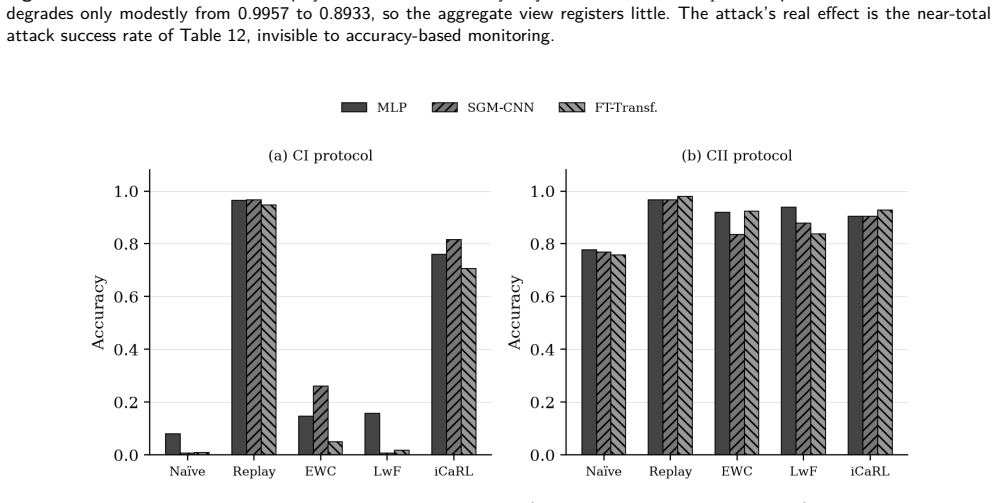
Stated as the authors would state it: a tabular transformer encoder paired with a benign-anchored, class-balanced experience replay buffer recovers near-joint-training performance in a continually learning intrusion detector, and the standard evaluation scenario used by prior work is unrealistically kind. Under the traditional class-incremental (CI) scenario benign traffic appears only in the first experience; the paper introduces the class-instance incremental (CII) scenario in which benign flows are present in every experience alongside newly arriving attack classes, arguing that this mirrors production exposure. The framework achieves 0.9994 accuracy and 0.9953 macro-F1 under CI and 0.9989 accuracy and 0.9960 macro-F1 under CII at a 10% per-class buffer budget, within 0.0003 of the joint oracle on accuracy, with forgetting and intransigence both below 0.01. Benign anchoring is the load-bearing component: re-exposing the benign class lifts memory-free baselines by 0.74–0.82 accuracy under CII. The flip side, which the paper investigates explicitly, is that the buffer is a persistent attack surface: a 1% label-flip budget collapses accuracy to 0.0053, while a backdoor that perturbs inter-arrival-time features of stored exemplars holds overall accuracy above 0.97 and reaches 95–100% attack success on trigger-carrying flows, a corruption an accuracy dashboard would not flag.
Load-bearing premise
The backdoor results rest on the assumption that an attacker can actually realize the inter-arrival-time trigger in live network traffic by pacing packet transmission, and that the fixed trigger perturbation survives feature standardization and the CICFlowMeter pipeline; the paper specifies neither the perturbation magnitude nor the fraction of stored exemplars injected, and offers no live-traffic demonstration.
Editorial extensions
If this is right
- A deployed IDS can be updated incrementally with a 1–10% per-class replay budget and land within 0.0003 accuracy of a model retrained on all historical data, removing the need for costly full retraining.
- The benign-anchored CII scenario should become the default evaluation for continual-learning IDS research, because it exposes that accuracy-only reporting flatters regularisation-based methods whose macro-F1 stays below 0.73 even when accuracy recovers.
- The replay store must be treated as security-critical state: a 1% label-flip budget disables the detector outright, so integrity protection, buffer auditing, and periodic revalidation of stored labels and features are operational requirements.
- The backdoor result implies that an attacker who can pace packet transmission could route chosen attack traffic past a detector whose top-line metrics look healthy, so monitoring must include attack-success-rate-style checks rather than aggregate accuracy alone.
- Because the same collapse-and-recovery pattern holds across MLP, CNN, and transformer backbones, the forgetting failure and its replay remedy are properties of the learning scenario rather than of any particular encoder.
Reading between the lines
- The paper attacks the buffer only under the CI scenario; applying the same two attacks under CII, where benign is re-exposed in every experience, is the natural next experiment, and it is not obvious that the backdoor's stealth survives the stronger benign anchoring.
- The trigger's realizability in live traffic is the paper's unstated load-bearing assumption; a live-traffic demonstration in which an attacker paces packets to hit the inter-arrival-time pattern would extend the result from benchmark to deployment.
- Three of the nine backdoor attack-success-rate cells exceed 100%, an artifact of the paper's own estimator that it openly explains; a cleaner protocol (one target class per run, a reset evaluation set, a single injection per experience) would sharpen the 95–100% claim.
- The benign-anchoring insight transfers beyond IDS: any continual classifier facing a persistent majority class, such as fraud detection or medical screening, could adopt the same guarantee of keeping the reference class in every replay batch.
Editorial analysis
A structured set of objections, weighed in public.
Referee Report
Summary. The paper proposes an adaptive network intrusion detection framework that couples a tabular transformer encoder with a class-balanced experience replay buffer in which the benign class is anchored in every replay update. It introduces a class-instance incremental (CII) scenario in which benign flows appear in every experience, evaluates the framework on CICIDS2017 under both the standard class-incremental (CI) and the proposed CII scenarios, and compares against naive fine-tuning, EWC, LwF, iCaRL, and two experience-replay baselines. The paper separately investigates two poisoning attacks on the replay buffer: label flipping and a clean-label timing-feature backdoor. The main empirical claims are that replay with a modest per-class budget recovers near-joint-training performance under both scenarios, that benign anchoring is essential for preventing forgetting, that label flipping collapses the model, and that the backdoor preserves high overall accuracy while achieving a high attack success rate on trigger-carrying flows.
Significance. If the central claims hold, the paper makes useful contributions: the CII scenario is a more realistic stress test than the usual CI setup, the adversarial treatment of the replay buffer as a persistent attack surface is timely and underexplored, and the cross-architecture benchmark in Section 5.7 supports the conclusion that the advantage of replay over regularization-based methods is scenario-level rather than encoder-specific. The paper also ships a public code repository and is unusually transparent about the flaws in its own backdoor ASR estimator, which is a genuine strength. The two load-bearing concerns are the unspecified construction of the CII training data, which prevents an apples-to-apples interpretation of the CII oracle comparison, and the single-seed evaluation that underlies the near-joint and best-performing claims.
major comments (4)
- [§3.6, Table 4; §5.2, Tables 7–8]
- [§3.5, §5.2, Table 7]
- [§5.6, Table 12]
- [§3.9, Tables 11–12]
minor comments (5)
- [Table 6]
- [§6, fifth takeaway]
- [§9 and §12]
- [Table 7]
- [References, [43]]
Circularity Check
No significant circularity: the central claims are empirical comparisons on an external benchmark; the only self-citation is a non-load-bearing reuse of the authors' own backdoor trigger construction.
full rationale
The paper's main claims—that benign-anchored replay recovers near-joint-training performance and that replay-buffer poisoning can collapse or backdoor the model—are empirical results on the external CICIDS2017 benchmark, measured against seven baselines under two scenarios. No performance number is obtained by fitting to the target claim; the replay budget is swept over {1%, 5%, 10%} and all results are reported, including the less flattering ones. The one notable self-citation is Section 3.9's `following the clean-label IAT-trigger construction of Guo et al. (2025b)`, whose authors overlap with the present paper. That citation supplies the trigger design for the backdoor attack, but the attack is actually implemented, executed, and its attack success rate is recomputed from the released training logs, so the measured outcomes do not reduce to the citation. The differing CII oracle (0.9955) versus CI oracle (0.9997) is an internal-consistency concern about how benign flows are reused in the CII union, but it is not a circular step: the CII replay result is compared with the same scenario's oracle and baselines. No fitted parameter is relabelled as a prediction, and no uniqueness theorem is imported from the authors' prior work to forbid alternatives.
Assumptions & free parameters
free parameters (2)
- per-class memory budget b =
1%, 5%, 10% (swept)
- backdoor trigger magnitude and injected fraction
assumptions (4)
- domain assumption CICIDS2017 is a valid proxy for production network traffic
- ad hoc to paper The CII scenario faithfully represents production benign exposure
- domain assumption An attacker can realize the IAT trigger on live traffic by pacing packet transmission
- domain assumption The defender has clean class labels at training time
Cite this review
Pith. "Pith review of Adaptive Intrusion Detection System using Transformer-Based Neural Networks and Continual Learning Approach with Adversarial Investigation." pith.science (2026). https://pith.science/paper/UCF5VD72
@misc{pith2026260804602,
  author       = {Pith},
  title        = {Pith review of: Adaptive Intrusion Detection System using Transformer-Based Neural Networks and Continual Learning Approach with Adversarial Investigation},
  year         = {2026},
  howpublished = {\url{https://pith.science/paper/UCF5VD72}},
  note         = {Machine review of arXiv:2608.04602}
}
read the original abstract
Network intrusion detection systems (IDS) trained on fixed traffic snapshots decay silently after deployment as threat distributions shift. Fine-tuning models on new attacks triggers catastrophic forgetting, while retraining from scratch is computationally infeasible. Replay-based continual learning counters this, but existing methods unrealistically confine benign traffic to a single early task and ignore the replay buffer as a potential attack surface. To address this, we present an adaptive IDS framework coupling a tabular transformer encoder with a class balanced experience replay buffer that replays benign traffic at every update to stabilize decision boundaries. We introduce the class-instance incremental (CII) scenario where benign flows reappear alongside new attacks as a more faithful stress test, and probe the buffer with overt label flipping and stealthy backdoor poisoning attacks. On the CICIDS2017 benchmark, our framework achieved 0.9994 accuracy under the traditional class incremental setup and 0.9989 under CII, with negligible forgetting, drastically outperforming sequential fine-tuning (0.0052), EWC (0.0324), LwF (0.0699), and iCaRL (0.8770) baselines. While injecting benign traffic into every experience proves essential for preventing forgetting, the replay buffer introduces critical vulnerabilities. Label-flipping collapses the model entirely (0.0053 accuracy at a 1% budget), and the backdoor maintains 0.97 overall accuracy while driving the attack success rate on trigger flows to 95%, evading standard monitoring. Ultimately, while a modest replay budget recovers near-joint-training performance, ensuring buffer integrity emerges as a strict operational requirement.
Figures


Figures from the paper (7 more)


Reference graph
Works this paper leans on
-
[1]
A H, N. F., Khraisat, A., S P, S. I., & Li, G. (2025). Adaptive memory replay for network intrusion detection: Tackling data drift and catastrophic for- getting. Computer Networks, 272, 111712.https: //doi.org/10.1016/j.comnet.2025.111712
-
[2]
Nguyen, T.-T., & Park, M. (2025). EL-GNN: A Continual-Learning-Based Graph Neural Network for Task-Incremental Intrusion Detection Systems. Electronics, 14(14), 2756.https://doi.org/10. 3390/electronics14142756
work page 2025
-
[3]
K., Reddy Tamma, B., & Channappayya, S
Amalapuram, S. K., Reddy Tamma, B., & Channappayya, S. S. (2024). SPIDER: A Semi- Supervised Continual Learning-based Network In- trusion Detection System. In Proc. IEEE INFO- COM 2024 (pp. 571–580).https://doi.org/10. 1109/INFOCOM52122.2024.10621428
arXiv 2024
-
[4]
Amalapuram, S. K., Channappayya, S. S., & Reddy Tamma, B. (2023). Augmented Memory Replay-based Continual Learning Approaches for Network Intrusion Detection. In Advances in Neural Information Processing Systems 36 (pp. 17156–17169)
work page 2023
-
[5]
P., Poornachandran, P., Al-Nemrat, A., & Venka- traman, S
Vinayakumar, R., Alazab, M., Soman, K. P., Poornachandran, P., Al-Nemrat, A., & Venka- traman, S. (2019). Deep Learning Approach for Intelligent Intrusion Detection System. IEEE Access, 7, 41525–41550.https://doi.org/10. 1109/ACCESS.2019.2895334
- [6]
- [7]
-
[8]
Shone, N., Ngoc, T. N., Phai, V. D., & Shi, Q. (2018). A Deep Learning Approach to Network IntrusionDetection.IEEETransactionsonEmerg- ing Topics in Computational Intelligence, 2(1), 41–50.https://doi.org/10.1109/TETCI.2017. 2772792
Show all 47 references
-
[9]
Huang, X., Khetan, A., Cvitkovic, M., & Karnin, Z. (2020). TabTransformer: Tabular Data Model- ing Using Contextual Embeddings. arXiv preprint arXiv:2012.06678
2020 arXiv
-
[10]
Gorishniy, Y., Rubachev, I., Khrulkov, V., & Babenko, A. (2021). Revisiting Deep Learn- ing Models for Tabular Data. In Advances in Neural Information Processing Systems 34 (pp. 18932–18943)
2021
-
[11]
Ö., & Pfister, T
Arik, S. Ö., & Pfister, T. (2021). TabNet: At- tentive Interpretable Tabular Learning. In Proc. AAAI Conf. on Artificial Intelligence, 35(8), 6679–6687
2021
-
[12]
B., & Goldstein, T
Somepalli, G., Goldblum, M., Schwarzschild, A., Bruss, C. B., & Goldstein, T. (2021). SAINT: Im- proved Neural Networks for Tabular Data via Row Attention and Contrastive Pre-training. arXiv preprint arXiv:2106.01342
2021 arXiv
-
[13]
&Hadsell, R
Kirkpatrick, J., Pascanu, R., Rabinowitz, N., Ve- ness,J.,Desjardins,G.,Rusu,A.A.,... &Hadsell, R. (2017). Overcoming catastrophic forgetting in neural networks. Proc. National Academy of Sci- ences, 114(13), 3521–3526.https://doi.org/10. 1073/pnas.1611835114
2017
-
[14]
Zenke, F., Poole, B., & Ganguli, S. (2017). Con- tinual Learning Through Synaptic Intelligence. In Proc. 34th International Conference on Machine Learning (pp. 3987–3995)
2017
-
[15]
Li, Z., & Hoiem, D. (2018). Learning Without Forgetting. IEEE Trans. Pattern Analysis and Machine Intelligence, 40(12), 2935–2947.https: //doi.org/10.1109/TPAMI.2017.2773081
2018
-
[16]
Lopez-Paz, D., & Ranzato, M. (2017). Gradient Episodic Memory for Continual Learning. In Ad- vances in Neural Information Processing Systems 30 (pp. 6467–6476)
2017
-
[17]
Chaudhry, A., Ranzato, M., Rohrbach, M., & Elhoseiny, M. (2019a). Efficient Lifelong Learning with A-GEM. In Proc. International Conference on Learning Representations. Ariffin et al.: Preprint Page 21 of 23 Adaptive IDS with Transformers, Continual Learning, and Adversarial I...
2019
-
[18]
A., Kolesnikov, A., Sperl, G., & Lam- pert, C
Rebuffi, S. A., Kolesnikov, A., Sperl, G., & Lam- pert, C. H. (2017). iCaRL: Incremental Classifier and Representation Learning. In Proc. IEEE Conf. on Computer Vision and Pattern Recognition (pp. 2001–2010)
2017
-
[19]
Buzzega, P., Boschini, M., Porrello, A., Abati, D., & Calderara, S. (2020). Dark Experience for General Continual Learning: a Strong, Simple Baseline. In Advances in Neural Information Pro- cessing Systems 33 (pp. 15920–15930)
2020
-
[20]
K., Torr, P
Chaudhry, A., Rohrbach, M., Elhoseiny, M., Ajanthan, T., Dokania, P. K., Torr, P. H. S., & Ranzato, M. (2019b). On Tiny Episodic Memories in Continual Learning. arXiv preprint arXiv:1902.10486
2019 arXiv
-
[21]
(2019).OnlineContinualLearningwithMaximally Interfered Retrieval
Aljundi, R., Belilovsky, E., Tuytelaars, T., Char- lin, L., Caccia, M., Lin, M., & Page-Caccia, L. (2019).OnlineContinualLearningwithMaximally Interfered Retrieval. In Advances in Neural Infor- mation Processing Systems 32 (pp. 11849–11860)
2019
-
[22]
Chrysakis, A., & Moens, M.-F. (2020). Online Continual Learning from Imbalanced Data. In Proc. 37th International Conference on Machine Learning (pp. 1952–1961)
2020
-
[23]
Riemer, M., Cases, I., Ajemian, R., Liu, M., Rish, I., Tu, Y., & Tesauro, G. (2019). Learning to Learn Without Forgetting by Maximizing Transfer and Minimizing Interference. In Proc. International Conference on Learning Representations
2019
-
[24]
McCloskey, M., & Cohen, N. J. (1989). Catas- trophic Interference in Connectionist Networks: The Sequential Learning Problem. Psychology of Learning and Motivation, 24, 109–165.https: //doi.org/10.1016/S0079-7421(08)60536-8
1989 doi
-
[25]
J., Mirza, M., Xiao, D., Courville, A., & Bengio, Y
Goodfellow, I. J., Mirza, M., Xiao, D., Courville, A., & Bengio, Y. (2013). An Empirical Investiga- tion of Catastrophic Forgetting in Gradient-Based Neural Networks. arXiv preprint arXiv:1312.6211
2013 arXiv
-
[26]
De Lange, M., Aljundi, R., Masana, M., Parisot, S., Jia, X., Leonardis, A., Slabaugh, G., & Tuyte- laars, T. (2022). A Continual Learning Survey: Defying Forgetting in Classification Tasks. IEEE Trans. Pattern Analysis and Machine Intelli- gence, 44(7), 3366–3385.https://doi.o...
2022
-
[27]
I., Kemker, R., Part, J
Parisi, G. I., Kemker, R., Part, J. L., Kanan, C., & Wermter, S. (2019). Continual lifelong learn- ing with neural networks: A review. Neural Net- works, 113, 54–71.https://doi.org/10.1016/j. neunet.2019.01.012
2019 doi
-
[28]
K., Ajanthan, T., & Torr, P
Chaudhry, A., Dokania, P. K., Ajanthan, T., & Torr, P. H. S. (2018). Riemannian Walk for Incremental Learning: Understanding Forgetting and Intransigence. In Proc. European Conference on Computer Vision (pp. 556–572).https://doi. org/10.1007/978-3-030-01252-6_33
2018 doi
-
[29]
Tavallaee, M., Bagheri, E., Lu, W., & Ghorbani, A. A. (2009). A Detailed Analysis of the KDD CUP 99 Data Set. In Proc. IEEE Symp. on Computational Intelligence in Security and De- fense Applications (pp. 1–6).https://doi.org/ 10.1109/CISDA.2009.5356528
2009
-
[30]
H., & Ghorbani, A
Sharafaldin, I., Lashkari, A. H., & Ghorbani, A. A. (2018). Toward Generating a New Intrusion Detection Dataset and Intrusion Traffic Charac- terization. In Proc. 4th International Conference on Information Systems Security and Privacy (ICISSP) (pp. 108–116)
2018
-
[31]
N., Kaiser, L., & Polosukhin, I
Vaswani, A., Shazeer, N., Parmar, N., Uszkor- eit, J., Jones, L., Gomez, A. N., Kaiser, L., & Polosukhin, I. (2017). Attention Is All You Need. In Advances in Neural Information Processing Systems 30 (pp. 5998–6008)
2017
-
[32]
A., Ibrahim, N
Shyaa, M. A., Ibrahim, N. F., Zainol, Z., Abdullah, R., Anbar, M., & Alzubaidi, L. (2024). Evolving Cybersecurity Frontiers: A Comprehensive Survey on Concept Drift and Feature Dynamics Aware Machine and Deep Learning in Intrusion Detection Systems. Engineering Applications of...
2024
-
[33]
Chai, Y., Du, L., Qiu, J., Yin, L., & Tian, Z. (2023). Dynamic Prototype Network Based on Sample Adaptation for Few-Shot Malware De- tection. IEEE Transactions on Knowledge and Data Engineering, 35(5), 4754–4766.https:// doi.org/10.1109/TKDE.2022.3142820
2023
-
[34]
Kim, M., Lee, D., Lee, K., Kim, D., Lee, S., & Kim, J. (2022). Deep Sequence Models for Packet Stream Analysis and Early Decisions. In Proc. IEEE 47th Conference on Local Computer Networks (LCN) (pp. 56–63).https://doi.org/ 10.1109/LCN53696.2022.9843272
2022
-
[35]
K., Tadwai, A., Vinta, R., Chan- nappayya, S
Amalapuram, S. K., Tadwai, A., Vinta, R., Chan- nappayya, S. S., & Tamma, B. R. (2022). Contin- ual learning for anomaly based network intrusion detection. In Proc. 14th International Conference on COMmunication Systems & NETworkS (COM- SNETS) (pp. 497–505). IEEE
2022
-
[36]
Smith,J.S.,Valkov,L.,Halbe,S.,Gutta,V.,Feris, R., Kira, Z., & Karlinsky, L. (2024). Adaptive memory replay for continual learning. In Proc. Ariffin et al.: Preprint Page 22 of 23 Adaptive IDS with Transformers, Continual Learning, and Adversarial Investigation IEEE/CVF Confere...
2024
-
[37]
Guo, J., & Schwaller, P. (2023). Augmented Mem- ory: Capitalizing on Experience Replay to Accel- erate De Novo Molecular Design. ACS Central Science, 9(12), 2273–2285.https://doi.org/10. 1021/acscentsci.3c01480
2023
-
[38]
The MITRE Corporation. (2026). CVE Program Metrics.https://www.cve.org/about/Metrics (accessed 5 July 2026)
2026
-
[39]
Biggio, B., Nelson, B., & Laskov, P. (2012). Poi- soning Attacks against Support Vector Machines. InProc.29thInternationalConferenceonMachine Learning (pp. 1807–1814)
2012
-
[40]
Biggio, B., & Roli, F. (2018). Wild patterns: Ten years after the rise of adversarial machine learning. Pattern Recognition, 84, 317–331.https://doi. org/10.1016/j.patcog.2018.07.023
2018 doi
-
[41]
Umer, M., Dawson, G., & Polikar, R. (2020). Tar- geted Forgetting and False Memory Formation in Continual Learners through Adversarial Backdoor Attacks. In Proc. International Joint Conference on Neural Networks (IJCNN) (pp. 1–8).https: //doi.org/10.1109/IJCNN48605.2020.9206809
2020
-
[42]
Guo, Z., Kumar, A., & Tourani, R. (2024). Per- sistent Backdoor Attacks in Continual Learning. arXiv preprint arXiv:2409.13864
2024 arXiv
-
[43]
Guo, C., Zaki, F., Ariffin, A., & Anuar, N. B. (2025b). Clean-Label Backdoor Attack on CNN-Based Network Traffic Classifiers with RhythmicFlow. In Proc. 2025 IEEE International Conference on Computing (ICOCO) (pp. 447–452).https://doi.org/10.1109/ ICOCO67189.2025.11334106
2025
-
[44]
Apruzzese, G., Andreolini, M., Colajanni, M., & Marchetti, M. (2021). Modeling Realistic Adver- sarialAttacksagainstNetworkIntrusionDetection Systems. Digital Threats: Research and Practice, 3(3), 1–19.https://doi.org/10.1145/3469659
2021 doi
-
[45]
Zhang, X., Wang, Y., Ohtsuki, T., Gui, G., Yuen, C., Di Renzo, M., & Sari, H. (2025). Malware Traffic Classification via Expandable Class Incre- mental Learning With Architecture Search. IEEE Transactions on Information Forensics and Secu- rity, 20, 6074–6085.https://doi.org/1...
2025
-
[46]
Guo, C., Li, X., Cheng, J., Yang, S., & Gong, H. (2025a). Continual Learning for Intrusion Detec- tion Under Evolving Network Threats. Future In- ternet, 17(10), 456.https://doi.org/10.3390/ fi17100456
2025
-
[47]
Chen, H., Wang, Z., Yang, S., Luo, X., He, D., & Chan, S. (2025). Intrusion Detection Using Synaptic Intelligent Convolutional Neural Net- works for Dynamic Internet of Things Envi- ronments. Alexandria Engineering Journal, 111, 78–91.https://doi.org/10.1016/j.aej.2024. 10.014...
2025 doi
Reviewed August 6, 2026 · model on record in the stance chip above.
Discussion (0). Sign in to comment.