REVIEW 3 major objections 6 minor 32 references
TRCoRSurg: Temporal-Relational Co-Reasoning for Surgical Video Triplet Recognition
T0 review · 3 major / 6 minor · reviewed 2026-08-06 · deepseek-v4-flash
Pith's one-line read Surgical video triplet recognition improves by jointly modeling label co-occurrence and temporal context, reaching state-of-the-art results on two benchmarks.
desk verdict The AP_IVT gains look real, but the TCER metric as defined in Eq. (17) is internally inconsistent and the advertised consistency reductions cannot be reproduced; fix that and this is a solid incremental paper. read the letter →
The pith
A machine-rendered reading of the paper's core claim, the machinery that carries it, and where it could break.
The reading
What carries the argument
The load-bearing machinery is a two-stream graph-and-attention architecture. Node features concatenate SigLIP text embeddings (intrinsic semantic priors) with class activation maps (variant visual evidence); edge weights are computed as $\sigma(z_{c_i}^\top z_{c_j} + M_{c_i c_j})$, where $M$ is the Jaccard co-occurrence matrix of the training set, and the zero-convolution-initialized MS-CAMRE adapts these relations. BTRFA applies two cross-attention branches (temporal-to-relational and relational-to-temporal) with a learnable gate to produce the fused representation. The new $TCER$ metric decomposes relational inconsistency into mis-match errors (correct entities, wrong pairing) and mis-class errors (wrong entity), giving a direct measure of compositional reasoning.
What would settle it
Train or fine-tune the model with the co-occurrence prior $M$ set to zero and compare $TCER_m$ on the same test set; or evaluate the published model on a held-out surgical domain whose co-occurrence statistics were not in $M$ (e.g., a different procedure type or medical center). If the $TCER$ gap over baselines collapses, the gains come from the dataset-specific prior rather than from the adaptive relational reasoning.
Extended reading notes
Core claim
The paper's central claim is that intra-frame label dependencies and inter-frame temporal relations should be co-reasoned, not fused post hoc. Its label correlation module builds a graph whose nodes combine text-encoder semantic priors with CAM-based visual cues, and whose edges are adaptively weighted by a dataset-level co-occurrence prior plus CAM-guided multi-scale cross-attention (MS-CAMRE). A Bidirectional Temporal-Relational Fusion Attention (BTRFA) module then exchanges information between the temporal and relational streams through symmetric cross-attention and gated fusion, so that temporal consistency and label plausibility reinforce each other. Supported by ablations, the paper reports state-of-the-art results and substantially lower $TCER_m$ and $TCER_c$ on both CholecT45 and ProstaTD.
Load-bearing premise
The framework's relational consistency gains depend on the training-set co-occurrence matrix $M$ being a stable prior that transfers to every test frame; if that assumption fails, the reported $TCER$ improvements may not transfer to new distributions.
Editorial extensions
If this is right
- If the reported gains hold, joint temporal-relational modeling becomes a stronger default for surgical triplet recognition than separate spatial, relational, and temporal branches.
- The $TCER$ metric gives practitioners a quantitative way to catch 'correct entities, wrong pairing' errors, which standard AP and Top-K metrics conceal.
- The two-stage training scheme (spatial pretraining, then joint temporal-relational fine-tuning) provides a practical template for adding relational reasoning to existing video models without destabilizing training.
- The framework's components are described as task-agnostic enough to transfer to other fine-grained multi-entity video recognition problems, such as human-object interaction or procedure phase analysis.
Reading between the lines
- The co-occurrence prior $M$ is a static training-set statistic; a natural extension would test whether the advertised consistency gains survive on unseen surgical centers or procedures where co-occurrence statistics shift.
- The coupling loss $L_{couple}$ forces atomic labels to be supported by at least one high-scoring triplet; this inductive bias alone may explain part of the $TCER$ drop, and could be evaluated independently in a lighter model.
- If $TCER$ were adopted by the community, it could reveal that other top-ranked triplet models have lower relational consistency than their $AP_{IVT}$ suggests, changing how surgical triplet results are compared.
- The dual-memory attention with depth 8 is borrowed from video segmentation; testing shorter or adaptive memory horizons would show whether the temporal gains are specific to that design or simply come from any temporal context.
Editorial analysis
A structured set of objections, weighed in public.
Referee Report
Summary. The manuscript proposes TRCoRSurg, a unified framework for surgical video triplet recognition that combines multi-scale spatial encoding, dual-memory temporal attention, label correlation modeling with MS-CAMRE edge refinement, and a bidirectional temporal-relational fusion attention (BTRFA) module. It also introduces a new evaluation metric, the Triplet Consistency Error Rate (TCER), with two components intended to measure mis-pairing and mis-classification of triplet components. Experiments on CholecT45 and ProstaTD report state-of-the-art AP_IVT of 40.9 and 37.5, respectively, and relative TCER reductions of over 36% and 25%.
Significance. If the reported results hold, the paper would make a useful practical contribution: it demonstrates consistent AP_IVT gains over several strong baselines on two datasets, provides ablations showing that each proposed module contributes, and releases code. The idea of a dedicated consistency metric for triplet composition is also valuable to the surgical video community. I do not see circularity in the design: the co-occurrence matrix M is computed from training labels, and TCER is not used as a training loss. However, the TCER_c metric as defined in Eq. (17) is internally inconsistent, and the lack of error bars and hyperparameter sensitivity analysis for key components leaves the quantitative claims less secure than the text suggests.
major comments (3)
- [3.5, Eq. (17)] The definition of TCER_c cannot yield the nonzero values reported in Table 1. Eq. (17) sets TCER_c = N_mis-class / N_marginal, where N_marginal is described as "the number of frames where all component predictions are correct," while N_mis-class counts frames "where at least one element in the predicted triplet does not belong to the ground-truth entity set." Any frame in N_mis-class necessarily contains an incorrect component prediction and therefore cannot be in N_marginal, making TCER_c identically zero or undefined. Table 1 nevertheless reports TCER_c values such as 2.80, 2.46, 2.24, 2.09, 5.20, 4.90, 5.00, and 4.70. The paper also does not specify how continuous triplet logits are thresholded to obtain the discrete predicted sets used in these counts. The advertised relative TCER reductions of over 36% and 25% therefore rest on an unreproducible metric and must be corrected, with the denominator and thresholding rule stated precisely, or removed from the claims.
- [Table 1 and Table 2] The ProstaTD results in Table 1 and every row of the ablation study in Table 2 are reported without variance or significance information. Since the central evidence is the AP_IVT improvement (e.g., 37.5 vs. 35.2 on ProstaTD, and 40.9 vs. 37.9 for the full model vs. no LCM in Table 2), the absence of error bars makes it impossible to distinguish these gains from training noise. Please report means and standard deviations over multiple seeds and, where feasible, a statistical test. In addition, the memory temporal depth N is set to 8 in Section 4 with no sensitivity analysis, so the contribution of the temporal memory module is not established over its hyperparameter range.
- [3.2, Eq. (6)] The dataset-level co-occurrence matrix M, computed from training-label statistics, is added directly to the adaptive correlation score inside the sigmoid in Eq. (6), but the paper provides no ablation of its strength or analysis of its stability. Because M is a fixed empirical prior, it may dominate the edge weights regardless of the visual evidence, which would make the relational gains dataset-specific. The authors should report results with M removed, with M scaled by different factors, and ideally a per-domain breakdown on ProstaTD's three heterogeneous domains, to demonstrate that the advertised AP_IVT and TCER gains do not depend on a fragile, dataset-specific prior.
minor comments (6)
- [3.5] The definition of "all component predictions are correct" is ambiguous for frames containing multiple ground-truth triplets; the matching rule between predicted and ground-truth entity sets should be stated formally.
- [Figures 2 and 3] Figures 2 and 3 are visually dense and several labels (e.g., "GCNA", "CACA", and the role of the zero-convolution arrow) are hard to read; please enlarge the figures and clarify the annotations.
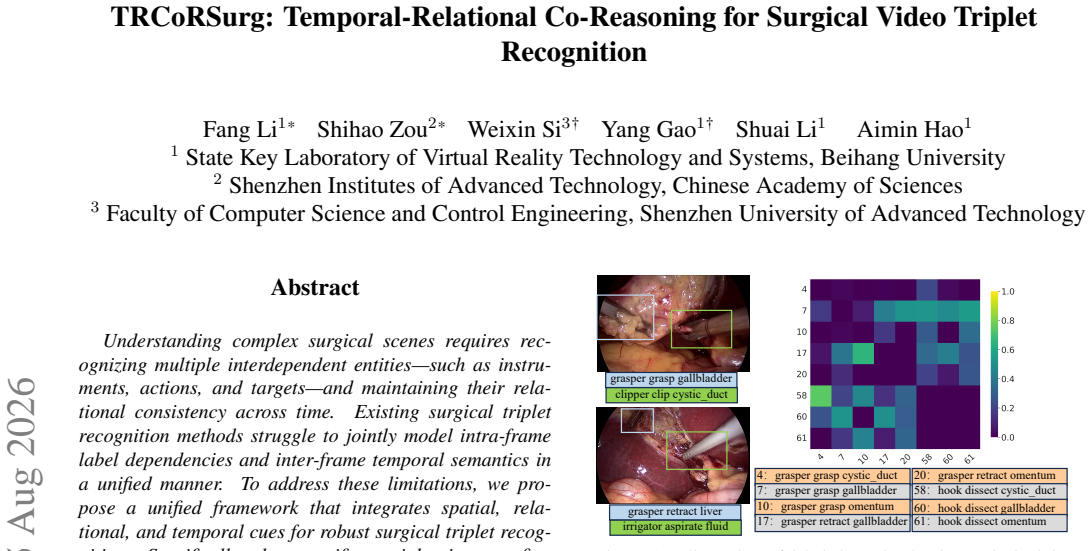
- [Figure 5] The qualitative example contains strings such as "grasper retract live" and "grasper null_verb null_target"; please confirm whether these are typos or intentional null tokens, and define how null predictions are handled in the evaluation metrics.
- [Table 1] Some baselines (TERL and CoLSurgical) have missing Top-k or TCER entries; please state whether these numbers were unavailable or not computed.
- [Section 5] The conclusion mentions that the model is complex and difficult to train, but no parameter count, FLOPs, or runtime comparison is provided; adding these would help readers assess practical deployability.
- [References] The reference list has formatting inconsistencies (e.g., duplicated "CVPR" in reference [4], and the venue name in [16] is not fully expanded); please normalize the bibliography style.
Circularity Check
No meaningful circularity in the core model; one definitional flaw makes the ancillary TCER_c numbers unreproducible.
-
self definitional
[Sec. 3.5, Eq. (17); Table 1; Abstract]
"T CERm = Nmis-match/Nmarginal, T CERc = Nmis-class/Nmarginal, (17) where Nmarginal denotes the number of frames where all component predictions are correct... Nmis-class measures frames where at least one element in the predicted triplet does not belong to the ground-truth entity set (e.g., (I1, V3, T1))."
By the paper's own definitions, a frame counted in Nmis-class contains an incorrect component prediction, so it cannot also be among the Nmarginal frames where all component predictions are correct. Therefore TCER_c is identically zero or undefined under Eq. (17), yet Table 1 reports nonzero values such as 2.80, 2.46, 2.24, 2.09, 5.20, 4.90, and 4.70, and the Abstract claims relative reductions of more than 36% and 25%. The TCER_c consistency result is thus a definitional artifact rather than a measurable empirical outcome, but this flaw is confined to the proposed metric and does not enter the training loss or the AP_IVT comparisons.
full rationale
The core architectural derivation is self-contained against external benchmarks. The AP_IVT improvements of 5.1% and 7.8% are ordinary benchmark comparisons; no equation in the model, from the multi-scale encoder through Eq. (16), is equivalent by construction to the reported outputs. The dataset-level co-occurrence matrix M in Eq. (6) is a training-set prior, not a fitted parameter over the test predictions, and TCER is not used as a training loss, so the model's predictions are not forced to minimize the advertised consistency measure. There is no load-bearing self-citation chain and no imported uniqueness theorem. The only concrete definitional reduction is Eq. (17), where the TCER_c numerator and denominator are mutually exclusive by definition, making the reported nonzero TCER_c values unreproducible. That is a soundness problem for the proposed metric, but it does not make the main recognition result circular, so the overall circularity score is low.
Assumptions & free parameters
free parameters (2)
- Memory temporal depth N =
8
- Co-occurrence prior matrix M =
Jaccard similarities over training-set label occurrences
assumptions (3)
- domain assumption Surgical triplets follow stable co-occurrence patterns that persist from training to test frames
- domain assumption Class activation maps provide reliable spatial evidence for each triplet entity label
- domain assumption SigLIP text embeddings carry useful semantic structure for instrument, verb, and target labels
invented entities (1)
-
Triplet Consistency Error Rate (TCER)
Cite this review
Pith. "Pith review of TRCoRSurg: Temporal-Relational Co-Reasoning for Surgical Video Triplet Recognition." pith.science (2026). https://pith.science/paper/KXVJS6AI
@misc{pith2026260804606,
  author       = {Pith},
  title        = {Pith review of: TRCoRSurg: Temporal-Relational Co-Reasoning for Surgical Video Triplet Recognition},
  year         = {2026},
  howpublished = {\url{https://pith.science/paper/KXVJS6AI}},
  note         = {Machine review of arXiv:2608.04606}
}
read the original abstract
Understanding complex surgical scenes requires recognizing multiple interdependent entities, such as instruments, actions, and targets, while maintaining their relational consistency across time. Existing surgical triplet recognition methods struggle to jointly model intra-frame label dependencies and inter-frame temporal semantics in a unified manner. To address these limitations, we propose a unified framework that integrates spatial, relational, and temporal cues for robust surgical triplet recognition. Specifically, class-specific spatial priors are first extracted through a multi-scale encoder. These priors are then refined by a Label Correlation Modeling module with multi-scale class activation map-guided relational extraction (MS-CAMRE), enabling the model to capture both static co-occurrence patterns and dynamic contextual dependencies among triplet components. Furthermore, a Bidirectional Temporal-Relational Fusion Attention (BTRFA) module harmonizes temporal and relational representations to achieve coherent temporal reasoning. We also introduce a new evaluation metric, the Triplet Consistency Error Rate (TCER), which quantitatively measures the model's ability to preserve causal and semantic consistency across triplets. Extensive experiments on the CholecT45 and ProstaTD datasets show that our method achieves state-of-the-art performance, improving AP_IVT by 5.1 percent and 7.8 percent, respectively. Moreover, according to TCER, our approach achieves relative reductions of more than 36 percent and 25 percent on the two datasets, respectively, demonstrating the effectiveness of our framework in temporal-relational co-reasoning.
Figures


Figures from the paper (4 more)


Reference graph
Works this paper leans on
-
[1]
Quo vadis, action recognition? a new model and the kinetics dataset
Joao Carreira and Andrew Zisserman. Quo vadis, action recognition? a new model and the kinetics dataset. Inpro- ceedings of the IEEE Conference on Computer Vision and Pattern Recognition, pages 6299–6308, 2017. 2
2017
-
[2]
Surgical activity triplet recognition via triplet disentangle- ment
Yiliang Chen, Shengfeng He, Yueming Jin, and Jing Qin. Surgical activity triplet recognition via triplet disentangle- ment. InInternational Conference on Medical Image Com- puting and Computer-Assisted Intervention, pages 451–461. Springer, 2023. 1, 2
work page 2023
-
[3]
Yiliang Chen, Zhixi Li, Cheng Xu, Alex Qinyang Liu, Xuemiao Xu, Jeremy Yuen-Chun Teoh, Shengfeng He, and Jing Qin. Prostatd: A large-scale multi-source dataset for structured surgical triplet detection.arXiv preprint arXiv:2506.01130, 2025. 5, 6
-
[4]
Multi-label image recognition with graph convolu- tional networks
Zhao-Min Chen, Xiu-Shen Wei, Peng Wang, and Yanwen Guo. Multi-label image recognition with graph convolu- tional networks. InIEEE Conference on Computer Vision and Pattern Recognition, CVPR 2019, Long Beach, CA, USA, June 16-20, 2019, pages 5177–5186. Computer Vision Foundation / IEEE, 2019. 2
work page 2019
-
[5]
Tail-enhanced rep- resentation learning for surgical triplet recognition
Shuangchun Gui and Zhenkun Wang. Tail-enhanced rep- resentation learning for surgical triplet recognition. InIn- ternational Conference on Medical Image Computing and Computer-Assisted Intervention, pages 689–699. Springer,
-
[6]
Mt4mtl-kd: A multi-teacher knowledge distillation framework for triplet recognition
Shuangchun Gui, Zhenkun Wang, Jixiang Chen, Xun Zhou, Chen Zhang, and Yi Cao. Mt4mtl-kd: A multi-teacher knowledge distillation framework for triplet recognition. IEEE Transactions on Medical Imaging, 43(4):1628–1639,
-
[7]
Zengyuan Lai, Jiarui Yang, Songpengcheng Xia, Qi Wu, Zhen Sun, Wenxian Yu, and Ling Pei. Smart: Scene-motion- aware human action recognition framework for mental dis- order group.IEEE Internet of Things Journal, 2024. 2
work page 2024
-
[8]
Uniformerv2: Unlocking the po- tential of image vits for video understanding
Kunchang Li, Yali Wang, Yinan He, Yizhuo Li, Yi Wang, Limin Wang, and Yu Qiao. Uniformerv2: Unlocking the po- tential of image vits for video understanding. InProceedings of the IEEE/CVF International Conference on Computer Vi- sion, pages 1632–1643, 2023. 2
work page 2023
Show all 32 references
-
[9]
Mvitv2: Improved multiscale vision transform- ers for classification and detection
Yanghao Li, Chao-Yuan Wu, Haoqi Fan, Karttikeya Man- galam, Bo Xiong, Jitendra Malik, and Christoph Feicht- enhofer. Mvitv2: Improved multiscale vision transform- ers for classification and detection. InProceedings of the IEEE/CVF conference on computer vision and pattern reco...
2022
-
[10]
Parameter-efficient framework for surgical action triplet recognition.Interna- tional Journal of Computer Assisted Radiology and Surgery, 19(7):1291–1299, 2024
Yuchong Li, Bizhe Bai, and Fucang Jia. Parameter-efficient framework for surgical action triplet recognition.Interna- tional Journal of Computer Assisted Radiology and Surgery, 19(7):1291–1299, 2024. 1
2024
-
[11]
Surgical action triplet recognition by using a multi-task prior-reinforced and cross-sample network
Yunlong Li, Zijian Zhao, and Renbo Li. Surgical action triplet recognition by using a multi-task prior-reinforced and cross-sample network. In2024 6th International Confer- ence on Electronic Engineering and Informatics (EEI), pages 1283–1289. IEEE, 2024. 1
2024
-
[12]
Sur- gical triplet recognition via diffusion model.arXiv preprint arXiv:2406.13210, 2024
Daochang Liu, Axel Hu, Mubarak Shah, and Chang Xu. Sur- gical triplet recognition via diffusion model.arXiv preprint arXiv:2406.13210, 2024. 1, 2
2024 arXiv
-
[13]
Deep learning in surgical process modeling: A systematic review of workflow recognition.Journal of Biomedical Informatics, page 104779, 2025
Zhenzhong Liu, Kelong Chen, Shuai Wang, Yijun Xiao, and Guobin Zhang. Deep learning in surgical process modeling: A systematic review of workflow recognition.Journal of Biomedical Informatics, page 104779, 2025. 1
2025
-
[14]
Surgical data science for next-generation interventions
Lena Maier-Hein, Swaroop S Vedula, Stefanie Speidel, Nas- sir Navab, Ron Kikinis, Adrian Park, Matthias Eisenmann, Hubertus Feussner, Germain Forestier, Stamatia Giannarou, et al. Surgical data science for next-generation interventions. Nature Biomedical Engineering, 1(9):691–...
2017
-
[15]
Rendezvous: Attention mechanisms for the recognition of surgical action triplets in endoscopic videos.Medical Image Analysis, 78:102433,
Chinedu Innocent Nwoye, Tong Yu, Cristians Gonzalez, Barbara Seeliger, Pietro Mascagni, Didier Mutter, Jacques Marescaux, and Nicolas Padoy. Rendezvous: Attention mechanisms for the recognition of surgical action triplets in endoscopic videos.Medical Image Analysis, 78:102433,
-
[16]
Cholectriplet2021: A benchmark challenge for surgical action triplet recognition
Chinedu Innocent Nwoye, Deepak Alapatt, Tong Yu, Armine Vardazaryan, Fangfang Xia, Zixuan Zhao, Tong Xia, Fucang Jia, Yuxuan Yang, Hao Wang, et al. Cholectriplet2021: A benchmark challenge for surgical action triplet recognition. Medical Image Analysis, 86:102803, 2023. 5, 6
2023
-
[17]
Instrument-tissue-guided surgical action triplet detection via textual-temporal trail exploration
Jialun Pei, Jiaan Zhang, Guanyi Qin, Kai Wang, Yueming Jin, and Pheng-Ann Heng. Instrument-tissue-guided surgical action triplet detection via textual-temporal trail exploration. IEEE transactions on medical imaging, 2025. 1
2025
-
[18]
Sam 2: Segment anything in images and videos.arXiv preprint arXiv:2408.00714, 2024
Nikhila Ravi, Valentin Gabeur, Yuan-Ting Hu, Ronghang Hu, Chaitanya Ryali, Tengyu Ma, Haitham Khedr, Roman R¨adle, Chloe Rolland, Laura Gustafson, et al. Sam 2: Segment anything in images and videos.arXiv preprint arXiv:2408.00714, 2024. 3
2024 arXiv
-
[19]
Rendezvous in time: an attention-based temporal fusion approach for surgical triplet recognition
Saurav Sharma, Chinedu Innocent Nwoye, Didier Mutter, and Nicolas Padoy. Rendezvous in time: an attention-based temporal fusion approach for surgical triplet recognition. International Journal of Computer Assisted Radiology and Surgery, 18(6):1053–1059, 2023. 2, 6, 8
2023
-
[20]
En- donet: a deep architecture for recognition tasks on laparo- scopic videos.IEEE transactions on medical imaging, 36 (1):86–97, 2016
Andru P Twinanda, Sherif Shehata, Didier Mutter, Jacques Marescaux, Michel De Mathelin, and Nicolas Padoy. En- donet: a deep architecture for recognition tasks on laparo- scopic videos.IEEE transactions on medical imaging, 36 (1):86–97, 2016. 1
2016
-
[21]
Temporal segment net- works: Towards good practices for deep action recognition
Limin Wang, Yuanjun Xiong, Zhe Wang, Yu Qiao, Dahua Lin, Xiaoou Tang, and Luc Van Gool. Temporal segment net- works: Towards good practices for deep action recognition. InEuropean conference on computer vision, pages 20–36. Springer, 2016. 2
2016
-
[22]
Multifuser: Multimodal fusion transformer for enhanced driver action recognition
Ruoyu Wang, Wenqian Wang, Jianjun Gao, Dan Lin, Kim- Hui Yap, and Bingbing Li. Multifuser: Multimodal fusion transformer for enhanced driver action recognition. In2024 IEEE 26th International Workshop on Multimedia Signal Processing (MMSP), pages 1–6. IEEE, 2024. 2
2024
-
[23]
Non-local neural networks
Xiaolong Wang, Ross Girshick, Abhinav Gupta, and Kaim- ing He. Non-local neural networks. InProceedings of the IEEE conference on computer vision and pattern recogni- tion, pages 7794–7803, 2018. 2
2018
-
[24]
Instance-aware graph convolutional network for multi- label classification.CoRR, abs/2008.08407, 2020
Yun Wang, Tong Zhang, Zhen Cui, Chunyan Xu, and Jian Yang. Instance-aware graph convolutional network for multi- label classification.CoRR, abs/2008.08407, 2020. 2
2008 arXiv
-
[25]
Nan Xi, Jingjing Meng, and Junsong Yuan. Forest graph convolutional network for surgical action triplet recognition in endoscopic videos.IEEE Transactions on Circuits and Systems for Video Technology, 32(12):8550–8561, 2022. 1, 2, 3
2022
-
[26]
Chain-of-look prompting for verb-centric surgical triplet recognition in en- doscopic videos
Nan Xi, Jingjing Meng, and Junsong Yuan. Chain-of-look prompting for verb-centric surgical triplet recognition in en- doscopic videos. InProceedings of the 31st ACM Interna- tional Conference on Multimedia, pages 5007–5016, 2023. 2, 6
2023
-
[27]
Self-distillation for surgi- cal action recognition
Amine Yamlahi, Thuy Nuong Tran, Patrick Godau, Melanie Schellenberg, Dominik Michael, Finn-Henri Smidt, Jan- Hinrich N ¨olke, Tim J Adler, Minu Dietlinde Tizabi, Chinedu Innocent Nwoye, et al. Self-distillation for surgi- cal action recognition. InInternational Conference on M...
2023
-
[28]
Sigmoid loss for language image pre-training
Xiaohua Zhai, Basil Mustafa, Alexander Kolesnikov, and Lucas Beyer. Sigmoid loss for language image pre-training. InProceedings of the IEEE/CVF international conference on computer vision, pages 11975–11986, 2023. 4
2023
-
[29]
Hierarchical knowledge graph for multi-label classification of remote sensing images.IEEE Transactions on Geoscience and Re- mote Sensing, 2024
Xiangrong Zhang, Wenhao Hong, Zhenyu Li, Xina Cheng, Xu Tang, Huiyu Zhou, and Licheng Jiao. Hierarchical knowledge graph for multi-label classification of remote sensing images.IEEE Transactions on Geoscience and Re- mote Sensing, 2024. 2
2024
-
[30]
Retrieval of surgical phase transitions using reinforcement learning
Yitong Zhang, Sophia Bano, Ann-Sophie Page, Jan Deprest, Danail Stoyanov, and Francisco Vasconcelos. Retrieval of surgical phase transitions using reinforcement learning. In International conference on medical image computing and computer-assisted intervention, pages 497–506. ...
-
[31]
Scene-aware label graph learning for multi-label image classification
Xuelin Zhu, Jian Liu, Weijia Liu, Jiawei Ge, Bo Liu, and Jiuxin Cao. Scene-aware label graph learning for multi-label image classification. InIEEE/CVF International Conference on Computer Vision, ICCV 2023, Paris, France, October 1-6, 2023, pages 1473–1482. IEEE, 2023. 2
2023
-
[32]
Capturing action triplet correlations for accurate surgical activity recog- nition.Computerized Medical Imaging and Graphics, page 102604, 2025
Xiaoyang Zou, Derong Yu, and Guoyan Zheng. Capturing action triplet correlations for accurate surgical activity recog- nition.Computerized Medical Imaging and Graphics, page 102604, 2025. 1
2025
Reviewed August 6, 2026 · model on record in the stance chip above.
Discussion (0). Sign in to comment.