REVIEW 4 major objections 5 minor 63 references
HiSC: Hierarchical Spatial Clustering Token Compression for Efficient 3D Scene Understanding
T0 review · 4 major / 5 minor · reviewed 2026-08-06 · deepseek-v4-flash
Pith's one-line read This paper claims that a training-free pipeline can remove about 90% of the visual tokens fed to a multi-view 3D vision-language model and still keep more than 90% of its benchmark performance, by merging and pruning tokens as spatially…
desk verdict A solid, useful token-compression method for 3D VLMs with a real but answerable question about cluster-budget feasibility under extreme compression. read the letter →
The pith
A machine-rendered reading of the paper's core claim, the machinery that carries it, and where it could break.
The reading
What carries the argument
The load-bearing objects are the connectivity graph and the object-centric cluster. The graph edge condition uses Euclidean distance in 3D below a threshold AND cosine similarity above a threshold, so edges exist only between tokens that are both geometrically adjacent and appearance-consistent; connected components of this graph capture physically consistent regions transitively, and each component is collapsed into one averaged super-token. Inside the LLM, SCluP first groups tokens by semantic similarity and then splits each group into spatially connected components, yielding clusters that line up with physical instances. Token budgets are allocated to clusters in proportion to squared importance scores, with a floor of one token per cluster to keep every object represented, and tokens within a cluster are selected by importance with a diversity bias toward tokens far in combined spatial-semantic distance. These mechanisms carry the argument because they turn compression into a coverage problem over physical regions instead of a per-token importance contest.
What would settle it
Take one ScanNet scene with a poster, sign, or other small textured detail on a large planar surface; run HiSC at 90% compression and ask a question whose answer is written on or determined by that detail. If the averaged super-token blurs the detail, the model should answer incorrectly while the uncompressed model and a version that keeps one representative token per component answer correctly.
Extended reading notes
Core claim
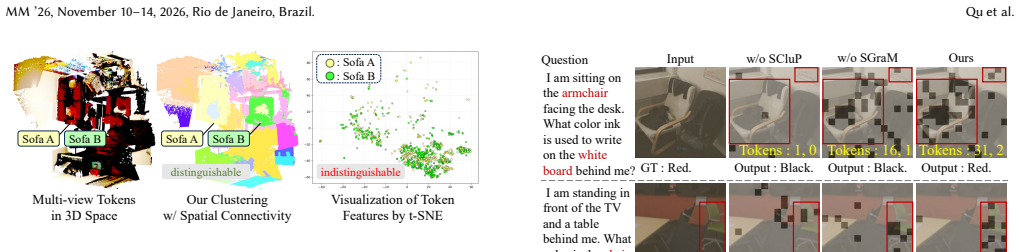
The central claim is that token-level pruning, which works for 2D VLMs, fails in multi-view 3D because redundancy is structured by physical space: tokens from the same surface are near-duplicates, and overlapping cameras repeat them. HiSC replaces independent token selection with cluster-level processing. First, a spatial graph-based merging stage builds connections only between tokens that are both spatially close and visually similar, extracts connected components, and averages each component into one super-token before the LLM. Second, a spatial clustering-based pruning stage partitions tokens into object-centric clusters, allocates token budgets across clusters by squared importance with at least one token per cluster, and picks tokens inside each cluster by importance plus a joint spatial-semantic diversity measure. Across grounding, dense captioning, and question answering benchmarks, the paper finds that this pipeline keeps object coverage and fine details even at 10% token retention, where independent pruning fragments objects and over-concentrates tokens.
Load-bearing premise
The load-bearing premise is that every token inside a spatially connected, appearance-similar region is a near-duplicate whose averaged super-token preserves what the LLM needs; if such a region contains subtle but task-critical variation, like a poster on a wall or a boundary between similar objects, averaging can erase it.
Editorial extensions
If this is right
- At 50% and 75% token budgets, HiSC keeps nearly all of the uncompressed model's accuracy on the five reported benchmarks, indicating that structured redundancy can be removed before it dilutes attention.
- At 10% token retention, HiSC reports a relative score of 92.46%, higher than the compared baselines, which cluster-level coverage matters most under aggressive compression.
- The two stages are complementary: the pre-LLM merge removes redundant tokens so the in-LLM budget is spent on informative regions, while the in-LLM prune adapts allocation to reasoning-relevant objects.
- Because HiSC is training-free and operates on tokens already constructed by a multi-view 3D VLM, the same pipeline can be attached to other models with the same token format.
Reading between the lines
- The graph-merge idea should transfer to other multi-view token streams, such as driving cameras or video, where overlapping observations create the same kind of spatially structured redundancy.
- A stress test for the 90% claim would be scenes with small text or thin decorations on large planar surfaces, where averaging a connected component may blur task-critical details that independent token selection would keep.
- If the connectivity assumption is right, HiSC should improve as camera overlap increases; a controlled experiment varying viewpoint density could separate the benefit of merging from the benefit of pruning.
- The paper reports aggregate benchmark scores, so a natural next measurement is per-answer reliability: whether the errors under 90% compression concentrate on questions about small objects, colors, or relationships rather than being spread evenly.
Signed reviews
Editorial analysis
A structured set of objections, weighed in public.
Referee Report
Summary. The paper proposes HiSC, a training-free token-compression framework for multi-view 3D vision-language models. It operates in two stages: SGraM merges redundant tokens by connected components of a joint geometric-semantic adjacency graph before LLM inference, and SCluP performs hierarchical cluster-level budget allocation and intra-cluster importance-diversity sampling during LLM inference. Experiments on five ScanNet-based benchmarks (ScanRefer, Multi3DRefer, Scan2Cap, ScanQA, SQA3D) using a LLaVA-Video 7B backbone compare HiSC against several 2D/3D pruning baselines under roughly 50%, 25%, and 10% token retention, reporting higher retained average scores and lower TFLOPS in all three regimes.
Significance. If the claims hold, HiSC is a useful plug-and-play compressor for multi-view 3D VLMs: it generalizes token selection to object-centric clusters, explicitly models cross-view geometric redundancy, and requires no training. The paper has clear strengths: a unified evaluation across five benchmarks, multiple baselines, component ablations, qualitative visualizations, and a public code link. The main caveats are empirical: no variance estimates are reported, several key thresholds are not analyzed, and the cluster-budget constraint is not verified against the reported compression ratios.
major comments (4)
- [§3.3.2] The budget allocation constraint n_k ≥ 1 with Σ_k n_k = N(l) is only satisfiable when N(l) ≥ K for every pruned layer, where K is the number of clusters produced by Eq. (4). The paper never reports K or the per-layer N(l) values, nor does it describe a fallback when K > N(l). Under the Extreme setting in Table 1, the average retained token count is 9.8% of the original sequence, so a scene with a large number of connected components could easily violate the constraint; the implementation must have either relaxed n_k ≥ 1 (undermining the object-coverage claim) or retained more tokens than the reported average. Please report K, N(l), and the exact handling of infeasible budgets.
- [Table 1 / §4.2.1] All reported numbers come from a single evaluation run, with no error bars, confidence intervals, or significance tests. Several headline comparisons are small: at Light compression, Ours achieves Relative Score 98.87% versus VFlowOpt's 98.15%, and per-metric margins are often below one point (e.g., ScanRefer Acc@0.25: 57.90 vs 57.47). Without variance estimates or significance testing, the claim that HiSC consistently outperforms all baselines is not statistically established.
- [§4.1.3] The method has several free hyperparameters—τ_geo, τ_sem, λ in Eq. (2)/(5), K_sem, τ_dist, the pruning layers, and β—but no sensitivity analysis or tuning procedure is reported. For a training-free method that is intended as a drop-in compressor, the absence of any analysis showing how performance varies with these thresholds is a load-bearing gap, especially for the extreme-compression regime where cluster structure determines whether object-level coverage is preserved. Please add a sensitivity study or a principled default-selection rule.
- [§3.2.2] Merging every token in a connected component into one super-token via feature and position averaging presumes that all tokens within the component are near-duplicates. This assumption is not tested: the paper does not report component-size statistics, measure merging-induced error, or analyze failure cases at object boundaries (e.g., a poster on a wall). Since SGraM removes tokens before the LLM ever sees them, any information lost at this stage cannot be recovered by SCluP; an analysis of merging error or a comparison against a no-merge oracle would strengthen the central claim.
minor comments (5)
- [Abstract] In the abstract, "show validate" should be "validate" or "show the effectiveness of".
- [Introduction, §1] The phrase "HiSC, a acceleration framework" should be corrected to "an acceleration framework".
- [§3.2.1] The sentence "This decoupled design provides special constraints enforce spatial validity" is ungrammatical and should be revised.
- [Table 1] The footnote markers for FastVGGT and BTP are not referenced in the main text; please explain the restrictions for these baselines in the caption or in §4.2.1.
- [References] Reference [14] lists the first author as "kaiyuan Li"; the capitalization should be corrected to "Kaiyuan Li".
Circularity Check
No significant circularity: the reported benchmark numbers are empirical measurements; no fitted parameter is renamed as a prediction and no load-bearing self-citation is used.
full rationale
Every load-bearing claim in HiSC is supported by direct experiment on standard ScanNet-derived validation/test splits with a fixed, publicly released Video-3D LLM backbone. Token importance is computed from the running model's cross-modal similarity and LLM attention, not from benchmark labels, so token selection does not encode the answer or the evaluation metric. The cluster-budget equations in Sec. 3.3.2 are allocation constraints, not fitted relationships used to manufacture the reported relative scores. Hyperparameters such as K_sem=16, the geometric and semantic thresholds, and the pruning layers are fixed configuration choices; even if some were selected on validation data, that is standard practice and does not make the measured outcome equivalent to an input. The paper's self-citations (e.g., refs. 17-20 and 46-54) concern unrelated topics such as image fusion, optical flow, and super-resolution, and none is used to justify the compression mechanism. The only algorithm adopted from prior work, BTP's selection strategy, is also included as a baseline and Table 4 shows that the full HiSC method outperforms its components, so the comparison is not circular. A non-circular correctness concern is noted rather than scored: Sec. 3.3.2 requires n_k >= 1 and sum n_k = N(l), which is feasible only if N(l) >= K, but the paper never reports K or a fallback at 9.8% average tokens. This is a completeness gap in the implementation description, not a circular derivation.
Assumptions & free parameters
free parameters (7)
- tau_geo (geometric adjacency threshold) =
not reported
- tau_sem (semantic similarity threshold) =
not reported
- lambda (diversity distance balance) =
not reported
- K_sem (number of semantic clusters) =
16
- tau_dist (spatial split threshold) =
1/28 of scene span
- pruning layers =
{1, 4, 7, 16, 23}
- decay factor beta =
0.01
assumptions (4)
- domain assumption Multi-view RGB-D frames with camera parameters are available and depth is accurate enough to place each patch in 3D.
- domain assumption Averaging features and positions inside a connected component preserves the information needed for downstream reasoning.
- domain assumption Cross-modal similarity and LLM attention provide a valid importance score for identifying reasoning-critical tokens.
- domain assumption Performance on ScanNet benchmarks with the LLaVA-Video backbone is representative of multi-view 3D VLM behavior.
Cite this review
Pith. "Pith review of HiSC: Hierarchical Spatial Clustering Token Compression for Efficient 3D Scene Understanding." pith.science (2026). https://pith.science/paper/SGYCAORL
@misc{pith2026260804610,
  author       = {Pith},
  title        = {Pith review of: HiSC: Hierarchical Spatial Clustering Token Compression for Efficient 3D Scene Understanding},
  year         = {2026},
  howpublished = {\url{https://pith.science/paper/SGYCAORL}},
  note         = {Machine review of arXiv:2608.04610}
}
read the original abstract
3D vision-language models (3D VLMs) enable spatial reasoning over multi-view scenes but suffer from substantial token redundancy due to duplicated observations and large uninformative regions, leading to high computational cost. Although visual token compression has shown promise in accelerating 2D VLMs, it fails to capture the structured nature of 3D scenes and leads to incomplete spatial coverage and loss of fine-grained details. In this paper, we propose \textbf{HiSC}, a training-free framework for hierarchical spatial clustering token compression in 3D VLMs. HiSC lifts token compression from token-level selection to cluster-level processing by organizing tokens into spatially grounded clusters using joint geometric and semantic cues. Specifically, we first introduce a \textbf{spatial graph-based merging (SGraM) strategy} that models cross-view redundancy as spatial connectivity and consolidates physically consistent regions, effectively merging extremely similar redundant tokens prior to LLM inference. We then propose a \textbf{spatial clustering-based pruning (SCluP) paradigm} within LLM inference, which performs hierarchical compression across clusters and within clusters, preserving object instance completeness while retaining fine-grained details for important regions. Extensive experiments on diverse 3D reasoning benchmarks show validate the effectiveness of HiSC, particularly under high visual token pruning ratios. Besides, HiSC achieves over 90\% token reduction with minimal performance degradation. Code is accessible at https://github.com/elecreak/HiSC.
Figures


Figures from the paper (1 more)
Reference graph
Works this paper leans on
-
[1]
Saeed Ranjbar Alvar, Gursimran Singh, Mohammad Akbari, and Yong Zhang
-
[2]
Daichi Azuma, Taiki Miyanishi, Shuhei Kurita, and Motoaki Kawanabe. 2022. Scanqa: 3d question answering for spatial scene understanding. InCVPR. 19129– 19139
work page 2022
-
[3]
Daniel Bolya, Cheng-Yang Fu, Xiaoliang Dai, Peizhao Zhang, Christoph Feicht- enhofer, and Judy Hoffman. 2023. Token Merging: Your ViT but Faster. InICLR
work page 2023
-
[4]
Dave Zhenyu Chen, Angel X Chang, and Matthias Nießner. 2020. Scanrefer: 3d object localization in rgb-d scans using natural language. InECCV. 202–221
work page 2020
-
[5]
Hanning Chen, Yang Ni, Wenjun Huang, Hyunwoo Oh, Yezi Liu, Tamoghno Das, and Mohsen Imani. 2025. LVLM_CSP: Accelerating Large Vision Language Models via Clustering, Scattering, and Pruning for Reasoning Segmentation. In ACM-MM. 3932–3941
work page 2025
-
[6]
Liang Chen, Haozhe Zhao, Tianyu Liu, Shuai Bai, Junyang Lin, Chang Zhou, and Baobao Chang. 2024. An image is worth 1/2 tokens after layer 2: Plug-and-play inference acceleration for large vision-language models. InECCV. 19–35
work page 2024
-
[7]
Sijin Chen, Xin Chen, Chi Zhang, Mingsheng Li, Gang Yu, Hao Fei, Hongyuan Zhu, Jiayuan Fan, and Tao Chen. 2024. Ll3da: Visual interactive instruction tuning for omni-3d understanding reasoning and planning. InCVPR. 26428–26438
work page 2024
-
[8]
Zhenyu Chen, Ali Gholami, Matthias Nießner, and Angel X Chang. 2021. Scan2cap: Context-aware dense captioning in rgb-d scans. InCVPR. 3193–3203
work page 2021
Show all 63 references
-
[9]
Angela Dai, Angel X Chang, Manolis Savva, Maciej Halber, Thomas Funkhouser, and Matthias Nießner. 2017. Scannet: Richly-annotated 3d reconstructions of indoor scenes. InCVPR. 5828–5839
2017
-
[10]
Rao Fu, Jingyu Liu, Xilun Chen, Yixin Nie, and Wenhan Xiong. 2025. Scene-llm: Extending language model for 3d visual reasoning. InW ACV. 2195–2206
2025
-
[11]
Yining Hong, Haoyu Zhen, Peihao Chen, Shuhong Zheng, Yilun Du, Zhenfang Chen, and Chuang Gan. 2023. 3D-LLM: Injecting the 3D World into Large Language Models. InNeurIPS, A. Oh, T. Naumann, A. Globerson, K. Saenko, M. Hardt, and S. Levine (Eds.), Vol. 36. 20482–20494
2023
-
[12]
Haifeng Huang, Yilun Chen, Zehan Wang, Rongjie Huang, Runsen Xu, Tai Wang, Luping Liu, Xize Cheng, Yang Zhao, Jiangmiao Pang, and Zhou Zhao. 2024. Chat- Scene: Bridging 3D Scene and Large Language Models with Object Identifiers. In NeurIPS. 113991–114017
2024
-
[13]
Wencan Huang, Daizong Liu, and Wei Hu. 2025. Fast3D: Accelerating 3D Multi- modal Large Language Models for Efficient 3D Scene Understanding. InACM-MM. 10935–10944
2025
-
[14]
kaiyuan Li, Xiaoyue Chen, Chen Gao, Yong Li, and Xinlei Chen. 2025. Balanced Token Pruning: Accelerating Vision Language Models Beyond Local Optimization. InNeurIPS
2025
-
[15]
Youngeun Kim, Youjia Zhang, Huiling Liu, Aecheon Jung, Sunwoo Lee, and Sungeun Hong. 2025. Training-Free Token Pruning via Zeroth-Order Gradient Estimation in Vision-Language Models.arXiv preprint arXiv:2509.24837(2025)
2025
-
[16]
Jiyang Li, Lechao Cheng, Zhangye Wang, Tingting Mu, and Jingxuan He. 2024. LoopGaussian: creating 3D cinemagraph with multi-view images via Eulerian motion field. InACM-MM. 476–485
2024
-
[17]
Miaoyu Li and Ying Fu. 2023. Joint self-attention Transformer for multispectral and hyperspectral image fusion.JIG28, 12 (2023), 3922–3934
2023
-
[18]
Yingping Liang and Ying Fu. 2025. Relation-guided adversarial learning for data-free knowledge transfer.IJCV133, 5 (2025), 2868–2885
2025
-
[19]
Yingping Liang, Ying Fu, Yutao Hu, Wenqi Shao, Jiaming Liu, and Debing Zhang
-
[20]
Yingping Liang, Ying Fu, Jiaming Liu, and Debing Zhang. 2026. Lift3Dreamer: Boosting Text-Driven Novel View Synthesis via Lifted 3D Inpainting Model from Single Images.Fundamental Research(2026)
2026
-
[21]
Flow-Anything: Learning Real-World Optical Flow Estimation From Large- Scale Single-View Images.TPAMI47, 10 (2025), 8435–8452
2025
-
[22]
Haotian Liu, Chunyuan Li, Qingyang Wu, and Yong Jae Lee. 2023. Visual Instruc- tion Tuning. InNeurIPS, A. Oh, T. Naumann, A. Globerson, K. Saenko, M. Hardt, and S. Levine (Eds.). 34892–34916
2023
-
[23]
Jiawen Lin, Shiran Bian, Yihang Zhu, Wenbin Tan, Yachao Zhang, Yuan Xie, and Yanyun Qu. 2025. SeqVLM: Proposal-Guided Multi-View Sequences Reasoning via VLM for Zero-Shot 3D Visual Grounding. InACM-MM. 3094–3103
2025
-
[24]
Xiaojian Ma, Silong Yong, Zilong Zheng, Qing Li, Yitao Liang, Song-Chun Zhu, and Siyuan Huang. 2022. Sqa3d: Situated question answering in 3d scenes.arXiv preprint arXiv:2210.07474(2022)
2022 arXiv
-
[25]
Ji Ma, Wei Suo, Peng Wang, and Yanning Zhang. 2025. Short-lvlm: Compressing and accelerating large vision-language models by pruning redundant layers. In ACM-MM. 3575–3584
2025
-
[26]
Alec Radford, Jong Wook Kim, Chris Hallacy, Aditya Ramesh, Gabriel Goh, Sandhini Agarwal, Girish Sastry, Amanda Askell, Pamela Mishkin, Jack Clark, et al. 2021. Learning transferable visual models from natural language supervision. InICML. 8748–8763
2021
-
[27]
Yao Mu, Qinglong Zhang, Mengkang Hu, Wenhai Wang, Mingyu Ding, Jun Jin, Bin Wang, Jifeng Dai, Yu Qiao, and Ping Luo. 2023. EmbodiedGPT: Vision- Language Pre-Training via Embodied Chain of Thought. InNeurIPS. 25081–25094
2023
-
[28]
Aurko Roy, Mohammad Saffar, Ashish Vaswani, and David Grangier. 2021. Ef- ficient content-based sparse attention with routing transformers.TACL(2021), 53–68
2021
-
[29]
Yongming Rao, Wenliang Zhao, Benlin Liu, Jiwen Lu, Jie Zhou, and Cho-Jui Hsieh. 2021. DynamicViT: Efficient Vision Transformers with Dynamic Token Sparsification. InNeurIPS. 13937–13949
2021
-
[30]
You Shen, Zhipeng Zhang, Yansong Qu, and Liujuan Cao. 2025. FastVGGT: Training-Free Acceleration of Visual Geometry Transformer.arXiv preprint arXiv:2509.02560(2025)
2025 arXiv
-
[31]
Michael Ryoo, AJ Piergiovanni, Anurag Arnab, Mostafa Dehghani, and Anelia Angelova. 2021. TokenLearner: Adaptive Space-Time Tokenization for Videos. In NeurIPS. 12786–12797
2021
-
[32]
Doan, Roger Wattenhofer, Vien Anh Ngo, Mathias Niepert, Daniel Sonntag, and Paul Swoboda
Tuan Anh Tran, Duy Minh Ho Nguyen, Hoai-Chau Tran, Michael Barz, Khoa D. Doan, Roger Wattenhofer, Vien Anh Ngo, Mathias Niepert, Daniel Sonntag, and Paul Swoboda. 2025. How Many Tokens Do 3D Point Cloud Transformer Architectures Really Need?. InAdvances in Neural Information P...
2025
-
[33]
Ye Tian, Ying Fu, and Jun Zhang. 2023. Transformer-based under-sampled single- pixel imaging.CJE32, 5 (2023), 1151–1159
2023
-
[34]
Haowei Wang, Jiji Tang, Jiayi Ji, Xiaoshuai Sun, Rongsheng Zhang, Yiwei Ma, Minda Zhao, Lincheng Li, Zeng Zhao, Tangjie Lv, et al. 2023. Beyond first impres- sions: Integrating joint multi-modal cues for comprehensive 3d representation. InACM-MM. 3403–3414
2023
-
[35]
Guangming Wang, Qizhen Ying, Yixiong Jing, Olaf Wysocki, and Brian Sheil
-
[36]
Yahong Wang, Juncheng Wu, Zhangkai Ni, Longzhen Yang, Yihang Liu, Chengmei Yang, Ying Wen, Xianfeng Tang, Hui Liu, Yuyin Zhou, et al. 2025. All You Need Are Random Visual Tokens? Demystifying Token Pruning in VLLMs.arXiv preprint arXiv:2512.07580(2025)
2025
-
[37]
Xiaoyang Wu, Li Jiang, Peng-Shuai Wang, Zhijian Liu, Xihui Liu, Yu Qiao, Wanli Ouyang, Tong He, and Hengshuang Zhao. 2024. Point transformer v3: Simpler faster stronger. InCVPR. 4840–4851
2024
-
[38]
Peng Wang, Shuai Bai, Sinan Tan, Shijie Wang, Zhihao Fan, Jinze Bai, Keqin Chen, Xuejing Liu, Jialin Wang, Wenbin Ge, et al. 2024. Qwen2-vl: Enhancing vision-language model’s perception of the world at any resolution.arXiv preprint arXiv:2409.12191(2024)
2024 arXiv
-
[39]
Yifan Xu, Zhijie Zhang, Mengdan Zhang, Kekai Sheng, Ke Li, Weiming Dong, Liqing Zhang, Changsheng Xu, and Xing Sun. 2022. Evo-vit: Slow-fast token evolution for dynamic vision transformer. InAAAI. 2964–2972
2022
-
[40]
Senqiao Yang, Yukang Chen, Zhuotao Tian, Chengyao Wang, Jingyao Li, Bei Yu, and Jiaya Jia. 2025. Visionzip: Longer is better but not necessary in vision language models. InCVPR. 19792–19802
2025
-
[41]
Runsen Xu, Xiaolong Wang, Tai Wang, Yilun Chen, Jiangmiao Pang, and Dahua Lin. 2024. Pointllm: Empowering large language models to understand point clouds. InECCV. 131–147
2024
-
[42]
Hanxun Yu, Wentong Li, Xuan Qu, Song Wang, Junbo Chen, and Jianke Zhu
-
[43]
JiangYong Yu, Sifan Zhou, Dawei Yang, Shuoyu Li, Shuo Wang, Xing Hu, Chen Xu, Zukang Xu, Changyong Shu, and Zhihang Yuan. 2025. Mquant: Unleashing the inference potential of multimodal large language models via static quantization. InACM-MM. 1783–1792
2025
-
[44]
Sihan Yang, Runsen Xu, Chenhang Cui, Tai Wang, Dahua Lin, and Jiangmiao Pang
-
[45]
Vflowopt: A token pruning framework for lmms with visual information flow-guided optimization. InICCV. 23924–23934
-
[46]
Tao Zhang, Ying Fu, Jun Zhang, and Chenggang Yan. 2024. Deep Guided Attention Network for Joint Denoising and Demosaicing in Real Image.CJE33, 1 (2024), 303–312
2024
-
[47]
VisionTrim: Unified Vision Token Compression for Training-Free MLLM Acceleration.arXiv preprint arXiv:2601.22674(2026)
2026
-
[48]
Yingkai Zhang, Shuang Chen, Ye Tian, Yunyi Gao, Jianyong Jiang, and Ying Fu. 2026. Supervise-assisted Multi-modality Fusion Diffusion Model for PET Restoration.TST(2026)
2026
-
[49]
Qizhe Zhang, Aosong Cheng, Ming Lu, Renrui Zhang, Zhiyong Zhuo, Jiajun Cao, Shaobo Guo, Qi She, and Shanghang Zhang. 2025. Beyond text-visual attention: Exploiting visual cues for effective token pruning in vlms. InICCV. 20857–20867
2025
-
[50]
Qizhe Zhang, Aosong Cheng, Ming Lu, Zhiyong Zhuo, Minqi Wang, Jiajun Cao, Shaobo Guo, Qi She, and Shanghang Zhang. 2024. [CLS] Attention is All You Need for Training-Free Visual Token Pruning: Make VLM Inference Faster.arXiv e-prints(2024), arXiv–2412
2024
-
[51]
Yingkai Zhang, Zeqiang Lai, Tao Zhang, Ying Fu, and Chenghu Zhou. 2025. Unaligned RGB Guided Hyperspectral Image Super-Resolution with Spatial- Spectral Concordance.IJCV133, 9 (2025), 6590–6610
2025
-
[52]
Tao Zhang, Binfeng Wang, Ying Fu, Songrong Liu, Jichao Ye, Peihong Shan, and Chenggang Yan. 2024. Deep learning-based spectral image super-resolution: A survey.JIG29, 8 (2024), 2113–2136
2024
-
[53]
Yingkai Zhang, Tao Zhang, Jing Nie, and Ying Fu. 2026. Enhancing Unregistered Hyperspectral Image Super-Resolution via Unmixing-based Abundance Fusion Learning. InCVPR. 41573–41583
2026
-
[54]
Yuan Zhang, Chun-Kai Fan, Junpeng Ma, Wenzhao Zheng, Tao Huang, Kuan Cheng, Denis Gudovskiy, Tomoyuki Okuno, Yohei Nakata, Kurt Keutzer, et al
-
[55]
Duo Zheng, Shijia Huang, and Liwei Wang. 2025. Video-3D LLM: Learning Position-Aware Video Representation for 3D Scene Understanding. InCVPR. 8995–9006
2025
-
[56]
Yiming Zhang, ZeMing Gong, and Angel X Chang. 2023. Multi3drefer: Grounding text description to multiple 3d objects. InICCV. 15225–15236. MM ’26, November 10–14, 2026, Rio de Janeiro, Brazil. Qu et al
2023
-
[57]
Chenming Zhu, Tai Wang, Wenwei Zhang, Jiangmiao Pang, and Xihui Liu. 2025. Llava-3d: A simple yet effective pathway to empowering lmms with 3d capabili- ties. InICCV. 4295–4305
2025
-
[58]
Yuanhan Zhang, Jinming Wu, Wei Li, Bo Li, Zejun Ma, Ziwei Liu, and Chunyuan Li. 2024. Llava-video: Video instruction tuning with synthetic data.arXiv preprint arXiv:2410.02713(2024)
2024 arXiv
-
[60]
Yingkai Zhang, Tao Zhang, Jing Nie, and Ying Fu. 2026. Real Noise Decoupling for Hyperspectral Image Denoising. InAAAI, Vol. 40. 12925–12933
2026
-
[62]
Wenzhao Zheng, Weiliang Chen, Yuanhui Huang, Borui Zhang, Yueqi Duan, and Jiwen Lu. 2024. Occworld: Learning a 3d occupancy world model for autonomous driving. InECCV. 55–72
2024
-
[2024]
Sparsevlm: Visual token sparsification for efficient vision-language model inference.arXiv preprint arXiv:2410.04417(2024)
2024 arXiv
-
[2025]
Divprune: Diversity-based visual token pruning for large multimodal models. InCVPR. 9392–9401
-
[2026]
ActionReasoning: Robot Action Reasoning in 3D Space with LLM for Robotic Brick Stacking.arXiv preprint arXiv:2602.21161(2026)
2026
Reviewed August 6, 2026 · model on record in the stance chip above.
Discussion (0). Continue with ORCID to comment.