REVIEW 3 major objections 4 minor 43 references
Wavefunctions of AdS$_3$ Universes and $T\bar{T}$-deformed Torus Partition Functions
T0 review · 3 major / 4 minor · reviewed 2026-08-06 · deepseek-v4-flash
Pith's one-line read The $T\bar T$-deformed torus partition function is an invertible integral transform of the bulk Wheeler-DeWitt wavefunction, and the inverse transform reconstructs the full bulk quantum state from the one-parameter family of deformed…
desk verdict The headline idea is attractive, but the claimed inverse kernel is identically zero on the paper's own equations, so the central reconstruction theorem fails. read the letter →
The pith
A machine-rendered reading of the paper's core claim, the machinery that carries it, and where it could break.
The reading
What carries the argument
The load-bearing object is the kernel transform (3.10) with kernel $K(\lambda,T)=2\sqrt{\pi}\,\lambda^{1/2}e^{2\lambda(1-\cosh T)}$, whose spectral building blocks are the modified Bessel functions $K_{ir}(2\lambda)$ selected as the physical solution of the flow equation in the $\lambda\to\infty$ CFT limit. What makes the construction work is that both the WdW equation and the $T\bar T$ flow equation contain the same shifted Maass Laplacian $\Delta_{\mathrm{Maass}}+\frac14$: the flow equation acquires this operator after the redefinition $Z_{T\bar T}=e^{2\lambda}\lambda^{1/2}\tilde Z_{T\bar T}$, and the WdW equation acquires it after the chosen operator ordering (2.26)--(2.28). The shared operator allows a common spectral decomposition into Maass forms, and the inverse transform (4.2)--(4.3) uses the Laplace identity (4.1) together with the formal operator $\sin(\pi\partial_T)$ to undo the forward transform. The variable $T$ is the WdW time, related to York time by $dT=d\tau/\sqrt{\tau^2-4\Lambda}$ (with the Euclidean analogue), and for Euclidean Rindler AdS$_3$ it equals $\ln\coth\rho$.
What would settle it
Take a known CFT torus partition function, apply the diffusion transform (3.16) to produce $Z_{T\bar T}(\lambda,m_a)$ at several values of $\lambda$, apply the inverse kernel (4.2)--(4.3), and check numerically whether the reconstructed $\Psi(T,m_a)$ satisfies the WdW equation (3.4) with $\Delta_{\mathrm{Maass}}+\frac14$; any finite-$\lambda$ mismatch would falsify the claimed invertibility.
Extended reading notes
Core claim
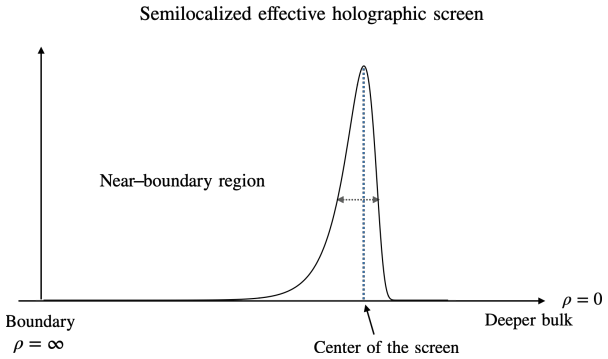
The central discovery is the identity (3.10), $$Z_{T\bar T}(\$\lambda$,m_a)=2\sqrt{\pi}\,\$lambda^{{1/2}}$\int_0^\infty dT\, e^{2\$\lambda$(1-\$\cosh$ T)}\Psi(T,m_a),$$ where $\lambda=m_2/\mu$ is the modular-invariant $T\bar T$ coupling and $\Psi$ is the WdW wavefunction at WdW time $T$. In the limit $\lambda\to\infty$ the kernel becomes a delta function on the half-line at $T=0$, the asymptotic boundary, so the undeformed torus partition function is the boundary value of the bulk wavefunction, as in standard AdS/CFT. For finite $\lambda$ the kernel has finite width and peaks at the radial position $\rho_*=\frac14\sinh^{-1}(4\lambda)$ in Rindler coordinates, so a fixed deformation is a finite-width bulk wavepacket. The paper derives an inverse kernel (4.2), using the Laplace identity for $K_{ir}(2\lambda)$, and shows that applying it to the family of deformed partition functions reconstructs $\Psi(T,m_a)$ exactly.
Load-bearing premise
The load-bearing premise is the operator-ordering choice in Eqs. (2.26)--(2.28) of Section 2, where the ordering of the torus modulus and its conjugate momentum is selected so that the kinetic operator becomes the shifted Maass Laplacian $\Delta_{\mathrm{Maass}}+\frac14$; the paper notes the ordering is chosen 'for reasons that will become apparent later', and with any other ordering the WdW equation would no longer match the $T\bar T$ flow equation, so the kernel transform would not have the derived form.
Editorial extensions
If this is right
- In the CFT limit $\lambda\to\infty$, the kernel localizes at $T=0$, so the undeformed torus partition function is the boundary value of the WdW wavefunction and standard AdS/CFT is recovered.
- At finite $\lambda$, the holographic screen is not a sharp cutoff but a semi-localized wavepacket centered at $\rho_*=\frac14\sinh^{-1}(4\lambda)$; stronger deformation moves the packet deeper into the bulk and broadens it, giving an operational meaning to the nonlocality of the $T\bar T$ deformation.
- The invertibility of the transform means the complete family of $T\bar T$-deformed torus partition functions is a tomographic encoding of the bulk quantum state: the object reconstructed is the WdW wavefunction itself, not merely a set of local bulk operators.
- After a double Wick rotation, the construction describes closed AdS$_3$ torus universes with no asymptotic boundary, and the CFT limit is carried by the maximal-volume Cauchy slice at $T=0$ rather than by a conformal boundary.
- For positive cosmological constant, the identical transform provides a dS$_3$ dictionary in which $T=0$ is realized at future infinity of the dS torus universe and, in the static-patch description, at the maximal-volume timelike surface $r=\ell/\sqrt{2}$, identifying that surface as a holographic screen.
Reading between the lines
- The paper's own footnote 1 flags that the rewriting leading to the WdW equation (2.25) holds only after solving the Hamiltonian constraint classically even though the constraint is then promoted to an operator equation; if that classical-then-quantum step is not admissible, the matching between the WdW equation and the T-bar-T flow equation would have to be revisited.
- If the transform is truly invertible, the same tomographic logic should extend beyond the torus to any one-parameter family of deformed partition functions whose flow operator shares a spectrum with the bulk WdW operator; the paper's schematic generalized kernel (6.5) is the natural place to test that numerically on higher-genus or punctured surfaces.
- The finite width of the kernel suggests a kind of radial uncertainty principle in finite-cutoff holography: a fixed coupling sets a bulk resolution scale rather than a boundary location, and two nearby couplings give overlapping wavepackets whose difference could be probed by comparing their reconstructed wavefunctions.
- The static-patch dS$_3$ result selects a concrete observable target: correlation functions anchored on the maximal-volume timelike surface $r=\ell/\sqrt{2}$ should reproduce the thermal observables of static-patch observers, a claim that can be tested once dS$_3$ holographic correlators are computed from the reconstructed wavefunction.
Editorial analysis
A structured set of objections, weighed in public.
Referee Report
Summary. The paper proposes an explicit holographic dictionary between T\bar{T}-deformed torus partition functions and bulk Wheeler-DeWitt (WdW) wavefunctions in AdS3 (and dS3) torus universes. The central object is the integral transform (3.10), which expresses the deformed partition function as a kernel transform of the bulk wavefunction, and the claimed inverse transform (4.2)-(4.3), which is supposed to reconstruct the wavefunction from the one-parameter family of deformed partition functions. The paper also claims that in the CFT limit the kernel localizes to a delta function at the asymptotic boundary, recovering standard AdS/CFT, and develops a wavepacket interpretation of the finite-coupling holographic screen, with extensions to de Sitter and flat space. The mathematical derivation relies on a specific operator ordering in the quantized Hamiltonian constraint that turns the kinetic term into the shifted Maass Laplacian, matching the T\bar{T} flow equation. The main advertised result is the invertibility of the kernel transform, which the paper uses to justify tomographic reconstruction and to distinguish its approach from finite-cutoff holography.
Significance. If the central claim were correct, the paper would provide a concrete, explicit relation between a one-parameter family of boundary partition functions and bulk quantum states, offering a refinement of the finite-cutoff interpretation of T\bar{T} and a novel reconstruction method for the WdW wavefunction. The paper is clearly written and contains several geometric identifications (Rindler AdS3, closed torus universes, static-patch de Sitter) that are of independent interest. The forward transform itself is a natural spectral representation using modified Bessel functions and Maass forms. However, the load-bearing mathematical assertions — the invertibility of the kernel and the delta-function normalization in the CFT limit — fail on direct algebraic checks. Since these failures invalidate the paper's principal claims, the significance cannot be realized in the present form.
major comments (3)
- [§4, Eqs. (4.2)–(4.3)] The proposed inverse kernel does not invert the forward transform (3.10). For a single Maass mode Ψ(T)=cos(rT), the forward transform gives Z(λ) ∝ λ^{1/2} e^{2λ} K_{ir}(2λ). Substituting this into (4.3), the λ-dependent prefactors cancel and the integrand becomes 2 K_{ir}(2λ) sin(π∂_T)[e^{-2λ cosh T}/sinh T]. Because cosh(T±iπ) = -cosh T and sinh(T±iπ) = -sinh T, the two terms in the finite-difference representation of sin(π∂_T) coincide, so the bracket vanishes identically for every λ and r. The right-hand side of (4.3) is therefore zero, not Ψ(T), for every spectral component in the paper's own expansion (3.7). This invalidates the claimed reconstruction and the statement that the kernel transform is one-to-one.
- [§3, Eqs. (3.10)–(3.12)] The kernel normalization is inconsistent with the stated delta-function limit (3.11). For the kernel K(λ,T) = 2√π λ^{1/2} e^{2λ(1-cosh T)}, the half-line integral of a constant test function gives ∫_0^∞ K(λ,T)dT → π as λ→∞, whereas the claimed limit K(λ,T) → δ(T) on the half-line requires the prefactor to be 2√(λ/π) (with ∫_0^∞ δ(T)dT = 1). Thus the CFT-limit localization at T=0 as stated does not follow from the equations as written.
- [§2, Eqs. (2.26)–(2.28)] The operator ordering that renders the kinetic operator precisely the shifted Maass Laplacian Δ_Maass + 1/4 is chosen ad hoc, with the paper stating that the ordering is fixed 'for reasons that will become apparent later.' The matching of the WdW equation (2.29) with the T\bar{T} flow equation (3.3) therefore appears to be engineered rather than derived, and the integral transform (3.10) is a consequence of this engineered coincidence. A different, equally allowed ordering would produce a different WdW equation and a different dictionary, so the claims of a 'precise' or 'canonical' relation between the bulk wavefunction and the deformed partition function need qualification.
minor comments (4)
- [§3.1, Eq. (3.16)] The diffusion transform (3.16) is introduced without specifying the normalization or domain of Z_CFT; the factor λ/π and the measure d^2ζ/ζ_2^2 should be defined precisely, including the exact convention for the fundamental domain of the modular parameter.
- [§2, footnote after Eq. (2.23)] The footnote attached to Eq. (2.23) says 'Equation (2.32) holds only after solving the Hamiltonian constraint classically,' but the reference to Eq. (2.32) appears to be a typo; the intended equation is likely (2.23) or (2.25).
- [References] The references are formatted inconsistently: several entries lack journal or volume details (e.g., [8], [9]), and the DOI in [33] appears to be a placeholder string rather than a valid identifier.
- [Throughout] There are several instances of 'T 2' or 'T 2-deformed' (e.g., in the Introduction and Section 6) where 'T\bar{T}' is evidently meant; these typographical errors make some passages difficult to read.
Circularity Check
No circularity: the WdW/flow operator matching is an openly declared construction, and the inverse-kernel/normalization problems are correctness concerns, not self-referential reductions.
full rationale
The paper's derivation chain is not circular. The TTbar flow equation (3.1) is an externally cited input, and the WdW equation (2.29) is obtained with an openly stated operator-ordering choice (2.27), which the paper explicitly says is made 'for reasons that will become apparent later.' That the ordering is chosen to match the shifted Maass Laplacian in the flow equation is a construction, not a hidden reduction: the integral transform (3.10) still requires solving the Bessel equation and imposing the CFT boundary condition. The normalization in (3.10) is a boundary condition, not a fitted parameter dressed as a prediction. There are no load-bearing self-citations: the flow equation, reduced phase-space quantization, and Laplace identity (4.1) are all attributed to other authors or are standard mathematics. Two serious concerns exist but they are correctness issues rather than circularity: the large-lambda normalization stated in (3.11) is inconsistent with the prefactor in (3.10), and the inverse kernel (4.2) appears not to invert (3.10) (e.g., sin(pi partial_T)[e^{-2 lambda cosh T}/sinh T] = 0 as a real function, so the proposed reconstruction would vanish on the forward image). These would need to be fixed for the paper's claims to stand, but they do not make the derivation circular.
Assumptions & free parameters
free parameters (1)
- Kernel normalization prefactor =
2 sqrt(pi) lambda^{1/2} (as written in (3.10)/(3.12))
assumptions (5)
- domain assumption The T-Tbar-deformed torus partition function satisfies the flow equation (3.1), equivalently (3.3), taken from references [31-34].
- ad hoc to paper The operator ordering in the quantized Hamiltonian constraint is chosen as in (2.26)-(2.28) so that the kinetic operator becomes the shifted Maass Laplacian, Delta_Maass + 1/4.
- standard math The spectral decomposition into Maass forms in (3.7) is complete, i.e., the Selberg spectral theorem holds for the modular torus.
- domain assumption The physical solution selects the K_ir branch and the cos(rT) branch via the CFT limit lambda to infinity.
- standard math The modified Bessel function integral identity (4.1) is correct as stated.
Cite this review
Pith. "Pith review of Wavefunctions of AdS$_3$ Universes and $T\bar{T}$-deformed Torus Partition Functions." pith.science (2026). https://pith.science/paper/FC3ORXFI
@misc{pith2026260804665,
  author       = {Pith},
  title        = {Pith review of: Wavefunctions of AdS$_3$ Universes and $T\barT$-deformed Torus Partition Functions},
  year         = {2026},
  howpublished = {\url{https://pith.science/paper/FC3ORXFI}},
  note         = {Machine review of arXiv:2608.04665}
}
abstract
We study wavefunctions of quantum gravity in asymptotically AdS$_3$ spacetimes and their relation to $T\bar T$-deformed torus partition functions. We show that the deformed partition function is given by an invertible integral transform of bulk wavefunctions, with a kernel encoding the relation between the $T\bar T$ coupling and the radial or temporal coordinate in the bulk. The invertibility of the transform allows the bulk wavefunction to be reconstructed from the family of $T\bar T$-deformed partition functions. In the CFT limit, the kernel effectively localizes at the asymptotic boundary, recovering the standard holographic relation in which the partition function on the torus is determined by the boundary value of the bulk wavefunction. For finite deformation, the kernel shifts the effective holographic screen away from the asymptotic boundary and broadens it into a finite bulk region. A $T\bar{T}$-deformed partition function at fixed coupling corresponds to a finite-width bulk wavepacket centered around a radial or temporal location set by the deformation scale. In Euclidean signature, the construction arises naturally from wavefunctions of Rindler AdS$_3$, while after a double Wick rotation it admits a Lorentzian interpretation in terms of closed AdS$_3$ torus universes without asymptotic boundaries. Finally, we discuss the extension of the present construction to de Sitter torus universes and its implications for de Sitter holography, and comment on possible generalizations to more general spatial topologies and higher-dimensional spacetimes.
Figures


Figures from the paper (1 more)

Reference graph
Works this paper leans on
-
[1]
The largeNlimit of superconformal field theories and supergravity,
J. M. Maldacena, “The largeNlimit of superconformal field theories and supergravity,” Adv. Theor. Math. Phys.2, 231 (1998) [Int. J. Theor. Phys.38, 1113 (1999)] [arXiv:hep- th/9711200]
arXiv 1998
-
[2]
Anti-de Sitter space and holography,
E. Witten, “Anti-de Sitter space and holography,” Adv. Theor. Math. Phys.2, 253 (1998) doi:10.4310/ATMP.1998.v2.n2.a2 [hep-th/9802150]
arXiv 1998
-
[3]
Gauge theory correlators from non- critical string theory,
S. S. Gubser, I. R. Klebanov and A. M. Polyakov, “Gauge theory correlators from non- critical string theory,” Phys. Lett. B428, 105 (1998) doi:10.1016/S0370-2693(98)00377- 3 [hep-th/9802109]
arXiv 1998
- [4]
-
[5]
Expectation value of composite fieldTanti-Tin two-dimensional quantum field theory,
A. B. Zamolodchikov, “Expectation value of composite fieldTanti-Tin two-dimensional quantum field theory,” hep-th/0401146. 24
-
[6]
On space of integrable quantum field theories,
F. A. Smirnov and A. B. Zamolodchikov, “On space of integrable quantum field theories,” Nucl. Phys. B915, 363 (2017) doi:10.1016/j.nuclphysb.2016.12.014 [arXiv:1608.05499 [hep-th]]
arXiv 2017
-
[7]
T¯T-deformed 2D Quantum Field Theories,
A. Cavagli` a, S. Negro, I. M. Sz´ ecs´ enyi and R. Tateo, “T¯T-deformed 2D Quantum Field Theories,” JHEP1610, 112 (2016) doi:10.1007/JHEP10(2016)112 [arXiv:1608.05534 [hep-th]]
arXiv 2016
-
[8]
Moving the CFT into the bulk withT ¯T,
L. McGough, M. Mezei and H. Verlinde, “Moving the CFT into the bulk withT ¯T,” arXiv:1611.03470 [hep-th]
Show all 43 references
-
[9]
Cutoff AdS 3 versus theT Tdeformation,
P. Kraus, J. Liu and D. Marolf, “Cutoff AdS 3 versus theT Tdeformation,” JHEP1807, 027 (2018) doi:10.1007/JHEP07(2018)027 [arXiv:1801.02714 [hep-th]]
2018 arXiv
-
[10]
GeometrizingT T,
P. Caputa, S. Datta, Y. Jiang, Y. Jiang, and P. Kraus, “GeometrizingT T,” JHEP03, 140 (2021) [erratum: JHEP09, 110 (2022)] doi:10.1007/JHEP03(2021)140 [arXiv:2011.04664 [hep-th]]
2021 arXiv
-
[11]
A note on the canonical formalism for gravity,
E. Witten, “A note on the canonical formalism for gravity,” Adv. Theor. Math. Phys. 27(2023) no.1, 311-380 doi:10.4310/ATMP.2023.v27.n1.a6 [arXiv:2212.08270 [hep-th]]
2023 arXiv
-
[12]
Cauchy slice holography: a new AdS/CFT dictionary,
G. Araujo-Regado, R. Khan and A. C. Wall, “Cauchy slice holography: a new AdS/CFT dictionary,” JHEP03(2023), 026 doi:10.1007/JHEP03(2023)026 [arXiv:2204.00591 [hep-th]]
2023 arXiv
-
[13]
Holographic representation of local bulk operators,
A. Hamilton, D. N. Kabat, G. Lifschytz and D. A. Lowe, “Holographic representation of local bulk operators,” Phys. Rev. D74(2006), 066009 doi:10.1103/PhysRevD.74.066009 [arXiv:hep-th/0606141 [hep-th]]; D. Kabat, G. Lifschytz, S. Roy and D. Sarkar, “Holographic representation o...
2006 arXiv
-
[14]
The Gravity Dual of a Density Matrix,
B. Czech, J. L. Karczmarek, F. Nogueira and M. Van Raamsdonk, “The Gravity Dual of a Density Matrix,” Class. Quant. Grav.29(2012), 155009 doi:10.1088/0264- 9381/29/15/155009 [arXiv:1204.1330 [hep-th]]. 25
2012 arXiv
-
[15]
Causality & holo- graphic entanglement entropy,
M. Headrick, V. E. Hubeny, A. Lawrence and M. Rangamani, “Causality & holo- graphic entanglement entropy,” JHEP12(2014), 162 doi:10.1007/JHEP12(2014)162 [arXiv:1408.6300 [hep-th]]
2014 arXiv
-
[16]
Maximin Surfaces, and the Strong Subadditivity of the Covariant Holographic Entanglement Entropy,
A. C. Wall, “Maximin Surfaces, and the Strong Subadditivity of the Covariant Holographic Entanglement Entropy,” Class. Quant. Grav.31(2014) no.22, 225007 doi:10.1088/0264-9381/31/22/225007 [arXiv:1211.3494 [hep-th]]
2014 arXiv
-
[17]
Relative entropy equals bulk relative entropy,
D. L. Jafferis, A. Lewkowycz, J. Maldacena and S. J. Suh, “Relative entropy equals bulk relative entropy,” JHEP06(2016), 004 doi:10.1007/JHEP06(2016)004 [arXiv:1512.06431 [hep-th]]
2016 arXiv
-
[18]
Reconstruction of Bulk Operators within the Entanglement Wedge in Gauge-Gravity Duality,
X. Dong, D. Harlow and A. C. Wall, “Reconstruction of Bulk Operators within the Entanglement Wedge in Gauge-Gravity Duality,” Phys. Rev. Lett.117(2016) no.2, 021601 doi:10.1103/PhysRevLett.117.021601 [arXiv:1601.05416 [hep-th]]
2016 arXiv
-
[19]
Entangle- ment Wedge Reconstruction via Universal Recovery Channels,
J. Cotler, P. Hayden, G. Penington, G. Salton, B. Swingle and M. Walter, “Entangle- ment Wedge Reconstruction via Universal Recovery Channels,” Phys. Rev. X9(2019) no.3, 031011 doi:10.1103/PhysRevX.9.031011 [arXiv:1704.05839 [hep-th]]
2019 arXiv
-
[20]
Reduction of the Einstein equations in (2+1)-dimensions to a Hamil- tonian system over Teichmuller space,
V. Moncrief, “Reduction of the Einstein equations in (2+1)-dimensions to a Hamil- tonian system over Teichmuller space,” J. Math. Phys.30, 2907-2914 (1989) doi:10.1063/1.528475
1989 doi
-
[21]
(2+1)-dimensional Pure Gravity for an Arbitrary Closed Initial Surface,
A. Hosoya and K. Nakao, “(2+1)-dimensional Pure Gravity for an Arbitrary Closed Initial Surface,” Class. Quant. Grav.7, 163 (1990) doi:10.1088/0264-9381/7/2/010; A. Hosoya and K. i. Nakao, “(2+1)-dimensional Quantum Gravity,” Prog. Theor. Phys. 84, 739-748 (1990) doi:10.1143/P...
1990 doi
-
[22]
Teichmuller Motion of (2+1)-dimensional Grav- ity With the Cosmological Constant,
Y. Fujiwara and J. Soda, “Teichmuller Motion of (2+1)-dimensional Grav- ity With the Cosmological Constant,” Prog. Theor. Phys.83, 733-748 (1990) doi:10.1143/PTP.83.733
1990 doi
-
[23]
Quantum gravity in 2+1 dimensions: The Case of a closed universe,
S. Carlip, “Quantum gravity in 2+1 dimensions: The Case of a closed universe,” Living Rev. Rel.8, 1 (2005) doi:10.12942/lrr-2005-1 [arXiv:gr-qc/0409039 [gr-qc]]
2005 arXiv
-
[24]
Classical and quantum evolutions of the de Sitter and the anti- de Sitter universes in (2+1)-dimensions,
K. Ezawa, “Classical and quantum evolutions of the de Sitter and the anti- de Sitter universes in (2+1)-dimensions,” Phys. Rev. D49(1994), 5211-5226 doi:10.1103/PhysRevD.49.5211 [arXiv:hep-th/9311103 [hep-th]]; K. Ezawa, “Chern-Simons quantization of (2+1) anti-de Sitter gravi...
1994 arXiv
-
[25]
(2+1)-dimensional Chern-Simons gravity as a Dirac square root,
S. Carlip, “(2+1)-dimensional Chern-Simons gravity as a Dirac square root,” Phys. Rev. D45(1992), 3584-3590 [erratum: Phys. Rev. D47(1993), 1729] doi:10.1103/PhysRevD.47.1729 [arXiv:hep-th/9109006 [hep-th]]
1992 arXiv
-
[26]
The Modular group, operator ordering, and time in (2+1)-dimensional gravity,
S. Carlip, “The Modular group, operator ordering, and time in (2+1)-dimensional gravity,” Phys. Rev. D47(1993), 4520-4524 doi:10.1103/PhysRevD.47.4520 [arXiv:gr- qc/9209011 [gr-qc]]
1993
-
[27]
Comparative quantizations of (2+1)-dimensional grav- ity,
S. Carlip and J. E. Nelson, “Comparative quantizations of (2+1)-dimensional grav- ity,” Phys. Rev. D51, 5643-5653 (1995) doi:10.1103/PhysRevD.51.5643 [arXiv:gr- qc/9411031 [gr-qc]]
1995
-
[28]
Conformally invariant orthogonal decomposition of symmetric tensors in Riemannian manifolds and the initial-value problem of general relativity
J. W. York, Jr., “Conformally invariant orthogonal decomposition of symmetric tensors in Riemannian manifolds and the initial-value problem of general relativity”, J. Math. Phys.14, 456 (1973)
1973
-
[29]
Hamiltonian reduction of Einstein’s equations of gen- eral relativity,
A. E. Fischer and V. Moncrief, “Hamiltonian reduction of Einstein’s equations of gen- eral relativity,” Nucl. Phys. B Proc. Suppl.57(1997), 142-161 doi:10.1016/S0920- 5632(97)00363-0
1997 doi
-
[30]
Quantum cosmology as automorphic dynamics,
V. Godet, “Quantum cosmology as automorphic dynamics,” [arXiv:2405.09833 [hep- th]]
-
[31]
T ¯Tdeformed partition functions,
S. Datta and Y. Jiang, “T ¯Tdeformed partition functions,” JHEP08(2018), 106 doi:10.1007/JHEP08(2018)106 [arXiv:1806.07426 [hep-th]]
2018 arXiv
-
[32]
Modular invariance and uniqueness ofT ¯Tdeformed CFT,
O. Aharony, S. Datta, A. Giveon, Y. Jiang and D. Kutasov, “Modular invariance and uniqueness ofT ¯Tdeformed CFT,” JHEP01(2019), 086 doi:10.1007/JHEP01(2019)086 [arXiv:1808.02492 [hep-th]]
2019 arXiv
-
[33]
Resurgent properties ofT ¯T-deformed conformal field the- ories,
J. Gu, Y. Jiang and H. Wang, “Resurgent properties ofT ¯T-deformed conformal field the- ories,” Phys. Rev. D112(2025) no.4, 045007 doi:10.1103/dvwg-9jcy [arXiv:2503.19350 [hep-th]]
2025 arXiv
-
[34]
Beyond Hagedorn: A Harmonic Approach toT ¯T- deformation,
J. Gu, J. Hou and Y. Jiang, “Beyond Hagedorn: A Harmonic Approach toT ¯T- deformation,” [arXiv:2604.20839 [hep-th]]
-
[35]
T Tpartition function from topological gravity,
S. Dubovsky, V. Gorbenko and G. Hern´ andez-Chifflet, “T Tpartition function from topological gravity,” JHEP1809, 158 (2018) doi:10.1007/JHEP09(2018)158 [arXiv:1805.07386 [hep-th]]
2018 arXiv
-
[36]
T T , JT , TJpartition sums from string theory,
A. Hashimoto and D. Kutasov, “T T , JT , TJpartition sums from string theory,” JHEP 02(2020), 080 doi:10.1007/JHEP02(2020)080 [arXiv:1907.07221 [hep-th]]. 27
2020 arXiv
-
[37]
The spectrum of pure dS3 gravity in the static patch,
J. Chakravarty, A. Maloney, K. Namjou and S. F. Ross, “The spectrum of pure dS3 gravity in the static patch,” JHEP10(2025), 021 doi:10.1007/JHEP10(2025)021 [arXiv:2505.06420 [hep-th]]
2025 arXiv
-
[38]
dS/dS andT T,
V. Gorbenko, E. Silverstein and G. Torroba, “dS/dS andT T,” JHEP03(2019), 085 doi:10.1007/JHEP03(2019)085 [arXiv:1811.07965 [hep-th]]
2019 arXiv
-
[39]
Algebras, regions, and observers.,
E. Witten, “Algebras, regions, and observers.,” Proc. Symp. Pure Math.107(2024), 247-276 doi:10.1090/pspum/107/01954 [arXiv:2303.02837 [hep-th]]
2024 arXiv
-
[40]
A background-independent algebra in quantum gravity,
E. Witten, “A background-independent algebra in quantum gravity,” JHEP03(2024), 077 doi:10.1007/JHEP03(2024)077 [arXiv:2308.03663 [hep-th]]
2024 arXiv
-
[41]
An algebra of ob- servables for de Sitter space,
V. Chandrasekaran, R. Longo, G. Penington and E. Witten, “An algebra of ob- servables for de Sitter space,” JHEP02(2023), 082 doi:10.1007/JHEP02(2023)082 [arXiv:2206.10780 [hep-th]]
2023 arXiv
-
[42]
The dS / CFT correspondence,
A. Strominger, “The dS / CFT correspondence,” JHEP10(2001), 034 doi:10.1088/1126-6708/2001/10/034 [arXiv:hep-th/0106113 [hep-th]]
2001 arXiv
-
[43]
T ¯Tdeformations in general dimensions,
M. Taylor, “T ¯Tdeformations in general dimensions,” Adv. Theor. Math. Phys.27 (2023) no.1, 37-63 doi:10.4310/ATMP.2023.v27.n1.a2 [arXiv:1805.10287 [hep-th]]. 28
2023 arXiv
Reviewed August 6, 2026 · model on record in the stance chip above.
Discussion (0). Sign in to comment.