REVIEW 4 major objections 5 minor 118 references
Benchmarking Deep Learning Models for Dense Event Classification of Offshore Wind Infrastructure in Sentinel-1 Time Series
T0 review · 4 major / 5 minor · reviewed 2026-08-06 · deepseek-v4-flash
Pith's one-line read A supervised BiLSTM outperforms the rule-based baseline at dense event classification of offshore wind infrastructure in Sentinel-1 time series.
desk verdict A useful, honestly written benchmark, but the headline comparison is not out-of-sample: test-set checkpoint selection inflates the BiLSTM's reported gain. read the letter →
The pith
A machine-rendered reading of the paper's core claim, the machinery that carries it, and where it could break.
The reading
What carries the argument
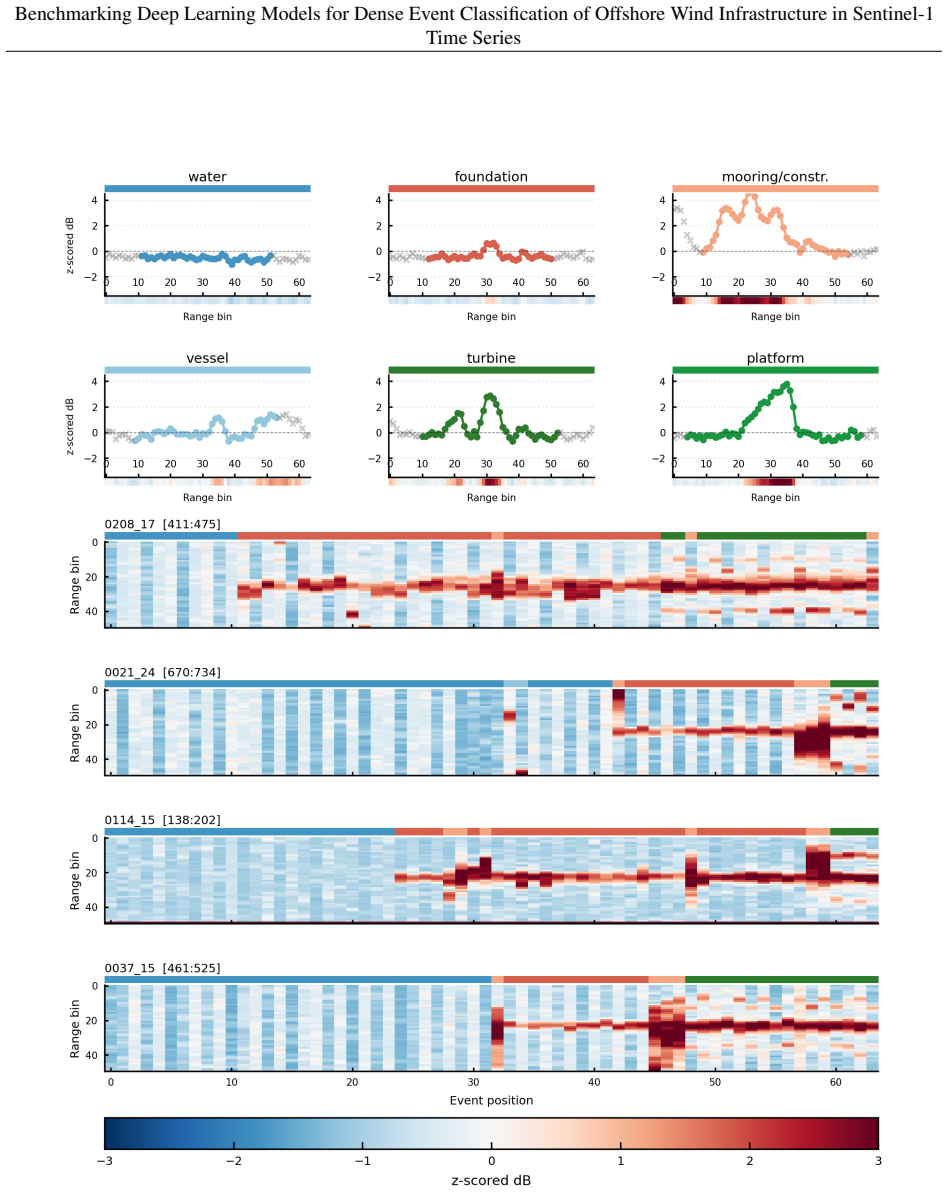
The central object is the supervised bidirectional LSTM built on a shared event-profile encoder. Each Sentinel-1 acquisition is reduced to a 64-bin 1D profile of maximum backscatter in range direction, paired with a binary valid-bin mask, and standardized with global statistics (mean -22.67 dB, sigma 5.98 dB). The encoder is a three-block 1D convolutional network with masked average and max pooling; the BiLSTM then reads sequences of 64 events in both directions and outputs per-event class logits. Evaluation uses the collapsed edit-similarity curve (AUCEditSim), a Levenshtein-derived sequence agreement metric, and transition-count comparisons; the final ensemble selects, per sequence, the label set with fewer class transitions.
What would settle it
Take a sample of turbines across the EU, UK, and China with registry-verified construction and grid-connection dates, run the published BiLSTM and ensemble on their Sentinel-1 sequences, and measure the offset between predicted and official deployment-phase boundaries; systematic offsets exceeding the acquisition repeat cycle, or predicted phases with no registry counterpart, would falsify the claimed day-level monitoring capability.
Extended reading notes
Core claim
The central claim is that dense event classification of Sentinel-1 offshore wind time series can be advanced beyond rule-based heuristics by supervised deep learning with bidirectional temporal context. The supervised-only BiLSTM encodes each acquisition as a 1D SAR backscatter profile, processes windows of 64 events in both directions, and predicts one of six classes per event: water, vessel, foundation, mooring/construction, turbine, or platform. On the benchmark test set it reaches an AUCEditSim of 0.8509 and a perfect-match rate of 0.5063, both above the rule-based baseline's 0.7853 and 0.3508. A transition-minimizing ensemble of BiLSTM and baseline labels raises the sequence-level rank correlation with test-set transition counts to 0.924, repairs the platform-class F1 from 0.4677 to 0.7352, and yields the labels used for the global deployment-phase analysis.
Load-bearing premise
The 661,732 new hand labels and the 328,657-event test set are treated as reliable ground truth for the six event classes, yet no inter-annotator agreement, independent verification against construction records, or label-quality audit is reported.
Editorial extensions
If this is right
- Dense event labels can now be produced automatically for all 14,840,637 events across 15,606 global sequences, replacing the rule-based classifier as the inference engine.
- The deployment phase of individual turbines can be isolated at day-level precision, revealing regional differences in duration and seasonality across China, the EU, and the UK.
- Bidirectional context is essential: all bidirectional variants beat the baseline, while causal and monotemporal models do not.
- Self-supervised pretraining did not help bidirectional models but did improve causal transformers, so labeled data, not representation quality, is the current bottleneck for offline models.
- The ensemble's recovery of platform and foundation classes shows that the deep model has not yet learned everything the rule-based classifier encodes, pointing to disagreement-based active learning as a next step.
Reading between the lines
- Because the test labels were produced by the same group that designed the rule-based baseline, part of the measured gain may reflect systematic label bias shared by both human and rule-based labeling; an independent audit against construction records would quantify this.
- The success of transition-minimizing ensembling suggests that a temporal-smoothness prior, applied directly inside the deep model, could recover some of the remaining gap without needing a second label source.
- The fixed 64-event window covers variable real-time periods because revisit times differ by region, so extending the window or using acquisition-time-aware architectures could remove the temporally implausible foundation predictions the authors observe.
- If the causal stream can be improved, a near-real-time global situational awareness service for offshore infrastructure becomes feasible; the paper's data and predictions provide the training basis for that.
Editorial analysis
A structured set of objections, weighed in public.
Referee Report
Summary. The paper compares ten deep learning model-training variants for dense six-class event labeling of Sentinel-1 offshore wind infrastructure time series. It introduces 500 newly hand-annotated time series with 661,732 events, trains FCNN, LSTM, and transformer variants with monotemporal, causal, and bidirectional context, with and without self-supervised pretraining, and evaluates them on a strictly isolated 328,657-event test set against the rule-based baseline of DeepOWT v3.25.1. The supervised BiLSTM is reported as best, raising AUCEditSim from 0.7853 to 0.8509 and perfect match rate from 0.3508 to 0.5063. The authors then construct a transition-minimizing ensemble of BiLSTM and baseline labels, use the resulting labels to isolate deployment phases of individual turbines globally, and report deployment durations and regional patterns for China, the EU, and the UK.
Significance. The data contribution is substantial: 500 hand-labeled time series, open predictions for 14.8 million events, and a systematic comparison of ten training variants are exactly the kind of resource the remote-sensing time-series community needs. If the headline comparison were clean, the result would be practically valuable for global offshore wind monitoring and for benchmarking future models. However, the evaluation protocol currently makes the central quantitative claim an optimistic upper bound rather than a fair out-of-sample comparison. The manuscript therefore needs a revision of the evaluation before the benchmark claim can be accepted.
major comments (4)
- [§4.1; §3.1.3] The evaluation is not fully out-of-sample because the reported numbers come from "the checkpoint with the peak AUCEditSim" (§4.1), while §3.1.3 states that early stopping is based on validation macro F1. Since AUCEditSim is computed on the 328,657-event test set, selecting the checkpoint by peak test-set score and then comparing that score with the rule-based baseline on the same test set converts training fluctuation into apparent gains. Please report the validation-selected checkpoint as the primary result, or use a nested or separate hold-out for checkpoint selection, and quantify the difference between validation-selected and test-selected numbers.
- [§4.1; §4.2] Each experiment appears to be a single training run, and no confidence intervals, standard deviations, or seed repetitions are reported anywhere in §4. With run-to-run variability unknown, the headline AUCEditSim gap of 0.8509 versus 0.7853 cannot be assessed for statistical reliability. Please provide multiple seeds, at least for the supervised BiLSTM and the best competitive variants, and report paired differences with confidence intervals, especially because checkpoint selection by peak test-set score amplifies the effect of random variation.
- [§3.1.6; §4.1; §4.2] The ensemble rule in §3.1.6 (choose the label source with fewer transitions, with BiLSTM on ties) is introduced after §4.1 reports that the BiLSTM's transition counts correlate better with the test set, and the ensemble is then evaluated on the same test set in §4.2. This is test-set-based method selection for the ensemble, so the reported AUCEditSim of 0.86 and the per-class F1 recoveries are optimistic. Please specify the ensemble rule before looking at the test set, tune it on a validation split, or show via sensitivity analysis that the conclusion is robust to the rule choice. Similarly, the guarding threshold of "ten or more consecutive water/vessel observations" used in §3.2 to define deployment onset was introduced after observing BiLSTM misclassifications (§5.3); its choice needs a sensitivity analysis or pre-specification.
- [§2.1; §3.1.5] The hand-annotated training labels and the test set come from the same group, and no inter-annotator agreement, label-quality audit, or independent verification against construction records is reported. Since the benchmark claims are measured against these labels, label noise or systematic annotation conventions shared with the rule-based baseline could inflate the apparent improvements. Please report annotation quality checks or at least discuss the potential direction and magnitude of this bias, and state clearly whether the test set is publicly available for independent re-labeling.
minor comments (5)
- [§2.1] The phrase "V-polarized (vertical sent - horizontal received)" is awkward and incomplete; it should read "vertical transmit, horizontal receive" with the hyphen and spacing fixed.
- [References] The Flanders Marine Institute reference has an incomplete year: "last access: 12 February 202." should be a complete year.
- [§3.1.6] The text contains "theunclearlabel" without a space; it should read "the unclear label."
- [§3.2] The phrase "V oronoi tessellation" has an unintended space; it should read "Voronoi tessellation."
- [§3.1.5] The abbreviation AUCEditSim is used in the abstract and throughout but is only defined in §3.1.5; please define it at first use in the abstract or introduction.
Circularity Check
Reported test-set results are selected by maximizing the test metric itself: Section 4.1 chooses the checkpoint with peak AUCEditSim, and the transition-minimizing ensemble is motivated by test-set correlations and then evaluated on the same test set.
-
fitted input called prediction
[Section 4.1 (Model performances), with Sections 3.1.4 and 3.1.5]
"For each, the following figures report the evaluation results of the checkpoint with the peak AUCEditSim. — All experiments produce trained model checkpoints, which are used to predict event labels on the benchmark test set."
AUCEditSim (Eq. 2) is defined on the M test sequences, and Section 3.1.4 says checkpoints 'are used to predict event labels on the benchmark test set.' Early stopping (Section 3.1.3) monitors validation macro F1, so the model selected for deployment would come from the validation criterion, not the test set. By reporting the checkpoint with peak AUCEditSim, the paper selects an epoch whose test-set score is the maximum over all evaluated epochs and then presents that maximum as the model's test-set performance. The headline comparison — BiLSTM 0.8509 vs. rule-based 0.7853 — is thus an optimistic upper bound obtained by optimizing the reported metric on the very data used for the comparison. The perfect match rate 0.5063 has the same status.
-
fitted input called prediction
[Section 4.1 (last paragraph), Sections 3.1.6 and 4.2]
"We correlate the transition counts of each prediction set, the BiLSTM and the rule-based baseline, with the transition counts of the test set. The BiLSTM reaches a Spearman’s ρ of 0.89, compared to 0.843 for the rule-based baseline. ... This motivated us to go further into minimizing label transition counts globally for the predictions of the 15,606 sequences."
The ensemble rule (Section 3.1.6) chooses, for each sequence, the labels with fewer transitions. The choice of transition-count minimization as the combination criterion is explicitly motivated in Section 4.1 by correlations computed against the test set ('We correlate the transition counts ... with the transition counts of the test set ... These statistical findings ... motivated us'). Section 4.2 then evaluates the resulting ensemble on that same test set and reports improved agreement (Spearman ρ 0.924; platform F1 0.7352).
full rationale
The paper is an empirical benchmark rather than a formal derivation chain, and most of its self-citations are legitimate data/comparator citations: DeepOWT v3.25.1, the rule-based baseline, and the hand-labeled test set come from Hoeser et al. (2026), and the newly hand-labeled 661,732 events are external to the model optimization. Those do not, by themselves, make the central comparison circular. The two concrete reductions are test-set-driven model selection steps. First, Section 4.1 reports, for every variant, the checkpoint with peak AUCEditSim. Since AUCEditSim (Eq. 2) is computed on the 328,657-event held-out test set and checkpoints are evaluated on that set (Section 3.1.4), the headline BiLSTM scores (0.8509 AUC, 0.5063 perfect match) are maxima over test-set epoch scores, not independent out-of-sample estimates; early stopping (Section 3.1.3) uses validation macro F1, so the reported checkpoint differs from the validation-selected deployable model. This is a fitted-input-called-prediction issue affecting the central claim. Second, the ensemble's transition-minimization objective is chosen after correlating transition counts with test-set labels (Section 4.1) and is then evaluated on that same test set (Section 4.2); the reported ensemble gains (ρ 0.924, platform F1 recovery) are in part a restatement of the criterion used to construct it. However, the model itself is trained only on human labels, the SSL/causal comparisons are not selected on the headline metric in the same way, and the deployment-duration medians are descriptive rather than derived from the test-set comparison. The circularity is therefore partial: score 6, not 8-10.
Assumptions & free parameters
free parameters (4)
- Window length L=64
- Deployment-phase guarding threshold =
10 consecutive water/vessel events
- Ensemble transition rule =
Choose label source with fewer transitions; ties go to BiLSTM
- Transition window jitter and padding =
jitter -3 to -8, 8 to 16; overshoot 16
assumptions (4)
- domain assumption The DeepOWT v3.25.1 rule-based labels are sufficiently accurate to serve as pseudo-labels for SSL sampling.
- domain assumption Column-wise maximum VH-polarized backscatter profiles are sufficient representations to distinguish the six event classes.
- domain assumption The held-out test set labels from Hoeser et al. [2026] are ground truth.
- domain assumption Collapsed edit similarity at quality threshold is the most meaningful evaluation metric.
Cite this review
Pith. "Pith review of Benchmarking Deep Learning Models for Dense Event Classification of Offshore Wind Infrastructure in Sentinel-1 Time Series." pith.science (2026). https://pith.science/paper/7MD3OARY
@misc{pith2026260804706,
  author       = {Pith},
  title        = {Pith review of: Benchmarking Deep Learning Models for Dense Event Classification of Offshore Wind Infrastructure in Sentinel-1 Time Series},
  year         = {2026},
  howpublished = {\url{https://pith.science/paper/7MD3OARY}},
  note         = {Machine review of arXiv:2608.04706}
}
read the original abstract
Monitoring of offshore wind energy infrastructure life cycles, especially during the deployment phase, is an important contribution for stakeholders to make informed decisions in a phase of increasing deployment activities. ESA's Sentinel-1 Synthetic Aperture Radar (SAR) mission produces large data archives that enable the global monitoring of offshore wind infrastructure. Turning these high-volume archives into information requires algorithms that automatically extract single event labels from dense time series at a global scale. In this study, we present a structured comparison of ten deep learning model-training variants for the dense classification of Sentinel-1 based offshore wind infrastructure time series, aiming to advance rule-based event classification of this task. We trained LSTM, Transformer, and fully connected model variants with monotemporal, unidirectional, and bidirectional context awareness, each with and without self-supervised pretraining. Among these, the supervised BiLSTM performs best, raising the target AUC score from 0.7853 for the rule-based baseline to 0.8509, and the perfect match rate from 0.3508 to 0.5063. Combining the BiLSTM predictions with the existing baseline labels in a label-transition-minimising ensemble further improves agreement with the test data. Using these improved labels, we isolate the deployment phase of individual turbines at a global scale and conduct a regional and subregional analysis covering 2016-01-01 to 2025-03-31, reporting median deployment durations of 84 d (China), 242 d (EU), and 258 d (UK). Deployment-related drivers, including legal regulations such as subsidies, and environmental conditions, emerge clearly from the analysed results across multiple spatial scales.
Figures


Figures from the paper (13 more)


Reference graph
Works this paper leans on
-
[1]
Wong and Christian Thomas and Patrick Halpin , keywords =
Brian A. Wong and Christian Thomas and Patrick Halpin , keywords =. Automating offshore infrastructure extractions using synthetic aperture radar & Google Earth Engine , journal =. 2019 , issn =. doi:https://doi.org/10.1016/j.rse.2019.111412 , url =
-
[3]
Soviet Physics Doklady , volume=
Binary codes capable of correcting deletions, insertions and reversals , author=. Soviet Physics Doklady , volume=
-
[4]
Heavy maintenance campaign completed on Hywind Scotland floating offshore wind farm , year =
-
[5]
and Haberland, Matt and Reddy, Tyler and Cournapeau, David and Burovski, Evgeni and Peterson, Pearu and Weckesser, Warren and Bright, Jonathan and
Virtanen, Pauli and Gommers, Ralf and Oliphant, Travis E. and Haberland, Matt and Reddy, Tyler and Cournapeau, David and Burovski, Evgeni and Peterson, Pearu and Weckesser, Warren and Bright, Jonathan and. Nature Methods , year =
-
[6]
Earth System Science Data , VOLUME =
Hoeser, Thorsten and Feuerstein, Stefanie and Kuenzer, Claudia , TITLE =. Earth System Science Data , VOLUME =. 2022 , NUMBER =
2022
-
[7]
Google Earth Engine: Planetary-scale geospatial analysis for everyone , journal =. 2017 , note =. doi:10.1016/j.rse.2017.06.031 , url =
-
[8]
Sensors , VOLUME =
Zhang, Jing and Wang, Qi and Su, Fenzhen , TITLE =. Sensors , VOLUME =. 2019 , NUMBER =
2019
-
[9]
Sentinel-1 Algorithms: Sentinel-1 Preprocessing , year =
Show all 118 references
-
[10]
Entropy , VOLUME =
Wang, Qi and Zhang, Jing and Su, Fenzhen , TITLE =. Entropy , VOLUME =. 2019 , NUMBER =
2019
-
[13]
International Journal of Remote Sensing , volume =
Shuai Zhang and Fangxiong Wang and Yingzi Hou and Junfu Wang and Jianke Guo , title =. International Journal of Remote Sensing , volume =. 2024 , publisher =
2024
-
[14]
GIScience & Remote Sensing , volume =
Qiannan Ding and Bo Tian and Chunpeng Chen and Yuekai Hu and Xue Li , title =. GIScience & Remote Sensing , volume =. 2024 , publisher =
2024
-
[16]
Remote Sensing , VOLUME =
Song, Xike and Li, Ziyang , TITLE =. Remote Sensing , VOLUME =. 2025 , NUMBER =
2025
-
[17]
Extraction of Offshore Wind Turbines in China by Combining Multispectral and SAR Image Data , year=
Wang, Fangxiong and Zhang, Shuai and Hou, Yingzi and Wang, Junfu , journal=. Extraction of Offshore Wind Turbines in China by Combining Multispectral and SAR Image Data , year=
-
[19]
LandTrendr — Temporal segmentation algorithms , journal =
Detecting trends in forest disturbance and recovery using yearly Landsat time series: 1. LandTrendr — Temporal segmentation algorithms , journal =. 2010 , issn =. doi:10.1016/j.rse.2010.07.008 , url =
2010 doi
-
[21]
Geo-spatial Information Science , volume =
Qiannan Ding and Chunpeng Chen and Bo Tian and Wenxiang Ji and Bin Zhang and Xue Li and Qing Yuan , title =. Geo-spatial Information Science , volume =. 2025 , publisher =
2025
-
[22]
and Matos-Carvalho, João P
Mota, Tiago and Vieira, Mario and Filipe, Leonardo and Fernandes, Daniel and Garcia, Nuno C. and Matos-Carvalho, João P. , booktitle=. Applying Machine Learning to SENTINEL Satellite Images to Predict the Operational State of Floating Offshore Wind Turbines , year=
-
[23]
Energies , VOLUME =
de Carvalho, Osmar Luiz Ferreira and de Carvalho Junior, Osmar Abílio and de Albuquerque, Anesmar Olino and Silva, Daniel Guerreiro e , TITLE =. Energies , VOLUME =. 2025 , NUMBER =
2025
-
[24]
Remote Sensing , VOLUME =
Fei, Yasen and Gao, Yongnian and Gu, Hongyuan and Sun, Yongqi and Tian, Yanjun , TITLE =. Remote Sensing , VOLUME =. 2025 , NUMBER =
2025
-
[27]
Automatic extraction of offshore platforms using time-series Landsat-8 Operational Land Imager data , journal =
Yongxue Liu and Chao Sun and Yuhao Yang and Minxi Zhou and Wenfeng Zhan and Wangyu Cheng , keywords =. Automatic extraction of offshore platforms using time-series Landsat-8 Operational Land Imager data , journal =. 2016 , issn =. doi:https://doi.org/10.1016/j.rse.2015.12.047 , url =
2016 doi
-
[29]
2023 , issn =
A review of geospatial technologies for improving Marine Spatial Planning: Challenges and opportunities , journal =. 2023 , issn =. doi:https://doi.org/10.1016/j.ocecoaman.2022.106280 , url =
2023
-
[30]
Susan Gourvenec and Fraser Sturt and Emily Reid and Federico Trigos , keywords =. Global assessment of historical, current and forecast ocean energy infrastructure: Implications for marine space planning, sustainable design and end-of-engineered-life management , journal =. 20...
2022
-
[31]
2023 , issn =
The properties of the global offshore wind turbine fleet , journal =. 2023 , issn =. doi:10.1016/j.rser.2023.113667 , url =
2023
-
[32]
2024 , issn =
Future global offshore wind energy under climate change and advanced wind turbine technology , journal =. 2024 , issn =. doi:10.1016/j.enconman.2024.119075 , url =
2024
-
[33]
2025 , issn =
From macro to micro: A multi-scale method for assessing coastal wind energy potential in China , journal =. 2025 , issn =. doi:10.1016/j.apenergy.2025.125729 , url =
2025
-
[34]
GMES Sentinel-1 mission , journal =
Ramon Torres and Paul Snoeij and Dirk Geudtner and David Bibby and Malcolm Davidson and Evert Attema and Pierre Potin and BjÖrn Rommen and Nicolas Floury and Mike Brown and Ignacio Navas Traver and Patrick Deghaye and Berthyl Duesmann and Betlem Rosich and Nuno Miranda and Cla...
2012 doi
-
[35]
Sentinel-1B In-Flight Anomaly Summary Report , year =
-
[36]
and Porchetta, S
Ivanova, T. and Porchetta, S. and Buckingham, S. and Glabeke, G. and van Beeck, J. and Munters, W. , TITLE =. Wind Energy Science , VOLUME =. 2025 , NUMBER =
2025
-
[37]
2024 , issn =
Offshore wind energy potential in Shandong Sea of China revealed by ERA5 reanalysis data and remote sensing , journal =. 2024 , issn =. doi:10.1016/j.jclepro.2024.142745 , url =
2024
-
[38]
2025 , issn =
Quantification of turbid wakes in offshore wind farms using satellite remote sensing , journal =. 2025 , issn =. doi:10.1016/j.scitotenv.2025.178814 , url =
2025
-
[39]
2022 , issn =
SyntEO: Synthetic dataset generation for earth observation and deep learning – Demonstrated for offshore wind farm detection , journal =. 2022 , issn =. doi:10.1016/j.isprsjprs.2022.04.029 , url =
2022 doi
-
[40]
Faster R-CNN: Towards Real-Time Object Detection with Region Proposal Networks , year=
Ren, Shaoqing and He, Kaiming and Girshick, Ross and Sun, Jian , journal=. Faster R-CNN: Towards Real-Time Object Detection with Region Proposal Networks , year=
-
[41]
arXiv preprint arXiv:2405.14458 , year=
YOLOv10: Real-Time End-to-End Object Detection , author=. arXiv preprint arXiv:2405.14458 , year=
-
[42]
Journal of Renewable and Sustainable Energy , volume =
Roddier, Dominique and Cermelli, Christian and Aubault, Alexia and Weinstein, Alla , title =. Journal of Renewable and Sustainable Energy , volume =. 2010 , month =. doi:10.1063/1.3435339 , url =
2010 doi
-
[43]
Emergence of floating offshore wind energy: Technology and industry , journal =
Nuno Bento and Margarida Fontes , keywords =. Emergence of floating offshore wind energy: Technology and industry , journal =. 2019 , issn =. doi:https://doi.org/10.1016/j.rser.2018.09.035 , url =
2019 doi
-
[44]
Union of the ESRI Country shapefile and the Exclusive Economic Zones (version 4) , howpublished =
-
[45]
Net Zero Strategy: Build Back Greener , howpublished =
-
[46]
An EU Strategy to harness the potential of offshore renewable energy for a climate neutral future , howpublished =
-
[47]
Gesetz zur Entwicklung und Förderung der Windenergie auf See (WindSeeG) , year =
-
[48]
UN Climate Summit 2025, 24 September 2025 , year =
2025
-
[49]
An innovative platform for exploring the Earth , howpublished =
terrabyte. An innovative platform for exploring the Earth , howpublished =
-
[50]
and Bachofer, F
Hoeser, T. and Bachofer, F. and Kuenzer, C. , title =. 2025 , doi =
2025
-
[51]
and Kuenzer, C
Hoeser, T. and Kuenzer, C. , title =. 2022 , doi =
2022
-
[52]
doi:10.5281/zenodo.18735421 , url =
Hoeser, Thorsten and Bachofer, Felix and Kuenzer, Claudia , title =. doi:10.5281/zenodo.18735421 , url =
-
[53]
Frontiers in Handwriting Recognition (ICFHR), 2014 14th International Conference on , pages=
Real-time segmentation of on-line handwritten arabic script , author=. Frontiers in Handwriting Recognition (ICFHR), 2014 14th International Conference on , pages=. 2014 , organization=
2014
-
[54]
Soft Computing and Pattern Recognition (SoCPaR), 2014 6th International Conference of , pages=
Fast classification of handwritten on-line Arabic characters , author=. Soft Computing and Pattern Recognition (SoCPaR), 2014 6th International Conference of , pages=. 2014 , organization=
2014
-
[55]
Advanced Data Mining and Applications: 12th International Conference, ADMA 2016, Gold Coast, QLD, Australia, December 12-15, 2016, Proceedings 12 , pages=
Prediction-Based, Prioritized Market-Share Insight Extraction , author=. Advanced Data Mining and Applications: 12th International Conference, ADMA 2016, Gold Coast, QLD, Australia, December 12-15, 2016, Proceedings 12 , pages=. 2016 , organization=
2016
-
[56]
Download Data | Global Energy Monitor , year =
-
[58]
2025 , howpublished =
2025
-
[59]
2025 , howpublished =
China Installs 26. 2025 , howpublished =
2025
-
[62]
The Journal of Supercomputing , year =
Khan, Mehak and Wang, Hongzhi and Riaz, Adnan and Elfatyany, Aya and Karim, Sajida , title =. The Journal of Supercomputing , year =. doi:10.1007/s11227-020-03560-z , url =
-
[64]
A Review of Deep Learning Models for Time Series Prediction , year=
Han, Zhongyang and Zhao, Jun and Leung, Henry and Ma, King Fai and Wang, Wei , journal=. A Review of Deep Learning Models for Time Series Prediction , year=
-
[67]
LSTM can Solve Hard Long Time Lag Problems , url =
Hochreiter, Sepp and Schmidhuber, J\". LSTM can Solve Hard Long Time Lag Problems , url =. Advances in Neural Information Processing Systems , editor =
-
[68]
, journal=
Amari, S.-I. , journal=. Learning Patterns and Pattern Sequences by Self-Organizing Nets of Threshold Elements , year=
-
[69]
, journal=
Werbos, P.J. , journal=. Backpropagation through time: what it does and how to do it , year=
-
[70]
1990 , issn =
Finding structure in time , journal =. 1990 , issn =. doi:https://doi.org/10.1016/0364-0213(90)90002-E , url =
1990 doi
-
[71]
and Kaiser, Lukasz and Polosukhin, Illia , title =
Vaswani, Ashish and Shazeer, Noam and Parmar, Niki and Uszkoreit, Jakob and Jones, Llion and Gomez, Aidan N. and Kaiser, Lukasz and Polosukhin, Illia , title =. Advances in Neural Information Processing Systems 30 (NeurIPS 2017) , year =
2017
-
[73]
and Paliwal, K.K
Schuster, M. and Paliwal, K.K. , journal=. Bidirectional recurrent neural networks , year=
-
[74]
Proceedings of the 2019 Conference of the North American Chapter of the Association for Computational Linguistics: Human Language Technologies (NAACL-HLT) , year =
Devlin, Jacob and Chang, Ming-Wei and Lee, Kenton and Toutanova, Kristina , title =. Proceedings of the 2019 Conference of the North American Chapter of the Association for Computational Linguistics: Human Language Technologies (NAACL-HLT) , year =. doi:10.18653/v1/N19-1423 , url =
2019 doi
-
[75]
2018 , howpublished =
Radford, Alec and Narasimhan, Karthik and Salimans, Tim and Sutskever, Ilya , title =. 2018 , howpublished =
2018
-
[76]
Language Models are Few-Shot Learners , url =
Brown, Tom and Mann, Benjamin and Ryder, Nick and Subbiah, Melanie and Kaplan, Jared D and Dhariwal, Prafulla and Neelakantan, Arvind and Shyam, Pranav and Sastry, Girish and Askell, Amanda and Agarwal, Sandhini and Herbert-Voss, Ariel and Krueger, Gretchen and Henighan, Tom a...
-
[78]
Learning Complex, Extended Sequences Using the Principle of History Compression , year=
Schmidhuber, Jürgen , journal=. Learning Complex, Extended Sequences Using the Principle of History Compression , year=
-
[82]
2024 , eprint =
Tseng, Gabriel and Cartuyvels, Ruben and Zvonkov, Ivan and Purohit, Mirali and Rolnick, David and Kerner, Hannah , title =. 2024 , eprint =
2024
-
[95]
Akhtar, B
N. Akhtar, B. Geyer, and C. Schrum. Impacts of accelerating deployment of offshore windfarms on near-surface climate. Scientific Reports, 12 0 (1): 0 18307, 2022. ISSN 2045-2322. doi:10.1038/s41598-022-22868-9. URL https://doi.org/10.1038/s41598-022-22868-9
2022 doi
-
[96]
Brown, B
T. Brown, B. Mann, N. Ryder, M. Subbiah, J. D. Kaplan, P. Dhariwal, A. Neelakantan, P. Shyam, G. Sastry, A. Askell, S. Agarwal, A. Herbert-Voss, G. Krueger, T. Henighan, R. Child, A. Ramesh, D. Ziegler, J. Wu, C. Winter, C. Hesse, M. Chen, E. Sigler, M. Litwin, S. Gray, B. Che...
1901
-
[97]
Devlin, M.-W
J. Devlin, M.-W. Chang, K. Lee, and K. Toutanova. BERT : Pre-training of deep bidirectional transformers for language understanding. In Proceedings of the 2019 Conference of the North American Chapter of the Association for Computational Linguistics: Human Language Technologie...
2019 arXiv
-
[98]
Q. Ding, B. Tian, C. Chen, Y. Hu, and X. Li. Identifying the spatio-temporal distribution characteristics of offshore wind turbines in china from sentinel-1 imagery using deep learning. GIScience & Remote Sensing, 61 0 (1): 0 2407389, 2024. doi:10.1080/15481603.2024.2407389
2024
-
[99]
Djath and J
B. Djath and J. Schulz-Stellenfleth. Characterizing atmospheric wakes of offshore wind farms with sentinel-1a sar observations. Journal of Physics: Conference Series, 3224 0 (3): 0 032110, may 2026. doi:10.1088/1742-6596/3224/3/032110. URL https://doi.org/10.1088/1742-6596/322...
2026 doi
-
[100]
Dosovitskiy, L
A. Dosovitskiy, L. Beyer, A. Kolesnikov, D. Weissenborn, X. Zhai, T. Unterthiner, M. Dehghani, M. Minderer, G. Heigold, S. Gelly, J. Uszkoreit, and N. Houlsby. An image is worth 16x16 words: Transformers for image recognition at scale. arXiv preprint arXiv:2010.11929, 2021. UR...
2010 arXiv
-
[101]
J. L. Elman. Finding structure in time. Cognitive Science, 14 0 (2): 0 179--211, 1990. ISSN 0364-0213. doi:https://doi.org/10.1016/0364-0213(90)90002-E. URL https://www.sciencedirect.com/science/article/pii/036402139090002E
1990
-
[102]
EnBW he dreiht: First wind turbine installed
EnBW Energie Baden-Württemberg AG . EnBW he dreiht: First wind turbine installed. https://www.enbw.com/press/enbw-he-dreiht-offshore-wind-farm.html, 2025. Press release. Accessed: 2026-06-29
2025
-
[103]
An eu strategy to harness the potential of offshore renewable energy for a climate neutral future
European Commission . An eu strategy to harness the potential of offshore renewable energy for a climate neutral future. https://eur-lex.europa.eu/legal-content/EN/TXT/PDF/?uri=CELEX:52020DC0741, 2020. last access: 12 February 2026
2020
-
[104]
Union of the esri country shapefile and the exclusive economic zones (version 4)
Flanders Marine Institute . Union of the esri country shapefile and the exclusive economic zones (version 4). https://www.marineregions.org/, 2024. last access: 12 February 202
2024
-
[105]
F. A. Gers, J. Schmidhuber, and F. Cummins. Learning to forget: Continual prediction with lstm. Neural Computation, 12 0 (10): 0 2451--2471, 10 2000. ISSN 0899-7667. doi:10.1162/089976600300015015. URL https://doi.org/10.1162/089976600300015015
-
[106]
Download data | global energy monitor
Global Energy Monitor . Download data | global energy monitor. https://globalenergymonitor.org/download-data, 2026. Accessed: 2026-06-29
2026
-
[107]
Graves and J
A. Graves and J. Schmidhuber. Framewise phoneme classification with bidirectional lstm and other neural network architectures. Neural Networks, 18 0 (5): 0 602--610, 2005. ISSN 0893-6080. doi:https://doi.org/10.1016/j.neunet.2005.06.042. URL https://www.sciencedirect.com/scien...
2005 doi
-
[108]
Z. Han, J. Zhao, H. Leung, K. F. Ma, and W. Wang. A review of deep learning models for time series prediction. IEEE Sensors Journal, 21 0 (6): 0 7833--7848, 2021. doi:10.1109/JSEN.2019.2923982
2021
-
[109]
T. He, Y. Hu, F. Li, Y. Chen, M. Zhang, Q. Zheng, Y. Jin, and H. Ren. Mapping land- and offshore-based wind turbines in china in 2023 with sentinel-2 satellite data. Renewable and Sustainable Energy Reviews, 214: 0 115566, 2025. ISSN 1364-0321. doi:10.1016/j.rser.2025.115566. ...
2023
-
[110]
Z. He, S. Xu, W. Shen, R. Long, and H. Yang. Overview of the development of the chinese jiangsu coastal wind-power industry cluster. Renewable and Sustainable Energy Reviews, 57: 0 59--71, 2016. ISSN 1364-0321. doi:https://doi.org/10.1016/j.rser.2015.12.187. URL https://www.sc...
2016 doi
-
[111]
Hochreiter and J
S. Hochreiter and J. Schmidhuber. Lstm can solve hard long time lag problems. In M. Mozer, M. Jordan, and T. Petsche, editors, Advances in Neural Information Processing Systems, volume 9. MIT Press, 1996. URL https://proceedings.neurips.cc/paper_files/paper/1996/file/a4d2f0d23...
1996
-
[112]
Hochreiter and J
S. Hochreiter and J. Schmidhuber. Long short-term memory. Neural Comput., 9 0 (8): 0 1735–1780, Nov. 1997. ISSN 0899-7667. doi:10.1162/neco.1997.9.8.1735. URL https://doi.org/10.1162/neco.1997.9.8.1735
1997 doi
-
[113]
Hoeser and C
T. Hoeser and C. Kuenzer. Global dynamics of the offshore wind energy sector monitored with sentinel-1: Turbine count, installed capacity and site specifications. International Journal of Applied Earth Observation and Geoinformation, 112: 0 102957, 2022. ISSN 1569-8432. doi:10...
2022
-
[114]
Hoeser, S
T. Hoeser, S. Feuerstein, and C. Kuenzer. Deepowt: a global offshore wind turbine data set derived with deep learning from sentinel-1 data. Earth System Science Data, 14 0 (9): 0 4251--4270, 2022. doi:10.5194/essd-14-4251-2022. URL https://essd.copernicus.org/articles/14/4251/2022/
2022 doi
-
[115]
Hoeser, F
T. Hoeser, F. Bachofer, and C. Kuenzer. Global offshore wind infrastructure: Deployment and operational dynamics from dense sentinel-1 time series. Science of Remote Sensing, 14: 0 100451, 2026. ISSN 2666-0172. doi:https://doi.org/10.1016/j.srs.2026.100451. URL https://www.sci...
2026
-
[116]
Howard and S
J. Howard and S. Ruder. Universal language model fine-tuning for text classification. In I. Gurevych and Y. Miyao, editors, Proceedings of the 56th Annual Meeting of the Association for Computational Linguistics (Volume 1: Long Papers), pages 328--339, Melbourne, Australia, Ju...
2018 doi
-
[117]
Ismail Fawaz, G
H. Ismail Fawaz, G. Forestier, J. Weber, L. Idoumghar, and P.-A. Muller. Deep learning for time series classification: a review. Data Mining and Knowledge Discovery, 33 0 (4): 0 917--963, July 2019. ISSN 1573-756X. doi:10.1007/s10618-019-00619-1. URL https://doi.org/10.1007/s1...
2019 doi
-
[118]
Lai, C.-Y
Y.-C. Lai, C.-Y. Choi, K. Lee, I.-K. Kwon, C.-H. Lin, L. Gibson, and W.-Y. Chen. Endangered black-faced spoonbills alter migration across the yellow sea due to offshore wind farms. Ecology, 106 0 (1): 0 e4485, 2025. doi:10.1002/ecy.4485. URL https://esajournals.onlinelibrary.w...
2025 doi
-
[119]
V. I. Levenshtein. Binary codes capable of correcting deletions, insertions and reversals. In Soviet Physics Doklady, volume 10, pages 707--710, 1966
1966
-
[120]
Lin and Y
S. Lin and Y. Xu. Were subsidy phase-outs premature for offshore wind power in china? Energy for Sustainable Development, 92: 0 101967, 2026. ISSN 0973-0826. doi:https://doi.org/10.1016/j.esd.2026.101967. URL https://www.sciencedirect.com/science/article/pii/S097308262600044X
2026
-
[121]
L. Liu, M. Wu, J. Zhao, L. Bing, L. Zheng, S. Luan, Y. Mao, M. Xue, J. Liu, and B. Liu. Deep learning-based monitoring of offshore wind turbines in shandong sea of china and their location analysis. Journal of Cleaner Production, 434: 0 140415, 2024. ISSN 0959-6526. doi:10.101...
2024
-
[122]
L. Liu, M. Wu, G. Chen, Y. Tang, X. Song, M. Zou, Y. Xu, X. Zhang, S. Wang, J. Lv, and L. Zheng. Satellite observations and deep learning unveil the rapid expansion of offshore wind turbines in china. Resources, Conservation and Recycling, 227: 0 108706, 2026. ISSN 0921-3449. ...
2026
-
[123]
Loshchilov and F
I. Loshchilov and F. Hutter. SGDR : Stochastic gradient descent with warm restarts. arXiv preprint arXiv:1608.03983, 2017. URL https://arxiv.org/abs/1608.03983
2017 arXiv
-
[124]
Loshchilov and F
I. Loshchilov and F. Hutter. Decoupled weight decay regularization. arXiv preprint arXiv:1711.05101, 2019. URL https://arxiv.org/abs/1711.05101
2019 arXiv
-
[125]
A. Miao, Y. Yuan, H. Wu, X. Ma, C. Shao, and S. Xiang. Pathway for china's provincial carbon emission peak: A case study of the jiangsu province. Energy, 298: 0 131417, 2024. ISSN 0360-5442. doi:https://doi.org/10.1016/j.energy.2024.131417. URL https://www.sciencedirect.com/sc...
2024
-
[126]
P. Ouro, R. Fernandez, A. Armstrong, B. Brooks, R. R. Burton, A. Folkard, S. Ilic, B. Parkes, D. M. Schultz, T. Stallard, and F. M. Watson. Environmental impacts from large-scale offshore renewable-energy deployment. Environmental Research Letters, 19 0 (6): 0 063001, may 2024...
2024 doi
-
[127]
F. S. Paolo, D. Kroodsma, J. Raynor, T. Hochberg, P. Davis, J. Cleary, L. Marsaglia, S. Orofino, C. Thomas, and P. Halpin. Satellite mapping reveals extensive industrial activity at sea. Nature, 625 0 (7993): 0 85--91, 2024. ISSN 1476-4687. doi:10.1038/s41586-023-06825-8. URL ...
2024 doi
-
[128]
Y. Qu, J. K. Swales, T. Hooper, M. C. Austen, X. Wang, E. Papathanasopoulou, J. Huang, and X. Yan. Economic trade-offs in marine resource use between offshore wind farms and fisheries in scottish waters. Energy Economics, 125: 0 106811, 2023. ISSN 0140-9883. doi:https://doi.or...
2023
-
[129]
Radford, K
A. Radford, K. Narasimhan, T. Salimans, and I. Sutskever. Improving language understanding by generative pre-training. https://api.semanticscholar.org/CorpusID:49313245, 2018. Accessed: 2026-06-30
2018
-
[130]
Rußwurm and M
M. Rußwurm and M. Körner. Self-attention for raw optical satellite time series classification. ISPRS Journal of Photogrammetry and Remote Sensing, 169: 0 421--435, 2020. ISSN 0924-2716. doi:https://doi.org/10.1016/j.isprsjprs.2020.06.006. URL https://www.sciencedirect.com/scie...
2020 doi
-
[131]
Schmidhuber
J. Schmidhuber. Learning complex, extended sequences using the principle of history compression. Neural Computation, 4 0 (2): 0 234--242, 1992. doi:10.1162/neco.1992.4.2.234
1992 doi
-
[132]
Schuster and K
M. Schuster and K. Paliwal. Bidirectional recurrent neural networks. IEEE Transactions on Signal Processing, 45 0 (11): 0 2673--2681, 1997. doi:10.1109/78.650093
1997 doi
-
[133]
H. S. Seung, M. Opper, and H. Sompolinsky. Query by committee. In Proceedings of the Fifth Annual Workshop on Computational Learning Theory, COLT '92, page 287–294, New York, NY, USA, 1992. Association for Computing Machinery. ISBN 089791497X. doi:10.1145/130385.130417. URL ht...
1992
-
[134]
Song and Z
X. Song and Z. Li. Seasonally robust offshore wind turbine detection in sentinel-2 imagery using imaging geometry-aware deep learning. Remote Sensing, 17 0 (14), 2025. ISSN 2072-4292. doi:10.3390/rs17142482. URL https://www.mdpi.com/2072-4292/17/14/2482
2025 doi
-
[135]
Spanier, T
R. Spanier, T. Hoeser, J. Truckenbrodt, F. Bachofer, and C. Kuenzer. Offshore oil and gas platform dynamics in the north sea, gulf of mexico, and persian gulf: exploiting the sentinel-1 archive. Big Earth Data, 0 0 (0): 0 1--27, 2026. doi:10.1080/20964471.2026.2679328. URL htt...
2026
-
[136]
China installs 26 MW offshore wind turbine, a world record
State-owned Assets Supervision and Administration Commission of the State Council . China installs 26 MW offshore wind turbine, a world record. http://en.sasac.gov.cn/2025/09/04/c_19791.htm, 2025. Accessed: 2026-06-29
2025
-
[137]
J. Su, M. Ahmed, Y. Lu, S. Pan, B. Wen, and Y. Liu. RoFormer : Enhanced transformer with rotary position embedding. Neurocomputing, 568: 0 127063, 2024. doi:10.1016/j.neucom.2023.127063. URL https://arxiv.org/abs/2104.09864
2024
-
[138]
Szostek, S
C. Szostek, S. Watson, N. Trifonova, N. Beaumont, and B. Scott. Spatial conflict in offshore wind farms: Challenges and solutions for the commercial fishing industry. Energy Policy, 200: 0 114555, 2025. ISSN 0301-4215. doi:https://doi.org/10.1016/j.enpol.2025.114555. URL https...
2025
-
[139]
Tseng, R
G. Tseng, R. Cartuyvels, I. Zvonkov, M. Purohit, D. Rolnick, and H. Kerner. Lightweight, pre-trained transformers for remote sensing timeseries, 2024. URL https://arxiv.org/abs/2304.14065
2024 arXiv
-
[140]
Net zero strategy: Build back greener
UK Government . Net zero strategy: Build back greener. https://assets.publishing.service.gov.uk/government/uploads/system/uploads/attachment_data/file/1033990/net-zero-strategy-beis.pdf, 2021. last access: 12 February 202
2021
-
[141]
Un climate summit 2025, 24 september 2025
United Nations, Department of Global Communications . Un climate summit 2025, 24 september 2025. Video, UN Web TV, 2025. URL https://webtv.un.org/en/asset/k12/k12ebey0bu. Broadcast by the Department of Global Communications; Subjects: Climate Change; Sustainable Development Go...
2025
-
[142]
Vaswani, N
A. Vaswani, N. Shazeer, N. Parmar, J. Uszkoreit, L. Jones, A. N. Gomez, L. Kaiser, and I. Polosukhin. Attention is all you need. In Advances in Neural Information Processing Systems 30 (NeurIPS 2017), pages 5998--6008, 2017. URL https://arxiv.org/abs/1706.03762
2017 arXiv
-
[143]
F. Wang, S. Zhang, Y. Hou, and J. Wang. Extraction of offshore wind turbines in china by combining multispectral and sar image data. IEEE Journal of Selected Topics in Applied Earth Observations and Remote Sensing, 17: 0 9266--9281, 2024 a . doi:10.1109/JSTARS.2024.3392695
2024
-
[144]
K. Wang, W. Xiao, T. He, and M. Zhang. Remote sensing unveils the explosive growth of global offshore wind turbines. Renewable and Sustainable Energy Reviews, 191: 0 114186, 2024 b . ISSN 1364-0321. doi:10.1016/j.rser.2023.114186. URL https://www.sciencedirect.com/science/arti...
2024
-
[145]
Wei, Q.-P
Y. Wei, Q.-P. Zou, and X. Lin. Evolution of price policy for offshore wind energy in china: Trilemma of capacity, price and subsidy. Renewable and Sustainable Energy Reviews, 136: 0 110366, 2021. ISSN 1364-0321. doi:https://doi.org/10.1016/j.rser.2020.110366. URL https://www.s...
2021
-
[146]
P. Werbos. Backpropagation through time: what it does and how to do it. Proceedings of the IEEE, 78 0 (10): 0 1550--1560, 1990. doi:10.1109/5.58337
1990 doi
-
[147]
F. Xing, Y. P. Wang, W. Ni, S. Gao, J. Jia, and J. Gao. Modeling multi-decadal morphological evolution of the radial-shaped sand ridges in the southern yellow sea, china. CATENA, 238: 0 107884, 2024. ISSN 0341-8162. doi:https://doi.org/10.1016/j.catena.2024.107884. URL https:/...
2024
-
[148]
W. Xu, Y. Liu, W. Wu, Y. Dong, W. Lu, Y. Liu, B. Zhao, H. Li, and R. Yang. Proliferation of offshore wind farms in the north sea and surrounding waters revealed by satellite image time series. Renewable and Sustainable Energy Reviews, 133: 0 110167, 2020. ISSN 1364-0321. doi:h...
2020
-
[149]
Zhang, F
S. Zhang, F. Wang, Y. Hou, J. Wang, and J. Guo. Global offshore wind turbine detection: a combined application of deep learning and google earth engine. International Journal of Remote Sensing, 45 0 (18): 0 6601--6623, 2024. doi:10.1080/01431161.2024.2391587
2024
-
[150]
Zhang, B
T. Zhang, B. Tian, D. Sengupta, L. Zhang, and Y. Si. Global offshore wind turbine dataset. Scientific Data, 8 0 (1): 0 191, 2021. ISSN 2052-4463. doi:10.1038/s41597-021-00982-z. URL 10.1038/s41597-021-00982-z
2021 doi
Reviewed August 6, 2026 · model on record in the stance chip above.
Discussion (0). Sign in to comment.