REVIEW 2 major objections 3 minor
Towards Valid B-Rep Generation: Training-Free Wireframe Anomaly Detection and Repair
T0 review · 2 major / 3 minor · reviewed 2026-08-06 · deepseek-v4-flash
Pith's one-line read A plug-and-play wireframe check-and-repair stage lifts the share of valid CAD models by 11 to 27 points.
desk verdict Solid training-free B-Rep validity repair with strong controls; verify dev/test disjointness before relying on ABC numbers. read the letter →
The pith
A machine-rendered reading of the paper's core claim, the machinery that carries it, and where it could break.
The reading
What carries the argument
The load-bearing mechanism is an energy-tilted sequence objective, $q^\star(x|c)\propto f_\phi(x|c)\exp[-E(W(x))]$, approximated locally during autoregressive decoding. At each token position where a prefix decoder exposes a partial wireframe $W_t=D_t(x_{\le t})$, the method draws at most $K$ candidate continuations and selects the one minimizing $-\log f_\phi(x_t|x_{<t},c)+\Delta E_t(x_t)$, where $\Delta E_t$ is the masked geometry or topology energy increment. For diffusion-based geometry stages, the same energies are applied through training-free guidance on the Tweedie clean estimate. This local reranking is what concentrates extra computation on risky prefixes instead of whole sequences.
What would settle it
Use the same GTAD routing on DTGBrepGen/ABC but set $K=1$, so only one token candidate is considered at each position; if Valid stays at 83.9%, then the energy-guided local candidate selection is not the source of the gain.
Extended reading notes
Core claim
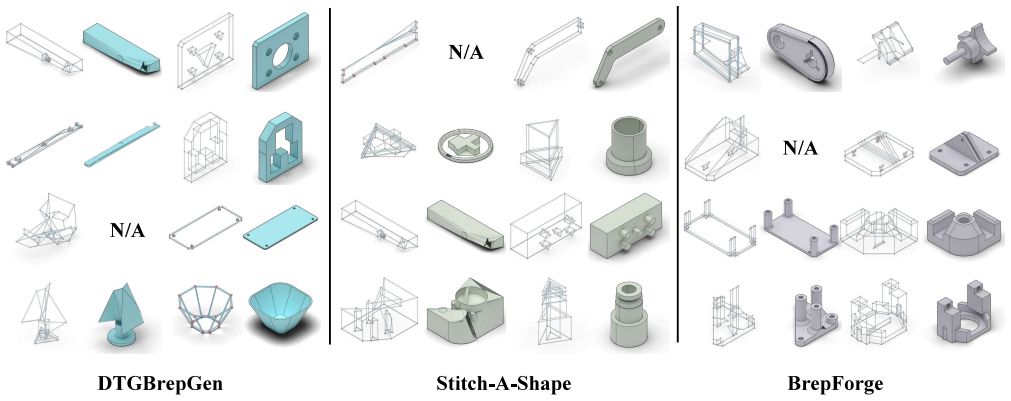
The central claim is that the intermediate wireframe, not the completed solid, is the right place to intervene for B-Rep validity. The proposed framework, WDR, uses a Geometric-Topology Anomaly Detector (GTAD) to combine a vision-language visual screen, a tangent-point-energy geometric risk score, and four topology-consistency checks, then uses an Energy-Guided Geometric-Topology Repair (EGGTR) module to rerun the risky part of generation with energy-tilted guidance. The paper reports that this raises kernel-checked validity across DTGBrepGen, Stitch-A-Shape, and BrepForge on DeepCAD and ABC, and that matched random-routing and Best-of-N controls show the improvement is not merely the effect of spending more test-time compute.
Load-bearing premise
The approach assumes every target generator lets you decode a partial wireframe from any prefix of its token sequence; if that is not true, the local repair step cannot run and only whole-output reranking remains.
Editorial extensions
If this is right
- Attaching WDR to an exposed wireframe stage raises kernel-checked Valid by 10.9 to 26.9 percentage points across DTGBrepGen, Stitch-A-Shape, and BrepForge on DeepCAD and ABC, while Novel and Unique remain close to baseline.
- On class-conditioned Furniture generation, WDR lifts the ten-class macro-average Valid from 64.36% to 73.63% for DTGBrepGen and from 58.59% to 68.04% for Stitch-A-Shape.
- On 3,000 matched point-cloud conditions, BrepForge with WDR improves Valid from 87.1% to 89.3% while also improving CD, EMD, and F-Score, so the validity gain does not come from ignoring the input condition.
- Combining VLM, geometric, and topological signals reaches an F1 of 81.97% for predicting downstream checker failure, above every single signal and every two-signal combination.
- Local energy-guided reranking with $K=4$ reaches 83.9% Valid on DTGBrepGen/ABC, 3.2 points above parallel Best-of-4 with lower peak memory, and matched random routing reaches only 80.2%, showing detector-informed routing rather than intervention volume drives the gain.
Reading between the lines
- A natural extension is to apply the same prefix-energy idea to command-sequence CAD generators, where a partial construction history can be scored before the model executes it; this would test whether wireframe exposure is truly required or merely convenient.
- The VLM branch is the largest latency contributor and performs worse alone than the combined detector, so a cheaper local vision model or a purely geometric-topological screen might retain most of the routing benefit; this is an inference from the paper's own ablation numbers, not a paper claim.
- If the gains persist under stricter distribution-alignment tests, wireframe-stage validity checking could become a standard inference-time component of multi-stage CAD generation, analogous to step-wise verification in modern sequence decoding.
- The paper optimizes an operational kernel-check criterion rather than manufacturability, so the method's ceiling is tied to what the OCCT checker can detect; extending the energies to functional or manufacturing constraints would be a separate research step it does not take.
Editorial analysis
A structured set of objections, weighed in public.
Referee Report
Summary. This paper proposes WDR, a training-free framework that improves the kernel-checked validity of B-Rep generation by detecting and repairing anomalous intermediate wireframes. GTAD combines a VLM-based coarse screening signal with a geometric detector (discrete tangent-point energy) and a topological detector (four incidence/loop/face/shell heuristics) to route samples to an EGGTR module, which performs energy-guided local candidate reranking for autoregressive stages and training-free diffusion guidance for geometry stages. Experiments on DTGBrepGen, Stitch-A-Shape, and BrepForge on DeepCAD and ABC, plus class-conditioned and point-cloud-conditioned settings, report consistent Valid gains of 10.9–26.9 percentage points with small changes in diversity metrics. Ablations with matched random routing, Best-of-N, and rejection-sampling controls are used to argue that the gains are not attributable to test-time compute alone.
Significance. If the validity and reproducibility concerns raised below are resolved, this is a useful contribution: a plug-and-play, training-free intervention at the intermediate wireframe stage that can be attached to existing multi-stage B-Rep generators without retraining. The paper has notable strengths: paired, seed-matched comparisons for all conditions; matched-random-routing and Best-of-N controls; bootstrap confidence intervals and McNemar tests for the main DTGBrepGen transitions; and a held-out detector test cohort that is explicitly disjoint from the detector development cohort. The paper is also commendably explicit that the geometric and topological energies are heuristics rather than validity certificates, and that the Valid metric is an operational kernel-level check rather than a guarantee of manufacturability.
major comments (2)
- [Supplementary, Implementation Details / Table 9] The headline 10.9–26.9 point Valid gains (Table 1) and the routing ablations (Tables 5 and 10 in the supplement) rest on a 3,000-sample ABC unconditional evaluation cohort, but the paper never states whether this cohort is disjoint from the 2,787-sample development cohort used to select the VLM backbone and the geometric threshold δ. Supplementary Table 9 only asserts disjointness between the 2,787-sample development cohort and the 2,787-sample held-out detector test cohort. If any of the 3,000 unconditional ABC samples coincide with the development cohort, the choice of Qwen3.5-Flash and δ=7.0 could bias the reported F1 and Valid gains. Please state explicitly whether the 3,000-sample ABC evaluation set used in Tables 1, 5, and 10 is disjoint from the development cohort; if it is not, rerun the affected evaluations on a disjoint set.
- [Experiments / Quantitative Evaluation and Supplementary 'Paired validity transitions'] Statistical support for the cross-generator claim is incomplete. Bootstrap CIs and McNemar p-values are reported only for DTGBrepGen transitions in the supplementary; the claims for Stitch-A-Shape and BrepForge on both datasets are supported only by point estimates in Table 1. Since the paper's central claim is that WDR improves Valid by 10.9–26.9 points 'across three generators and two datasets,' this breadth claim would be materially strengthened by paired transition counts and McNemar tests (or bootstrap CIs) for all six unconditional comparisons, or by an explicit statement that the authors limit the significance claim to DTGBrepGen.
minor comments (3)
- [Energy-Guided Geometric-Topology Repair, Eq. (12)] The guidance terms Δ_t and Δ_0 in Eq. (12) are undefined in the main text and require the reader to consult the supplementary's 'Complete TFG Procedure.' A one-sentence gloss or a pointer to the exact supplementary equation would improve readability.
- [Table 1 caption] The header of Table 1 is difficult to parse because a single metric label such as 'Valid' appears above three slash-separated numbers without visual alignment to the three metric columns. A multi-row header with clear column separation would help.
- [Supplementary, External VLM Data Governance] The VLM-based detector relies on an external API with temperature 1.0 and default provider routing, so the binary routing signals are not deterministically reproducible from the described protocol. Please state whether the reported routing results were obtained with a single API call per sample and how nondeterminism was handled (e.g., fixed seed or multiple runs).
Circularity Check
No significant circularity: WDR's validity gains are measured by an external kernel checker, the energies are explicitly heuristic, and the routing is benchmarked against matched random-routing and Best-of-N controls.
full rationale
The paper's central claim is an empirical improvement in kernel-checked validity (Tables 1, 5, 10) measured by an external OCCT/occwl checker. The WDR components are explicitly heuristic: tangent-point energy is called 'a heuristic self-intersection-related risk score, not a complete predicate' and the topology criteria are 'representation-calibrated risk heuristics rather than universal necessary conditions.' No equation defines the validity label in terms of the energies, and no energy is fitted to the checker output. The detector's F1 is reported on a disjoint held-out cohort (Supplementary Table 9), and the VLM backbone and threshold δ are frozen before that evaluation. The end-to-end gains are supported by matched random-routing (Table 5) and Best-of-N controls (Table 7), which separate the detector's routing benefit from test-time compute alone. The only mild concern is that the paper never explicitly states whether the 3,000-sample ABC end-to-end evaluation cohort is disjoint from the 2,787-sample development cohort used to select δ and the VLM backbone; this is a data-hygiene ambiguity rather than a construction-level circularity, as no quoted passage exhibits a prediction reducing to its own inputs. The method is a training-free intervention that combines existing techniques (TFG, energy-based reranking) without claiming a first-principles derivation, so the central claim retains independent empirical content.
Assumptions & free parameters
free parameters (4)
- Geometric detector threshold delta =
7.0
- Local reranking candidate count K =
4
- Guidance weights lambda_geom and lambda_topo =
1 (equal weights)
- Topology heuristic bounds (vertex degree [2,8], minimum loop size 3) =
[2,8], 3
assumptions (5)
- domain assumption Intermediate wireframes are exposed and prefix-decodable at every autoregressive step (W_t = D_t(x_{≤t})).
- ad hoc to paper Handcrafted energy scores and the VLM signal are useful proxies for downstream OCCT validity risk.
- domain assumption The OCCT/occwl kernel checker conditions define the validity criterion for evaluation.
- domain assumption The frozen pre-trained generators' candidate support is rich enough to contain valid continuations after guided resampling.
- standard math Standard diffusion and reranking results (Tweedie formula, DDIM, TFG guidance) are sound.
Cite this review
Pith. "Pith review of Towards Valid B-Rep Generation: Training-Free Wireframe Anomaly Detection and Repair." pith.science (2026). https://pith.science/paper/6GFXGTFF
@misc{pith2026260804955,
  author       = {Pith},
  title        = {Pith review of: Towards Valid B-Rep Generation: Training-Free Wireframe Anomaly Detection and Repair},
  year         = {2026},
  howpublished = {\url{https://pith.science/paper/6GFXGTFF}},
  note         = {Machine review of arXiv:2608.04955}
}
read the original abstract
Multi-stage boundary representation (B-Rep) generation leverages intermediate wireframes to synthesize CAD models. However, geometric and topological risks in these wireframes -- such as self-intersections, edge collapses, and disconnected vertices -- can propagate to invalid final B-Reps. Mitigating such failures by retraining large generative models is computationally prohibitive. We propose Wireframe Detection and Repair (WDR), a training-free framework that intervenes at the intermediate wireframe stage to improve downstream B-Rep validity. WDR features a Geometric-Topology Anomaly Detector (GTAD) that combines parallel VLM-based coarse screening with geometric and topological detectors to predict downstream invalidity risk and route generation to dedicated branches. An Energy-Guided Geometric-Topology Repair (EGGTR) module then performs detector-triggered guided regeneration through geometry and topology branches. By scaling test-time computation via Energy-Guided Resampling and training-free guidance for diffusion models, WDR can be integrated into autoregressive and diffusion pipelines without retraining. Extensive experiments demonstrate consistent improvements in kernel-checked validity while largely retaining the measured diversity and distributional quality of synthesized CAD models. The code will be made publicly available upon acceptance.
Figures


Figures from the paper (10 more)



Reviewed August 6, 2026 · model on record in the stance chip above.
Discussion (0). Sign in to comment.