REVIEW 3 major objections 5 minor 73 references
Coupled quintessence from an axion dark sector
T0 review · 3 major / 5 minor · reviewed 2026-08-06 · deepseek-v4-flash
Pith's one-line read Two interacting axions can mimic phantom dark energy without any phantom field.
desk verdict The two-axion to coupled-quintessence reduction drops a phi-dependent vacuum term that is ~20 orders of magnitude too large to ignore; the fit to DESI is for a different model. read the letter →
The pith
A machine-rendered reading of the paper's core claim, the machinery that carries it, and where it could break.
The reading
What carries the argument
The load-bearing identity is Eq. (18), $\rho_\chi/\rho_{\chi,0} = (m_\chi(\phi)/m_{\chi,0}) a^{-3}$, which converts the fast oscillating heavy axion into a dust-like fluid whose mass is modulated by the light axion. It follows from a WKB solution of the $\chi$ equation of motion, valid when $\epsilon \equiv \dot{m}_u/m_u^2 \ll 1$, and it is the input to the sourced continuity equation (19) that defines the coupled quintessence description. From that scaling, the paper derives the effective dark-energy equation of state (38), whose phantom crossing at low redshift is controlled by the sign of the coupling $Q(\phi)$; the sign flip is driven by the transition of the effective potential minimum from $\phi = \pi$ to $\phi = 0$. The heavy axion mass $m_\chi$ drops out of the fluid dynamics, leaving only the coupling strength $\beta$ and the ratio $m_\phi/H_0$ as the free dark-sector parameters.
What would settle it
Directly integrate the full two-axion background and perturbation equations at a physically relevant dark-matter mass, such as $m_\chi \sim 10^{-20}$ eV or above, and compare the time-averaged dark-matter density with Eq. (18); if the WKB envelope deviates from the dust-like scaling during the effective-potential transition or during early matter domination, the sourced continuity equation and the derived effective equation of state (38) do not describe the two-axion system.
Extended reading notes
Core claim
The central claim is that a two-axion dark sector with a light dark-energy axion and a heavy dark-matter axion can be recast exactly as coupled quintessence, provided the heavy axion stays on its WKB branch. The interaction endows the dark-matter mass with a phi dependence given by $m_\chi(\phi) = m_\chi \sqrt{1 + \beta \cos(\phi/f_\phi)}$, Eq. (11), so the dark-matter density follows $\rho_\chi/\rho_{\chi,0} = (m_\chi(\phi)/m_{\chi,0}) a^{-3}$, Eq. (18). Because the effective potential for $\phi$ shifts its minimum from $\phi = \pi$ at early times to $\phi = 0$ at late times, the field's derivative changes sign; the coupling $Q(\phi)$ consequently switches from negative to positive, injecting energy into the dark-matter component and producing a percent-level dip in $\rho_\chi$ relative to cold dark matter. When this is interpreted as a standard dark-energy component plus standard CDM, the resulting effective equation of state, Eq. (38), crosses below $w = -1$ at low redshift although the actual field equation of state stays above $-1$. This offers a string-motivated, non-phantom explanation of the DESI DR2 preference for an apparent phantom crossing.
Load-bearing premise
The WKB averaging that turns the rapidly oscillating heavy axion into a pressureless fluid is assumed to hold for the entire cosmic history at the physically required masses $m_\chi \gtrsim 10^{-20}$ eV, but it is only checked numerically at $m_\chi = 670\, m_\phi$, many orders of magnitude below the target hierarchy.
Editorial extensions
If this is right
- The model predicts that the apparent phantom crossing in the effective dark-energy equation of state appears without violating the null energy condition in the dark sector.
- The physical CDM density parameter is derived from Eq. (18) evaluated today, so the model connects the present dark-matter abundance to the present field value $\phi_0$ and the coupling $\beta$.
- Because $f_\phi$ is fixed by closure and is anti-correlated with $m_\phi$, the model permits a sub-Planckian decay constant $f_\phi \sim 0.5 M_P$ without fine-tuning the initial field value.
- The perturbation equations (24)-(25) follow from the same coupling function $\gamma(\phi)$, so the growth of structure and CMB lensing carry a distinct imprint of the sign change of $Q(\phi)$ around $z \sim 1$-$2$.
Reading between the lines
- The WKB approximation is validated numerically only at $m_\chi = 670\, m_\phi$, many orders of magnitude below the physical mass range, so the background and perturbation predictions for $m_\chi \gtrsim 10^{-20}\,\mathrm{eV}$ depend on an extrapolation that the paper does not directly test.
- The mechanism is not unique to axions: any dark sector with a heavy oscillating field whose mass is modulated by a light field should produce a similar mirage phantom crossing, so the effective description may generalize to other couplings.
- A direct numerical integration of the two-axion equations at the physical mass hierarchy would settle whether the WKB branch survives the effective-potential transition; the current check leaves that question open.
- The model predicts a percent-level suppression of the dark-matter density relative to CDM at low redshift, which could be distinguished from a genuine phantom component with tomographic growth-rate or high-precision BAO data.
Editorial analysis
A structured set of objections, weighed in public.
Referee Report
Summary. This paper proposes that a dark sector composed of two interacting axion-like fields — a light quintessence axion φ with m_φ ∼ H0 and a heavy dark-matter axion χ with m_χ ≳ 10⁻²⁰ eV — can be recast, after WKB-averaging the fast χ oscillations, as coupled quintessence with a φ-dependent dark-matter mass m_χ(φ) = m_χ sqrt(1 + β cos(φ/f_φ)) (Eq. 11). In this fluid description the dark-matter density scales as ρ_χ ∝ a⁻³ m_χ(φ) (Eq. 18), and the coupling function Q changes sign from negative to positive at low redshift, producing an 'apparent' phantom crossing in the effective dark-energy equation of state (Eq. 38) without an actual phantom component, in line with the DESI DR2 CPL preference. The authors implement the coupled-quintessence background and perturbation equations in CLASS and analyze CMB (Planck PR4 CamSpec + ACT DR6), DESI DR2 BAO, and three SNIa compilations, obtaining Δχ² between −8.6 and −13.7 relative to ΛCDM and Bayes factors ln B between −0.44 and +0.95 (Table II). Appendix A validates the WKB reduction numerically at the reduced mass ratio m_χ/m_φ = 6.7 × 10² and reports the scaling of the WKB parameter ε with m_χ.
Significance. If the reduction from the two-axion Lagrangian (Eq. 3) to the coupled-quintessence system were sound, this would be a valuable string-motivated embedding of the phantom-mirage mechanism, with the additional virtue of a genuine likelihood analysis: the paper uses three independent SNIa compilations, reports both maximum-likelihood improvements and full PolyChord evidences, and is transparently explicit that the w < −1 crossing is an apparent, reconstruction-level effect rather than a property of the fundamental dark-energy equation of state. The early-time result that the coupling is negative during the tracking phase (Eq. 29) is a clean and correct general statement for this class of models. These strengths, however, apply to the phenomenological coupled-quintessence system (Eqs. 19–27); the paper's distinctive claim, that this system is the adiabatic limit of the axion dark sector (Eq. 3) at the required mass hierarchy, is not supported by the equations as written (Major 1), and the statistical constraints in Table II therefore cannot be attributed to the axion model as it stands.
major comments (3)
- [Section II, Eqs. (3), (10), (16), (26)–(27)] The reduction to coupled quintessence drops the φ-dependent minimum energy of the χ potential. Expanding Eq. (3) about χ_min (Eq. 6) gives Veff,χ(χ̃) = VDS(φ,χ_min) + ½ m_χ²(φ) χ̃² (Eq. 10); to first order in β, VDS(φ,χ_min) = Λ_χ⁴ [1 − sqrt(1+β²+2β cos(φ/f_φ))] ≈ −βΛ_χ⁴ cos(φ/f_φ). This term is then discarded: Eq. (16) defines ρ_χ from the quadratic part only, and Eq. (27) takes Veff,φ = Λ_φ⁴(1−cos φ) + ρ_χ,0 a⁻³ sqrt(1+β cos φ). In the target regime (m_χ ≳ 10⁻²⁰ eV with O(1) misalignment), Λ_χ⁴ is fixed by the DM density through ρ_χ,0 = ½ Λ_χ⁴ θ_i² a_osc³, with a_osc ~ 10⁻⁹–10⁻⁷, so Λ_χ⁴/ρ_χ,0 ~ 10¹⁹–10²⁵. The force on φ from the omitted term, (βΛ_χ⁴/f_φ) sin(φ/f_φ), exceeds the retained modulation force, (βρ_χ,0 a⁻³/2f_φ) sin(φ/f_φ), by a factor 2Λ_χ⁴/(ρ_χ,0 a⁻³) ≳ 10²⁰ at a = 1. Hence Eq. (27) is not the effective potential of Eq. (3), and the statement that 'the first term in Eq. (10) is a constant' fails precisely when φ evolves (Fig. 3, a ≈ 10⁻²–1). A correct treatment with U(φ) = V_φ + VDS(φ,χ_min) would pin φ near 0 on a short timescale for β > 0, eliminating the late-time mass modulation and the phantom mirage. Appendix A does not test the reduction, because Eqs. (A1)–(A4) are derived from the truncated quadratic theory and contain no VDS(φ,χ_min) term. The constraints of Table II therefore apply to a different model.
- [Section II.B, Eq. (21)] The printed expression for γ(φ) has the wrong dimension. From the definition γ ≡ d ln m_χ(φ)/dφ (Eq. 20) with m_χ(φ) = m_χ sqrt(1+β cos(φ/f_φ)), the correct result is γ = −β sin(φ/f_φ) / (2 f_φ [1 + β cos(φ/f_φ)]), with units 1/f_φ, whereas Eq. (21) contains an extra factor 1/f_φ. The expression for Q(φ) printed on the same line is consistent with the 1/f_φ form, so Eqs. (20) and (21) are mutually inconsistent. Since γ enters the early-time attractor (Eqs. 28–29) and the perturbation equations (24)–(25), whose k²γδφ term scales with γ, the manuscript must state which expression was implemented in the CLASS code; as printed, the perturbation equations do not follow from the stated γ.
- [Appendix A, Figs. 7–8] The numerical validation of the WKB/fluid approximation is performed at m_χ = 6.7 × 10² m_φ, for which the heavy field begins oscillating only around a ≈ 10⁻² (z_i ≈ 100), i.e., after matter–radiation equality; the appendix itself acknowledges the resulting baryon-dominated intermediate epoch, which does not occur for the target masses. The scaling ε ∝ H/m_χ shown in Fig. 8 is a plausible basis for extrapolation to m_χ ≳ 10⁻²⁰ eV, but the validation shown does not cover the early radiation- and matter-dominated epochs for the target hierarchy, and it is precisely there that the adiabatic variable m_χ(φ) changes most rapidly via the attractor (Eq. 28). The paper should either validate numerically at a mass large enough for oscillations to begin before a_eq, or provide an analytic bound on ε over the full integration range. As noted in Major 1, this check also validates only the truncated quadratic model, not the full potential (3).
minor comments (5)
- [Section III, Eq. (38)] The formula as printed is garbled ('weff (a) = wϕ(a)h mχ(ϕ) mχ,0 − 1 i ρχ,0a−3 ρϕ + 1'); please reset the typesetting. The surrounding text, which states that weff < −1 follows from m_χ(φ) < m_χ,0, implies the intended form is weff = w_φ / [1 + (m_χ(φ)/m_χ,0 − 1) ρ_χ,0 a⁻³/ρ_φ].
- [Figure 3] The caption quotes φ_i = 1.64 f_φ and the plotted range is φ ∈ [1.4, 2.1], which is inconsistent with the text's statement that the early-time minimum lies at φ_crit = π and with the prior δ_i ≡ φ_i − φ_crit ∈ [0.01, 1.57] of Table I; please clarify the axis convention and how δ_i is realized in the figures.
- [Throughout] Typos and wording: 'their may instead be evidence' (Sec. I), 'it's energy density' (Sec. I), 'repsectively' (Eq. 3), 'FLR W metric' should be 'FLRW' (Sec. IV A), and 'as an WKB' and '0 < φ/f_φ < πregion' (Sec. II).
- [Abstract] The claim of a 'sub-Planckian decay constant' is supported only by the maximum-likelihood point for two of the three datasets; the 68% intervals for log(f_φ/M_P) in Table II also include positive (super-Planckian) values. Please quantify or qualify the claim (the body text already uses the more appropriate qualifier 'marginal').
- [Section III, around Eq. (29)] The statement that the initial coupling satisfies Q < 0 'always' should be qualified as holding when φ′ follows the attractor (28); the later sign flip is a dynamical outcome rather than an immediate consequence of the sign of γ.
Circularity Check
No significant circularity: the phantom-crossing EoS is explicitly an 'apparent' bookkeeping device and the model is tested against external data.
full rationale
The derivation chain from the two-axion potential to coupled quintessence is carried out in the paper: the WKB averaging of the heavy axion (Eqs. 13-18) produces the dust-like fluid with a phi-dependent mass, and this is then coupled to the light axion through the sourced continuity equations. The effective DE equation of state, Eq. (38), is introduced as an explicit redefinition of the dark-sector split, equating rho_phi+rho_chi to rho_eff+rho_CDM with rho_CDM=rho_chi,0 a^-3. The paper transparently calls the resulting crossing 'apparent', and the crossing condition w_eff<-1 is not an input but follows from the model dynamics m_chi(phi)<m_chi,0 for beta>0. The statistical analysis uses external CMB, BAO, and SN datasets and compares to LambdaCDM with chi^2 and Bayes factors, so the central quantitative claims are not fitted-input predictions. The only self-citation, Ref. [22] (including author Copeland), is used to identify the standard coupled-quintessence form of Eq. (18), but Eq. (18) is independently derived in the text, so the citation is not load-bearing. The WKB validation in Appendix A is admittedly performed at a smaller mass hierarchy (m_chi=6.7e2 m_phi) and extrapolated to the physical hierarchy; this is an acknowledged limitation and a potential robustness concern, but it is not a circular reduction of a claimed result to its inputs. No step was found where a result is equivalent by construction or by self-citation to the premise being tested.
Assumptions & free parameters
free parameters (4)
- beta (axion-axion coupling strength) =
0.077 (+0.047/-0.042), best-fit 0.108 (CMB+DESI DR2+Pantheon+)
- log(m_phi/H0) (DE axion mass) =
-0.346 (+0.681/-0.342), best-fit 0.058 (Pantheon+ combination)
- delta_i (initial field displacement from effective minimum) =
0.839 (+0.519/-0.359), best-fit 1.383 (Pantheon+ combination)
- f_phi (DE axion decay constant, derived) =
derived: log10(f/Mp) 0.41 (+0.35/-0.67); best-fit 0.06 (Pantheon+), -0.14 (Union3), -0.27 (Dovekie)
assumptions (6)
- standard math WKB solution u(t) = C/sqrt(m_u) exp(+/- i integral m_u dt) with epsilon << 1 approximates the DM axion dynamics.
- domain assumption Mass hierarchy m_chi >> m_phi ~ H0, with m_chi >= 10^-20 eV.
- ad hoc to paper Small-coupling expansion beta <= 0.1 and A(phi, chi_min) ~ 1, giving m_chi^2(phi) = m_chi^2 [1 + beta cos(phi/f_phi)].
- ad hoc to paper Interaction potential V_int = -Lambda_phi,chi^4 cos(phi/f_phi - chi/f_chi) is the correct low-energy description of the axion-axion coupling.
- domain assumption Initial DE axion field sits near the early minimum of the effective potential, phi_crit ~ pi, with displacement delta_i in [0, pi/2].
- domain assumption Perturbation equations (24)-(25) for the coupled fluid, taken from [48,49], remain valid for this axion model.
Cite this review
Pith. "Pith review of Coupled quintessence from an axion dark sector." pith.science (2026). https://pith.science/paper/TLXCJDI4
@misc{pith2026260805032,
  author       = {Pith},
  title        = {Pith review of: Coupled quintessence from an axion dark sector},
  year         = {2026},
  howpublished = {\url{https://pith.science/paper/TLXCJDI4}},
  note         = {Machine review of arXiv:2608.05032}
}
abstract
Recent observational data arising from the DESI collaboration has hinted at a possible departure from the standard $\Lambda$CDM cosmological model, preferring instead the presence of a dynamical dark energy component. Specifically, the associated equation of state of the dark energy features a crossing into the so-called phantom regime, which is challenging to accommodate in canonical single scalar-field scenarios. However, this behavior can be effectively described by an interacting dark sector, where the specific dark energy equation of state remains above the phantom divide whilst the dark matter component deviates from the standard cold dark matter evolution. In this work, we explore this possibility in the context of an axion dark sector, where both the dark energy and dark matter are represented by two interacting axion-like fields. We show that given the required mass hierarchy for these fields to play such roles, their dynamics can be effectively placed in the coupled quintessence framework, where their motion follows from a sourced continuity equation in the fluid description. In this regime, we perform a statistical analysis of this scenario with current data, finding that a sub-Planckian dark energy axion decay constant stays well within the observational bounds without the need to fine-tune the associated field's initial conditions. We also perform a comparison with $\Lambda$CDM, where we find that the model provides a better fit to the data while staying competitive from a Bayesian perspective.
Figures


Figures from the paper (5 more)




Reference graph
Works this paper leans on
-
[1]
M. Abdul Karim et al. (DESI), DESI DR2 results. II. Measurements of baryon acoustic oscillations and cos- mological constraints, Phys. Rev. D 112, 083515 (2025), arXiv:2503.14738 [astro-ph.CO]
arXiv 2025
-
[2]
M. Chevallier and D. Polarski, Accelerating universes with scaling dark matter, Int. J. Mod. Phys. D 10, 213 (2001), arXiv:gr-qc/0009008
arXiv 2001
-
[3]
E. V. Linder, Exploring the expansion history of the uni- verse, Phys. Rev. Lett. 90, 091301 (2003), arXiv:astro- ph/0208512
arXiv 2003
-
[4]
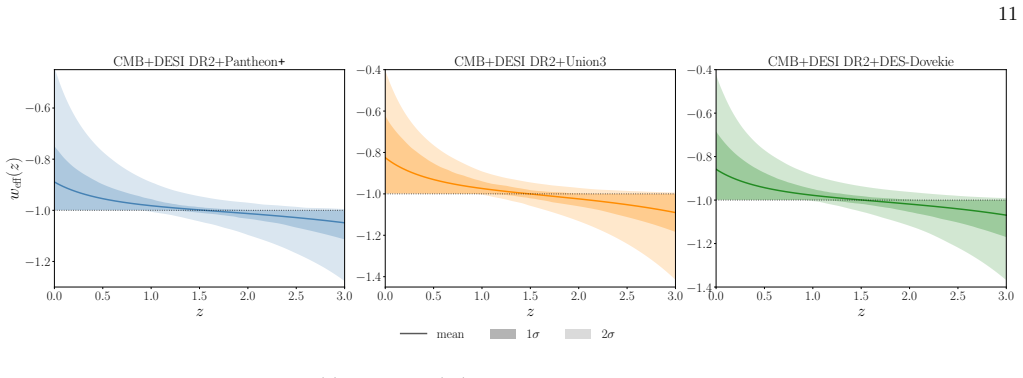
While the fiducial DE EoS stays bounded above −1, the effective EoS crosses to the weff < −1 region at low redshifts, in a similar fashion to the CPL best-fit curve given in pink. Inspection of Eq. (38) shows that this is achieved for wϕ(a) ∼ −1 whenever mχ(ϕ) < mχ,0, in agreement with Fig. 1 for β >0. Therefore, it is clear that the coupled quintessence ...
-
[5]
W. J. Wolf, C. Garc ´ ıa-Garc ´ ıa, T. Anton, and P. G. Ferreira, Assessing Cosmological Evidence for Nonmin- imal Coupling, Phys. Rev. Lett. 135, 081001 (2025), arXiv:2504.07679 [astro-ph.CO]
arXiv 2025
-
[6]
S. S. Mishra, Effective phantom dark energy: What cos- mological reconstruction does and does not imply, Phys. Dark Univ. 53, 102399 (2026), arXiv:2605.27301 [astro- ph.CO]
arXiv 2026
-
[7]
R. R. Caldwell and E. V. Linder, Null impact of the null energy condition in current cosmology, JCAP 05, 008, arXiv:2511.07526 [astro-ph.CO]
-
[8]
S. Das, P. S. Corasaniti, and J. Khoury, Super- acceleration as signature of dark sector interaction, Phys. Rev. D 73, 083509 (2006), arXiv:astro-ph/0510628
arXiv 2006
Show all 73 references
-
[9]
M. Kopp, C. Skordis, D. B. Thomas, and S. Ili´ c, Dark Matter Equation of State through Cosmic History, Phys. Rev. Lett. 120, 221102 (2018), arXiv:1802.09541 [astro- ph.CO]
2018 arXiv
-
[10]
R. Liu, Y. Zhu, W. Hu, and V. Miranda, Phantom mi- rage from axion dark energy, Phys. Rev. D 113, 083506 (2026), arXiv:2510.14957 [astro-ph.CO]
2026
-
[11]
M. A. Buen-Abad, R. Essig, D. McKeen, and Y.-M. Zhong, Cosmological constraints on dark matter inter- actions with ordinary matter, Phys. Rept. 961, 1 (2022), arXiv:2107.12377 [astro-ph.CO]
2022 arXiv
-
[12]
Ili´ c, M
S. Ili´ c, M. Kopp, C. Skordis, and D. B. Thomas, Dark matter properties through cosmic history, Phys. Rev. D 104, 043520 (2021), arXiv:2004.09572 [astro-ph.CO]
2021 arXiv
-
[13]
K. K. Boddy, V. Gluscevic, V. Poulin, E. D. Kovetz, M. Kamionkowski, and R. Barkana, Critical assessment of CMB limits on dark matter-baryon scattering: New treatment of the relative bulk velocity, Phys. Rev. D 98, 123506 (2018), arXiv:1808.00001 [astro-ph.CO]
2018 arXiv
-
[14]
Gluscevic and K
V. Gluscevic and K. K. Boddy, Constraints on Scat- tering of keV–TeV Dark Matter with Protons in the Early Universe, Phys. Rev. Lett. 121, 081301 (2018), arXiv:1712.07133 [astro-ph.CO]
2018 arXiv
-
[15]
R. Shah, P. Mukherjee, and S. Pal, Interacting dark sec- tors in light of DESI DR2, Mon. Not. Roy. Astron. Soc. 542, 2936 (2025), arXiv:2503.21652 [astro-ph.CO]
2025 arXiv
-
[16]
T.-N. Li, W. Giar` e, G.-H. Du, Y.-H. Li, E. Di Valentino, J.-F. Zhang, and X. Zhang, Strong Evidence for Dark Sector Interactions, (2026), arXiv:2601.07361 [astro- ph.CO]
2026 arXiv
-
[17]
Chakraborty, P
A. Chakraborty, P. K. Chanda, S. Das, and K. Dutta, DESI results: Hint towards coupled dark matter and dark energy, JCAP 11, 047, arXiv:2503.10806 [astro- ph.CO]
-
[18]
Silva, M
E. Silva, M. A. Sabogal, M. Scherer, R. C. Nunes, E. Di Valentino, and S. Kumar, New constraints on inter- acting dark energy from DESI DR2 BAO observations, Phys. Rev. D 111, 123511 (2025), arXiv:2503.23225 [astro-ph.CO]
2025 arXiv
-
[19]
Petri, V
V. Petri, V. Marra, and R. von Marttens, Dark de- generacy in DESI DR2 data: Interacting or evolving dark energy?, Phys. Rev. D 10.1103/3k93-p1n8 (2026), arXiv:2508.17955 [astro-ph.CO]
2026
-
[20]
C. You, D. Wang, and T. Yang, Dynamical dark energy implies a coupled dark sector: Insights from DESI DR2 via a data-driven approach, Phys. Rev. D 112, 043503 (2025), arXiv:2504.00985 [astro-ph.CO]
2025 arXiv
-
[21]
Amendola, Coupled quintessence, Phys
L. Amendola, Coupled quintessence, Phys. Rev. D 62, 043511 (2000), arXiv:astro-ph/9908023
2000 arXiv
-
[22]
Sevillano Mu˜ noz and M
S. Sevillano Mu˜ noz and M. Trodden, Unified dark sector approaches to cosmological tensions, (2026), arXiv:2607.27515 [astro-ph.CO]
2026 arXiv
-
[23]
D’Amico, T
G. D’Amico, T. Hamill, and N. Kaloper, Quantum field theory of interacting dark matter and dark energy: Dark monodromies, Phys. Rev. D 94, 103526 (2016), arXiv:1605.00996 [hep-th]
2016 arXiv
-
[24]
Pourtsidou, C
A. Pourtsidou, C. Skordis, and E. J. Copeland, Models of dark matter coupled to dark energy, Phys. Rev. D 88, 083505 (2013), arXiv:1307.0458 [astro-ph.CO]
2013 arXiv
-
[25]
J. E. Kim, H. P. Nilles, and M. Peloso, Completing nat- ural inflation, JCAP 01, 005, arXiv:hep-ph/0409138
-
[26]
M. C. David Marsh, The Swampland, Quintessence and the Vacuum Energy, Phys. Lett. B 789, 639 (2019), arXiv:1809.00726 [hep-th]. 15
2019 arXiv
-
[27]
Kaloper, A
N. Kaloper, A. Lawrence, and L. Sorbo, An Igno- ble Approach to Large Field Inflation, JCAP 03, 023, arXiv:1101.0026 [hep-th]
-
[28]
Silverstein and A
E. Silverstein and A. Westphal, Monodromy in the CMB: Gravity Waves and String Inflation, Phys. Rev. D 78, 106003 (2008), arXiv:0803.3085 [hep-th]
2008 arXiv
-
[29]
J. A. Frieman, C. T. Hill, A. Stebbins, and I. Waga, Cosmology with ultralight pseudo-nambu- goldstone bosons, Phys. Rev. Lett. 75, 2077 (1995), arXiv:astro-ph/9505060
1995 arXiv
-
[30]
Freese, J
K. Freese, J. A. Frieman, and A. V. Olinto, Natural in- flation with pseudo-nambu-goldstone bosons, Phys. Rev. Lett. 65, 3233 (1990)
1990
-
[31]
J. E. Kim and H. P. Nilles, A quintessential axion, Phys. Lett. B 553, 1 (2003), arXiv:hep-ph/0210402
2003 arXiv
-
[32]
J. E. Kim, Axion and almost massless quark as in- gredients of quintessence, JHEP 05, 022, arXiv:hep- ph/9811509
-
[33]
Banks, M
T. Banks, M. Dine, P. J. Fox, and E. Gorbatov, On the possibility of large axion decay constants, JCAP 06, 001, arXiv:hep-th/0303252
-
[34]
W. Lin, L. Visinelli, and T. T. Yanagida, Testing quintessence axion dark energy with recent cosmological results, JCAP 10, 023, arXiv:2504.17638 [astro-ph.CO]
-
[35]
D. J. E. Marsh, E. Macaulay, M. Trebitsch, and P. G. Ferreira, Ultra-light axions: Degeneracies with massive neutrinos and forecasts for future cosmological observa- tions, Phys. Rev. D 85, 103514 (2012), arXiv:1110.0502
2012 arXiv
-
[36]
Arkani-Hamed, L
N. Arkani-Hamed, L. Motl, A. Nicolis, and C. Vafa, The String landscape, black holes and gravity as the weakest force, JHEP 06, 060, arXiv:hep-th/0601001
-
[37]
L. A. Ure˜ na L´ opez and A. X. Gonzalez-Morales, To- wards accurate cosmological predictions for rapidly os- cillating scalar fields as dark matter, JCAP 07, 048, arXiv:1511.08195
-
[38]
Hlozek, D
R. Hlozek, D. Grin, D. J. E. Marsh, and P. G. Ferreira, A search for ultralight axions using precision cosmological data, Phys. Rev. D 91, 103512 (2015), arXiv:1410.2896
2015 arXiv
-
[39]
Passaglia and W
S. Passaglia and W. Hu, Accurate effective fluid approx- imation for ultralight axions, Phys. Rev. D 105, 123529 (2022), arXiv:2201.10238 [astro-ph.CO]
2022 arXiv
-
[40]
Gaughan, A
L. Gaughan, A. M. Green, and A. Moss, Ultra-light axion constraints from Planck and ACT: the role of nonlinear modelling, (2026), arXiv:2605.12054 [astro-ph.CO]
2026 arXiv
-
[41]
Khoury, M.-X
J. Khoury, M.-X. Lin, and M. Trodden, Cosmological Evidence for Dark Axion-Dark Baryon Interactions from Apparent Phantom Crossing, (2026), arXiv:2607.16191 [astro-ph.CO]
2026 arXiv
-
[42]
Khoury, M.-X
J. Khoury, M.-X. Lin, and M. Trodden, Apparent w <- 1 and a Lower S8 from Dark Axion and Dark Baryons Interactions, Phys. Rev. Lett. 135, 181001 (2025), arXiv:2503.16415 [astro-ph.CO]
2025
-
[43]
R. D. Peccei and H. R. Quinn, CP conservation in the presence of instantons, Phys. Rev. Lett. 38, 1440 (1977)
1977
-
[44]
Delaunay, S
C. Delaunay, S. J. Lee, Y. Yin, and B. Yu, Natural Phan- tom Crossing from Axion-WIMP Interactions, (2026), arXiv:2607.28721 [hep-ph]
2026 arXiv
-
[45]
Wilczek, Problem of strong P and T invariance in the presence of instantons, Phys
F. Wilczek, Problem of strong P and T invariance in the presence of instantons, Phys. Rev. Lett. 40, 279 (1978)
1978
-
[46]
Weinberg, A new light boson?, Phys
S. Weinberg, A new light boson?, Phys. Rev. Lett. 40, 223 (1978)
1978
-
[47]
Merzbacher, Quantum Mechanics , 3rd ed
E. Merzbacher, Quantum Mechanics , 3rd ed. (Wiley- VCH, 1997) p. 672
1997
-
[48]
Rogers and H
K. Rogers and H. Peiris, Strong bound on canonical ul- tralight axion dark matter from the lyman-alpha forest, Physical Review Letters 126 (2021)
2021
-
[49]
Xia, Constraint on coupled dark energy models from observations, Physical Review D 80, 10.1103/phys- revd.80.103514 (2009)
J.-Q. Xia, Constraint on coupled dark energy models from observations, Physical Review D 80, 10.1103/phys- revd.80.103514 (2009)
2009 doi
-
[50]
A. W. Brookfield, C. van de Bruck, and L. M. H. Hall, New interactions in the dark sector mediated by dark energy, Phys. Rev. D 77, 043006 (2008), arXiv:0709.2297 [astro-ph]
2008 arXiv
-
[51]
Lesgourgues, The cosmic linear anisotropy solving sys- tem (class) i: Overview (2011), arXiv:1104.2932 [astro- ph.IM]
J. Lesgourgues, The cosmic linear anisotropy solving sys- tem (class) i: Overview (2011), arXiv:1104.2932 [astro- ph.IM]
2011 arXiv
-
[52]
Archidiacono, E
M. Archidiacono, E. Castorina, D. Redigolo, and E. Salvioni, Unveiling dark fifth forces with linear cos- mology, JCAP 10, 074, arXiv:2204.08484 [astro-ph.CO]
-
[53]
Torrado and A
J. Torrado and A. Lewis, Cobaya: Code for Bayesian Analysis of hierarchical physical models, JCAP 05, 057, arXiv:2005.05290 [astro-ph.IM]
2005 arXiv
-
[54]
D. Blas, J. Lesgourgues, and T. Tram, The cosmic linear anisotropy solving system (class). part ii: Approximation schemes, Journal of Cosmology and Astroparticle Physics 2011 (07), 034–034
2011
-
[55]
W. J. Handley, M. P. Hobson, and A. N. Lasenby, poly- chord: next-generation nested sampling, Monthly No- tices of the Royal Astronomical Society 453, 4385–4399 (2015)
2015
-
[56]
W. J. Handley, M. P. Hobson, and A. N. Lasenby, Poly- Chord: nested sampling for cosmology, Mon. Not. Roy. Astron. Soc. 450, L61 (2015), arXiv:1502.01856 [astro- ph.CO]
2015 arXiv
-
[57]
Cartis, J
C. Cartis, J. Fiala, B. Marteau, and L. Roberts, Im- proving the flexibility and robustness of model-based derivative-free optimization solvers, ACM Trans. Math. Softw. 45, 10.1145/3338517 (2019)
2019 doi
-
[58]
For low multipoles (ℓ <30), we use the Commander and SimAll likelihoods for the TT and EE spec- tra, respectively
as well as the Data Release 6 of the ground- based ACT telescope [59]. For low multipoles (ℓ <30), we use the Commander and SimAll likelihoods for the TT and EE spec- tra, respectively. At high multipoles ( ℓ ≥ 30), we employ the CamSpec likelihood derived from the Planck PR4 ...
2023
-
[59]
Lewis, GetDist: a Python package for analysing Monte Carlo samples, JCAP 08, 025, arXiv:1910.13970 [astro- ph.IM]
A. Lewis, GetDist: a Python package for analysing Monte Carlo samples, JCAP 08, 025, arXiv:1910.13970 [astro- ph.IM]
1910 arXiv
-
[60]
Aghanim et al
N. Aghanim et al. (Planck), Planck 2018 results. V. CMB power spectra and likelihoods, Astron. Astrophys. 641, A5 (2020), arXiv:1907.12875 [astro-ph.CO]
2020 arXiv
-
[61]
F. J. Qu et al. (ACT), The Atacama Cosmology Tele- scope: A Measurement of the DR6 CMB Lensing Power Spectrum and Its Implications for Structure Growth, Astrophys. J. 962, 112 (2024), arXiv:2309.07766 [astro- ph.CO]
2024 arXiv
-
[62]
Rosenberg, S
E. Rosenberg, S. Gratton, and G. Efstathiou, CMB power spectra and cosmological parameters from Planck PR4 with CamSpec, Mon. Not. Roy. Astron. Soc. 517, 4620 (2022), arXiv:2205.10869 [astro-ph.CO]
2022 arXiv
-
[63]
Carron, M
J. Carron, M. Mirmelstein, and A. Lewis, CMB lensing from Planck PR4 maps, JCAP 09, 039, arXiv:2206.07773 [astro-ph.CO]
-
[64]
M. S. Madhavacheril et al. (ACT), The Atacama Cos- mology Telescope: DR6 Gravitational Lensing Map and Cosmological Parameters, Astrophys. J. 962, 113 (2024), arXiv:2309.07773 [astro-ph.CO]
2024 arXiv
-
[65]
Scolnic et al
D. Scolnic et al. , The Pantheon+ Analysis: The Full Data Set and Light-curve Release, Astrophys. J. 938, 113 (2022), arXiv:2112.03863 [astro-ph.CO]
2022 arXiv
-
[66]
Rubin, G
D. Rubin, G. Aldering, M. Betoule, A. Fruchter, X. Huang, A. G. Kim, C. Lidman, E. Linder, S. Perlmut- ter, P. Ruiz-Lapuente, and N. Suzuki, Union Through 16 UNITY: Cosmology with 2,000 SNe Using a Unified Bayesian Framework, Astrophys. J. 986, 231 (2025), arXiv:2311.12098 [as...
2025 arXiv
-
[67]
Popovic, P
B. Popovic, P. Shah, W. D. Kenworthy, R. Kessler, T. M. Davis, A. Goobar, D. Scolnic, M. Vincenzi, P. Wiseman, et al. , The Dark Energy Survey Supernova Program: A Reanalysis of Cosmology Results and Evidence for Evolv- ing Dark Energy with an Updated Type Ia Supernova Calibra...
2025 arXiv
-
[68]
Popovic, W
B. Popovic, W. D. Kenworthy, et al. , A Reassessment of the Pantheon+ and DES 5YR Calibration Uncer- tainties: Dovekie, (2025), submitted, arXiv:2506.05471 [astro-ph.CO]
2025 arXiv
-
[69]
T. M. C. Abbott et al. (DES), The Dark Energy Sur- vey: Cosmology Results with ∼1500 New High-redshift Type Ia Supernovae Using the Full 5-year Dataset, Astro- phys. J. Lett. 973, L14 (2024), arXiv:2401.02929 [astro- ph.CO]
2024 arXiv
-
[70]
Trotta, Bayesian Methods in Cosmology (2017) arXiv:1701.01467 [astro-ph.CO]
R. Trotta, Bayesian Methods in Cosmology (2017) arXiv:1701.01467 [astro-ph.CO]
2017 arXiv
-
[71]
Trotta, Bayes in the sky: Bayesian inference and model selection in cosmology, Contemp
R. Trotta, Bayes in the sky: Bayesian inference and model selection in cosmology, Contemp. Phys. 49, 71 (2008), arXiv:0803.4089 [astro-ph]
2008 arXiv
-
[72]
Handley, anesthetic: nested sampling visualisation, The Journal of Open Source Software 4, 1414 (2019)
W. Handley, anesthetic: nested sampling visualisation, The Journal of Open Source Software 4, 1414 (2019)
2019
-
[73]
Jeffreys, Theory of Probability , 3rd ed., Oxford Clas- sics (Oxford University Press, Oxford, UK, 1998) reprint of the 1961 edition
H. Jeffreys, Theory of Probability , 3rd ed., Oxford Clas- sics (Oxford University Press, Oxford, UK, 1998) reprint of the 1961 edition
1998
Reviewed August 6, 2026 · model on record in the stance chip above.
Discussion (0). Sign in to comment.