REVIEW 4 major objections 6 minor 54 references
Comparative analysis of fiber Bragg grating filter losses inscribed by continuous wave UV and femtosecond-IR lasers for astrophotonics
T0 review · 4 major / 6 minor · reviewed 2026-08-08 · deepseek-v4-flash
Pith's one-line read This paper claims that UV- and fs-IR-written fiber Bragg grating OH filters split losses: UV high-NA fiber wins on cladding-mode loss (~0.5 dB) but loses on insertion loss (4.6 dB), while fs-IR SMF-28 wins on insertion loss (<0.05 dB)…
desk verdict The measured loss trade-off between UV- and fs-IR-inscribed FBG filters is the real contribution; the system-level IL<1 dB claim is an unverified estimate that needs softening. read the letter →
The pith
A machine-rendered reading of the paper's core claim, the machinery that carries it, and where it could break.
The reading
What carries the argument
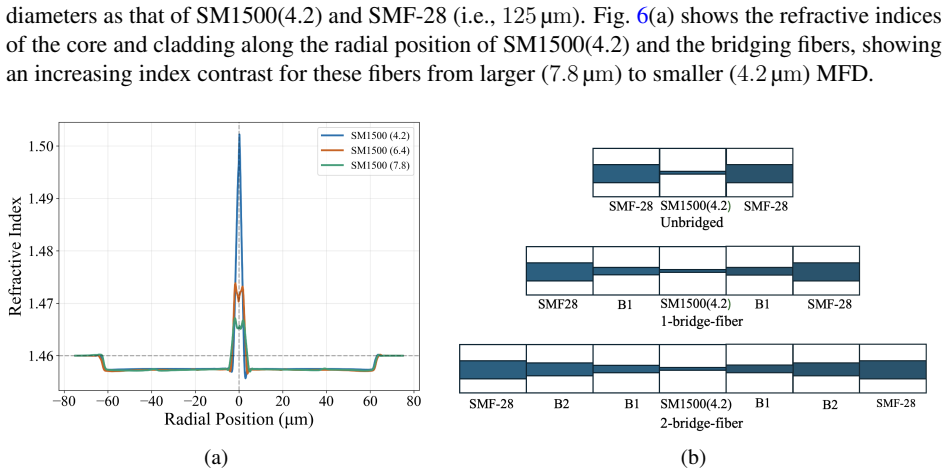
The argument is carried by a loss decomposition into two mechanisms. Cladding-mode loss arises when the index perturbation written into the fiber core couples the guided core mode to counter-propagating cladding modes, producing short-wavelength dips; high-NA fibers confine the mode and reduce this coupling. Insertion loss is dominated by splice loss from mode-field-diameter mismatch, modeled by the Marcuse power-transmission coefficient $T=(2w_1w_2/(w_1^2+w_2^2))^2\exp[-2(\pi n_2 w_1 w_2 \theta)^2/((w_1^2+w_2^2)\lambda^2)]$, plus fiber attenuation from heavy dopants. The enabling fabrication tools are a CW 244 nm UV laser writing multi-channel gratings through a complex phase mask with overlapping channels, and an 800 nm femtosecond-IR laser writing through a phase mask with integrated shaping apertures that control the spectral profile. The mitigation machinery is bridging: intermediate fibers with intermediate mode-field diameters step the mode field from 4.2 µm to 10.4 µm, converting a 4.76 dB direct splice loss into 1.75 dB, and a reduced-clad SM1500(4.2/80) fiber directly interfaces the filter to an AWG chip with an estimated ~0.44 dB splice loss.
What would settle it
A concrete check would be to inscribe the full ~105-line H-band filter set, or a dense block of at least 20–30 lines, in SM1500(4.2) and SMF-28 and measure accumulated insertion loss and cladding-mode loss; if per-line losses compound, the sub-1 dB viability conclusion would fail. A second check is to measure the splice loss of the proposed reduced-clad bridging configuration in-house, since the 0.44 dB figure comes from a manufacturer's technical bulletin rather than the authors' own measurements.
Extended reading notes
Core claim
The central discovery, on the paper's own terms, is a quantitative loss trade-off between inscription platforms rather than a single winner. For five notch filters in the 1546–1552 nm range, UV-inscribed FBGs in SM1500(4.2)—a high-NA, bend-insensitive photosensitive fiber—reach a cladding-mode loss of about 0.5 dB at 1547.43 nm, the lowest among photosensitive fibers and lower than the fs-IR aperture-shaped filters in SMF-28 (0.93 dB at 1544.07 nm), but they pay for this with an insertion loss of 4.6 dB at 1550 nm, dominated by mode-field mismatch at splices to standard fiber. fs-IR-inscribed gratings in non-photosensitive SMF-28 have insertion loss below 0.05 dB, because no mode-field mismatch is involved, and a cladding-mode loss of 0.93 dB. The paper reports that a two-bridging-fiber connection reduces the high-NA insertion loss by ~3 dB (4.76 dB to 1.75 dB), and that once the filters are integrated with a photonic lantern upstream and an arrayed-waveguide-grating chip downstream, both platforms achieve insertion loss below 1 dB; a proposed reduced-clad bridge could push this below 0.5 dB while halving the number of splice junctions.
Load-bearing premise
The load-bearing premise is that the performance of five closely spaced test lines, written in short fiber lengths, predicts the loss budget of the full ~105-line H-band OH-suppression filter set with realistic fiber lengths and many notches.
Editorial extensions
If this is right
- Astrophotonic instrument designers get a quantitative decision rule: choose UV-inscribed SM1500(4.2) when cladding-mode purity is the priority, and accept bridging to manage insertion loss.
- fs-IR inscription in SMF-28 is the lower-insertion-loss route, but the 0.93 dB cladding-mode loss here is higher than the 0.2 dB reported for standard fs-IR phase-mask writing, with shaping apertures identified as the cause.
- Two-stage bridging cuts the SM1500(4.2)-to-SMF-28 splice loss from about 4.8 dB to about 1.8 dB, and one-sided bridging in a photonic-lantern chain brings total insertion loss below 1 dB for the UV platform.
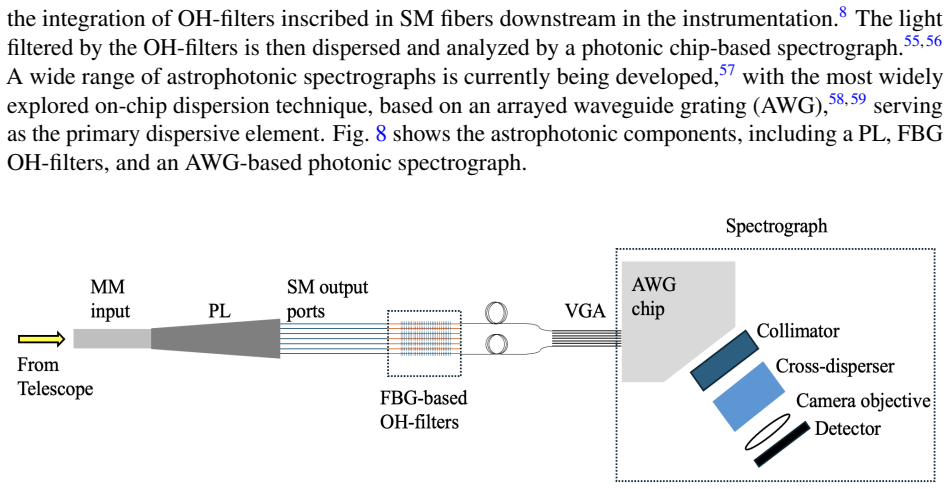
- Using a reduced-clad bridge fiber can bring both platforms below 0.5 dB insertion loss and halve the splice-junction count from 4 to 2 per channel, a meaningful saving for a 19-port photonic lantern (76 to 38 junctions).
- When filters sit between a photonic lantern and an AWG spectrograph, the insertion-loss difference between UV and fs-IR platforms shrinks below the level that decides platform choice, leaving cladding-mode loss as the remaining discriminator.
Reading between the lines
- If the loss-per-line result extends, the full 105-line filter set will likely need a longer fiber and more complex phase masks; cladding-mode loss could scale with the number of notches and accumulated UV fluence, so the sub-1 dB budget is an extrapolation until the full set is written.
- The 0.2 dB cladding-mode loss quoted for standard fs-IR phase-mask inscription suggests the aperture-shaped profile is the price of spectral control; a two-step inscription that shapes the spectrum but expands the index modification into the cladding could plausibly recover both low cladding-mode loss and low insertion loss.
- The proposed compact bridge could be tested immediately without an astronomical spectrograph: splice SMF-28 to SM1500(7.8/80) to SM1500(4.2/80), measure insertion loss and cladding-mode loss at 1550 nm, and compare against the manufacturer's 0.44 dB figure.
- Because CMS2 under UV inscription only reached 82% reflectivity, the comparison excludes the strongest gratings in a cladding-mode-suppressed fiber; hydrogenation studies would be needed before ruling out that platform.
Signed reviews
Editorial analysis
A structured set of objections, weighed in public.
Referee Report
Summary. The manuscript presents a comparative study of insertion loss (IL) and cladding-mode (CM) loss in five-line fiber Bragg grating (FBG) OH-suppression filters fabricated by continuous-wave UV inscription in three photosensitive fibers (PS1250, SM1500(4.2), CMS2) and by femtosecond-IR inscription in SMF-28 and CMS2. The central finding is a trade-off: UV-inscribed filters in SM1500(4.2) show the lowest CM loss among the photosensitive fibers (about 0.5 dB) but the highest IL (4.6 dB), whereas fs-IR-inscribed filters in SMF-28 show IL below 0.05 dB with a higher CM loss of 0.93 dB. The paper then evaluates tapering and bridging approaches to reduce the SM1500(4.2) splice loss, reporting that a two-bridge configuration reduces IL from about 4.76 dB to 1.75 dB, and uses this to infer that both filter platforms can be integrated into an astrophotonic system with IL below 1 dB. A compact reduced-clad bridge configuration is proposed to further lower IL below 0.5 dB. The full H-band set of about 105 OH lines is deferred to future work.
Significance. If the central results hold, the manuscript provides a useful quantitative trade-off for instrument designers choosing between UV- and fs-IR-inscribed FBG filters for OH suppression, and it addresses the current unavailability of the CMS8 fiber used in earlier GNOSIS/PRAXIS demonstrations. The paper's strengths include direct comparative measurements across multiple fibers and inscription methods, replicate samples for the bridging configurations (Table 3), a clear statement of the controlled five-line test case, and an honest identification of several open issues (e.g., CM-loss behavior with reduced-clad fibers, validation of the proposed bridge scheme). The main limitation is that the headline system-level 'viability with IL below 1 dB' claim rests on an inferred, rather than directly measured, one-sided bridge loss and on manufacturer technical-bulletin data for the proposed <0.5 dB configuration.
major comments (4)
- [§4.1, Fig. 9, Table 3] The claim that UV-inscribed SM1500(4.2) filters will incur IL<1 dB when placed between a photonic lantern and a V-groove array is supported only by halving the measured two-sided two-bridge loss of 1.75±0.22 dB (Table 3) and adding a 0.05 dB direct-splice estimate. This assumes the two bridge chains contribute equally and independently, but the angular misalignment per splice is uncontrolled within 0.2°–1° and the Marcuse equation (Eq. 1) has an exponential angular term, so the one-sided loss is not guaranteed to be half of the two-sided mean. Taking the measured standard deviation at face value, the one-sided value has about ±0.16 dB uncertainty, and adding the 0.05 dB direct splice leaves little margin below the 1 dB threshold. The authors should either measure the one-sided bridge configuration directly or report a conservative upper bound; as written, the IL<1 dB system-level claim is not established.
- [§4.1/§5; Table 2] The system-level 'viability' discussion treats IL and CM loss separately, but for an OH-suppression filter the CM loss is also a real throughput loss. For the fs-IR SMF-28 platform, IL<0.05 dB plus CM loss 0.93 dB is just below 1 dB total; for the UV SM1500(4.2) platform, the inferred one-sided IL of about 0.88 dB plus the 0.05 dB direct splice plus the measured CM loss of 0.49 dB exceeds 1 dB. The manuscript should state explicitly whether the '<1 dB' viability threshold applies to IL alone or to total filter-induced loss, and if the latter, the SM1500(4.2) conclusion needs revision.
- [§2.4, Table 2] The headline loss values in Table 2 are single-point measurements with no error bars or replicate information, while Table 3 reports means and standard deviations only for the bridging study. This matters for the comparative ranking: for example, the CM losses for SM1500(4.2) and CMS2(UV) are 0.49 dB and 0.52 dB, respectively, a difference comparable to typical measurement repeatability. Without uncertainties or at least a statement of measurement reproducibility, the claim that SM1500(4.2) achieves the lowest CM loss among photosensitive fibers is not yet quantitatively supported.
- [§4.2, Table 4] The proposed compact bridge configuration with IL<0.5 dB is based entirely on average splice-loss values from a manufacturer's technical bulletin (reference 62), and the manuscript explicitly lists experimental validation as future work. This is therefore a projection, not a demonstrated result. The abstract and Section 5 present the '<0.5 dB' figure without this caveat; the wording should be adjusted so that the distinction between measured and proposed performance is clear.
minor comments (6)
- [§1, §4.2] The five-line test array is explicitly a controlled case, but several statements in the abstract and conclusions ('both filter platforms remain viable for integration into an astrophotonic system') could be read as applying to the complete 105-line OH-suppression filter set. A sentence clarifying that viability is currently demonstrated only for the five-line subset would prevent over-interpretation.
- [Table 2] The notation for fiber types is inconsistent: SM1500(4.2) is sometimes written as SM1500(4.2/125), and the table uses 'SMF' while the text uses 'SMF-28'. Please standardize the nomenclature.
- [§2.4.3] The footnote for CMS2(UV) correctly states that its performance is not directly comparable because the gratings are weaker (reflectivity about 82% versus >96%); this caveat should also be mentioned in the abstract where CMS2 results are summarized or omitted from the summary if not essential.
- [§3.2, Fig. 7] The text says the two-bridge configuration reduces IL 'from 4.7 dB to 1.77 dB' at 1570 nm, while Table 3 reports 4.76±0.24 dB and 1.75±0.22 dB at 1550 nm. Please clarify whether the figure is at 1570 nm and whether the difference from the table is due to wavelength dependence or to using a different sample.
- [§4.1] The sentence 'It is not straightforward to assess how incorporating a reduced-clad fiber at the interface will affect CM losses for both fiber platforms, warranting further study' is an important limitation that appears only in Section 4.1. It should be reflected in the conclusions as well, since it directly affects the system-level viability assessment.
- [References] Reference 62 is cited as a technical bulletin with a URL but no accession date or document number beyond 'TN34.1'. Including the full title, version, and date of the bulletin would improve reproducibility.
Circularity Check
No significant circularity: the loss comparison is empirical and self-contained; the system-level IL estimates are extrapolations flagged for future validation, not conclusions identical to their inputs.
full rationale
The central loss values come from independent measurements of transmission spectra (IL at 1550 nm, CM at the largest short-wavelength dip) and from Marcuse's splice-loss equation applied to datasheet parameters; neither quantity is defined in terms of the paper's conclusions. The bridging comparison (Section 3.2) is a direct measurement of 12 samples, and the 3 dB improvement is read from those measurements. The system-level 'IL < 1 dB' statement (Section 4.1) is an arithmetic inference: the measured two-sided 2-bridge IL of 1.77 dB is halved to estimate the one-sided contribution, assuming symmetric splices. That assumption is untested, but this is an extrapolation/validation gap, not circularity, because the conclusion is not an input to the measurement. Likewise, the proposed 'IL < 0.5 dB' compact bridge configuration (Section 4.2) relies on splice-loss values from a manufacturer's technical bulletin (Ref. 62) and the paper explicitly lists experimental validation as future work; this is a dependence on unverified external data, not a self-referential reduction. Self-citations (Refs. 31, 32, 34, 51, 59, 61) are used for fabrication methods and background; the filter losses themselves are measured and presented in this paper, so no load-bearing claim reduces to a self-citation. No step in the derivation chain is equivalent by construction to its own input.
Assumptions & free parameters
assumptions (4)
- domain assumption Marcuse's splice-loss equation (Eq. 1) with assumed n2 = 1.45 and theta <= 1 degree accurately predicts splice loss.
- domain assumption The five chosen OH lines (1546.2 to 1551.8 nm) are a representative controlled test case for the full ~105-line H-band filter set.
- domain assumption Manufacturer's technical bulletin splice-loss values (Table 4) are accurate for the proposed compact bridge configuration.
- domain assumption Single-wavelength IL measurements (1550 nm or above 1552 nm) represent the loss across the filter band.
Cite this review
Pith. "Pith review of Comparative analysis of fiber Bragg grating filter losses inscribed by continuous wave UV and femtosecond-IR lasers for astrophotonics." pith.science (2026). https://pith.science/paper/VN3MFDQH
@misc{pith2026260805349,
  author       = {Pith},
  title        = {Pith review of: Comparative analysis of fiber Bragg grating filter losses inscribed by continuous wave UV and femtosecond-IR lasers for astrophotonics},
  year         = {2026},
  howpublished = {\url{https://pith.science/paper/VN3MFDQH}},
  note         = {Machine review of arXiv:2608.05349}
}
abstract
Fiber Bragg grating (FBG) filters have been demonstrated as promising components in astrophotonic instrumentation for near-infrared ground-based observations. Given the photon-starved nature of astronomical applications, it is critical to minimize insertion losses across astrophotonic components. In addition to the insertion loss (IL) introduced by specialty fibers and inscription techniques, FBGs exhibit cladding mode (CM) losses. In this work, we studied the loss characteristics of five filter lines in three photosensitive fibers, i.e., a low-numerical-aperture (NA) fiber, a high-NA bend-insensitive fiber, and a cladding-mode-suppressed (CMS) fiber, and in a non-photosensitive fiber, SMF-28. The filters were inscribed using two phase mask-based illumination methods: a continuous wave ultraviolet (UV) laser with a complex phase mask allowing for multi-channel filters, and a femtosecond infrared (fs-IR) laser with phase mask integrated shaping apertures for spectral profile control. Our results show that UV-inscribed gratings in high-NA bend-insensitive fiber yield the lowest CM losses ($\approx$ 0.5 dB) among photosensitive fibers, but exhibit the highest IL (4.6 dB), and FBGs in non-photosensitive SMF-28 fiber, inscribed with fs-IR, achieve the lowest IL (< 0.05 dB) with a comparatively higher CM loss (0.93 dB). To reduce the high IL in high-NA fiber, we explored tapering and bridging methods and report that bridging reduces IL by $\sim$ 3 dB. We show that both filter platforms remain viable for integration into an astrophotonic system, with IL below 1 dB. Finally, we propose a compact bridge-fiber scheme with the potential to further reduce IL to below 0.5 dB while reducing the number of bridging fibers and, consequently, the number of splice junctions by 50%.
Figures


Figures from the paper (12 more)





Reference graph
Works this paper leans on
-
[1]
The Astrophysical Journal , keywords =
Direct T _ e -based Metallicities of z = 2--9 Galaxies with JWST/NIRSpec: Empirical Metallicity Calibrations Applicable from Reionization to Cosmic Noon. The Astrophysical Journal , keywords =. doi:10.3847/1538-4357/ad15fc , archivePrefix =. 2303.08149 , primaryClass =
-
[2]
Monthly Notices of the Royal Astronomical Society , keywords =
Discovery and properties of ultra-high redshift galaxies (9 < z < 12) in the JWST ERO SMACS 0723 Field. Monthly Notices of the Royal Astronomical Society , keywords =. doi:10.1093/mnras/stac3347 , archivePrefix =. 2207.11217 , primaryClass =
-
[3]
doi:10.1051/0004-6361/202451689
A grand-design spiral galaxy 1.5 billion years after the. doi:10.1051/0004-6361/202451689
-
[4]
Steidel, Charles C. and Adelberger, Kurt L. and Giavalisco, Mauro and Dickinson, Mark and Pettini, Max , title =. The Astrophysical Journal , abstract =. 1999 , month =. doi:10.1086/307363 , url =
doi:10.1086/307363 1999
-
[5]
Maihara, Toshinori and Iwamuro, Fumihide and Yamashita, Takuya and Hall, Donald N. B. and Cowie, Lennox L. and Tokunaga, Alan T. and Pickles, Andrew , title =. Publications of the Astronomical Society of the Pacific , abstract =. 1993 , month =. doi:10.1086/133259 , url =
-
[6]
OH emission bands in the spectrum of the night sky. II. APJ , year = 1950, month = jul, volume =. doi:10.1086/145321 , adsurl =
-
[7]
Ellis, SC and Bland-Hawthorn, J , journal=. The case for. 2008 , publisher=
work page 2008
-
[8]
Nature Communications , year = 2011, month = Dec, volume =
A complex multi-notch astronomical filter to suppress the bright infrared sky. Nature Communications , year = 2011, month = Dec, volume =
work page 2011
Show all 54 references
-
[9]
and Ellis, Simon C
Trinh, Christopher Q. and Ellis, Simon C. and Bland-Hawthorn, Joss and Lawrence, Jon S. and Horton, Anthony J. and Leon-Saval, Sergio G. and Shortridge, Keith and Bryant, Julia and Case, Scott and Colless, Matthew and Couch, Warrick and Freeman, Kenneth and Löhmannsröben, Hans...
2013
-
[10]
Monthly Notices of the Royal Astronomical Society , volume =
Ellis, S C and Bland-Hawthorn, J and Lawrence, J S and Horton, A J and Content, R and Roth, M M and Pai, N and Zhelem, R and Case, S and Hernandez, E and Leon-Saval, S G and Haynes, R and Min, S S and Giannone, D and Madhav, K and Rahman, A and Betters, C and Haynes, D and Cou...
2020 doi
-
[11]
and Wang, L
Skaar, J. and Wang, L. and Erdogan, T. , journal=. On the synthesis of fiber. 2001 , volume=
2001
-
[12]
Reconstruction of gratings from noisy reflection data , volume =
Johannes Skaar and Ricardo Feced , journal =. Reconstruction of gratings from noisy reflection data , volume =. 2002 , url =. doi:10.1364/JOSAA.19.002229 , abstract =
2002 doi
-
[13]
and Kolossovski, K.Y
Buryak, A.V. and Kolossovski, K.Y. and Stepanov, D.Yu. , journal=. Optimization of refractive index sampling for multichannel fiber. 2003 , volume=
2003
-
[14]
Bland-Hawthorn and A
J. Bland-Hawthorn and A. Buryak and K. Kolossovski , journal =. Optimization algorithm for ultrabroadband multichannel aperiodic fiber. 2008 , url =. doi:10.1364/JOSAA.25.000153 , abstract =
2008 doi
-
[15]
Optical Engineering , number =
Yisi Liu and Jing-Jong Pan and Claire Gu and Feng-Qing Zhou and Liang Dong , title =. Optical Engineering , number =. 2004 , doi =
2004
-
[16]
Friberg and Pierre-Yves Fonjallaz , journal =
Ingemar Petermann and Bengt Sahlgren and Sten Helmfrid and Ari T. Friberg and Pierre-Yves Fonjallaz , journal =. Fabrication of advanced fiber. 2002 , url =. doi:10.1364/AO.41.001051 , abstract =
2002 doi
-
[17]
2004 , month=Apr #
Dmitrii Yu Stepanov and Igor Anikeev and Zourab Brodzeli , title=". 2004 , month=Apr # " 1", publisher=
2004
-
[18]
Physics-Uspekhi , abstract =
Ivanov, Oleg V and Nikitov, Sergei A and Gulyaev, Yurii V , title =. Physics-Uspekhi , abstract =. 2006 , month =. doi:10.1070/PU2006v049n02ABEH005784 , url =
2006 doi
-
[19]
Journal of Optics , abstract =
Li, Hongye and Zhao, Xiaofan and Rao, Binyu and Wang, Meng and Wang, Zefeng , title =. Journal of Optics , abstract =. 2020 , month =. doi:10.1088/2040-8986/ab92b7 , url =
2020 doi
-
[20]
Jovanovic, Nemanja and Gatkine, Pradip and Anugu, Narsireddy and Amezcua-Correa, Rodrigo and Basu Thakur, Ritoban and Beichman, Charles and Bender, Chad F. and Berger, Jean-Philippe and Bigioli, Azzurra and Bland-Hawthorn, Joss and Bourdarot, Guillaume and Bradford, Charles M ...
2023
-
[21]
and Sipe, J.E
Mizrahi, V. and Sipe, J.E. , journal=. Optical properties of photosensitive fiber phase gratings , year=
-
[22]
Gbadebo and Elena G
Adenowo A. Gbadebo and Elena G. Turitsyna and John A. R. Williams , journal =. Fabrication of precise aperiodic multichannel fibre. 2018 , url =. doi:10.1364/OE.26.001315 , abstract =
2018 doi
-
[23]
and Ding, Huimin and Mihailov, Stephen J
Grobnic, Dan and Hnatovsky, Cyril and Dedyulin, Sergey and Walker, Robert B. and Ding, Huimin and Mihailov, Stephen J. , TITLE =. Sensors , VOLUME =. 2021 , NUMBER =
2021
-
[24]
Goebel and Gayathri Bharathan and Martin Ams and Maximilian Heck and Ria G
Thorsten A. Goebel and Gayathri Bharathan and Martin Ams and Maximilian Heck and Ria G. Kr\". Realization of aperiodic fiber. Opt. Lett. , keywords =. 2018 , url =. doi:10.1364/OL.43.003794 , abstract =
2018 doi
-
[25]
Astrophotonics: a new era for astronomical instruments , volume =
Joss Bland-Hawthorn and Pierre Kern , journal =. Astrophotonics: a new era for astronomical instruments , volume =. 2009 , url =. doi:10.1364/OE.17.001880 , abstract =
2009 doi
-
[26]
Dinkelaker and Aashia Rahman and Joss Bland-Hawthorn and Faustine Cantalloube and Simon Ellis and Philippe Feautrier and Michael Ireland and Lucas Labadie and Robert R
Aline N. Dinkelaker and Aashia Rahman and Joss Bland-Hawthorn and Faustine Cantalloube and Simon Ellis and Philippe Feautrier and Michael Ireland and Lucas Labadie and Robert R. Thomson , journal =. Astrophotonics: introduction to the feature issue , volume =. 2021 , url =. do...
2021 doi
-
[27]
Leon-Saval and Christopher H
Barnaby Norris and Simon Gross and Sergio G. Leon-Saval and Christopher H. Betters and Julia Bryant and Qingshan Yu and Adeline Haobing Wang and Glen Douglass and Elizabeth Arcadi and Ahmed Sanny and Michael Withford and Peter Tuthill and Joss Bland-Hawthorn , journal =. 2024 ...
2024 doi
-
[28]
Roth and Kalaga Madhav and Andreas Stoll and Daniel Bodenm
Martin M. Roth and Kalaga Madhav and Andreas Stoll and Daniel Bodenm. Integrated Optics: Devices, Materials, and Technologies XXVII , editor =. 2023 , doi =
2023
-
[29]
2024 , eprint=
Astrophotonics: recent and future developments , author=. 2024 , eprint=
2024
-
[30]
A&A , keywords =
Detection of the gravitational redshift in the orbit of the star S2 near the Galactic centre massive black hole. A&A , keywords =. doi:10.1051/0004-6361/201833718 , archivePrefix =. 1807.09409 , primaryClass =
-
[31]
Xijie Luo and Aashia Rahman and Kalaga Madhav and Thomas Siefke and Ria G. Kr. Advances in Optical and Mechanical Technologies for Telescopes and Instrumentation VI , editor =. 2024 , doi =
2024
-
[32]
Fabrication of Precise Fiber
Xijie Luo and Aashia Rahman and Anna Maria Wei. Fabrication of Precise Fiber. Conference on Lasers and Electro-Optics/Europe (CLEO/Europe 2025) and European Quantum Electronics Conference (EQEC 2025) , journal =. 2025 , url =
2025
-
[33]
and Voigtländer, C
Thomas, J. and Voigtländer, C. and Becker, R.G. and Richter, D. and Tünnermann, A. and Nolte, S. , title =. Laser & Photonics Reviews , volume =. doi:https://doi.org/10.1002/lpor.201100033 , url =. https://onlinelibrary.wiley.com/doi/pdf/10.1002/lpor.201100033 , year =
-
[34]
and Smelser, C.W
Grobnic, D. and Smelser, C.W. and Mihailov, S.J. and Walker, R.B. and Lu, P. , journal=. Fiber. 2004 , volume=
2004
-
[35]
Ria G. Kr\". Shaping the spectral response of ultrashort pulse phase mask written fiber. Opt. Express , keywords =. 2025 , url =. doi:10.1364/OE.558398 , abstract =
2025 doi
-
[36]
, title =
Marcuse, D. , title =. Bell System Technical Journal , volume =. doi:https://doi.org/10.1002/j.1538-7305.1977.tb00534.x , url =. https://onlinelibrary.wiley.com/doi/pdf/10.1002/j.1538-7305.1977.tb00534.x , abstract =
1977
-
[37]
Andrew D. Yablon. Optical Fiber Fusion Splicing. 2005
2005
-
[38]
Electronics Letters , year=
Matching fibres for low loss coupling into fibre amplifiers , author=. Electronics Letters , year=
-
[39]
2004 , month=Dec #
Harish C Chandan and Masakazu Nakano , title=". 2004 , month=Dec # " 1", publisher=
2004
-
[40]
and Aizawa, Y
Shiraishi, K. and Aizawa, Y. and Kawakami, S. , journal=. Beam expanding fiber using thermal diffusion of the dopant , year=
-
[41]
Electronics Letters , year=
Simple fusion splicing technique for reducing splicing loss between standard singlemode fibres and erbium-doped fibre , author=. Electronics Letters , year=
-
[42]
Davenport and Momen Diab and Pranab J
John J. Davenport and Momen Diab and Pranab J. Deka and Aashana Tripathi and Kalaga Madhav and Martin M. Roth , journal =. Photonic lanterns: a practical guide to filament tapering , volume =. 2021 , url =
2021
-
[43]
and Madhav, K
Aashia, R. and Madhav, K. V. and Srinivasan, B. and Asokan, S. , journal=. Strain-Temperature Discrimination Using a Single Fiber. 2010 , volume=
2010
-
[44]
Yablon and M
Andrew D. Yablon and M. Sumetsky , journal =. Optimum intermediate fibers for reducing interconnection loss: exact solution , volume =. 2007 , url =. doi:10.1364/OL.32.000617 , abstract =
2007 doi
-
[45]
S. G. Leon-Saval and T. A. Birks and J. Bland-Hawthorn and M. Englund , journal =. Multimode fiber devices with single-mode performance , volume =. 2005 , url =. doi:10.1364/OL.30.002545 , abstract =
2005 doi
-
[46]
Leon-Saval and Alexander Argyros and Joss Bland-Hawthorn , journal =
Sergio G. Leon-Saval and Alexander Argyros and Joss Bland-Hawthorn , journal =. Photonic lanterns: a study of light propagation in multimode to single-mode converters , volume =. 2010 , url =. doi:10.1364/OE.18.008430 , abstract =
2010 doi
-
[47]
doi:10.1111/j.1365-2966.2009.16173.x , archivePrefix =
Astrophotonic spectroscopy: defining the potential advantage. doi:10.1111/j.1365-2966.2009.16173.x , archivePrefix =. 0910.4361 , primaryClass =
2009
-
[48]
Bland-Hawthorn and A
J. Bland-Hawthorn and A. Horton , title =. Ground-based and Airborne Instrumentation for Astronomy , editor =. 2006 , doi =
2006
-
[49]
Applied Sciences , VOLUME =
Gatkine, Pradip and Veilleux, Sylvain and Dagenais, Mario , TITLE =. Applied Sciences , VOLUME =. 2019 , NUMBER =
2019
-
[50]
Arrayed waveguide grating spectrometers for astronomical applications: new results , volume =
Pradip Gatkine and Sylvain Veilleux and Yiwen Hu and Joss Bland-Hawthorn and Mario Dagenais , journal =. Arrayed waveguide grating spectrometers for astronomical applications: new results , volume =. 2017 , url =. doi:10.1364/OE.25.017918 , abstract =
2017 doi
-
[51]
Madhav and Martin M
Andreas Stoll and Kalaga V. Madhav and Martin M. Roth , journal =. Design, simulation and characterization of integrated photonic spectrographs for astronomy: generation-. 2021 , url =. doi:10.1364/OE.430794 , abstract =
2021 doi
-
[52]
Efficient ultra-broadband low-resolution astrophotonic spectrographs , volume =
Pradip Gatkine and Greg Sercel and Nemanja Jovanovic and Ronald Broeke and Katarzyna. Efficient ultra-broadband low-resolution astrophotonic spectrographs , volume =. Opt. Express , keywords =. 2024 , url =. doi:10.1364/OE.512305 , abstract =
2024 doi
-
[53]
Ground-based and Airborne Instrumentation for Astronomy X , editor =
Eloy Hernandez and Alan G. Ground-based and Airborne Instrumentation for Astronomy X , editor =. 2024 , doi =
2024
-
[54]
and Qi, G
Dong, L. and Qi, G. and Marro, M. and Bhatia, V. and Hepburn, L.L. and Swan, M. and Collier, A. and Weidman, D.L. , journal=. Suppression of cladding mode coupling loss in fiber. 2000 , volume=
2000
Reviewed August 8, 2026 · model on record in the stance chip above.
Discussion (0). Continue with ORCID to comment.