REVIEW 2 major objections 6 minor 88 references
The TASSIE Program. II: Three Close-In Companions Orbiting Sun-Like Stars
T0 review · 2 major / 6 minor · reviewed 2026-08-08 · deepseek-v4-flash
Pith's one-line read This paper confirms two of three TESS giant-planet candidates as true hot giants — a typical hot Jupiter and an inflated Saturn-mass planet — and leaves the third as a likely young-star companion awaiting mass measurement.
desk verdict TOI-3053b is secure, but the TOI-3278b mass rests on clipped FEROS RVs with jitter exceeding the signal; require an un-clipped fit before trusting it. read the letter →
The pith
A machine-rendered reading of the paper's core claim, the machinery that carries it, and where it could break.
The reading
What carries the argument
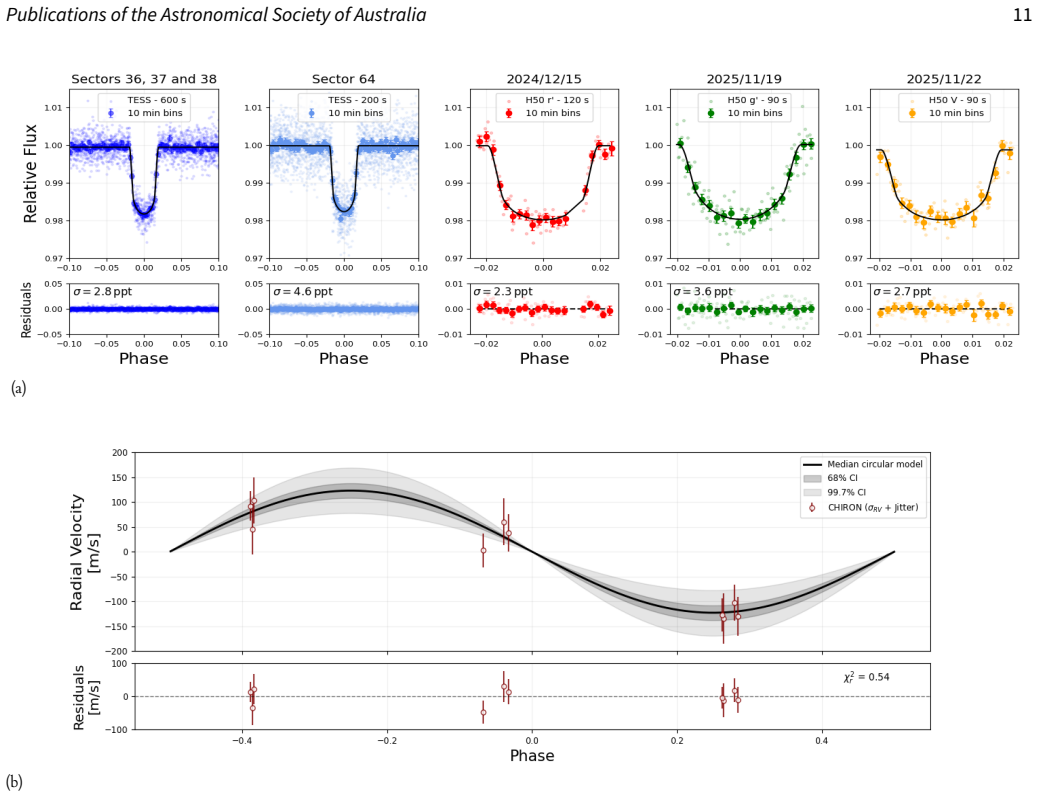
The analysis is carried by a joint photometric and radial-velocity model built in the Juliet code (Espinoza et al., 2019), which couples the BATMAN transit model to the RadVel Keplerian model and explores the parameter space with nested sampling. Gaussian-process kernels absorb correlated noise — a quasi-periodic kernel for the active star TOI-3272 and Matérn 3/2 kernels elsewhere — while the transit shape fixes the radius ratio and the RV semi-amplitude fixes the planet mass. Around this core sits a validation chain: TRICERATOPS false-positive probabilities (Giacalone et al., 2021), achromatic transit-depth comparisons across filters, Gaia DR3 RUWE astrometry, archival photographic plates, and (for TOI-3053) SOAR speckle imaging. The combination is what lets the paper move from transiting candidate to confirmed planet with a mass.
What would settle it
Obtain or re-fit the full set of 34 FEROS radial velocities for TOI-3278 (including the 10 rejected points) with the same circular-orbit model; if the semi-amplitude K departs significantly from 40.1 ± 8.5 m/s, the claimed mass of 0.30 ± 0.07 $M_J$ would not survive. Alternatively, a single additional season of high-precision RVs from HARPS or an equivalent spectrograph would settle whether the 3.25-day Keplerian is real at that amplitude.
Extended reading notes
Core claim
On the paper's own terms, the central discovery is the confirmation and mass characterisation of two transiting hot giant planets orbiting thin-disk G dwarfs of roughly solar metallicity. TOI-3053b has radius 1.21±0.03 $R_J$, mass 0.85±0.12 $M_J$ and bulk density 0.64±0.10 g cm$^{-3}$; TOI-3278b/HATS-78b has radius 1.24±0.04 $R_J$, mass 0.30±0.07 $M_J$ and density 0.21±0.05 g cm$^{-3}$, making it an inflated Saturn-mass object. The paper further argues that both planets appear inflated relative to the Thorngren et al. (2019) mass–radius relation, and that TOI-3272.01 is consistent with a hot Jupiter but lacks a mass measurement. These are presented as additions to the census of close-in giants from TESS, relevant to migration mechanisms and radius-inflation models.
Load-bearing premise
The mass of TOI-3278b depends on the assumption that the 10 FEROS radial velocities rejected as outliers were not taken near the orbital velocity maxima or minima; if they were, the fitted semi-amplitude of 40.1 m/s and the derived 0.30 Jupiter-mass planet would be biased.
Editorial extensions
If this is right
- Two more hot giants with secure masses and densities enter the mass–radius diagram, tightening the empirical constraints on how much irradiation inflates close-in giant planets.
- TOI-3278b's density of 0.21 g cm$^{-3}$ makes it a strong case study for radius-inflation mechanisms, and its old host star (about 8.9 Gyr) suggests it may be re-inflating as the star nears the end of its main-sequence lifetime.
- If TOI-3272.01 is confirmed, it would be a hot Jupiter around a 1.1 Gyr old star — precisely the young population needed to study giant-planet evolution over the first billion years.
- The paper's calculation that these targets fall below the TSM threshold for JWST or Ariel transmission spectroscopy implies such observations would be challenging unless masses sit at the lower ends of their error ranges.
- The systems support the TESS follow-up pipeline for the faint (V > 13) and distant hosts that upcoming missions like the Roman Galactic Bulge Time Domain Survey will find.
Reading between the lines
- A useful check the paper does not perform would be a blinded re-fit of the TOI-3278 RVs with all 34 FEROS points included; until either that is done or new RVs arrive, the mass of TOI-3278b should carry the flagged uncertainty about the 10 rejected outliers.
- The same joint-modelling pipeline could be applied to the unconfirmed TOI-3272.01 once youth indicators (Li, Ca H&K) are checked; a young-star classification would make the 1.15 $R_J$ radius particularly interesting for inflation models, since young giants are expected to be inflated.
- The achromatic depth test for TOI-3272.01 was ambiguous, and the paper's own suggestion of a youth spectrum is essentially a test of whether spot modulation is altering the transit depth — an observation that could be carried out with a single high-SNR spectrum.
- The heavy reliance on TGLC re-extractions for faint targets implies that some published TESS transit depths for similar stars may carry pipeline-dependent biases; systematic re-analysis of faint TOIs would be a natural extension.
Editorial analysis
A structured set of objections, weighed in public.
Referee Report
Summary. This paper presents ground- and space-based follow-up of three TESS hot-giant-planet candidates (TOI-3053.01, TOI-3272.01, and TOI-3278.01/HATS-78). Using TESS and UTGO/H50 photometry, reconnaissance and high-resolution spectroscopy, speckle imaging, and Juliet joint modelling of light curves and radial velocities, the authors confirm two of the candidates as planets: TOI-3053b, a hot Jupiter with M=0.85±0.12 MJ, R=1.21±0.03 RJ, and TOI-3278b/HATS-78b, an inflated Saturn-mass planet with M=0.30±0.07 MJ, R=1.24±0.04 RJ. The third candidate, TOI-3272.01, remains unconfirmed. The paper also derives stellar parameters, ages, and discusses the systems in the context of the short-period giant planet population and radius inflation.
Significance. If the results hold, the paper delivers two well-characterised additions to the short-period giant planet sample, including a low-density Saturn-mass planet (TOI-3278b) around a star near the end of its main-sequence lifetime, which is potentially relevant for radius-inflation studies. The analysis uses standard, widely tested tools (Juliet, ARIADNE, TRICERATOPS, MIST), reports per-instrument parameters and posteriors, and provides a public repository for the modelling notebooks. The vetting is generally careful: the blended 0.416-day eclipsing binary near TOI-3053 is identified and modelled with a GP, and the chromaticity and statistical false-positive tests are appropriate. The main weakness is the undocumented rejection of 10 of 34 FEROS radial velocities for TOI-3278, on which the planet mass determination rests; this makes the confirmation of TOI-3278b currently less secure than the text claims.
major comments (2)
- [§2.4.2, Table A2, §4.2.3] The 5-sigma outlier rejection of FEROS RVs is not reproducible or adequately justified. The text states that 10 of 34 measurements were rejected as 5-sigma outliers, but it does not specify the reference model (e.g., a constant velocity, a preliminary Keplerian, or an iterative clip of residuals), the number of iterations, or the values of the rejected points. Table A2 lists only the 24 retained FEROS measurements. The global fit in §4.2.3 then yields K=40.1±8.5 m/s with a fitted FEROS jitter of 46.5±7.45 m/s, so the jitter exceeds the Keplerian amplitude. Iterative sigma-clipping around a trial model can preferentially remove points at the velocity extrema (suppressing a real K) or remove noise-driven extremes (creating a spurious K). Since the quoted mass M=0.30±0.07 MJ is derived directly from this K, the confirmation of TOI-3278b is not secure unless the authors provide the full 34-point RV dataset, the exact rejection algorithm, and a fit to all 34 points (or a robust likelihood) demonstrating that K is stable under this choice.
- [§2.1.3, §4.2.3] The exclusion of TESS Sector 13 from the TOI-3278 modelling is not quantitatively justified. The text says the noise/systematics were 'too severe to provide meaningful information about the transit', but no diagnostic, fit with Sector 13 included, or comparison of derived parameters is shown. This data selection could in principle affect the transit depth, ephemeris, and hence the radius and density of TOI-3278b. Please present a fit that includes Sector 13 with an appropriate detrending model, or show explicitly that its inclusion leaves the reported parameters unchanged within uncertainties.
minor comments (6)
- [§2.1.2 vs §4.2.2] The text says TOI-3272 was observed by TESS in Sectors 11, 12, 13, 27, 38, 39, 65, 66, 67, 93 and 94, but §4.2.2 lists the modelled sectors as 27, 38, 39, 65, 66, 67, 93, 94 and 95; the discrepancy (Sectors 11, 12, 13 omitted and Sector 95 added) should be clarified.
- [§4.2.2, Table 5] The period of TOI-3272.01 is quoted as 'P3053b = 3.1466961 ± 0.0000057 days'; the subscript should refer to TOI-3272.01, not TOI-3053b.
- [§5.1] There is a typo in 'the inferred age of TOI-3278 implies that is is close to the end of its main-sequence lifetime'; 'is is' should be 'it is'.
- [§2.2.1] The FLOYDS spectra for TOI-3278 have R≈500 and a useful wavelength range limited to the visible; the statement that this rules out double-lined binaries should be qualified, since such low resolution and limited wavelength coverage can miss companions with small RV separations.
- [Table 3] The 'This work' entries in the 'Source' column are inconsistent in capitalization (e.g., 'This Work' in the Age row); unify the formatting.
- [§4.2.3] The HARPS dataset consists of only 3 RVs with a median uncertainty of 27 m/s; the paper should state explicitly that these points alone cannot independently constrain the orbital amplitude and that the mass determination relies on the FEROS data, which is already the case in the text but would be clearer in Section 4.2.3.
Circularity Check
No significant circularity: this is an observational characterization paper whose planet masses, radii, and densities are derived from independent RV and transit data plus external stellar models.
full rationale
The central claims of the paper are empirical characterizations, not theory-derived predictions that reduce to their own inputs. Planet radii come from TESS and ground-based transit photometry modeled with Juliet; planet masses come from independent CHIRON and FEROS/HARPS radial velocities; stellar parameters come from SED fitting with external model grids and MIST isochrones. The radius and mass are combined to give densities, and the inflation comparison is made against an external mass-radius relation (Thorngren et al. 2019). The stellar density prior used in the transit fit (Table A3) is derived from the independently fitted stellar parameters, which is standard practice and does not constitute circularity because the stellar parameters are not derived from the transit fit. The paper cites prior work by the same team (Plunkett et al. 2025) for target selection, but that citation is not load-bearing for the confirmation of the planets or for the quoted masses and radii. The FEROS 5-sigma clipping described in Section 2.4.2 is a data-selection and robustness concern: without the rejected RVs or an unclipped fit, the derived K = 40.1 +/- 8.5 m/s and the resulting mass could be biased. That concern, however, is not circularity under the definitions used here, because the mass is still an empirical fit to the retained data and is not equal to an input by construction. The paper also explicitly and repeatedly states its limitations, including that TOI-3272.01 remains unconfirmed and requires high-precision RVs, and that TRICERATOPS cannot statistically validate giant planets alone. I find no step in the derivation chain that is equivalent to its input by definition, no fitted parameter renamed as a prediction, and no load-bearing self-citation chain. Therefore the appropriate circularity score is 0.
Assumptions & free parameters
free parameters (5)
- Rotation period of TOI-3272 (P_rot) =
13.44 ± 0.46 days
- RV jitter for FEROS (J_FEROS) =
46.5 m/s
- Dilution factors for TOI-3272 ground-based light curves =
0.95-0.96
- GP rotation period for TOI-3053 (QPK kernel) =
0.4166 days
- Limb darkening coefficients (q1, q2) per instrument =
Various (Table 5)
assumptions (7)
- domain assumption Gaia DR3 astrometry and photometry provide unbiased stellar distances, radii, and extinction constraints.
- domain assumption MIST isochrones and stellar atmosphere model grids (Phoenix, Kurucz, ATLAS9, BT-Settl) can be interpolated to derive accurate stellar masses, radii, and ages.
- domain assumption The Mamajek & Hillenbrand (2008) gyrochronology relation maps rotation period and colour to stellar age for TOI-3272.
- domain assumption The TESS light curves (QLP and TGLC extractions) are sufficiently de-blended and calibrated for transit fitting.
- ad hoc to paper The 0.416-day periodic signal in the TOI-3053 light curve is a nearby blended eclipsing binary that can be modelled with a quasi-periodic GP without affecting the 2.99-day transit.
- domain assumption Radial velocity variations are dominated by the orbital motion of a bound companion, not by stellar activity or systematic errors.
- ad hoc to paper The FEROS 5-sigma outlier rejection did not remove points that carry the orbital signal.
Cite this review
Pith. "Pith review of The TASSIE Program. II: Three Close-In Companions Orbiting Sun-Like Stars." pith.science (2026). https://pith.science/paper/WYHFXD3M
@misc{pith2026260805500,
  author       = {Pith},
  title        = {Pith review of: The TASSIE Program. II: Three Close-In Companions Orbiting Sun-Like Stars},
  year         = {2026},
  howpublished = {\url{https://pith.science/paper/WYHFXD3M}},
  note         = {Machine review of arXiv:2608.05500}
}
abstract
We present three southern transiting giant planet candidates alerted by the Transiting Exoplanet Survey Satellite (TESS) mission and investigated at the University of Tasmania Greenhill Observatory (UTGO). The candidate planets are orbiting thin disk G-dwarf main-sequence stars with roughly solar metallicity, possessing orbital periods between 2.9 - 3.3 days and radii of 1.1 - 1.3 $R_{J}$. We performed ground-based follow-up photometry primarily with the UTGO Harlingten 50 cm, then gathered reconnaissance spectra, high angular resolution imaging and high-precision radial velocities to rule out false positive scenarios. We confirmed that two of these systems host true exoplanets and constrained their masses. TOI-3053b is a typical hot Jupiter, with $M_{3053b} = 0.85 \pm 0.12$ M$_{J}$ and a bulk density of $\rho_{3053b} = 0.64 \pm 0.10$ g cm$^{-3}$. TOI-3278b / HATS-78b is a hot Saturn-mass planet ($M_{3278b} = 0.30 \pm 0.07$ $M_{J}$) with a highly inflated atmosphere and a low density of $\rho_{3278b} = 0.21 \pm 0.05$ g cm$^{-3}$. The other candidate (TOI-3272.01) remains unconfirmed, but appears consistent with being a hot Jupiter. TOI-3272.01 is notable as a candidate planet orbiting a potentially young to intermediate age star, with a rotational analysis indicating an age estimate of $T_{3272} = 1.1 \pm 0.2$ Gyr. These systems add to a growing sample of hot giant planets from TESS that may provide constraints on the migration pathways and radius inflation of the broader close-in exoplanet population.
Figures


Figures from the paper (5 more)



Reference graph
Works this paper leans on
-
[1]
Determining stellar atmospheric parameters and chemical abundances of FGK stars with iSpec. , keywords =. doi:10.1051/0004-6361/201423945 , archivePrefix =. 1407.2608 , primaryClass =
-
[2]
ARIADNE: measuring accurate and precise stellar parameters through SED fitting. , keywords =. doi:10.1093/mnras/stac956 , archivePrefix =. 2204.03769 , primaryClass =
-
[3]
Accurate masses and radii of normal stars: modern results and applications. , keywords =. doi:10.1007/s00159-009-0025-1 , archivePrefix =. 0908.2624 , primaryClass =
-
[4]
SkyMapper Southern Survey: First Data Release (DR1). , keywords =. doi:10.1017/pasa.2018.5 , archivePrefix =. 1801.07834 , primaryClass =
arXiv 2018
-
[5]
The Two Micron All Sky Survey (2MASS). , keywords =. doi:10.1086/498708 , adsurl =
-
[6]
The Wide-field Infrared Survey Explorer (WISE): Mission Description and Initial On-orbit Performance. , keywords =. doi:10.1088/0004-6256/140/6/1868 , archivePrefix =. 1008.0031 , primaryClass =
-
[7]
A grid of MARCS model atmospheres for late-type stars. I. Methods and general properties. , keywords =. doi:10.1051/0004-6361:200809724 , archivePrefix =. 0805.0554 , primaryClass =
-
[8]
Modelling of Stellar Atmospheres , year = 2003, editor =
New Grids of ATLAS9 Model Atmospheres. Modelling of Stellar Atmospheres , year = 2003, editor =. doi:10.48550/arXiv.astro-ph/0405087 , archivePrefix =. astro-ph/0405087 , primaryClass =
Show all 88 references
-
[9]
Astronomy and Astrophysics , keywords =
A new extensive library of PHOENIX stellar atmospheres and synthetic spectra. Astronomy and Astrophysics , keywords =. doi:10.1051/0004-6361/201219058 , archivePrefix =. 1303.5632 , primaryClass =
-
[10]
16th Cambridge Workshop on Cool Stars, Stellar Systems, and the Sun , year = 2011, editor =
Model Atmospheres From Very Low Mass Stars to Brown Dwarfs. 16th Cambridge Workshop on Cool Stars, Stellar Systems, and the Sun , year = 2011, editor =. doi:10.48550/arXiv.1011.5405 , archivePrefix =. 1011.5405 , primaryClass =
-
[11]
Astronomy and Astrophysics , keywords =
Elemental abundance trends in the Galactic thin and thick disks as traced by nearby F and G dwarf stars. Astronomy and Astrophysics , keywords =. doi:10.1051/0004-6361:20031213 , adsurl =
-
[12]
, keywords =
Calculating Galactic Space Velocities and Their Uncertainties, with an Application to the Ursa Major Group. , keywords =. doi:10.1086/114370 , adsurl =
-
[13]
Summary of the content and survey properties
Gaia Data Release 3. Summary of the content and survey properties. Astronomy and Astrophysics , keywords =. doi:10.1051/0004-6361/202243940 , archivePrefix =. 2208.00211 , primaryClass =
-
[14]
Local standard of rest
Local stellar kinematics from RAVE data - I. Local standard of rest. Monthly Notices of the Royal Astronomical Society , keywords =. doi:10.1111/j.1365-2966.2010.17983.x , archivePrefix =. 1011.1188 , primaryClass =
2010
-
[15]
BANYAN. XI. The BANYAN Multivariate Bayesian Algorithm to Identify Members of Young Associations with 150 pc. The Astrophysical Journal , keywords =. doi:10.3847/1538-4357/aaae09 , archivePrefix =. 1801.09051 , primaryClass =
-
[16]
, keywords =
Vetting of 384 TESS Objects of Interest with TRICERATOPS and Statistical Validation of 12 Planet Candidates. , keywords =. doi:10.3847/1538-3881/abc6af , archivePrefix =. 2002.00691 , primaryClass =
2002 arXiv
-
[17]
, keywords =
Unresolved stellar companions with Gaia DR2 astrometry. , keywords =. doi:10.1093/mnras/staa1522 , archivePrefix =. 2003.05467 , primaryClass =
2003 arXiv
-
[18]
New Horizons in Time Domain Astronomy , year = 2012, editor =
Opening the 100-Year Window for Time-Domain Astronomy. New Horizons in Time Domain Astronomy , year = 2012, editor =. doi:10.1017/S1743921312000166 , archivePrefix =. 1211.1051 , primaryClass =
2012 arXiv
-
[19]
, keywords =
ATLAS: A High-cadence All-sky Survey System. , keywords =. doi:10.1088/1538-3873/aabadf , archivePrefix =. 1802.00879 , primaryClass =
-
[20]
, keywords =
The All-Sky Automated Survey for Supernovae (ASAS-SN) Light Curve Server v1.0. , keywords =. doi:10.1088/1538-3873/aa80d9 , archivePrefix =. 1706.07060 , primaryClass =
-
[21]
, keywords =
The Wide Field Spectrograph (WiFeS). , keywords =. doi:10.1007/s10509-007-9510-z , archivePrefix =. 0705.0287 , primaryClass =
-
[22]
, keywords =
PyWiFeS: a rapid data reduction pipeline for the Wide Field Spectrograph (WiFeS). , keywords =. doi:10.1007/s10509-013-1682-0 , archivePrefix =. 1311.2666 , primaryClass =
-
[23]
, keywords =
MESA Isochrones and Stellar Tracks (MIST) 0: Methods for the Construction of Stellar Isochrones. , keywords =. doi:10.3847/0067-0049/222/1/8 , archivePrefix =. 1601.05144 , primaryClass =
-
[24]
, keywords =
Ten Years of Speckle Interferometry at SOAR. , keywords =. doi:10.1088/1538-3873/aaa7d9 , archivePrefix =. 1801.04772 , primaryClass =
-
[25]
SOAR TESS Survey. I. Sculpting of TESS Planetary Systems by Stellar Companions. , keywords =. doi:10.3847/1538-3881/ab55e9 , archivePrefix =. 1908.10871 , primaryClass =
1908 arXiv
-
[26]
, keywords =
juliet: a versatile modelling tool for transiting and non-transiting exoplanetary systems. , keywords =. doi:10.1093/mnras/stz2688 , archivePrefix =. 1812.08549 , primaryClass =
-
[27]
, keywords =
The TESS Faint-star Search: 1617 TOIs from the TESS Primary Mission. , keywords =. doi:10.3847/1538-4365/ac5688 , archivePrefix =. 2112.02176 , primaryClass =
-
[28]
Research Notes of the American Astronomical Society , keywords =
Photometry of 10 Million Stars from the First Two Years of TESS Full Frame Images: Part I. Research Notes of the American Astronomical Society , keywords =. doi:10.3847/2515-5172/abca2e , archivePrefix =. 2011.06459 , primaryClass =
2011 arXiv
-
[29]
, keywords =
A box-fitting algorithm in the search for periodic transits. , keywords =. doi:10.1051/0004-6361:20020802 , archivePrefix =. astro-ph/0206099 , primaryClass =
-
[30]
, keywords =
PROSE: a PYTHON framework for modular astronomical images processing. , keywords =. doi:10.1093/mnras/stab3113 , archivePrefix =. 2111.02814 , primaryClass =
-
[31]
, keywords =
Las Cumbres Observatory Global Telescope Network. , keywords =. doi:10.1086/673168 , archivePrefix =. 1305.2437 , primaryClass =
-
[32]
, keywords =
Understanding the Effects of Stellar Multiplicity on the Derived Planet Radii from Transit Surveys: Implications for Kepler, K2, and TESS. , keywords =. doi:10.1088/0004-637X/805/1/16 , archivePrefix =. 1503.03516 , primaryClass =
-
[33]
Publications of the Astronomical Society of Australia , author=
TASSIE: a TASmanian Search for Inclined Exoplanets , DOI=. Publications of the Astronomical Society of Australia , author=. 2025 , pages=
2025
-
[34]
, keywords =
Reanalysis of the FEROS observations of HIP 11952. , keywords =. doi:10.1051/0004-6361/201321497 , archivePrefix =. 1307.5072 , primaryClass =
-
[35]
, keywords =
CERES: A Set of Automated Routines for Echelle Spectra. , keywords =. doi:10.1088/1538-3873/aa5455 , archivePrefix =. 1609.02279 , primaryClass =
-
[36]
Lightkurve: Kepler and TESS time series analysis in Python
-
[37]
, keywords =
Classifying Single Stars and Spectroscopic Binaries Using Optical Stellar Templates. , keywords =. doi:10.3847/1538-4365/aba1e7 , archivePrefix =. 2006.01199 , primaryClass =
2006 arXiv
-
[38]
, keywords =
Intrinsic Colors, Temperatures, and Bolometric Corrections of Pre-main-sequence Stars. , keywords =. doi:10.1088/0067-0049/208/1/9 , archivePrefix =. 1307.2657 , primaryClass =
-
[39]
A new formalism for the floating-mean and Keplerian periodograms
The generalised Lomb-Scargle periodogram. A new formalism for the floating-mean and Keplerian periodograms. , keywords =. doi:10.1051/0004-6361:200811296 , archivePrefix =. 0901.2573 , primaryClass =
-
[40]
, keywords =
Fast and Scalable Gaussian Process Modeling with Applications to Astronomical Time Series. , keywords =. doi:10.3847/1538-3881/aa9332 , archivePrefix =. 1703.09710 , primaryClass =
-
[41]
, keywords =
HATSouth: A Global Network of Fully Automated Identical Wide-Field Telescopes. , keywords =. doi:10.1086/669529 , archivePrefix =. 1206.1391 , primaryClass =
-
[42]
, year = 1995, month = nov, volume =
A Jupiter-mass companion to a solar-type star. , year = 1995, month = nov, volume =. doi:10.1038/378355a0 , adsurl =
1995 doi
-
[43]
, keywords =
TESS-Gaia Light Curve: A PSF-based TESS FFI Light-curve Product. , keywords =. doi:10.3847/1538-3881/acaaa7 , archivePrefix =. 2301.03704 , primaryClass =
-
[44]
Observatory Operations: Strategies, Processes, and Systems IX , year = 2022, editor =
The ESO science archive. Observatory Operations: Strategies, Processes, and Systems IX , year = 2022, editor =. doi:10.1117/12.2628253 , archivePrefix =. 2209.11605 , primaryClass =
2022 arXiv
-
[45]
, keywords =
Photoevaporation and high-eccentricity migration created the sub-Jovian desert. , keywords =. doi:10.1093/mnras/sty1760 , archivePrefix =. 1807.00012 , primaryClass =
-
[46]
, keywords =
Origins of Hot Jupiters. , keywords =. doi:10.1146/annurev-astro-081817-051853 , archivePrefix =. 1801.06117 , primaryClass =
-
[47]
Journal of Astronomical Telescopes, Instruments, and Systems , year = 2015, month = jan, volume =
Transiting Exoplanet Survey Satellite (TESS). Journal of Astronomical Telescopes, Instruments, and Systems , year = 2015, month = jan, volume =. doi:10.1117/1.JATIS.1.1.014003 , adsurl =
2015 doi
-
[48]
Science , keywords =
Kepler Planet-Detection Mission: Introduction and First Results. Science , keywords =. doi:10.1126/science.1185402 , adsurl =
-
[49]
Space Telescopes and Instrumentation 2016: Optical, Infrared, and Millimeter Wave , year = 2016, editor =
The science of ARIEL (Atmospheric Remote-sensing Infrared Exoplanet Large-survey). Space Telescopes and Instrumentation 2016: Optical, Infrared, and Millimeter Wave , year = 2016, editor =. doi:10.1117/12.2232370 , adsurl =
2016 doi
-
[50]
Optical and Infrared Spectroscopy of Circumstellar Matter , year = 1999, editor =
The FEROS spectrograph. Optical and Infrared Spectroscopy of Circumstellar Matter , year = 1999, editor =
1999
-
[51]
Optical and IR Telescope Instrumentation and Detectors , year = 2000, editor =
HARPS: a new high-resolution spectrograph for the search of extrasolar planets. Optical and IR Telescope Instrumentation and Detectors , year = 2000, editor =. doi:10.1117/12.395516 , adsurl =
-
[52]
The GAPS Programme with HARPS-N at TNG . XIV. Investigating giant planet migration history via improved eccentricity and mass determination for 231 transiting planets. , keywords =. doi:10.1051/0004-6361/201629882 , archivePrefix =. 1704.00373 , primaryClass =
-
[53]
Protostars and Planets VI , year = 2014, editor =
Planet-Disk Interactions and Early Evolution of Planetary Systems. Protostars and Planets VI , year = 2014, editor =. doi:10.2458/azu_uapress_9780816531240-ch029 , archivePrefix =. 1312.4293 , primaryClass =
2014 arXiv
-
[54]
, keywords =
Searching for GEMS: Characterizing Six Giant Planets Around Cool Dwarfs. , keywords =. doi:10.3847/1538-3881/ad7796 , archivePrefix =. 2408.14694 , primaryClass =
-
[55]
, keywords =
TESS Hunt for Young and Maturing Exoplanets (THYME): A Planet in the 45 Myr Tucana-Horologium Association. , keywords =. doi:10.3847/2041-8213/ab2988 , archivePrefix =. 1906.10703 , primaryClass =
1906 arXiv
-
[56]
, keywords =
Constraining the atmospheric elements in hot Jupiters with Ariel. , keywords =. doi:10.1093/mnras/stad1721 , adsurl =
-
[57]
, keywords =
The Imprint of Exoplanet Formation History on Observable Present-day Spectra of Hot Jupiters. , keywords =. doi:10.3847/0004-637X/832/1/41 , archivePrefix =. 1609.03019 , primaryClass =
- [58]
-
[59]
, keywords =
Warm Jupiters from Secular Planet-Planet Interactions. , keywords =. doi:10.3847/0004-637X/829/2/132 , archivePrefix =. 1604.00010 , primaryClass =
-
[60]
, keywords =
Improved Age Estimation for Solar-Type Dwarfs Using Activity-Rotation Diagnostics. , keywords =. doi:10.1086/591785 , archivePrefix =. 0807.1686 , primaryClass =
-
[61]
Annual Review of Astronomy and Astrophysics , keywords =
The Eccentric Kozai-Lidov Effect and Its Applications. Annual Review of Astronomy and Astrophysics , keywords =. doi:10.1146/annurev-astro-081915-023315 , archivePrefix =. 1601.07175 , primaryClass =
-
[62]
The Astrophysical Journal , keywords =
Effects of Secular Interactions in Extrasolar Planetary Systems. The Astrophysical Journal , keywords =. doi:10.1086/506142 , archivePrefix =. astro-ph/0606346 , primaryClass =
-
[63]
, keywords =
Origins of Eccentric Extrasolar Planets: Testing the Planet-Planet Scattering Model. , keywords =. doi:10.1086/590926 , archivePrefix =. astro-ph/0703163 , primaryClass =
-
[64]
, keywords =
Transiting Exoplanet Yields for the Roman Galactic Bulge Time Domain Survey Predicted from Pixel-level Simulations. , keywords =. doi:10.3847/1538-4365/acf3df , archivePrefix =. 2305.16204 , primaryClass =
- [65]
-
[66]
, keywords =
On the Exoplanet Yield of Gaia Astrometry. , keywords =. doi:10.3847/1538-3881/ae21de , archivePrefix =. 2511.04673 , primaryClass =
-
[67]
Research Notes of the American Astronomical Society , keywords =
An Empirical Mass-Radius Relation for Cool Giant Planets. Research Notes of the American Astronomical Society , keywords =. doi:10.3847/2515-5172/ab4353 , adsurl =
-
[68]
, keywords =
The Mass of KOI-94d and a Relation for Planet Radius, Mass, and Incident Flux. , keywords =. doi:10.1088/0004-637X/768/1/14 , archivePrefix =. 1303.2150 , primaryClass =
-
[69]
, keywords =
A Framework for Prioritizing the TESS Planetary Candidates Most Amenable to Atmospheric Characterization. , keywords =. doi:10.1088/1538-3873/aadf6f , archivePrefix =. 1805.03671 , primaryClass =
-
[70]
, keywords =
Evidence of three mechanisms explaining the radius anomaly of hot Jupiters. , keywords =. doi:10.1051/0004-6361/202038361 , archivePrefix =. 2009.04291 , primaryClass =
2009 arXiv
-
[71]
, keywords =
Primary Transit of the Planet HD 189733b at 3.6 and 5.8 m. , keywords =. doi:10.1086/527045 , archivePrefix =. 0711.2142 , primaryClass =
-
[72]
, keywords =
Statistics of Long Period Gas Giant Planets in Known Planetary Systems. , keywords =. doi:10.3847/0004-637X/821/2/89 , archivePrefix =. 1601.07595 , primaryClass =
-
[73]
Friends of Hot Jupiters. I. A Radial Velocity Search for Massive, Long-period Companions to Close-in Gas Giant Planets. , keywords =. doi:10.1088/0004-637X/785/2/126 , archivePrefix =. 1312.2954 , primaryClass =
-
[74]
, keywords =
TESS Spots a Hot Jupiter with an Inner Transiting Neptune. , keywords =. doi:10.3847/2041-8213/ab7302 , archivePrefix =. 2003.10852 , primaryClass =
2003 arXiv
-
[75]
, keywords =
WASP-47: A Hot Jupiter System with Two Additional Planets Discovered by K2. , keywords =. doi:10.1088/2041-8205/812/2/L18 , archivePrefix =. 1508.02411 , primaryClass =
-
[76]
, keywords =
The James Webb Space Telescope. , keywords =. doi:10.1007/s11214-006-8315-7 , archivePrefix =. astro-ph/0606175 , primaryClass =
-
[77]
, keywords =
Measuring Reddening with Sloan Digital Sky Survey Stellar Spectra and Recalibrating SFD. , keywords =. doi:10.1088/0004-637X/737/2/103 , archivePrefix =. 1012.4804 , primaryClass =
-
[78]
Software and Cyberinfrastructure for Astronomy V , year = 2018, editor =
Real-time processing of the imaging data from the network of Las Cumbres Observatory Telescopes using BANZAI. Software and Cyberinfrastructure for Astronomy V , year = 2018, editor =. doi:10.1117/12.2314340 , archivePrefix =. 1811.04163 , primaryClass =
2018 arXiv
-
[79]
American Astronomical Society Meeting Abstracts \#233 , year = 2019, series =
TESS Follow-up Observing Program Working Group (TFOP WG) Sub Group 1 (SG1): Ground-based Time-series Photometry. American Astronomical Society Meeting Abstracts \#233 , year = 2019, series =
2019
-
[80]
, keywords =
CHIRON A Fiber Fed Spectrometer for Precise Radial Velocities. , keywords =. doi:10.1086/674012 , archivePrefix =. 1309.3971 , primaryClass =
-
[81]
, keywords =
batman: BAsic Transit Model cAlculatioN in Python. , keywords =. doi:10.1086/683602 , archivePrefix =. 1507.08285 , primaryClass =
-
[82]
, keywords =
RadVel: The Radial Velocity Modeling Toolkit. , keywords =. doi:10.1088/1538-3873/aaaaa8 , archivePrefix =. 1801.01947 , primaryClass =
-
[83]
, keywords =
Efficient, uninformative sampling of limb darkening coefficients for two-parameter laws. , keywords =. doi:10.1093/mnras/stt1435 , archivePrefix =. 1308.0009 , primaryClass =
-
[84]
, keywords =
DYNESTY: a dynamic nested sampling package for estimating Bayesian posteriors and evidences. , keywords =. doi:10.1093/mnras/staa278 , archivePrefix =. 1904.02180 , primaryClass =
1904 arXiv
-
[85]
Nature Astronomy , keywords =
Continuous helium absorption from both the leading and trailing tails of WASP-107 b. Nature Astronomy , keywords =. doi:10.1038/s41550-025-02710-8 , archivePrefix =. 2505.20588 , primaryClass =
-
[86]
, keywords =
Identifying Planetary Transit Candidates in TESS Full-frame Image Light Curves via Convolutional Neural Networks. , keywords =. doi:10.3847/1538-3881/abf4c6 , archivePrefix =. 2101.10919 , primaryClass =
-
[87]
, keywords =
AstroImageJ: Image Processing and Photometric Extraction for Ultra-precise Astronomical Light Curves. , keywords =. doi:10.3847/1538-3881/153/2/77 , archivePrefix =. 1701.04817 , primaryClass =
-
[88]
, keywords =
The Fourth US Naval Observatory CCD Astrograph Catalog (UCAC4). , keywords =. doi:10.1088/0004-6256/145/2/44 , archivePrefix =. 1212.6182 , primaryClass =
Reviewed August 8, 2026 · model on record in the stance chip above.
Discussion (0). Continue with ORCID to comment.