REVIEW 2 major objections 4 minor 83 references
Search-Aided Joint Agent-Environment Reinforcement Learning for Robust Lifelong Multi-Agent Path Finding with Rotations
T0 review · 2 major / 4 minor · reviewed 2026-08-08 · deepseek-v4-flash
Pith's one-line read This paper argues that jointly training an agent policy and a learned edge-cost guidance policy, shielded by the search algorithm Causal PIBT, yields the best reported throughput on a lifelong multi-agent path-finding model with…
desk verdict A solid new model and a credible same-model win over Causal-PIBT, but the 'outperforms all SoTA' claim rests on a model-mismatch comparison that should be reframed. read the letter →
The pith
A machine-rendered reading of the paper's core claim, the machinery that carries it, and where it could break.
The reading
What carries the argument
The load-bearing mechanism is a two-level joint training loop. At decision times, each free agent's convolutional policy proposes a next-vertex subgoal from an 11×11 local view; a synchronized variant of Causal PIBT resolves the proposals by depth-first priority inheritance, effectively propagating one agent's intention along a chain of robots and treating busy agents' current and subgoal vertices as obstacles. In parallel, the environment policy, a CNN over the obstacle map and precomputed vertex/edge visitation statistics, samples per-edge Gaussian costs, and backward Dijkstra over the state space of vertex–orientation pairs converts those costs into minimum-cost distance heuristics that are fed into the agent policy via skip connections. Both policies are updated with PPO-based rules inside shared simulations, with Causal PIBT treated as part of the environment so policy gradients need no correction for the search's action modifications. Together these pieces convert the near-impossible random exploration of coordinated motion in corridors into guided, intention-coupled decisions.
What would settle it
Two checks would settle the claims. Reproduce the six-map evaluation at 256 agents with 32 seeds: if Causal-PIBT's mean throughput matches SJRL's within one standard deviation on the dense Warehouse and Sortation maps, the headline improvement claim fails. And execute SJRL's plans on physical differential-drive robots at operating speed: if the robots cannot stop within the one-vertex spacing the model allows, the LMAPF-R2 safety model, and with it the claimed practical relevance, fails.
Extended reading notes
Core claim
The central claim is that a lifelong MAPF planner becomes simultaneously more realistic and more effective when the standard discrete model is replaced by LMAPF-R2, which prohibits following collisions (a 1-robust safety constraint) and requires orientation-dependent in-place rotation, and when two policies are trained jointly rather than separately. In SJRL, the agent policy predicts the next vertex as a subgoal instead of a primitive action, which imposes a policy hierarchy that makes coordinated exploration tractable; synchronized Causal PIBT then resolves the proposed subgoals through priority inheritance, where the robust constraint is enforced during greedy action execution toward the assigned subgoal. The environment policy, a CNN fed by the obstacle map and precomputed traffic statistics, outputs Gaussian edge costs bounded to [1,10]; backward Dijkstra over vertex–orientation states turns those costs into heuristic distances that condition the agent policy through skip connections. The two policies reinforce each other, the agent policy learning local reactive coordination while the environment policy balances global traffic, and the paper's ablations attribute the gains to the joint optimization, the subgoal hierarchy, and the search shield rather than to any single component.
Load-bearing premise
The practical value of the whole approach rests on the assumption that the LMAPF-R2 abstraction, a one-vertex following distance and discrete in-place rotation on a 4-neighbor grid, faithfully describes how real warehouse robots move and how close they may safely follow one another.
Editorial extensions
If this is right
- At runtime only the agent policy must execute, since the environment policy's edge costs and Dijkstra heuristics are precomputed once per map, keeping inference under 0.05 seconds per timestep.
- The throughput gap over Causal-PIBT widens as agents are added on dense maps, so the advantage concentrates exactly in the high-density regime warehouses operate in.
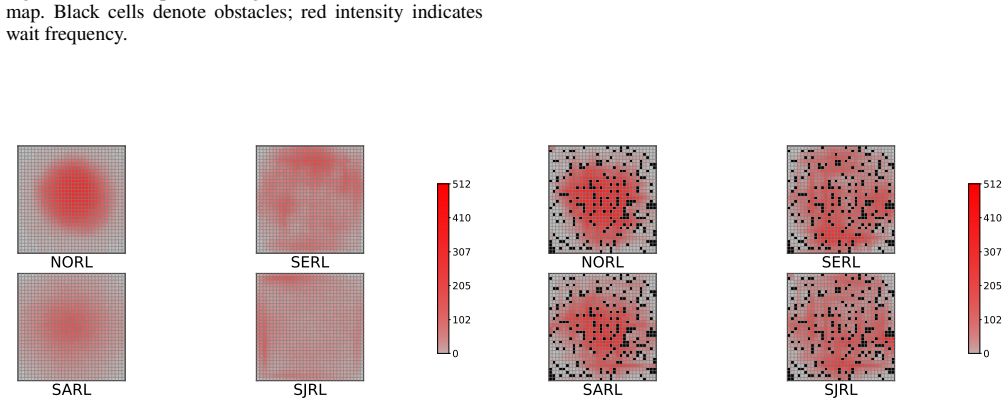
- Ablations show joint training beats agent-only and environment-only training, and the wait heatmaps show the two policies divide labor: one relieves local congestion, the other balances global traffic.
- Replacing the subgoal hierarchy and intention propagation with naive action- or vertex-based shielding causes large performance drops, particularly on maps with long corridors, pinning the feasibility of RL in this model on the search shield.
- Under the standard MAPF model the leading learned planners have converged to nearly equal throughput, whereas SJRL holds a consistent margin under LMAPF-R2, which the paper reads as evidence that the modeling choice itself is a major lever.
Reading between the lines
- A natural stress test the paper does not run: scale the safety margin from one vertex to a k-vertex following gap; because the robust constraint enters only through obstacle bookkeeping in Causal PIBT and the greedy action rule, the same joint-training loop should extend with modest changes to k-robust settings.
- The paper reports that SJRL trained from scratch still trails SJRL initialized with expert one-way aisle costs, which suggests the joint objective has local optima that PPO does not escape; a curriculum that imitates one-way traffic before fine-tuning would be a direct, testable remedy.
- The same agent-environment joint learning pattern, a global cost field re-planned cheaply with local reactions learned, applies beyond warehousing to any large multi-agent coordination setting such as building evacuation, drone corridor management, or map-scale traffic control.
- Because the guidance graph is recomputed only once per map, refreshing it periodically as traffic patterns drift during a long shift is a cheap adaptation that would likely compound SJRL's gains; the authors explicitly leave this online-update extension open.
Editorial analysis
A structured set of objections, weighed in public.
Referee Report
Summary. The paper introduces LMAPF-R2, a lifelong multi-agent path finding model that augments the standard model with robust safety constraints (prohibition of following collisions) and in-place rotation constraints, motivated by warehouse robot kinematics. The authors propose Search-Aided Joint Reinforcement Learning (SJRL), which couples a subgoal-predicting agent policy with a modified Causal PIBT collision shield and an environment policy that learns edge costs providing global guidance via backward Dijkstra search. The agent and environment policies are trained jointly with PPO/MAPPO-style updates. Experiments on six maps with 32-320 agents, ablations (SARL, SERL, CMA-ES), and a mixed-reality 8-robot demonstration show that SJRL improves over the search-only baseline Causal PIBT and over the single-policy ablations. The paper also compares SJRL against SILLM, MAGAT+, and HMAGAT and claims SJRL 'consistently outperforms all of them', while acknowledging those baselines use the standard LMAPF model.
Significance. If the central claims hold, the paper makes a useful contribution: it demonstrates that learning-based LMAPF can be extended to a more realistic kinematic model with scalable results, and it provides a joint co-optimization framework for agent and environment policies. The empirical methodology is solid in several respects: 32 random seeds, large agent-count sweeps, a meaningful ablation structure, and a physical-robot validation. The core same-model comparison against Causal-PIBT appears credible and is well supported. However, two load-bearing issues need to be resolved: the state-of-the-art comparison in Section 5.2 is confounded by a model mismatch, and the claim in Section 4.2 that treating Causal PIBT as part of the environment introduces no policy-gradient bias is not theoretically justified.
major comments (2)
- [Section 4.2, last paragraph] The claim that 'SJRL consistently outperforms all of them' (referring to SILLM, MAGAT+, and HMAGAT) is not supported as a fair algorithmic comparison. As the paper itself states, 'SARL and SJRL adopt the LMAPF-R2 model, whereas the other methods use the standard LMAPF model.' The baselines are trained and evaluated under the standard model with ADG-based execution scheduling, while SJRL is trained and evaluated directly under LMAPF-R2. This is a comparison of different problem models rather than different solvers for the same problem. The results can at most demonstrate the value of modeling robust and rotational constraints during planning; they cannot support the stronger claim that SJRL is a better LMAPF algorithm. The authors should either remove the SoTA-comparison claim or explicitly reframe it as a model-abstraction study, with the baselines adapted to LMAPF-R2 or with the comparison confined to same-model methods.
- [Section 4.2, last paragraph] The statement that 'treating Causal PIBT as part of the environment... does not bias the policy gradient' is not justified and is likely incorrect as stated. During training, the agent policy samples a subgoal bv_i, and Causal PIBT may change that subgoal (via priority inheritance and intention propagation) to a different final subgoal sg_i. The final subgoal is the action that actually determines the agent's subsequent behavior and reward. Standard PPO updates use the log-probability of the sampled action bv_i; but the return depends on sg_i, which is a deterministic function of the joint sampled subgoals of all free agents. The policy-gradient theorem therefore does not directly apply. To obtain an unbiased gradient, the authors must either (a) use the probability of the final subgoal under the induced distribution (e.g., by summing over preimages of the shield mapping), (b) use the joint-action log-probability (sum of individual log-probs) so that the deterministic shield becomes part of the reward function of the joint action, or (c) provide a proof that the shield mapping is injective or that the bias vanishes. Without such a correction, PPO may be optimizing a biased objective, which undermines the theoretical soundness of the training procedure. The paper currently provides no such proof.
minor comments (4)
- [Throughout] The name 'Causal-PIBT' is written inconsistently as 'Causal-PIBT' and 'Causal PIBT' in different places; please standardize.
- [Section 5.1] The paper repeatedly uses the word 'significantly' (e.g., 'SJRL significantly outperforms') without reporting statistical significance tests. With 32 seeds, the authors should provide confidence intervals or a formal test (e.g., paired bootstrap) to support the word 'significant'.
- [Figure 6 caption] The MPD formula is given as sum_i,j p_i p_j dist_ij, but it is not clear whether this is normalized by the total probability mass. If p_i are empirical occupation probabilities that sum to 1, the expression is fine; otherwise, please clarify the normalization.
- [Appendix C.3] The physical-robot validation uses only 8 physical robots and 248 virtual robots; this is a positive step, but the throughput numbers appear lower than the simulation results (e.g., SJRL 1.01 vs. >2 in Figure 5). The paper should briefly explain the discrepancy (e.g., execution disturbances, P3GASUS overhead) to avoid confusion.
Circularity Check
No circularity found: the same-model Causal-PIBT comparison is a controlled ablation, and the learned policies optimize throughput via RL rather than being fitted to it.
full rationale
The paper's central claim—that SJRL significantly improves over Causal-PIBT—is tested against NORL, a no-RL baseline running the same Causal-PIBT variant under the same LMAPF-R2 model with handcrafted heuristics; SJRL adds RL-trained agent and environment policies. The environment policy is trained by MAPPO/PPO to maximize the summed agent reward, which is a potential-based shaping of throughput (per-action -1 plus progress dist(sprev,g)-dist(scurr,g)); it is not fitted to reproduce the reported throughput numbers, and evaluation uses held-out goal/start samples and agent counts on the same maps. Self-citations to SILLM, CS-PIBT, and GGO identify components whose contributions are isolated by ablations (SARL vs SERL vs SJRL; NACS/NVCS vs Causal PIBT), so they are not load-bearing unverified premises. The Section 5.2 comparison against HMAGAT/MAGAT+/SILLM is confounded by model mismatch (LMAPF-R2 vs standard LMAPF), and the paper explicitly concedes this: 'A key reason is that SARL and SJRL adopt the LMAPF-R2 model, whereas the other methods use the standard LMAPF model.' That is a benchmark-fairness limitation, not a circular derivation, because the comparison outcome is empirical rather than forced by construction. No equation or fitted parameter in the paper is equivalent by construction to the claimed outputs.
Assumptions & free parameters
free parameters (5)
- Initial mean edge cost =
5.5
- Edge cost range =
[1,10]
- Agent local view size =
11x11
- Team reward neighborhood size =
5x5
- Entropy loss weight =
0
assumptions (5)
- domain assumption The robust constraint (no following collisions) is sufficient to guarantee a minimum safe distance between differential-drive robots in warehouses.
- domain assumption The 4-neighbor grid graph with in-place rotations faithfully models the kinematics of the target robots.
- domain assumption Training on a single map with 256 agents generalizes to 32 to 320 agents on the same map with random starts and goals.
- ad hoc to paper Treating Causal PIBT as part of the environment during RL training does not bias the policy gradient.
- domain assumption The environment policy's edge costs, generated by a CNN, provide guidance that is complementary to the agent policy.
invented entities (1)
-
Virtual agents (one per graph edge)
Cite this review
Pith. "Pith review of Search-Aided Joint Agent-Environment Reinforcement Learning for Robust Lifelong Multi-Agent Path Finding with Rotations." pith.science (2026). https://pith.science/paper/7A4NJCGI
@misc{pith2026260805588,
  author       = {Pith},
  title        = {Pith review of: Search-Aided Joint Agent-Environment Reinforcement Learning for Robust Lifelong Multi-Agent Path Finding with Rotations},
  year         = {2026},
  howpublished = {\url{https://pith.science/paper/7A4NJCGI}},
  note         = {Machine review of arXiv:2608.05588}
}
read the original abstract
Lifelong Multi-Agent Path Finding (LMAPF) requires repeatedly planning collision-free paths for agents that continuously receive new goals upon reaching their current ones. While many learning-based planners have been proposed for LMAPF, most rely on oversimplified kinematic assumptions that may overlook motion constraints critical to real-world performance. In this work, we study a more realistic LMAPF model derived from many real-world automated warehouse systems, termed LMAPF-R2, which incorporates robust safety constraints and in-place rotation constraints. These constraints substantially increase coordination difficulty, particularly in highly constrained spaces. To address these challenges, we propose Search-Aided Joint Reinforcement Learning (SJRL). We first augment neural policies with Causal PIBT, a single-step search-based planner that resolves agents' collisions and propagates their intentions. We then introduce a unified RL formulation that jointly optimizes agent and environment policies, where the environment policy learns graph edge costs to provide global movement guidance via backward Dijkstra search. Experiments demonstrate that SJRL achieves significant improvements over the strong search-based planner, Causal-PIBT, across multiple high-density maps. We further validate SJRL in a challenging mixed-reality warehouse environment with 8 physical robots and 248 virtual robots.
Figures


Figures from the paper (11 more)



Reference graph
Works this paper leans on
-
[1]
Proceedings of the AAAI Conference on Artificial Intelligence (AAAI) , volume=
Structure and intractability of optimal multi-robot path planning on graphs , author=. Proceedings of the AAAI Conference on Artificial Intelligence (AAAI) , volume=
-
[2]
Proceedings of the International Joint Conference on Artificial Intelligence (IJCAI) , pages =
Yulun Zhang and He Jiang and Varun Bhatt and Stefanos Nikolaidis and Jiaoyang Li , title =. Proceedings of the International Joint Conference on Artificial Intelligence (IJCAI) , pages =
-
[3]
Efficient Bounded-Suboptimal Multi-Agent Path Finding and Motion Planning via Improvements to Focal Search
Liron Cohen. Efficient Bounded-Suboptimal Multi-Agent Path Finding and Motion Planning via Improvements to Focal Search. 2020
2020
-
[4]
Proceedings of the International Joint Conference on Artificial Intelligence, (IJCAI) , pages =
Anytime Multi-Agent Path Finding via Large Neighborhood Search , author =. Proceedings of the International Joint Conference on Artificial Intelligence, (IJCAI) , pages =
-
[5]
Minghua Liu and Hang Ma and Jiaoyang Li and Sven Koenig , title =. AAMAS , pages =
-
[6]
Proceedings of the International Symposium on Combinatorial Search (SoCS) , volume=
Multi-Agent Pathfinding: Definitions, Variants, and Benchmarks , author=. Proceedings of the International Symposium on Combinatorial Search (SoCS) , volume=
-
[7]
Guni Sharon and Roni Stern and Ariel Felner and Nathan R. Sturtevant , title =. Artificial Intelligence , volume =
-
[8]
Proceedings of the AAAI Conference on Artificial Intelligence , volume=
Finding Optimal Solutions to Cooperative Pathfinding Problems , author=. Proceedings of the AAAI Conference on Artificial Intelligence , volume=
Show all 83 references
-
[9]
Proceedings of the AAAI Conference on Artificial Intelligence (AAAI) , volume=
Traffic Flow Optimisation for Lifelong Multi-Agent Path Finding , author=. Proceedings of the AAAI Conference on Artificial Intelligence (AAAI) , volume=
-
[10]
IEEE Robotics and Automation Letters , volume=
Mobile robot path planning in dynamic environments through globally guided reinforcement learning , author=. IEEE Robotics and Automation Letters , volume=. 2020 , publisher=
2020
-
[11]
2023 , publisher=
Lin, Qiushi and Ma, Hang , journal=. 2023 , publisher=
2023
-
[12]
Proceedings of the AAAI Conference on Artificial Intelligence (AAAI) , volume=
Decentralized Monte Carlo Tree Search for Partially Observable Multi-Agent Pathfinding , author=. Proceedings of the AAAI Conference on Artificial Intelligence (AAAI) , volume=
-
[13]
Proceedings of the International Symposium on Combinatorial Search , volume=
Bootstrap learning of heuristic functions , author=. Proceedings of the International Symposium on Combinatorial Search , volume=
-
[14]
arXiv preprint arXiv:2407.14931 , year=
POGEMA: A Benchmark Platform for Cooperative Multi-Agent Navigation , author=. arXiv preprint arXiv:2407.14931 , year=
-
[15]
2018 15th International Conference on Control, Automation, Robotics and Vision (ICARCV) , pages=
Lifelong multi-agent path finding in a dynamic environment , author=. 2018 15th International Conference on Control, Automation, Robotics and Vision (ICARCV) , pages=. 2018 , organization=
2018
-
[16]
Proceedings of the AAAI Conference on Artificial Intelligence (AAAI) , volume=
Lifelong Multi-Agent Path Finding in Large-Scale Warehouses , author=. Proceedings of the AAAI Conference on Artificial Intelligence (AAAI) , volume=
-
[17]
Proceedings of the 16th Conference on Autonomous Agents and MultiAgent Systems (AAMAS) , pages=
Lifelong Multi-Agent Path Finding for Online Pickup and Delivery Tasks , author=. Proceedings of the 16th Conference on Autonomous Agents and MultiAgent Systems (AAMAS) , pages=
-
[18]
Proceedings of the International Joint Conference on Autonomous Agents and Multiagent Systems (AAMAS) , year=
Task and path planning for multi-agent pickup and delivery , author=. Proceedings of the International Joint Conference on Autonomous Agents and Multiagent Systems (AAMAS) , year=
-
[19]
Artificial Intelligence , volume=
Priority Inheritance with Backtracking for Iterative Multi-Agent Path Finding , author=. Artificial Intelligence , volume=. 2022 , publisher=
2022
-
[20]
2021 , publisher=
Damani, Mehul and Luo, Zhiyao and Wenzel, Emerson and Sartoretti, Guillaume , journal=. 2021 , publisher=
2021
-
[21]
Proceedings of the AAAI Conference on Artificial Intelligence (AAAI) , volume=
Learn to Follow: Decentralized Lifelong Multi-Agent Pathfinding via Planning and Learning , author=. Proceedings of the AAAI Conference on Artificial Intelligence (AAAI) , volume=
-
[22]
2019 , publisher=
Sartoretti, Guillaume and Kerr, Justin and Shi, Yunfei and Wagner, Glenn and Kumar, TK Satish and Koenig, Sven and Choset, Howie , journal=. 2019 , publisher=
2019
-
[23]
Wang, Yutong and Xiang, Bairan and Huang, Shinan and Sartoretti, Guillaume , booktitle=
-
[24]
Proceedings of the AAAI Conference on Artificial Intelligence , volume=
LNS2+ RL: Combining multi-agent reinforcement learning with large neighborhood search in multi-agent path finding , author=. Proceedings of the AAAI Conference on Artificial Intelligence , volume=
-
[25]
Liu, Zuxin and Chen, Baiming and Zhou, Hongyi and Koushik, Guru and Hebert, Martial and Zhao, Ding , booktitle=
-
[26]
2024 IEEE International Conference on Robotics and Automation (ICRA) , pages=
Alpha: Attention-based long-horizon pathfinding in highly-structured areas , author=. 2024 IEEE International Conference on Robotics and Automation (ICRA) , pages=. 2024 , organization=
2024
-
[27]
IEEE Robotics and Automation Letters , volume=
Learning Selective Communication for Multi-Agent Path Finding , author=. IEEE Robotics and Automation Letters , volume=. 2021 , publisher=
2021
-
[28]
IEEE Robotics and Automation Letters , volume=
Message-Aware Graph Attention Networks for Large-Scale Multi-Robot Path Planning , author=. IEEE Robotics and Automation Letters , volume=. 2021 , publisher=
2021
-
[29]
Gao, Jianqi and Li, Yanjie and Yang, Xiaoqing and Tan, Mingshan , journal=
-
[30]
Improving Learnt Local
Veerapaneni, Rishi and Wang, Qian and Ren, Kevin and Jakobsson, Arthur and Li, Jiaoyang and Likhachev, Maxim , booktitle=. Improving Learnt Local
-
[31]
Proceedings of the AAAI Conference on Artificial Intelligence (AAAI) , volume=
Lacam: Search-Based Algorithm for Quick Multi-Agent Pathfinding , author=. Proceedings of the AAAI Conference on Artificial Intelligence (AAAI) , volume=
-
[32]
arXiv preprint arXiv:2201.09467 , year=
Ctrms: Learning to construct cooperative timed roadmaps for multi-agent path planning in continuous spaces , author=. arXiv preprint arXiv:2201.09467 , year=
-
[33]
arXiv preprint arXiv:2404.03554 , year=
No Panacea in Planning: Algorithm Selection for Suboptimal Multi-Agent Path Finding , author=. arXiv preprint arXiv:2404.03554 , year=
-
[34]
2023 IEEE International Conference on Robotics and Automation (ICRA) , pages=
Congestion prediction for large fleets of mobile robots , author=. 2023 IEEE International Conference on Robotics and Automation (ICRA) , pages=. 2023 , organization=
2023
-
[35]
IEEE International Conference on Robotics and Automation (ICRA) , pages=
Distributed heuristic multi-agent path finding with communication , author=. IEEE International Conference on Robotics and Automation (ICRA) , pages=. 2021 , organization=
2021
-
[36]
International Conference on Robotics and Automation (ICRA) , pages=
Multi-agent path finding with prioritized communication learning , author=. International Conference on Robotics and Automation (ICRA) , pages=. 2022 , organization=
2022
-
[37]
Proceedings of the International Symposium on Combinatorial Search , volume=
Suboptimal variants of the conflict-based search algorithm for the multi-agent pathfinding problem , author=. Proceedings of the International Symposium on Combinatorial Search , volume=
-
[38]
Artificial intelligence , volume=
Subdimensional expansion for multirobot path planning , author=. Artificial intelligence , volume=. 2015 , publisher=
2015
-
[39]
Stuckey and Jiaoyang Li and Sven Koenig , title =
Hang Ma and Daniel Harabor and Peter J. Stuckey and Jiaoyang Li and Sven Koenig , title =. AAAI , pages =
-
[40]
2013 , organization=
Ferner, Cornelia and Wagner, Glenn and Choset, Howie , booktitle=. 2013 , organization=
2013
-
[41]
Brown , title =
Alan S. Brown , title =
-
[42]
2022 , booktitle =
Yu, Chao and Velu, Akash and Vinitsky, Eugene and Gao, Jiaxuan and Wang, Yu and Bayen, Alexandre and Wu, Yi , title =. 2022 , booktitle =
2022
-
[43]
Proceedings of the International Joint Conference on Artificial Intelligence (IJCAI) , pages =
Priority Inheritance with Backtracking for Iterative Multi-agent Path Finding , author =. Proceedings of the International Joint Conference on Artificial Intelligence (IJCAI) , pages =
-
[44]
IEEE Transactions on Robotics , volume=
Receding horizon re-ordering of multi-agent execution schedules , author=. IEEE Transactions on Robotics , volume=. 2023 , publisher=
2023
-
[45]
arXiv preprint arXiv:2010.05254 , year=
A feedback scheme to reorder a multi-agent execution schedule by persistently optimizing a switchable action dependency graph , author=. arXiv preprint arXiv:2010.05254 , year=
2010 arXiv
-
[46]
Proceedings of the International Conference on Control, Automation, Robotics and Vision (ICARCV) , pages=
Multi-Agent Pathfinding for Deadlock Avoidance on Rotational Movements , author=. Proceedings of the International Conference on Control, Automation, Robotics and Vision (ICARCV) , pages=
-
[47]
IEEE International Conference on Automation Science and Engineering (CASE) , pages=
Fast Multi-Agent Path Planning with Turn Actions: A Priority Inheritance Approach , author=. IEEE International Conference on Automation Science and Engineering (CASE) , pages=
-
[48]
Proceedings of the International Symposium on Combinatorial Search (SoCS) , pages=
Efficient Multi-Agent Path Finding with Turn Actions , author=. Proceedings of the International Symposium on Combinatorial Search (SoCS) , pages=
-
[49]
ICAPS 2024 System's Demonstration track , year=
The League of Robot Runners Competition: Goals, Designs, and Implementation , author=. ICAPS 2024 System's Demonstration track , year=
2024
-
[50]
Proceedings of the International Symposium on Combinatorial Search (SoCS) , pages =
He Jiang and Yulun Zhang and Rishi Veerapaneni and Jiaoyang Li , title =. Proceedings of the International Symposium on Combinatorial Search (SoCS) , pages =
-
[51]
Advancing MAPF Towards the Real World: A Scalable Multi-Agent Realistic Testbed (
Yan, Jingtian and Li, Zhifei and Kang, William and Zheng, Kevin and Zhang, Yulun and Chen, Zhe and Zhang, Yue and Harabor, Daniel and Smith, Stephen F and Li, Jiaoyang , journal=. Advancing MAPF Towards the Real World: A Scalable Multi-Agent Realistic Testbed (
-
[52]
Enhancing
Yukhnevich, Egor and Andreychuk, Anton , journal=. Enhancing
-
[53]
Proceedings of the international symposium on combinatorial search , volume=
Which MAPF Model Works Best for Automated Warehousing? , author=. Proceedings of the international symposium on combinatorial search , volume=
-
[54]
Proceedings of the International Conference on Automated Planning and Scheduling , volume=
Multi-agent path finding with kinematic constraints , author=. Proceedings of the International Conference on Automated Planning and Scheduling , volume=
-
[55]
IEEE Robotics and Automation Letters , volume=
Persistent and Robust Execution of MAPF Schedules in Warehouses , author=. IEEE Robotics and Automation Letters , volume=. 2019 , publisher=
2019
-
[56]
P3GASUS: Pre-Planned Path Execution Graphs for Multi-Agent Systems at Ultra-Large Scale , year=
Duhan, Tanishq and He, Chengyang and Sartoretti, Guillaume , journal=. P3GASUS: Pre-Planned Path Execution Graphs for Multi-Agent Systems at Ultra-Large Scale , year=
-
[57]
Proceedings of the AAAI Conference on Artificial Intelligence , volume=
Multi-Agent Motion Planning for Differential Drive Robots Through Stationary State Search , author=. Proceedings of the AAAI Conference on Artificial Intelligence , volume=
-
[58]
Chakravarty, Arjo and Grey, Michael X and Muthugala, M. A. Viraj J. and Elara, Mohan Rajesh , booktitle=. Extending
-
[59]
arXiv preprint arXiv:2510.00425 , year=
Conflict-Based Search as a Protocol: A Multi-Agent Motion Planning Protocol for Heterogeneous Agents, Solvers, and Independent Tasks , author=. arXiv preprint arXiv:2510.00425 , year=
-
[60]
Robotics and Autonomous Systems , volume=
CL-MAPF: Multi-Agent Path Finding for Car-Like Robots with Kinematic and Spatiotemporal Constraints , author=. Robotics and Autonomous Systems , volume=. 2022 , publisher=
2022
-
[61]
2026 , pages =
db-LaCAM: Fast and Scalable Multi-Robot Kinodynamic Motion Planning with Discontinuity-Bounded Search and Lightweight MAPF , author =. 2026 , pages =
2026
-
[62]
Journal of Artificial Intelligence Research , volume=
Robust Multi-Agent Path Finding and Executing , author=. Journal of Artificial Intelligence Research , volume=
-
[63]
Proceedings of the international symposium on combinatorial search , volume=
Robust multi-agent path finding , author=. Proceedings of the international symposium on combinatorial search , volume=
-
[64]
Proceedings of the International Conference on Automated Planning and Scheduling (ICAPS) , volume=
Probabilistic Robust Multi-Agent Path Finding , author=. Proceedings of the International Conference on Automated Planning and Scheduling (ICAPS) , volume=
-
[65]
Proceedings of the AAAI Conference on Artificial Intelligence , volume=
Symmetry Breaking for k-Robust Multi-Agent Path Finding , author=. Proceedings of the AAAI Conference on Artificial Intelligence , volume=
-
[66]
Proceedings of the IEEE International Conference on Robotics and Automation (ICRA) , pages=
Deploying Ten Thousand Robots: Scalable Imitation Learning for Lifelong Multi-Agent Path Finding , author=. Proceedings of the IEEE International Conference on Robotics and Automation (ICRA) , pages=
-
[67]
Proceedings of the AAAI Conference on Artificial Intelligence (AAAI) , volume=
MAPF-GPT: Imitation Learning for Multi-Agent Pathfinding at Scale , author=. Proceedings of the AAAI Conference on Artificial Intelligence (AAAI) , volume=
-
[68]
IEEE/RSJ International Conference on Intelligent Robots and Systems (IROS) , pages=
Advancing Learnable Multi-Agent Pathfinding Solvers with Active Fine-Tuning , author=. IEEE/RSJ International Conference on Intelligent Robots and Systems (IROS) , pages=. 2025 , organization=
2025
-
[69]
International Conference on Learning Representations (ICLR) , year =
Pairwise is Not Enough: Hypergraph Neural Networks for Multi-Agent Pathfinding , author =. International Conference on Learning Representations (ICLR) , year =
-
[70]
Proceedings of the AAAI Conference on Artificial Intelligence (AAAI) , volume =
Graph Attention-Guided Search for Dense Multi-Agent Pathfinding , author =. Proceedings of the AAAI Conference on Artificial Intelligence (AAAI) , volume =
-
[71]
arXiv preprint arXiv:2308.04292 , year=
Engineering LaCAM*: Towards Real-Time, Large-Scale, and Near-Optimal Multi-Agent Pathfinding , author=. arXiv preprint arXiv:2308.04292 , year=
-
[72]
Work Smarter Not Harder: Simple Imitation Learning with
Veerapaneni, Rishi and Jakobsson, Arthur and Ren, Kevin and Kim, Samuel and Li, Jiaoyang and Likhachev, Maxim , booktitle=. Work Smarter Not Harder: Simple Imitation Learning with
-
[73]
Proceedings of the AAAI Conference on Artificial Intelligence (AAAI) , pages=
Time-Independent Planning for Multiple Moving Agents , author=. Proceedings of the AAAI Conference on Artificial Intelligence (AAAI) , pages=
-
[74]
Proceedings of the AAAI Conference on Artificial Intelligence (AAAI) , pages=
Online Guidance Graph Optimization for Lifelong Multi-Agent Path Finding , author=. Proceedings of the AAAI Conference on Artificial Intelligence (AAAI) , pages=
-
[75]
Hansen, Nikolaus , journal=. The
-
[76]
Co-Optimizing Reconfigurable Environments and Policies for Decentralized Multiagent Navigation , year=
Gao, Zhan and Yang, Guang and Prorok, Amanda , journal=. Co-Optimizing Reconfigurable Environments and Policies for Decentralized Multiagent Navigation , year=
-
[77]
arXiv preprint arXiv:2511.03100 , year=
Scaling Multi-Agent Environment Co-Design with Diffusion Models , author=. arXiv preprint arXiv:2511.03100 , year=
-
[78]
arXiv preprint arXiv:1707.06347 , year=
Proximal Policy Optimization Algorithms , author=. arXiv preprint arXiv:1707.06347 , year=
-
[79]
, title =
NaturalPoint, Inc. , title =. 2026 , note =
2026
-
[80]
arXiv preprint arXiv:2511.09331 , year=
CoRL-MPPI: Enhancing MPPI with Learnable Behaviours for Efficient and Provably-Safe Multi-Robot Collision Avoidance , author=. arXiv preprint arXiv:2511.09331 , year=
-
[81]
Proceedings of the AAAI Conference on Artificial Intelligence (AAAI) , pages=
CAMAR: Continuous Actions Multi-Agent Routing , author=. Proceedings of the AAAI Conference on Artificial Intelligence (AAAI) , pages=
-
[82]
IEEE International Conference on Robotics and Automation (ICRA) , pages=
MARF: Cooperative Multi-Agent Path Finding with Reinforcement Learning and Frenet Lattice in Dynamic Environments , author=. IEEE International Conference on Robotics and Automation (ICRA) , pages=
-
[83]
Mean-Field Deep Reinforcement Learning for Multi-Agent Path Finding , year=
Huo, Lin and Mao, Jianlin and San, Hongjun and Li, Ruiqi and Xuan, Zhiwei , journal=. Mean-Field Deep Reinforcement Learning for Multi-Agent Path Finding , year=
Reviewed August 8, 2026 · model on record in the stance chip above.
Discussion (0). Continue with ORCID to comment.