REVIEW 2 major objections 4 minor 30 references
A priori error estimator for reduced-order models based on the higher-order Craig-Bampton method in dynamic substructuring
T0 review · 2 major / 4 minor · reviewed 2026-08-08 · deepseek-v4-flash
Pith's one-line read For Craig–Bampton and higher-order Craig–Bampton reduced models, eigenvalue errors can be estimated a priori from reduced-order eigenpairs and already-assembled full matrices, with no full-order solve.
desk verdict New HCB-1 eigenvalue error estimator is cheap and works; CB estimator extension is solid but its validation is narrower than the abstract claims, so worth refereeing with requests for exact-denominator validation and data. read the letter →
The pith
A machine-rendered reading of the paper's core claim, the machinery that carries it, and where it could break.
The reading
What carries the argument
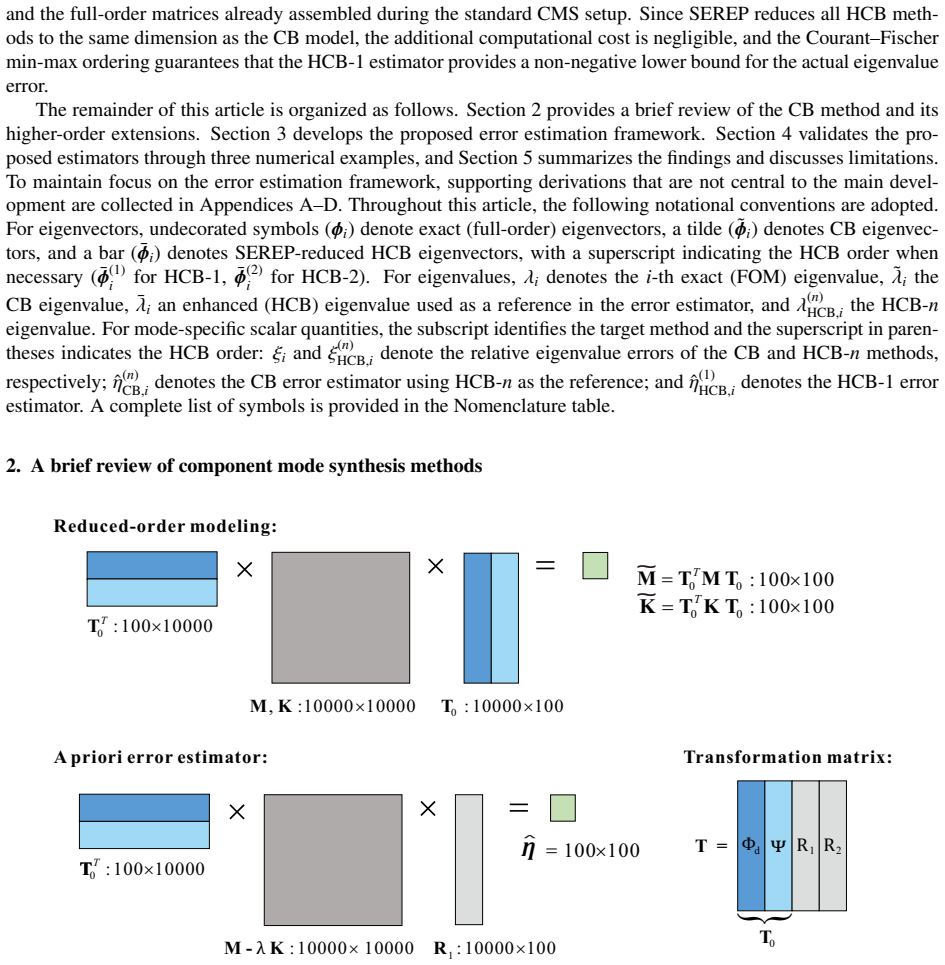
The engine is the nested Ritz subspace hierarchy $\mathcal{R}(T_{\mathrm{CB}}) \subset \mathcal{R}(T_{\mathrm{HCB-1}}) \subset \mathcal{R}(T_{\mathrm{HCB-2}})$, built by augmenting the CB basis with Neumann-series residual modes and then compressing back to CB dimension with SEREP. The auxiliary matrix $G(\mu)=M_p-\mu^{-1}K_p$ converts the Rayleigh-quotient perturbation terms into products of already-assembled full-order matrices, so the estimator needs only reduced eigenpairs plus matrices that exist from the CMS setup. The HCB-1 estimator's derivation relies on a rank-1 mass-orthogonal projection of each HCB-2 eigenvector onto the corresponding HCB-1 eigenvector, with mode-correspondence coefficient $c_i\approx 1$; this makes all stiffness cross-terms cancel, leaving the estimator as a pure eigenvalue difference. Courant–Fischer min-max ordering then guarantees that difference is non-negative, so the HCB-1 estimate is a true lower bound on the actual relative error.
What would settle it
Compute the true relative errors for a substructuring configuration where the highest tracked eigenvalue is deliberately placed near the smallest discarded substructure frequency (for example, retaining only five normal modes per component in the reactor pressure vessel model); the estimator-to-truth ratios should drop markedly below 0.85 for the HCB-1 estimator and below 0.76 for the CB estimator on those modes, directly falsifying the claimed validity range.
Extended reading notes
Core claim
The paper's central claim is that the relative eigenvalue error of a Craig–Bampton reduced model can be predicted by the formula $\hat{\eta}^{(n)}_{\mathrm{CB},i} = 2\,\bar{\phi}_i^T T_0^T G(\bar\lambda_i) T_r \bar\phi_i + \bar\phi_i^T T_r^T G(\bar\lambda_i) T_r \bar\phi_i$, where $G(\mu)=M_p-\mu^{-1}K_p$ is built from the already-assembled full-order matrices, $T_0$ and $T_r$ split the HCB transformation into its CB-like base and its residual correction, and $(\bar\lambda_i,\bar\phi_i)$ is the $i$-th HCB-$n$ eigenpair after SEREP compression. For the HCB-1 model itself, it claims that the relative eigenvalue error is estimated by $\hat{\eta}^{(1)}_{\mathrm{HCB},i} = (\lambda^{(1)}_{\mathrm{HCB},i}-\lambda^{(2)}_{\mathrm{HCB},i})/\lambda^{(2)}_{\mathrm{HCB},i}$, a non-negative lower bound that follows from the nested Ritz subspaces and a rank-1 mass-orthogonal projection that cancels all stiffness cross-terms. In validation runs on a cantilever plate, a 90-degree elbow pipe, and a reactor pressure vessel, the CB estimator tracks true errors with ratios mostly between 0.76 and 1.06, while the HCB-1 estimator stays between 0.85 and 0.99, and the full-order eigenproblem is never solved.
Load-bearing premise
Everything rests on the target mode sitting comfortably below the lowest frequency of the modes discarded in each substructure—only then does the Neumann-series expansion converge fast enough that HCB-2 is a much better model than HCB-1, and the estimates' accuracy collapses as this gap narrows.
Editorial extensions
If this is right
- Users of CB and HCB reduced models can estimate per-mode relative eigenvalue errors from data they already have—the reduced eigenpairs and assembled full matrices—so no full-order solve is needed for certification.
- Because HCB-1 and HCB-2 are compressed to the same dimension as CB, the extra cost of the HCB-1 estimator is just the mode-correspondence coefficients plus a few dense products, negligible compared with the reduced solves.
- The HCB-1 estimator is a consistent slight underestimate (lower bound) guaranteed by the monotone eigenvalue ordering, so reported errors will not silently flip sign.
- For high modes where CB errors are large, using a higher-order HCB reference (HCB-2 or beyond) should restore estimation accuracy, since the leading-order denominator approximation $u_0^T M_p u_0 \approx 1$ is what degrades.
- The framework turns the HCB hierarchy into a practical certification and basis-sizing tool, which the paper identifies as a promising route to automated adaptive mode selection for digital-twin applications.
Reading between the lines
- Inference: the HCB-1 estimator's shortfall is controlled by the ratio $\xi_{\mathrm{HCB-2}}/\hat{\eta}$ through Eq. (53), so iterating the hierarchy one more step could yield a corrected, tighter a priori bound without ever solving the full-order problem.
- Inference: the same hierarchical eigenvalue-difference logic should transfer to other nested projection-based reduced models—dual Craig–Bampton, automated multilevel substructuring, or enriched POD bases—wherever Courant–Fischer min-max ordering holds.
- Inference: the mode-correspondence coefficient $c_i$ could serve as a cheap reliability indicator, warning users when closely spaced or repeated eigenvalues break the one-to-one mode mapping before the estimator is trusted.
- Inference: the CB estimator's $O(N_b^2)$ dense cross-product cost points to interface reduction as a natural companion; combining the two would make the estimator affordable for industrial models with very large boundary DOF counts.
Editorial analysis
A structured set of objections, weighed in public.
Referee Report
Summary. The paper proposes a priori error estimators for the Craig-Bampton (CB) and higher-order Craig-Bampton (HCB) reduced-order models. The CB estimator, Eq. (42), is derived from a Rayleigh quotient perturbation analysis that decomposes an HCB eigenvector into a base (CB-like) part and a residual part, and the HCB-1 estimator, Eq. (50), is the relative eigenvalue gap between HCB-1 and HCB-2, justified by the nested Ritz subspace structure and Courant-Fischer monotonicity. The estimators require only reduced-order eigenpairs and already-assembled full-order matrices, not the full-order eigenpairs. Numerical experiments on a cantilever plate, an elbow pipe, and a reactor pressure vessel report estimation ratios close to 1 for many modes, with degradation for some high modes and for modes where the Neumann-series convergence is slow.
Significance. The hierarchical estimation idea is genuinely useful: it turns the nested HCB hierarchy into an error reference, avoids solving the full-order eigenproblem, and the HCB-1 estimator has a clean non-negativity property from min-max ordering. The appendices provide a consistent derivation of the residual flexibility, the coupled inertia force, and the decomposition-based estimator, which are reproducible and give confidence in the algebra. If the CB estimator's high-mode limitation were resolved, the framework would offer practitioners a practical, low-cost accuracy indicator for CMS-based ROMs. The paper also honestly reports the per-mode estimation ratios and the Neumann-series convergence dependence, which is commendable.
major comments (2)
- [Appendix D, Remark 2, and Section 4] The central validation claim for the CB estimator is not secured for the modes where the estimator is most needed. The derivation of Eq. (D5) invokes the leading-order approximation u0,i^T M_p u0,i ≈ 1, and the numerical results in Section 4 show exactly where this fails: for the cantilever plate the CB estimator ratio degrades to 0.76 for modes 11–20, and for the pipe to 0.93. The paper's own Remark 2 acknowledges that the exact-denominator variant η_ex_CB,i removes this approximation but states that validation of this variant is left for future work. Consequently, the abstract's statement that both estimators are validated is an overstatement; the current evidence validates Eq. (42) only under favorable conditions (small residual component), and the regime of large CB errors, where an error certificate is most valuable, is left without validated support. The authors should either validate the exact-denominator variant numerically for the high-mode cases or explicitly restrict the claim to the regime u0,i^T M_p u0,i ≈ 1 and provide the condition under which the estimator can be trusted.
- [Section 3.3, page 10] The statement that evaluating Eq. (50) requires only the HCB-1 and HCB-2 reduced-order eigenvalues, 'both of which are obtained by solving reduced eigenvalue problems of the same size as the CB model', is incorrect for the HCB-2 reference. As Eq. (31) shows, constructing the HCB-2 SEREP projection requires solving the augmented HCB-2 eigenvalue problem of size n_CB + 2N_b (sum N_d + 3N_b), not the CB size n_CB; only after SEREP is the final reduced eigenproblem of size n_CB. This misstates the computational overhead of the HCB-1 estimator and undermines the claim that the additional cost is negligible. The overhead discussion in Section 4 and Table 7 should be revised to reflect the true size of the HCB-2 augmented solve, which grows with N_b.
minor comments (4)
- [Eq. (14)] The definition of the coupled inertia force contains a typographical symbol 'B' where an equality sign is intended; it should read M_hat_c = M_ss Ψ_b + M_sb.
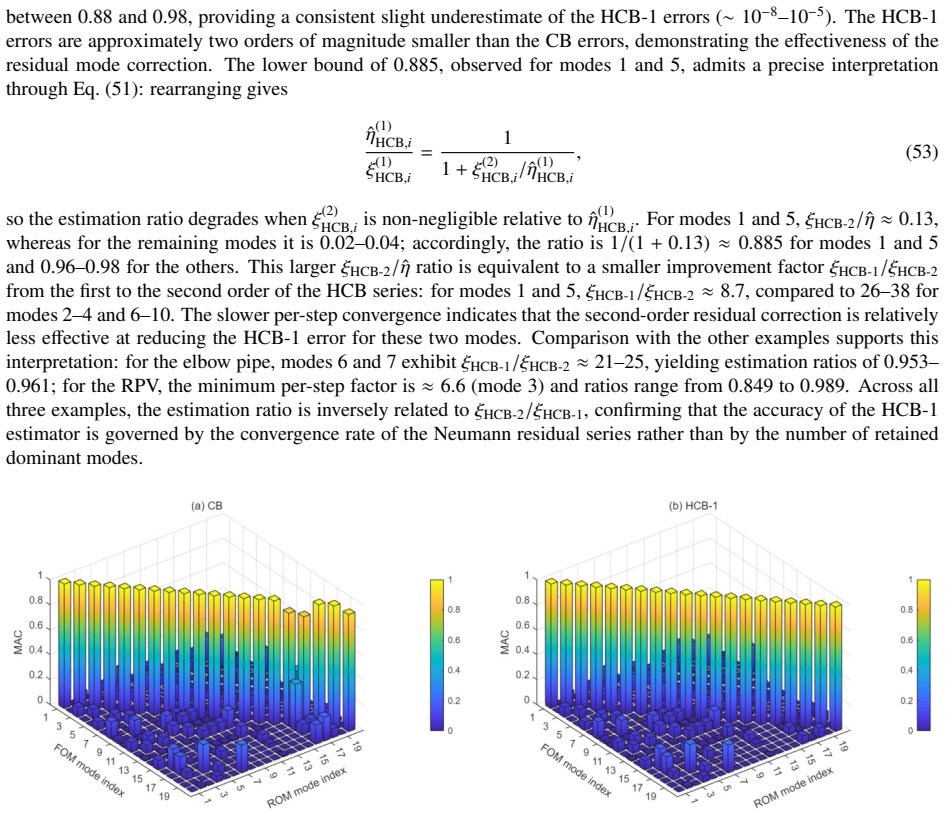
- [Figure 4 and Table 2] The caption of Figure 4 reports CB estimator ratios in the range 0.76–1.00 for all 20 modes, while Table 2, which lists only the first 10 modes, shows ratios 0.94–1.00. The text should reconcile the full-mode range with the table and state that the reported degradation occurs for modes 11–20.
- [Section 4, Table 7] The HCB-2 row is listed as a shared cost 'required for ROM', but HCB-2 is not needed to compute the CB estimator in Eq. (42) with n=1; it is only needed for the HCB-1 estimator of Eq. (50). The cost attribution in Table 7 would be clearer if the HCB-2 solve were separated according to which estimator it supports.
- [Section 3.3, Eq. (51)] The sentence 'providing a slight underestimate (lower bound) of the true HCB-1 error' is only proved for the case ξ_HCB-2,i ≥ 0, which follows from the min-max ordering; it would be helpful to state explicitly that the lower-bound property relies on the ordering in Eq. (44) and on the same mode correspondence being maintained between HCB-1 and HCB-2.
Circularity Check
No significant circularity: the estimators are hierarchical comparisons of successive reduced-order solutions, not fits or tautologies.
full rationale
The central derivations are self-contained rather than circular. The CB estimator in Eq. (42) is obtained in Appendix D by a Rayleigh-quotient perturbation analysis of the decomposition u_i = u_0,i + u_r,i, and the HCB-1 estimator in Eq. (50) is derived via the rank-1 mass-orthogonal projection in Eqs. (45)-(49); it reduces to the relative difference of the HCB-1 and HCB-2 eigenvalues because the stiffness cross-terms cancel exactly. No free parameter is fitted to the target eigenvalue errors, and no predicted quantity is used as its own input: the HCB-2 eigenpairs serve as an independent, higher-order reference, and the estimator is explicitly shown in Eq. (51) to be (xi_HCB1 - xi_HCB2)/(1 + xi_HCB2), a lower bound, not an identity defining xi_HCB1. Validation is performed against external full-order-model eigenvalues in Tables 2, 4, and 6, so the numerical claims are not self-confirming. The self-citations to the authors' earlier HCB paper [15] and earlier CB estimator [23] do not carry the load: the Neumann-series residual flexibility and the nested-subspace inclusion are restated and derived in Eqs. (16)-(19) and (43), and the Courant-Fischer ordering is cited to standard texts [27-29]. The acknowledged limitations (Remark 2 on the breakdown of u_0^T M_p u_0 approx 1 for high plate modes with ratios as low as 0.76, and the HCB-1 estimator's consistent underestimation at 0.85-0.99) are honest correctness caveats rather than circular steps; the exact-denominator variant is explicitly left for future work, which further supports the absence of any disguised circularity.
Assumptions & free parameters
free parameters (2)
- Retained dominant mode counts N_d^(k) =
10, 10, 8 (plate); 15, 15, 15 (pipe); 15, 15, 15 (RPV)
- Residual mode column normalization (L2) =
unit L2 norm
assumptions (6)
- domain assumption Neumann series expansion (Eq. 16) converges, requiring the eigenvalue of interest λ < min(diag(Λ_r)) for each substructure
- standard math Nested subspace structure and Courant-Fischer min-max principle imply monotone eigenvalue ordering (Eq. 44)
- domain assumption One-to-one mode correspondence between successive HCB levels (c_i ≈ 1 in Eq. 45)
- domain assumption Leading-order approximation u0^T M_p u0 ≈ 1 in Appendix D
- standard math SEREP preserves the augmented eigenvalues for the retained modes
- standard math Spectral decomposition identities for residual flexibility (Eqs. 18-19)
Cite this review
Pith. "Pith review of A priori error estimator for reduced-order models based on the higher-order Craig-Bampton method in dynamic substructuring." pith.science (2026). https://pith.science/paper/5HEQZQDG
@misc{pith2026260805625,
  author       = {Pith},
  title        = {Pith review of: A priori error estimator for reduced-order models based on the higher-order Craig-Bampton method in dynamic substructuring},
  year         = {2026},
  howpublished = {\url{https://pith.science/paper/5HEQZQDG}},
  note         = {Machine review of arXiv:2608.05625}
}
read the original abstract
The Craig-Bampton (CB) method is a widely used dynamic substructuring technique based on component mode synthesis (CMS). The higher-order Craig-Bampton (HCB) method augments the CB basis with residual modes from a Neumann series expansion of the residual flexibility matrix, where HCB-n retains terms up to the n-th order and is reduced back to the CB size via the System Equivalent Reduction Expansion Process (SEREP), achieving improved accuracy at the same model dimension. However, assessing the accuracy of a reduced model without solving the full-order problem remains a fundamental challenge: if the full-order solution is required to evaluate the error, the purpose of model reduction is defeated. Despite the demonstrated superiority of the HCB method, no a priori error estimator (one that predicts eigenvalue errors without solving the full-order eigenvalue problem) has been proposed for it. The present work addresses this gap with a hierarchical estimation framework that exploits the nested Ritz subspace structure of the HCB method, where each higher-order solution serves as a reference for estimating the error of the preceding order. The framework provides (i) a generalized CB error estimator derived from a Rayleigh quotient perturbation analysis, and (ii) a novel HCB-1 error estimator using the HCB-2 eigensolution as a reference. Numerical examples across models of varying geometric complexity validate both estimators.
Figures

Figures from the paper (7 more)


Reference graph
Works this paper leans on
- [23]
-
[1]
M. Torzoni, M. Tezzele, S. Mariani, A. Manzoni, K. E. Willcox, A digital twin framework for civil engineering structures, Computer Methods in Applied Mechanics and Engineering 418 (2024) 116584.doi:10.1016/j. cma.2023.116584
- [2]
-
[3]
M. G. Kapteyn, D. J. Knezevic, D. B. P. Huynh, M. Tran, K. E. Willcox, Data-driven physics-based digital twins via a library of component-based reduced-order models, International Journal for Numerical Methods in Engineering 123 (13) (2022) 2986–3003.doi:10.1002/nme.6423. 23
doi:10.1002/nme.6423 2022
-
[4]
J. Toivanen, P. Avery, C. Farhat, A multilevel FETI-DP method and its performance for problems with billions of degrees of freedom, International Journal for Numerical Methods in Engineering 116 (10–11) (2018) 661–682. doi:10.1002/nme.5938
-
[5]
K. Lu, K. Zhang, H. Zhang, X. Gu, Y . Jin, S. Zhao, C. Fu, Y . Yang, A review of model order reduction methods for large-scale structure systems, Shock and Vibration 2021 (2021) 6631180.doi:10.1155/2021/6631180
-
[6]
Y . Sun, Y . Lu, Z. Song, Review on the theories and applications of dynamic condensation and component mode synthesis methods in solving fem-based structural dynamics, Acta Mechanica Solida Sinica 36 (3) (2023) 361– 389
work page 2023
-
[7]
M. Kim, J. Jeong, J. Kim, PDE-constrained optimization for virtual sensing in structural dynamics: Full-field displacement and force recovery from sparse sensors, arXiv preprint arXiv:2606.29349 (2026)
work page Pith review arXiv 2026
Show all 30 references
-
[8]
S. Weng, H. Zhu, Y . Xia, J. Li, W. Tian, A review on dynamic substructuring methods for model updating and damage detection of large-scale structures, Advances in Structural Engineering 23 (3) (2020) 584–600
2020
-
[9]
H. Zhu, J. Li, W. Tian, S. Weng, Y . Peng, Z. Zhang, Z. Chen, An enhanced substructure-based response sen- sitivity method for finite element model updating of large-scale structures, Mechanical Systems and Signal Processing 154 (2021) 107359
2021
-
[10]
Mencik, N
J.-M. Mencik, N. Bouhaddi, Dynamic reanalysis of structures with geometric variability and parametric uncer- tainties via an adaptive model reduction method, Mechanical Systems and Signal Processing 190 (2023) 110127
2023
-
[11]
R. R. Craig, Jr, M. C. Bampton, Coupling of substructures for dynamic analyses, AIAA Journal 6 (7) (1968) 1313–1319
1968
-
[12]
W. Tian, S. Weng, Y . Xia, H. Zhu, F. Gao, Y . Sun, J. Li, An iterative reduced-order substructuring approach to the calculation of eigensolutions and eigensensitivities, Mechanical Systems and Signal Processing 130 (2019) 361–377
2019
-
[13]
R. W. Hagos, J.-H. Han, Modified iterative-order-reduction substructuring method with interface boundary re- duction, AIAA Journal 61 (12) (2023) 5558–5570
2023
-
[14]
R. W. Hagos, S. Chang, A review of the accuracy of primal assembly model order reduction techniques, Multi- scale Science and Engineering 4 (4) (2022) 179–201
2022
-
[15]
Kim, S.-H
J. Kim, S.-H. Boo, P.-S. Lee, Considering the higher-order effect of residual modes in the Craig–Bampton method, AIAA Journal 56 (1) (2017) 403–412.doi:10.2514/1.J055666
2017 doi
-
[16]
O’Callahan, P
J. O’Callahan, P. Avitabile, R. Riemer, System equivalent reduction expansion process (SEREP), in: Proceedings of the 7th International Modal Analysis Conference, 1989, pp. 29–37
1989
-
[17]
Elssel, H
K. Elssel, H. V oss, An a priori bound for automated multilevel substructuring, SIAM Journal on Matrix Analysis and Applications 28 (2) (2007) 386–397
2007
-
[18]
G. Wang, Y . Wang, Z. Chen, F. Wang, S. Li, X. Cui, A gpu-accelerated automated multilevel substructuring method for modal analysis of structures, Computers & Structures 305 (2024) 107516
2024
-
[19]
G. Wang, Y . Wang, X. Hu, X. Cui, X. Yu, S. Liu, Fine-grained parallelization of automated multilevel substruc- turing method for modal frequency response analysis, Computers & Structures 319 (2025) 108003
2025
-
[20]
G. Wang, Y . Wang, X. Hu, X. Cui, X. Yu, S. Liu, A hybrid openmp/mpi parallel automated multilevel substruc- turing method for finite element modal analysis, Computational Mechanics (2026) 1–18
2026
-
[21]
Jakobsson, M
H. Jakobsson, M. G. Larson, A posteriori error analysis of component mode synthesis for the elliptic eigenvalue problem, Computer Methods in Applied Mechanics and Engineering 200 (41–44) (2011) 2840–2847. 24
2011
-
[22]
Hetmaniuk, R
U. Hetmaniuk, R. B. Lehoucq, A review of some domain decomposition methods for eigenvalue problems, SIAM Review 52 (2) (2010) 171–199
2010
-
[24]
Boo, J.-G
S.-H. Boo, J.-G. Kim, P.-S. Lee, A simplified error estimator for the CB method and its application to error control, Computers & Structures 164 (2016) 53–62
2016
-
[25]
J.-H. Kim, J. Kim, P.-S. Lee, Improving the accuracy of the dual Craig–Bampton method, Computers & Struc- tures 191 (2017) 22–32
2017
-
[26]
F. M. Gruber, D. J. Rixen, Dual Craig–Bampton component mode synthesis method for model order reduction of nonclassically damped linear systems, Mechanical Systems and Signal Processing 111 (2018) 678–698
2018
-
[27]
Courant, D
R. Courant, D. Hilbert, Methods of Mathematical Physics, V ol. 1, Wiley-Interscience, New York, 1953
1953
-
[28]
B. N. Parlett, The Symmetric Eigenvalue Problem, SIAM, Philadelphia, 1998
1998
-
[29]
G. H. Golub, C. F. Van Loan, Matrix Computations, 4th Edition, Johns Hopkins University Press, Baltimore, 2013
2013
-
[30]
Pastor, M
M. Pastor, M. Binda, T. Har ˇcarik, Modal assurance criterion, Procedia Engineering 48 (2012) 543–548. 25
2012
Reviewed August 8, 2026 · model on record in the stance chip above.
Discussion (0). Continue with ORCID to comment.