REVIEW 4 major objections 4 minor 59 references
SEAM: Global consistency beyond local accuracy in scientific machine learning
T0 review · 4 major / 4 minor · reviewed 2026-08-08 · deepseek-v4-flash
Pith's one-line read Explanation-admissibility is exactly computable as a single defect vector, and SEAM-Ω turns that vector into a scientific verdict.
desk verdict A coherent sheaf-based audit for global consistency of scientific explanations, with an exact-feasibility verdict that is honest but narrowly applicable to noiseless channel-concentrated cases. read the letter →
The pith
A machine-rendered reading of the paper's core claim, the machinery that carries it, and where it could break.
The reading
What carries the argument
The central object is the finite explanation sheaf and its 1-cochain obstruction $\omega = D s$. Each region carries a stalk partitioned into state, closure, and observation channels, with optional contract metadata; each overlap carries an overlap stalk, and the hand-crafted linear restriction maps $\rho_{i,ij}$ extract the quantities that must agree. Under Assumption A0 the restrictions are block-diagonal per channel, so the channel decomposition of $\omega$ commutes with the coboundary. The argument is carried by exact conditions: admissibility is $\omega = 0$, a budgeted hypothesis $P$ survives exactly when $\omega \in \operatorname{im}(D P)$, and the closed-form minimum-cost repair uses the restricted pseudoinverse $A_P^+$ of Theorem 1, with the blind admissible subspace $\ker D \cap \ker O$ recording what observations cannot resolve.
What would settle it
Run the same backend through a three-region cover whose explanations agree on every pair but violate a constraint that only appears when all three regions are considered together, and with all restrictions block-diagonal; if SEAM-Ω reports $\omega = 0$ while the triple-overlap mismatch exists, the pairwise 1-skeleton verdict is incomplete.
Extended reading notes
Core claim
The central claim, stated on the paper's own terms, is that the local-to-global consistency of scientific explanations is exactly certifiable as linear algebra. Given a cover of regions, stacked explanations $s$, and restriction maps assembled into a coboundary matrix $D$, the obstruction $\omega = D s$ vanishes if and only if neighboring restrictions agree on every overlap, so $\omega$ is the exact certificate of admissibility rather than a heuristic score. When $\omega \neq 0$, the block-diagonal channel structure of the restrictions splits $\omega$ into state, closure, and observation components; the budgeted intervention theorem then tests each declared account by checking whether the revisions that account permits can remove the whole obstruction, i.e., whether $\omega \in \operatorname{im}(D P)$, with the minimum-cost repair given in closed form by a pseudoinverse. The paper also claims that identifiability separates inconsistency from directions the observations cannot see, and that the streaming obstruction tracks learned generators under distribution shift, as evidenced by nineteen experiments including the Fourier neural operator monitoring study.
Load-bearing premise
The framework stands or falls on the modeling premise that a real backend's local explanation can be faithfully represented as a finite vector with state, closure, and observation blocks and that all relevant inconsistencies appear on pairwise overlaps, a restriction the paper itself declares.
Editorial extensions
If this is right
- A SEAM audit can certify global admissibility of a deployed scientific model family in closed form, at the cost of one matrix-vector product once $D$ is assembled.
- Local validation, benchmark splits, and residual checks are no longer sufficient evidence of coherence; systems must also pass the overlap restriction test.
- Reported channel dominance converts a vague 'something is inconsistent' into a concrete localization: state, closure, or observation channel, and which overlaps carry the defect.
- Budgeted intervention turns diagnostic disagreement into a hypothesis test: a declared account is refuted if its permitted revisions cannot remove the whole obstruction, and priced by its minimum feasible repair cost.
- The streaming obstruction $\omega(t)$ provides a distribution-shift monitor for learned operators that correlates with prediction error and is cheaper than ensemble-variance baselines.
Reading between the lines
- Editorial inference: the pairwise-overlap 1-skeleton is a declared limitation, so a natural next test is whether triple-overlap obstructions capture failures that pairwise agreement misses; the paper's own Section 11.1 leaves this open.
- Editorial inference: because the restriction maps are linear and the sheaf is finite, the construction generalizes immediately to heterogeneous backends (solvers, regressors, neural operators) once a common channel schema is fixed; a reader could apply it to multimodal sensor fusion.
- Editorial inference: the minimum-cost repair cost, while not a cross-account ranking, could serve as a quantitative measure of how much revision a surviving hypothesis demands, enabling comparisons of required interventions across repeated audits.
- Editorial inference: the identifiability subspace suggests a data-acquisition guideline: add observations that shrink $\ker D \cap \ker O$ before trust is placed in closure attributions.
Editorial analysis
A structured set of objections, weighed in public.
Referee Report
Summary. The paper introduces Scientific Explanation-Admissibility Machines (SEAM), a framework for auditing whether locally plausible scientific explanations can be assembled into a globally consistent account. The concrete instantiation SEAM-Omega represents each region by a finite-dimensional explanation stalk with state, closure, observation, and optional metadata channels; restriction maps compare neighboring explanations on pairwise overlaps; the coboundary matrix D assembles these restrictions; and the obstruction omega = D s measures the failure of global admissibility. The paper develops a channel-resolved diagnosis of omega, a budgeted intervention framework in which declared scientific hypotheses are represented as projection matrices P and tested by exact feasibility of omega in im(DP), an identifiability analysis based on ker D intersect ker O, and a streaming monitoring extension. The theoretical results include a closed-form minimum-cost intervention theorem (Theorem 1), identifiability dimension formulas (Proposition 7.2), closure-restricted recoverability (Corollary 7.3), and a conservation-contract detectability bound (Theorem 2). The empirical section reports nineteen experiments spanning synthetic PDEs, Fourier neural operator monitoring, four public datasets, and synthetic financial and industrial systems.
Significance. If the central claims hold, the paper offers a genuinely useful formal object: a computable, channel-resolved obstruction that separates local accuracy from global explainability, together with an auditable procedure for testing competing repair hypotheses. The theoretical core is straightforward and mostly correct: the definitions of the coboundary and obstruction are standard, the pseudoinverse-based feasibility and minimum-cost formulas in Theorem 1 are properly derived, and the identifiability and closure-recovery statements follow from elementary linear algebra. The paper is also commendably explicit about its assumptions: Assumption A0 (block-diagonal channel restrictions) and Assumption A3 (the conditions of Theorem 2) are stated, and Section 11.1 openly declares the pairwise-overlap limitation. The experimental protocol is unusually detailed about seeds, tolerances, and data provenance, and the zero-floor control and monotonicity sweep are useful sanity checks.
major comments (4)
- [§9.3.1] The hidden-source recovery experiment is circular as a validation of closure recoverability. The setup states that 'the local explanation emits a closure-summary block measuring the missing-source residual on the overlap' and that 'this block is audited through the closure restriction.' In other words, the injected source is encoded in the very channel whose recovery is then reported. It is therefore not surprising that the closure channel contributes 99.9992% of ||omega||^2 and that the closure repair succeeds. The experiment would be informative only if the backend's closure block were not defined as the missing-source residual, for example if the source were injected into the state dynamics while the closure block is learned or is a generic closure parameter. As written, the claim 'missing closure is recoverable' is built into the data-generation step rather than demonstrated by the audit.
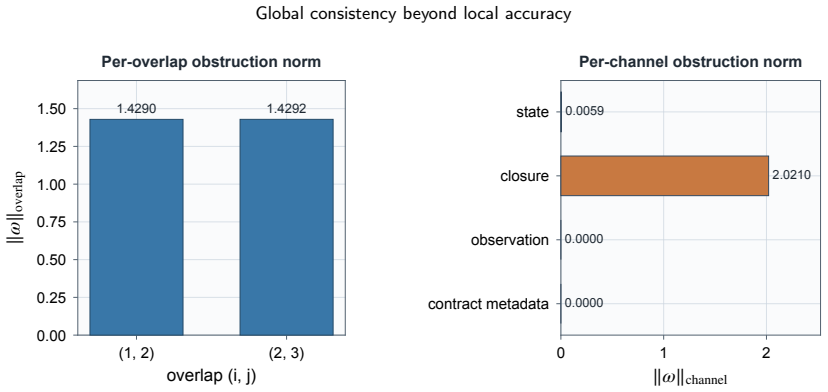
- [Definition 2.5; Algorithm 2; §9.3.1; §9.4] The advertised decisive branch of the framework—exact feasibility, omega in im(DP), refuting or retaining a declared account—is fragile under realistic noise and discretization. Under Assumption A0, a single-channel hard budget is feasible only when the obstruction components in all other channels vanish exactly. Real scientific explanations are noisy, discretized, and approximate, so every channel generically carries a nonzero component; the formal verdict then falls into the 'unresolved by the declared specific accounts' branch. The paper's own experiments illustrate this. In §9.3.1, the saved obstruction has a state-channel norm of 0.005873 alongside the closure-channel norm of 2.020986, so the exact closure-revision budget is infeasible by the strict definition; the paper switches to a projected reconstruction with residual below 5%. In §9.4, the data–physics conflict attribution uses soft squared intervention norms because exact single-channel hard costs are +infinity whenever non-target components are nonzero. The manuscript does not report a single real-data or realistically noisy experiment in which the exact branch returns a definitive retain/refute verdict. This does not invalidate the theorems, which are correct conditional statements, but it means the central operational claim of the abstract and Section 1 is not supported by the evidence. The paper should either demonstrate the exact branch on data with realistic noise, or explicitly and prominently characterize the exact branch as a noiseless/synthetic-only guarantee and present the soft records as the primary practical output.
- [§9.8.2 and §6] The FNO OOD monitoring experiment shows a strong correlation between ||omega(t)|| and the reference L2 error, but this is an uncalibrated empirical association, not a detection guarantee, and the exact feasibility branch plays no role in the monitoring use case. The paper does state in §6 that 'SEAM does not assign a universal alarm threshold' and in §9.8.2 that the experiment 'does not establish a calibrated probabilistic detector.' That honesty is appreciated. Still, the abstract's claim that 'SEAM detects incompatible explanations even when local predictions are accurate' is repeatedly supported by correlation-style evidence rather than by a decision procedure with controlled error rates. A revision should either add threshold-based detection evaluation (e.g., ROC or precision-recall against injected shifts) or consistently phrase the monitoring claim as 'correlates with' rather than 'detects.'
- [Section 3.4 and Section 11.1] The framework's validity depends on Assumption A0 and on the modeling premise that a backend's local explanation can be faithfully represented as a finite-dimensional vector with block-diagonal linear restriction maps. The paper declares this limitation in Section 11.1, which is appropriate. However, the consequences for the channel diagnostics are stronger than the discussion suggests: if a backend's explanation contains cross-channel coupling, or if inconsistencies arise only in triple-overlap interactions, then every channel-dominance report and every budgeted verdict built on the 1-skeleton and block-diagonal restrictions can be incomplete or misleading. The manuscript should state explicitly, in the introduction and in the interpretation guide, that all channel diagnoses and budget verdicts are conditional on these representational choices, not merely on the pairwise-overlap approximation.
minor comments (4)
- [Definition 3.9] The definition of the hard residual writes r_hard_P(omega) = omega - (DP)(DP)^+ omega in ker(DP)^ op; the notation 'ker(DP)^ op' is nonstandard. It should be the orthogonal complement of the range of DP, or equivalently ker((DP)^ op). This is a notation issue, not a mathematical error.
- [Section 2.3, Definition 2.5] The piecewise verdict in Definition 2.5 uses tau_zero for the global admissibility branch, but no guidance is given for choosing tau_zero in practice, even though the later experiments fix it at 10^-6. Since the exact branch is so sensitive to tiny nonzero components, a short paragraph on how to set tau_zero relative to discretization error or sensor noise would materially improve the operational usefulness.
- [Appendix E.1] The seed protocol is described as 'a fixed set of n = 5 seeds,' and deterministic experiments are said to be 'executed across the same schedule.' This is acceptable, but the notation '0.0266±0.0000' for a deterministic result is confusing; it would be clearer to report deterministic results as exact values and reserve plus-minus notation for genuinely stochastic quantities.
- [Section 9.7.1] The random-sinusoid Burgers stress test reports ||omega|| = 0.4754±0.0000, but the reader is not told what the obstruction norm would be if the same generator produced a globally admissible family. Without an admissibility control for the same random-sinusoid family, the experiment demonstrates that omega is nonzero but not that it is informative as a stress test.
Circularity Check
Hidden-source recovery and closure-feasibility are by-construction: the closure block is defined as the missing-source residual, so the recovered source is a pseudoinverse of its own input.
-
fitted input called prediction
[Section 9.3.1 (Hidden-source recovery for Burgers), Setup and Results]
"the local explanation emits a closure-summary block measuring the missing-source residual on the overlap. ... The closure-channel recovery module computes the Moore–Penrose projected correction δ⋆_C; under the sign convention, the recovered physical source increment is −δ⋆_C."
By Corollary 7.3, for any raw defect ω = Ds, the closure-channel obstruction is automatically ω_closure = D_C s_C. In this experiment, s_C is defined as the missing-source residual. Therefore the recovered source increment −δ⋆_C = −D_C^+ ω_closure is just the Moore–Penrose inverse applied to the very residual that was placed in the closure block. The 'recovery' verifies that a pseudoinverse can invert the linear map that generated its own right-hand side; it does not provide independent evidence that SEAM infers hidden physics from overlap disagreement. The reported peak accuracy (0.501 vs 0.5) reflects the resolution of the closure-summary encoding, not an independent discovery of the source.
-
self definitional
[Section 4.3 (Closure-restricted repair), after Corollary 7.3]
"For a raw SEAM-Ω defect ω=Ds, that image condition holds automatically, since ω_closure = D_C s_C for the closure-channel component s_C of s, so the closure repair needs no separate image-membership test."
This statement makes closure-repair feasibility an algebraic identity rather than an empirical hypothesis: every raw defect's closure channel is in the image of D_C by construction of ω_closure. In the hidden-source experiment, the closure channel is nonzero because the missing-source residual was deliberately placed in the closure block, so the 'missing-physics account survives' by definition of the experimental construction. The closure account is never at risk of refutation in this setup, and the experiment therefore cannot validate the claim that the closure channel captures the true cause of the disagreement.
full rationale
The formal framework is largely self-contained: omega = D s is a definition, and Theorem 1, Proposition 7.2, Corollary 7.3, and Theorem 2 are proved from Moore–Penrose identities and stated assumptions (A0–A4). No load-bearing self-citation chain or imported uniqueness theorem appears; the paper does not rely on its own prior results. Most experiments are genuine external checks, including the FNO OOD correlation against a reference solver, zero-floor negative controls, and cross-framework audits on open datasets. However, the hidden-source recovery validation is circular by construction: the closure-summary block is defined as the missing-source residual, making omega_closure that residual by definition, and the recovered source profile is the pseudoinverse applied to that same quantity. Additionally, Corollary 7.3 states that closure-channel feasibility is automatic for raw defects, so the closure account in that experiment is retained by an identity rather than by empirical support. These are partial empirical circularities in a key validation, not deficiencies in the theorem-level mathematics. The overall circularity score is therefore 6: one or more 'predictions' reduce by construction while the central theoretical derivation remains independent.
Assumptions & free parameters
assumptions (5)
- ad hoc to paper A0: Restriction maps act block-diagonally across state, closure, observation, and metadata channels.
- domain assumption A1: Repairs are subtracted from stalk vectors, s_repaired = s - P delta_star.
- standard math A2: Cost metric C is positive definite on C^0(F).
- ad hoc to paper A3: For Theorem 2, baseline closure restrictions cancel on the overlap, the repair direction lies in the row space of the endpoint restriction, the neighbor contributes zero restricted repair, and the endpoint restriction has positive rank.
- domain assumption A4: Only pairwise overlaps, the 1-skeleton of the nerve, are considered.
Cite this review
Pith. "Pith review of SEAM: Global consistency beyond local accuracy in scientific machine learning." pith.science (2026). https://pith.science/paper/ZU66QYOA
@misc{pith2026260805702,
  author       = {Pith},
  title        = {Pith review of: SEAM: Global consistency beyond local accuracy in scientific machine learning},
  year         = {2026},
  howpublished = {\url{https://pith.science/paper/ZU66QYOA}},
  note         = {Machine review of arXiv:2608.05702}
}
abstract
Scientific machine learning commonly validates models at the level of a subdomain, a benchmark split, or an explanation for one prediction. Yet such local checks cannot establish whether the resulting explanations can be assembled into one globally admissible explanation. We introduce Scientific Explanation-Admissibility Machines (SEAM), a generator-agnostic framework that makes this local-to-global consistency question computable across regions, sensors, regimes, and model components. The finite explanation-sheaf instantiation SEAM-$\Omega$ represents each region by a structured explanation with state, closure, and observation channels together with optional contract metadata; compares neighboring explanations on their overlaps; and converts disagreement into a channel-resolved obstruction. This obstruction locates inconsistency and tests competing declared accounts by restricting each repair to the revisions that one account permits. Exact feasibility refutes or retains an account; when exact repair is unavailable, residual-aware regularized records provide a separately labeled empirical attribution. The framework also separates inconsistency from non-identifiability and monitors learned generators under distribution shift. We establish theorems for minimum-cost intervention and conservation-contract detectability, together with companion results for identifiability and closure recoverability. Across nineteen experiments involving synthetic partial differential equation systems and out-of-distribution Fourier neural operator (FNO) monitoring, SEAM detects incompatible explanations even when local predictions are accurate, and attributes failures to specific channels and overlaps. SEAM adds a global explanation-consistency audit to existing solvers and learning models, testing whether their local explanations form a coherent scientific account.
Figures


Figures from the paper (6 more)




Reference graph
Works this paper leans on
-
[1]
author Abramsky, S. , author Brandenburger, A. , year 2011 . title The sheaf-theoretic structure of non-locality and contextuality . journal New Journal of Physics volume 13 , pages 113036
work page 2011
-
[2]
author Bellman, R. , author str \"o m, K.J. , year 1970 . title On structural identifiability . journal Mathematical Biosciences volume 7 , pages 329--339
work page 1970
-
[3]
author Bodnar, C. , author Giovanni, F.D. , author Chamberlain, B.P. , author Li \' o , P. , author Bronstein, M.M. , year 2022 . title Neural Sheaf Diffusion: A Topological Perspective on Heterophily and Oversmoothing in GNNs , in: booktitle NeurIPS
work page 2022
- [4]
-
[5]
author Brynjarsd \'o ttir, J. , author O'Hagan, A. , year 2014 . title Learning about physical parameters: The importance of model discrepancy . journal Inverse Problems volume 30 , pages 114007
work page 2014
-
[6]
author Chen, J. , author Xu, W. , author Xu, Z. , author Guti \' e rrez, N.G. , author Narra, S.P. , author McComb, C. , year 2025 . title Enforcing the principle of locality for physical simulations with neural operators . journal J. Comput. Phys. volume 538 , pages 114131
work page 2025
-
[7]
author Chen, T. , author Guestrin, C. , year 2016 . title XGBoost: A Scalable Tree Boosting System , in: booktitle KDD , pp. pages 785--794
work page 2016
-
[8]
author Cont, R. , year 2001 . title Empirical properties of asset returns: stylized facts and statistical issues . journal Quantitative Finance volume 1 , pages 223
work page 2001
Show all 59 references
-
[9]
, year 2014
author Curry, J.M. , year 2014 . title Sheaves, cosheaves and applications
2014
-
[10]
, year 2016
author De Vito, S. , year 2016 . title Air Quality . howpublished https://doi.org/10.24432/C59K5F
2016 doi
-
[11]
, author Iaccarino, G
author Duraisamy, K. , author Iaccarino, G. , author Xiao, H. , year 2019 . title Turbulence modeling in the age of data . journal Annual Review of Fluid Mechanics volume 51 , pages 357--377
2019
-
[12]
, author Hanke, M
author Engl, H.W. , author Hanke, M. , author Neubauer, A. , year 1996 . title Regularization of inverse problems . volume volume 375
1996
-
[13]
, author Zliobaite, I
author Gama, J. , author Zliobaite, I. , author Bifet, A. , author Pechenizkiy, M. , author Bouchachia, A. , year 2014 . title A survey on concept drift adaptation . journal ACM Comput. Surv. volume 46 , pages 44:1--44:37
2014
-
[14]
, year 2014
author Ghrist, R.W. , year 2014 . title Elementary applied topology . volume volume 1
2014
-
[15]
, author Thule, C
author Gomes, C. , author Thule, C. , author Broman, D. , author Larsen, P.G. , author Vangheluwe, H. , year 2018 . title Co-Simulation: A Survey . journal ACM Comput. Surv. volume 51 , pages 49:1--49:33
2018
-
[16]
, author Pleiss, G
author Guo, C. , author Pleiss, G. , author Sun, Y. , author Weinberger, K.Q. , year 2017 . title On Calibration of Modern Neural Networks , in: booktitle ICML , pp. pages 1321--1330
2017
-
[17]
, author Gebhart, T
author Hansen, J. , author Gebhart, T. , year 2020 . title Sheaf Neural Networks . journal CoRR volume abs/2012.06333
2020 arXiv
-
[18]
, author Ghrist, R
author Hansen, J. , author Ghrist, R. , year 2019 . title Toward a spectral theory of cellular sheaves . journal J. Appl. Comput. Topol. volume 3 , pages 315--358
2019
-
[19]
, author Ghrist, R
author Hansen, J. , author Ghrist, R. , year 2021 . title Opinion Dynamics on Discourse Sheaves . journal SIAM J. Appl. Math. volume 81 , pages 2033--2060
2021
-
[20]
, author Berard, A
author H \' e brail, G. , author Berard, A. , year 2012 . title Individual household electric power consumption . howpublished https://doi.org/10.24432/C58K54
2012 doi
-
[21]
, author Li, W
author Hegde, A. , author Li, W. , author Oreluk, J. , author Packard, A.K. , author Frenklach, M. , year 2018 . title Consistency Analysis for Massively Inconsistent Datasets in Bound-to-Bound Data Collaboration . journal SIAM/ASA J. Uncertain. Quantification volume 6 , pages...
2018
-
[22]
, author Gimpel, K
author Hendrycks, D. , author Gimpel, K. , year 2017 . title A Baseline for Detecting Misclassified and Out-of-Distribution Examples in Neural Networks , in: booktitle ICLR
2017
-
[23]
, year 2019
author Hogue, J. , year 2019 . title Metro Interstate Traffic Volume . howpublished https://doi.org/10.24432/C5X60B
2019 doi
-
[24]
, author Karniadakis, G.E
author Jagtap, A.D. , author Karniadakis, G.E. , year 2021 . title Extended Physics-informed Neural Networks (XPINNs): A Generalized Space-Time Domain Decomposition based Deep Learning Framework for Nonlinear Partial Differential Equations , in: booktitle AAAI Spring Symposium: MLPS
2021
-
[25]
, author Kharazmi, E
author Jagtap, A.D. , author Kharazmi, E. , author Karniadakis, G.E. , year 2020 . title Conservative physics-informed neural networks on discrete domains for conservation laws: Applications to forward and inverse problems . journal Computer Methods in Applied Mechanics and En...
2020
-
[26]
, author Kevrekidis, I.G
author Karniadakis, G.E. , author Kevrekidis, I.G. , author Lu, L. , author Perdikaris, P. , author Wang, S. , author Yang, L. , year 2021 . title Physics-informed machine learning . journal Nature Reviews Physics volume 3 , pages 422--440
2021
-
[27]
, author O'Hagan, A
author Kennedy, M.C. , author O'Hagan, A. , year 2001 . title Bayesian calibration of computer models . journal Journal of the Royal Statistical Society: Series B (Statistical Methodology) volume 63 , pages 425--464
2001
-
[28]
, author Li, Z
author Kovachki, N.B. , author Li, Z. , author Liu, B. , author Azizzadenesheli, K. , author Bhattacharya, K. , author Stuart, A.M. , author Anandkumar, A. , year 2023 . title Neural Operator: Learning Maps Between Function Spaces With Applications to PDEs . journal J. Mach. L...
2023
-
[29]
, author Gholami, A
author Krishnapriyan, A.S. , author Gholami, A. , author Zhe, S. , author Kirby, R.M. , author Mahoney, M.W. , year 2021 . title Characterizing possible failure modes in physics-informed neural networks , in: booktitle NeurIPS , pp. pages 26548--26560
2021
-
[30]
, year 2002
author LeVeque, R.J. , year 2002 . title Finite volume methods for hyperbolic problems . volume volume 31
2002
-
[31]
, author Kovachki, N.B
author Li, Z. , author Kovachki, N.B. , author Azizzadenesheli, K. , author Liu, B. , author Bhattacharya, K. , author Stuart, A.M. , author Anandkumar, A. , year 2021 . title Fourier Neural Operator for Parametric Partial Differential Equations , in: booktitle ICLR
2021
-
[32]
, year 2020
author Lim, L. , year 2020 . title Hodge Laplacians on Graphs . journal SIAM Rev. volume 62 , pages 685--715
2020
-
[33]
, author Jin, P
author Lu, L. , author Jin, P. , author Pang, G. , author Zhang, Z. , author Karniadakis, G.E. , year 2021 . title Learning nonlinear operators via DeepONet based on the universal approximation theorem of operators . journal Nat. Mach. Intell. volume 3 , pages 218--229
2021
-
[34]
, author Markham, A
author Moseley, B. , author Markham, A. , author Nissen - Meyer, T. , year 2023 . title Finite basis physics-informed neural networks (FBPINNs): a scalable domain decomposition approach for solving differential equations . journal Adv. Comput. Math. volume 49 , pages 62
2023
-
[35]
, author Jordache, C
author Narasimhan, S. , author Jordache, C. , year 1999 . title Data reconciliation and gross error detection: An intelligent use of process data
1999
-
[36]
, author Fertig, E
author Ovadia, Y. , author Fertig, E. , author Ren, J. , author Nado, Z. , author Sculley, D. , author Nowozin, S. , author Dillon, J.V. , author Lakshminarayanan, B. , author Snoek, J. , year 2019 . title Can you trust your model's uncertainty? Evaluating predictive uncertain...
2019
-
[37]
, year 1954
author Page, E.S. , year 1954 . title Continuous inspection schemes . journal Biometrika volume 41 , pages 100--115
1954
-
[38]
, author Duraisamy, K
author Parish, E.J. , author Duraisamy, K. , year 2016 . title A paradigm for data-driven predictive modeling using field inversion and machine learning . journal J. Comput. Phys. volume 305 , pages 758--774
2016
-
[39]
, author Varoquaux, G
author Pedregosa, F. , author Varoquaux, G. , author Gramfort, A. , author Michel, V. , author Thirion, B. , author Grisel, O. , author Blondel, M. , author Prettenhofer, P. , author Weiss, R. , author Dubourg, V. , author VanderPlas, J. , author Passos, A. , author Cournapeau...
2011
-
[40]
, year 1955
author Penrose, R. , year 1955 . title A generalized inverse for matrices , in: booktitle Mathematical Proceedings of the Cambridge Philosophical Society , pp. pages 406--413
1955
-
[41]
, author Valli, A
author Quarteroni, A. , author Valli, A. , year 1999 . title Domain decomposition methods for partial differential equations
1999
-
[42]
, author G \" u nnemann, S
author Rabanser, S. , author G \" u nnemann, S. , author Lipton, Z.C. , year 2019 . title Failing Loudly: An Empirical Study of Methods for Detecting Dataset Shift , in: booktitle NeurIPS , pp. pages 1394--1406
2019
-
[43]
, author Ma, Y
author Rackauckas, C. , author Ma, Y. , author Martensen, J. , author Warner, C. , author Zubov, K. , author Supekar, R. , author Skinner, D. , author Ramadhan, A.J. , year 2020 . title Universal Differential Equations for Scientific Machine Learning . journal CoRR volume abs/...
2020 arXiv
-
[44]
, author Perdikaris, P
author Raissi, M. , author Perdikaris, P. , author Karniadakis, G.E. , year 2019 . title Physics-informed neural networks: A deep learning framework for solving forward and inverse problems involving nonlinear partial differential equations . journal J. Comput. Phys. volume 37...
2019
-
[45]
, author Kreutz, C
author Raue, A. , author Kreutz, C. , author Maiwald, T. , author Bachmann, J. , author Schilling, M. , author Klingm \" u ller, U. , author Timmer, J. , year 2009 . title Structural and practical identifiability analysis of partially observed dynamical models by exploiting th...
2009
-
[46]
, year 1987
author Reiter, R. , year 1987 . title A Theory of Diagnosis from First Principles . journal Artif. Intell. volume 32 , pages 57--95
1987
-
[47]
, year 2014
author Robinson, M. , year 2014 . title Topological signal processing . volume volume 81
2014
-
[48]
, year 2017 a
author Robinson, M. , year 2017 a. title Sheaf and duality methods for analyzing multi-model systems , in: booktitle Recent Applications of Harmonic Analysis to Function Spaces, Differential Equations, and Data Science: Novel Methods in Harmonic Analysis, Volume 2 , pp. pages 653--703
2017
-
[49]
, year 2017 b
author Robinson, M. , year 2017 b. title Sheaves are the canonical data structure for sensor integration . journal Inf. Fusion volume 36 , pages 208--224
2017
-
[50]
, year 2020
author Robinson, M. , year 2020 . title Assignments to sheaves of pseudometric spaces . journal Compositionality volume 2 , pages 2
2020
-
[51]
, author Perktold, J
author Seabold, S. , author Perktold, J. , year 2010 . title Statsmodels: Econometric and Statistical Modeling with Python , in: booktitle SciPy , p. pages 92
2010
-
[52]
, author Jagtap, A.D
author Shukla, K. , author Jagtap, A.D. , author Karniadakis, G.E. , year 2021 . title Parallel physics-informed neural networks via domain decomposition . journal J. Comput. Phys. volume 447 , pages 110683
2021
-
[53]
, author Praditia, T
author Takamoto, M. , author Praditia, T. , author Leiteritz, R. , author MacKinlay, D. , author Alesiani, F. , author Pfl \" u ger, D. , author Niepert, M. , year 2022 . title PDEBench: An Extensive Benchmark for Scientific Machine Learning , in: booktitle NeurIPS
2022
-
[54]
Geological Survey , year 2023
author U.S. Geological Survey , year 2023 . title USGS water data for the nation: US Geological Survey National Water Information System database
2023
-
[55]
, author Rengaswamy, R
author Venkatasubramanian, V. , author Rengaswamy, R. , author Yin, K. , author Kavuri, S.N. , year 2003 . title A review of process fault detection and diagnosis: Part I: Quantitative model-based methods . journal Comput. Chem. Eng. volume 27 , pages 293--311
2003
-
[56]
, author Pronzato, L
author Walter, E. , author Pronzato, L. , year 1997 . title Identification of Parametric Models from Experimental Data . address Berlin
1997
-
[57]
, year 1972
author Wedin, P. . , year 1972 . title Perturbation bounds in connection with singular value decomposition . journal BIT Numerical Mathematics volume 12 , pages 99--111
1972
-
[58]
, year 1973
author Wedin, P. . , year 1973 . title Perturbation theory for pseudo-inverses . journal BIT Numerical Mathematics volume 13 , pages 217--232
1973
-
[59]
, author Jia, X
author Willard, J. , author Jia, X. , author Xu, S. , author Steinbach, M.S. , author Kumar, V. , year 2023 . title Integrating Scientific Knowledge with Machine Learning for Engineering and Environmental Systems . journal ACM Comput. Surv. volume 55 , pages 66:1--66:37
2023
Reviewed August 8, 2026 · model on record in the stance chip above.
Discussion (0). Continue with ORCID to comment.