REVIEW 2 major objections 4 minor 10 references
BlockPython: A Process-Aware Agent-Supported Platform for the Transition from Block-Based to Python Programming
T0 review · 2 major / 4 minor · reviewed 2026-08-08 · deepseek-v4-flash
Pith's one-line read BlockPython claims to tell apart conceptual misunderstanding from Python syntax errors during the block-to-text transition.
desk verdict A coherent system-design report for block-to-text transition; the diagnostic core is plausible but unvalidated, so treat it as a design reference, not an evidence claim. read the letter →
The pith
A machine-rendered reading of the paper's core claim, the machinery that carries it, and where it could break.
The reading
What carries the argument
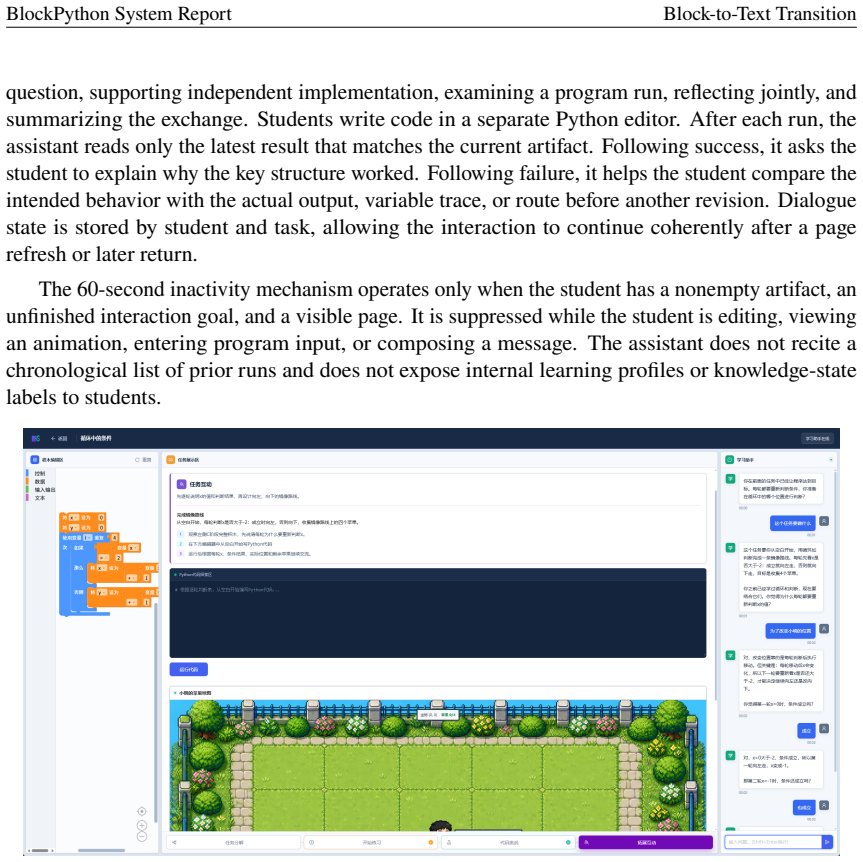
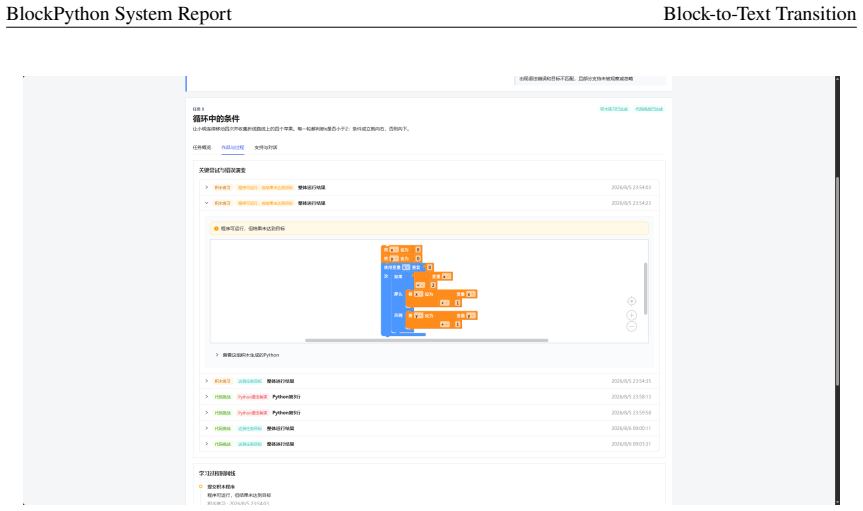
The central object is the four-stage learning workflow together with the continuous process-evidence pipeline. Blocks are translated into executable Python with a line-to-block mapping; authentic runtime events drive a visualization; and every run, help request, and artifact snapshot is recorded. The mechanism that carries the argument is the layering of a deterministic rule system below a learning assistant: rules evaluate, diagnose, and control stages, while the assistant only consumes verified evidence. On that basis the system classifies a learner's difficulty as concept-based or syntax-based and selects support accordingly.
What would settle it
Take a set of Code Challenge transcripts from real students, have expert teachers label each difficulty as conceptual or syntax-based, and compare those labels with BlockPython's deterministic diagnosis. A systematic disagreement—for example, cases where a missing colon is caused by not understanding the block it came from, or where correct syntax masks a wrong mental model—would show that the evidence pipeline does not separate the two difficulty types as claimed.
Extended reading notes
Core claim
The paper's core discovery is a platform architecture in which a deterministic rule system, not a language model, is the source of truth for student work. In BlockPython, students move through four stages—Task Decomposition, Block-Based Practice, Code Challenge, and Extended Interaction—and every stage leaves behind artifacts that are bound to a specific task, stage, and version. When a student writes blocks, the system generates executable Python and maps each code line to a source block; when the student writes Python, the same runtime records output, variables, branches, and loops. Diagnosis is therefore based on verified evidence: an incorrect program cannot be called correct, a stage cannot be unlocked by the assistant, and support responses that do not match the artifact are discarded. The claimed result is that difficulties in computational understanding can be distinguished from difficulties in Python expression, and that this distinction drives both the level of support and teacher-facing reports.
Load-bearing premise
The whole system depends on the recorded process evidence being enough to reliably tell a conceptual misunderstanding from a Python expression error; if a student's screen activity and chat do not carry that information, the adaptive support loses its grounding.
Editorial extensions
If this is right
- Teachers would receive per-task reports showing whether a student struggled with the computational concept or with Python syntax, with each conclusion traceable to a specific artifact or run.
- Learners who already understand a concept would get lighter, location-focused prompts, while learners with conceptual gaps would get explanations and micro-examples before more code is written.
- Because identical blocks and code can be compared across tasks, recurring difficulties and changes in reliance on support would show up automatically in a cross-task profile.
- Failures in the language-model service would not interrupt learning, since execution, evaluation, and stage control live in the deterministic layer.
- The same artifact-plus-runtime design is reusable in other block-to-text curricula, because success is judged by behavior, not by matching a reference solution.
Reading between the lines
- A natural extension would be to compare the platform's difficulty classification with human expert labels on the same student artifacts; the paper describes the data that would make this possible but does not report such a validation.
- If the distinction between conceptual and expressive difficulty proves reliable, the same evidence pipeline could be used to formatively assess other representational transitions, such as from visual or pseudocode to other text languages.
- The design implies a testable claim about scaffolding: that level-appropriate, evidence-tied prompts should reduce repeated identical errors more than unspecific hints would, and a controlled comparison against a non-process-aware tutor would separate the effect of the evidence pipeline from the effect of general assistance.
Editorial analysis
A structured set of objections, weighed in public.
Referee Report
Summary. BlockPython is a web-based platform designed to support lower-secondary students transitioning from block-based to text-based programming. It presents a four-stage workflow (Task Decomposition, Block-Based Practice, Code Challenge, Extended Interaction), uses bidirectional block-to-Python translation and program visualization, and combines a deterministic rule system with a learning assistant that uses continuously collected process evidence (block artifacts, code versions, run outcomes, support use, dialogue) to diagnose whether a learner's difficulty is conceptual or a Python-expression problem. The paper describes the platform architecture, six instructional tasks, evidence-collection and versioning mechanisms, and teacher-facing reports. No empirical data are reported; the paper is presented as a system-design reference.
Significance. If the paper's central diagnostic claim were supported, BlockPython would be a meaningful design contribution to an important transition problem in programming education. The architecture is coherent and contains several well-considered safeguards: the deterministic rule system is the source of truth for execution, evaluation, and stage control; language-model outputs are validated against current artifacts; run results are bound to artifact versions; and teacher reports preserve traceability to raw evidence. These features make the platform a credible substrate for future studies. However, the paper's value claim—that the collected process evidence identifies different difficulties in computational understanding and Python expression—is currently an unvalidated assumption. The recommended revision is therefore to provide a validation study of the diagnostic labels, or to explicitly reposition the system and soften the claims.
major comments (2)
- [Abstract and §2.3] The central value claim—that BlockPython can identify whether a learner's difficulty is in computational understanding or in Python expression—is load-bearing but unsupported. Section 2.3 says the system can identify cases in which students 'expressed the logic correctly with blocks but encountered a local Python syntax problem' and cases in which 'a condition, loop, or statement sequence was omitted during translation,' and Section 4 derives concept-oriented, transfer-oriented, and syntax-oriented support from this classification. The recorded evidence is behavioral (block artifacts, code versions, run outcomes, error categories), and the deterministic evaluator reports objective mismatches, not cognitive causes. A valid-syntax wrong program using '=' for '==', an off-by-one range, or a misplaced indentation can be either a conceptual misunderstanding or a local expression slip; a syntax error can hide a missing structure or a typo. The manuscript reports no accuracy, inter-rater agreement, or label-level validation for this diagnosis. Please add an empirical study comparing BlockPython's diagnoses with expert human coding of the same logs (e.g., agreement and confusion matrix), or revise the Abstract, Sections 2.3 and 4, and the teacher-report claims to present these as heuristic labels with stated uncertainty.
- [§4 (prompt effect inference)] The labels 'adopted,' 'partially adopted,' 'ignored,' and 'unobserved' for prompt effects are inferred from subsequent artifact changes. A student may modify the indicated structure without understanding the reason, or may ignore a prompt while already knowing the concept, so the inference is not reliable in both directions. These labels are used to update learning evidence and appear in teacher reports (Section 6), so their validity matters for the paper's claims about accurate learning process reports. Please validate the prompt-outcome inference or clearly mark these labels as provisional in the teacher interface and in the text.
minor comments (4)
- [§2.3] Clarify the phrase 'the final block semantics from Block-Based Practice' because the Code Challenge presents a complete, connected block program as a read-only reference; it is unclear whether this reference is the student's own prior artifact, the canonical target, or both.
- [§4] Specify what validation checks are applied to language-model responses before they are accepted (e.g., exact matching of block counts, variable names, or code lines); the phrase 'checked against the current artifact' is too vague to be reproducible.
- [§6] Rephrase 'CSV contains a readable task-level summary' (e.g., 'The CSV format provides a readable task-level summary'), and list which hashes and model audit fields the JSON research package includes.
- [General] The paper would benefit from a short limitations paragraph stating that the difficulty classification and prompt-outcome inference are heuristic and require empirical validation.
Circularity Check
No circularity: BlockPython is a self-contained system-design description with no fitted predictions, no derivation chain, and no load-bearing self-citation.
full rationale
BlockPython reports no equations, fitted parameters, or quantitative predictions, so there is no derivation that could reduce to its inputs. The central claim that process evidence lets the platform distinguish computational-understanding difficulties from Python-expression difficulties (Abstract; Section 2.3) is an asserted design capability, not a result derived from a fitted quantity; the paper explicitly ties the diagnosis to deterministic evaluation of artifacts, run outcomes, and code structure rather than to the assistant's own output. The assistant's role is bounded by a deterministic rule system, and the paper states that statements about block count, text values, variables, code lines, and task semantics are checked against the current artifact. No self-citations appear in the reference list, and no uniqueness theorem or prior-work ansatz is invoked as load-bearing. The identified gap, that the behavior-level evidence may underdetermine the latent conceptual-versus-syntax classification, is an empirical validation concern, not a circularity; it should be tested with label-agreement data, but it does not make the system's claims equivalent to their inputs by construction.
Assumptions & free parameters
assumptions (3)
- domain assumption The cognitive gap between block-based and Python programming can be bridged by the four-stage workflow.
- domain assumption Process evidence (block artifacts, code versions, run outcomes, support use, dialogue) is sufficient to distinguish computational understanding from Python expression difficulties.
- domain assumption A deterministic rule system can objectively evaluate task objectives across multiple test cases.
Cite this review
Pith. "Pith review of BlockPython: A Process-Aware Agent-Supported Platform for the Transition from Block-Based to Python Programming." pith.science (2026). https://pith.science/paper/ETNZLU24
@misc{pith2026260805716,
  author       = {Pith},
  title        = {Pith review of: BlockPython: A Process-Aware Agent-Supported Platform for the Transition from Block-Based to Python Programming},
  year         = {2026},
  howpublished = {\url{https://pith.science/paper/ETNZLU24}},
  note         = {Machine review of arXiv:2608.05716}
}
read the original abstract
The transition from block-based to text-based programming requires learners to convert visible program structures into abstract textual expressions, which may create a cognitive gap between understanding computational concepts and expressing them in Python syntax. To support this transition, we designed and implemented BlockPython. The platform centers on bidirectional translation between blocks and Python and guides learners through four stages: Task Decomposition, Block-Based Practice, Code Challenge, and Extended Interaction. Across these stages, learners progressively establish connections among program structure, runtime behavior, and textual code. During learning, the platform continuously collects process evidence, including block artifacts, code versions, run outcomes, use of support, and dialogue. Deterministic diagnosis, program visualization, and the learning assistant use this evidence to identify different difficulties in computational understanding and Python expression. The rule-based system is responsible for program execution, objective evaluation, and stage control, while the learning assistant uses verified evidence to provide explanations, prompts, and guiding questions. This report describes the design rationale, learning workflow, and process-aware support mechanisms of BlockPython and provides a system-design reference for supporting the transition from block-based to text-based programming and for analyzing learning processes.
Figures


Figures from the paper (5 more)



Reference graph
Works this paper leans on
-
[1]
Brown, N. C. C., Kölling, M., Kyfonidis, C., & Weill-Tessier, P. (2022). Transitioning from blocks to text. In Proceedings of the 53rd ACM Technical Symposium on Computer 10 BlockPython System Report Block-to-Text Transition Science Education V. 2 (pp. 1045–1046). Association for Computing Machinery.https: //doi.org/10.1145/3478432.3499033
-
[2]
Weintrop, D., & Wilensky, U. (2018). How block-based, text-based, and hybrid block/text modalities shape novice programming practices. International Journal of Child-Computer Interaction, 17, 83–92.https://doi.org/10.1016/j.ijcci.2018.04.005
-
[3]
Strong, G., Bresnihan, N., & Tangney, B. (2025). Supporting learners in the transition from block-basedtotext-basedprogramming: Asystematicreview.JournalofComputerLanguages, 84, 101342.https://doi.org/10.1016/j.cola.2025.101342
arXiv 2025
- [4]
-
[5]
Tsai, M. J., Chien, F. P., Sun, W. T., & Jha, N. K. (2025). How block-based programming supports novice learners’ coding comprehension: Evidence from eye-tracking lag-sequential analysis. Computers & Education, 239, 105430.https://doi.org/10.1016/j.compedu. 2025.105430
arXiv 2025
-
[6]
Kölling, M., Brown, N. C. C., & Altadmri, A. (2015). Frame-based editing: Easing the transitionfromblockstotext-basedprogramming.InProceedingsoftheWorkshopinPrimary and Secondary Computing Education (pp. 29–38). Association for Computing Machinery. https://doi.org/10.1145/2818314.2818331
arXiv 2015
-
[7]
Runde, R. K., Cutts, Q., & Skaarseth, L. K. (2023). Exploring Scratch to Python transfer in Norwegian lower secondary schools. Norsk IKT-konferanse for forskning og utdanning, (4). https://www.ntnu.no/ojs/index.php/nikt/article/view/5721
work page 2023
-
[8]
In Proceedings of the 54th ACM Technical Symposium on Computer Science Education V
Kazemitabaar,M.,Chyhir,V.,Weintrop,D.,&Grossman,T.(2023).Scaffoldingprogress: How structured editors shape novice errors when transitioning from blocks to text. In Proceedings of the 54th ACM Technical Symposium on Computer Science Education V. 1 (pp. 556–562). Association for Computing Machinery.https://doi.org/10.1145/3545945.3569723
arXiv 2023
Show all 10 references
-
[9]
Journal of Educational Computing Research, 62(5), 1082–1106.https: //doi.org/10.1177/07356331241240047
Mladenović,M.,Žanko,Ž.,&Zaharija,G.(2024).Fromblockstotext: Bridgingprogramming misconceptions. Journal of Educational Computing Research, 62(5), 1082–1106.https: //doi.org/10.1177/07356331241240047
2024 doi
-
[10]
Lin, Y., Weintrop, D., & McKenna, J. (2025). Switch mode: How one environment supports multiple strategies to transition from block-based to text-based programming. International JournalofChild-ComputerInteraction,44,100737. https://doi.org/10.1016/j.ijcci. 2025.100737 11
2025
Reviewed August 8, 2026 · model on record in the stance chip above.
Discussion (0). Continue with ORCID to comment.