REVIEW 3 major objections 5 minor 53 references
ATP: Anatomical Torque with Passivity-based Control Framework for Safe Upper-Limb Exoskeleton Assistance
T0 review · 3 major / 5 minor · reviewed 2026-08-15 · deepseek-v4-flash
Pith's one-line read A unified framework turns anatomical muscle torques into safe, trajectory-free assistance for upper-limb exoskeletons.
desk verdict Solid integration of learned muscle-derived torque references with passivity-based delivery; the tracking guarantee is shakier than the abstract suggests. read the letter →
The pith
A machine-rendered reading of the paper's core claim, the machinery that carries it, and where it could break.
The reading
What carries the argument
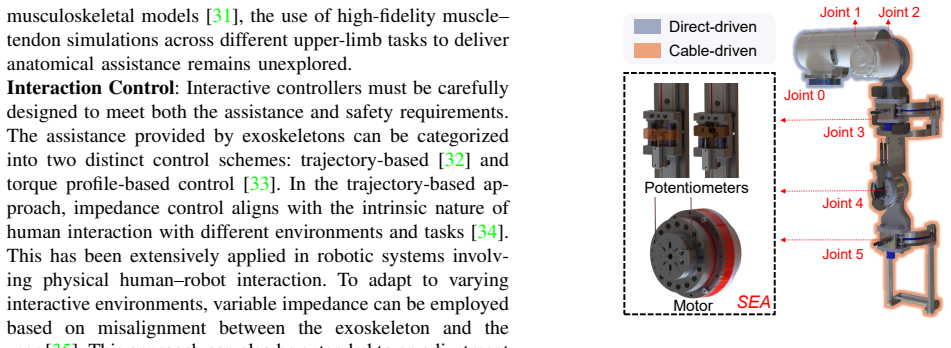
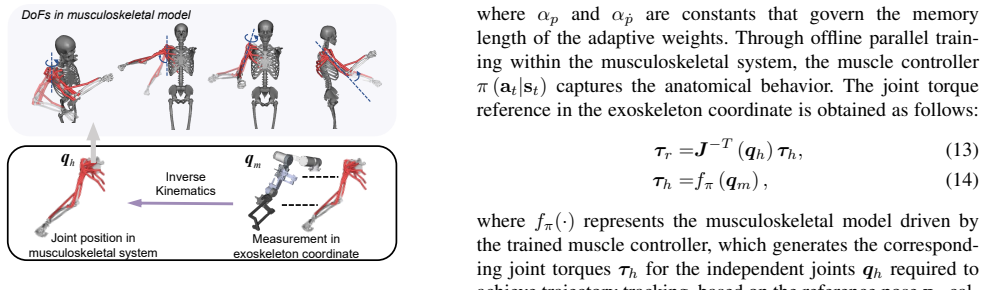
The load-bearing mechanism is the three-stage ATP chain. First, a unified muscle controller, trained by reinforcement learning in a GPU-accelerated musculoskeletal simulation, maps wearer kinematics to anatomical torque references and generalizes across diverse movements. Second, an online torque-refinement optimization repeatedly minimizes the distance from the reference while penalizing torque-rate and a learned anomaly score, which suppresses tendon-induced spikes and reshapes assistance during collisions or near kinematic singularities. Third, an interaction-torque controller built with backstepping for the cable-driven series-elastic exoskeleton uses two virtual energy tanks—reservoirs that store or release interaction energy—so that when a tank is depleted the controller relaxes the tracking objective to keep the human-robot port passive, and resumes tracking once replenished. Theorem 1 gives asymptotic stability and accurate torque tracking under the condition that the environment dissipates energy (inequality (53)) and the gain and parameter conditions (37)–(39) hold.
What would settle it
Have a participant deliberately push against the assisted joints so that interaction power $\dot{q}^T\tau_e$ is positive over a sustained interval, and record whether the closed loop remains passive and torque tracking is preserved. If the system still tracks torque while net energy flows from the human into the robot, the dissipative-environment inequality (53) used in Theorem 1 is violated; if tracking degrades exactly when tank energy is exhausted, the guarantee holds only under the paper's stated assumption.
Extended reading notes
Core claim
The central discovery, stated on the paper's own terms, is that a unified reinforcement-learning muscle controller trained in a scalable musculoskeletal simulation can produce real-time anatomical joint-torque references that generalize across many upper-limb motions, and that these references can be made safe and deliverable by online refinement plus a passivity-preserving interaction-torque controller. The controller tracks the refined torque on a cable-driven series-elastic exoskeleton without constraining the wearer to a preset trajectory, and the energy-tank corrections guarantee passivity and resume torque tracking after the tank is replenished. The pilot EMG evidence supports the claim that assistance reduces the activity of primary target muscles by up to 48% relative to moving without the exoskeleton, and reduces it relative to gravity compensation and open-loop assistance in the tested tasks.
Load-bearing premise
The safety and stability guarantee assumes the wearer's arm and surroundings only absorb energy and never actively push energy back into the exoskeleton, so a person who deliberately resists or drives the motion lies outside the guarantee.
Editorial extensions
If this is right
- Upper-limb exoskeletons can deliver assist-as-needed torque support during unscripted, multi-joint movements without restricting the wearer's motion freedom.
- A muscle controller trained jointly on diverse motion datasets retains most of its per-task tracking performance and generalizes to real-time, unseen movements measured by IMUs.
- The online refinement module can detect and respond to anomalous interaction conditions, reducing assistance during simulated collisions and generating corrective torque near kinematic singularities.
- The energy-tank controller preserves passivity even when tracking is temporarily suspended, and automatically returns to accurate torque tracking after the tank is replenished.
- In the pilot EMG study, ATP reduced primary target-muscle activity by up to 48% in a dynamic multi-joint task compared with moving without the exoskeleton, and matched or improved on gravity-compensation and open-loop assistance.
Reading between the lines
- Because the passivity proof relies on a dissipative human/environment, field deployments would need to detect active user effort or otherwise guarantee safe behavior when the wearer pushes energy into the system.
- The same learned-muscle-reference plus energy-tank delivery pattern could transfer to other compliant wearable robots; a direct next test is whether metabolic cost, not just EMG, decreases as assistance is scaled.
- Because the anomaly score guides refinement in only two tested scenarios, the framework invites extension to other anomalies, such as payload handling or involuntary spasms, which the paper explicitly leaves for future work.
Signed reviews
Editorial analysis
A structured set of objections, weighed in public.
Referee Report
Summary. The paper proposes ATP, a three-stage framework for upper-limb exoskeleton assistance: a reinforcement-learned musculoskeletal muscle controller that generates anatomical reference torques from a MuJoCo/MyoArm model, an online torque-refinement module that smooths the reference and incorporates a learned anomaly score, and an interaction-torque controller with energy-tank-based passivity preservation for a cable-driven SEA exoskeleton. The authors report simulation results, real-hardware torque-tracking experiments on two direct-drive shoulder joints and one cable-driven elbow joint, and an EMG study with five participants showing reduced target-muscle activity during static and dynamic tasks, with reductions up to 48% relative to unassisted movement. The central claims are that ATP generalizes to complex nonperiodic upper-limb movements without predefined trajectories and that the interaction-torque controller provides rigorous closed-loop torque-tracking guarantees subject to passivity.
Significance. If the results hold, the paper would make a useful contribution by combining learned biomechanical torque references with passivity-based interaction control for upper-limb exoskeletons. The open-sourced GPU-accelerated musculoskeletal training environment, the real-world torque-tracking RMSEs of 0.14-0.27 Nm, the explicit passivity demonstrations during tank switching, and the ablation of anomaly-guided torque refinement are concrete strengths that go beyond a purely simulation-based study. However, the paper's theoretical torque-tracking guarantee currently depends on an unvalidated environment-passivity assumption, and the EMG evaluation lacks inferential statistics. These issues do not invalidate the empirical results, but they require the theoretical claims to be restated or supported with additional evidence.
major comments (3)
- [Section V, Theorem 1 and Eq. (53)] The proof of Theorem 1 relies on Eq. (53), which asserts that the human/environment is dissipative: Hdot_env(x_env) <= -qdot^T tau_e, justified only by the statement 'Dissipation can always be presumed in the environment.' This is a behavioral assumption about the wearer, not a property of the robot controller, and it is not measured or enforced in the experiments. Indeed, the tank-replenishment phases in Figs. 14 and 15 (green shaded regions) show the wearer moving the joint so that the interaction torque is aligned with the joint rotation, i.e., qdot^T tau_e > 0, which means the wearer is injecting energy into the exoskeleton. Under Eq. (53), such an interaction would require the human arm to be dissipating mechanical energy at the same moment. If the wearer is instead an active energy source, Vdot in Eq. (52) is not necessarily negative, so Theorem 1 does not establish asymptotic stability or torque-tracking convergence. The observed 'resumes tracking after tank replenishment' is therefore an empirical result, not a theoretical guarantee. The authors should either measure or enforce environment passivity, or explicitly restrict the claim to passive environments and soften the abstract/introduction statement that 'rigorous theoretical analysis guarantees closed-loop torque tracking subject to passivity.'
- [Section V, Proposition 1] The proof of Proposition 1 asserts, immediately before Eq. (23), that 'By choosing a sufficiently large beta_q and a correspondingly larger K_q, there exists a finite mu such that lim sup_{t->inf} ||M(q) qddot~|| <= mu whenever ||tau_tilde_f|| <= zeta.' This bound on ||M(q) qddot~|| is load-bearing for the subsequent uniform ultimate boundedness argument in Eqs. (24)-(27), but no derivation is provided. The bound should follow from the observer error dynamics (22) with explicit conditions on beta_q, K_q, and the boundedness properties of M(q), C(qdot,q), and g(q); as written, the proof leaves a gap between the stability of qtilde and the required bound on the second derivative. Please supply this derivation or state the additional assumptions needed.
- [Section VII-C, Fig. 19] The EMG study is presented as a central validation of the assistance benefit, but no inferential statistics are reported. The text says the data were 'statistically analyzed across all trials,' yet the results in Fig. 19 are summarized only as mean reductions (e.g., 64%, 45%, 59%, 33%, 48%, 47%) for a cohort of five participants. Because the static-task results are very similar between ATP and gravity compensation, and the dynamic-task effects vary across muscles and tasks, the claim that ATP reduces target-muscle activity compared with the baselines needs repeated-measures statistical analysis (or at least confidence intervals and effect sizes) to be supported. Without such analysis, the reported percentages may not be robust to individual-subject variability.
minor comments (5)
- [Section IV, Eq. (16)] The anomaly-score dynamics s(t+1) = s(t) + (partial f_a / partial tau_e)^T u_d Delta t assume that the diffusion-model-based anomaly score is differentiable with respect to tau_e; please clarify whether this gradient is computed analytically or numerically, and whether s is treated as a scalar throughout.
- [Section V, Eqs. (41) and (44)] The tank dynamics contain divisions by t_f and t_o. If the tanks can reach exactly zero energy, the right-hand sides are singular. The definitions of L_{f,o} and delta_{f,o} suggest the tanks are prevented from reaching zero, but this should be stated explicitly, together with the initialization of t_f and t_o.
- [Table V] The entries for Lafan1 and Ours have no standard deviations, while the other datasets do; the meaning of the 'Ratio' column (e.g., 1.55 (64.5%)) should be explained more clearly, since the percentage appears to be a performance-retention measure rather than a ratio.
- [Section VI] The ethics approval text contains the placeholder 'XXX' ('approved by the ethics committee of XXX'); the institution should be named.
- [Abstract and Section VIII] The source code is mentioned as 'available at ATP_muscle_controller,' but no URL or repository identifier is given; please provide a complete reference.
Circularity Check
No significant circularity: the torque-tracking and passivity results rest on explicit dissipativity assumptions and algebraic tank design, while the EMG outcomes are measured rather than model-derived.
full rationale
The derivation chain is not circular. The muscle controller is trained in a GPU-accelerated MuJoCo/MyoArm environment to minimize a tracking reward (Eqs. 6-8), and the resulting torque reference is a model output; the reported EMG reductions in Section VII-C are measured from five participants, not computed from the model or from the assistance scaling. The passivity/torque-tracking argument in Theorem 1 is a standard Lyapunov and energy-tank construction: Eq. (53), Hdot_env(x_env) <= -qdot^T tau_e, is an explicit dissipativity assumption on the human/environment, and the theorem is stated conditionally as 'if the passivity is not violated.' The tank corrections (43) and (48) together with Table III verify Hdot <= qdot^T tau_e algebraically, so the passivity guarantee is a design verification rather than a renamed input. The 'resumes tracking after energy-tank replenishment' behavior is demonstrated experimentally in Figs. 14-15, and is therefore an empirical result rather than a prediction generated from Eq. (53). The anomaly detector and intention predictor from the authors' prior work [46] are used as off-the-shelf components and are not relied upon to prove the central torque-tracking guarantee or the EMG outcomes; their reuse is a normal component citation, not a load-bearing self-citation. No fitted parameter is renamed as a prediction, and no quantity is defined in terms of the quantity it is supposed to predict. The main caveat, that Eq. (53) is a behavioral assumption about the wearer that the tank-replenishment experiments do not directly measure, is a soundness and applicability concern rather than a circularity in the derivation chain.
Assumptions & free parameters
free parameters (5)
- EMG assistance scaling factor =
30% of tau_d baseline for 70 kg, scaled by body weight
- Torque-refinement look-ahead interval =
10 ms
- Muscle controller reward weights =
sigma_p=0.3, sigma_pdot=30, lambda_a=1.5, alpha_p=0.001, alpha_pdot=0.001
- Passivity controller gains =
K_p=0.5, K_d=0.05, K_v=5, K_s=2.0, K_theta=1.0, alpha_theta=5.0, K_e=4.0, beta_e=30, K=2.0 Nm/rad (simulation)
- Torque-refinement MPC weights/horizon =
Not reported
assumptions (6)
- standard math The robot dynamics satisfy M(q) positive definite/symmetric, Mdot-2C skew-symmetric, and B, K constant diagonal positive definite.
- domain assumption The human/environment is passive and dissipative: Hdot_env(x_env) <= -qdot^T tau_e.
- domain assumption The MyoArm musculoskeletal model is a valid stand-in for the wearer's upper limb, and the learned muscle torques constitute an anatomical reference.
- domain assumption The inverse kinematic mapping q_h = f^{-1}(q_m) exists and the Jacobian can be inverted except at the noted singularity.
- domain assumption The friction estimation error is bounded: ||tau_tilde_f|| <= zeta.
- domain assumption The anomaly score from [46] is a valid safety/comfort signal for online refinement.
Cite this review
Pith. "Pith review of ATP: Anatomical Torque with Passivity-based Control Framework for Safe Upper-Limb Exoskeleton Assistance." pith.science (2026). https://pith.science/paper/YF5ZF3M6
@misc{pith2026260805723,
  author       = {Pith},
  title        = {Pith review of: ATP: Anatomical Torque with Passivity-based Control Framework for Safe Upper-Limb Exoskeleton Assistance},
  year         = {2026},
  howpublished = {\url{https://pith.science/paper/YF5ZF3M6}},
  note         = {Machine review of arXiv:2608.05723}
}
read the original abstract
Providing assistance across diverse movements is a central objective of exoskeletons, and anatomical knowledge can enable responsive support that generalizes across tasks. However, anatomical assistance has mainly been studied for lower-limb exoskeletons, where periodic, weight-bearing motions impose lower demands on torque precision. Extending such assistance to complex, nonperiodic upper-limb movements remains challenging. This paper proposes Anatomical Torque with Passivity-Based Control (ATP) for safe upper-limb exoskeleton assistance. First, a scalable musculoskeletal simulation framework trains a unified reinforcement-learning muscle controller that generalizes across upper-limb movements and generates anatomical reference torques without complex biomechanical computations. Second, an online torque-refinement scheme adapts the reference to diverse movements, suppresses tendon-induced spikes, and incorporates a learned anomaly score for safe and comfortable assistance. Third, an interaction torque controller delivers assistance through a cable-driven compliant exoskeleton without constraining motion to predefined trajectories, while an energy tank preserves passivity with theoretical guarantees on torque tracking and system passivity. Simulations and real-world experiments show accurate tracking of long-duration motion sequences and generalization to real-time human movements. The controller achieves accurate torque tracking while preserving passivity and resumes tracking after energy-tank replenishment. An EMG study with five participants further shows reduced target-muscle activity during static and dynamic tasks compared with gravity compensation and open-loop assistance, with reductions of up to 48% relative to movement without the exoskeleton in a dynamic multi-joint task.
Figures


Figures from the paper (13 more)


Reference graph
Works this paper leans on
-
[1]
(2026) Hypershell x exoskeleton
Hypershell. (2026) Hypershell x exoskeleton. [Online]. Available: https://hypershell.tech/
work page 2026
-
[2]
Design, development, and control of a hand/wrist exoskeleton for rehabilitation and training,
M. Dragusanu, M. Z. Iqbal, T. L. Baldi, D. Prattichizzo, and M. Malvezzi, “Design, development, and control of a hand/wrist exoskeleton for rehabilitation and training,”IEEE Transactions on Robotics, vol. 38, no. 3, pp. 1472–1488, 2022
work page 2022
-
[3]
Biomechanical design of the berkeley lower extremity exoskeleton (BLEEX),
A. B. Zoss, H. Kazerooni, and A. Chu, “Biomechanical design of the berkeley lower extremity exoskeleton (BLEEX),”IEEE/ASME Transac- tions on mechatronics, vol. 11, no. 2, pp. 128–138, 2006
work page 2006
-
[4]
Human- in-the-loop optimization of exoskeleton assistance via online simulation of metabolic cost,
D. F. Gordon, C. McGreavy, A. Christou, and S. Vijayakumar, “Human- in-the-loop optimization of exoskeleton assistance via online simulation of metabolic cost,”IEEE Transactions on Robotics, vol. 38, no. 3, pp. 1410–1429, 2022
work page 2022
-
[5]
Task-agnostic exoskeleton control via biological joint moment estimation,
D. D. Molinaro, K. L. Scherpereel, E. B. Schonhaut, G. Evangelopoulos, M. K. Shepherd, and A. J. Young, “Task-agnostic exoskeleton control via biological joint moment estimation,”Nature, vol. 635, no. 8038, pp. 337–344, 2024
work page 2024
-
[6]
Human-cooperative control design of a walking exoskeleton for body weight support,
Z. Li, Z. Ren, K. Zhao, C. Deng, and Y . Feng, “Human-cooperative control design of a walking exoskeleton for body weight support,”IEEE Transactions on Industrial Informatics, vol. 16, no. 5, pp. 2985–2996, 2019
work page 2019
-
[7]
H. Wang, Y . Yao, H. Lei, Y . Shi, and S. Pei, “High-accuracy early recognition of upper-limb motions for exoskeleton-assisted mirror reha- bilitation,”IEEE Robotics and Automation Letters, 2025
work page 2025
-
[8]
A semantic- aware framework for safe and intent-integrative assistance in upper-limb exoskeletons,
Y . Chen, S. Miao, C. Wu, J. Mu, B. Ouyang, and X. Li, “A semantic- aware framework for safe and intent-integrative assistance in upper-limb exoskeletons,”IEEE Robotics and Automation Letters, vol. 11, no. 5, pp. 5938–5945, 2026
work page 2026
Show all 53 references
-
[9]
Mujoco playground,
K. Zakka, B. Tabanpour, Q. Liao, M. Haiderbhai, S. Holt, J. Y . Luo, A. Allshire, E. Frey, K. Sreenath, L. A. Kahrs,et al., “Mujoco playground,”arXiv preprint arXiv:2502.08844, 2025
2025 arXiv
-
[10]
Myosim: Fast and physiologically realistic mujoco models for mus- culoskeletal and exoskeletal studies,
H. Wang, V . Caggiano, G. Durandau, M. Sartori, and V . Kumar, “Myosim: Fast and physiologically realistic mujoco models for mus- culoskeletal and exoskeletal studies,” in2022 International Conference on Robotics and Automation (ICRA). IEEE, 2022, pp. 8104–8111
2022
-
[11]
mjlab: A lightweight framework for gpu-accelerated robot learning,
K. Zakka, Q. Liao, B. Yi, L. L. Lay, K. Sreenath, and P. Abbeel, “mjlab: A lightweight framework for gpu-accelerated robot learning,” arXiv preprint arXiv:2601.22074, 2026
2026
-
[12]
Emg-based model predictive control for physical human–robot interaction: Application for assist-as- needed control,
T. Teramae, T. Noda, and J. Morimoto, “Emg-based model predictive control for physical human–robot interaction: Application for assist-as- needed control,”IEEE Robotics and Automation Letters, vol. 3, no. 1, pp. 210–217, 2017
2017
-
[13]
The effects of incline level on optimized lower-limb exoskeleton assistance: A case series,
P. W. Franks, G. M. Bryan, R. Reyes, M. P. O’Donovan, K. N. Gregorczyk, and S. H. Collins, “The effects of incline level on optimized lower-limb exoskeleton assistance: A case series,”IEEE Transactions on Neural Systems and Rehabilitation Engineering, vol. 30, pp. 2494–2505, 2022
2022
-
[14]
A low-profile hip exoskeleton for pathological gait assistance: design and pilot testing,
S. S. P. A. Bishe, L. Liebelt, Y . Fang, and Z. F. Lerner, “A low-profile hip exoskeleton for pathological gait assistance: design and pilot testing,” in2022 International Conference on Robotics and Automation (ICRA). IEEE, 2022, pp. 5461–5466
2022
-
[15]
Human-in-the-loop optimization of exoskeleton assistance during walking,
J. Zhang, P. Fiers, K. A. Witte, R. W. Jackson, K. L. Poggensee, C. G. Atkeson, and S. H. Collins, “Human-in-the-loop optimization of exoskeleton assistance during walking,”Science, vol. 356, no. 6344, pp. 1280–1284, 2017
2017
-
[16]
Automatically customizing a powered knee prosthesis with human in the loop using adaptive dynamic programming,
Y . Wen, A. Brandt, J. Si, and H. H. Huang, “Automatically customizing a powered knee prosthesis with human in the loop using adaptive dynamic programming,” in2017 International Symposium on Wearable Robotics and Rehabilitation (WeRob). IEEE, 2017, pp. 1–2
2017
-
[17]
Human-in-the- loop optimization of hip assistance with a soft exosuit during walking,
Y . Ding, M. Kim, S. Kuindersma, and C. J. Walsh, “Human-in-the- loop optimization of hip assistance with a soft exosuit during walking,” Science Robotics, vol. 3, no. 15, p. eaar5438, 2018
2018
-
[18]
Personal- izing exoskeleton assistance while walking in the real world,
P. Slade, M. J. Kochenderfer, S. L. Delp, and S. H. Collins, “Personal- izing exoskeleton assistance while walking in the real world,”Nature, vol. 610, no. 7931, pp. 277–282, 2022
2022
-
[19]
Learning to assist different wearers in multitasks: efficient and individualized human-in-the-loop adaptation framework for lower-limb exoskeleton,
Y . Chen, S. Miao, G. Chen, J. Ye, C. Fu, B. Liang, S. Song, and X. Li, “Learning to assist different wearers in multitasks: efficient and individualized human-in-the-loop adaptation framework for lower-limb exoskeleton,”IEEE Transactions on Robotics, 2024
2024
-
[20]
Opensim: Simulating musculoskeletal dynamics and neuromuscular control to study human and animal movement,
A. Seth, J. L. Hicks, T. K. Uchida, A. Habib, C. L. Dembia, J. J. Dunne, C. F. Ong, M. S. DeMers, A. Rajagopal, M. Millard,et al., “Opensim: Simulating musculoskeletal dynamics and neuromuscular control to study human and animal movement,”PLoS computational biology, vol. 14, n...
2018
-
[21]
Subject-independent, biological hip moment estimation during multi- modal overground ambulation using deep learning,
D. D. Molinaro, I. Kang, J. Camargo, M. C. Gombolay, and A. J. Young, “Subject-independent, biological hip moment estimation during multi- modal overground ambulation using deep learning,”IEEE Transactions on Medical Robotics and Bionics, vol. 4, no. 1, pp. 219–229, 2022
2022
-
[22]
Reinforce- ment learning methods for assistive and rehabilitation robotic systems: A survey,
M. Sharifi, S. Tripathi, Y . Chen, Q. Zhang, and M. Tavakoli, “Reinforce- ment learning methods for assistive and rehabilitation robotic systems: A survey,”IEEE Transactions on Systems, Man, and Cybernetics: Systems, 2025
2025
-
[23]
End-to-end deep reinforcement learning for exoskeleton control,
L. Rose, M. C. Bazzocchi, and G. Nejat, “End-to-end deep reinforcement learning for exoskeleton control,” in2020 IEEE international conference on systems, man, and cybernetics (SMC). IEEE, 2020, pp. 4294–4301
2020
-
[24]
Experiment-free exoskeleton assistance via learning in simulation,
S. Luo, M. Jiang, S. Zhang, J. Zhu, S. Yu, I. Dominguez Silva, T. Wang, E. Rouse, B. Zhou, H. Yuk,et al., “Experiment-free exoskeleton assistance via learning in simulation,”Nature, vol. 630, no. 8016, pp. 353–359, 2024
2024
-
[25]
Robust walking control of a lower limb rehabilitation exoskeleton coupled with a musculoskeletal model via deep reinforcement learning,
S. Luo, G. Androwis, S. Adamovich, E. Nunez, H. Su, and X. Zhou, “Robust walking control of a lower limb rehabilitation exoskeleton coupled with a musculoskeletal model via deep reinforcement learning,” Journal of neuroengineering and rehabilitation, vol. 20, no. 1, p. 34, 2023
2023
-
[26]
Robust neural network controller for a lower limb exoskeleton with minimal sensor configuration: a deep reinforcement learning approach with policy distillation,
S. Luo, K. Feng, G. Androwis, S. Adamovich, E. Nunez, H. Su, and X. Zhou, “Robust neural network controller for a lower limb exoskeleton with minimal sensor configuration: a deep reinforcement learning approach with policy distillation,”Journal of NeuroEngineering and Rehabili...
2025
-
[27]
Predicting sit-to-stand motions with a deep reinforcement learning based controller under idealized exoskeleton assistance,
N. Ratnakumar, K. Akba¸ s, R. Jones, Z. You, and X. Zhou, “Predicting sit-to-stand motions with a deep reinforcement learning based controller under idealized exoskeleton assistance,”Multibody System Dynamics, pp. 1–18, 2024
2024
-
[28]
Control- ling fes of arm movements using physics-informed reinforcement learn- ing via co-kriging adjustment,
N. Wannawas, C. Diaz-Pintado, J. Narayan, and A. A. Faisal, “Control- ling fes of arm movements using physics-informed reinforcement learn- ing via co-kriging adjustment,” in2024 IEEE International Conference on Robotics and Automation (ICRA). IEEE, 2024, pp. 5555–5560
2024
-
[29]
Scalable muscle-actuated human simulation and control,
S. Lee, M. Park, K. Lee, and J. Lee, “Scalable muscle-actuated human simulation and control,”ACM Transactions On Graphics (TOG), vol. 38, no. 4, pp. 1–13, 2019
2019
-
[30]
Self model for embodied intelligence: Modeling full-body human musculoskeletal system and locomotion control with hierarchical low-dimensional representation,
C. Zuo, K. He, J. Shao, and Y . Sui, “Self model for embodied intelligence: Modeling full-body human musculoskeletal system and locomotion control with hierarchical low-dimensional representation,” in2024 IEEE International Conference on Robotics and Automation (ICRA). IEEE, 2...
2024
-
[31]
Towards embodied ai with musclemimic: Unlock- ing full-body musculoskeletal motor learning at scale,
C. Li, C. Wang, B. Ziliotto, M. Simos, J. Kovecses, G. Durandau, and A. Mathis, “Towards embodied ai with musclemimic: Unlock- ing full-body musculoskeletal motor learning at scale,”arXiv preprint arXiv:2603.25544, 2026
2026
-
[32]
Fuzzy adaptive controller of a wearable assistive upper limb exoskeleton using a disturbance observer,
M. S. Amiri and R. Ramli, “Fuzzy adaptive controller of a wearable assistive upper limb exoskeleton using a disturbance observer,”IEEE Transactions on Human-Machine Systems, 2025
2025
-
[33]
semg-based joint force control for an upper-limb power-assist exoskeleton robot,
Z. Li, B. Wang, F. Sun, C. Yang, Q. Xie, and W. Zhang, “semg-based joint force control for an upper-limb power-assist exoskeleton robot,” IEEE journal of biomedical and health informatics, vol. 18, no. 3, pp. 1043–1050, 2013
2013
-
[34]
Learning impedance control for robotic manipulators,
C.-C. Cheah and D. Wang, “Learning impedance control for robotic manipulators,”IEEE Transactions on Robotics and Automation, vol. 14, no. 3, pp. 452–465, 1998
1998
-
[35]
Intention-driven variable impedance control for physical human-robot interaction,
Y . Huo, X. Li, X. Zhang, and D. Sun, “Intention-driven variable impedance control for physical human-robot interaction,” in2021 IEEE/ASME International Conference on Advanced Intelligent Mecha- tronics (AIM). IEEE, 2021, pp. 1220–1225
2021
-
[36]
Safe and individualized motion planning for upper-limb exoskeleton robots using human demon- stration and interactive learning,
Y . Chen, G. Chen, J. Ye, X. Qiu, and X. Li, “Safe and individualized motion planning for upper-limb exoskeleton robots using human demon- stration and interactive learning,” in2024 IEEE International Conference on Robotics and Automation (ICRA). IEEE, 2024, pp. 15 307–15 313
2024
-
[37]
Estimating human joint moments unifies exoskeleton control, reducing user effort,
D. D. Molinaro, I. Kang, and A. J. Young, “Estimating human joint moments unifies exoskeleton control, reducing user effort,”Science robotics, vol. 9, no. 88, p. eadi8852, 2024
2024
-
[38]
On human-in-the-loop optimization of human–robot interaction,
P. Slade, C. Atkeson, J. M. Donelan, H. Houdijk, K. A. Ingraham, M. Kim, K. Kong, K. L. Poggensee, R. Riener, M. Steinert,et al., “On human-in-the-loop optimization of human–robot interaction,”Nature, vol. 633, no. 8031, pp. 779–788, 2024
2024
-
[39]
C. A. Desoer and M. Vidyasagar,Feedback systems: input-output properties. SIAM, 2009. 17
2009
-
[40]
Passivity and stability of human–robot inter- action control for upper-limb rehabilitation robots,
J. Zhang and C. C. Cheah, “Passivity and stability of human–robot inter- action control for upper-limb rehabilitation robots,”IEEE Transactions on Robotics, vol. 31, no. 2, pp. 233–245, 2015
2015
-
[41]
Passivity preser- vation for variable impedance control of compliant robots,
E. Spyrakos-Papastavridis, P. R. Childs, and J. S. Dai, “Passivity preser- vation for variable impedance control of compliant robots,”IEEE/ASME Transactions on Mechatronics, vol. 25, no. 5, pp. 2342–2353, 2019
2019
-
[42]
Unified force-impedance control,
S. Haddadin and E. Shahriari, “Unified force-impedance control,”The International Journal of Robotics Research, vol. 43, no. 13, pp. 2112– 2141, 2024
2024
-
[43]
A unified passivity-based control framework for position, torque and impedance control of flexible joint robots,
A. Albu-Schäffer, C. Ott, and G. Hirzinger, “A unified passivity-based control framework for position, torque and impedance control of flexible joint robots,”The International Journal of Robotics Research, vol. 26, no. 1, pp. 23–39, 2007
2007
-
[44]
C. C. Cheah and X. Li,Task-space sensory feedback control of robot manipulators. Springer, 2015, vol. 73
2015
-
[45]
Control theory of nonlinear mechanical systems,
S. Arimoto, “Control theory of nonlinear mechanical systems,”A Passivity-based and Circuit-theoretic Approach, 1996
1996
-
[46]
Upper- limb rehabilitation with a dual-mode individualized exoskeleton robot: A generative-model-based solution,
Y . Chen, S. Miao, J. Ye, G. Chen, J. Cheng, K. Du, and X. Li, “Upper- limb rehabilitation with a dual-mode individualized exoskeleton robot: A generative-model-based solution,”The International Journal of Robotics Research, p. 02783649251333479, 2025
2025
-
[47]
Kungfubot: Physics-based humanoid whole-body control for learning highly-dynamic skills,
W. Xie, J. Han, J. Zheng, H. Li, X. Liu, J. Shi, W. Zhang, C. Bai, and X. Li, “Kungfubot: Physics-based humanoid whole-body control for learning highly-dynamic skills,”arXiv preprint arXiv:2506.12851, 2025
2025 arXiv
-
[48]
Adaptive human–robot interaction control for robots driven by series elastic actuators,
X. Li, Y . Pan, G. Chen, and H. Yu, “Adaptive human–robot interaction control for robots driven by series elastic actuators,”IEEE Transactions on Robotics, vol. 33, no. 1, pp. 169–182, 2016
2016
-
[49]
Adaptive task-space regulation of rigid-link flexible-joint robots with uncertain kinematics,
C. Liu, C. C. Cheah, and J.-J. E. Slotine, “Adaptive task-space regulation of rigid-link flexible-joint robots with uncertain kinematics,”Automatica, vol. 44, no. 7, pp. 1806–1814, 2008
2008
-
[50]
Unified passivity-based cartesian force/impedance control for rigid and flexible joint robots via task- energy tanks,
C. Schindlbeck and S. Haddadin, “Unified passivity-based cartesian force/impedance control for rigid and flexible joint robots via task- energy tanks,” in2015 IEEE international conference on robotics and automation (ICRA). IEEE, 2015, pp. 440–447
2015
-
[51]
Valve-based virtual energy tanks: A framework to simultaneously passify controls and embed control objectives,
E. Shahriari, L. Johannsmeier, and S. Haddadin, “Valve-based virtual energy tanks: A framework to simultaneously passify controls and embed control objectives,” in2018 Annual American Control Conference (ACC). IEEE, 2018, pp. 3634–3641
2018
-
[52]
Ott,Cartesian impedance control of redundant and flexible-joint robots
C. Ott,Cartesian impedance control of redundant and flexible-joint robots. Springer, 2008
2008
-
[53]
Robot operating system 2: Design, architecture, and uses in the wild,
S. Macenski, T. Foote, B. P. Gerkey, C. Lalancette, and W. Woodall, “Robot operating system 2: Design, architecture, and uses in the wild,”Science Robotics, vol. 7, 2022. [Online]. Available: https://api.semanticscholar.org/CorpusID:248736816 18
2022
Reviewed August 15, 2026 · model on record in the stance chip above.
Discussion (0). Continue with ORCID to comment.