REVIEW 3 major objections 5 minor 35 references
How Loud Must a Neutron-Star Merger Be to Reveal Its Equation of State?
T0 review · 3 major / 5 minor · reviewed 2026-08-07 · deepseek-v4-flash
Pith's one-line read For zero-noise binary neutron-star signals in a third-generation detector network, the Bayesian evidence ratio between competing equations of state follows $\Delta\log Z \approx C\,(\Delta\tilde{\Lambda}\,\mathrm{SNR})^2$, with a…
desk verdict Useful, honest empirical study of EOS-discrimination SNR, but the signature 0.3% transfer claim rests on a single draw and a prefactor calibrated at SNR~3355 being applied at SNR~50. read the letter →
The pith
A machine-rendered reading of the paper's core claim, the machinery that carries it, and where it could break.
The reading
What carries the argument
The key machinery is the Laplace/Occam-factor expansion of the Bayesian evidence, which turns the evidence difference into $\frac{1}{2}\|\delta h_\perp\|^2$, where $\delta h_\perp$ is the noise-weighted waveform mismatch between the correct and wrong-EOS templates after all nuisance parameters (mass ratio, spin, coalescence time) are optimized. Because the wrong-EOS arm can compensate part of the tidal mismatch by shifting these nuisance parameters, only the orthogonalized residual $\delta h_\perp$ contributes to the penalty, and this construction is what carries the argument from waveform mismatch to model selection. At leading post-Newtonian order the tidal phase is linear in $\tilde{\Lambda}$, so the residual mismatch is proportional to $\Delta\tilde{\Lambda}\,\mathrm{SNR}$, giving the closed-form threshold relation $\rho_T = (1/\Delta\tilde{\Lambda})\sqrt{T/C}$ for a Jeffreys-scale label $T$.
What would settle it
Take an EOS pair and a binary mass point that appear in none of the paper's four curves or five spot-checks, calibrate $C$ from three high-SNR anchor runs, and measure the decisive-evidence SNR with full nested sampling; if the measured value falls outside the pre-registered 95% prediction interval, or if the zero-noise $\Delta\log Z$ at a moderate SNR around 40 deviates from $C(\Delta\tilde{\Lambda}\,\mathrm{SNR})^2$ by more than the roughly 30% scatter seen in $C$, the claimed predictive transferability is falsified.
Extended reading notes
Core claim
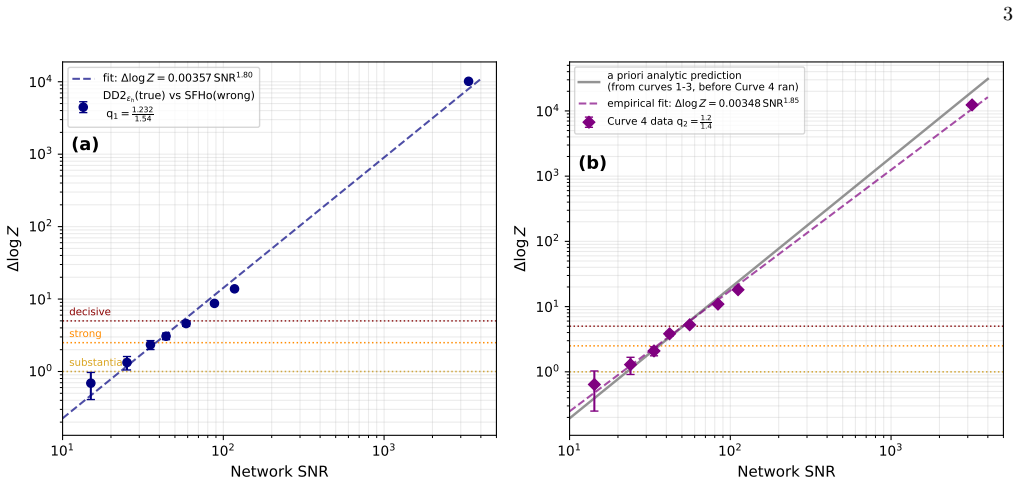
The central claim is that the Occam-factor penalty for recovering a neutron-star signal with the wrong equation of state is, at leading order, half the squared noise-weighted mismatch between the correct and wrong templates, and because the tidal phase is linear in the mass-weighted tidal deformability $\tilde{\Lambda}$, the evidence difference reduces to $\Delta\log Z \approx C\,(\Delta\tilde{\Lambda}\,\mathrm{SNR})^2$. The paper verifies this with full Bayesian nested-sampling parameter estimation on zero-noise simulated signals in an Einstein Telescope plus two Cosmic Explorer network, using the IMRPhenomD NRTidalv2 waveform, and shows that the fitted exponent approaches the asymptotic value 2 as SNR grows. It then demonstrates the relation's predictive power: calibrating the prefactor $C$ from three configurations at an anchor SNR near 3355, it predicted the decisive-evidence SNR for a fourth, independent binary mass point as 50.8, and the subsequent measurement gave 50.7, within the pre-registered 95% interval. The paper stresses that $C$ is not universal — it depends on masses, spins, sky location, and the detector network — and that the exponent statement is best read as a trend toward 2, since dropping the highest-SNR anchor point substantially weakens the constraint on $n$.
Load-bearing premise
The whole predictive scheme rests on the assumption that a prefactor $C$ calibrated at very loud, noise-free signals with a single sky position and inclination transfers unchanged to the moderate-SNR regime and to binary configurations outside the calibration set, where the wrong-EOS arm may compensate the mismatch in different ways.
Editorial extensions
If this is right
- For a fixed EOS pair and detector network, the decisive-discrimination SNR can be computed as $(1/\Delta\tilde{\Lambda})\sqrt{5/C}$, turning an expensive nested-sampling campaign into a one-line estimate.
- Reducing the tidal-deformability contrast between two candidates pushes all Jeffreys-threshold SNRs upward while leaving the scaling exponent unchanged, and near-degenerate EOS pairs with $\Delta\tilde{\Lambda}\approx 10$--$30$ would require SNR around 900--2800, within reach only for rare, GW170817-distance-like events.
- Swapping which EOS is injected and which is recovered changes threshold SNRs by only about 20%, so the scaling is not an artifact of one EOS being the 'true' one.
- The exponent $n$ is best interpreted as approaching $2$ as SNR increases rather than as a tightly constrained constant; densifying the high-SNR grid reduces the anchor point's leverage sevenfold, so the quadratic law is supported by continuity of the local slope $K=\Delta\log Z/\mathrm{SNR}^2$.
Reading between the lines
- A natural extension the paper leaves implicit: the same Occam-factor argument should apply to any discrete model-selection problem where the waveform difference is linear in a scalar parameter, such as choosing among modified-gravity theories, giving an analogous $(\Delta \text{parameter} \times \mathrm{SNR})^2$ law with a redefined prefactor.
- The doppelg\"anger caveat suggests that single-event loudness will not settle the equation of state for pairs of physically distinct EOS that nearly agree in $\tilde{\Lambda}$; population-level or multi-messenger information rather than a solitary loud burst would carry that part of the program.
- A cheap test of the framework's scope would be to densify the SNR grid for Curves 2--4 the way Curve 1 was densified, checking whether the smooth, curvature-free decline of $K$ seen in Curve 1 generalizes before trusting the high-SNR asymptotic form away from the fiducial configuration.
Editorial analysis
A structured set of objections, weighed in public.
Referee Report
Summary. The paper performs full Bayesian nested-sampling parameter estimation on simulated binary neutron star signals in an ET+2CE network, using zero-noise injections and the IMRPhenomD NRTidalv2 waveform, and measures the log-evidence difference between a correct-EOS and an incorrect-EOS recovery model across four configurations and a range of network SNR. The central claim is that this difference follows a near-quadratic scaling, ΔlogZ ≈ C(ΔΛ̃·SNR)^2, with C dependent on binary properties and detector configuration but transferable across configurations once calibrated. The headline quantitative test is a pre-registered, out-of-sample prediction: calibrating C on three configurations at the dL=42 Mpc anchor (SNR≈3355) predicts a decisive-evidence threshold for a fourth, unmeasured binary mass point at SNR≈50.8, and the subsequently measured value is 50.7, inside the pre-registered 95% interval. The paper also reports a five-draw spot-check across further EOS pairs in which four of five draws agree within ~15%, with one 44% underprediction attributed to unusually efficient mass-ratio compensation.
Significance. If the scaling law and the transferability of C were robust, the paper would provide a practical planning tool for 3G detectors and a useful bridge between analytic Occam-factor arguments and full Bayesian model selection. The paper is commendably transparent: it includes an explicit derivation of the leading-order quadratic form, a genuine out-of-sample pre-registered test, per-point data tables, anchor-leverage sensitivity analyses, a densification check, a free-sky/noise robustness check, and public code and data. These are real strengths. However, the load-bearing extrapolation from the anchor SNR to the moderate-SNR threshold regime is not supported by the paper's own data: within a single curve the effective coefficient ΔlogZ/(ΔΛ̃^2 SNR^2) varies by up to a factor of ~1.8 between the anchor and the decisive threshold, and the anchor-dropped fits in the threshold regime give exponents as low as n=1.20-1.75. The Curve 4 prediction therefore rests on an unquantified scale extrapolation, and the 0.3% agreement, while striking, is a single draw rather than evidence that the anchor calibration constrains the prediction regime.
major comments (3)
- [Supplemental Material, 'Derivation of the analytic scaling relation', Eq. (4), Tables S3 and S7] The coefficient in the claimed quadratic law is not constant across SNR within a single curve. For Curve 1, K = ΔlogZ/SNR^2 decreases monotonically from 3.07e-3 at SNR=14.99 to 9.01e-4 at the SNR=3355 anchor, a factor of 3.4. Equivalently, the effective coefficient C_eff = K/(ΔΛ̃)^2 at the Curve 1 decisive threshold (SNR=55.9) is about 1.09e-8, while the anchor value in Table S1 is 6.18e-9; using the anchor value alone would predict a decisive threshold of ~74.5 instead of the measured 55.9. The Curve 4 prediction in Table S2 is made at SNR≈50 using C calibrated at SNR≈3355, and the reported 95% interval propagates only the ±12.9% anchor-to-anchor scatter, not this scale dependence. The 0.3% agreement at the Curve 4 decisive threshold is therefore a single draw and cannot by itself validate the quadratic law in the prediction regime.
- [Table S8 and 'Curve 1 densification' subsection] The anchor-drop sensitivity analysis directly exposes the problem. Removing the anchor lowers the fitted exponent to n=1.20-1.75, and the remaining seven points per curve span only SNR≈15-117, which is exactly the regime where the decisive thresholds for Curves 1-4 lie. The densification of Curve 1 fills the gap between SNR≈117 and SNR≈3355 and shows smooth behavior there, but it contains no point below SNR≈117; hence it does not constrain K in the regime where the predictions are made. The statement that the fitted exponent 'trends toward' the asymptotic n=2 is therefore not supported in the moderate-SNR regime that matters for the headline prediction.
- [Table S9, SLy4/FSU2 spot-check] The spot-check campaign provides a direct counterexample to the transferability claim in the prediction regime. For SLy4(true)/FSU2(wrong) at m1/m2=1.8/1.2, the Bayesian inference gives ΔlogZ=1.11±0.32 against the analytical prediction of 2.50, i.e., only 44% of the predicted value, at SNR≈43. The paper attributes this to unusually efficient mass-ratio compensation and notes that the same EOS pair at a different mass ratio does not show the suppression. This is an honest and informative caveat, but it also demonstrates that the scaling estimate can fail by more than a factor of two in the exact SNR regime where the paper wants to predict thresholds. The conclusion should be reframed so that the 'closed-form estimate' is presented as a rough first-order benchmark requiring per-configuration recalibration, not as a predictive law validated by the Curve 4 result.
minor comments (5)
- [Abstract and Table I] The abstract states n≃1.74-1.95 while the main text variously says n≈1.8-2 and n=1.74-1.95; please unify the quoted range in the abstract, conclusion, and Table I.
- [Eq. (3)] In Eq. (3), the integral J is defined with an integrand containing Sn(f), but Sn(f) is not defined at that point; please specify that it is the one-sided noise power spectral density of the network and state the convention used.
- [Figure S2 caption] The caption reads '15 off normal incidence'; this should be '15° off normal incidence' with the degree symbol.
- [Supplemental Material, 'Bayesian inference setup'] The phrase 'A point easily missed: Λ1 and Λ2 are not themselves free sampled parameters' is useful but phrased informally; consider moving this explanation to a dedicated paragraph or figure caption so it reads as a standard methodological note.
- [Table S9 column definitions] The definitions of 'Analytical', 'Fit', and 'Fit (n=2)' are dense and appear partially after the table; please move them into the table caption or a clear preceding paragraph so the columns are self-explanatory.
Circularity Check
No significant circularity: the quadratic scaling is derived from a Laplace/Occam expansion, and the Curve 4 prediction uses a prefactor calibrated on three separate configurations, not on the predicted configuration.
full rationale
The paper's derivation chain is self-contained. The central scaling ΔlogZ ≈ C(ΔΛ̃·SNR)^2 is obtained in the Supplemental Material by a Laplace/Occam-factor expansion of the evidence, with C defined as I⊥/2, a distance-independent integral, rather than taken from a fit to the predicted configuration. The prefactor is calibrated from the anchor points of Curves 1–3 (Table S1) and then used to predict the decisive-evidence SNR for Curve 4, a binary mass point that was not part of the calibration set; the reported empirical threshold came from an independent nested-sampling run (Tables S6 and S8). No equation in the paper reduces the Curve 4 prediction to a fitted value of Curve 4 itself. The only self-references are to the publicly available code and data repositories [27,28], which are not load-bearing for the physical claim. The paper explicitly discloses the anchor-leverage sensitivity of the fitted exponent and the moderate-SNR scatter in C; these are correctness or extrapolation caveats, not circularity, and the manuscript does not conceal them.
Assumptions & free parameters
free parameters (4)
- Prefactor C =
7.19e-9 (mean of Curves 1-3)
- Power-law exponent n =
1.74-1.95 per curve; 1.20-1.75 without the anchor point
- Power-law amplitude A =
3.57e-3, 2.08e-3, 1.46e-3, 3.48e-3 per curve
- Hybrid EOS transition energy density epsilon_t =
500 and 200 MeV fm^-3 (epsilon_h and epsilon_l)
assumptions (6)
- standard math The Bayesian evidence integral can be approximated by a Laplace expansion about the best fit.
- domain assumption To leading post-Newtonian order, the tidal waveform phase is linear in the mass-weighted tidal deformability Lambda.
- ad hoc to paper The posterior-volume and prior terms Delta vol in the evidence difference are subleading and can be dropped or absorbed into the calibration scatter.
- domain assumption Zero-noise injections make the noise cross-term vanish and enforce log L(theta_true) = 0.5 SNR squared exactly.
- domain assumption The prefactor C, calibrated at extreme SNR, transfers to moderate SNR and across binary mass and EOS pairs.
- domain assumption The IMRPhenomD NRTidalv2 waveform and the EOS mass-Lambda tables adequately represent tidal effects for EOS discrimination.
Cite this review
Pith. "Pith review of How Loud Must a Neutron-Star Merger Be to Reveal Its Equation of State?." pith.science (2026). https://pith.science/paper/2DKAHUZN
@misc{pith2026260805794,
  author       = {Pith},
  title        = {Pith review of: How Loud Must a Neutron-Star Merger Be to Reveal Its Equation of State?},
  year         = {2026},
  howpublished = {\url{https://pith.science/paper/2DKAHUZN}},
  note         = {Machine review of arXiv:2608.05794}
}
abstract
The tidal response of neutron stars during binary inspiral encodes the equation of state (EOS) of dense matter in the gravitational-wave signal. Quantifying the signal-to-noise ratio (SNR) required to distinguish competing EOS models with third-generation detectors is therefore essential. We perform Bayesian nested-sampling parameter estimation on simulated binary neutron star signals observed by an Einstein Telescope plus two Cosmic Explorer detector network and compute the evidence difference between correct- and incorrect-EOS recovery models over a broad range of SNR. Across two tidal-deformability contrasts, a swap of the true and recovery EOS, and two binary mass points, we find a common scaling, $\Delta\log Z = A\,\mathrm{SNR}^{n}$ with $n \simeq 1.74$--$1.95$, where the EOS contrast and binary properties determine only the prefactor $A$. This behavior follows from an Occam-factor argument, yielding $\Delta\log Z \propto (\Delta\tilde{\Lambda}\,\mathrm{SNR})^{2}$. Calibrating this relation on three configurations predicts, before the run, the SNR required for decisive EOS discrimination in the fourth to within $0.3\%$. These results establish a quantitative framework for assessing the EOS-discrimination reach of third-generation gravitational-wave detector networks.
Figures
Reference graph
Works this paper leans on
-
[1]
J. S. Read, L. Baiotti, J. D. E. Creighton, J. L. Friedman, B. Giacomazzo, K. Kyutoku, C. Markakis, L. Rezzolla, M. Shibata, and K. Taniguchi, Phys. Rev. D88, 044042 (2013), arXiv:1306.4065
arXiv 2013
-
[2]
B. P. Abbottet al.(LIGO Scientific, Virgo), Phys. Rev. Lett.119, 161101 (2017), arXiv:1710.05832 [gr-qc]
arXiv 2017
-
[3]
Punturoet al., Class
M. Punturoet al., Class. Quant. Grav.27, 194002 (2010)
2010
-
[4]
D. Reitzeet al., Bull. Am. Astron. Soc.51, 035 (2019), arXiv:1907.04833 [astro-ph.IM]
arXiv 2019
-
[5]
Measuring tidal effects with the Einstein Telescope: A design study
A. Puecher, A. Samajdar, and T. Dietrich, Phys. Rev. D108, 023018 (2023), arXiv:2304.05349 [astro-ph.IM]
work page Pith review arXiv 2023
-
[6]
L. Wade, J. D. E. Creighton, E. Ochsner, B. D. Lackey, B. F. Farr, T. B. Littenberg, and V. Raymond, Phys. Rev. D89, 103012 (2014)
work page 2014
-
[7]
B. D. Lackey and L. Wade, Phys. Rev. D91, 043002 (2015)
work page 2015
-
[8]
R. Kashyap, I. Gupta, A. Dhani, M. Bapna, and B. Sathyaprakash, Phys. Rev. D113, 063019 (2026), arXiv:2502.03831 [gr-qc]
Show all 35 references
-
[9]
Biswas, E
B. Biswas, E. Smyrniotis, I. Liodis, and N. Stergioulas, Phys. Rev. D109, 064048 (2024), arXiv:2309.05420
2024 arXiv
-
[10]
B. P. Abbottet al.(LIGO Scientific, Virgo), Class. Quant. Grav.37, 045006 (2020), arXiv:1908.01012 [gr-qc]
2020 arXiv
-
[11]
Lindblom, B
L. Lindblom, B. J. Owen, and D. A. Brown, Phys. Rev. D78, 124020 (2008), arXiv:0809.3844 [gr-qc]
2008 arXiv
-
[12]
T. D. P. Edwards, K. W. K. Wong, K. K. H. Lam, A. Coogan, D. Foreman-Mackey, M. Isi, and A. Zimmerman, Phys. Rev. D110, 064028 (2024), arXiv:2302.05329 [astro-ph.IM]
2024 arXiv
-
[13]
K. W. K. Wong, M. Isi, and T. D. P. Edwards, Astrophys. J.958, 129 (2023), arXiv:2302.05333 [astro-ph.IM]
2023 arXiv
-
[14]
Wouters, P
T. Wouters, P. T. H. Pang, T. Dietrich, and C. Van Den Broeck, Phys. Rev. D110, 083033 (2024), arXiv:2404.11397 [astro-ph.IM]
2024
-
[15]
Dietrich, S
T. Dietrich, S. Bernuzzi, and W. Tichy, Phys. Rev. D96, 121501 (2017), arXiv:1706.02969 [gr-qc]
2017 arXiv
-
[16]
Dietrich, A
T. Dietrich, A. Samajdar, S. Khan, N. K. Johnson-McDaniel, R. Dudi, and W. Tichy, Phys. Rev. D100, 044003 (2019), arXiv:1905.06011 [gr-qc]
2019 arXiv
-
[17]
J. R. Oppenheimer and G. M. Volkoff, Phys. Rev.55, 374 (1939)
1939
-
[18]
R. C. Tolman, Phys. Rev.55, 364 (1939)
1939
-
[19]
A. W. Steiner, M. Hempel, and T. Fischer, Astrophys. J.774, 17 (2013)
2013
-
[20]
Typel, G
S. Typel, G. R¨ opke, T. Kl¨ ahn, D. Blaschke, and H. H. Wolter, Phys. Rev. C81, 015803 (2010)
2010
-
[21]
B. P. Abbottet al.(LIGO Scientific, Virgo), Astrophys. J. Lett.848, L12 (2017), arXiv:1710.05833 [astro-ph.HE]. 14
2017 arXiv
-
[22]
Hotokezaka, E
K. Hotokezaka, E. Nakar, O. Gottlieb, S. Nissanke, K. Masuda, G. Hallinan, K. P. Mooley, and A. T. Deller, Nature Astron.3, 940 (2019), arXiv:1806.10596
2019 arXiv
-
[23]
Jeffreys,Theory of Probability, 3rd ed
H. Jeffreys,Theory of Probability, 3rd ed. (Oxford University Press, Oxford, 1961)
1961
-
[24]
Chabanat, P
E. Chabanat, P. Bonche, P. Haensel, J. Meyer, and R. Schaeffer, Nucl. Phys. A635, 231 (1998), [Erratum: Nucl.Phys.A 643, 441–441 (1998)]
1998
-
[25]
C. A. Raithel and E. R. Most, Phys. Rev. Lett.130, 201403 (2023), arXiv:2208.04294 [astro-ph.HE]
2023 arXiv
-
[26]
C. A. Raithel and E. R. Most, Phys. Rev. D108, 023010 (2023), arXiv:2208.04295 [astro-ph.HE]
2023 arXiv
-
[27]
how loud must a neutron-star merger be to reveal its equation of state?
S. M. A. Imam, Jim nested sampling: Code and data for “how loud must a neutron-star merger be to reveal its equation of state?” (2026), GitHub repository. Accessed July 2026
2026
-
[28]
how loud must a neutron-star merger be to reveal its equation of state?
S. M. A. Imam, Data for “how loud must a neutron-star merger be to reveal its equation of state?”, Zenodo (2026)
2026
-
[29]
Iacovelli, M
F. Iacovelli, M. Mancarella, S. Foffa, and M. Maggiore, Astrophys. J. Suppl.263, 2 (2022), arXiv:2207.06910
2022 arXiv
-
[30]
Srivastava, D
V. Srivastava, D. Davis, K. Kuns, P. Landry, S. Ballmer, M. Evans, E. D. Hall, J. Read, and B. S. Sathyaprakash, Astrophys. J.931, 22 (2022), arXiv:2201.10668
2022 arXiv
-
[31]
Branchesiet al., Journal of Cosmology and Astroparticle Physics2023(07), 068
M. Branchesiet al., Journal of Cosmology and Astroparticle Physics2023(07), 068
-
[32]
B. P. Abbottet al., Astrophys. J. Lett.848, L13 (2017), arXiv:1710.05834
2017 arXiv
-
[33]
G. A. Lalazissis, T. Nikˇ si´ c, D. Vretenar, and P. Ring, Phys. Rev. C71, 024312 (2005)
2005
-
[34]
Chen and J
W.-C. Chen and J. Piekarewicz, Phys. Rev. C90, 044305 (2014)
2014
-
[35]
G. A. Lalazissis, J. K¨ onig, and P. Ring, Phys. Rev. C55, 540 (1997), arXiv:nucl-th/9607039
1997 arXiv
Reviewed August 7, 2026 · model on record in the stance chip above.
Discussion (0). Continue with ORCID to comment.