REVIEW 4 major objections 4 minor 20 references
Controllable Clothing: Precise Labels and Generation for Virtual Try-On with Latent Diffusion Models
T0 review · 4 major / 4 minor · reviewed 2026-08-07 · deepseek-v4-flash
Pith's one-line read Adding precise fit labels lets a virtual try-on model generate many versions of one garment instead of a single average fit.
desk verdict Plausible VITON conditioning idea with honest limitations, but the control claim is unvalidated; worth a referee to demand quantitative evidence. read the letter →
The pith
A machine-rendered reading of the paper's core claim, the machinery that carries it, and where it could break.
The reading
What carries the argument
The machinery is the label-injection path around a frozen latent diffusion model. An IP-adapter, which feeds image embeddings into cross-attention, provides the semantic garment embedding, and a trainable MLP/residual module named ControllableClothing adds the concatenated label vector to that embedding. A custom up-block T2I adapter, a light-weight module that does element-wise addition at up-sampling tensors, injects fine detail. The labels themselves come from a pre-processing chain built from open-source segmentation and keypoint models: distances are measured in pixel space from segmentation masks relative to body keypoints such as hips, chest, shoulders, elbow, and wrist, then normalized by body height or shoulder width and standardized across the dataset. Dynamic masks are created in the data loader, and a boolean label tells the model whether an extra mask region below the garment was added.
What would settle it
Hold the garment image, person image, mask, and text prompt fixed, then sweep one continuous label such as shoulder fraction from zero to one or neckline depth from positive to negative across several random seeds; if the generated images show no systematic change in shoulder coverage or neckline, the label channel is not learned. A second check is to retrain with label values randomly shuffled and compare outputs to the trained model; indistinguishable outputs would mean the label vector is being ignored.
Extended reading notes
Core claim
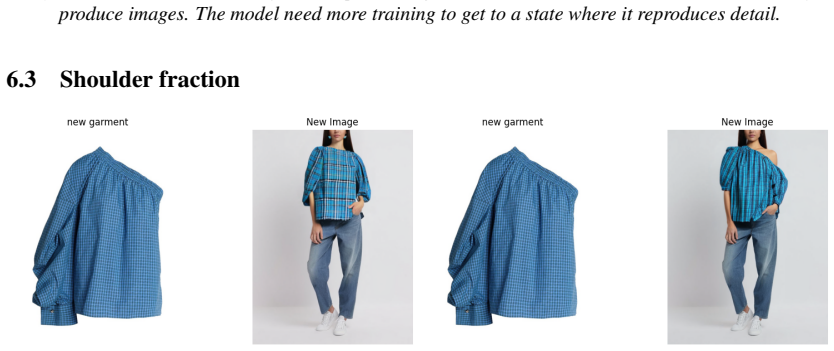
The central claim is that pairing garment images with precise fit labels lets a pretrained latent diffusion model generate a diverse, user-steerable set of try-on images, instead of a single average fit. The report constructs a label vector from one-hot classes and continuous floats computed in pixel space—shoulder fraction, hip distance, normalized neckline depth and width, and sleeve-length class—and injects it into an IP-adapter embedding through a small trainable residual module, while a custom up-block T2I adapter supplies detail. Qualitative experiments show that changing the continuous values changes shoulder styling, neckline depth, garment length, and waist regeneration, and that the numeric labels behave better than the one-hot ones. The author is careful to call the evidence preliminary: the up-block adapter was trained for only a fraction of the total epochs, and the unique contribution of the one-hot encoding is unclear because garment type and sleeve length were already supplied as text.
Load-bearing premise
The load-bearing premise is that the custom label vector has its own influence on what the diffusion model generates; if the model already gets the same information from the text prompt and the garment image, the whole control mechanism adds nothing.
Editorial extensions
If this is right
- If the method works as described, a virtual try-on system can expose controls for shoulder coverage, neckline depth, garment length relative to the hip, and sleeve length, and each control changes the generated outfit rather than only the prompt.
- Because the position labels are measured in pixel space and normalized, they give the model explicit geometric guidance that a latent text or image embedding alone does not carry; the paper states this is why these features work well despite little training.
- The mask-plus-boolean mechanism makes it possible to regenerate a waist or crop-top area upward from the mask boundary, letting a user dress a person in a shorter garment than the one in the source photo.
- The paper's critique of one-hot semantic labels implies that future versions should encode attributes such as sleeve length as continuous variables between zero and one.
Reading between the lines
- A natural ablation the paper did not report would train with the label vector present versus the same labels removed or shuffled while keeping text prompts fixed; near-identical outputs would mean the claimed control mechanism reduces to the text prompt.
- Because the current labels are global scalars, the architecture cannot pin a boundary to an exact pixel row; combining label injection with spatial conditioning such as a hemline mask is a likely next step for precise geometric placement.
- The segmentation-based measurement pipeline is itself a load-bearing contribution, so the method's reliability is tied to segmentation quality; an extension would test robustness by adding controlled noise to shoulder and neckline masks during training.
- If the waist-mask boolean generalizes, the same boundary-regeneration trick could apply to necklines, cuffs, or hemlines, turning the model into a general 'regenerate from this boundary' tool for garment edits.
Signed reviews
Editorial analysis
A structured set of objections, weighed in public.
Referee Report
Summary. The paper proposes ControllableClothing, a method for adding fine-grained control to latent-diffusion-based virtual try-on. Garment images are pre-processed with segmentation (GroundingDINO, SAM, OpenPose) to extract continuous measurements (shoulder coverage fraction, hip distance, neckline depth/width) and one-hot class labels (sleeve length, fit, style). These labels are concatenated with an IP-adapter image embedding and passed through a custom trainable MLP; additionally, a custom up-block T2I adapter is introduced. Training on DressCode and VitonHD, the author claims the model can steer fit and style at inference. Evaluation is qualitative: a handful of generated images showing changed conditions, plus a one-image ablation. The author openly acknowledges in Section 8 that the one-hot encoding effect is unclear and that several labels were also passed as text prompts during training.
Significance. If the central claim holds, the method would address a real limitation of VITON systems, which typically produce a single average fit with no user control over sleeve length, neckline depth, or shoulder coverage. The proposed label-extraction pipeline in pixel space is a plausible and reproducible alternative to latent-space captioning, and the custom up-block T2I adapter is a sensible architectural contribution. The author's decision to train on open datasets with open tools and to document limitations honestly (Section 8) counts in the paper's favor. However, the reported evidence does not currently establish the causal control claim, because the evaluation lacks quantitative metrics, seed control, repeated generations, and a held-out split. The paper is therefore best seen as an early technical report with a promising direction rather than a validated method.
major comments (4)
- [Section 6, Figures 14–20] The central claim that user-controllable labels steer generation is supported only by a small set of curated single images. No inference seeds are reported, no repeated generations per condition are shown, and no quantitative metric (e.g., LPIPS, FID, measured garment-length error, or fraction of correct semantic labels) distinguishes label-driven variation from sampling noise. Because Figures 14–15 are generated without text prompts, the differences could reflect prompt-free behavior or seed variation rather than the one-hot vector. I request a controlled evaluation: fix the seed, mask, prompt, and all other inputs, vary one label at a time, and report distributions of a relevant metric over multiple seeds, ideally on a held-out split of DressCode/VitonHD rather than on the training set.
- [Section 8, Discussion of one-hot encoding] The manuscript itself states, 'the effect of the one-hot encoding is unclear' and that 'the type of garment ... was passed as a prompt along with five other random labels' and that sleeve length information was 'added as a prompt.' Since the text prompt already conveyed these attributes, the label vector's non-redundant influence is exactly the load-bearing mechanism asserted in the abstract. The ablation study in Section 7 removes entire modules but does not test whether the label input alone changes the output when the prompt is held fixed. To support the control claim, the author needs an experiment where the label vector is varied while the text prompt (if any) and all other conditioning are held constant; without such a test, the method may reduce to prompt conditioning plus sampling noise.
- [Section 6.3, Figure 19] The shoulder-fraction demonstration shows a single pair of images with left-frac and right-frac set to different values. This is a suggestive example, but a single unseeded pair cannot exclude cherry-picking, especially because the paper reports that manual changes can have 'unforeseen consequences' (Section 6.1, Figure 14). For a claim that 'setting right-frac to 1 and left to 0' yields asymmetric shoulder coverage, I ask for several seeds per condition and a quantitative measure of shoulder coverage in the output, computed with the same segmentation pipeline used for labels.
- [Section 6.4, Figure 20] The waist-mask control experiment also relies on two examples per condition without seeds or a numeric measure of the resulting garment length. Since the comparison is between two generated images with 'the exact same mask' but different waist-mask values, the relevant question is whether this parameter changes the output distribution systematically. Please provide repeated generations and a metric such as the distance from the hem to the mask boundary.
minor comments (4)
- [Section 6.1] The text references 'Figure 24' in the discussion of Figure 13, and the figure numbering in the appendix appears inconsistent (e.g., 'Figure 24' is described as a 'relatively good example' while the appendix orders figures differently); please renumber and cross-check all figure references.
- [Section 4.4] Table 1 lists questions and answers from GPT-4o, but the reader cannot tell which of these were actually used as labels versus which were rejected; Section 8 mentions that some question types were rejected. Please clarify the final label set and its encoding in a single table.
- [Section 5.2] The dimensions of the up-block T2I intermediate tensors are listed, but the paper does not give the number of training steps, learning rate, batch size, or the exact random chance for adding extra waist mask. Adding these hyperparameters would improve reproducibility.
- [Throughout] There are several typos and grammatical issues (e.g., 'bu' for 'but', 'the model with not learn', 'looses' for 'loses', 'unpainted' for 'unmasked', 'nlp' for 'MLP' in Section 8). A careful proofread is needed.
Circularity Check
No circularity: the control claim is an unproven empirical hypothesis; the report's own Section 8 admits the one-hot conditioning may be redundant, but nothing in the derivation collapses into its inputs.
full rationale
The paper contains no derivation chain whose output equals its input by construction. The diffusion loss (Eq. 3) and the label-conditioned adapters are standard conditional modeling; the trained MLP is not constrained so that varying a label at inference reproduces the label's training-time measurement. The continuous labels (shoulder fraction, hip distance, neckline depth) are extracted by pixel-space segmentation and are then used as conditioning inputs; there is no fitted parameter that is later renamed as a 'prediction' of the same quantity. Likewise, the central claim that adapters enable user control rests on qualitative images, not on an equation that forces the result. The most serious admitted limitation appears in Section 8: 'the effect of the one-hot encoding is unclear' and garment type and sleeve length 'was passed as a prompt along with five other random labels.' This is a genuine threat to the causal interpretation of the control claim—the one-hot vector may be redundant with text conditioning—but redundancy is a confound, not a circular reduction. The report also evaluates on images from the training distribution without a held-out split or seed controls, which undermines the evidence for the control claim as an empirical matter. However, circularity requires exhibiting a specific reduction of a claimed result to its own inputs or to a load-bearing self-citation; no such reduction is present, and no load-bearing result is imported from the author's own prior work. The score is therefore 0.
Assumptions & free parameters
assumptions (5)
- ad hoc to paper The chosen scalar and class labels can summarize the aspects of garment fit and style that matter for control.
- domain assumption The segmentation and keypoint models yield measurements accurate enough for training labels.
- ad hoc to paper The custom MLP and T2I adapters can learn to map the label vector to output changes.
- domain assumption SDXL and the pretrained IP-adapter provide a suitable base for VITON fine-tuning.
- standard math The diffusion process obeys the standard DDPM equations (1)-(5).
Cite this review
Pith. "Pith review of Controllable Clothing: Precise Labels and Generation for Virtual Try-On with Latent Diffusion Models." pith.science (2026). https://pith.science/paper/P4CZXPWT
@misc{pith2026260805834,
  author       = {Pith},
  title        = {Pith review of: Controllable Clothing: Precise Labels and Generation for Virtual Try-On with Latent Diffusion Models},
  year         = {2026},
  howpublished = {\url{https://pith.science/paper/P4CZXPWT}},
  note         = {Machine review of arXiv:2608.05834}
}
read the original abstract
In this technical report, I present a new method for guiding image generation in the context of Virtual- Try-On (VITON). The proposed method leverages new open source Ai models to augment the image data with labels, such as lengths and styles. By training adapters with these labels paired with images of the garments, the model can produce a more diverse set of images that the user can control. For the end user, such as a retailer, this means that they can assure that the produced image is as true to the true fit as possible, not misleading consumers
Figures


Figures from the paper (22 more)




Reference graph
Works this paper leans on
-
[1]
High- resolution image synthesis with latent diffusion models, 2022
Robin Rombach, Andreas Blattmann, Dominik Lorenz, Patrick Esser, and Björn Ommer. High- resolution image synthesis with latent diffusion models, 2022
work page 2022
-
[2]
Sdxl: Improving latent diffusion models for high-resolution image synthesis, 2023
Dustin Podell, Zion English, Kyle Lacey, Andreas Blattmann, Tim Dockhorn, Jonas Müller, Joe Penna, and Robin Rombach. Sdxl: Improving latent diffusion models for high-resolution image synthesis, 2023
2023
-
[3]
Imagdressing-v1: Customizable virtual dressing, 2024
Fei Shen, Xin Jiang, Xin He, Hu Ye, Cong Wang, Xiaoyu Du, Zechao Li, and Jinhui Tang. Imagdressing-v1: Customizable virtual dressing, 2024
work page 2024
-
[4]
Shion Honda. Viton-gan: Virtual try-on image generator trained with adversarial loss.Eurograph- ics 2019 - Posters, 2019
work page 2019
-
[5]
Viton-hd: High-resolution virtual try-on via misalignment-aware normalization, 2021
Seunghwan Choi, Sunghyun Park, Minsoo Lee, and Jaegul Choo. Viton-hd: High-resolution virtual try-on via misalignment-aware normalization, 2021
work page 2021
-
[7]
Adding conditional control to text-to-image diffusion models, 2023
Lvmin Zhang, Anyi Rao, and Maneesh Agrawala. Adding conditional control to text-to-image diffusion models, 2023
2023
-
[8]
Animate anyone: Consistent and controllable image-to-video synthesis for character animation, 2024
Li Hu, Xin Gao, Peng Zhang, Ke Sun, Bang Zhang, and Liefeng Bo. Animate anyone: Consistent and controllable image-to-video synthesis for character animation, 2024
work page 2024
-
[9]
Improving diffusion models for authentic virtual try-on in the wild, 2024
Yisol Choi, Sangkyung Kwak, Kyungmin Lee, Hyungwon Choi, and Jinwoo Shin. Improving diffusion models for authentic virtual try-on in the wild, 2024
work page 2024
Show all 20 references
-
[10]
Stableviton: Learning semantic correspondence with latent diffusion model for virtual try-on, 2023
Jeongho Kim, Gyojung Gu, Minho Park, Sunghyun Park, and Jaegul Choo. Stableviton: Learning semantic correspondence with latent diffusion model for virtual try-on, 2023
2023
-
[11]
Tryondiffusion: A tale of two unets, 2023
Luyang Zhu, Dawei Yang, Tyler Zhu, Fitsum Reda, William Chan, Chitwan Saharia, Mohammad Norouzi, and Ira Kemelmacher-Shlizerman. Tryondiffusion: A tale of two unets, 2023
2023
-
[12]
Ip-adapter: Text compatible image prompt adapter for text-to-image diffusion models, 2023
Hu Ye, Jun Zhang, Sibo Liu, Xiao Han, and Wei Yang. Ip-adapter: Text compatible image prompt adapter for text-to-image diffusion models, 2023
2023
-
[13]
Learning transferable visual models from natural language supervision, 2021
Alec Radford, Jong Wook Kim, Chris Hallacy, Aditya Ramesh, Gabriel Goh, Sandhini Agarwal, Girish Sastry, Amanda Askell, Pamela Mishkin, Jack Clark, Gretchen Krueger, and Ilya Sutskever. Learning transferable visual models from natural language supervision, 2021
2021
-
[14]
Ootdiffusion: Outfitting fusion based latent diffusion for controllable virtual try-on, 2024
Yuhao Xu, Tao Gu, Weifeng Chen, and Chengcai Chen. Ootdiffusion: Outfitting fusion based latent diffusion for controllable virtual try-on, 2024
2024
-
[15]
Denoising diffusion probabilistic models, 2020
Jonathan Ho, Ajay Jain, and Pieter Abbeel. Denoising diffusion probabilistic models, 2020
2020
-
[16]
T2i-adapter: Learning adapters to dig out more controllable ability for text-to-image diffusion models, 2023
Chong Mou, Xintao Wang, Liangbin Xie, Yanze Wu, Jian Zhang, Zhongang Qi, Ying Shan, and Xiaohu Qie. T2i-adapter: Learning adapters to dig out more controllable ability for text-to-image diffusion models, 2023
2023
-
[17]
Self-correction for human parsing.arXiv preprint arXiv:1910.09777, 2019
Peike Li, Yunqiu Xu, Yunchao Wei, and Yi Yang. Self-correction for human parsing.arXiv preprint arXiv:1910.09777, 2019
1910 arXiv
-
[18]
Dress code: High-resolution multi-category virtual try-on, 2022
Davide Morelli, Matteo Fincato, Marcella Cornia, Federico Landi, Fabio Cesari, and Rita Cuc- chiara. Dress code: High-resolution multi-category virtual try-on, 2022
2022
-
[19]
Grounding dino: Marrying dino with grounded pre-training for open-set object detection, 2024
Shilong Liu, Zhaoyang Zeng, Tianhe Ren, Feng Li, Hao Zhang, Jie Yang, Qing Jiang, Chunyuan Li, Jianwei Yang, Hang Su, Jun Zhu, and Lei Zhang. Grounding dino: Marrying dino with grounded pre-training for open-set object detection, 2024. 20
2024
-
[20]
Berg, Wan-Yen Lo, Piotr Dollár, and Ross Girshick
Alexander Kirillov, Eric Mintun, Nikhila Ravi, Hanzi Mao, Chloe Rolland, Laura Gustafson, Tete Xiao, Spencer Whitehead, Alexander C. Berg, Wan-Yen Lo, Piotr Dollár, and Ross Girshick. Seg- ment anything, 2023
2023
-
[21]
G. M. Merz, Y . Liu, C. J. Burke, P. D. Aleo, X. Liu, M. C. Kind, V . Kindratenko, and Y . Liu. Detection, instance segmentation, and classification for astronomical surveys with deep learning (deepdisc): Detectron2 implementation and demonstration with hyper suprime-cam data,...
2023
Reviewed August 7, 2026 · model on record in the stance chip above.
Discussion (0). Continue with ORCID to comment.