REVIEW 3 major objections 5 minor 34 references
Descoped and Upscoped FCC-ee Running Scenarios in the SMEFT
T0 review · 3 major / 5 minor · reviewed 2026-08-07 · deepseek-v4-flash
Pith's one-line read A staged top-quark run, not raw luminosity, is what preserves the FCC-ee's new-physics reach.
desk verdict Read it before the next ESPPU26 scoping meeting: the top-run result is new and holds up, but its quantitative size rests on an admitted systematics rescaling rule. read the letter →
The pith
A machine-rendered reading of the paper's core claim, the machinery that carries it, and where it could break.
The reading
What carries the argument
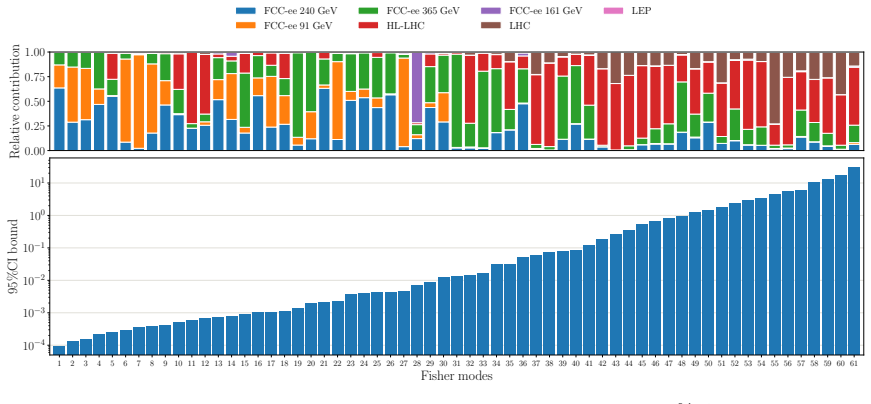
The load-bearing object is a global SMEFT fit to 61 independent dimension-six Wilson coefficients in the Warsaw basis, with one-loop renormalisation-group running from a 10 TeV initial scale down to the observables. To locate the source of the scenario differences, the paper decomposes the Fisher information matrix $F_{ii'}=\sum_{j,j'}\kappa_{i,j}\Sigma^{-1}_{j,j'}\kappa_{i',j'}$ into dataset groups and diagonalises it, so that each eigenmode of the coefficient space is assigned a fractional contribution from LEP, LHC, HL-LHC, and each FCC-ee energy point. This decomposition shows that the first roughly 40 eigenmodes are FCC-ee-dominated while the remaining directions need HL-LHC data, and that the top-quark run works through two channels: new observables that lift correlations, and a sharper top mass that reduces parametric uncertainties on the Z-pole observables. Luminosity changes enter only through rescaling statistical and statistically-driven systematics by $\sqrt{L_{\rm baseline}/L_{\rm scenario}}$, with all other systematics kept fixed.
What would settle it
Run the same global SMEFT fit with a dedicated detector-level simulation of the 2-IP, 30 MW FCC-ee that recomputes the systematic uncertainties on the Z-pole asymmetries and Higgs measurements as functions of integrated luminosity instead of the assumed $\sqrt{L}$ rescaling; if those systematics scale more steeply with luminosity, the descoped scenarios would degrade relative to baseline and the top-run-versus-luminosity contrast would shrink.
Extended reading notes
Core claim
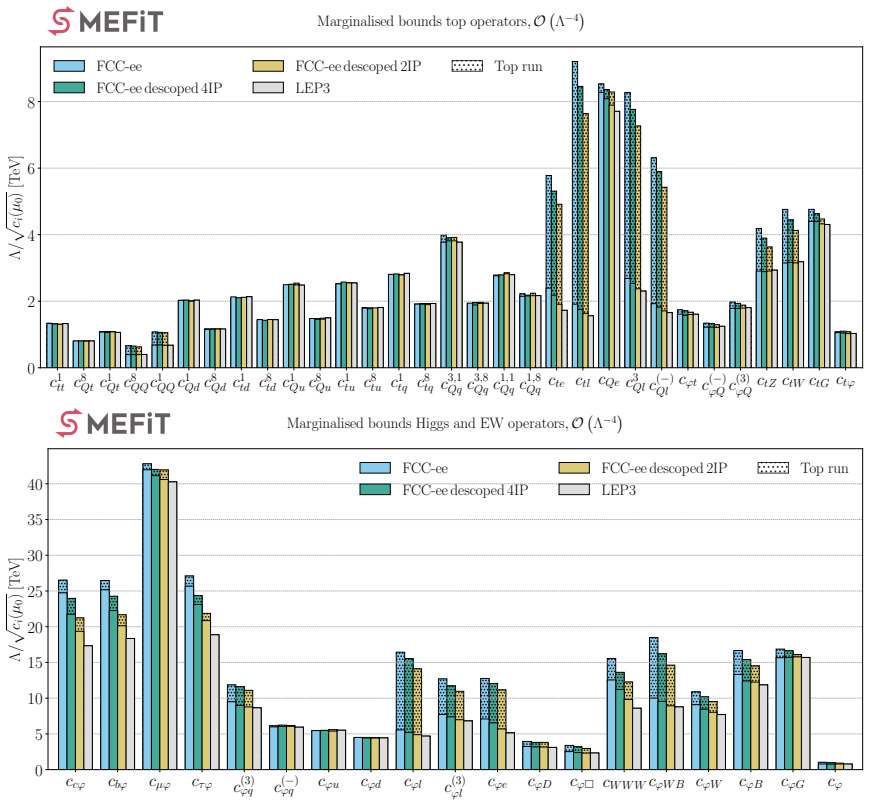
The paper's central claim is that a substantial fraction of the FCC-ee physics potential depends on the top-quark run at $\sqrt{s}=365$ GeV, and that the combination of a staged top run with LHC/HL-LHC data is what separates any FCC-ee variant from LEP3. In individual fits, where each of the 61 Wilson coefficients is constrained one at a time, the top run improves the mass reach by typically less than 10%; in the marginalised fit, where all coefficients vary simultaneously, the same run produces improvements of order 100% or more, moving for example $c_{t\ell}$ from about 1.5 TeV to 4 TeV at the baseline. The mechanism is twofold: the top run adds observables with new operator dependencies that break flat directions and correlations in the 61-dimensional parameter space, and it pins down the top-quark mass to roughly 10 MeV, reducing parametric uncertainties that would otherwise limit the Z-pole observables. The paper shows that an FCC-ee dataset alone has Fisher-information rank 52 out of 61, so the HL-LHC is required to lift the remaining flat directions, which is why luminosity upscoping and descoping matter so little. The same pattern controls the Higgs self-coupling: without the top run all scenarios return the LEP3-level bound $\delta\kappa_3=0.280$, while a staged top run gives 0.164 (baseline), 0.183 (4-IP descope), and 0.203 (2-IP descope).
Load-bearing premise
That the descoped and upscoped projections can be modelled by rescaling statistical and statistically-driven systematic uncertainties by the square root of the luminosity ratio while keeping all other systematics fixed, an approximation the paper states needs dedicated simulations that are not yet available.
Editorial extensions
If this is right
- A descoped FCC-ee running nine years at two IPs and 30 MW collects 36.5% of baseline luminosity; without a top run its global marginalised bounds sit at LEP3 level, and running 23 years to recover the luminosity does not recover the lost reach.
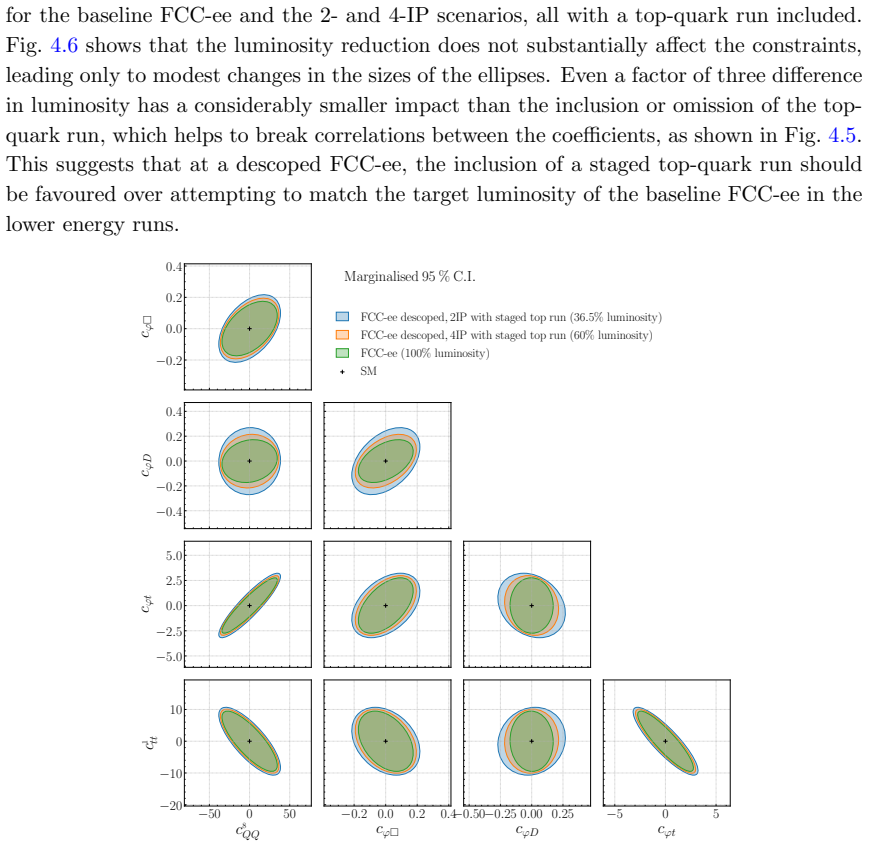
- Restoring a staged top-quark run at 36.5% (two-IP) or 60% (four-IP) of the baseline 365 GeV luminosity recovers most of the baseline constraints, making the staged top run the minimum ingredient for a meaningful descoped programme.
- Upscoping luminosity by 20% at all energies or by 50% on the top run alone improves the global bounds only marginally, so the exact luminosity of the top run is comparatively unimportant once it is present.
- In the global marginalised fit, HL-LHC systematic uncertainties are the dominant limitation; the FCC-ee alone constrains 52 of the 61 directions, so the LHC and FCC-ee are complementary programmes rather than substitutes.
- On the Higgs self-coupling, the top run tightens $\delta\kappa_3$ from 0.280 without a top run (equal to LEP3) to 0.164 at the baseline, 0.183 at the four-IP descope, and 0.203 at the two-IP descope.
Reading between the lines
- If a dedicated simulation showed that a larger share of FCC-ee systematics scale with luminosity than the $\sqrt{L}$ rescaling assumed here, the descoped scenarios would degrade and the upscoped ones would improve, shrinking the apparent gap between the top-run effect and the luminosity effect.
- The conclusion that luminosity matters little once a top run is present suggests that preserving even a reduced 365 GeV run is a better use of resources than building four IPs or running at 50 MW, a cost-benefit judgement the paper does not itself make.
- The flat-directions diagnosis makes the FCC-ee projections hostage to HL-LHC assumptions: improved HL-LHC systematics would tighten all FCC-ee variants together and could make the luminosity ranking more visible, while degraded HL-LHC performance would weaken every FCC-ee scenario.
- The paper's linear-versus-quadratic comparison is illustrative; a full $\mathcal{O}(\Lambda^{-4})$ global fit across all 61 operators would test whether the top-run dominance persists when quadratic corrections reshape the correlations.
Editorial analysis
A structured set of objections, weighed in public.
Referee Report
Summary. The manuscript uses the SMEFiT global fit framework to project the SMEFT reach of several FCC-ee running scenarios relative to the baseline FCC-ee programme and to LEP3. The scenarios are a 2-IP descoped FCC-ee with reduced synchrotron-radiation power, a 4-IP descoped variant, both optionally supplemented by a staged top-quark run, and two upscoped variants (a uniform 20% luminosity increase and a 50% increase of the top-quark run only). The analysis is carried out in a 61-operator dimension-six SMEFT with U(2)^3 flavour symmetry, at linear and quadratic order in the EFT expansion, and with aggressive or ideal theory-uncertainty assumptions. The main findings are that the top-quark run at 365 GeV is essential to outperform LEP3 in the marginalised fit, that luminosity variations have comparatively modest effects once a (staged) top run is present, and that systematic uncertainties of the HL-LHC projections constitute the dominant limitation of the global fit. The paper argues that the LHC and FCC-ee should be viewed as complementary programmes.
Significance. If correct, the analysis provides timely quantitative input for the ESPPU26 discussion of descoped FCC-ee options, and it offers useful comparative benchmarks for future collider physics assessments. The manuscript builds on the public SMEFiT code and database, and it presents the results of a genuinely global 61-parameter fit, including Fisher-information decompositions, rank analyses, quadratic EFT corrections, and a dedicated treatment of parametric top-mass uncertainties. These are concrete strengths. The central limitation is acknowledged by the authors themselves: the modelling of FCC-ee systematic uncertainties in non-baseline scenarios rests on a binary luminosity-rescaling rule that is explicitly stated to await dedicated simulations. Since that rule directly controls the quantitative conclusions about descoping, upscoping, and the role of luminosity, the headline claims should be regarded as conditional on this assumption until it is validated or bracketed by a sensitivity study.
major comments (3)
- [Sec. 3, "Experimental projections"] The systematics rescaling rule is load-bearing and not fully specified. The text states that, for descoped and upscoped scenarios, statistically driven systematics are rescaled by the square root of the luminosity ratio while all other systematics are held fixed, but it does not provide a per-observable list of which systematics fall into which class, so the results are not fully reproducible. More importantly, this binary rule directly determines the conclusions in Secs. 4.1 and 4.2 that luminosity variations have limited impact and that descoped scenarios with a staged top run retain most of the baseline reach. The authors should provide the full classification and a robustness scan over alternative rescaling choices -- for example, scaling all systematics with sqrt(L), or scaling none -- and show how the bounds in Figs. 4.6, 4.8, and 4.12, as well as the delta_kappa_3 values in Sec. 4.4, change under these alternatives.
- [Sec. 4.3, Table 4.1] The claim that the HL-LHC systematics are the dominant limitation of the global fit is supported by Fig. 4.9 and the Fisher-mode decomposition, but two pieces of information are missing. First, the notion of "constrained directions" in Table 4.1 (52/61, 38/61, 61/61) is not defined: the rank of a Fisher matrix is a mathematical statement only up to an eigenvalue threshold, and no threshold is stated. Second, the flat-direction structure and the perceived HL-LHC bottleneck are computed with the covariance matrix built using the Sec. 3 rescaling rule; under an equally plausible alternative rule, the number of FCC-ee-only constrained directions and the size of the HL-LHC contribution could change. The paper should state the eigenvalue threshold used to define rank and should present at least one alternative-rule version of Fig. 4.9 or Table 4.1 to show the stability of the bottleneck claim.
- [Sec. 4.1, Fig. 4.6, and Sec. 5] The conclusion that "a staged top-quark run should be favoured over attempting to match the target luminosity of the baseline FCC-ee" is presented as a physics-reach statement but is then phrased as a recommendation that goes beyond physics: no cost model or funding schedule is included, although the scenarios are motivated by cost considerations. In addition, the manuscript attributes much of the top-run benefit to the improved top-quark mass measurement and the resulting reduction of parametric uncertainties, yet it never reports the assumed top-quark mass precision in the baseline and staged-top-run scenarios. Given that the abstract and Sec. 3 place weight on this parametric-uncertainty propagation, the paper should state the m_t uncertainty inputs (e.g., the values from Ref. [7]) for the baseline and staged scenarios and show how they enter the quoted bounds.
minor comments (5)
- [Table 2.1 caption] The caption contains a formatting typo: "T able 2.1" should be "Table 2.1", and the header "LUminosity" should be "Luminosity".
- [Sec. 4.1] The text says "Even a factor of three difference in luminosity" when comparing the baseline (100%) with the 2-IP descoped (36.5%) scenarios; the actual ratio is 205/74.8 = 2.74 for the Z-pole run. Please use the exact ratio or write "almost a factor of three".
- [Fig. 4.4] The table inside Fig. 4.4 is labeled as showing "diagonal entries of the Fisher Information Matrix," but the displayed numbers appear to be relative contributions (percentages) of each dataset group to the diagonal element; please clarify the normalization and units in the caption.
- [Sec. 4.3, footnote 1] The footnote beginning "We observe that the 55th Fisher mode..." appears without a footnote marker in the main text; please add the appropriate marker and ensure the footnote is properly anchored.
- [Sec. 4.1, Eq. (4.1)] The sentence "V_post increases by 8% once the top-quark run is excluded" is ambiguous because an increase of the posterior volume corresponds to weaker constraints; please rephrase to say explicitly that the volume increases, i.e., the constraints degrade, and that this confirms the constraining power of the top run.
Circularity Check
No circularity: the scenario comparisons are outputs of a transparent SMEFiT fit, while the Sec. 3 systematics rescaling is an acknowledged assumption rather than a fitted prediction.
full rationale
The paper is a projection exercise built on a fixed SMEFiT likelihood; its main claims (top-run importance, mild luminosity sensitivity, and HL-LHC systematics as the global-fit bottleneck) are outputs of the 61-parameter fit, not quantities inserted as inputs. The only potentially load-bearing modeling choice is the Sec. 3 rule that statistical uncertainties and statistically-driven systematics rescale as sqrt(L_baseline/L_scenario) while other systematics are held fixed; the paper explicitly states that this 'requires dedicated simulations that are currently not available.' That is a transparent, externally checkable assumption about the future experiments, not a circular reduction: no equation is defined in terms of the conclusions it supports, and no fitted parameter is relabeled as a prediction. The SMEFiT framework and Ref. [14] are same-group citations, but they supply the computational machinery and baseline projections; the present paper computes the scenario comparisons itself, and the conclusions do not reduce to a self-citation. No uniqueness theorem or ansatz is smuggled in via citation. The acknowledged absence of dedicated systematic studies in Sec. 3 is the main limitation and should be weighed as a robustness/correctness concern, not as circularity.
Assumptions & free parameters
free parameters (3)
- Aggressive theory uncertainty scenario =
sizes from ESPPU26 Briefing Book (Ref. [31])
- Systematic luminosity rescaling rule =
1/sqrt(L_baseline/L_scenario) for statistically driven systematics; fixed otherwise
- Top-quark mass parametric uncertainty =
about 10 MeV with top run; degraded without
assumptions (5)
- domain assumption Only CP-even dimension-six Warsaw-basis operators with a U(2)^3 flavor symmetry are retained, giving 61 operators
- domain assumption Linear EFT expansion at O(Lambda^-2) is the default, with quadratic corrections as a cross-check
- standard math One-loop RGE running of Wilson coefficients from mu0 = 10 TeV down to observable scales
- domain assumption Projected (HL-)LHC and FCC-ee input datasets from Refs. [14] and [23] are accepted as given
- domain assumption Parametric uncertainties are propagated with the code of Ref. [32], with top-mass precision depending on whether the 365 GeV run exists
Cite this review
Pith. "Pith review of Descoped and Upscoped FCC-ee Running Scenarios in the SMEFT." pith.science (2026). https://pith.science/paper/CUDIIN6Q
@misc{pith2026260805874,
  author       = {Pith},
  title        = {Pith review of: Descoped and Upscoped FCC-ee Running Scenarios in the SMEFT},
  year         = {2026},
  howpublished = {\url{https://pith.science/paper/CUDIIN6Q}},
  note         = {Machine review of arXiv:2608.05874}
}
read the original abstract
We present projections for the sensitivity to new physics of descoped and upscoped FCC-ee scenarios in the framework of the Standard Model Effective Field Theory (SMEFT). Starting from the baseline FCC-ee programme, we analyse the subsequent impact of, first, removing the top-quark run, then reducing the beam power from 50 MW to 30 MW, and finally removing two interaction points (IPs), in all cases propagating the resulting loss in top-quark mass precision through increased parametric uncertainties. We also analyse the possibility of a staged top-quark run, where the top-quark run is partially restored in case funding becomes available only at a later stage. Motivated by the trade-off between beam power and operational costs, we also consider two upscoped scenarios, either through a uniform increase in luminosity across all energy runs, or through a luminosity enhancement targeting exclusively the top-quark run. We explore the sensitivity and limitations of each scenario and highlight in particular the complementarity between the FCC-ee projections and the (HL)-LHC measurements. By comparing the physics impact of the different running scenarios with the FCC-ee baseline, we show explicitly the importance of the top-quark run, indicating that a substantial fraction of the FCC-ee physics potential depends on it.
Figures


Figures from the paper (9 more)






Reference graph
Works this paper leans on
-
[14]
T. Armadillo, E. Celada, J. ter Hoeve, F. Maltoni, L. Mantani, J. Rojo et al.,New Physics Reach through Precision at Future Colliders: a Multi-Pronged Approach,2604.16596
-
[7]
M.M. Defranchis, J. de Blas, A. Mehta, M. Selvaggi and M. Vos,A detailed study on the prospects for a t t threshold scan in e +e− collisions,JHEP11(2025) 020 [2503.18713]
arXiv 2025
-
[4]
CERN 2016-2025 (with emphasis on the past five years)
F. Gianotti et al., “CERN 2016-2025 (with emphasis on the past five years) .” Address to the personnel of CERN, 16 Dec 2025, slides 97–106, https://indico.cern.ch/event/1621529/, Dec., 2025
-
[5]
A. Blondel, C. Grojean, P. Janot and G. Wilkinson,First comments on a descoped/staged FCC-ee,2601.05283
-
[6]
J. de Blas, A. Canepa, C. Diaconu, M. Dunford, P. Hern´ andez, G. Isidori et al.,Report by esg working group 2b: Project comparison – physics potential, Technical Report CERN-ESU-2026-006, CERN, Geneva (Mar., 2026), DOI. – 28 – c1 tt c8 Qt c1 Qt c8 QQc1 QQ c1 Qd c8 Qd c1 td c8 td c1 Qu c8 Qu c1 tu c8 tu c1 tq c8 tq c3,1 Qq c3,8 Qq c1,1 Qq c1,8 Qq cte ctl ...
work page 2026
-
[8]
J. ter Hoeve, L. Mantani, J. Rojo, A.N. Rossia and E. Vryonidou,Higgs trilinear coupling in the standard model effective field theory at the high luminosity LHC and the FCC-ee,Phys. Rev. D112(2025) 013008 [2504.05974]
arXiv 2025
-
[9]
V. Maura, B.A. Stefanek and T. You,The Higgs Self-Coupling at FCC-ee,Phys. Rev. Lett. 135(2025) 141802 [2503.13719]
arXiv 2025
-
[10]
From the Strategy update to the project approval (and beyond)
P. Janot, “From the Strategy update to the project approval (and beyond).” 118th plenary ECF A meeting, 9-10 July 2026, slides 44–46,https://indico.cern.ch/event/1567686/ contributions/7102020/attachments/3311207/5929158/FCC-PED-ECFA09072026.pdf, 2026. – 29 –
Show all 34 references
-
[11]
Brivio and M
I. Brivio and M. Trott,The Standard Model as an Effective Field Theory,Phys. Rept.793 (2019) 1 [1706.08945]
2019 arXiv
-
[12]
Isidori, F
G. Isidori, F. Wilsch and D. Wyler,The standard model effective field theory at work,Rev. Mod. Phys.96(2024) 015006 [2303.16922]
2024 arXiv
-
[13]
ter Hoeve, G
J. ter Hoeve, G. Magni, J. Rojo, A.N. Rossia and E. Vryonidou,The automation of SMEFT-assisted constraints on UV-complete models,JHEP01(2024) 179 [2309.04523]
2024 arXiv
-
[15]
Allwicher, M
L. Allwicher, M. McCullough and S. Renner,New physics at Tera-Z: precision renormalised, JHEP02(2025) 164 [2408.03992]
2025 arXiv
-
[16]
Maura, B.A
V. Maura, B.A. Stefanek and T. You,Accuracy complements energy: electroweak precision tests at Tera-Z,JHEP10(2025) 022 [2412.14241]
2025 arXiv
-
[17]
Gargalionis, J
J. Gargalionis, J. Quevillon, P.N.H. Vuong and T. You,Linear Standard Model extensions in the SMEFT at one loop and Tera-Z,JHEP07(2025) 136 [2412.01759]
2025
-
[18]
Hartland, F
N.P. Hartland, F. Maltoni, E.R. Nocera, J. Rojo, E. Slade, E. Vryonidou et al.,A Monte Carlo global analysis of the Standard Model Effective Field Theory: the top quark sector, JHEP04(2019) 100 [1901.05965]
2019 arXiv
-
[19]
van Beek, E.R
S. van Beek, E.R. Nocera, J. Rojo and E. Slade,Constraining the SMEFT with Bayesian reweighting,SciPost Phys.7(2019) 070 [1906.05296]. [20]SMEFiTcollaboration,Combined SMEFT interpretation of Higgs, diboson, and top quark data from the LHC,JHEP11(2021) 089 [2105.00006]
2019 arXiv
-
[21]
Ethier, R
J.J. Ethier, R. Gomez-Ambrosio, G. Magni and J. Rojo,SMEFT analysis of vector boson scattering and diboson data from the LHC Run II,Eur. Phys. J. C81(2021) 560 [2101.03180]
2021 arXiv
-
[22]
Giani, G
T. Giani, G. Magni and J. Rojo,SMEFiT: a flexible toolbox for global interpretations of particle physics data with effective field theories,Eur. Phys. J. C83(2023) 393 [2302.06660]
2023 arXiv
-
[23]
Celada, T
E. Celada, T. Giani, J. ter Hoeve, L. Mantani, J. Rojo, A.N. Rossia et al.,Mapping the SMEFT at high-energy colliders: from LEP and the (HL-)LHC to the FCC-ee,JHEP09 (2024) 091 [2404.12809]
2024 arXiv
-
[24]
ter Hoeve, L
J. ter Hoeve, L. Mantani, J. Rojo, A.N. Rossia and E. Vryonidou,Connecting scales: RGE effects in the SMEFT at the LHC and future colliders,JHEP06(2025) 125 [2502.20453]
2025 arXiv
-
[25]
What comes after the ESG recommendation? Focusing on PED short-term priorities
P. Janot, “What comes after the ESG recommendation? Focusing on PED short-term priorities.” Slides presented at the 9th FCC Physics Workshop, Munich, Germany, Jan., 2026
2026
-
[26]
Grzadkowski, M
B. Grzadkowski, M. Iskrzynski, M. Misiak and J. Rosiek,Dimension-Six Terms in the Standard Model Lagrangian,JHEP10(2010) 085 [1008.4884]
2010 arXiv
-
[27]
Blondel, C
A. Blondel, C. Grojean, P. Janot and G. Wilkinson,Higgs Factory options for CERN: A comparative study,2412.13130. [28]FCCcollaboration,Prospects in electroweak, Higgs and Top physics at FCC, 3, 2025. 10.17181/n78xk-qcv56. – 30 –
2025 arXiv
-
[29]
BLONDEL,Statistical and experimental systematic uncertainties on ewpos at the z pole in fcc-ee, Mar., 2025
A. BLONDEL,Statistical and experimental systematic uncertainties on ewpos at the z pole in fcc-ee, Mar., 2025. 10.17181/3rj9z-94994
2025 doi
-
[30]
Asteriadis, S
K. Asteriadis, S. Dawson, P.P. Giardino and R. Szafron,e +e− →ZH process in the SMEFT beyond leading order,JHEP02(2025) 162 [2409.11466]
2025 arXiv
-
[31]
de Blas et al.,Physics Briefing Book: Input for the 2026 update of the European Strategy for Particle Physics,2511.03883
J. de Blas et al.,Physics Briefing Book: Input for the 2026 update of the European Strategy for Particle Physics,2511.03883
2026
-
[32]
Mildner,An EWPD SMEFT likelihood for the LHC — and how to improve it with measurements of W and Z boson properties,JHEP07(2025) 089 [2412.07651]
H. Mildner,An EWPD SMEFT likelihood for the LHC — and how to improve it with measurements of W and Z boson properties,JHEP07(2025) 089 [2412.07651]
2025 arXiv
-
[33]
McCullough,An Indirect Model-Dependent Probe of the Higgs Self-Coupling,Phys
M. McCullough,An Indirect Model-Dependent Probe of the Higgs Self-Coupling,Phys. Rev. D90(2014) 015001 [1312.3322]
2014 arXiv
-
[34]
Maltoni, D
F. Maltoni, D. Pagani and X. Zhao,Constraining the Higgs self-couplings at e +e− colliders, JHEP07(2018) 087 [1802.07616]
2018 arXiv
-
[35]
Asteriadis, S
K. Asteriadis, S. Dawson, P.P. Giardino and R. Szafron,Impact of Next-to-Leading-Order Weak Standard-Model-Effective-Field-Theory Corrections in e+e-→ZH,Phys. Rev. Lett.133 (2024) 231801 [2406.03557]
2024 arXiv
-
[36]
Allwicher, C
L. Allwicher, C. Grojean and L. Tabatt,Could electron-top interactions spoil the measurement of the Higgs trilinear? A quantitative estimate at future lepton colliders,JHEP 05(2026) 187 [2512.06916]
2026 arXiv
-
[37]
Cepeda et al.,Report from Working Group 2: Higgs Physics at the HL-LHC and HE-LHC,CERN Yellow Rep
M. Cepeda et al.,Report from Working Group 2: Higgs Physics at the HL-LHC and HE-LHC,CERN Yellow Rep. Monogr.7(2019) 221 [1902.00134]
2019 arXiv
-
[38]
Mantani,Exploring the SMEFT landscape: Bayesian Model Selection for indirect discovery,2605.21594
L. Mantani,Exploring the SMEFT landscape: Bayesian Model Selection for indirect discovery,2605.21594
-
[39]
Hirsch, L
M. Hirsch, L. Mantani and V. Sanz,Data-Driven Discovery Strategy for Standard Model Effective Field Theory Searches,Phys. Rev. Lett.135(2025) 241801 [2507.11109]. – 31 –
2025
Reviewed August 7, 2026 · model on record in the stance chip above.
Discussion (0). Continue with ORCID to comment.