REVIEW 4 major objections 5 minor 137 references
Floating Radiance Networks
T0 review · 4 major / 5 minor · reviewed 2026-08-07 · deepseek-v4-flash
Pith's one-line read FlaRe ties neural radiance fields to explicit planar primitives, so one learned scene model supports rendering, ray tracing, deformation, mesh extraction, and stylization.
desk verdict FlaRe combines known building blocks into a genuinely new single representation; core rendering numbers are solid, but ray tracing, deformation, and stylization claims rest only on qualitative demos. read the letter →
The pith
A machine-rendered reading of the paper's core claim, the machinery that carries it, and where it could break.
The reading
What carries the argument
The load-bearing object is the isotropic planar generalized Gaussian primitive: a flattened, elliptical Gaussian with a shape parameter κ, represented by a shared triangulated polygon proxy so rays can be intersected on the GPU. Each primitive stores a trainable latent descriptor $z_i \in \mathbb{R}^{96}$ that encodes the local radiance field. A single three-layer auto-decoder MLP maps the descriptor, LUT-encoded local coordinates $(u,v)$, and positionally encoded view direction to color and opacity; the final opacity is the MLP prediction modulated by the generalized Gaussian kernel. A collision-free multiresolution lookup table replaces hashed encodings, and warmup with a constant-color base renderer stabilizes geometry before the neural appearance is enabled.
What would settle it
Train FlaRe on a scene containing a planar mirror, then render a reflection from a novel viewpoint and compare it against a ground-truth photograph taken from the mirrored camera position; if the reflected image's error is substantially larger than the primary-view error, the descriptors do not generalize to secondary rays.
Extended reading notes
Core claim
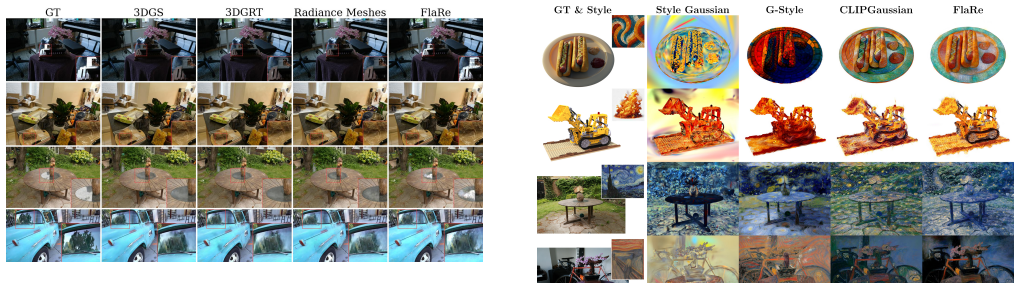
The central claim is that a scene can be represented as a set of independently addressable planar primitives, each with its own compact latent vector, and that this representation is expressive enough to serve simultaneously as the renderer, the ray-tracing engine, and the editable object model. Color and opacity are not stored per primitive as fixed coefficients; they are decoded at every ray–primitive intersection from the primitive descriptor, local surface coordinates, and viewing direction by a network shared by all primitives. The paper's experiments show that this design preserves reconstruction quality comparable to dedicated renderers on standard reconstruction benchmarks, while the explicit structure gives recursive reflection and refraction, deformation, TSDF mesh extraction, and style transfer in one model.
Load-bearing premise
The per-primitive descriptor is learned only from photometric loss on training views, yet operations like reflections, refractions, deformation, and stylization require it to stay valid for new ray directions and new geometry; the paper shows these work qualitatively but gives no numerical evaluation of that extrapolation.
Editorial extensions
If this is right
- The same trained scene can be rendered with hardware-accelerated primary rays and recursive secondary rays for reflections, refractions, transparency, and shadows, without converting to another representation.
- Deforming the proxy polygon recovers updated Gaussian parameters directly, so primitive-level geometry edits take effect without retraining.
- Appearance stylization runs in descriptor space while fine-tuning the shared decoder, preserving structure and shading.
- The representation retains reconstruction quality under aggressive primitive reduction, so a compact primitive set suffices for many scenes.
- The collision-free LUT encoding outperforms hash grids at equal parameter budgets on controlled 2D signal reconstruction.
Reading between the lines
- If descriptor stability holds under non-rigid deformation, the same representation could plug into animation or physics pipelines, since the primitives are already mesh proxies.
- The finite planar primitives likely make the unified representation most tractable for object-centric and indoor scenes; the paper itself notes far-field outdoor accuracy is limited.
- The LUT-encoding result suggests collision-free lookup may benefit other coordinate-based neural fields beyond planar Gaussian primitives.
Editorial analysis
A structured set of objections, weighed in public.
Referee Report
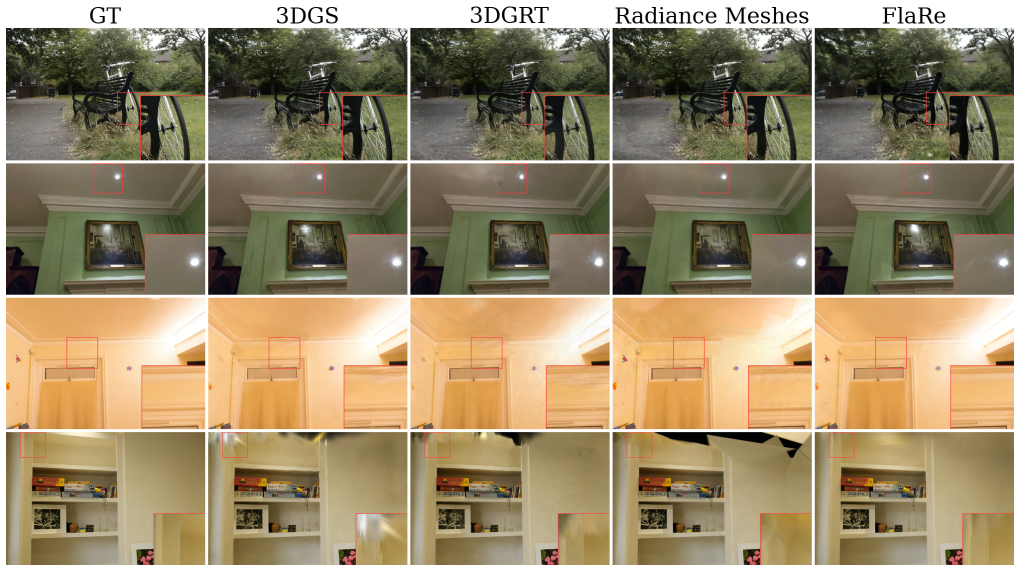
Summary. The paper introduces Floating Radiance Networks (FlaRe), a scene representation in which the scene is composed of planar generalized Gaussian primitives, each carrying a 96-dimensional latent descriptor of a local 2D neural radiance field. A lightweight shared auto-decoder maps the descriptor, local surface coordinates, and viewing direction to color and opacity, with hardware-accelerated ray–triangle proxies used for intersection. The authors claim that this single representation supports high-quality novel-view synthesis as well as recursive ray tracing, primitive-level deformation, mesh extraction, and appearance stylization without task-specific scene models. Quantitative results are reported on Mip-NeRF360, Tanks and Temples, and Deep Blending (Table 2), with additional controlled experiments on LUT-Encoding and primitive reduction. The supplement contains detailed gradient derivations, architecture descriptions, and reproducibility notes.
Significance. If the unified-scene-model claim is substantiated, FlaRe would be a valuable step toward bridging neural radiance fields and conventional graphics pipelines, because the same explicit primitives would serve rendering, ray tracing, editing, and geometry extraction. The paper has notable strengths: it ships source code, provides thorough analytic gradient derivations in the supplement, includes a controlled, seeded comparison of LUT-Encoding against hash grids, and evaluates primitive reduction against two pruning baselines. However, the distinctive capabilities beyond novel-view synthesis are currently supported only by qualitative figures, and the main quantitative claim is weakened by a hyperparameter-selection procedure that appears to use test performance. The significance of the work therefore depends on additional validation that is not yet present in the manuscript.
major comments (4)
- [Graphics Capabilities; Ray-Tracing; Mesh modification] The central claim that FlaRe supports recursive ray tracing, deformation, stylization, and mesh extraction within one untrained representation is supported only by qualitative images (Figs. 2, 4, 7, 8). The per-primitive descriptors z_i are optimized solely against a photometric loss on primary camera rays (main-text loss in §3.4 and supplement Eq. for L), so the validity of the decoded radiance under secondary-ray directions, deformed local frames, and stylized descriptors is an empirical claim that is never measured. I request numerical evaluations: for example, PSNR/SSIM or relative error in reflected/refracted regions against reference renderings, Chamfer distance or F-score for deformed geometry, CLIP score and structure-preservation metrics for stylization, and Chamfer/F-score for mesh extraction on a standard dataset. Without such measurements, the headline unification claim is not established and the contribution reduces to a competitive novel-view-synthesis method with disconnected demos.
- [Supplementary Material, Reproducibility, Hyperparameter search] The supplement states: 'Hyperparameter selection during tuning is guided by validation/test PSNR.' Because Table 2 reports test-set PSNR as the primary evidence of competitive NVS quality, the reported rankings may be optimistically biased toward the test set. This is load-bearing for the paper's second main claim. The authors should clarify whether the final numbers were selected on a held-out validation split or on the test split, report the selection protocol per scene, and ideally provide sensitivity of Table 2 to hyperparameter choices or standard errors over multiple training runs.
- [Ray-Tracing; Color aggregation along the ray] The recursive ray-tracing capability is not described at the algorithmic level. The main text and supplement detail only primary-ray rendering (ordered intersections, front-to-back compositing, loss function). There is no description of how secondary rays are generated, how material properties (reflection/refraction coefficients, roughness) are assigned or computed, how many bounces are supported, or how the shared decoder is evaluated at secondary intersections (e.g., whether the same z_i is used and how the viewing direction is expressed in the primitive frame). This missing specification prevents reproducibility of the claimed ray-tracing results and makes it impossible to assess the off-distribution query premise.
- [Table 2; Novel-View Synthesis] The quantitative comparison in Table 2 reports a single value per metric without error bars or significance tests. Several margins are small (e.g., Mip-NeRF360 PSNR 28.93 for FlaRe versus 28.89 for Nexels and 28.84 for Scaffold-GS), and the reported SSIM/LPIPS for FlaRe trail several baselines. Given the hyperparameter-selection concern, the claim of 'competitive' quality would be strengthened by reporting variance across seeds or at least a clear statement of the number of runs and the selection rule for the reported result.
minor comments (5)
- [Abstract] The abstract contains a duplicated sentence: 'Source code is available online. Source code can be found at: https://github.com/KByrski/FlaRe'. One of the two sentences should be removed.
- [Loss function (§3.4) and Supplementary Loss function] The notation for the loss weights is inconsistent: the main text uses λ1 and λ2 in the total loss on the left-hand side, while the supplement defines L = λ1·((1−λ)·LRGB,base + λ·LRGB,FlaRe) + λ2·Ls. The main text additionally writes Ls with a subscript λ_s. These should be unified.
- [Mesh modification (Supplementary)] The procedure for computing the texture-coordinate transformation A when 4∤k is described with 'one can express ... and then compute ... using these same coefficients', which is difficult to follow. A closed-form expression or pseudocode for this case would improve reproducibility.
- [LUT-Encoding experiment] The supplement honestly reports that the equal-budget hash grid outperforms the proposed LUT on the localized-detail signal (51.72 dB versus 43.05 dB). This caveat should also appear in the main-text discussion of Table 3, since it qualifies the claim that LUT-Encoding is uniformly superior.
- [Figure 9] The compression study in Figure 9 reports PSNR versus primitive count, but the curves for PUP-3DGS and LP-3DGS are not tabulated in the main text. The supplement Table 4 helps, but a short statement of the operating points (e.g., the exact remaining primitive ratios for PUP-3DGS) in the figure caption would improve readability.
Circularity Check
No significant circularity: the central claims are benchmarked against external datasets and baselines; self-citations are prior building blocks, not load-bearing evidence.
full rationale
FlaRe is an empirical scene-representation system. Its core equations (Sec. 3) define a rendering model and a photometric training loss; novel-view results, ray tracing, deformation, mesh extraction, and stylization are presented as capabilities of the trained representation and are compared with external methods on standard benchmarks. The per-primitive descriptor is trained against training-view photometric loss, and downstream operations query the same decoder; no derived quantity is shown to be identical by construction to a fitted parameter or to a self-cited theorem. The paper cites prior work by the same authors (RaySplats, REdiSplats, IRIS, CLIPGaussian, etc.), but these are used as related work or building blocks and are not the evidence for the current claims. The LUT-encoding experiment fits encoders to the five 2D signals and reports reconstruction PSNR; this is a controlled ablation of the encoding component, not a disguised prediction of the scene model, and the paper acknowledges the localized-detail exception. The absence of quantitative metrics for reflection/refraction, deformation, and stylization is a validation gap, not circularity. No load-bearing step reduces to its own inputs.
Assumptions & free parameters
free parameters (6)
- Per-primitive latent descriptor z_i (dim 96) =
learned
- Per-primitive geometry and static attributes (μ_i, q_i, s_i, c_const,i, α_const,i, κ_i) =
learned
- Shared decoder weights Θ and LUT features F =
learned
- Warmup schedule (warmup_start_iter, warmup_end_iter) and loss weights (λ1, λ2) =
chosen via coordinate descent on PSNR
- LUT resolutions [16,25,40,64], descriptor dimension 96, positional-encoding bands 4 =
chosen by hand
- Proxy parameters: polygon side count k, α_min threshold, HIT_BUFFER_SIZE=16 =
chosen by hand
assumptions (6)
- domain assumption A scene is faithfully representable by a finite set of planar primitives, each with a localized radiance function.
- domain assumption Photometric L2 loss on posed images jointly determines correct geometry and appearance.
- standard math Ordered alpha compositing of ray-primitive intersections is a correct image formation model.
- standard math Hardware ray-triangle intersection on affine-transformed canonical polygons yields correct ordered hit lists.
- domain assumption The proxy polygon scaled by Δs captures the Gaussian support down to opacity α_min, so clipping is negligible.
- ad hoc to paper A single normalization constant R* is stable across all κ values and prevents LUT coordinate drift during training.
Cite this review
Pith. "Pith review of Floating Radiance Networks." pith.science (2026). https://pith.science/paper/VSHR3M6B
@misc{pith2026260805920,
  author       = {Pith},
  title        = {Pith review of: Floating Radiance Networks},
  year         = {2026},
  howpublished = {\url{https://pith.science/paper/VSHR3M6B}},
  note         = {Machine review of arXiv:2608.05920}
}
read the original abstract
Recent advances in neural scene representations enable photorealistic novel-view synthesis, yet most methods remain tightly coupled to a single rendering paradigm, limiting their versatility and integration with conventional graphics workflows. We introduce Floating Radiance Networks (FlaRe), a neural scene representation combining explicit ray-traceable geometry with continuous neural radiance functions. A scene is represented by floating planar generalized Gaussian primitives, each carrying a compact latent descriptor of a local radiance field. A lightweight decoder shared across the scene maps this descriptor, local surface coordinates, and viewing direction to color and opacity. This formulation preserves the expressiveness of neural fields while providing an explicitly addressable structure that can be efficiently queried and manipulated. Hardware-accelerated primitive intersections enable interactive rendering and recursive ray-tracing, including reflections, refractions, transparency, and shadows. The same representation further supports primitive-level deformation, mesh extraction, and appearance stylization directly in its learned descriptor space. Experiments across standard reconstruction benchmarks demonstrate competitive rendering quality while using a compact set of primitives. Together, these results establish FlaRe as a versatile representation that brings high-fidelity neural rendering, ray-tracing, geometric manipulation, and appearance editing into a unified scene model. Source code is available online. Source code can be found at: https://github.com/KByrski/FlaRe
Figures


Figures from the paper (11 more)




Reference graph
Works this paper leans on
-
[1]
Srinivasan and Matthew Tancik and Jonathan T
Ben Mildenhall and Pratul P. Srinivasan and Matthew Tancik and Jonathan T. Barron and Ravi Ramamoorthi and Ren Ng , year=
-
[2]
ACM Transactions on Graphics , volume=
3D Gaussian Splatting for Real-Time Radiance Field Rendering , author=. ACM Transactions on Graphics , volume=
-
[3]
CVPR , year=
SuGaR: Surface-Aligned Gaussian Splatting for Efficient 3D Mesh Reconstruction and High-Quality Mesh Rendering , author=. CVPR , year=
-
[4]
European Conference on Computer Vision , pages=
Neumesh: Learning disentangled neural mesh-based implicit field for geometry and texture editing , author=. European Conference on Computer Vision , pages=. 2022 , organization=
2022
-
[5]
2024 , eprint=
Piotr Borycki and Weronika Smolak and Joanna Waczyńska and Marcin Mazur and Sławomir Tadeja and Przemysław Spurek , title=. 2024 , eprint=
2024
-
[6]
2026 , eprint=
Affine-Equivariant Kernel Space Encoding for NeRF Editing , author=. 2026 , eprint=
2026
-
[7]
Nerfstudio: A Modular Framework for Neural Radiance Field Development , url=
Tancik, Matthew and Weber, Ethan and Ng, Evonne and Li, Ruilong and Yi, Brent and Wang, Terrance and Kristoffersen, Alexander and Austin, Jake and Salahi, Kamyar and Ahuja, Abhik and Mcallister, David and Kerr, Justin and Kanazawa, Angjoo , year=. Nerfstudio: A Modular Framework for Neural Radiance Field Development , url=. doi:10.1145/3588432.3591516 , b...
- [8]
Show all 137 references
-
[9]
ICCV , year=
Mip-NeRF: A Multiscale Representation for Anti-Aliasing Neural Radiance Fields , author=. ICCV , year=
-
[10]
2020 , eprint=
NeRF: Representing Scenes as Neural Radiance Fields for View Synthesis , author=. 2020 , eprint=
2020
-
[11]
2023 , eprint=
NeuralEditor: Editing Neural Radiance Fields via Manipulating Point Clouds , author=. 2023 , eprint=
2023
-
[12]
ACM Transactions on Graphics (TOG) , volume=
3d gaussian ray tracing: Fast tracing of particle scenes , author=. ACM Transactions on Graphics (TOG) , volume=. 2024 , publisher=
2024
-
[13]
Communication, Simulation, and Intelligent Agents: Implications of Personal Intelligent Machines for Medical Education
Clancey, William J. Communication, Simulation, and Intelligent Agents: Implications of Personal Intelligent Machines for Medical Education. Proceedings of the Eighth International Joint Conference on Artificial Intelligence (IJCAI-83)
-
[14]
Classification Problem Solving
Clancey, William J. Classification Problem Solving. Proceedings of the Fourth National Conference on Artificial Intelligence
-
[15]
, title =
Robinson, Arthur L. , title =. 1980 , doi =. https://science.sciencemag.org/content/208/4447/1019.full.pdf , journal =
1980
-
[16]
New Ways to Make Microcircuits Smaller---Duplicate Entry
Robinson, Arthur L. New Ways to Make Microcircuits Smaller---Duplicate Entry. Science
-
[17]
Clancey and Glenn Rennels , abstract =
Diane Warner Hasling and William J. Clancey and Glenn Rennels , abstract =. Strategic explanations for a diagnostic consultation system , journal =. 1984 , issn =. doi:https://doi.org/10.1016/S0020-7373(84)80003-6 , url =
1984 doi
-
[18]
and Rennels, Glenn R
Hasling, Diane Warner and Clancey, William J. and Rennels, Glenn R. and Test, Thomas. Strategic Explanations in Consultation---Duplicate. The International Journal of Man-Machine Studies
-
[19]
Poligon: A System for Parallel Problem Solving
Rice, James. Poligon: A System for Parallel Problem Solving
-
[20]
Transfer of Rule-Based Expertise through a Tutorial Dialogue
Clancey, William J. Transfer of Rule-Based Expertise through a Tutorial Dialogue
-
[21]
The Engineering of Qualitative Models
Clancey, William J. The Engineering of Qualitative Models
-
[22]
2017 , eprint=
Attention Is All You Need , author=. 2017 , eprint=
2017
-
[23]
Pluto: The 'Other' Red Planet
NASA. Pluto: The 'Other' Red Planet
-
[24]
CVPR , ee =
Yuan, Yu-Jie and Sun, Yang-Tian and Lai, Yu-Kun and Ma, Yuewen and Jia, Rongfei and Gao, Lin , biburl =. CVPR , ee =
-
[25]
ICCV , ee =
Wang, Xiangyu and Zhu, Jingsen and Ye, Qi and Huo, Yuchi and Ran, Yunlong and Zhong, Zhihua and Chen, Jiming , biburl =. ICCV , ee =
-
[26]
Neural Impostor: Editing Neural Radiance Fields with Explicit Shape Manipulation
Liu, Ruiyang and Xiang, Jinxu and Zhao, Bowen and Zhang, Ran and Yu, Jingyi and Zheng, Changxi , biburl =. Neural Impostor: Editing Neural Radiance Fields with Explicit Shape Manipulation. , volume =. CoRR , keywords =
-
[27]
ACM SIGGRAPH computer graphics , volume=
Ray tracing volume densities , author=. ACM SIGGRAPH computer graphics , volume=. 1984 , publisher=
1984
-
[28]
Proceedings of the 2023 ACM international conference on multimedia retrieval , pages=
Rip-nerf: Learning rotation-invariant point-based neural radiance field for fine-grained editing and compositing , author=. Proceedings of the 2023 ACM international conference on multimedia retrieval , pages=
2023
-
[29]
Proceedings of the IEEE/CVF conference on computer vision and pattern recognition , pages=
Nerf-editing: geometry editing of neural radiance fields , author=. Proceedings of the IEEE/CVF conference on computer vision and pattern recognition , pages=
-
[30]
Proceedings of the IEEE/CVF conference on computer vision and pattern recognition , pages=
Neuraleditor: Editing neural radiance fields via manipulating point clouds , author=. Proceedings of the IEEE/CVF conference on computer vision and pattern recognition , pages=
-
[31]
Advances in Neural Information Processing Systems , volume=
Papr: Proximity attention point rendering , author=. Advances in Neural Information Processing Systems , volume=
-
[32]
arXiv preprint arXiv:2409.05819 , year=
Gasp: Gaussian splatting for physic-based simulations , author=. arXiv preprint arXiv:2409.05819 , year=
-
[33]
Martin-Brualla, Ricardo and Radwan, Noha and Sajjadi, Mehdi S. M. and Barron, Jonathan T. and Dosovitskiy, Alexey and Duckworth, Daniel , title =. CVPR , year=
-
[34]
Computer Vision and Image Understanding , volume=
Gaussian splatting with nerf-based color and opacity , author=. Computer Vision and Image Understanding , volume=. 2025 , publisher=
2025
-
[35]
arXiv preprint arXiv:2402.01459 , year=
Games: Mesh-based adapting and modification of gaussian splatting , author=. arXiv preprint arXiv:2402.01459 , year=
-
[36]
Proceedings of the IEEE/CVF Conference on Computer Vision and Pattern Recognition , pages=
Sugar: Surface-aligned gaussian splatting for efficient 3d mesh reconstruction and high-quality mesh rendering , author=. Proceedings of the IEEE/CVF Conference on Computer Vision and Pattern Recognition , pages=
-
[37]
Proceedings of the Computer Vision and Pattern Recognition Conference , pages=
Mani-gs: Gaussian splatting manipulation with triangular mesh , author=. Proceedings of the Computer Vision and Pattern Recognition Conference , pages=
-
[38]
arXiv preprint arXiv:2405.15491 , year=
GSDeformer: Direct, Real-time and Extensible Cage-based Deformation for 3D Gaussian Splatting , author=. arXiv preprint arXiv:2405.15491 , year=
-
[39]
Proceedings of the IEEE/CVF Conference on Computer Vision and Pattern Recognition , pages=
Physgaussian: Physics-integrated 3d gaussians for generative dynamics , author=. Proceedings of the IEEE/CVF Conference on Computer Vision and Pattern Recognition , pages=
-
[40]
Advances in Neural Information Processing Systems , volume=
Differentiable blocks world: Qualitative 3d decomposition by rendering primitives , author=. Advances in Neural Information Processing Systems , volume=
-
[41]
ACM Transactions on Graphics (ToG) , volume=
Instant neural graphics primitives with a multiresolution hash encoding , author=. ACM Transactions on Graphics (ToG) , volume=. 2022 , publisher=
2022
-
[42]
Proceedings of the IEEE/CVF Conference on Computer Vision and Pattern Recognition (CVPR) , month =
Fridovich-Keil, Sara and Yu, Alex and Tancik, Matthew and Chen, Qinhong and Recht, Benjamin and Kanazawa, Angjoo , title =. Proceedings of the IEEE/CVF Conference on Computer Vision and Pattern Recognition (CVPR) , month =. 2022 , pages =
2022
-
[43]
European Conference on Computer Vision , pages=
Lagrangian hashing for compressed neural field representations , author=. European Conference on Computer Vision , pages=. 2024 , organization=
2024
-
[44]
Proceedings of the IEEE/CVF international conference on computer vision , pages=
Non-rigid neural radiance fields: Reconstruction and novel view synthesis of a dynamic scene from monocular video , author=. Proceedings of the IEEE/CVF international conference on computer vision , pages=
-
[45]
ACM Transactions on Graphics (TOG) , volume=
HyperNeRF: a higher-dimensional representation for topologically varying neural radiance fields , author=. ACM Transactions on Graphics (TOG) , volume=. 2021 , publisher=
2021
-
[46]
Proceedings of the IEEE/CVF Winter Conference on Applications of Computer Vision , pages=
Neural implicit representations for physical parameter inference from a single video , author=. Proceedings of the IEEE/CVF Winter Conference on Applications of Computer Vision , pages=
-
[47]
Proceedings of the ACM on Computer Graphics and Interactive Techniques , volume=
Nerfshop: Interactive editing of neural radiance fields , author=. Proceedings of the ACM on Computer Graphics and Interactive Techniques , volume=
-
[48]
IEEE Transactions on Pattern Analysis and Machine Intelligence , volume=
Interactive nerf geometry editing with shape priors , author=. IEEE Transactions on Pattern Analysis and Machine Intelligence , volume=. 2023 , publisher=
2023
-
[49]
European Conference on Computer Vision , pages=
Deforming radiance fields with cages , author=. European Conference on Computer Vision , pages=. 2022 , organization=
2022
-
[50]
Advances in Neural Information Processing Systems , volume=
Cagenerf: Cage-based neural radiance field for generalized 3d deformation and animation , author=. Advances in Neural Information Processing Systems , volume=
-
[51]
Proceedings of the IEEE/CVF Conference on Computer Vision and Pattern Recognition , pages=
Pie-nerf: Physics-based interactive elastodynamics with nerf , author=. Proceedings of the IEEE/CVF Conference on Computer Vision and Pattern Recognition , pages=
-
[52]
Computer Graphics Forum , volume=
VolTeMorph: Real-time, Controllable and Generalizable Animation of Volumetric Representations , author=. Computer Graphics Forum , volume=. 2024 , organization=
2024
-
[53]
Proceedings of the IEEE/CVF Conference on Computer Vision and Pattern Recognition , pages=
Editablenerf: Editing topologically varying neural radiance fields by key points , author=. Proceedings of the IEEE/CVF Conference on Computer Vision and Pattern Recognition , pages=
-
[54]
IEEE Transactions on Pattern Analysis and Machine Intelligence , volume=
Neural radiance fields from sparse rgb-d images for high-quality view synthesis , author=. IEEE Transactions on Pattern Analysis and Machine Intelligence , volume=. 2022 , publisher=
2022
-
[55]
Proceedings of the IEEE/CVF Conference on Computer Vision and Pattern Recognition , pages=
Conerf: Controllable neural radiance fields , author=. Proceedings of the IEEE/CVF Conference on Computer Vision and Pattern Recognition , pages=
-
[56]
Proceedings of the IEEE/CVF conference on computer vision and pattern Recognition , pages=
Humannerf: Free-viewpoint rendering of moving people from monocular video , author=. Proceedings of the IEEE/CVF conference on computer vision and pattern Recognition , pages=
-
[57]
arXiv preprint arXiv:2406.01476 , year=
DreamPhysics: Learning Physical Properties of Dynamic 3D Gaussians with Video Diffusion Priors , author=. arXiv preprint arXiv:2406.01476 , year=
-
[58]
Advances in Neural Information Processing Systems , volume=
Neuphysics: Editable neural geometry and physics from monocular videos , author=. Advances in Neural Information Processing Systems , volume=
-
[59]
2021 IEEE/CVF International Conference on Computer Vision (ICCV) , pages=
Neural radiance flow for 4d view synthesis and video processing , author=. 2021 IEEE/CVF International Conference on Computer Vision (ICCV) , pages=. 2021 , organization=
2021
-
[60]
Proceedings of the IEEE/CVF Conference on Computer Vision and Pattern Recognition , pages=
Sine: Semantic-driven image-based nerf editing with prior-guided editing field , author=. Proceedings of the IEEE/CVF Conference on Computer Vision and Pattern Recognition , pages=
-
[61]
Advances in Neural Information Processing Systems , volume=
Vica-nerf: View-consistency-aware 3d editing of neural radiance fields , author=. Advances in Neural Information Processing Systems , volume=
-
[62]
Advances in neural information processing systems , volume=
Decomposing nerf for editing via feature field distillation , author=. Advances in neural information processing systems , volume=
-
[63]
SIGGRAPH Asia 2022 Conference Papers , pages=
Nerffaceediting: Disentangled face editing in neural radiance fields , author=. SIGGRAPH Asia 2022 Conference Papers , pages=
2022
-
[64]
Proceedings of the IEEE/CVF conference on computer vision and pattern recognition , pages=
Fenerf: Face editing in neural radiance fields , author=. Proceedings of the IEEE/CVF conference on computer vision and pattern recognition , pages=
-
[65]
Proceedings of the IEEE/CVF Winter Conference on Applications of Computer Vision , pages=
Control-nerf: Editable feature volumes for scene rendering and manipulation , author=. Proceedings of the IEEE/CVF Winter Conference on Applications of Computer Vision , pages=
-
[66]
Proceedings of the IEEE/CVF International Conference on Computer Vision , pages=
Faceclipnerf: Text-driven 3d face manipulation using deformable neural radiance fields , author=. Proceedings of the IEEE/CVF International Conference on Computer Vision , pages=
-
[67]
Proceedings of the IEEE/CVF Conference on Computer Vision and Pattern Recognition , pages=
Removing objects from neural radiance fields , author=. Proceedings of the IEEE/CVF Conference on Computer Vision and Pattern Recognition , pages=
-
[68]
Proceedings of the IEEE/CVF international conference on computer vision , pages=
Blending-nerf: Text-driven localized editing in neural radiance fields , author=. Proceedings of the IEEE/CVF international conference on computer vision , pages=
-
[69]
Proceedings of the IEEE/CVF conference on computer vision and pattern recognition , pages=
Nerv: Neural reflectance and visibility fields for relighting and view synthesis , author=. Proceedings of the IEEE/CVF conference on computer vision and pattern recognition , pages=
-
[70]
European Conference on Computer Vision , pages=
Nerf for outdoor scene relighting , author=. European Conference on Computer Vision , pages=. 2022 , organization=
2022
-
[71]
Proceedings of the IEEE/CVF international conference on computer vision , pages=
Editing conditional radiance fields , author=. Proceedings of the IEEE/CVF international conference on computer vision , pages=
-
[72]
Proceedings of the 31st ACM International Conference on Multimedia , pages=
Recolornerf: Layer decomposed radiance fields for efficient color editing of 3d scenes , author=. Proceedings of the 31st ACM International Conference on Multimedia , pages=
-
[73]
Proceedings of the IEEE/CVF conference on computer vision and pattern recognition , pages=
Clip-nerf: Text-and-image driven manipulation of neural radiance fields , author=. Proceedings of the IEEE/CVF conference on computer vision and pattern recognition , pages=
-
[74]
Proceedings of the IEEE/CVF international conference on computer vision , pages=
Instruct-nerf2nerf: Editing 3d scenes with instructions , author=. Proceedings of the IEEE/CVF international conference on computer vision , pages=
-
[75]
Proceedings of the IEEE/CVF International Conference on Computer Vision , pages=
Sked: Sketch-guided text-based 3d editing , author=. Proceedings of the IEEE/CVF International Conference on Computer Vision , pages=
-
[76]
Proceedings of the IEEE/CVF Conference on Computer Vision and Pattern Recognition , pages=
Hexplane: A fast representation for dynamic scenes , author=. Proceedings of the IEEE/CVF Conference on Computer Vision and Pattern Recognition , pages=
-
[77]
Proceedings of the IEEE/CVF International Conference on Computer Vision , pages=
Forward flow for novel view synthesis of dynamic scenes , author=. Proceedings of the IEEE/CVF International Conference on Computer Vision , pages=
-
[78]
Proceedings of the IEEE/CVF International Conference on Computer Vision , pages=
Dynamic view synthesis from dynamic monocular video , author=. Proceedings of the IEEE/CVF International Conference on Computer Vision , pages=
-
[79]
Proceedings of the IEEE/CVF international conference on computer vision , pages=
Nerfies: Deformable neural radiance fields , author=. Proceedings of the IEEE/CVF international conference on computer vision , pages=
-
[80]
CVPR , pages=
Point-nerf: Point-based neural radiance fields , author=. CVPR , pages=
-
[81]
CoRR , volume =
Vani Nagarajan and Durga Mandarapu and Milind Kulkarni , title =. CoRR , volume =. 2023 , url =. 2305.18356 , archivePrefix =
2023 arXiv
-
[82]
CVPR , year=
Mip-NeRF 360: Unbounded Anti-Aliased Neural Radiance Fields , author=. CVPR , year=
-
[83]
ACM Transactions on Graphics (TOG) , year=
Local Light Field Fusion: Practical View Synthesis with Prescriptive Sampling Guidelines , author=. ACM Transactions on Graphics (TOG) , year=
-
[84]
Structure-from-Motion Revisited , booktitle=
Sch\". Structure-from-Motion Revisited , booktitle=
-
[85]
IEEE/CVF Conference on Computer Vision and Pattern Recognition (CVPR) , year=
PermutoSDF: Fast Multi-View Reconstruction with Implicit Surfaces using Permutohedral Lattices , author=. IEEE/CVF Conference on Computer Vision and Pattern Recognition (CVPR) , year=
-
[86]
2018 , url =
Blender - a 3D modelling and rendering package , author =. 2018 , url =
2018
-
[87]
IEEE International Conference on Robotics and Automation , year=
NeuraLoc: Visual Localization in Neural Implicit Map with Dual Complementary Features , author=. IEEE International Conference on Robotics and Automation , year=
-
[88]
Learning Any-View 6DoF Robotic Grasping in Cluttered Scenes via Neural Surface Rendering , booktitle =
Snehal Jauhri and Ishikaa Lunawat and Georgia Chalvatzaki , editor =. Learning Any-View 6DoF Robotic Grasping in Cluttered Scenes via Neural Surface Rendering , booktitle =. 2024 , url =. doi:10.15607/RSS.2024.XX.046 , timestamp =
2024 doi
-
[89]
2025 , eprint=
NeRF-Based Transparent Object Grasping Enhanced by Shape Priors , author=. 2025 , eprint=
2025
-
[90]
2024 , url =
Genesis Authors , title =. 2024 , url =
2024
-
[91]
ACM Transactions on Graphics (TOG) , volume=
QuanTaichi: A Compiler for Quantized Simulations , author=. ACM Transactions on Graphics (TOG) , volume=. 2021 , publisher=
2021
-
[92]
Ichnowski*, Jeffrey and Avigal*, Yahav and Kerr, Justin and Goldberg, Ken , booktitle=
-
[93]
arXiv preprint arXiv:2302.01838 , year=
vMAP: Vectorised Object Mapping for Neural Field SLAM , author=. arXiv preprint arXiv:2302.01838 , year=
-
[94]
ACM SIGGRAPH 2023 Conference Proceedings , series =
Nerfstudio: A Modular Framework for Neural Radiance Field Development , author =. ACM SIGGRAPH 2023 Conference Proceedings , series =
2023
-
[95]
Thirty-Fifth Conference on Neural Information Processing Systems , year=
Volume rendering of neural implicit surfaces , author=. Thirty-Fifth Conference on Neural Information Processing Systems , year=
-
[96]
arXiv preprint arXiv:2303.13022 , year=
ENVIDR: Implicit Differentiable Renderer with Neural Environment Lighting , author=. arXiv preprint arXiv:2303.13022 , year=
-
[97]
2022 , booktitle=
Plenoxels: Radiance Fields without Neural Networks , author=. 2022 , booktitle=
2022
-
[98]
arXiv preprint arXiv:2404.17672 , year=
BlenderAlchemy: Editing 3D Graphics with Vision-Language Models , author=. arXiv preprint arXiv:2404.17672 , year=
-
[99]
Fang, Shuangkang and Shen, I-Chao and Igarashi, Takeo and Wang, Yufeng and Wang, Zesheng and Yang, Yi and Ding, Wenrui and Zhou, Shuchang , journal =
-
[100]
Weber, Ethan and Holynski, Aleksander and Jampani, Varun and Saxena, Saurabh and Snavely, Noah and Kar, Abhishek and Kanazawa, Angjoo , booktitle =
-
[101]
2025 , eprint=
HuSc3D: Human Sculpture dataset for 3D object reconstruction , author=. 2025 , eprint=
2025
-
[102]
ACM Transactions on Graphics (ToG) , volume=
Deep blending for free-viewpoint image-based rendering , author=. ACM Transactions on Graphics (ToG) , volume=. 2018 , publisher=
2018
-
[103]
ACM Transactions on Graphics (ToG) , volume=
Tanks and temples: Benchmarking large-scale scene reconstruction , author=. ACM Transactions on Graphics (ToG) , volume=. 2017 , publisher=
2017
-
[104]
2025 , eprint=
Radiance Meshes for Volumetric Reconstruction , author=. 2025 , eprint=
2025
-
[105]
ICCV , year=
Zip-NeRF: Anti-Aliased Grid-Based Neural Radiance Fields , author=. ICCV , year=
-
[106]
arXiv , year =
Triangle Splatting for Real-Time Radiance Field Rendering , author =. arXiv , year =
-
[107]
and Hedman, Peter and Mildenhall, Ben and Attal, Benjamin and Szeliski, Richard and Barron, Jonathan T
Verbin, Dor and Srinivasan, Pratul P. and Hedman, Peter and Mildenhall, Ben and Attal, Benjamin and Szeliski, Richard and Barron, Jonathan T. , title =. SIGGRAPH Asia 2024 Conference Papers , articleno =. 2024 , isbn =. doi:10.1145/3680528.3687585 , abstract =
2024
-
[108]
Holland, Leif Van and Bliersbach, Ruben and M. TraM-. Computer Graphics Forum , year =
-
[109]
Proceedings of the 31st ACM International Conference on Multimedia , pages=
Mirror-NeRF: Learning Neural Radiance Fields for Mirrors with Whitted-Style Ray Tracing , author=. Proceedings of the 31st ACM International Conference on Multimedia , pages=
-
[110]
European Conference on Computer Vision (ECCV) , year =
Anpei Chen and Zexiang Xu and Andreas Geiger and Jingyi Yu and Hao Su , title =. European Conference on Computer Vision (ECCV) , year =
-
[111]
Proceedings of the IEEE/CVF Conference on Computer Vision and Pattern Recognition , pages=
Scaffold-gs: Structured 3d gaussians for view-adaptive rendering , author=. Proceedings of the IEEE/CVF Conference on Computer Vision and Pattern Recognition , pages=
-
[112]
SIGGRAPH 2024 Conference Papers , year =
2D Gaussian Splatting for Geometrically Accurate Radiance Fields , author=. SIGGRAPH 2024 Conference Papers , year =
2024
-
[113]
Deferred neural rendering: image synthesis using neural textures , year =
Thies, Justus and Zollh\". Deferred neural rendering: image synthesis using neural textures , year =. ACM Trans. Graph. , month = jul, articleno =. doi:10.1145/3306346.3323035 , abstract =
-
[114]
Proceedings of the IEEE/CVF International Conference on Computer Vision (ICCV) , month =
Govindarajan, Shrisudhan and Rebain, Daniel and Yi, Kwang Moo and Tagliasacchi, Andrea , title =. Proceedings of the IEEE/CVF International Conference on Computer Vision (ICCV) , month =. 2025 , pages =
2025
-
[115]
2026 , eprint=
IRIS: Intersection-aware Ray-based Implicit Editable Scenes , author=. 2026 , eprint=
2026
-
[116]
arXiv , year =
Power Foam: Unifying Real-Time Differentiable Ray Tracing and Rasterization , author =. arXiv , year =
-
[117]
ICCV , year =
Lu, Fan and Xu, Yan and Chen, Guang and Li, Hongsheng and Lin, Kwan-Yee and Jiang, Changjun , title =. ICCV , year =
-
[118]
arXiv preprint arXiv:2412.12734 , year=
Gaussian billboards: Expressive 2d gaussian splatting with textures , author=. arXiv preprint arXiv:2412.12734 , year=
-
[119]
ACM Transactions on Graphics and SIGGRAPH Asia , year =
Nicolas Moenne-Loccoz and Ashkan Mirzaei and Or Perel and Riccardo de Lutio and Janick Martinez Esturo and Gavriel State and Sanja Fidler and Nicholas Sharp and Zan Gojcic , title =. ACM Transactions on Graphics and SIGGRAPH Asia , year =
-
[120]
Conference on Computer Vision and Pattern Recognition (CVPR) , year=
3DGUT: Enabling Distorted Cameras and Secondary Rays in Gaussian Splatting , author=. Conference on Computer Vision and Pattern Recognition (CVPR) , year=
-
[121]
arXiv preprint arXiv:2501.19196 , year=
Raysplats: Ray tracing based gaussian splatting , author=. arXiv preprint arXiv:2501.19196 , year=
-
[122]
2025 , eprint=
REdiSplats: Ray Tracing for Editable Gaussian Splatting , author=. 2025 , eprint=
2025
-
[123]
z ewska, Weronika and Spurek, Przemys aw
Tobiasz, Rafa and Wilczy \' n ski, Grzegorz and Mazur, Marcin and Tadeja, S awomir and Smolak-Dy \. z ewska, Weronika and Spurek, Przemys aw. MeshSplats: Mesh-Based Rendering with Gaussian Splatting Initialization. Computational Science -- ICCS 2026. 2026
2026
-
[124]
The Thirty-ninth Annual Conference on Neural Information Processing Systems , year=
LinPrim: Linear Primitives for Differentiable Volumetric Rendering , author=. The Thirty-ninth Annual Conference on Neural Information Processing Systems , year=
-
[125]
ECCV , year=
Gaussian Frosting: Editable Complex Radiance Fields with Real-Time Rendering , author=. ECCV , year=
-
[126]
Proceedings of the IEEE/CVF Conference on Computer Vision and Pattern Recognition (CVPR) , month =
Chen, Yiwen and Chen, Zilong and Zhang, Chi and Wang, Feng and Yang, Xiaofeng and Wang, Yikai and Cai, Zhongang and Yang, Lei and Liu, Huaping and Lin, Guosheng , title =. Proceedings of the IEEE/CVF Conference on Computer Vision and Pattern Recognition (CVPR) , month =. 2024 ...
2024
-
[127]
ECCV , year=
Gaussian Grouping: Segment and Edit Anything in 3D Scenes , author=. ECCV , year=
-
[128]
The Thirty-ninth Annual Conference on Neural Information Processing Systems , year=
CLIPGaussian: Universal and Multimodal Style Transfer Based on Gaussian Splatting , author=. The Thirty-ninth Annual Conference on Neural Information Processing Systems , year=
-
[129]
arXiv preprint arXiv:2403.07807 , year=
StyleGaussian: Instant 3D Style Transfer with Gaussian Splatting , author=. arXiv preprint arXiv:2403.07807 , year=
-
[130]
arXiv preprint arXiv:2512.13796 , year=
Nexels: Neurally-textured surfels for real-time novel view synthesis with sparse geometries , author=. arXiv preprint arXiv:2512.13796 , year=
-
[131]
Point-Based Neural Rendering with Per-View Optimization
Kopanas, Georgios and Philip, Julien and Leimkühler, Thomas and Drettakis, George. Point-Based Neural Rendering with Per-View Optimization. Computer Graphics Forum (Proceedings of the Eurographics Symposium on Rendering). 2021
2021
-
[132]
ACM Transactions on Graphics , volume=
Neural Point Catacaustics for Novel-View Synthesis of Reflections , author=. ACM Transactions on Graphics , volume=
-
[133]
Proceedings of the Computer Vision and Pattern Recognition Conference , pages=
Pup 3d-gs: Principled uncertainty pruning for 3d gaussian splatting , author=. Proceedings of the Computer Vision and Pattern Recognition Conference , pages=
-
[134]
Advances in Neural Information Processing Systems , volume=
Lp-3dgs: Learning to prune 3d gaussian splatting , author=. Advances in Neural Information Processing Systems , volume=
-
[135]
SIGGRAPH Asia 2024 Technical Communications , pages=
Stylegaussian: Instant 3d style transfer with gaussian splatting , author=. SIGGRAPH Asia 2024 Technical Communications , pages=
2024
-
[136]
Computer Graphics Forum , volume=
G-Style: Stylized Gaussian Splatting , author=. Computer Graphics Forum , volume=. 2024 , organization=
2024
-
[137]
Proceedings of the IEEE/CVF conference on computer vision and pattern recognition , pages=
Sparse voxels rasterization: Real-time high-fidelity radiance field rendering , author=. Proceedings of the IEEE/CVF conference on computer vision and pattern recognition , pages=
Reviewed August 7, 2026 · model on record in the stance chip above.
Discussion (0). Continue with ORCID to comment.