REVIEW 3 major objections 5 minor 78 references
A Unified Risk View of Uncertainty: Posterior Risk for Disentanglement and Evaluation Beyond Proxies
T0 review · 3 major / 5 minor · reviewed 2026-08-07 · deepseek-v4-flash
Pith's one-line read The paper defines uncertainty as a predictor's expected loss under the posterior over plausible ground-truth functions, unifying the Bayesian variance view and the frequentist excess-risk view, and uses GP semi-synthetic regression to…
desk verdict Sound theory and a transparent oracle benchmark for uncertainty disentanglement, with untested external validity as the main caveat. read the letter →
The pith
A machine-rendered reading of the paper's core claim, the machinery that carries it, and where it could break.
The reading
What carries the argument
The load-bearing object is the sample-conditional posterior risk defined in Eq. (2), $R_S(\hat f;x) = \mathbb{E}_{f \sim \Pi(\cdot|S)} \mathbb{E}_{Y \sim P(\cdot|x,f)}[\ell(\hat f(x), Y)]$, together with its Bregman decomposition (Proposition 2.3), which splits the risk into a Bayes-error (aleatoric) term, a generalized variance over the posterior, and a generalized bias of the estimator. Under squared loss this collapses to the identity $R_S(\hat f;x) = \sigma_\epsilon^2(x) + \sigma_f^2(x) + (\hat f(x)-m_S(x))^2$, which is what turns the definition into a computable evaluation target: in the semi-synthetic GP setting the posterior $\Pi(\cdot|S)$ is the same Gaussian process that generated the targets, so $\sigma_\epsilon^2(x)$, $\sigma_f^2(x)$, and $m_S(x)$ are all known analytically. The benchmark estimates each method's reported epistemic and aleatoric uncertainty and scores them by Spearman rank correlation against these oracle targets, with ablation studies of architecture, activation, tuning objective, and optimizer serving to control the many degrees of freedom that otherwise dominate method comparisons.
What would settle it
Re-run the benchmark suite with targets drawn from a non-GP generative process (for example, a Bayesian neural network prior or a Student-t noise model) and compute approximate oracle targets by Hamiltonian Monte Carlo; if the methods that rank highest under the GP oracle do not also lead in Spearman correlation against these approximate targets, the transfer assumption fails. A cheaper check is to recompute oracle rankings under CRPS on the existing GP presets; if method rankings flip substantially, the current conclusions are specific to squared loss.
Extended reading notes
Core claim
The central claim is that uncertainty disentanglement should be anchored to sample-conditional pointwise posterior risk, $R_S(\hat f; x) = \mathbb{E}_{Y \sim P(\cdot|x,S)}[\ell(\hat f(x), Y)]$, the expected loss of the actually deployed predictor under the posterior over plausible latent ground-truth functions given the observed sample $S$. For squared loss with additive noise this becomes $$R_S(\hat f; x) = \sigma_\$epsilon^{2}$(x) + \$sigma_f^{2}$(x) + (\hat f(x) - m_S(x))^2,$$ so aleatoric uncertainty is the noise variance, and epistemic uncertainty is the sum of the posterior variance $\sigma_f^2(x)$ and the squared deviation of the estimator from the posterior mean $m_S(x)$. The Bayesian posterior-variance view and the frequentist pointwise-excess-risk view are both recovered as special cases: the former when the deployed predictor equals the posterior mean, the latter when the posterior collapses to a Dirac measure at one ground-truth function. The paper then constructs semi-synthetic regression datasets with real covariates and GP-sampled targets, making the oracle epistemic and aleatoric targets exactly computable, and finds that current methods, evaluated by rank correlation against these targets, are far from oracle-level, generally track the posterior-variance component more than the bias component, and perform unevenly across datasets.
Load-bearing premise
The whole empirical ranking rests on the assumption that methods ranked against a perfectly specified GP oracle, where the posterior used for evaluation is the same distribution that generated the targets, will perform similarly in realistic settings where the model is misspecified and no exact posterior exists; the paper states this transfer is untested.
Editorial extensions
If this is right
- If posterior risk is the right target, then a method that reports only posterior spread can understate epistemic uncertainty whenever the deployed predictor deviates from the posterior mean, and a method that reports only pointwise excess risk can understate uncertainty in data-sparse regions.
- Oracle evaluation without proxies is feasible in controlled settings: real covariates with GP-generated targets and a correctly specified posterior yield exact targets for aleatoric and epistemic uncertainty at every evaluation point.
- Accurate point prediction does not imply trustworthy uncertainty disentanglement: in the benchmark, models with similar predictive performance differ substantially in their Spearman correlation against the oracle targets.
- Deep ensembles, FSP-Laplace, and CatBoost-KGB emerge as the most reliable general-purpose starting points among tested methods, while aleatoric rankings remain weakly separated and dataset-dependent.
- Most epistemic estimates align more with the posterior-variance component than with the full posterior excess-risk target, meaning current methods largely miss the estimator-bias contribution to epistemic uncertainty.
Reading between the lines
- Beyond the paper: recomputing oracle rankings under CRPS or NLL (whose decompositions the appendix derives) would directly test whether the benchmark conclusions depend on the squared-loss choice, and method rankings could plausibly shift.
- Beyond the paper: the implicit transfer claim is that GP-oracle rankings predict performance in realistic misspecified settings; this could be tested by generating data from a deliberately non-GP process (e.g., a Bayesian neural network prior or heavy-tailed noise) and checking whether the top-ranked methods under the GP oracle still lead against approximate MCMC targets.
- Beyond the paper: the definition suggests a practical diagnostic for safety-critical deployment, namely computing the squared-bias term $(\hat f(x)-m_S(x))^2$ whenever a posterior approximation is available, since methods that ignore it will systematically understate epistemic uncertainty under misspecification.
- Beyond the paper: the benchmark's oracle targets could be reused for model selection or early stopping, because they separate irreducible noise from reducible estimator error pointwise in a way proxy tasks cannot.
Signed reviews
Editorial analysis
A structured set of objections, weighed in public.
Referee Report
Summary. The paper proposes a unified definition of uncertainty as sample-conditional posterior risk: for a fixed input x and observed sample S, the uncertainty of a deployed predictor f_hat is the expected loss under the posterior distribution over plausible ground-truth functions (Eq. 2). Under squared loss, this decomposes into aleatoric uncertainty sigma_eps^2(x), posterior variance sigma_f^2(x), and an estimator-dependent squared bias term (f_hat(x)-m_S(x))^2 (Eq. 4). The paper shows that the Bayesian posterior-variance view and the frequentist pointwise-excess-risk view are recovered as special cases, and it develops a semi-synthetic benchmark in which real covariates are paired with targets generated from a Gaussian-process prior, so that oracle aleatoric and epistemic targets are analytically computable. The empirical study evaluates a range of uncertainty-disentanglement methods on a development suite and a held-out benchmark suite, using Spearman rank correlation against the oracle targets as the primary metric, and reports ablations over architecture, activation, tuning objective, and optimizer. The headline findings are that predictive accuracy does not guarantee good uncertainty disentanglement, that ensemble-style neural methods and several tree-based methods provide the strongest epistemic rankings, and that EDL is strongest in aleatoric/epistemic calibration.
Significance. The theoretical core of the paper is sound and valuable. The derivation from Eq. (2) to Eq. (4) correctly applies the Bregman bias-variance identity, and the special-case recoveries of posterior-variance-based and excess-risk-based epistemic uncertainty are clean and clearly stated. The explicit separation of estimator-dependent bias from posterior spread is a useful conceptual contribution, as is the point that standard posterior-spread measures can miss misspecification and optimization error. The benchmark is also carefully constructed: the GP-based oracle targets are correctly specified by construction, the development/held-out split is a genuine strength, and the empirical study reports standard errors and multiple diagnostics, including risk-coverage curves, calibration plots, and a decomposition of epistemic estimates into posterior-variance and bias components. If the method rankings are taken as internally valid, the paper provides concrete practical information about which uncertainty estimators align with a well-defined oracle target.
major comments (3)
- [Sections 4.1, 5.2, 6, and 7] The benchmark's oracle targets are internally valid because the data-generating GP prior and the posterior used for computing Eq. (4) coincide, but the paper's practical recommendations in Section 7 (deep ensembles, FSP-Laplace, and CatBoost-KGB as reliable starting points) are derived solely from rankings against this correctly specified GP oracle. Since the stated contribution is an evaluation 'beyond proxies,' the external relevance of these rankings is load-bearing. The paper should add a misspecification stress test, for example by generating targets from a different kernel than the one used for the posterior, or from a non-GP function class, and showing whether the method rankings are preserved. Without such a test, the benchmark establishes internal consistency but does not substantiate the general practical takeaways.
- [Eq. (4) and Section 5.2] The oracle epistemic target used for ranking methods is method-specific: it contains the term (f_hat(x)-m_S(x))^2, so the target depends on the predictor being evaluated. A method with a predictive mean close to the GP posterior mean faces a target dominated by sigma_f^2, whereas a method with a biased mean faces a target with a substantial additional squared-bias component. Cross-method comparisons of Spearman rank correlation against such method-specific targets can therefore conflate the quality of the uncertainty estimate with differences in the composition of the target. The paper should report, alongside Figure 2, correlations against a common target such as sigma_f^2 alone, or otherwise demonstrate that the main method rankings are stable when the target composition changes. Figure 13 partially addresses this issue, but it is relegated to the appendix and does not directly test the stability of the headline ranking.
- [Sections 4.1 and 5.2] Several of the methods that rank well in the main benchmark are themselves GP-based or GP-motivated (notably CatBoost-KGB, which explicitly samples from a GP posterior, and FSP-Laplace, which regularizes toward a GP prior). Given that the oracle targets are computed from a GP posterior, these methods may benefit from an advantage that is inherent to the evaluation protocol rather than to their general uncertainty-disentanglement quality. The paper should either analyze this potential confound explicitly, for example by comparing method rankings on tasks where the prior is deliberately misspecified, or temper the recommendations so that they are clearly restricted to the correctly specified GP setting.
minor comments (5)
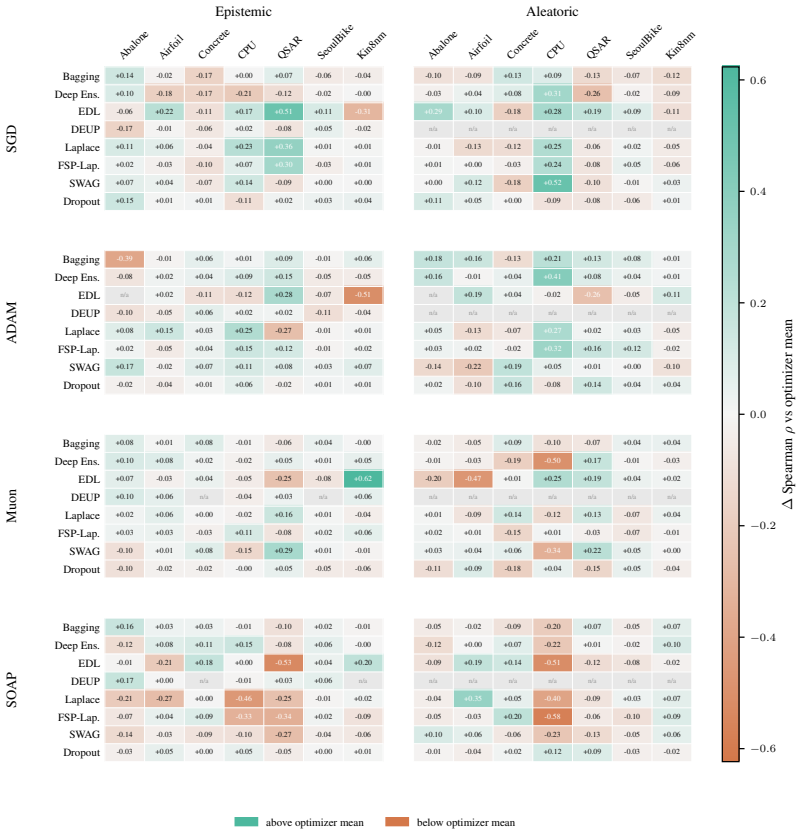
- [Section 1 and Appendix A] The empirical benchmark is instantiated only under squared loss, although Appendix A derives decompositions for CRPS and negative log-likelihood. The main text should state more prominently that all benchmark conclusions are specific to the squared-loss risk functional, since Implication 2 notes that the semantics of aleatoric and epistemic uncertainty depend on the chosen loss or scoring rule.
- [Section 5.1] The text says that 'the ablations ran in between 3-9 hours while the final evaluation took 4hours'; '4hours' should be '4 hours', and 'ran in between' is awkwardly phrased.
- [Throughout] The name 'SW AG' appears with a space in multiple places (e.g., Section 5 and Appendix D.4), which is inconsistent with the standard notation 'SWAG' used elsewhere; please standardize.
- [Section 5.2] The reported Kendall's W value of approximately 0.46 for method-rank preservation across datasets is given without a confidence interval or significance test; since the number of datasets is small (seven), the uncertainty in W should be quantified or at least discussed.
- [Appendix C] The dataset presets report 'Posterior std median' values but do not explain how this quantity is computed or how it should be interpreted relative to the aleatoric std. A brief definition in the appendix would improve reproducibility.
Circularity Check
No circular derivation; the benchmark oracle is self-referential only in the transparent, acknowledged sense of a controlled semi-synthetic reference.
full rationale
The paper's formal chain is self-contained: Definition 2.2 stipulates sample-conditional posterior risk, and Proposition 2.3/Eq. (4) are algebraic consequences of the Bregman bias-variance identity [Pfau, 2025] under the stated MSE additive-noise assumptions. No fitted parameter is renamed as a prediction in the theory. The benchmark oracle is intentionally constructed from the same GP prior that generates the targets, as stated in Section 4.1: 'Because the prior used for conditioning is the same prior that generated the target function, the resulting posterior is correctly specified by construction.' This makes the oracle internally consistent rather than independently measured, and the paper explicitly disclaims broader ground-truth status in Section 1: 'We do not claim that this GP-based construction provides a notion of ground truth that generalizes to all other modalities' and in Section 6, where the GP restriction is listed as a limitation. The only self-citation, Mucsányi et al. [2024], is background on existing benchmark heterogeneity, not a load-bearing uniqueness or existence claim. Concerns about transfer of method rankings to misspecified non-GP settings are external-validity risks, not circularity.
Assumptions & free parameters
free parameters (4)
- GP kernel hyperparameters per preset =
per-preset values in Tables 1-14, e.g. Abalone sigma^2=2.001, kernel arc-cosine degree 0
- Heteroscedastic noise model sigma(x) =
reported as per-preset aleatoric std, e.g.
- Mahalanobis-bin sampling profiles =
fractions such as balanced (0.2,0.2,0.2,0.2,0.2) or OOD (0.5,0,0,0,0)
- Method hyperparameters =
per-method search spaces in Appendix D, tuned via 10 W&B Bayesian sweeps
assumptions (6)
- standard math All expectations are finite and Bayes acts/centroids exist (Prop 2.3).
- standard math phi is strictly convex and continuously differentiable; losses are proper scoring rules or squared loss.
- domain assumption The data-generating process is a Gaussian process with known noise model, so the posterior p(f|S) is correctly specified and analytic.
- domain assumption Squared-error/MSE risk is the operative oracle for the benchmark.
- domain assumption Training sample S is drawn according to Mahalanobis-bin profiles and noise variance depends only on x.
- domain assumption The deployed predictor fhat is evaluated pointwise against a posterior that is conditionally independent of fhat given S.
Cite this review
Pith. "Pith review of A Unified Risk View of Uncertainty: Posterior Risk for Disentanglement and Evaluation Beyond Proxies." pith.science (2026). https://pith.science/paper/S7ZF2DQN
@misc{pith2026260805995,
  author       = {Pith},
  title        = {Pith review of: A Unified Risk View of Uncertainty: Posterior Risk for Disentanglement and Evaluation Beyond Proxies},
  year         = {2026},
  howpublished = {\url{https://pith.science/paper/S7ZF2DQN}},
  note         = {Machine review of arXiv:2608.05995}
}
read the original abstract
Reliable uncertainty estimates are critical in safety-sensitive applications, where understanding the sources of predictive uncertainty is essential. This often requires disentangling epistemic uncertainty from aleatoric uncertainty, yet these uncertainty types are not defined consistently across the literature, making it difficult to assess whether a method produces accurate uncertainty estimates. Evaluation is further complicated by the fact that ground-truth epistemic uncertainty is typically unavailable. Existing benchmarks therefore mostly rely on proxy tasks such as out-of-distribution detection, which do not provide complete ground-truth uncertainty targets and offer limited insight into the structure and quality of uncertainty estimates. We propose a unified definition of uncertainty as pointwise posterior risk, the expected loss of a predictor under the distribution of plausible ground-truth functions given the data. This view combines Bayesian uncertainty over functions with estimator-dependent deviations from the posterior mean, capturing effects such as misspecification and optimization error. This formulation constitutes the foundation of a theory-backed benchmark that enables direct computation of oracle epistemic and aleatoric uncertainty using semi-synthetic datasets with real covariates and known generative processes. By avoiding proxy evaluations, the benchmark enables fine-grained analysis of uncertainty estimates. Empirically, we find that accurate prediction does not guarantee reliable uncertainty disentanglement. The benchmark reveals practically useful differences between methods, identifying approaches with meaningful alignment to oracle uncertainty targets while exposing sensitivity to datasets and modeling choices.
Figures


Figures from the paper (10 more)




Reference graph
Works this paper leans on
-
[1]
Bayesian Active Learning for Classification and Preference Learning , author =. 2011 , eprint =. doi:10.48550/arXiv.1112.5745 , url =
-
[2]
What Uncertainties Do We Need in Bayesian Deep Learning for Computer Vision? , author =. 2017 , eprint =
work page 2017
-
[3]
Understanding Measures of Uncertainty for Adversarial Example Detection , author =. 2018 , eprint =. doi:10.48550/arXiv.1803.08533 , url =
-
[4]
Disentangling Epistemic and Aleatoric Uncertainty in Reinforcement Learning , author =. 2022 , eprint =
work page 2022
-
[5]
Quantifying Aleatoric and Epistemic Uncertainty in Machine Learning: Are Conditional Entropy and Mutual Information Appropriate Measures? , author =. 2022 , eprint =
work page 2022
-
[6]
An Axiomatic Assessment of Entropy- and Variance-based Uncertainty Quantification in Regression , author =. 2025 , eprint =
work page 2025
-
[7]
Benchmarking Uncertainty Disentanglement: Specialized Uncertainties for Specialized Tasks , author =. 2024 , eprint =
work page 2024
-
[8]
From Risk to Uncertainty: Generating Predictive Uncertainty Measures via Bayesian Estimation , author =. 2024 , eprint =
work page 2024
Show all 78 references
-
[9]
2021 , eprint =
DEUP: Direct Epistemic Uncertainty Prediction , author =. 2021 , eprint =
2021
-
[10]
2025 , eprint =
Uncertainty Quantification for Regression using Proper Scoring Rules , author =. 2025 , eprint =
2025
-
[11]
2025 , eprint =
Why Machine Learning Models Fail to Fully Capture Epistemic Uncertainty , author =. 2025 , eprint =
2025
-
[12]
2021 , eprint=
Uncertainty estimation under model misspecification in neural network regression , author=. 2021 , eprint=
2021
- [13]
-
[14]
2025 , eprint =
Scale estimation and rate-unbiasedness for Gaussian processes under smoothness misspecification , author =. 2025 , eprint =. doi:10.48550/arXiv.2110.02810 , url =
2025 doi
-
[15]
, urldate =
Vapnik, Vladimir N. , urldate =. The Nature of Statistical Learning Theory , rights =. 2000 , doi =
2000
- [16]
-
[17]
2023 , eprint=
How Reliable is Your Regression Model's Uncertainty Under Real-World Distribution Shifts? , author=. 2023 , eprint=
2023
-
[18]
2022 , eprint=
Robust uncertainty estimates with out-of-distribution pseudo-inputs training , author=. 2022 , eprint=
2022
-
[19]
2020 , eprint=
Deep Evidential Regression , author=. 2020 , eprint=
2020
-
[20]
2024 , eprint=
Are Uncertainty Quantification Capabilities of Evidential Deep Learning a Mirage? , author=. 2024 , eprint=
2024
-
[21]
2022 , eprint=
A view on model misspecification in uncertainty quantification , author=. 2022 , eprint=
2022
-
[22]
Sculley and Joshua V
Jasper Snoek and Yaniv Ovadia and Emily Fertig and Balaji Lakshminarayanan and Sebastian Nowozin and D. Sculley and Joshua V. Dillon and Jie Ren and Zachary Nado , editor =. Can you trust your model's uncertainty? Evaluating predictive uncertainty under dataset shift , booktit...
2019
-
[23]
Aleatoric and epistemic uncertainty in machine learning: an introduction to concepts and methods , journal =
Eyke H. Aleatoric and epistemic uncertainty in machine learning: an introduction to concepts and methods , journal =. 2021 , doi =
2021
-
[24]
Erickson , title =
Shahriar Faghani and Mana Moassefi and Pouria Rouzrokh and Bardia Khosravi and Francis Baffour and Michael D Ringler and Bradley J. Erickson , title =. Radiology , year =. doi:10.1148/radiol.222217 , url =
-
[25]
Yuko Kato and David M. J. Tax and Marco Loog , title =. CoRR , volume =. 2022 , doi =
2022
-
[26]
Medical Image Analysis , volume =
A review of uncertainty quantification in medical image analysis: Probabilistic and non-probabilistic methods , author =. Medical Image Analysis , volume =. 2024 , doi =
2024
-
[27]
Aleatoric and epistemic uncertainty in machine learning: an introduction to concepts and methods , volume=
Hüllermeier, Eyke and Waegeman, Willem , year=. Aleatoric and epistemic uncertainty in machine learning: an introduction to concepts and methods , volume=. Machine Learning , publisher=. doi:10.1007/s10994-021-05946-3 , number=
-
[28]
Proceedings of the 39th International Conference on Machine Learning , series =
On the Practicality of Deterministic Epistemic Uncertainty , author =. Proceedings of the 39th International Conference on Machine Learning , series =. 2022 , editor =
2022
-
[29]
Journal of Machine Learning Research , volume =
Deep Out-of-Distribution Uncertainty Quantification via Weight Entropy Maximization , author =. Journal of Machine Learning Research , volume =. 2025 , url =. 2309.15704 , archivePrefix =
2025 arXiv
-
[30]
ICML 2021 Workshop on Uncertainty and Robustness in Deep Learning , year =
On Pitfalls in OoD Detection: Predictive Entropy Considered Harmful , author =. ICML 2021 Workshop on Uncertainty and Robustness in Deep Learning , year =
2021
- [31]
-
[32]
Machine Learning: Science and Technology , volume =
Deeply Uncertain: Comparing Methods of Uncertainty Quantification in Deep Learning Algorithms , author =. Machine Learning: Science and Technology , volume =. 2021 , doi =
2021
-
[33]
Reliability Engineering & System Safety , volume =
A benchmark on uncertainty quantification for deep learning prognostics , author =. Reliability Engineering & System Safety , volume =. 2025 , doi =
2025
-
[34]
MELBA: Journal of Machine Learning for Biomedical Imaging , volume =
Recalibration of Aleatoric and Epistemic Regression Uncertainty in Medical Imaging , author =. MELBA: Journal of Machine Learning for Biomedical Imaging , volume =. 2021 , pages =
2021
-
[35]
Pattern Recognition Letters , volume =
Uncertainty quantification metrics for deep regression , author =. Pattern Recognition Letters , volume =. 2024 , doi =
2024
-
[36]
2024 , archivePrefix=
One Step Closer to Unbiased Aleatoric Uncertainty Estimation , author =. 2024 , archivePrefix=. 2312.10469 , primaryClass =
2024 arXiv
-
[37]
NPJ Digital Medicine , author =
Second opinion needed: communicating uncertainty in medical machine learning , volume =. NPJ Digital Medicine , author =. 2021 , pmid =. doi:10.1038/s41746-020-00367-3 , abstract =
2021 doi
-
[38]
Advances in Neural Information Processing Systems , year =
What Uncertainties Do We Need in Bayesian Deep Learning for Computer Vision? , author =. Advances in Neural Information Processing Systems , year =
-
[39]
Machine Learning: Science and Technology , volume =
Deeply Uncertain: Comparing Methods of Uncertainty Quantification in Deep Learning Algorithms , author =. Machine Learning: Science and Technology , volume =. 2020 , doi =
2020
-
[40]
2022 IEEE/CVF Conference on Computer Vision and Pattern Recognition Workshops (CVPRW) , pages =
A Deeper Look into Aleatoric and Epistemic Uncertainty Disentanglement , author =. 2022 IEEE/CVF Conference on Computer Vision and Pattern Recognition Workshops (CVPRW) , pages =. 2022 , doi =
2022
- [41]
-
[42]
2022 , eprint=
Nonparametric Uncertainty Quantification for Single Deterministic Neural Network , author=. 2022 , eprint=
2022
-
[43]
2024 , eprint=
Efficient Lifelong Model Evaluation in an Era of Rapid Progress , author=. 2024 , eprint=
2024
-
[44]
2025 , eprint=
ImageNot: A contrast with ImageNet preserves model rankings , author=. 2025 , eprint=
2025
-
[45]
2015 , eprint=
ImageNet Large Scale Visual Recognition Challenge , author=. 2015 , eprint=
2015
-
[46]
Sebastian Felix Fischer and Matthias Feurer and Bernd Bischl , booktitle=. Open. 2023 , url=
2023
-
[47]
2025 , eprint=
A Generalized Bias-Variance Decomposition for Bregman Divergences , author=. 2025 , eprint=
2025
-
[48]
2024 , eprint=
Is Epistemic Uncertainty Faithfully Represented by Evidential Deep Learning Methods? , author=. 2024 , eprint=
2024
-
[49]
2021 , eprint=
Implicit Bias of SGD for Diagonal Linear Networks: a Provable Benefit of Stochasticity , author=. 2021 , eprint=
2021
-
[50]
MacKay, David J. C. , title =. Neural Computation , year = 1992, volume = 4, number = 3, month = may, doi =
1992
-
[51]
and Basu, Sanjay and Ng, Andrew and Schuler, Alejandro , title =
Duan, Tony and Avati, Anand and Ding, Daisy Yi and Thai, Khanh K. and Basu, Sanjay and Ng, Andrew and Schuler, Alejandro , title =. Proceedings of the 37th International Conference on Machine Learning , articleno =. 2020 , publisher =
2020
-
[52]
2021 , eprint=
Uncertainty in Gradient Boosting via Ensembles , author=. 2021 , eprint=
2021
-
[53]
2019 , eprint=
CatBoost: unbiased boosting with categorical features , author=. 2019 , eprint=
2019
-
[54]
2023 , eprint=
Gradient Boosting Performs Gaussian Process Inference , author=. 2023 , eprint=
2023
-
[55]
Revisiting Deep Learning Models for Tabular Data , url =
Gorishniy, Yury and Rubachev, Ivan and Khrulkov, Valentin and Babenko, Artem , booktitle =. Revisiting Deep Learning Models for Tabular Data , url =
-
[56]
2017 , eprint=
Simple and Scalable Predictive Uncertainty Estimation using Deep Ensembles , author=. 2017 , eprint=
2017
-
[57]
Proceedings of The 33rd International Conference on Machine Learning , pages =
Dropout as a Bayesian Approximation: Representing Model Uncertainty in Deep Learning , author =. Proceedings of The 33rd International Conference on Machine Learning , pages =. 2016 , editor =
2016
-
[58]
Laplace Redux - Effortless Bayesian Deep Learning , url =
Daxberger, Erik and Kristiadi, Agustinus and Immer, Alexander and Eschenhagen, Runa and Bauer, Matthias and Hennig, Philipp , booktitle =. Laplace Redux - Effortless Bayesian Deep Learning , url =
-
[59]
Laplax: Laplace Approximations in JAX , year =
Weber, Tobias and Mucs. Laplax: Laplace Approximations in JAX , year =. GitHub repository , howpublished =
-
[60]
2024 , eprint=
FSP-Laplace: Function-Space Priors for the Laplace Approximation in Bayesian Deep Learning , author=. 2024 , eprint=
2024
-
[61]
Machine Learning , volume =
Bagging Predictors , author =. Machine Learning , volume =. 1996 , doi =
1996
-
[62]
2019 , eprint=
A Simple Baseline for Bayesian Uncertainty in Deep Learning , author=. 2019 , eprint=
2019
-
[63]
1994 , howpublished =
Nash, Warwick and Sellers, Tracy and Talbot, Simon and Cawthorn, Andrew and Ford, Wes , title =. 1994 , howpublished =
1994
-
[64]
and Marcolini, Michael , title =
Brooks, Thomas and Pope, D. and Marcolini, Michael , title =. 1989 , howpublished =
1989
-
[65]
1998 , howpublished =
Yeh, I-Cheng , title =. 1998 , howpublished =
1998
-
[66]
2015 , howpublished =
Ballabio, Davide and Cassotti, Matteo and Consonni, Viviana and Todeschini, Roberto , title =. 2015 , howpublished =
2015
-
[67]
2020 , howpublished =
2020
-
[68]
, howpublished =
n.d. , howpublished =
-
[69]
2022 , howpublished =
2022
-
[70]
, title =
Olson, Craig A. , title =. Journal of Applied Econometrics , year =
-
[71]
Wickham, Hadley , year =
-
[72]
Proceedings of the Seventeenth International Conference on Machine Learning , year =
Vijayakumar, Sethu and Schaal, Stefan , title =. Proceedings of the Seventeenth International Conference on Machine Learning , year =
-
[73]
2023 , howpublished =
2023
-
[74]
Kelley and Barry, Ronald , title =
Pace, R. Kelley and Barry, Ronald , title =. Geographical Analysis , year =
-
[75]
Modeling Wine Preferences by Data Mining from Physicochemical Properties , journal =
Cortez, Paulo and Cerdeira, Ant. Modeling Wine Preferences by Data Mining from Physicochemical Properties , journal =. 2009 , volume =
2009
-
[76]
Ghahramani, Zoubin , year =
-
[77]
2013 , howpublished =
Rana, Prashant , title =. 2013 , howpublished =
2013
-
[78]
2020 , howpublished =
Biewald, Lukas , title =. 2020 , howpublished =
2020
Reviewed August 7, 2026 · model on record in the stance chip above.
Discussion (0). Continue with ORCID to comment.