REVIEW 3 major objections 4 minor 46 references
Spinning Particle Dynamics and Observational Redshift around an Asymptotically Flat Symmergent Black Hole
T0 review · 3 major / 4 minor · reviewed 2026-08-07 · deepseek-v4-flash
Pith's one-line read This paper claims that the sign of the boson-fermion imbalance in symmergent gravity is written into the spatial pattern of photon redshift around a black hole: smooth for fermion-dominated spectra, oscillatory for boson-dominated ones.
desk verdict A careful, well-caveated application of standard particle-dynamics and redshift machinery to a symmergent black-hole exterior; the central smooth-vs-oscillatory distinction is internally sound, but the claim that this constrains nB-nF rests on an imported, untested premise. read the letter →
The pith
A machine-rendered reading of the paper's core claim, the machinery that carries it, and where it could break.
The reading
What carries the argument
The load-bearing object is the radial conformal mode φ(r)=ε f(r) that maps the exterior geometry onto Schwarzschild, ds²=$e^{{−φ}}$(−Ψdt²+dr²/Ψ+r²dΩ²) to first order, with Ψ=1−2M/r. It obeys the linear equation (r²Ψφ′)′=γ r²φ, whose large-radius solutions are $e^{{−√γ r}}$/(√γ r) for γ>0 and cos(√|γ| r+δ)/(√|γ| r) for γ<0. This single mode carries the sign dichotomy into every observable, and the product identity (1+z+)(1+z−)=1/A(re) turns the two redshift branches into a direct measurement of the lapse. The numerical pipeline integrates this ODE inward from Cauchy data at large radius with explicit amplitude ε=0.05 and phase δ=0, filtering everything by |εf|≤0.1.
What would settle it
Measure both signed frequency shifts from the same circular emission ring around a black hole of known mass, form (1+z+)(1+z−)A(re) with A(re)=1−2M/re, and look at the radial pattern: monotonic positive deviation would match fermion domination, alternating sign would match boson domination, and no pattern would rule out the perturbative conformal exterior.
Extended reading notes
Core claim
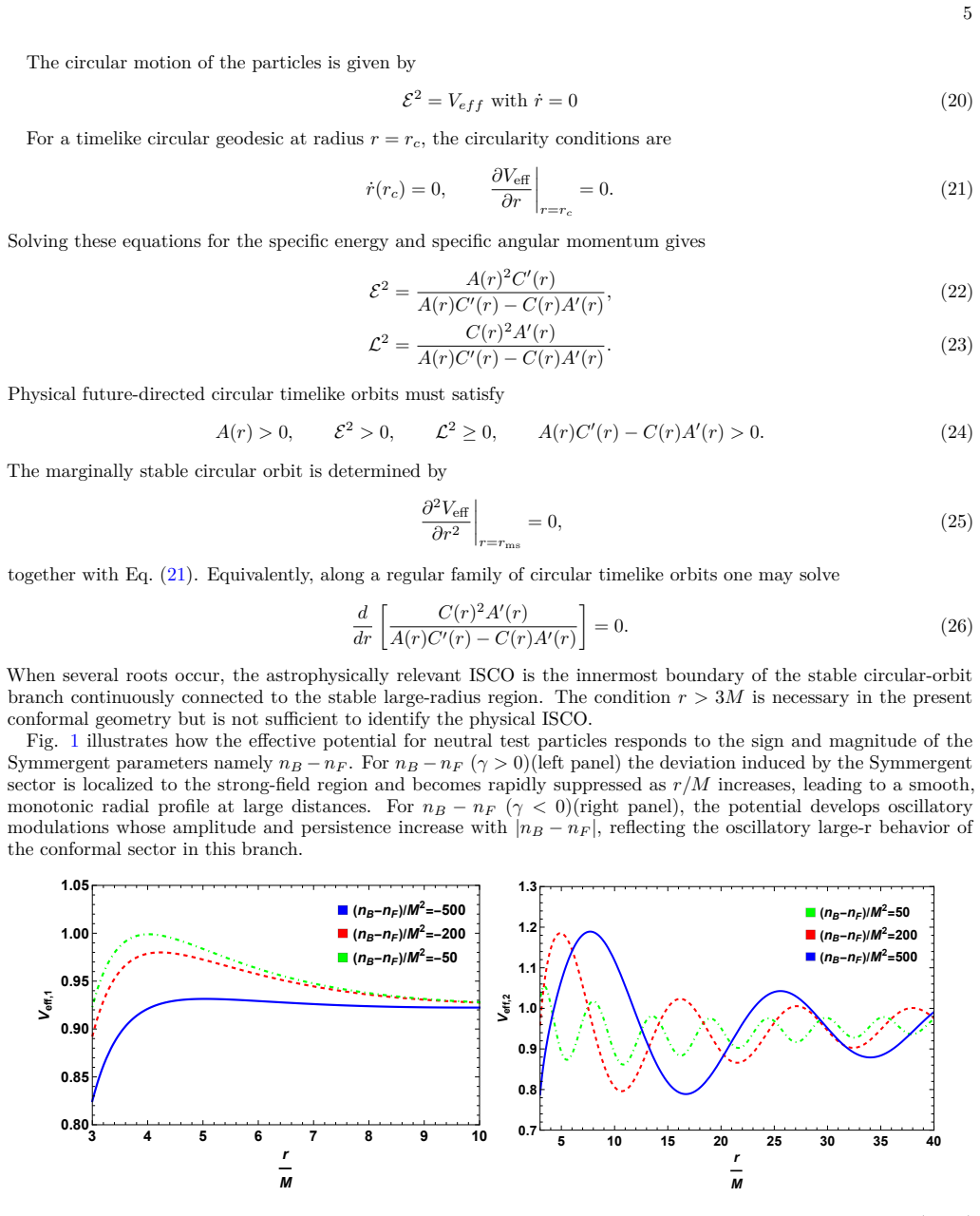
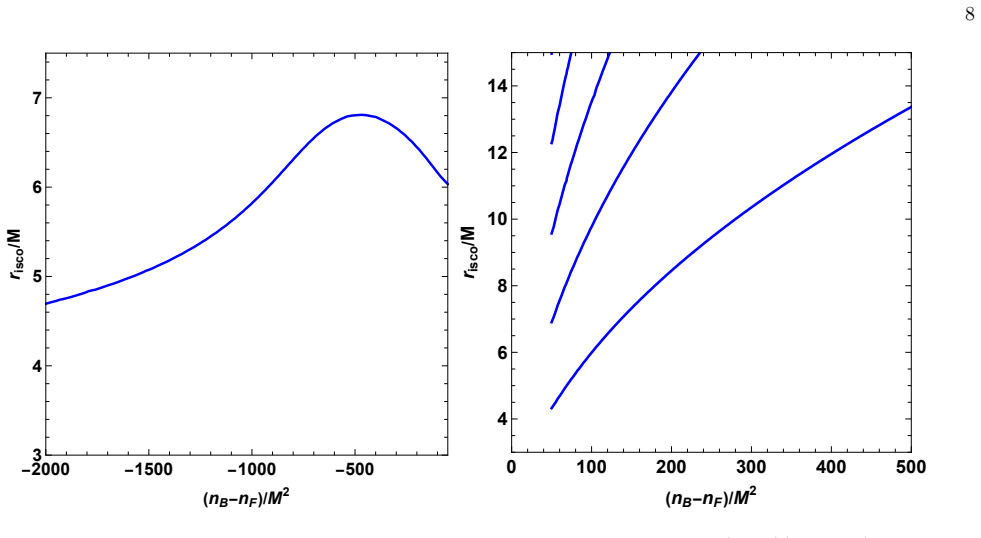
The central claim is that the two signs of the symmergent parameter γ, which is inversely proportional to nB−nF, produce two qualitatively different black-hole exteriors: for γ>0 (fermion-dominated) the conformal deformation is a Yukawa-suppressed, short-ranged correction, while for γ<0 (boson-dominated) it is an oscillatory inverse-radius tail. All the derived observables—effective potentials, ISCO radii and angular momenta, center-of-mass collision energies, and photon frequency shifts—inherit this dichotomy. The sharpest single result is the model-independent product identity (1+z+)(1+z−)=1/A(re), which reconstructs the lapse function at the emission radius from the two signed branches of the frequency shift. The spatial form of the reconstructed lapse thus distinguishes the sign of nB−nF, but the magnitude remains degenerate with the deformation amplitude ε, the oscillatory phase δ, and the independently unknown mass and emitter radius.
Load-bearing premise
The identification γ = −64π/[3(nB−nF)] ties the sign of the quadratic-curvature coefficient to the particle spectrum; if particle content does not fix the R² coefficient in exactly this way, the claimed smooth-versus-oscillatory dichotomy does not follow.
Editorial extensions
If this is right
- For γ>0 (fermion-dominated spectrum), all derived quantities—effective potential, ISCO radius, collision energy, and frequency shifts—deviate smoothly and locally from Schwarzschild, with the largest effect at the inner edge.
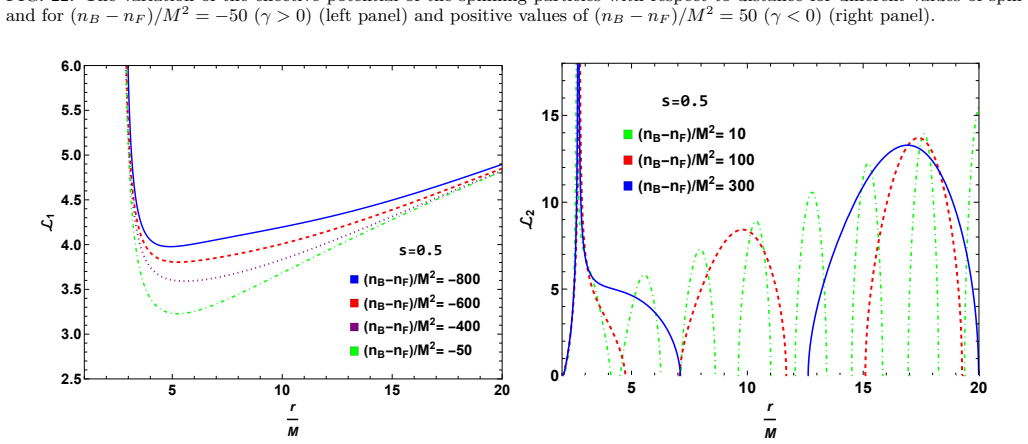
- For γ<0 (boson-dominated spectrum), the oscillatory tail creates alternating radial bands; circular orbits exist only in admissible intervals, and stability must be checked separately via the second derivative of the effective potential.
- The identity (1+z+)(1+z−)=1/A(re) means that two measured shifts from one circular ring reconstruct the lapse; the fractional deviation from Schwarzschild is exactly e^{εf(re)}−1, so the sign pattern distinguishes the two branches.
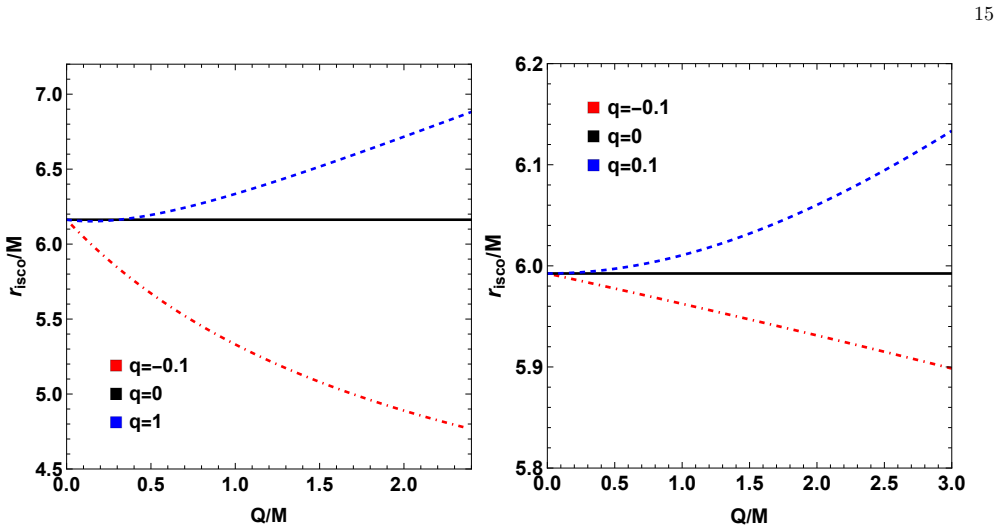
- Charged and spinning probes add independent handles: the Coulomb term tilts the potential and shifts the ISCO inward or outward with the sign of qQ, while spin-curvature coupling reorders the ISCO energy and angular-momentum thresholds differently in the two branches.
- The magnitude of |nB−nF| cannot be extracted from frequency shifts alone; the amplitude ε, the phase δ (in the oscillatory branch), and independent knowledge of M and re are all required.
Reading between the lines
- The paper leaves implicit that the product identity is not specific to symmergent gravity: any static, spherically symmetric metric with circular emitters and a static observer at infinity satisfies it, so the reconstruction method could serve as a general lapse-mapping tool for black-hole shadows and accretion rings.
- If the γ<0 branch's alternating stable and unstable intervals were realized in nature, quasi-periodic oscillations in accretion-disk spectra might show radial banding; this is a testable extension the paper does not pursue.
- The degeneracy between nB−nF and the boundary-condition amplitude suggests that combining these redshift measurements with independent shadow or lensing constraints, which are sensitive to the same ε, could break the degeneracy and turn a sign constraint into a magnitude constraint.
Editorial analysis
A structured set of objections, weighed in public.
Referee Report
Summary. The paper analyzes timelike particle dynamics, collision energetics, and photon frequency shifts in a perturbative, asymptotically flat solution of symmergent gravity that is conformal to Schwarzschild at linear order. It derives radial equations and effective potentials for neutral, charged, and spinning (MPD–Tulczyjew) probes, computes ISCO and center-of-mass energy diagnostics, and derives the product identity (1+z_+)(1+z_-)=1/A(r_e) for photons emitted by circular geodesic sources. The authors show that the sign of the parameter gamma determines whether the conformal deformation is Yukawa-like or oscillatory, and they propose that the spatial pattern of a reconstructed lapse can constrain the sign of n_B - n_F. The analysis is consistently restricted to |epsilon f(r)| <= 0.1, with explicit filters and numerical checks.
Significance. This is a careful and internally consistent phenomenological study. It contains several useful results that are independent of the symmergent framework details, especially the redshift product identity and the exact simplification of the circular-orbit denominator to 2 e^{-2 epsilon f}(r - 3M). The numerical implementation is checked against the Schwarzschild limit and the product identity to machine precision, and the authors are unusually explicit about validity domains and degeneracies. However, the headline inference from the lapse pattern to the sign of n_B - n_F depends on the symmergent relation Eq. (2), which is imported from earlier work rather than derived or tested here, and the self-flagged horizon non-regularity for gamma > 0 weakens the black-hole interpretation. These issues are fixable but require revision.
major comments (3)
- [Section IV.C; Eq. (2)] The central claim that the spatial form of the reconstructed lapse constrains the sign of n_B - n_F rests entirely on Eq. (2), gamma = -64 pi / [3(n_B - n_F)], which is imported from refs. [9-13] and is not derived or independently tested in this paper. The dichotomy between smooth and oscillatory patterns is a statement about the sign of gamma; translating it into a statement about the sign of n_B - n_F requires the assumed proportionality c_O = (n_B - n_F)/(128 pi^2). If that coefficient receives additional contributions or uses a different sign convention, the observable constrains gamma but not the particle content. Please either derive Eq. (2) within the paper or explicitly state that the particle-content interpretation is contingent on the external framework identification.
- [Section V; Eq. (6)] The Conclusion states that a nontrivial decaying gamma > 0 mode cannot be simultaneously regular at the Schwarzschild horizon under standard boundary assumptions, but no derivation of this statement appears in the body. Since Eq. (6) is singular at r = 2M and the spacetime is used only for r >= 6M in the numerical analysis, this is a load-bearing limitation for the 'black hole' label in the title and for any near-horizon interpretation of the Yukawa branch. Please supply the regularity analysis or explicitly relabel the setup as an exterior-patch model without horizon claims.
- [Section III.C; Eqs. (63)-(74)] The spinning-particle analysis defines circular orbits by p^r = 0 and marginal stability by d^2/dr^2 (p^r/m)^2 = 0, after correctly warning that p^mu/m is not the tangent four-velocity under the Tulczyjew spin supplementary condition. Since the physical radial velocity u^r is related to p^r by spin-dependent terms, the turning points and stability boundaries in the canonical-momentum space need not coincide with those of the physical center-of-mass trajectory. Please state explicitly whether the reported spinning-particle ISCOs are conditions on p^r or on the physical four-velocity, and, if the latter, provide the relation and estimate the difference at the displayed |s|/M values.
minor comments (4)
- [Section II] The symbols n_B and n_F are not explicitly defined as numbers of bosonic and fermionic degrees of freedom at first use; please add a brief definition for clarity.
- [References] References [9] and [13] appear to be the same paper (same title, same journal and volume, same arXiv number); please merge or remove the duplicate.
- [Section IV.C] The reconstruction formula Eq. (105) is introduced with the assumption that M and r_e are known, but the conditions that the two shifts come from the same circular ring and that the emitter is equatorial are mentioned only later; moving these conditions next to Eq. (105) would improve clarity.
- [Various figures and text] There are several typographical and spacing issues, e.g., 'coefficient' appears as 'coefficent' through the text, 'Figure33displaysthephysicaldeformation' lacks spaces, Ref. [42] spells 'Tulzcyjew' instead of 'Tulczyjew', and the caption of Fig. 8 says 'the n_B - n_F branch' where it should say 'the n_B - n_F < 0 branch'.
Circularity Check
No circularity: the Yukawa/oscillatory distinction is derived from the sign of gamma in a linear ODE, with amplitude and phase treated as free; the imported nB-nF link and the product identity are stated as premises/checks, not as self-confirming predictions.
full rationale
The derivation chain is self-contained for the claims actually made. The central dichotomy (Yukawa vs oscillatory) follows from the sign of gamma in the linear ODE (6)-(13); the paper never fits gamma or the amplitude to the observables it 'predicts.' The particle-content link (2) is an imported theoretical premise from the symmergent literature (refs. [9-13]), not derived from the redshift or orbital data, so any failure of that premise would weaken the inference to nB-nF, but that is a correctness/assumption risk, not circularity. The lapse reconstruction (104)-(105) is a genuine identity, and the paper explicitly labels agreement with it as an internal implementation check, not independent validation. The amplitude epsilon and phase delta are declared free boundary-condition data, and the degeneracy of the reconstruction with epsilon, delta, M, and re is stated. The flagged horizon non-regularity of the gamma>0 mode is a domain limitation, not a circular step. No equation is defined in terms of the quantity it is used to predict; no fitted parameter is renamed a prediction; no load-bearing claim rests on a self-citation.
Assumptions & free parameters
free parameters (4)
- epsilon (deformation amplitude) =
0.05 (chosen for all numerics)
- delta (oscillatory phase) =
0 (chosen)
- Q (external electric field strength) =
0.5 M in illustrative plots
- s (spin per unit mass) =
-0.5, 0, 0.5
assumptions (5)
- domain assumption Symmergent effective action (Eq. 1) with the R^2 coefficient set by cO = (nB - nF)/(128 pi^2).
- domain assumption Linearized conformal exterior (Eq. 5) with phi satisfying (r^2 Psi phi')' = gamma r^2 phi (Eq. 6).
- ad hoc to paper Decaying boundary conditions (Eq. 13) with delta = 0.
- standard math MPD equations with Tulczyjew SSC (Eqs. 46-49).
- domain assumption Test electromagnetic field with no backreaction (Eq. 31, 45).
Cite this review
Pith. "Pith review of Spinning Particle Dynamics and Observational Redshift around an Asymptotically Flat Symmergent Black Hole." pith.science (2026). https://pith.science/paper/MRL6IAKN
@misc{pith2026260806114,
  author       = {Pith},
  title        = {Pith review of: Spinning Particle Dynamics and Observational Redshift around an Asymptotically Flat Symmergent Black Hole},
  year         = {2026},
  howpublished = {\url{https://pith.science/paper/MRL6IAKN}},
  note         = {Machine review of arXiv:2608.06114}
}
abstract
We investigate timelike particle dynamics, collision energetics, and photon frequency shifts in the perturbative variable-scalar curvature branch of asymptotically flat symmergent gravity. The low-energy vacuum action contains an $R^{2}$ correction whose coefficient is set by the boson--fermion imbalance of the underlying quantum field theory. At linear order, the exterior geometry is conformal to Schwarzschild spacetime through a radial mode satisfying a linear equation. We retain an independent boundary-condition-dependent amplitude and restrict the analysis to the perturbative domain. The two signs of the symmergent parameter $\gamma$ yield distinct profiles: $\gamma>0$ gives a Yukawa-suppressed deformation, whereas $\gamma<0$ produces an oscillatory inverse-radius deformation. We derive radial equations, effective potentials, circular-orbit and marginal-stability conditions for neutral, electrically charged, and spinning massive particles. Charged particles are treated in the test-field approximation, while spinning particles obey the Mathisson--Papapetrou--Dixon equations with the Tulczyjew condition. We also compute the center-of-mass energy of neutral-particle collisions and the frequency shifts of photons emitted tangentially by circular geodesic sources and detected by a static observer at infinity. The redshift and blueshift factors satisfy $(1+z_{+})(1+z_{-})=1/A(r_e)$, directly linking their product to the lapse function at emission. The $\gamma>0$ branch yields smooth, short-range deviations from Schwarzschild dynamics, whereas the $\gamma<0$ branch can generate oscillatory radial bands admitting circular-orbit solutions whose stability must be tested independently. These observables provide complementary probes of the variable-curvature sector, although their quantitative interpretation also depends on the deformation amplitude and, for the oscillatory branch, its phase.
Figures


Figures from the paper (36 more)







Reference graph
Works this paper leans on
-
[1]
Equations of motion of spinning particles In this section, we briefly review the theoretical framework for the motion of spinning test particles in the gravita- tional field of compact objects. While a spinless particle follows the usual geodesic equations, the presence of intrinsic spin leads to non-geodesic dynamics due to spin–curvature coupling. The m...
-
[2]
For simplicity, we restrict the motion to the equatorial plane,θ = π/2
Effective potential for spinning particles’ motion Our goal is to construct the effective potential governing a spinning test particle in the spacetime of asymptotically flat symmergent black-hole exterior. For simplicity, we restrict the motion to the equatorial plane,θ = π/2. In a static, spherically symmetric background, the dynamics admits two conserv...
work page 2000
-
[3]
First M87 Event Horizon Telescope Results. V. Physical Origin of the Asymmetric Ring,
Kazunori Akiyama et al. (Event Horizon Telescope), “First M87 Event Horizon Telescope Results. V. Physical Origin of the Asymmetric Ring,”Astrophys. J. Lett. 875, L5 (2019), arXiv:1906.11242 [astro-ph.GA]
arXiv 2019
-
[4]
Kazunori Akiyama et al. (Event Horizon Telescope), “First Sagittarius A* Event Horizon Telescope Results. I. The Shadow of the Supermassive Black Hole in the Center of the Milky Way,”Astrophys. J. Lett. 930, L12 (2022)
work page 2022
-
[5]
Shadow of rotating non-Kerr black hole,
Farruh Atamurotov, Ahmadjon Abdujabbarov, and Bobomurat Ahmedov, “Shadow of rotating non-Kerr black hole,” Phys. Rev. D 88, 064004 (2013)
work page 2013
-
[6]
Optical properties of black hole in the presence of plasma: shadow,
Farruh Atamurotov and Bobomurat Ahmedov, “Optical properties of black hole in the presence of plasma: shadow,”Phys. Rev. D 92, 084005 (2015), arXiv:1507.08131 [gr-qc]
arXiv 2015
-
[7]
Shadow of rotating regular black holes,
Ahmadjon Abdujabbarov, Muhammed Amir, Bobomurat Ahmedov, and Sushant G. Ghosh, “Shadow of rotating regular black holes,”Phys. Rev. D 93, 104004 (2016), arXiv:1604.03809 [gr-qc]
arXiv 2016
-
[8]
Magnetically charged black holes from non- linear electrodynamics and the Event Horizon Telescope,
Alireza Allahyari, Mohsen Khodadi, Sunny Vagnozzi, and David F. Mota, “Magnetically charged black holes from non- linear electrodynamics and the Event Horizon Telescope,”JCAP 02, 003 (2020), arXiv:1912.08231 [gr-qc]
arXiv 2020
Show all 46 references
-
[9]
Hunting for extra dimensions in the shadow of M87*,
Sunny Vagnozzi and Luca Visinelli, “Hunting for extra dimensions in the shadow of M87*,”Phys. Rev. D 100, 024020 (2019), arXiv:1905.12421 [gr-qc]
2019 arXiv
-
[10]
Horizon-scale tests of gravity theories and fundamental physics from the Event Horizon Telescope image of Sagittarius A,
Sunny Vagnozzi et al., “Horizon-scale tests of gravity theories and fundamental physics from the Event Horizon Telescope image of Sagittarius A,”Class. Quant. Grav. 40, 165007 (2023), arXiv:2205.07787 [gr-qc]
2023 arXiv
-
[12]
Emergent Gravity as the Eraser of Anomalous Gauge Boson Masses, and QFT-GR Concord,
Durmus Demir, “Emergent Gravity as the Eraser of Anomalous Gauge Boson Masses, and QFT-GR Concord,”Gen. Rel. Grav. 53, 22 (2021), arXiv:2101.12391 [gr-qc]
2021 arXiv
-
[13]
Symmergent Gravity, Seesawic New Physics, and their Experimental Signatures,
Durmus Demir, “Symmergent Gravity, Seesawic New Physics, and their Experimental Signatures,”Adv. High Energy Phys. 2019, 4652048 (2019), arXiv:1901.07244 [hep-ph]
2019 arXiv
-
[14]
Curvature-Restored Gauge Invariance and Ultraviolet Naturalness,
Durmus Ali Demir, “Curvature-Restored Gauge Invariance and Ultraviolet Naturalness,”Adv. High Energy Phys. 2016, 6727805 (2016), arXiv:1605.00377 [hep-ph]
2016 arXiv
-
[15]
Gauge and Poincaré properties of the UV cutoff and UV completion in quantum field theory,
Durmus Demir, “Gauge and Poincaré properties of the UV cutoff and UV completion in quantum field theory,”Phys. Rev. D 107, 105014 (2023), arXiv:2305.01671 [hep-th]
2023 arXiv
-
[16]
Asymptotically-Flat Black Hole Solutions in Symmer- gent Gravity,
Beyhan Puliçe, Reggie C. Pantig, Ali Övgün, and Durmuş Demir, “Asymptotically-Flat Black Hole Solutions in Symmer- gent Gravity,”Fortsch. Phys. 72, 2300138 (2024), arXiv:2403.02373 [gr-qc]
2024
-
[17]
Black hole shadow in symmergent gravity,
İrfan Çimdiker, Durmuş Demir, and Ali Övgün, “Black hole shadow in symmergent gravity,”Phys. Dark Univ. 34, 100900 (2021), arXiv:2110.11904 [gr-qc]
2021 arXiv
-
[18]
Quasiperiodic os- cillations, weak field lensing and shadow cast around black holes in Symmergent gravity,
Javlon Rayimbaev, Reggie C. Pantig, Ali Övgün, Ahmadjon Abdujabbarov, and Durmuş Demir, “Quasiperiodic os- cillations, weak field lensing and shadow cast around black holes in Symmergent gravity,”Annals of Physics (2023), 10.1016/j.aop.2023.169335, arXiv:2206.06599 [gr-qc]
2023
-
[19]
Testing symmergent gravity through the shadow image and weak field photon deflection by a rotating black hole using the M87∗ and Sgr. A∗ results,
Reggie C. Pantig, Ali Övgün, and Durmuş Demir, “Testing symmergent gravity through the shadow image and weak field photon deflection by a rotating black hole using the M87∗ and Sgr. A∗ results,” Eur. Phys. J. C 83, 250 (2023), arXiv:2208.02969 [gr-qc]
2023 arXiv
-
[20]
Thermodynamics and logarithmic corrections of symmergent black holes,
Riasat Ali and Rimsha Babar and Zunaira Akhtar and Ali Övgün, “Thermodynamics and logarithmic corrections of symmergent black holes,”Results in Physics , 106300 (2023)
2023
-
[21]
Thin accretion disk images of the black hole in symmergent gravity,
İlim İrfan Çimdiker, Ali Övgün, and Durmuş Demir, “Thin accretion disk images of the black hole in symmergent gravity,” Class. Quant. Grav. 40, 184001 (2023), arXiv:2308.03947 [gr-qc]
2023 arXiv
-
[22]
Constraints on charged symmergent black hole from shadow and lensing,
Beyhan Puliçe, Reggie C. Pantig, Ali Övgün, and Durmuş Demir, “Constraints on charged symmergent black hole from shadow and lensing,”Class. Quant. Grav. 40, 195003 (2023), arXiv:2308.08415 [gr-qc]
2023 arXiv
-
[23]
Spinning test particles in theγ spacetime,
Bobir Toshmatov and Daniele Malafarina, “Spinning test particles in theγ spacetime,” Phys. Rev. D 100, 104052 (2019), arXiv:1910.11565 [gr-qc]
2019 arXiv
-
[24]
Spinning test particle motion around a traversable wormhole,
Carlos A. Benavides-Gallego, Wen-Biao Han, Daniele Malafarina, Bobomurat Ahmedov, and Ahmadjon Abdujabbarov, “Spinning test particle motion around a traversable wormhole,”Phys. Rev. D 104, 084024 (2021), arXiv:2107.07998 [gr-qc]
2021 arXiv
-
[25]
Spinning magnetized particles orbiting magnetized Schwarzschild black holes,
Farrux Abdulxamidov, Javlon Rayimbaev, Ahmadjon Abdujabbarov, and Zdeněk Stuchlík, “Spinning magnetized particles orbiting magnetized Schwarzschild black holes,”Phys. Rev. D 108, 044030 (2023), arXiv:2308.05392 [gr-qc]
2023 arXiv
-
[26]
Collisions and circular motion of spinning-charged particle around magnetized black holes in modified gravity,
Tursinbay Oteev, Javlon Rayimbaev, Bobomurat Ahmedov, Inomjon Ibragimov, Murodbek Vapayev, and Sokhibjan Muminov, “Collisions and circular motion of spinning-charged particle around magnetized black holes in modified gravity,” Phys. Dark Univ. 50, 102118 (2025)
2025
-
[27]
Spinning particle motion and MCMC analysis of S2 star orbiting Sgr A∗,
Uktamjon Uktamov, Bakhtiyor Narzilloev, Ibrar Hussain, Ahmadjon Abdujabbarov, and Bobomurat Ahmedov, “Spinning particle motion and MCMC analysis of S2 star orbiting Sgr A∗,” Phys. Dark Univ. 49, 102022 (2025)
2025
-
[28]
Dy- namics of spinning particles around the loop quantum black hole,
Gulnisa Abdukayumova, Farruh Atamurotov, Ahmadjon Abdujabbarov, Phongpichit Channuie, and G. Mustafa, “Dy- namics of spinning particles around the loop quantum black hole,”Nucl. Phys. B 1024, 117353 (2026)
2026
-
[29]
Dynamics of spinning particles around static black holes in effective quantum gravity,
Dilmurod Umarov, Farruh Atamurotov, Sushant G. Ghosh, Ahmadjon Abdujabbarov, and G. Mustafa, “Dynamics of spinning particles around static black holes in effective quantum gravity,”Eur. Phys. J. C 85, 800 (2025). 39
2025
-
[30]
Dy- namics of spinning particles around the Reissner-Nordstrom-like black hole,
Gulnisa Abdukayumova, Farruh Atamurotov, Ahmadjon Abdujabbarov, Phongpichit Channuie, and G. Mustafa, “Dy- namics of spinning particles around the Reissner-Nordstrom-like black hole,”Nucl. Phys. B 1019, 117121 (2025)
2025
-
[31]
Spinning particle motion around charged decoupled hairy black hole,
Gulzoda Rakhimova, Farruh Atamurotov, Nozima Juraeva, Ahmadjon Abdujabbarov, and G. Mustafa, “Spinning particle motion around charged decoupled hairy black hole,”Phys. Dark Univ. 47, 101721 (2025)
2025
-
[32]
Spinning particle motion around asymptotically safe gravity exhibiting regular black holes,
Sojida Mannobova, Farruh Atamurotov, Ahmadjon Abdujabbarov, Badr S. Alkahtani, and G. Mustafa, “Spinning particle motion around asymptotically safe gravity exhibiting regular black holes,”Eur. Phys. J. C 85, 586 (2025)
2025
-
[33]
Spinning particles as probes of quartic square-root Horndeski gravity: spin–curvature coupling and orbital dynamics,
Ziyodulla Turakhonov, Tolibjon Ibrokhimov, Farruh Atamurotov, Ahmadjon Abdujabbarov, Ahdab K. Althukair, and Euaggelos E. Zotos, “Spinning particles as probes of quartic square-root Horndeski gravity: spin–curvature coupling and orbital dynamics,”Eur. Phys. J. Plus 141, 629 (2026)
2026
-
[34]
Particle motion and epicyclic frequencies in the einstein special unitary matrices sigma model of black holes,
Abdelmalek Bouzenada, Imtiaz Khan, Asifa Ashraf, Emre Demir, Ertan Güdekli, Ikhtiyor Saidov, and Farruh Atamurotov, “Particle motion and epicyclic frequencies in the einstein special unitary matrices sigma model of black holes,”Phys. Dark Univ. 51, 102216 (2026)
2026
-
[35]
Epicyclic frequencies around charged regular black hole: constraints using different quasars data,
G. Mustafa, Faisal Javed, Sushant G. Ghosh, S. K. Maurya, and Farruh Atamurotov, “Epicyclic frequencies around charged regular black hole: constraints using different quasars data,”Eur. Phys. J. C 86, 6 (2026)
2026
-
[36]
Rotating black holes: Locally nonrotating frames, energy extraction, and scalar synchrotron radiation,
James M. Bardeen, William H. Press, and Saul A Teukolsky, “Rotating black holes: Locally nonrotating frames, energy extraction, and scalar synchrotron radiation,”Astrophys. J. 178, 347 (1972)
1972
-
[37]
The Optical Appearance of a Star Orbiting an Extreme Kerr Black Hole,
C. T. Cunningham and James M. Bardeen, “The Optical Appearance of a Star Orbiting an Extreme Kerr Black Hole,” Astrophys. J. 183, 237–264 (1973)
1973
-
[38]
The effects of redshifts and focusing on the spectrum of an accretion disk around a Kerr black hole,
C. T. Cunningham, “The effects of redshifts and focusing on the spectrum of an accretion disk around a Kerr black hole,” Astrophys. J. 202, 788–802 (1975)
1975
-
[39]
Image of a spherical black hole with thin accretion disk,
J. P. Luminet, “Image of a spherical black hole with thin accretion disk,” Astron. Astrophys. 75, 228–235 (1979)
1979
-
[40]
Observational redshift from general spheri- cally symmetric black holes,
Diego A. Martinez-Valera, Mehrab Momennia, and Alfredo Herrera-Aguilar, “Observational redshift from general spheri- cally symmetric black holes,”Eur. Phys. J. C 84, 288 (2024), arXiv:2311.17993 [gr-qc]
2024 arXiv
-
[41]
Beyond Schwarzschild-de Sitter spacetimes: III. A perturbative vacuo with non-constant scalar cur- vature in R + R2 gravity,
Hoang Ky Nguyen, “Beyond Schwarzschild-de Sitter spacetimes: III. A perturbative vacuo with non-constant scalar cur- vature in R + R2 gravity,” (2022), arXiv:2211.07380 [gr-qc]
2022 arXiv
-
[42]
Neue mechanik materieller systemes,
Myron Mathisson, “Neue mechanik materieller systemes,” Acta Phys. Polon. 6, 163–2900 (1937)
1937
-
[43]
Spinning test particles in general relativity. 1
Achille Papapetrou, “Spinning test particles in general relativity. 1.”Proc. Roy. Soc. Lond. A 209, 248–258 (1951)
1951
-
[44]
Motion of multipole particles in general relativity theory binaries,
B. Tulzcyjew, “Motion of multipole particles in general relativity theory binaries,” Acta Phys. Polon. 18, 393 (1959)
1959
-
[45]
Gravitational waves from a spinning particle plunging into a Kerr black hole,
Motoyuki Saijo, Kei-Ichi Maeda, Masaru Shibata, and Yasushi Mino, “Gravitational waves from a spinning particle plunging into a Kerr black hole,” Phys. Rev. D 58 (1998)
1998
-
[46]
On the Physical significance of the Riemann tensor,
F. A. E. Pirani, “On the Physical significance of the Riemann tensor,”Acta Phys. Polon. 15, 389–405 (1956)
1956
-
[47]
Redshift spectroscopy as a probe of regular black holes, black bounces, and scalar-hair compact objects,
Ali Övgün, Reggie C. Pantig, and Joel Saavedra, “Redshift spectroscopy as a probe of regular black holes, black bounces, and scalar-hair compact objects,”Phys. Dark Univ. 53, 102392 (2026)
2026
Reviewed August 7, 2026 · model on record in the stance chip above.
Discussion (0). Sign in to comment.