REVIEW 3 major objections 4 minor 105 references
EmoWorld: A Decoupled Affective Field for Controllable Emotional Video Generation
T0 review · 3 major / 4 minor · reviewed 2026-08-07 · deepseek-v4-flash
Pith's one-line read EmoWorld claims that the emotional feel of generated video can be controlled without retraining: global atmosphere, localized affect-bearing cues, and temporal progression are steered at three separate points in a frozen video diffusion…
desk verdict The central VAS result is likely confounded: the paper's own Eq. 11 contradicts the claimed matched-prompt comparison, so the 19% gain needs re-evaluation before the headline claim is trusted. read the letter →
The pith
A machine-rendered reading of the paper's core claim, the machinery that carries it, and where it could break.
The reading
What carries the argument
The central object is the decoupled affective field: a one-time-recorded collection of per-emotion, per-layer steering vectors plus a language-space affective cue library, indexed by task and retrieved at inference. The supporting principle is support-matching — each affective factor is represented on the support it acts on: layer-wise hidden states for atmosphere, sparse prompt-velocity residual coordinates for semantic cues, and frame-wise velocity fields for temporal progression. The load-bearing mechanism for transitions is GSlerp, great-circle interpolation between normalized endpoint residual directions on the unit hypersphere with separate linear interpolation of their magnitudes; it exists to prevent the norm shrinkage and cancellation that linear chord interpolation suffers when endpoint directions differ.
What would settle it
Compute the per-scene steering vectors $d_{e,l}$ from the 649 panorama pairs individually instead of pooling them: if the cross-scene variance is comparable to or larger than the separation between emotions, the averaged direction is not a clean, scene-invariant affect direction. In parallel, measure depth-map or edge consistency between neutral and edited panoramas; a large degradation would show the "geometry-preserving" edits are not geometry-preserving, breaking the assumption that the steering vector carries only affect. A third check: apply a Wan-extracted vector to CogVideoX without re-extraction and see whether CLIP-Emo moves; if it does not, the portability claim is limited to re-extracted vectors rather than general.
Extended reading notes
Core claim
The paper's central claim is that within one frozen flow-matching video DiT, global atmosphere, affect-bearing semantic content, and temporal affect progression live at different computational scales and can be steered independently at those scales. Visual Atmosphere Steering (VAS) broadcasts a normalized, emotion- and layer-specific steering vector — the averaged hidden-state difference between emotionally edited and neutral panoramas — into selected hidden states, shifting lighting, color, and mood scene-wide. Semantic Affective Steering (SAS) separates the velocity-prediction difference caused by an emotion-augmented prompt into a per-frame spatially constant part and a zero-mean part, then keeps only the largest-magnitude fraction $\rho$ of coordinates as a sparse, independently scalable correction for localized cues. Temporal Affective Steering (TAS) treats the start and end emotions as endpoint residual fields over the (denoising step, video frame) domain and interpolates their normalized directions along a great circle on the unit hypersphere, with magnitudes interpolated separately, producing a smooth affective progression that is generated rather than blended afterward. EmoWorld asserts these operators work across 27 emotion categories in both text-to-video and image-to-video settings, transfer to other Video-DiT backbones, and compose with camera-conditioned control — all without updating generator parameters.
Load-bearing premise
The load-bearing premise is that Qwen-Image-Edit's neutral-to-emotion edits change only the affect while preserving scene geometry, identity, and viewpoint, and that averaging the resulting feature differences over 649 panoramas yields a scene-invariant steering direction that transfers to video latents and to other video backbones; the paper does not quantitatively verify the geometry preservation or the scene-invariance.
Editorial extensions
If this is right
- One frozen Wan2.2 generator serves base generation, atmosphere steering, cue-enhanced prompting, transitions, and camera-conditioned composition, so emotional control adds no training, adapter, or per-emotion checkpoint.
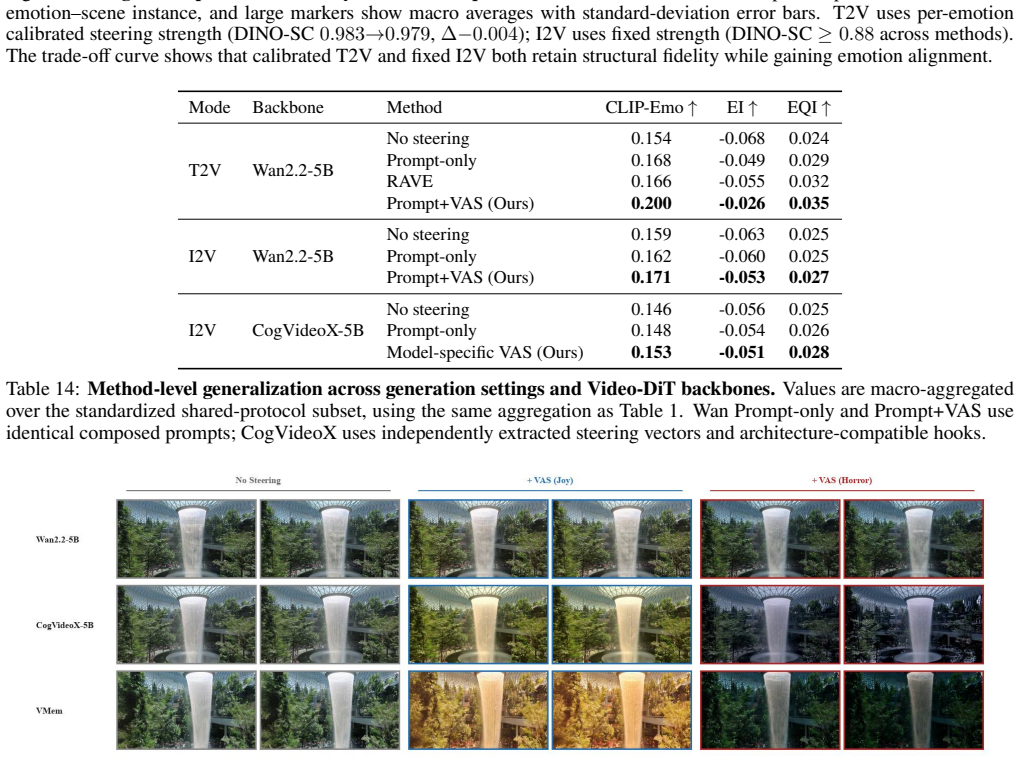
- VAS improves T2V target-emotion alignment by 19 percent (CLIP-Emo from 0.168 to 0.200) while lowering the temporal-fluctuation proxy from 1.22 to 0.63, indicating atmosphere steering both strengthens affect and steadies frames on the evaluated prompts.
- In the cue-matched comparison, SAS raises whole-frame alignment by 37 percent and detected affect-bearing cues from 2.57 to 3.50 per frame, showing semantic strength can be scaled independently of global atmosphere.
- TAS raises transition monotonicity to 0.788 in T2V (versus 0.687 for the strongest baseline) and from -0.325 to 0.421 in I2V, meaning smooth emotion progression is achievable without post-generation blending or per-frame prompting.
- The same extraction-injection recipe instantiates on CogVideoX and VMem with backbone-specific probes and composes with prescribed camera paths, supporting portability beyond the Wan backbone.
Reading between the lines
- The support-matching recipe is not emotion-specific: any composite video control that mixes a global appearance factor, localized content, and temporal evolution (for example, weather plus decorations plus a storm-front transition) could be factorized the same way in a frozen model, which is a directly testable extension of the paper's stated principle.
- Because the steering vectors are extracted from static panoramas, the same vectors should steer a frozen image DiT to give training-free image-atmosphere control; the video-specific machinery (frame schedules, TAS) is an add-on, predicting a concrete cross-modal transfer result the paper does not run.
- The factorial result that GSlerp improves endpoint arrival and path linearity under both endpoint constructions while monotonicity depends on the endpoint field suggests the optimal transition recipe pairs a specific endpoint construction with a specific interpolation geometry; testing all four conditions across more emotion pairs and scenes would reveal whether one combination wins generally.
- Everything downstream inherits the assumption that the neutral-to-edited panorama pair is a pure affect change; if the edit model perturbs geometry or texture, the steering vector silently mixes affect with unrelated image change, so measuring per-scene direction variance is the natural stress test.
Editorial analysis
A structured set of objections, weighed in public.
Referee Report
Summary. EmoWorld proposes a training-free framework for emotional control of frozen video diffusion transformers, decomposing affect into global atmosphere, semantic cues, and temporal progression. It constructs emotion-specific steering vectors and a language-space cue library from paired neutral/emotion-edited panoramas. At inference, VAS injects layer-wise steering into hidden states, SAS sparsifies and scales the prompt-velocity residual, and TAS interpolates endpoint residual fields via great-circle interpolation over denoising and frame coordinates. The paper reports improved target-emotion alignment, semantic-cue presence, and transition monotonicity over baselines on Wan2.2, with portability to CogVideoX and VMem, plus a human perceptual study.
Significance. If the central comparison is matched, the framework is a solid training-free contribution: it keeps the generator frozen, provides three complementary operators that can be composed, and ships a reproducible evaluation protocol with measured inference cost, a participant-level human study with Holm-adjusted p-values, and cross-backbone demonstrations. The decoupling of atmosphere, semantic cues, and temporal progression is a useful conceptual organization for controllable video generation, and the great-circle interpolation for transition residuals is a sensible design choice supported by a matched LERP/GSlerp ablation. The main reservation is that the headline VAS result currently rests on an ambiguous prompt-matching definition, and the per-emotion calibration of steering strength weakens the aggregate claim until it is fully disclosed.
major comments (3)
- [§3 (Visual Atmosphere Steering), Eq. (11), Figure 2, Table 1] The headline VAS comparison is internally inconsistent. Eq. (11) with λ_sem = 0 gives v̂ = v∅ + w(v_b^VAS − v∅), i.e., VAS applied to the base scene prompt p_b, not to the cue-augmented prompt p_e. Figure 2 labels v_base as AC−/VAS− and shows the final assembly v_base + ω r_atm + s(τ) r_sem, confirming that the formal operator contains no v_e^VAS pass. Yet Table 1 and its caption claim that 'Prompt-only and Prompt+VAS use identical cue-library-composed prompts.' If the implementation uses v_e^VAS, then Eq. (11) and Figure 2 omit the required forward pass; if it uses v_b^VAS, then the comparison changes both the prompt and the steering simultaneously, and the reported 19% CLIP-Emo gain cannot be attributed to VAS. The same ambiguity affects the human VAS study (Table 11) because its two arms inherit the same prompt difference. Please clarify with equations and code, and either correct the formal definition or rerun the matched comparison.
- [§4 (Comparative Results), Table 13, Figure 9] The headline T2V gain is achieved with per-emotion calibrated steering strength ('T2V: calibrated strength' in Figure 9), while the I2V evaluation uses a fixed global strength and shows a much smaller gain (0.162→0.171 in Table 1). This means the 19% improvement is not a single-parameter result but depends on tuning one strength value per emotion category. The paper does not specify the calibration procedure, the number of categories used for tuning, or the variance of the resulting gains. Please report the calibration protocol, the selected strengths, and the T2V result under a fixed strength, so readers can judge how much of the aggregate gain comes from per-emotion tuning.
- [Tables 1, 2, 3 and supplementary Section C] The main quantitative claims (CLIP-Emo gains, temporal-fluctuation reduction, monotonicity values) are reported as point estimates without error bars or significance tests. The TAS evaluation is small (27 T2V and 18 I2V videos), and the macro-averages in Table 1 aggregate over 27 categories with per-emotion calibration. The supplementary provides participant-level bootstrap CIs for the human study, but not for the automatic metrics that carry the paper's central claims. Please add bootstrap or other interval estimates for the headline numbers, and state whether the differences in Tables 1 and 2 are significant under a paired or hierarchical resampling scheme.
minor comments (4)
- [Abstract] The abstract contains a typo: 'WepresentEmoWorld' should be 'We present EmoWorld.'
- [§3 (Visual Atmosphere Steering)] The sentence defining Prompt+VAS as 'the matched condition that applies the same library-composed emotion-augmented prompt as Prompt-only while enabling VAS' should be aligned with Eq. (11) and Figure 2; as written, it contradicts the formal assembly.
- [Supplementary Table 7] The factorial TAS test set uses a different evaluator ('updated compute_metrics_v3.py') than the multi-pair interpolation ablation in Table 6, and the footnote correctly warns that absolute values are not comparable. This is awkward but transparent; consider presenting both in a single consistent metric definition in the final version.
- [§4 (Experimental Settings)] The main text states that VAS strength is 0.18 for T2V and 0.15 for I2V, but Figure 9 later refers to per-emotion calibrated strength for T2V. Please reconcile these statements early in the paper, since the current presentation is confusing.
Circularity Check
No significant circularity: the learned steering vectors are evaluated with external metrics and matched comparisons, so no claimed prediction reduces to its own inputs by construction.
full rationale
EmoWorld builds its VAS, SAS, and TAS operators from paired neutral and emotion-edited panoramas, but the evaluation does not define the reported gains in terms of those same constructions. VAS vectors (Eq. 3-4) are extracted by averaging feature differences and then injected into hidden states (Eq. 7); the reported CLIP-Emo, EI, and human-preference metrics are external to this extraction, so an improvement is not tautological. The SAS comparison is explicitly cue-matched: 'we compare Cue+VAS with Cue+VAS+SAS using the same cue-augmented prompt, initialization, seed, VAS strength, and sampling settings,' which prevents the cue wording itself from explaining the gain. TAS is benchmarked against EFM and Prompt2Progression with separate interpolation and endpoint ablations, again using external trajectory metrics. The self-citations (EmoSpace, the authors' survey, MagicScroll) appear in related-work context and are not load-bearing for any derivation. One reporting inconsistency exists: Eq. 11's four-pass assembly defines r_atm from the base prompt, while Table 1's caption says 'Prompt-only and Prompt+VAS use identical cue-library-composed prompts.' If the implementation follows Eq. 11 literally, the VAS comparison changes both prompt and steering at once, which would be an evaluation-matching concern rather than a circular derivation, since neither condition's score is defined by the other. No step in the paper reduces a claimed prediction to a fitted parameter, a self-citation chain, or a definitional identity.
Assumptions & free parameters
free parameters (6)
- VAS strength =
0.18 (T2V), 0.15 (I2V), 0.22 (TAS); per-emotion calibrated in T2V full benchmark
- SAS retention ratio rho =
0.20
- SAS semantic strength lambda_sem =
5.0
- TAS transition profile =
beta_min=0.1, beta_max=0.9, sharpness=3.0, t_mid=F/2
- CFG scale w =
5.0
- Cue retrieval choice =
not specified
assumptions (5)
- domain assumption Qwen-Image-Edit emotion edits preserve scene geometry and identity
- domain assumption Steering vectors are scene-invariant and transfer to video latents and other backbones
- domain assumption CLIP-Emo cosine similarity is a valid measure of target-emotion alignment
- domain assumption Velocity fields can be linearly decomposed, thresholded, and interpolated while remaining valid generative directions
- standard math Standard classifier-free guidance equations for flow matching apply
invented entities (1)
-
Decoupled affective field
Cite this review
Pith. "Pith review of EmoWorld: A Decoupled Affective Field for Controllable Emotional Video Generation." pith.science (2026). https://pith.science/paper/5LXF6BXD
@misc{pith2026260806231,
  author       = {Pith},
  title        = {Pith review of: EmoWorld: A Decoupled Affective Field for Controllable Emotional Video Generation},
  year         = {2026},
  howpublished = {\url{https://pith.science/paper/5LXF6BXD}},
  note         = {Machine review of arXiv:2608.06231}
}
read the original abstract
Emotion shapes how viewers interpret a scene, yet existing video generators entangle global atmosphere, affect-bearing semantic cues, and temporal progression within a single text condition. We present EmoWorld, a framework that decouples these factors within a frozen flow-matching video diffusion transformer (Video DiT). A one-time preparation stage extracts layer-specific affect directions and a reusable cue library from geometry-preserving neutral and emotion-edited panoramas. At inference, Visual Atmosphere Steering (VAS) injects atmosphere directions into hidden states, Semantic Affective Steering (SAS) isolates a separately scalable prompt residual for semantic cues, and Temporal Affective Steering (TAS) interpolates endpoint residual fields across denoising and video time. On Wan2.2, VAS improves target-emotion alignment by 19% while reducing a temporal-fluctuation proxy by 48%; SAS improves target-emotion alignment by 37% and increases detected affect-bearing cues by 36%; and TAS improves transition monotonicity by 15% over the strongest baseline. EmoWorld is evaluated across 27 emotion categories in text-to-video and image-to-video settings, demonstrates portability across multiple Video-DiT backbones, and supports camera-conditioned composition without updating generator parameters.
Figures


Figures from the paper (10 more)




Reference graph
Works this paper leans on
-
[1]
Wan: Open and Advanced Large-Scale Video Generative Models , author=. 2503.20314 , archivePrefix=
-
[2]
International Conference on Learning Representations (ICLR) , year=
CogVideoX: Text-to-Video Diffusion Models with An Expert Transformer , author=. International Conference on Learning Representations (ICLR) , year=
-
[3]
Open-Sora: Democratizing Efficient Video Production for All , author=. 2412.20404 , archivePrefix=
-
[4]
Proceedings of the 41st International Conference on Machine Learning , series=
VideoPoet: A Large Language Model for Zero-Shot Video Generation , author=. Proceedings of the 41st International Conference on Machine Learning , series=. 2024 , url=
2024
-
[5]
HunyuanVideo: A Systematic Framework For Large Video Generative Models , author=. 2412.03603 , archivePrefix=
-
[6]
Proceedings of the IEEE/CVF International Conference on Computer Vision (ICCV) , pages=
Adding Conditional Control to Text-to-Image Diffusion Models , author=. Proceedings of the IEEE/CVF International Conference on Computer Vision (ICCV) , pages=. 2023 , doi=
2023
-
[7]
ControlVideo: Training-free Controllable Text-to-Video Generation , author=. 2305.13077 , archivePrefix=
-
[8]
ACM SIGGRAPH Conference Papers , pages=
MotionCtrl: A Unified and Flexible Motion Controller for Video Generation , author=. ACM SIGGRAPH Conference Papers , pages=. 2024 , doi=
2024
Show all 105 references
-
[9]
Proceedings of the IEEE/CVF Conference on Computer Vision and Pattern Recognition (CVPR) , pages=
A Style-Based Generator Architecture for Generative Adversarial Networks , author=. Proceedings of the IEEE/CVF Conference on Computer Vision and Pattern Recognition (CVPR) , pages=. 2019 , doi=
2019
-
[10]
2310.01405 , archivePrefix=
Representation Engineering: A Top-Down Approach to AI Transparency , author=. 2310.01405 , archivePrefix=
-
[11]
2308.10248 , archivePrefix=
Steering Language Models With Activation Engineering , author=. 2308.10248 , archivePrefix=
-
[12]
Proceedings of the 62nd Annual Meeting of the Association for Computational Linguistics (Volume 1: Long Papers) , pages=
Steering Llama 2 via Contrastive Activation Addition , author=. Proceedings of the 62nd Annual Meeting of the Association for Computational Linguistics (Volume 1: Long Papers) , pages=. 2024 , doi=
2024
-
[13]
Proceedings of the National Academy of Sciences , volume=
Self-Report Captures 27 Distinct Categories of Emotion Bridged by Continuous Gradients , author=. Proceedings of the National Academy of Sciences , volume=. 2017 , doi=
2017
-
[14]
2025 , doi=
Lin, Shaoqing and Teng, Chong and Li, Fei and Ji, Donghong and Qu, Lizhen and Li, Zhuang , booktitle=. 2025 , doi=
2025
-
[15]
Proceedings of the IEEE/CVF Conference on Computer Vision and Pattern Recognition (CVPR) , pages=
Automatic 3D Indoor Scene Modeling from Single Panorama , author=. Proceedings of the IEEE/CVF Conference on Computer Vision and Pattern Recognition (CVPR) , pages=. 2018 , doi=
2018
-
[16]
Proceedings of the IEEE/CVF International Conference on Computer Vision (ICCV) , pages=
Text2Room: Extracting Textured 3D Meshes from 2D Text-to-Image Models , author=. Proceedings of the IEEE/CVF International Conference on Computer Vision (ICCV) , pages=. 2023 , doi=
2023
-
[17]
Proceedings of the IEEE/CVF Conference on Computer Vision and Pattern Recognition (CVPR) , pages=
LucidDreamer: Towards High-Fidelity Text-to-3D Generation via Interval Score Matching , author=. Proceedings of the IEEE/CVF Conference on Computer Vision and Pattern Recognition (CVPR) , pages=. 2024 , doi=
2024
-
[18]
Proceedings of the IEEE/CVF Conference on Computer Vision and Pattern Recognition (CVPR) , pages=
WonderJourney: Going from Anywhere to Everywhere , author=. Proceedings of the IEEE/CVF Conference on Computer Vision and Pattern Recognition (CVPR) , pages=. 2024 , doi=
2024
-
[19]
Proceedings of the IEEE/CVF Conference on Computer Vision and Pattern Recognition (CVPR) , pages=
WonderWorld: Interactive 3D Scene Generation from a Single Image , author=. Proceedings of the IEEE/CVF Conference on Computer Vision and Pattern Recognition (CVPR) , pages=. 2025 , doi=
2025
-
[20]
Taming Stable Diffusion for Text to 360
Zhang, Cheng and Wu, Qianyi and Gambardella, Camilo Cruz and Huang, Xiaoshui and Phung, Dinh and Ouyang, Wanli and Cai, Jianfei , booktitle=. Taming Stable Diffusion for Text to 360. 2024 , doi=
2024
-
[21]
PanoWan: Lifting Diffusion Video Generation Models to 360
Xia, Yifei and Weng, Shuchen and Yang, Siqi and Liu, Jingqi and Zhu, Chengxuan and Teng, Minggui and Jia, Zijian and Jiang, Han and Shi, Boxin , eprint=. PanoWan: Lifting Diffusion Video Generation Models to 360
-
[22]
Proceedings of the IEEE/CVF International Conference on Computer Vision (ICCV) , pages=
DreamCube: RGB-D Panorama Generation via Multi-Plane Synchronization , author=. Proceedings of the IEEE/CVF International Conference on Computer Vision (ICCV) , pages=. 2025 , doi=
2025
-
[23]
IEEE Transactions on Visualization and Computer Graphics , volume=
HoloDreamer: Holistic 3D Panoramic Scene Generation From Text Descriptions , author=. IEEE Transactions on Visualization and Computer Graphics , volume=. 2026 , doi=
2026
-
[24]
European Conference on Computer Vision (ECCV) , pages=
DreamScene360: Unconstrained Text-to-3D Scene Generation with Panoramic Gaussian Splatting , author=. European Conference on Computer Vision (ECCV) , pages=. 2024 , doi=
2024
-
[25]
ACM SIGGRAPH Conference Paper Track , pages=
LayerPano3D: Layered 3D Panorama for Hyper-Immersive Scene Generation , author=. ACM SIGGRAPH Conference Paper Track , pages=. 2025 , doi=
2025
-
[26]
Proceedings of the IEEE/CVF Conference on Computer Vision and Pattern Recognition Workshops (CVPRW) , pages=
PanoDreamer: Consistent Text to 360-Degree Scene Generation , author=. Proceedings of the IEEE/CVF Conference on Computer Vision and Pattern Recognition Workshops (CVPRW) , pages=. 2025 , doi=
2025
-
[27]
2508.08086 , archivePrefix=
Matrix-3D: Omnidirectional Explorable 3D World Generation , author=. 2508.08086 , archivePrefix=
-
[28]
Proceedings of the IEEE/CVF International Conference on Computer Vision (ICCV) , pages=
3D Scene Graph: A Structure for Unified Semantics, 3D Space, and Camera , author=. Proceedings of the IEEE/CVF International Conference on Computer Vision (ICCV) , pages=. 2019 , doi=
2019
-
[29]
Proceedings of the IEEE/CVF International Conference on Computer Vision (ICCV) , pages=
DeepPanoContext: Panoramic 3D Scene Understanding with Holistic Scene Context Graph and Relation-based Optimization , author=. Proceedings of the IEEE/CVF International Conference on Computer Vision (ICCV) , pages=. 2021 , doi=
2021
-
[30]
Proceedings of the IEEE/CVF International Conference on Computer Vision (ICCV) , pages=
Controllable 3D Outdoor Scene Generation via Scene Graphs , author=. Proceedings of the IEEE/CVF International Conference on Computer Vision (ICCV) , pages=. 2025 , doi=
2025
-
[31]
2601.19433 , archivePrefix=
RoamScene3D: Immersive Text-to-3D Scene Generation via Adaptive Object-aware Roaming , author=. 2601.19433 , archivePrefix=
-
[32]
Proceedings of the IEEE/CVF Conference on Computer Vision and Pattern Recognition (CVPR) , pages=
EmoGen: Emotional Image Content Generation with Text-to-Image Diffusion Models , author=. Proceedings of the IEEE/CVF Conference on Computer Vision and Pattern Recognition (CVPR) , pages=. 2024 , doi=
2024
-
[33]
Proceedings of the IEEE/CVF International Conference on Computer Vision (ICCV) , pages=
EmotiCrafter: Text-to-Emotional-Image Generation based on Valence-Arousal Model , author=. Proceedings of the IEEE/CVF International Conference on Computer Vision (ICCV) , pages=. 2025 , doi=
2025
-
[34]
Proceedings of the IEEE/CVF International Conference on Computer Vision (ICCV) , pages=
Make Me Happier: Evoking Emotions Through Image Diffusion Models , author=. Proceedings of the IEEE/CVF International Conference on Computer Vision (ICCV) , pages=. 2025 , doi=
2025
-
[35]
Proceedings of the IEEE/CVF Conference on Computer Vision and Pattern Recognition (CVPR) , pages=
EmoEdit: Evoking Emotions through Image Manipulation , author=. Proceedings of the IEEE/CVF Conference on Computer Vision and Pattern Recognition (CVPR) , pages=. 2025 , doi=
2025
-
[36]
The Era of Interactive Media , publisher=
Image Re-emotionalizing , author=. The Era of Interactive Media , publisher=. 2012 , doi=
2012
-
[37]
IEEE Transactions on Affective Computing , volume=
EmoAgent: A Multi-Agent Framework for Diverse Affective Image Manipulation , author=. IEEE Transactions on Affective Computing , volume=. 2026 , doi=
2026
-
[38]
2508.03535 , archivePrefix=
CoEmoGen: Towards Semantically-Coherent and Scalable Emotional Image Content Generation , author=. 2508.03535 , archivePrefix=
-
[39]
IEEE Transactions on Image Processing , volume=
UniEmo: Unifying Emotional Understanding and Generation with Learnable Expert Queries , author=. IEEE Transactions on Image Processing , volume=. 2026 , doi=
2026
-
[40]
2603.09286 , archivePrefix=
CogBlender: Towards Continuous Cognitive Intervention in Text-to-Image Generation , author=. 2603.09286 , archivePrefix=
-
[41]
2602.11658 , archivePrefix=
EmoSpace: Fine-Grained Emotion Prototype Learning for Immersive Affective Content Generation , author=. 2602.11658 , archivePrefix=
-
[42]
Proceedings of the IEEE/CVF International Conference on Computer Vision (ICCV) , pages=
DimensionX: Create Any 3D and 4D Scenes from a Single Image with Decoupled Video Diffusion , author=. Proceedings of the IEEE/CVF International Conference on Computer Vision (ICCV) , pages=. 2025 , doi=
2025
-
[43]
Proceedings of the IEEE/CVF International Conference on Computer Vision (ICCV) , pages=
VMem: Consistent Interactive Video Scene Generation with Surfel-Indexed View Memory , author=. Proceedings of the IEEE/CVF International Conference on Computer Vision (ICCV) , pages=. 2025 , doi=
2025
-
[44]
1812.01717 , archivePrefix=
Towards Accurate Generative Models of Video: A New Metric & Challenges , author=. 1812.01717 , archivePrefix=
-
[45]
Proceedings of the IEEE/CVF International Conference on Computer Vision (ICCV) , pages=
From Prompt to Progression: Taming Video Diffusion Models for Seamless Attribute Transition , author=. Proceedings of the IEEE/CVF International Conference on Computer Vision (ICCV) , pages=. 2025 , doi=
2025
-
[46]
Proceedings of the IEEE/CVF Conference on Computer Vision and Pattern Recognition (CVPR) , pages=
TempoControl: Temporal Attention Guidance for Text-to-Video Models , author=. Proceedings of the IEEE/CVF Conference on Computer Vision and Pattern Recognition (CVPR) , pages=. 2026 , eprint=
2026
-
[47]
Journal of Personality and Social Psychology , volume=
A Circumplex Model of Affect , author=. Journal of Personality and Social Psychology , volume=. 1980 , doi=
1980
-
[48]
Proceedings of the IEEE/CVF Conference on Computer Vision and Pattern Recognition (CVPR) , pages=
FreeU: Free Lunch in Diffusion U-Net , author=. Proceedings of the IEEE/CVF Conference on Computer Vision and Pattern Recognition (CVPR) , pages=. 2024 , doi=
2024
-
[49]
Pattern Recognition , volume=
FreeStyle: Free Lunch for Text-guided Style Transfer using Diffusion Models , author=. Pattern Recognition , volume=. 2026 , doi=
2026
-
[50]
Proceedings of the IEEE/CVF Conference on Computer Vision and Pattern Recognition (CVPR) , pages=
Weight Space Representation Learning via Neural Field Adaptation , author=. Proceedings of the IEEE/CVF Conference on Computer Vision and Pattern Recognition (CVPR) , pages=. 2026 , eprint=
2026
-
[51]
2024 , url=
Unveiling the Secret of AdaLN-Zero in Diffusion Transformer , author=. 2024 , url=
2024
-
[52]
2412.07750 , archivePrefix=
Motion by Queries: Identity-Motion Trade-offs in Text-to-Video Generation , author=. 2412.07750 , archivePrefix=
-
[53]
Computer Vision and Image Understanding , volume=
Style Transfer with Diffusion Models for Synthetic-to-Real Domain Adaptation , author=. Computer Vision and Image Understanding , volume=. 2025 , doi=
2025
-
[54]
2508.02324 , archivePrefix=
Qwen-Image Technical Report , author=. 2508.02324 , archivePrefix=
-
[55]
Transactions on Machine Learning Research , year=
Oquab, Maxime and Darcet, Timoth. Transactions on Machine Learning Research , year=. 2304.07193 , archivePrefix=
-
[56]
Proceedings of the 38th International Conference on Machine Learning , series=
Learning Transferable Visual Models from Natural Language Supervision , author=. Proceedings of the 38th International Conference on Machine Learning , series=. 2021 , url=
2021
-
[57]
Proceedings of the IEEE/CVF International Conference on Computer Vision (ICCV) , pages=
Scalable Diffusion Models with Transformers , author=. Proceedings of the IEEE/CVF International Conference on Computer Vision (ICCV) , pages=. 2023 , doi=
2023
-
[58]
Proceedings of the AAAI Conference on Artificial Intelligence , volume=
T2I-Adapter: Learning Adapters to Dig Out More Controllable Ability for Text-to-Image Diffusion Models , author=. Proceedings of the AAAI Conference on Artificial Intelligence , volume=. 2024 , doi=
2024
-
[59]
2604.09213 , archivePrefix=
SHIFT: Steering Hidden Intermediates in Flow Transformers , author=. 2604.09213 , archivePrefix=
-
[60]
2026 , month=
Power Steering: Behavior Steering via Layer-to-Layer Jacobian Singular Vectors , author=. 2026 , month=
2026
-
[61]
2603.09313 , archivePrefix=
Curveball Steering: The Right Direction To Steer Isn't Always Linear , author=. 2603.09313 , archivePrefix=
-
[62]
International Conference on Learning Representations (ICLR) , year=
Exploring Diverse Generation Paths via Inference-time Stiefel Activation Steering , author=. International Conference on Learning Representations (ICLR) , year=. 2601.22010 , archivePrefix=
-
[63]
2026 , url=
Manifold Steering Reveals the Shared Geometry of Neural Network Representation and Behavior , author=. 2026 , url=. 2605.05115 , archivePrefix=
2026 arXiv
-
[64]
2026 , url=
SteeringDiffusion: A Bottlenecked Activation Control Interface for Diffusion Models , author=. 2026 , url=. 2605.01653 , archivePrefix=
2026 arXiv
-
[65]
Advances in Neural Information Processing Systems , year=
Unleashing Diffusion Transformers for Visual Correspondence by Modulating Massive Activations , author=. Advances in Neural Information Processing Systems , year=. 2505.18584 , archivePrefix=
-
[66]
Proceedings of the 41st International Conference on Machine Learning , series=
HelmFluid: Learning Helmholtz Dynamics for Interpretable Fluid Prediction , author=. Proceedings of the 41st International Conference on Machine Learning , series=. 2024 , url=
2024
-
[67]
Proceedings of the 41st International Conference on Machine Learning , series=
The Linear Representation Hypothesis and the Geometry of Large Language Models , author=. Proceedings of the 41st International Conference on Machine Learning , series=. 2024 , url=
2024
-
[68]
First Conference on Language Modeling (COLM) , year=
The Geometry of Truth: Emergent Linear Structure in Large Language Model Representations of True/False Datasets , author=. First Conference on Language Modeling (COLM) , year=. 2310.06824 , archivePrefix=
-
[69]
Proceedings of the IEEE/CVF Conference on Computer Vision and Pattern Recognition (CVPR) , pages=
RAVE: Randomized Noise Shuffling for Fast and Consistent Video Editing with Diffusion Models , author=. Proceedings of the IEEE/CVF Conference on Computer Vision and Pattern Recognition (CVPR) , pages=. 2024 , doi=
2024
-
[70]
Proceedings of the IEEE/CVF Conference on Computer Vision and Pattern Recognition (CVPR) , pages=
CCEdit: Creative and Controllable Video Editing via Diffusion Models , author=. Proceedings of the IEEE/CVF Conference on Computer Vision and Pattern Recognition (CVPR) , pages=. 2024 , doi=
2024
-
[71]
2026 , url=
Gaintseva, Tatiana and Oncescu, Andreea-Maria and Ma, Chengcheng and Liu, Ziquan and Benning, Martin and Slabaugh, Gregory and Deng, Jiankang and Elezi, Ismail , booktitle=. 2026 , url=
2026
-
[72]
International Conference on Learning Representations (ICLR) , year=
Training-free Camera Control for Video Generation , author=. International Conference on Learning Representations (ICLR) , year=. 2406.10126 , archivePrefix=
-
[73]
, eprint=
Kundu, Rohit and Dutta, Arindam and Bose, Sarosij and Balachandran, Athula and Roy-Chowdhury, Amit K. , eprint=
-
[74]
CVPR Workshop on Hallucination of Observations (HOW) , year=
Concept Spaces in the Residual Stream of Diffusion Transformers , author=. CVPR Workshop on Hallucination of Observations (HOW) , year=
-
[75]
2026 , eprint=
Xu, Qianxun and Song, Chenxi and Cai, Yujun and Zhang, Chi , booktitle=. 2026 , eprint=
2026
-
[76]
International Conference on Learning Representations (ICLR) , year=
Temporal-wise Separable Attention for Multi-Event Video Generation , author=. International Conference on Learning Representations (ICLR) , year=
-
[77]
Wang, Zhen and Xu, Youcan and Xiao, Jun and Chen, Long , eprint=
-
[78]
Li, Zhengyu and Yang, Sheng and Song, Jiaming and Liu, Xihui and Zhang, Yong , booktitle=
-
[79]
Kulikov, Vladimir and Paiss, Ron and Voynov, Andrey and Mosseri, Inbar and Dekel, Tali and Michaeli, Tomer , eprint=
-
[80]
Qiu, Zongyang and Wang, Bingyuan and Chen, Xingbei and others , booktitle=
-
[81]
Othman, Naima and Ben Amar, Chokri and Ali, Imen , eprint=
-
[82]
2026 , eprint=
Yang, Jingyuan and Bai, Zihuan and Huang, Hui , booktitle=. 2026 , eprint=
2026
-
[83]
2023 , eprint=
Brack, Manuel and Friedrich, Felix and Hintersdorf, Dominik and Struppek, Lukas and Schramowski, Patrick and Kersting, Kristian , booktitle=. 2023 , eprint=
2023
-
[84]
Ezra, Rotem and Zisling, Hedi and Berman, Nimrod and Naiman, Ilan and Gorkor, Alexey and Nochumsohn, Liran and Nachmani, Eliya and Azencot, Omri , eprint=
-
[85]
Kulikov, Vladimir and Kleiner, Matan and Huberman-Spiegelglas, Inbar and Michaeli, Tomer , booktitle=
-
[86]
2606.04775 , archivePrefix=
Activation Steering of Video Generation Models via Reduced-Order Linear Optimal Control , author=. 2606.04775 , archivePrefix=
-
[87]
IEEE/CVF International Conference on Computer Vision (ICCV) , year=
From Prompt to Progression: Taming Video Diffusion Models for Seamless Attribute Transition , author=. IEEE/CVF International Conference on Computer Vision (ICCV) , year=. 2509.19690 , archivePrefix=
-
[88]
Proceedings of the IEEE/CVF International Conference on Computer Vision (ICCV) , pages=
Delta Denoising Score , author=. Proceedings of the IEEE/CVF International Conference on Computer Vision (ICCV) , pages=. 2023 , eprint=
2023
-
[89]
Proceedings of the IEEE/CVF Conference on Computer Vision and Pattern Recognition (CVPR) , pages=
Contrastive Denoising Score for Text-Guided Latent Diffusion Image Editing , author=. Proceedings of the IEEE/CVF Conference on Computer Vision and Pattern Recognition (CVPR) , pages=. 2024 , eprint=
2024
-
[90]
2025 , eprint=
Avrahami, Omri and Patashnik, Or and Fried, Ohad and Nemchinov, Egor and Aberman, Kfir and Lischinski, Dani and Cohen-Or, Daniel , booktitle=. 2025 , eprint=
2025
-
[91]
Liao, Ruotong and Huang, Guowen and Cheng, Qing and Zhai, Guangyao and Zhang, Lei and Xiao, Xun and Seidl, Thomas and Cremers, Daniel and Tresp, Volker , eprint=
-
[92]
Advances in Neural Information Processing Systems (NeurIPS) , year=
Video Diffusion Models are Training-free Motion Interpreter and Controller , author=. Advances in Neural Information Processing Systems (NeurIPS) , year=. 2405.14864 , archivePrefix=
-
[93]
2604.04064 , archivePrefix=
Extracting and Steering Emotion Representations in Small Language Models , author=. 2604.04064 , archivePrefix=
-
[94]
Valence-Arousal Subspace in
Sun, Renjie and Yan, Mingyu and Lu, Kenji and Lee, Yo-Sub and Zhang, Yi and Shao, Jie , booktitle=. Valence-Arousal Subspace in. 2026 , eprint=
2026
-
[95]
Grounding
Liu, Shilong and Zeng, Zhaoyang and Ren, Tianhe and Li, Feng and Zhang, Hao and Yang, Jie and Li, Chunyuan and Yang, Jianwei and Su, Hang and Zhu, Jun and Zhang, Lei , booktitle=. Grounding
-
[96]
SIGGRAPH Asia 2024 Conference Papers , pages=
Follow-Your-Emoji: Fine-Controllable and Expressive Freestyle Portrait Animation , author=. SIGGRAPH Asia 2024 Conference Papers , pages=
2024
-
[97]
Proceedings of the IEEE/CVF Conference on Computer Vision and Pattern Recognition (CVPR) , pages=
MoEE: Mixture of Emotion Experts for Audio-Driven Portrait Animation , author=. Proceedings of the IEEE/CVF Conference on Computer Vision and Pattern Recognition (CVPR) , pages=
-
[98]
ICLR workshop on deep generative models for highly structured data , year=
Video Diffusion Models , author=. ICLR workshop on deep generative models for highly structured data , year=
-
[99]
arXiv preprint arXiv:2311.15127 , year=
Stable Video Diffusion: Scaling Latent Video Diffusion Models to Large Datasets , author=. arXiv preprint arXiv:2311.15127 , year=
-
[100]
arXiv preprint arXiv:2506.04590 , year=
Follow-Your-Creation: Empowering 4D Creation through Video Inpainting , author=. arXiv preprint arXiv:2506.04590 , year=
-
[101]
arXiv preprint arXiv:2506.05207 , year=
Follow-Your-Motion: Video Motion Transfer via Efficient Spatial-Temporal Decoupled Finetuning , author=. arXiv preprint arXiv:2506.05207 , year=
-
[102]
arXiv preprint arXiv:2507.16869 , year=
Controllable video generation: A survey , author=. arXiv preprint arXiv:2507.16869 , year=
-
[103]
Proceedings of the AAAI Conference on Artificial Intelligence , volume=
Dit4Edit: Diffusion Transformer for Image Editing , author=. Proceedings of the AAAI Conference on Artificial Intelligence , volume=
-
[104]
ACM Computing Surveys , volume=
Diffusion-Based Visual Art Creation: A Survey and New Perspectives , author=. ACM Computing Surveys , volume=. 2025 , publisher=
2025
-
[105]
2025 IEEE Conference Virtual Reality and 3D User Interfaces (VR) , pages=
MagicScroll: Enhancing Immersive Storytelling with Controllable Scroll Image Generation , author=. 2025 IEEE Conference Virtual Reality and 3D User Interfaces (VR) , pages=. 2025 , organization=
2025
Reviewed August 7, 2026 · model on record in the stance chip above.
Discussion (0). Sign in to comment.