REVIEW 4 major objections 6 minor 106 references
The Super Bigbite Spectrometer physics program
T0 review · 4 major / 6 minor · reviewed 2026-08-10 · deepseek-v4-flash
Pith's one-line read The Super Bigbite Spectrometer's large acceptance combined with high-luminosity operation makes it uniquely capable at JLab for measuring very small cross sections, enabling precision nucleon structure measurements to Q^2 near 10 (GeV/c)^2.
desk verdict A competent, honest SBS program overview whose quantitative performance claims—especially usable luminosity and SIDIS statistics—are asserted rather than demonstrated; worth peer review with a request to substantiate or soften them. read the letter →
The pith
A machine-rendered reading of the paper's core claim, the machinery that carries it, and where it could break.
The reading
What carries the argument
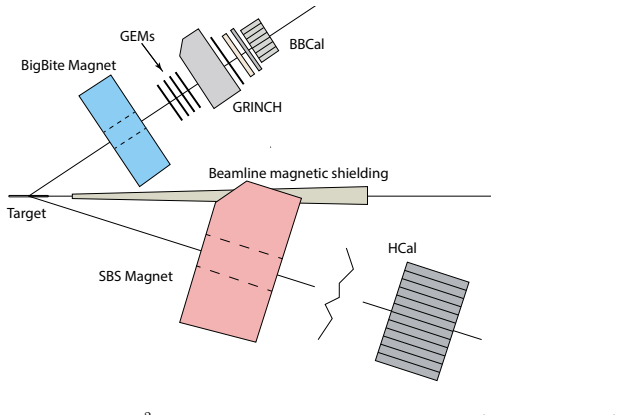
The object that carries the argument is the SBS magnet: a single dipole with an open geometry and a notch in the yoke that lets the downstream beam line pass through the magnet, preserving a roughly 70 msr acceptance at small scattering angles. This geometry is what allows the detector stack to sit close to the target with no shielding hut, which in turn keeps the luminosity-acceptance product high. The detector components that make the open geometry work are the load-bearing mechanisms: large GEM trackers with about 70 micrometer plane resolution, a segmented hadron calorimeter with 0.75 ns timing that seeds track search in a crowded tracker, and a lead-glass calorimeter heated to roughly 200 degrees Celsius to maintain transparency at high luminosity. The proposed DOSBS modification, widening the exit gap of the dipole with spare iron pieces from the original magnets, would double the acceptance to 260 msr and is the basis for the forward-looking weak-interaction program.
What would settle it
A rate-capability test would settle the claim: measure the SBS tracker hit occupancy, tracking efficiency, and trigger dead time as a function of beam current up to $3x10^{38}$ $cm^{-2}$ $s^{-1}$; if efficiency degrades or dead time grows beyond the quoted projections before that luminosity is reached, the uniqueness of the luminosity-solid-angle product is called into question.
Extended reading notes
Core claim
The central claim is that no other spectrometer at the laboratory offers the product of solid angle and luminosity that SBS provides, and that this product is what makes high-$Q^{2}$ measurements of tiny cross sections practical. The authors support this by describing the instrument: a single large dipole in an open geometry, with the yoke cut so the downstream beam line can pass through, giving 70 msr at forward angles; no shielding hut, relying instead on a high-energy trigger threshold; GEM-based tracking with roughly 70 micrometer resolution; a hadron calorimeter that supplies a track-search seed under large occupancy; and a radiation-hard lead-glass calorimeter run near 200 degrees Celsius to survive $3x10^{38}$ $cm^{-2}$ $s^{-1}$. On this basis the paper maintains that the SBS program can bring G_p^E/G_p^M to $Q^{2}$ near 11 (GeV/c)^2, extend G_n^E/G_n^M to $Q^{2}$ near 9.8 (GeV/c)^2, make the neutron G_n^M measurement precise to about 2-3 percent, and provide high-statistics neutron TMD data. The first round of experiments has run; GEn-II has taken data at $Q^{2}$ = 3.0, 6.8, and 9.8 (GeV/c)^2.
Load-bearing premise
The program depends on the detectors actually working at the claimed rates: with the shielding hut removed, the GEM trackers and trigger must function at luminosities up to $3x10^{38}$ $cm^{-2}$ $s^{-1}$ despite very crowded hit patterns.
Editorial extensions
If this is right
- High-precision measurements of G_p^E/G_p^M at Q^2 near 11 (GeV/c)^2 and G_n^E/G_n^M near 10 (GeV/c)^2 would become available, nearly tripling the range over which the neutron electric form factor ratio is accurately known.
- All four elastic nucleon form factors would be known accurately to roughly 10 (GeV/c)^2, allowing the u- and d-quark flavor-separated form factors to that scale, directly testing diquark-correlation models.
- The SIDIS measurement with a polarized helium-3 target would provide roughly 10 to 100 times the statistical power of existing neutron TMD data at high x, sharpening studies of the Sivers and Collins effects.
- The wide-angle pion photoproduction experiments could confirm or rule out the twist-3 GPD prediction A_LL = -K_LL, testing a GPD-based description of that process.
- The DOSBS upgrade, with 260 msr acceptance and projected 0.5 percent momentum resolution, would open new measurements in phi-meson electroproduction, charged weak-current neutrino production, and parity-violating elastic and inelastic electron scattering.
Reading between the lines
- The paper does not quantify how far the open-geometry concept could be pushed; if the claimed rate capability is real, streaming readout and online tracking could plausibly raise the luminosity ceiling further, but that is an extrapolation, not a paper claim.
- The uniqueness claim is facility-relative; the same design logic of maximizing the luminosity-acceptance product with a single open dipole would transfer to other high-duty-factor electron accelerators, though the paper does not discuss such transfers.
- If DOSBS reaches its projected acceptance and momentum resolution, single-arm parity-violating electron scattering at high Q^2 becomes a natural follow-on, and the paper itself only says the idea is worth further examination.
Editorial analysis
A structured set of objections, weighed in public.
Referee Report
Summary. The manuscript presents the Super Bigbite Spectrometer (SBS) physics program at Jefferson Lab: the open-geometry dipole spectrometer, its detector systems (GEM trackers, HCAL, BigBite, ECAL, polarized 3He target, Compact Photon Source), and the planned measurements of elastic nucleon form factors, flavor-separated form factors, SIDIS/TMDs, pion photoproduction, and wide-angle Compton scattering. It also proposes a DOSBS upgrade to 260 msr. The central argument is that SBS's combination of ~70 msr solid angle and high usable luminosity gives a unique luminosity-solid-angle product at JLab, enabling high-precision measurements at high momentum transfer.
Significance. If the claimed rate envelope holds, the program would deliver a major step in nucleon structure: form-factor data near Q^2 ~10 (GeV/c)^2, a u/d flavor decomposition, and an order-of-magnitude statistical gain in polarized SIDIS. The paper's strengths are its coherent assembly of instrument parameters, concrete technical innovations such as the convection-driven 3He target and the Compact Photon Source, and direct pointers to the underlying proposals. Its main weakness is that the load-bearing performance numbers—the Fig. 1 luminosity-solid-angle envelope, the 2-3% projected GMn errors, the 10-100x SIDIS statistical power, and the DOSBS acceptance—are asserted without derivations, simulations, or measured reconstruction performance. These gaps are addressable and do not in themselves invalidate the program, but they must be fixed before the quantitative claims can be accepted.
major comments (4)
- [Abstract; Fig. 1; Secs. II.A, II.D, II.F] The central claim that SBS is 'presently unique' in its luminosity-solid-angle product is not yet supported by rate-capability evidence. Section II.F documents only that the ECAL remained transparent at 3x10^38 cm^-2 s^-1; it does not address GEM occupancy, trigger dead time, or tracking efficiency. Section II.D explicitly invokes HCal track seeding 'due to the large occupancy in the tracker at the required operating luminosity,' and Section II.A makes the high-energy trigger threshold the enabling assumption. Please provide measured or simulated occupancies, trigger rates, and reconstruction efficiencies for the full detector package, or explicitly label the Fig. 1 envelope as a design goal rather than demonstrated performance.
- [Sec. II.E vs Sec. IV] The SIDIS experiment's projected '10-100 times larger' statistical power assumes a polarized 3He target luminosity 'up to nearly 10^38 cm^-2 s^-1' (Sec. IV), yet Sec. II.E reports that the GEn-II target actually ran at roughly 4.5x10^36 cm^-2 s^-1, a factor of about 20 lower. The manuscript does not state what target or beam modification justifies the higher luminosity or whether it has been demonstrated. Without that basis, the SIDIS statistical-power claim inherits an unverified rate capability; please either document the target performance projection or rescale the claim.
- [Secs. III.B, III.C, IV] The quantitative projections are asserted without derivations or citations to a specific simulation: the '2-3%' projected GMn errors (Sec. III.B), the '10-100 times' SIDIS statistical power (Sec. IV), and the extension to Q^2 = 18 (GeV/c)^2 (Sec. III.B). Because the first SBS runs have already been completed, and Sec. III.C states that the GEn-II analysis is 'well underway,' the paper could show measured yields, efficiencies, and systematic budgets, or cite the proposal calculations. As written, these numbers cannot be checked by the reader and should be either justified or softened.
- [Sec. II.H and Sec. VI] The DOSBS upgrade figures of 130 msr and 260 msr at 28 degrees, and the 0.5% momentum resolution quoted in Sec. VI.C, are stated without field-map studies, simulation results, or a reference to a technical design. Since Sec. VI uses these numbers to argue that PVDIS with roughly 20x the acceptance of the earlier measurement and strange-form-factor separations become possible, the acceptance and resolution claims need at least a supporting simulation or design reference, or explicit provisional status.
minor comments (6)
- [Abstract] The phrase 'quantities such the elastic nucleon form factors' is missing 'as,' and 'even broader physic program' should read 'even broader physics program.'
- [Fig. 1] The vertical axis label 'Luminosity [Hz/cm2]' should use units of cm^-2 s^-1 to match the notation used in the text.
- [Sec. II.F] The temperature '∼200 C ◦' should be typeset as '~200 °C.'
- [Fig. 8] The label 'GRINCH' appears in the figure but the acronym is never defined in the text; it should be introduced if this detector is part of the standard layout.
- [Sec. III.A] The sentence 'recently completed data taking and will determine the ratio' mixes tenses; it should say the run is complete and that the result will be reported after analysis.
- [Sec. VI.C] The phrase 'around 260-msr solid' should read 'around 260 msr of solid angle.'
Circularity Check
No circular derivation: SBS projections rest on asserted rate capability and pending analyses, not on fitted inputs or self-citation chains.
full rationale
This paper is an experimental program overview, not a derivation that reduces a predicted quantity to an input. The central quantitative claims are the L·Ω figure-of-merit and projected statistical reach, but these are asserted from instrument design and proposal simulations rather than derived from a fitted parameter or from the target observable itself. Equations (2) and (3) are standard kinematic relations for polarization transfer and double-spin asymmetries; they are not used to fit SBS performance. The flavor-decomposition relations following Eq. (4) are textbook consequences of charge symmetry applied to measured form factors, and the underlying form-factor data are external. The luminosity and solid-angle values in Fig. 1 are stated as design/operational characteristics, and the uniqueness claim follows from that stated figure-of-merit, not from a self-referential definition. The paper does rely extensively on self-authored proposals and preprints (e.g., refs. [19,20,21,34,35,54,55,71,73]) for the instrument design and program projections, and several analyses are still unpublished ('nearing completion', 'well underway'), so those projections are not independently verified here. That is a correctness and validation concern, not circularity: the claims would fail or be rescaled if the assumed tracker occupancy, trigger thresholds, or target luminosities are not met, but that is an empirical rate-capability risk rather than a logical reduction of an output to an input. Accordingly, no specific circular step can be quoted, and the score reflects only the prevalence of unverified self-citations that do not carry the logical weight of the argument.
Assumptions & free parameters
assumptions (4)
- standard math One-photon exchange approximation for elastic eN scattering and the double-polarization formulas (Eqs. 1-3).
- domain assumption Charge symmetry between up and down quark distributions in the proton and neutron.
- domain assumption The polarized 3He nucleus is a suitable effective polarized neutron target.
- ad hoc to paper The performance envelope in Figure 1 (luminosity versus solid angle) and the projected DOSBS acceptance of 260 msr are correct.
Cite this review
Pith. "Pith review of The Super Bigbite Spectrometer physics program." pith.science (2026). https://pith.science/paper/EW77GJRD
@misc{pith2026260806505,
  author       = {Pith},
  title        = {Pith review of: The Super Bigbite Spectrometer physics program},
  year         = {2026},
  howpublished = {\url{https://pith.science/paper/EW77GJRD}},
  note         = {Machine review of arXiv:2608.06505}
}
read the original abstract
The structure of the nucleon is a central problem in strong interaction physics in the non-perturbative regime. Indeed, the vast majority of the known matter in the Universe is made of protons and neutrons which are a remarkable emergent phenomenon of quantum chromodynamics. A critical aspect of investigating nucleon structure experimentally is the measurement of fundamental quantities such the elastic nucleon form factors. Also important is the measurement transverse momentum dependent distribution functions. Accessing such quantities experimentally, however, is challenging because of the small cross sections involved, particularly at high momentum transfer. We present here a physics program that is addressing this challenge based on the Super Bigbite Spectrometer (SBS) that has recently been built at the Thomas Jefferson National Accelerator Facility. SBS provides a relatively large solid angle of 70 msr and can be used at high luminosities and forward-scattering angles. It is based on a single large dipole magnet in an open-geometry in which the detector package has a direct line of sight to the target. This approach is only possible through the use of detector technology that can operate at very high rates while providing excellent spatial resolution. It is the product of solid angle and luminosity that is critical when measuring small cross sections, and in this regard, among spectrometer systems at JLab, SBS is presently unique in its capability. The first set of experiments utilizing SBS has been successfully completed, and more experiments are planned for the future. We also discuss a proposed upgrade that would increase the SBS solid angle to 260 msr, thereby opening perspectives for an even broader physic program.
Figures


Figures from the paper (7 more)



Reference graph
Works this paper leans on
-
[1]
E. E. Chambers and R. Hofstadter, Structure of the proton, Phys. Rev.103, 1454 (1956)
1956
-
[2]
Breidenbachet al., Observed Behavior of Highly Inelastic Electron-Proton Scattering, Phys
M. Breidenbachet al., Observed Behavior of Highly Inelastic Electron-Proton Scattering, Phys. Rev. Lett.23, 935 (1969)
1969
-
[3]
Ashmanet al., An investigation of the spin structure of the proton in deep inelastic scattering of polarised muons on polarised protons, Nuclear Physics B328, 1 (1989)
J. Ashmanet al., An investigation of the spin structure of the proton in deep inelastic scattering of polarised muons on polarised protons, Nuclear Physics B328, 1 (1989)
1989
-
[4]
G. D. Cates, C. W. de Jager, S. Riordan, and B. Wojtsekhowski, Flavor decomposition of the elastic nucleon electromag- netic form factors, Phys. Rev. Lett.106, 252003 (2011)
2011
-
[5]
D. J. Gross and F. Wilczek, Ultraviolet Behavior of Non-Abelian Gauge Theories, Phys. Rev. Lett.30, 1343–1346 (1973)
1973
-
[6]
M¨ ulleret al., Wave functions, evolution equations and evolution kernels from light-ray operators of qcd, Fortschritte der Physik/Progress of Physics42, 101
D. M¨ ulleret al., Wave functions, evolution equations and evolution kernels from light-ray operators of qcd, Fortschritte der Physik/Progress of Physics42, 101
-
[7]
Ji, Deeply virtual compton scattering, Phys
X. Ji, Deeply virtual compton scattering, Phys. Rev. D55, 7114 (1997)
1997
-
[8]
Radyushkin, Scaling limit of deeply virtual compton scattering, Physics Letters B380, 417 (1996)
A. Radyushkin, Scaling limit of deeply virtual compton scattering, Physics Letters B380, 417 (1996)
1996
Show all 106 references
-
[9]
C. Chen, C. Fischer, C. Roberts, and J. Segovia, Form factors of the nucleon axial current, Physics Letters B815, 136150 (2021)
2021
-
[10]
Alexandrouet al., Proton and neutron electromagnetic form factors from lattice QCD in the continuum limit (2025), arXiv:2507.20910 [hep-lat]
C. Alexandrouet al., Proton and neutron electromagnetic form factors from lattice QCD in the continuum limit (2025), arXiv:2507.20910 [hep-lat]
2025 arXiv
-
[11]
Diehl and P
M. Diehl and P. Kroll, Nucleon form factors, generalized parton distributions and quark angular momentum, Eur. Phys. J. C73, 2397 (2013)
2013
-
[12]
Norum, J
B. Norum, J. McCarthy, and R. York, Cebaf — a high energy, high duty factor electron accelerator for nuclear physics, Nuclear Instruments and Methods in Physics Research Section B: Beam Interactions with Materials and Atoms10-11, 337 (1985)
1985
-
[13]
Gross, Cebaf: A microscope for nuclei, Nuclear Instruments and Methods in Physics Research Section B: Beam Interactions with Materials and Atoms24-25, 432 (1987)
F. Gross, Cebaf: A microscope for nuclei, Nuclear Instruments and Methods in Physics Research Section B: Beam Interactions with Materials and Atoms24-25, 432 (1987)
1987
-
[14]
Leemann, D
C. Leemann, D. Douglas, and G. Krafft, The Continuous Electron Beam Accelerator Facility: CEBAF at the Jefferson Laboratory, Annual Review Nuclear and Particle Science51, 413
-
[15]
P. A. Adderleyet al., The continuous electron beam accelerator facility at 12 gev, Phys. Rev. Accel. Beams27, 084802 (2024)
2024
-
[16]
Wojtsekhowski, Nucleon form factors program with SBS at JLAB, Int
B. Wojtsekhowski, Nucleon form factors program with SBS at JLAB, Int. J. Mod. Phys. Conf. Ser.35, 1460427 (2014), arXiv:1401.0859 [nucl-ex]
2014 arXiv
-
[17]
M. Y. Barabanovet al., Diquark correlations in hadron physics: Origin, impact and evidence, Prog. Part. Nucl. Phys. 116, 103835 (2021), arXiv:2008.07630 [hep-ph]
2021 arXiv
-
[18]
Cheng, Z.-Q
P. Cheng, Z.-Q. Yao, D. Binosi, Y. Lu, and C. D. Roberts, Quark + diquark description of nucleon elastic electromagnetic form factors, The European Physical Journal A61, 255 (2025)
2025
-
[19]
(contact), E
Perdrisat, C.F., Pentchev, L. (contact), E. Cisbani, V. Punjabi, M. Khandaker, B. Wojtsekhowski,et al., Large Acceptance Proton Form Factor Ratio Method at 13 and 15 (GeV/c) 2 Using Recoil Polarization Method (2007),https://www.jlab. org/exp_prog/proposals/07/PR12-07-109.pdf
2007
-
[20]
(contact), G
Wojtsekhowski, B. (contact), G. D. Cates, S. Riordan,et al., Measurement of the Neutron Electromagnetic Form Factor RatioG n E/Gn M G at HighQ 2 (2009),https://hallaweb.jlab.org/collab/PAC/PAC34/PR-09-016-gen.pdf
2009
-
[21]
Quinn, Wojtsekhowski, B
B. Quinn, Wojtsekhowski, B. (contact), R. Gilman,et al., Precision Measurement of the Neutron Magnetic Form Factor Up toQ 2 = 18.0 (GeV/c)2 by the Ratio Method (2009),https://www.jlab.org/exp_prog/proposals/09/PR12-09-019.pdf
2009
-
[22]
(contact), B
Keppel, C. (contact), B. Wojtsekhowski, P. King, D. Dutta, J. Annand, J. Zhang,et al., Measurement of Tagged Deep Inelastic Scattering (TDIS) (2015),https://www.jlab.org/exp_prog/proposals/15/PR12-15-006.pdf
2015
-
[23]
G. D. Cates, E. Cisbani, G. Franklin, A. Puckett, Wojtsekhowski, B. (contact),et al., Measurement of the Semi-Inclusive πand K electro-production in DIS regime from transversely polarized 3He target with the SBS and BB spectrometers in Hall A (2009),https://misportal.jlab.org/...
2009
-
[24]
(contact), B
Annand, J. (contact), B. Wojtsekhowski, B. Sawatzky, N. Piskunov, V. Bellini, M. Kohl,et al., Measurement of the Ratio GEn/GMn by the Double-polarized 2H(⃗ e,e’⃗ n) Reaction (2017),https://www.jlab.org/exp_prog/proposals/17/ PR12-17-004.pdf
2017
-
[25]
Alsalmi, Fuchey, E
S. Alsalmi, Fuchey, E. (contact), B. Wojtsekhowski,et al., Measurement of the Two-Photon Exchange Contribution to the Electron-Neutron Elastic Scattering Cross Section (2020),https://misportal.jlab.org/pacProposals/proposals/ 1599/attachments/127361/Proposal.pdf
2020
-
[26]
(contact), H
Dutta, D. (contact), H. Gao, S. Sirca, A. Amaryan, I. Strakovsky,et al., Wide Angle, Exclusive Photoproduction ofπ 0 Mesons (2014),https://www.jlab.org/exp_prog/proposals/14/PR12-14-005.pdf
2014
-
[27]
Niculescu, B
G. Niculescu, B. Wojtsekhowski, D. Day, D. Keller, J. Zhang, Hamilton, D. (contact),et al., Polarization Observables in Wide-Angle Compton Scattering at large s, t, and u (2017),https://misportal.jlab.org/pacProposals/proposals/ 1353/attachments/98388/Proposal.pdf
2017
-
[28]
(contact), J
Puckett, A. (contact), J. Bernauer, A. Schmidt,et al., High-precision measurement ofµ pGp E/Gp M atQ 2 = 3.7 GeV2 via Po- larization Transfer (2024),https://misportal.jlab.org/mis/physics/experiments/viewProposal.cfm?paperId=1122. 18
2024
-
[29]
(contact), S
Fuchey, E. (contact), S. Alsalmi, P. Datta,et al., Measurement of the Two-Photon Exchange Contribution in Electron-Neutron and Positron-Neutron Elastic Scattering (2025),https://www.jlab.org/exp_prog/proposals/25/ PR12%2B25-006.pdf
2025
-
[30]
(contact), E
Hyde, Ch. (contact), E. Fuchey,et al., The Deepest Phi Experiment (2026),https://www.jlab.org/exp_prog/ proposals/26/LOI12-26-008.pdf
2026
-
[31]
Nguyen, Wojtsekhowski, B
H. Nguyen, Wojtsekhowski, B. (contact), W. Xiong,et al., Neutrino production in the Nucleon-Deltap(⃗ e,∆0 →p+π −)νe Reaction (2026),https://www.jlab.org/exp_prog/proposals/26/LOI12-26-009.pdf
2026
-
[32]
Sauli, The gas electron multiplier (GEM): Operating principles and applications, Nucl
F. Sauli, The gas electron multiplier (GEM): Operating principles and applications, Nucl. Instrum. and Meth. A805, 2 (2016)
2016
-
[33]
Basoket al., The spatial resolution measurements on the small prototype of the Super Charm-Tau Factory drift chamber, Nucl
I. Basoket al., The spatial resolution measurements on the small prototype of the Super Charm-Tau Factory drift chamber, Nucl. Instrum. and Meth. A1064, 169419 (2024)
2024
-
[34]
Wojtsekhowski, G
B. Wojtsekhowski, G. D. Cates, E. Cisbani, M. Jones, G. Franklin, N. Liyanage, L. Pentchev, A. J. R. Puckett, and R. Wines, A forward-angle large-acceptance magnetic spectrometer (2026), arXiv:2604.02136 [hep-ex]
2026 arXiv
-
[35]
Cisbani, Jones, M.K., N
E. Cisbani, Jones, M.K., N. Liyanage, L. Pentchev, Puckett, A.J.R., Wojtsekhowski, B. (contact),et al., Large Acceptance Proton Form Factor Ratio Method up tp 14.5 (GeV/c) 2 Using Recoil-Polarization Method (2017),https://www.jlab. org/exp_prog/proposals/19/E12-07-109{%}20Update.pdf
2017
-
[36]
de Langeet al., A large acceptance spectrometer for the internal target facility at nikhef, Nucl
D. de Langeet al., A large acceptance spectrometer for the internal target facility at nikhef, Nucl. Instrum. Meth. A406, 182 (1998)
1998
-
[37]
Riordanet al., Measurements of the Electric Form Factor of the Neutron up toQ 2 = 3.4 GeV 2 using the Reaction 3 ⃗He(⃗ e, e′n)pp, Phys
S. Riordanet al., Measurements of the Electric Form Factor of the Neutron up toQ 2 = 3.4 GeV 2 using the Reaction 3 ⃗He(⃗ e, e′n)pp, Phys. Rev. Lett.105, 262302 (2010)
2010
-
[38]
Chirapatpimolet al.(Hall A Collaboration), Precision measurement of thep(e, e ′ p)π0 reaction at threshold, Phys
K. Chirapatpimolet al.(Hall A Collaboration), Precision measurement of thep(e, e ′ p)π0 reaction at threshold, Phys. Rev. Lett.114, 192503 (2015)
2015
-
[39]
X. Qianet al.(Jefferson Lab Hall A Collaboration), Single Spin Asymmetries in Charged Pion Production from Semi- Inclusive Deep Inelastic Scattering on a Transversely Polarized 3He Target atQ 2 = 1.4−2.7 GeV 2, Phys. Rev. Lett. 107, 072003 (2011)
2011
-
[40]
Gnanvoet al., Large Size GEM for Super Bigbite Spectrometer (SBS) Polarimeter for Hall A 12 GeV program at JLab, Nucl
K. Gnanvoet al., Large Size GEM for Super Bigbite Spectrometer (SBS) Polarimeter for Hall A 12 GeV program at JLab, Nucl. Instrum. Meth. A782, 77 (2015), arXiv:1409.5393 [physics.ins-det]
2015 arXiv
-
[41]
P. Dattaet al., The BigBite Calorimeter for the Super Bigbite Spectrometer Program at Jefferson Lab, Nuclear Instru- ments and Methods in Physics Research Section A: Accelerators, Spectrometers, Detectors and Associated Equipment 1090, 171669 (2026)
2026
-
[42]
Blankleider and R
B. Blankleider and R. M. Woloshyn, Quasielastic Scattering of Polarized Electrons on Polarized 3He, Phys. Rev.C29, 538 (1984)
1984
-
[43]
Roheet al., Measurement of the neutron electric form-factor G(en) at 0.67-(GeV/c)**2 via He-3(pol.)(e(pol.),e’ n), Phys
D. Roheet al., Measurement of the neutron electric form-factor G(en) at 0.67-(GeV/c)**2 via He-3(pol.)(e(pol.),e’ n), Phys. Rev. Lett.83, 4257 (1999)
1999
-
[44]
B. S. Schlimmeet al., Measurement of the Neutron Electric to Magnetic Form Factor Ratio atQ 2=1.58 GeV 2 Using the Reaction 3 → He ( → e , e ′ n)pp, Phys. Rev. Lett.111, 132504 (2013)
2013
-
[45]
P. I. Anthonyet al., Deep inelastic scattering of polarized electrons by polarized 3He and the study of the neutron spin structure, Phys. Rev. D54, 6620 (1996)
1996
-
[46]
A. B.-A. Barangaet al., Polarization of 3He by Spin Exchange with Optically Pumped Rb and K Vapors, Phys. Rev. Lett.80, 2801 (1998)
1998
-
[47]
J. T. Singhet al., Development of high-performance alkali-hybrid polarized 3he targets for electron scattering, Phys. Rev. C91, 055205 (2015)
2015
-
[48]
Wojtsekhowski, Prospect for measuring GEn at high momentum transfer, inExclusive Processes at High Momentum Transfer(2002) pp
B. Wojtsekhowski, Prospect for measuring GEn at high momentum transfer, inExclusive Processes at High Momentum Transfer(2002) pp. 273–281, arXiv:1706.02747 [physics.ins-det]
2002 arXiv
-
[49]
P. A. M. Dolphet al., Gas dynamics in high-luminosity polarized 3He targets using diffusion and convection, Phys. Rev. C84, 065201 (2011)
2011
-
[50]
D. G. Crabbet al., Observation of a 96% proton polarization in irradiated ammonia, Phys. Rev. Lett.64, 2627 (1990)
1990
-
[51]
W. Meyer, Ammonia as a polarized solid target material—a review, Nuclear Instruments and Methods in Physics Research Section A: Accelerators, Spectrometers, Detectors and Associated Equipment526, 12 (2004), proceedings of the ninth International Workshop on Polarized Solid Tar...
2004
-
[52]
M. A. Shupeet al., Neutral-pion photoproduction and proton Compton scattering at large angles, Phys. Rev. D19, 1921 (1979)
1979
-
[53]
R. L. Andersonet al., Measurements of exclusive photoproduction processes at large values oftandufrom 4 to 7.5 gev, Phys. Rev. D14, 679 (1976)
1976
-
[54]
Wojtsekhowski and G
B. Wojtsekhowski and G. Niculescu, Conceptual design report a compact photon source (2017), arXiv:1712.06419 [physics.acc-ph]
2017 arXiv
-
[55]
D. Dayet al., A conceptual design study of a Compact Photon Source (CPS) for Jefferson Lab, Nuclear Instruments and Methods in Physics Research Section A: Accelerators, Spectrometers, Detectors and Associated Equipment957, 163429 (2020)
2020
-
[56]
Wojtsekhowski, PVDIS experiment with Double Open SBS, (currently under development)
B. Wojtsekhowski, PVDIS experiment with Double Open SBS, (currently under development)
-
[57]
M. N. Rosenbluth, High energy elastic scattering of electrons on protons, Physical Review79, 615 (1950)
1950
-
[58]
R. G. Sachs, High-Energy Behavior of Nucleon Electromagnetic Form Factors, Phys. Rev.126, 2256 (1962). 19
1962
-
[59]
Where, in units in whichℏ=c= 1, we take the Mott cross section to be given by dσM ott/dΩe = ((α2 cos2 θe 2 )/(4E2 e sin4 θe 2 ))(E′ e/Ee) where we include the recoil factorE ′ e/Ee
-
[60]
A. I. Akhiezer, L. N. Rozentsveig, and I. M. Shumushkevich, Scattering of electrons by protons, Soviet Physics JETP3, 588 (1958), Zhurnal Eksperimental’noi i Teoretischeskoi Fiziki, 33, 765 (1957)
1958
-
[61]
R. G. Arnold, C. E. Carlson, and F. Gross, Polarization Transfer in Elastic electron Scattering from Nucleons and Deuterons, Phys. Rev.C23, 363 (1981)
1981
-
[62]
M. K. Joneset al.,G Ep /GMp Ratio by Polarization Transfer in⃗ ep→e⃗ p, Phys. Rev. Lett.84, 102002w (2000)
2000
-
[63]
A. J. R. Puckettet al.(The Jefferson Lab Hall A Collaboration), Final analysis of proton form factor ratio data at Q2 = 4.0, 4.8, and 5.6 gev 2, Phys. Rev. C85, 045203 (2012)
2012
-
[64]
P. A. M. Guichon and M. Vanderhaeghen, How to Reconcile the Rosenbluth and the Polarization Transfer Methods in the Measurement of the Proton Form Factors, Phys. Rev. Lett.91, 142303 (2003)
2003
-
[65]
Durand, Inelastic Electron-Deuteron Scattering Cross Sections at High Energies, Phys
L. Durand, Inelastic Electron-Deuteron Scattering Cross Sections at High Energies, Phys. Rev.115, 1020 (1959)
1959
-
[66]
Bartelet al., Measurement of proton and neutron electromagnetic form factors at squared four-momentum transfers up to 3 (gev/c)2, Nuclear Physics B58, 429 (1973)
W. Bartelet al., Measurement of proton and neutron electromagnetic form factors at squared four-momentum transfers up to 3 (gev/c)2, Nuclear Physics B58, 429 (1973)
1973
-
[67]
Rocket al., Measurement of elastic electron-neutron scattering and inelastic electron-deuteron scattering cross sections at high momentum transfer, Phys
S. Rocket al., Measurement of elastic electron-neutron scattering and inelastic electron-deuteron scattering cross sections at high momentum transfer, Phys. Rev. D46, 24 (1992)
1992
-
[68]
Xuet al., Transverse AsymmetryA T ′ from the Quasielastic 3 ⃗He(⃗ e, e′) Process and the Neutron Magnetic Form Factor, Phys
W. Xuet al., Transverse AsymmetryA T ′ from the Quasielastic 3 ⃗He(⃗ e, e′) Process and the Neutron Magnetic Form Factor, Phys. Rev. Lett.85, 2900 (2000)
2000
-
[69]
Gaoet al., Measurement of the neutron magnetic form factor from inclusive quasielastic scattering of polarized electrons from polarized 3He, Phys
H. Gaoet al., Measurement of the neutron magnetic form factor from inclusive quasielastic scattering of polarized electrons from polarized 3He, Phys. Rev. C50, R546(R) (1994)
1994
-
[70]
Lachnietet al.(CLAS Collaboration), Precise measurement of the neutron magnetic form factorG n M in the few-gev 2 region, Phys
J. Lachnietet al.(CLAS Collaboration), Precise measurement of the neutron magnetic form factorG n M in the few-gev 2 region, Phys. Rev. Lett.102, 192001 (2009)
2009
-
[71]
Quinn, Wojtsekhowski, B
B. Quinn, Wojtsekhowski, B. (contact), R. Gilman,et al., Precision measurement of the neutron magnetic form factor at q2=16.0 and 18.0 (gev/c) 2 by the ratio method (2009),https://www.jlab.org/exp_prog/proposals/10/PR12-10-005. pdf
2009
-
[72]
Donnelly and A
T. Donnelly and A. Raskin, Considerations of polarization in inclusive electron scattering from nuclei, Annals of Physics 169, 247 (1986)
1986
-
[73]
Beminiwattha, D
R. Beminiwattha, D. Hamilton, C. Palatchi, K. Paschke, Wojtsekhowski, B. (contact),et al., A Search for a Nonzero Strange Form Factor of the Proton at 2.5 (GeV/c) 2 (2017),https://misportal.jlab.org/pacProposals/proposals/ 1862/attachments/174136/Proposal.pdf
2017
-
[74]
Barabanovet al., Diquark correlations in hadron physics: Origin, impact and evidence, Progress in Particle and Nuclear Physics116, 103835 (2021)
M. Barabanovet al., Diquark correlations in hadron physics: Origin, impact and evidence, Progress in Particle and Nuclear Physics116, 103835 (2021)
2021
-
[75]
M. E. Christyet al., Form factors and two-photon exchange in high-energy elastic electron-proton scattering, Phys. Rev. Lett.128, 102002 (2022)
2022
-
[76]
Sivers, Single Spin Production Asymmetries from the Hard Scattering of Point-Like Constituents, Phys
D. Sivers, Single Spin Production Asymmetries from the Hard Scattering of Point-Like Constituents, Phys. Rev. D41, 83 (1990)
1990
-
[77]
Collins, Fragmentation of transversely polarized quarks probed in transverse momentum distributions, Nuclear Physics B396, 161 (1993)
J. Collins, Fragmentation of transversely polarized quarks probed in transverse momentum distributions, Nuclear Physics B396, 161 (1993)
1993
-
[78]
Airapetianet al.(The HERMES Collaboration), Single-Spin Asymmetries in Semi-Inclusive Deep-Inelastic Scattering on a Transversely Polarized Hydrogen Target, Phys
A. Airapetianet al.(The HERMES Collaboration), Single-Spin Asymmetries in Semi-Inclusive Deep-Inelastic Scattering on a Transversely Polarized Hydrogen Target, Phys. Rev. Lett.94, 012002 (2005)
2005
-
[79]
Adolphet al., Sivers asymmetry extracted in SIDIS at the hard scales of the Drell–Yan process at COMPASS, Physics Letters B770, 138–145 (2017)
C. Adolphet al., Sivers asymmetry extracted in SIDIS at the hard scales of the Drell–Yan process at COMPASS, Physics Letters B770, 138–145 (2017)
2017
-
[80]
J. F. Gunion, S. J. Brodsky, and R. Blankenbecler, Large-angle scattering and the interchange force, Phys. Rev. D8, 287 (1973)
1973
-
[81]
H. W. Huang and P. Kroll, Large momentum transfer electroproduction of mesons, The European Physical Journal C - Particles and Fields17, 1423 (2000)
2000
-
[82]
M. C. Kunkelet al.(CLAS Collaboration), Exclusive photoproduction ofπ 0 up to large values of mandelstam variables s, t,anduwith clas, Phys. Rev. C98, 015207 (2018)
2018
-
[83]
Kroll and K
P. Kroll and K. Passek-Kumeriˇ cki, Wide-angle photo- and electroproduction of pions to twist-3 accuracy, Phys. Rev. D 104, 054040 (2021)
2021
-
[84]
(contact), J
Puckett A. (contact), J. Arrington, A. Tadepalli, B. Wojtsekhowski,et al., Polarization Transfer in Wide-Angle Charged Pion Photoproduction (2020),https://misportal.jlab.org/mis/physics/experiments/viewProposal.cfm?paperId= 992
2020
-
[85]
(contact), G
Wojtsekhowski, B. (contact), G. D. Cates, R. Montgomery, A. Tadepalli,et al., Double Spin Asymmetry in Wide-Angle Charged Pion Photoproduction (2021),https://misportal.jlab.org/mis/physics/experiments/viewProposal.cfm? paperId=1047
2021
-
[86]
Danagoulianet al.(Jefferson Lab Hall A Collaboration), Compton-Scattering Cross Section on the Proton at High Momentum Transfer, Phys
A. Danagoulianet al.(Jefferson Lab Hall A Collaboration), Compton-Scattering Cross Section on the Proton at High Momentum Transfer, Phys. Rev. Lett.98, 152001 (2007)
2007
-
[87]
D. J. Hamiltonet al.(Jefferson Lab Hall A Collaboration), Polarization Transfer in Proton Compton Scattering at High Momentum Transfer, Phys. Rev. Lett.94, 242001 (2005)
2005
-
[88]
Fanelliet al., Polarization Transfer in Wide-Angle Compton Scattering and Single-Pion Photoproduction from the Proton, Phys
C. Fanelliet al., Polarization Transfer in Wide-Angle Compton Scattering and Single-Pion Photoproduction from the Proton, Phys. Rev. Lett.115, 152001 (2015). 20
2015
-
[89]
Kroll, The GPD and spin correlations in wide-angle Compton scattering, The European Physical Journal A53, 130 (2017)
P. Kroll, The GPD and spin correlations in wide-angle Compton scattering, The European Physical Journal A53, 130 (2017)
2017
-
[90]
Hamilton, S
D. Hamilton, S. Sirca, Wojtsekhowski, B. (contact),et al., Wide-angle Compton Scattering at 8 and 10 GeV Photon Energies (2014),https://www.jlab.org/exp_prog/proposals/14/PR12-14-003.pdf
2014
-
[91]
W. Hamdiet al., Intrinsic energy and time resolution of the jefferson lab hall c neutral particle spectrometer, Nuclear In- struments and Methods in Physics Research Section A: Accelerators, Spectrometers, Detectors and Associated Equipment 1086, 171323 (2026)
2026
-
[92]
V. D. Burkert, L. Elouadrhiri, and F. X. Girod, The pressure distribution inside the proton, Nature557, 396 (2018)
2018
-
[93]
Duranet al., Determining the gluonic gravitational form factors of the proton, Nature615, 813 (2023)
B. Duranet al., Determining the gluonic gravitational form factors of the proton, Nature615, 813 (2023)
2023
-
[94]
R. D. McKeown, Sensitivity of polarized elastic electron-proton scattering to the anomalous baryon number magnetic moment, Phys. Lett. B219, 140 (1989)
1989
-
[95]
D. H. Beck, Strange-quark vector currents and parity-violating electron scattering from the nucleon and from nuclei, Phys. Rev. D39, 3248 (1989)
1989
-
[96]
Muelleret al.(SAMPLE Collaboration), Measurement of the proton’s neutral weak magnetic form factor, Phys
B. Muelleret al.(SAMPLE Collaboration), Measurement of the proton’s neutral weak magnetic form factor, Phys. Rev. Lett.78, 3824 (1997)
1997
-
[97]
D. S. Armstronget al.(G0 Collaboration), Strange-quark contributions to parity-violating asymmetries in the forward g0 electron-proton scattering experiment, Phys. Rev. Lett.95, 092001 (2005)
2005
-
[98]
Androi´ cet al.(G0 Collaboration), Strange quark contributions to parity-violating asymmetries in the backward angle g0 electron scattering experiment, Phys
D. Androi´ cet al.(G0 Collaboration), Strange quark contributions to parity-violating asymmetries in the backward angle g0 electron scattering experiment, Phys. Rev. Lett.104, 012001 (2010)
2010
-
[99]
Baunacket al., Measurement of Strange Quark Contributions to the Vector Form Factors of the Proton atQ 2 = 0.22 (GeV/c) 2, Phys
S. Baunacket al., Measurement of Strange Quark Contributions to the Vector Form Factors of the Proton atQ 2 = 0.22 (GeV/c) 2, Phys. Rev. Lett.102, 151803 (2009)
2009
-
[100]
K. A. Aniolet al.(HAPPEX Collaboration), Parity-violating electroweak asymmetry inP(⃗ e, e)pscattering, Phys. Rev. C69, 065501 (2004)
2004
-
[101]
Achaet al.(HAPPEX Collaboration), Precision measurements of the nucleon strange form factors atQ 2 ∼0.1 gev 2, Phys
A. Achaet al.(HAPPEX Collaboration), Precision measurements of the nucleon strange form factors atQ 2 ∼0.1 gev 2, Phys. Rev. Lett.98, 032301 (2007)
2007
-
[102]
Ahmedet al.(HAPPEX Collaboration), New precision limit on the strange vector form factors of the proton, Phys
Z. Ahmedet al.(HAPPEX Collaboration), New precision limit on the strange vector form factors of the proton, Phys. Rev. Lett.108, 102001 (2012)
2012
-
[103]
Prescottet al., Parity non-conservation in inelastic electron scattering, Physics Letters B77, 347 (1978)
C. Prescottet al., Parity non-conservation in inelastic electron scattering, Physics Letters B77, 347 (1978)
1978
-
[104]
Wanget al.(Jefferson Lab PVDIS Collaboration), Measurement of parity violation in electron-quark scattering, Nature 506, 67 (2014)
D. Wanget al.(Jefferson Lab PVDIS Collaboration), Measurement of parity violation in electron-quark scattering, Nature 506, 67 (2014)
2014
-
[105]
L. Kasperet al., Development and characterization of mpgd-based transition radiation detectors, Nuclear Instruments and Methods in Physics Research Section A: Accelerators, Spectrometers, Detectors and Associated Equipment1087, 171403 (2026)
2026
-
[106]
P. A. Souder, Parity Violation in Deep Inelastic Scattering with the SoLID Spectrometer at JLab, International Journal of Modern Physics: Conference Series40, 1660077 (2016). 21
2016
Reviewed August 10, 2026 · model on record in the stance chip above.
Discussion (0). Continue with ORCID to comment.