REVIEW 5 major objections 6 minor 38 references
CrystalGRPO: Target-Aligned and Coverage-Preserving Reinforcement Learning for Flow-Based Crystal Structure Prediction
T0 review · 5 major / 6 minor · reviewed 2026-08-10 · deepseek-v4-flash
Pith's one-line read The paper claims that reinforcement-learning post-training which jointly updates coordinates and lattice, with a hybrid energy-and-match reward and coverage control, recovers target polymorphs better than coordinate-only or energy-only…
desk verdict A well-controlled empirical paper that extends flow-model RL to joint coordinate-lattice crystal generation; the theory is mostly fine, the missing code and significance tests are the main obstacles. read the letter →
The pith
A machine-rendered reading of the paper's core claim, the machinery that carries it, and where it could break.
The reading
What carries the argument
The machinery is a stochastic joint coordinate–lattice policy obtained by ODE-to-SDE conversion of the pretrained flow, with per-step Gaussian transitions. Coordinates are sampled in Euclidean covering space and wrapped onto the torus, while lattices stay Euclidean; the policy ratio and reference KL are evaluated on the unwrapped lifted proposals and normalized by crystal size so the score does not grow with N. This policy is optimised with a group-relative advantage; for the coverage mode, the advantage is modified to max(A_g,0) for valid unmatched candidates, and the reference-policy KL is applied over the full trajectory rather than only early high-noise steps.
What would settle it
Compute the true wrapped transition density on the torus by marginalising the Gaussian over lattice shifts and compare the exact per-step importance ratio and KL with the lifted-ratio versions that CrystalGRPO uses on a small MP-20 subset; a measurable gap would show the surrogate gradient is biased.
Extended reading notes
Core claim
On its own terms, the paper's central discovery is that reward-guided post-training for crystal structure prediction should optimise the joint coordinate–lattice state rather than only fractional coordinates, and should combine an energy signal with an explicit structural-match signal plus coverage control. Concretely, starting from PXRDGen or OMatG backbones on MP-20 and MPTS-52, both CrystalGRPO variants reduce one- and twenty-sample RMSE compared with coordinate-only reinforcement (OMatG-IRL) in all four settings, CrystalGRPO-Q consistently raises Top-1 match rate, and CrystalGRPO-C raises Top-20 match rate in all four settings. The two variants share one joint SDE policy and hybrid reward, differing only in the reference-KL schedule and in a coverage-aware advantage that stops valid but unmatched candidates from being pushed down because they fall below the group mean.
Load-bearing premise
The paper relies on the assumption that the per-step Gaussian policy likelihood computed on the unwrapped coordinate proposal is a valid surrogate for the true periodic (wrapped) sampling distribution, even though the same wrapped structure has many lifts and no unbiasedness proof is given.
Editorial extensions
If this is right
- Joint coordinate–lattice optimisation is a drop-in post-training recipe: it can be applied to any pretrained flow-based crystal generator that exposes velocity fields for both coordinates and lattice, including backbones with different lattice priors.
- CrystalGRPO-Q and CrystalGRPO-C give complementary operating points, so a practitioner can choose the mode according to whether a single best guess or a candidate set matters more.
- Coverage preservation extends recovery to harder, low-frequency targets rather than merely refining targets the pretrained model already recovers, at a small cost in average RMSE over matches.
- PXRD conditioning changes the role of the energy reward: with target diffraction information, energy-only RL raises match rate without increasing low-energy mismatched candidates, whereas without PXRD it increases them by 164 percent.
- The two coverage mechanisms, full-trajectory reference regularization and the coverage-aware advantage, each shift the operating point measurably, so they can be tuned independently for intermediate quality–coverage trade-offs.
Reading between the lines
- Inference: the lifted-action surrogate is the main technical risk; the paper scores policy ratios on the pre-wrap Euclidean proposal, but the environment observes the wrapped state, so the gradient is unbiased only if the periodic transition kernel remains Gaussian after wrapping. A small-system experiment comparing lifted-ratio GRPO with wrapped-ratio GRPO would settle this.
- Inference: the coverage-aware advantage is a generic candidate-set regulariser that could transfer to other generative sampling tasks with finite budgets, such as molecular docking or property-guided generation, where valid but unrewarded candidates should not be suppressed.
- Inference: because StructureMatcher uses fixed tolerances, the hybrid reward implicitly biases the policy toward structures that are exactly recoverable under those tolerances; tighter tolerances would likely trade Top-1 for geometric precision, a testable knob.
- Inference: the reported consistency across two backbones with different lattice priors suggests the joint-policy benefit comes from allowing the lattice to adapt during post-training rather than from any particular lattice initialization scheme.
Editorial analysis
A structured set of objections, weighed in public.
Referee Report
Summary. The paper proposes CrystalGRPO, a reinforcement-learning post-training framework for flow-based crystal structure prediction (CSP). It converts pretrained ODE samplers into joint coordinate-lattice SDE policies, combines MACE-predicted energy with a StructureMatcher-based recovery score, and introduces two operating modes: CrystalGRPO-Q, which uses standard group-relative optimization with early-stage KL regularization, and CrystalGRPO-C, which adds full-trajectory KL regularization and a coverage-aware advantage that removes negative updates for valid unmatched candidates. Experiments on MP-20 and MPTS-52 with PXRDGen and OMatG backbones report that both variants reduce one- and twenty-sample RMSE relative to coordinate-only RL (OMatG-IRL), that Q improves MR@1, and that C improves MR@20 across all four settings. The paper also includes ablations and a PXRD-conditioned analysis showing that energy-only rewards increase low-energy mismatched candidates under composition-only conditioning.
Significance. If the joint coordinate-lattice stochastic policy is valid, CrystalGRPO offers a general post-training recipe for flow-based CSP that explicitly targets the trade-off between single-draw accuracy and finite-budget coverage. The formulation of CSP as budgeted target recovery is appropriate, and the two-mode design is a useful conceptual contribution. The empirical comparison is extensive: two datasets, two pretrained backbones, an end-to-end comparison with the closest RL baseline, and careful ablations. The paper also ships detailed hyperparameters and algorithm descriptions, which support reproducibility. The main weaknesses are the incomplete theoretical justification of the lifted-action surrogate and the absence of uncertainty quantification, which makes the headline improvements, especially the small MR@20 gains, hard to evaluate. Overall, the contribution is promising but requires a major revision to address these load-bearing issues.
major comments (5)
- [Section 4.1] The joint coordinate-lattice policy samples a Euclidean lift eF_{t-δ} and then wraps it to the periodic state F_{t-δ}, and the per-step importance ratio and KL divergence are computed on the lifted Gaussian proposals. The paper explicitly states this design choice but does not prove that the resulting surrogate objective is an unbiased estimator of the policy gradient for the wrapped transition kernel on the torus, nor does it bound the wrap-induced mismatch. With the noise schedule σ_t = min(0.2 sqrt(t/(1-t)), 5) reaching values as large as 5 at early steps, wrap crossings are not rare, and the wrapped transition kernel is a wrapped Gaussian whose likelihood ratio differs from the lifted Gaussian ratio. The central contribution of the paper therefore rests on an unverified assumption.
- [Section 4.2 vs. Supplementary 10.1] The main text defines the hybrid reward as R_g = -λ_E ΔE_g + λ_S S_g, an additive combination that gives dense energy guidance to all candidates. In contrast, the implementation in Supplementary Section 10.1 is R_g = K_S S_g (1 + K_E Q^E_g) with S_g = 0 for unmatched candidates, so unmatched structures receive reward zero regardless of their energy. This means the energy term only refines matched candidates and does not provide dense guidance to the rest of the distribution. The main-text description and the motivation in Figure 1 are therefore inconsistent with the actual reward, and the 'w/o Hybrid Reward' ablation in Table 3 does not isolate the energy contribution as described.
- [Tables 1 and 2] All reported metrics are point estimates without error bars, confidence intervals, or significance tests. Several of the headline differences are small; for example, MR@20 in Table 1 changes from 80.23 to 80.62 on MP-20 and from 38.74 to 39.08 on MPTS-52, and in Table 2 from 78.52 to 80.41 for PXRDGen on MP-20. Without repeated seeds or a bootstrap, the claims that CrystalGRPO-C 'achieves a higher Top-20 across all settings' and that both variants 'reduce RMSE' in all four settings are not statistically supported.
- [Table 2] The pre-RL SDE/50 controls show that replacing ODE with SDE sampling degrades RMSE substantially (e.g., PXRDGen MP-20: RMSE@1 from 0.1026 to 0.1837, RMSE@20 from 0.0839 to 0.1476), even though MR@1 and MR@20 stay nearly flat. The paper interprets this as preserving target-recovery behavior, but geometric precision is sharply reduced. The RMSE improvements of the RL methods over the SDE/50 controls may therefore partly reflect recovery of precision lost by stochasticization rather than genuine reward-driven refinement. A decomposition of the RMSE gain into sampler-recovery and reward-driven components would strengthen the attribution.
- [Section 4.3 and Section 6.4] The coverage-aware advantage sets \tilde A_g = max(A_g, 0) for valid unmatched candidates, which by construction removes negative updates for these candidates. The MR@20 improvement of CrystalGRPO-C is therefore a built-in consequence of the mechanism rather than an emergent property of the joint policy or hybrid reward. The paper acknowledges that C does not directly optimize MR@20, but the headline claim 'CrystalGRPO-C achieves higher Top-20 across all settings' should be presented with this caveat in the abstract, and ideally with an explicit comparison (such as the Q variant) showing that the coverage mechanism is necessary for the MR@20 preservation.
minor comments (6)
- [Section 4.1] The size-normalized log-ratio eℓ_t is a heuristic normalization and is not the actual log-likelihood ratio for the Gaussian transitions; the paper should either justify this approximation theoretically or provide an ablation comparing it with the exact ratio.
- [Section 6.2] The statement 'Both variants also improve geometric accuracy' is based on RMSE computed only on matched structures; because the set of matched targets changes across methods, direct RMSE comparisons are not apples-to-apples. This is acknowledged in Section 6.4 but should be stated when the metric is introduced.
- [Section 3 and Section 4.1] The notation d_L is used both for the dimensionality of the lattice representation and for the lattice mean-shift divergence in the size-normalized KL; please disambiguate these two uses.
- [Throughout] The inference step count is denoted inconsistently as both 'N_t' and 'Nt'; please standardize the notation.
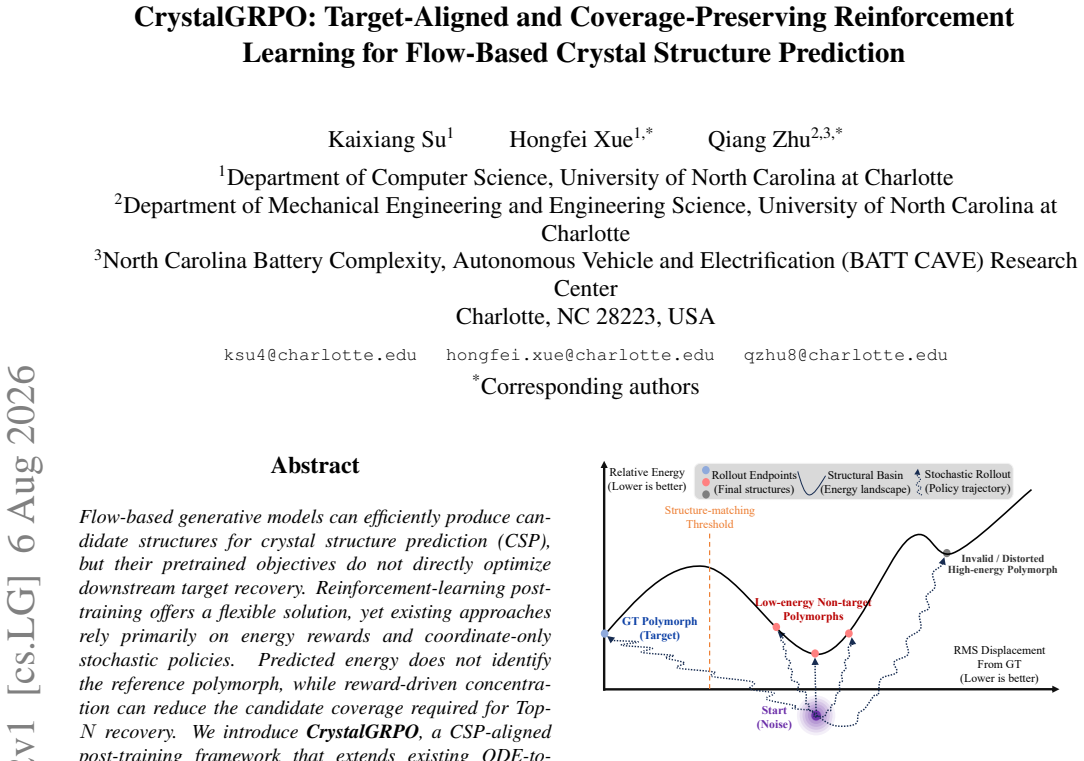
- [Figure 1] The axes of the schematic projection are not labeled, which makes the figure difficult to interpret; please add axis labels or a more detailed caption explaining the coordinate system.
- [Abstract] The abstract states that both variants reduce 'one- and twenty-sample RMSE relative to coordinate-only reinforcement in all four backbone-dataset settings,' but this claim is only verified for the N_t=50 evaluation in Table 2, not for the higher-step settings in Table 1; please specify the evaluation protocol in the abstract.
Circularity Check
No significant circularity: the target-aligned reward and coverage-aware advantage are deliberate designs, not hidden reductions; the only overlapping-author citation is confined to related work.
full rationale
The derivation chain is not circular. The joint coordinate-lattice SDE policy, size-normalized likelihood ratios, and reference KL divergence are explicit extensions of the external Flow-GRPO construction [15] and do not assume the reported results. The reward/evaluation overlap (StructureMatcher used both in the hybrid reward and in the MR/RMSE metrics) is a deliberate target-aligned objective, not a hidden reduction: the paper reports post-training measurements on standard benchmarks and does not claim the reward identifies the reference polymorph without ground-truth labels. The coverage-aware advantage (eA_g = max(A_g,0) for valid unmatched candidates) is defined in terms of the same matcher, which makes the direction of the MR@20 effect expected, but the reported gains are empirical magnitudes and rankings, not identities. The only overlapping-author citation (LEGO-xtal [23]) appears in Related Work, is not load-bearing, and does not justify any result. The weakest point is the lifted-Gaussian policy ratio: the paper evaluates per-step ratios and KL on the unwrapped proposal eF_{t-delta} while the environment state is wrapped F_{t-delta}; this is a potential bias in the periodic policy gradient, but it is a correctness/identifiability gap rather than a circularity, because the paper explicitly redefines the action as the lift. No circular step was identified.
Assumptions & free parameters
free parameters (8)
- Noise scale a in sigma_t =
0.2
- Reference KL regularization coefficient beta =
not reported
- Ratio clipping threshold c_r =
not reported
- Energy reward coefficient K_E =
0.05
- Energy normalization scale E0 =
0.5 eV/atom
- StructureMatcher decay scale tau =
0.5
- Early-stage KL threshold tau_KL for Q =
0.6
- PPO clipping epsilon =
0.2
assumptions (5)
- standard math Gaussian transition kernels with shared covariance yield the stated KL and importance-ratio formulas
- domain assumption The ODE-to-SDE stochasticization preserves the pretrained marginals for the joint coordinate-lattice flow
- domain assumption MACE-MP-0 medium energies are an adequate proxy for the relative stability of generated structures and for ground-truth energies
- domain assumption StructureMatcher with stol=0.5, ltol=0.3, angle_tol=10 degrees is a valid target-identity criterion
- domain assumption Reward clipping values and the coverage-aware advantage do not introduce a systematic bias in favor of the reported MR@20 result
Cite this review
Pith. "Pith review of CrystalGRPO: Target-Aligned and Coverage-Preserving Reinforcement Learning for Flow-Based Crystal Structure Prediction." pith.science (2026). https://pith.science/paper/MXGAB4LD
@misc{pith2026260806582,
  author       = {Pith},
  title        = {Pith review of: CrystalGRPO: Target-Aligned and Coverage-Preserving Reinforcement Learning for Flow-Based Crystal Structure Prediction},
  year         = {2026},
  howpublished = {\url{https://pith.science/paper/MXGAB4LD}},
  note         = {Machine review of arXiv:2608.06582}
}
read the original abstract
Flow-based generative models can efficiently produce candidate structures for crystal structure prediction (CSP), but their pretrained objectives do not directly optimize downstream target recovery. Reinforcement-learning post-training offers a flexible solution, yet existing approaches rely primarily on energy rewards and coordinate-only stochastic policies. Predicted energy does not identify the reference polymorph, while reward-driven concentration can reduce the candidate coverage required for Top-N recovery. We introduce CrystalGRPO, a CSP-aligned post-training framework that extends existing ODE-to-SDE policy constructions to the joint coordinate--lattice state. CrystalGRPO combines MACE-predicted energy with a StructureMatcher-based recovery score and provides two operating modes: CrystalGRPO-Q, which prioritizes single-draw recovery, and CrystalGRPO-C, which combines full-trajectory reference regularization with a coverage-aware group advantage to preserve finite-budget target recovery. Across MP-20 and MPTS-52 with PXRDGen and OMatG backbones, both variants reduce one- and twenty-sample RMSE relative to coordinate-only reinforcement in all four backbone--dataset settings. CrystalGRPO-Q consistently improves Top-1, whereas CrystalGRPO-C achieves a higher Top-20 across all settings.
Figures

Reference graph
Works this paper leans on
-
[1]
Luis M Antunes, Keith T Butler, and Ricardo Grau-Crespo. Crystal structure generation with autoregressive large lan- guage modeling.Nature Communications, 15(1):10570,
-
[2]
A foundation model for atomistic materials chemistry.The Journal of chemical physics, 163(18), 2025
Ilyes Batatia, Philipp Benner, Yuan Chiang, Alin M Elena, D´avid P Kov ´acs, Janosh Riebesell, Xavier R Advincula, Mark Asta, Matthew Avaylon, William J Baldwin, et al. A foundation model for atomistic materials chemistry.The Journal of chemical physics, 163(18), 2025. 5
work page 2025
-
[3]
Training diffusion models with reinforce- ment learning.arXiv preprint arXiv:2305.13301, 2023
Kevin Black, Michael Janner, Yilun Du, Ilya Kostrikov, and Sergey Levine. Training diffusion models with reinforce- ment learning.arXiv preprint arXiv:2305.13301, 2023. 3
arXiv 2023
-
[4]
Matinvent: Reinforcement learning for 3d crystal diffusion generation
Junwu Chen, Jeff Guo, and Philippe Schwaller. Matinvent: Reinforcement learning for 3d crystal diffusion generation. InAI for Accelerated Materials Design-ICLR 2025, 2025. 2, 3
work page 2025
-
[5]
Fine-tuned language models generate stable inorganic ma- terials as text
Nate Gruver, Anuroop Sriram, Andrea Madotto, An- drew Gordon Wilson, Larry Zitnick, and Zachary Ulissi. Fine-tuned language models generate stable inorganic ma- terials as text. InInternational conference on learning rep- resentations, pages 21671–21690, 2024. 3
work page 2024
-
[6]
Open materials generation with inference-time reinforcement learning
Philipp H ¨ollmer and Stefano Martiniani. Open materials generation with inference-time reinforcement learning. In Forty-third International Conference on Machine Learning,
-
[7]
Tadmor, and Stefano Martiniani
Philipp H ¨ollmer, Thomas Egg, Maya Martirossyan, Eric Fuemmeler, Zeren Shui, Amit Gupta, Pawan Prakash, Adrian Roitberg, Mingjie Liu, George Karypis, Mark Transtrum, Richard Hennig, Ellad B. Tadmor, and Stefano Martiniani. Open materials generation with stochastic inter- polants. InForty-second International Conference on Ma- chine Learning, 2025. 3, 6, 7
work page 2025
-
[8]
Crystal structure prediction by joint equivariant diffusion
Rui Jiao, Wenbing Huang, Peijia Lin, Jiaqi Han, Pin Chen, Yutong Lu, and Yang Liu. Crystal structure prediction by joint equivariant diffusion. InThirty-seventh Conference on Neural Information Processing Systems, 2023. 2, 3, 6, 1
work page 2023
Show all 38 references
-
[9]
Space group constrained crystal generation.arXiv preprint arXiv:2402.03992, 2024
Rui Jiao, Wenbing Huang, Yu Liu, Deli Zhao, and Yang Liu. Space group constrained crystal generation.arXiv preprint arXiv:2402.03992, 2024. 3
2024 arXiv
-
[10]
Wyckoffdiff–a generative diffusion model for crystal symmetry.arXiv preprint arXiv:2502.06485, 2025
Filip Ekstr ¨om Kelvinius, Oskar B Andersson, Abhijith S Parackal, Dong Qian, Rickard Armiento, and Fredrik Lind- sten. Wyckoffdiff–a generative diffusion model for crystal symmetry.arXiv preprint arXiv:2502.06485, 2025. 3
2025
-
[11]
Llm meets dif- fusion: a hybrid framework for crystal material generation
Subhojyoti Khastagir, Kishalay Das, Pawan Goyal, Seung- Cheol Lee, Satadeep Bhattacharjee, et al. Llm meets dif- fusion: a hybrid framework for crystal material generation. Advances in Neural Information Processing Systems, 38: 169190–169215, 2026. 3
2026
-
[12]
SymmCD: Symmetry- preserving crystal generation with diffusion models
Daniel Levy, Siba Smarak Panigrahi, S ´ekou-Oumar Kaba, Qiang Zhu, Kin Long Kelvin Lee, Mikhail Galkin, Santi- ago Miret, and Siamak Ravanbakhsh. SymmCD: Symmetry- preserving crystal generation with diffusion models. InThe Thirteenth International Conference on Learning Repres...
2025
-
[13]
Powder diffraction crystal structure determination us- ing generative models.Nature Communications, 16(1):7428,
Qi Li, Rui Jiao, Liming Wu, Tiannian Zhu, Wenbing Huang, Shifeng Jin, Yang Liu, Hongming Weng, and Xiaolong Chen. Powder diffraction crystal structure determination us- ing generative models.Nature Communications, 16(1):7428,
-
[14]
Flow matching for generative modeling
Yaron Lipman, Ricky TQ Chen, Heli Ben-Hamu, Maximil- ian Nickel, and Matthew Le. Flow matching for generative modeling. InThe eleventh international conference on learn- ing representations, 2022. 2
2022
-
[15]
Flow-GRPO: Training flow matching models via online RL
Jie Liu, Gongye Liu, Jiajun Liang, Yangguang Li, Jiaheng Liu, Xintao Wang, Pengfei Wan, Di ZHANG, and Wanli Ouyang. Flow-GRPO: Training flow matching models via online RL. InThe Thirty-ninth Annual Conference on Neu- ral Information Processing Systems, 2025. 2, 3, 4, 5 9
2025
-
[16]
Crystalflow: a flow-based generative model for crystalline materials.Nature Communications, 16(1):9267, 2025
Xiaoshan Luo, Zhenyu Wang, Qingchang Wang, Xuechen Shao, Jian Lv, Lei Wang, Yanchao Wang, and Yanming Ma. Crystalflow: a flow-based generative model for crystalline materials.Nature Communications, 16(1):9267, 2025. 2, 3, 6
2025
-
[17]
All that structure matches does not glitter.Advances in Neural Information Processing Systems, 38, 2026
Maya Martirossyan, Thomas Egg, Philipp H ¨ollmer, George Karypis, Mark Transtrum, Adrian Roitberg, Mingjie Liu, Richard Hennig, Ellad Tadmor, and Stefano Martiniani. All that structure matches does not glitter.Advances in Neural Information Processing Systems, 38, 2026. 2
2026
-
[18]
Genera- tive models for crystalline materials.Advanced Materials, 38(18):e23620, 2026
Houssam Metni, Laura Ruple, Lauren N Walters, Luca Tor- resi, Jonas Teufel, Henrik Schopmans, Jona ¨Ostreicher, Yu- meng Zhang, Marlen Neubert, Yuri Koide, et al. Genera- tive models for crystalline materials.Advanced Materials, 38(18):e23620, 2026. 1
2026
-
[19]
Benjamin Kurt Miller, Ricky T. Q. Chen, Anuroop Sriram, and Brandon M Wood. FlowMM: Generating materials with riemannian flow matching. InForty-first International Con- ference on Machine Learning, 2024. 2, 3
2024
-
[20]
Reliable crystal structure predictions from first principles.Nature Commu- nications, 13(1):3095, 2022
Rahul Nikhar and Krzysztof Szalewicz. Reliable crystal structure predictions from first principles.Nature Commu- nications, 13(1):3095, 2022. 1
2022
-
[21]
Python materials genomics (pymatgen): A robust, open-source python library for materials analysis.Computa- tional Materials Science, 68:314–319, 2013
Shyue Ping Ong, William Davidson Richards, Anubhav Jain, Geoffroy Hautier, Michael Kocher, Shreyas Cholia, Dan Gunter, Vincent L Chevrier, Kristin A Persson, and Gerbrand Ceder. Python materials genomics (pymatgen): A robust, open-source python library for materials analysis.C...
2013
-
[22]
Guiding generative mod- els to uncover diverse and novel crystals via reinforcement learning.Nature Machine Intelligence, pages 1–13, 2026
Hyunsoo Park and Aron Walsh. Guiding generative mod- els to uncover diverse and novel crystals via reinforcement learning.Nature Machine Intelligence, pages 1–13, 2026. 3
2026
-
[23]
Ai- assisted rapid crystal structure generation towards a target local environment.npj Computational Materials, 2026
Osman Goni Ridwan, Sylvain Piti ´e, Monish Soundar Raj, Dong Dai, Gilles Frapper, Hongfei Xue, and Qiang Zhu. Ai- assisted rapid crystal structure generation towards a target local environment.npj Computational Materials, 2026. 3
2026
-
[24]
Proximal policy optimization algo- rithms.arXiv preprint arXiv:1707.06347, 2017
John Schulman, Filip Wolski, Prafulla Dhariwal, Alec Rad- ford, and Oleg Klimov. Proximal policy optimization algo- rithms.arXiv preprint arXiv:1707.06347, 2017. 2
2017 arXiv
-
[25]
Deepseekmath: Pushing the limits of math- ematical reasoning in open language models.arXiv preprint arXiv:2402.03300, 2024
Zhihong Shao, Peiyi Wang, Qihao Zhu, Runxin Xu, Junxiao Song, Xiao Bi, Haowei Zhang, Mingchuan Zhang, YK Li, Yang Wu, et al. Deepseekmath: Pushing the limits of math- ematical reasoning in open language models.arXiv preprint arXiv:2402.03300, 2024. 5
2024 arXiv
-
[26]
Jaakkola, Elsa Olivetti, and Rafael G ´omez-Bombarelli
Akshay Subramanian, Elton Pan, Juno Nam, Maurice Weiler, Shuhui Qu, Cheol Woo Park, Tommi S. Jaakkola, Elsa Olivetti, and Rafael G ´omez-Bombarelli. Packflow: Genera- tive molecular crystal structure prediction via reinforcement learning alignment, 2026. 3
2026
-
[27]
The thermo- dynamic scale of inorganic crystalline metastability.Science advances, 2(11):e1600225, 2016
Wenhao Sun, Stephen T Dacek, Shyue Ping Ong, Geof- froy Hautier, Anubhav Jain, William D Richards, Anthony C Gamst, Kristin A Persson, and Gerbrand Ceder. The thermo- dynamic scale of inorganic crystalline metastability.Science advances, 2(11):e1600225, 2016. 2
2016
-
[28]
Fine- tuning of continuous-time diffusion models as entropy- regularized control.arXiv preprint arXiv:2402.15194, 2024
Masatoshi Uehara, Yulai Zhao, Kevin Black, Ehsan Haji- ramezanali, Gabriele Scalia, Nathaniel Lee Diamant, Alex M Tseng, Tommaso Biancalani, and Sergey Levine. Fine- tuning of continuous-time diffusion models as entropy- regularized control.arXiv preprint arXiv:2402.15194, 2024. 2
2024 arXiv
-
[29]
Pass@k policy optimization: Solving harder reinforcement learning prob- lems
Christian Walder and Deep Tejas Karkhanis. Pass@k policy optimization: Solving harder reinforcement learning prob- lems. InThe Thirty-ninth Annual Conference on Neural In- formation Processing Systems, 2025. 6
2025
-
[30]
A periodic bayesian flow for material gener- ation.arXiv preprint arXiv:2502.02016, 2025
Hanlin Wu, Yuxuan Song, Jingjing Gong, Ziyao Cao, Yawen Ouyang, Jianbing Zhang, Hao Zhou, Wei-Ying Ma, and Jingjing Liu. A periodic bayesian flow for material gener- ation.arXiv preprint arXiv:2502.02016, 2025. 3
2025 arXiv
-
[31]
Jaakkola
Tian Xie, Xiang Fu, Octavian-Eugen Ganea, Regina Barzi- lay, and Tommi S. Jaakkola. Crystal diffusion variational au- toencoder for periodic material generation. InInternational Conference on Learning Representations, 2022. 3, 6
2022
-
[32]
Does rein- forcement learning really incentivize reasoning capacity in LLMs beyond the base model? InThe Thirty-ninth An- nual Conference on Neural Information Processing Systems,
Yang Yue, Zhiqi Chen, Rui Lu, Andrew Zhao, Zhaokai Wang, Yang Yue, Shiji Song, and Gao Huang. Does rein- forcement learning really incentivize reasoning capacity in LLMs beyond the base model? InThe Thirty-ninth An- nual Conference on Neural Information Processing Systems,
-
[33]
A generative model for inorganic materials design.Nature, 2025
Claudio Zeni, Robert Pinsler, Daniel Z ¨ugner, Andrew Fowler, Matthew Horton, Xiang Fu, Zilong Wang, Aliak- sandra Shysheya, Jonathan Crabb ´e, Shoko Ueda, Roberto Sordillo, Lixin Sun, Jake Smith, Bichlien Nguyen, Hannes Schulz, Sarah Lewis, Chin-Wei Huang, Ziheng Lu, Yichi Zh...
2025
-
[34]
Detailed Preliminaries and Derivations 8.1. Crystal Structure Prediction Crystal structure prediction aims to recover the periodic atomic arrangement and lattice consistent with a given chemical composition and, when available, experimental observations. A crystal is represent...
-
[35]
:= 1 2π atan2 sin(ωi),cos(ω i) , whereω i := 2π(F i 1 −F i 0)andVrepresents a tangent ve- locity vector. To rigorously address the global translation-invariance, we acquire the final target velocity field by removing the mean torus translation from the base logarithmic map: vX...
-
[36]
Both variants follow the same on-policy GRPO pipeline, alternating between stochastic rollout collection and policy optimization
CrytalGRPO Training Algorithm Training procedure.The training procedures of CrystalGRPO-C and CrystalGRPO-Q are summarized in Algorithms 1 and 2, respectively. Both variants follow the same on-policy GRPO pipeline, alternating between stochastic rollout collection and policy o...
-
[37]
CSP-aligned Hybrid Reward 3
Joint-SDE Crystal Rollout 2. CSP-aligned Hybrid Reward 3. Coverage-Aware Group Advantage Trajectory. 1 Fractional coordinates ↝ ↝ ↝ ↝ Lattice ⋮ Trajectory. G Fractional coordinates Lattice Candidate crystal Energy gap Validity Recovery score Reward ∆𝑄𝑔,1 𝐸matched 𝑆𝑔,1 𝑹𝟏 𝑹𝟏 … ...
-
[38]
CSP-aligned Hybrid Reward For completeness and reproducibility, we provide the ex- act reward implementation used to obtain the reported re- sults
Detailed Reward Design and Experimental Configurations 10.1. CSP-aligned Hybrid Reward For completeness and reproducibility, we provide the ex- act reward implementation used to obtain the reported re- sults. In the target-aligned reward configuration, the Struc- tureMatcher s...
Reviewed August 10, 2026 · model on record in the stance chip above.
Discussion (0). Continue with ORCID to comment.