REVIEW 5 major objections 5 minor 103 references
Alkali Metallicity, Mineral Clouds, and Deep Atmospheric Variability on Jupiter
T0 review · 5 major / 5 minor · reviewed 2026-08-10 · deepseek-v4-flash
Pith's one-line read Jupiter's apparent alkali deficit is likely an illusion created by deep mineral clouds that remove free electrons, not sodium and potassium.
desk verdict A serious hypothesis paper offering two novel 'mineral cloud' rescues for Jupiter's alkali depletion, but the dust-catalyzed scenario rests on a tuned nucleation rate and a globally uniform mixing assumption. read the letter →
The pith
A machine-rendered reading of the paper's core claim, the machinery that carries it, and where it could break.
The reading
What carries the argument
The central machinery is the deep mineral cloud layer in the 1000–2000 bar region acting in one of two ways: as a chemical trap for alkali vapors, through the formation of the feldspar-group minerals albite (NaAlSi$_3$O$_8$) and leucite (KAlSi$_2$O$_6$), or as a source of positive ions, since hot grains emit adsorbed alkali ions that drive electron recombination. In both cases the load-bearing quantity is the free electron density, the dominant source of microwave opacity near 1000 bar. The models track cloud mass, particle size, and surface area through the microphysical code ExoLyn and couple them to a dusty-plasma charge balance that includes electron and ion capture, thermionic emission, and alkali ion desorption.
What would settle it
A measurement of the deep cloud particle size distribution and mass loading in the 1000–2000 bar region (for instance, from MWR polarimetry or a future radio occultation) that showed particles larger than tens of microns and mass mixing ratios far below $10^{-3}$ would falsify the common premise of both mechanisms: insufficient cloud surface area to remove the electrons.
Extended reading notes
Core claim
The central claim is that the electron-depleted deep atmosphere of Jupiter inferred from the Juno MWR 0.6 GHz channel does not require subsolar sodium and potassium abundances. In the chemical sequestration scenario, mixing with $K_{zz}\sim10^7$–$10^8$ cm$^2$ s$^{-1}$ lofts deep refractory condensates such as spinel into the 1000–2000 bar window, where a solution-mediated reaction on transient alkali-silicate melts converts them to albite feldspar and leucite, stripping Na and K out of the gas. In the dust-catalyzed recombination scenario, the alkali metals remain gaseous, but micron-sized iron, silicate, and oxide grains thermally emit adsorbed potassium ions, and the extra cations force the equilibrium electron density down by about an order of magnitude through gas-phase recombination. The paper shows with the GGchem thermochemical code and the ExoLyn microphysical cloud code that either mechanism can match the observed nadir brightness temperature and limb darkening with solar alkali abundances, and it interprets the residual latitudinal variability in 61 perijoves as the signature of spatially heterogeneous mineral clouds controlling the electron density.
Load-bearing premise
The argument stands on the assumption that Jupiter's deep atmosphere is turbulent enough to keep substantial mineral clouds suspended and chemically active in the 1000–2000 bar region, and that those clouds either form feldspar and leucite or emit alkali ions fast enough to strip free electrons before the particles sink.
Editorial extensions
If this is right
- Juno MWR observations no longer require subsolar sodium and potassium on Jupiter; the bulk alkali inventory can be solar or even supersolar, consistent with formation by icy planetesimal accretion.
- The deep atmosphere between $10^2$ and $10^5$ bar is chemically active and vertically connected, so the traditional rainout assumption of isolated condensate layers is called into question.
- Spatially variable electron density in the kilobar region, inferred from the 61-perijove dataset, implies that deep mineral clouds are heterogeneously distributed and modulated by atmospheric dynamics.
- Alkali salt clouds in brown dwarfs are not a unique signature of rainout, because the equilibrium chemistry leaves residual alkali vapor that condenses as salts regardless.
Reading between the lines
- A natural extension: if dust-catalyzed recombination operates on Jupiter, similar electron suppression should appear in other gas giants and in brown dwarfs with deep mineral clouds, so their microwave spectra may look transparent without any true alkali depletion.
- The fluxing-agent hypothesis is directly testable; lab measurements of alkali feldspar growth rates on spinel seeds in high-pressure hydrogen would determine whether chemical sequestration can beat gravitational settling.
- The channel-1-minus-channel-2 differential method could be applied to Saturn, where Cassini radio occultation data might reveal analogous latitudinal variability from deep mineral clouds.
Editorial analysis
A structured set of objections, weighed in public.
Referee Report
Summary. This manuscript proposes that Juno MWR 0.6 GHz observations indicating deep electron depletion on Jupiter can be reconciled with solar or supersolar alkali abundances by two deep-mineral-cloud mechanisms: chemical sequestration of Na and K into feldspar and leucite under an equilibrium (no-rainout) chemistry, and dust-catalyzed recombination in which thermally emitted alkali ions from suspended iron/silicate grains enhance cation densities and suppress free electrons. The authors use the GGchem thermochemical equilibrium code, the ExoLyn microphysical cloud model with a parameterized nucleation rate, and the HARP radiative transfer package, obtaining fits to the MWR nadir brightness temperature and limb darkening. They also present a differential channel-1/channel-2 analysis of 61 perijoves as evidence for persistent latitudinal variability in the deep atmosphere, which they attribute to heterogeneous, cloud-modulated electron densities. The paper is explicit that the feldspar formation pathways are speculative and that the nucleation rate is poorly constrained, and it frames the modeling as a proof of concept.
Significance. If the proposed mechanisms were validated, they would resolve a major tension in Jupiter science: the MWR electron depletion could be a cloud/transport signature rather than a bulk subsolar refractory inventory, preserving consistency with the supersolar volatile enrichments measured by Galileo and with planetesimal-accretion formation scenarios. Strengths of the paper include the use of established thermochemical and microphysical codes, explicit sensitivity tests on elemental abundances and nucleation rate, and use of an extended MWR dataset beyond previous work. The paper also offers a falsifiable distinction: patchy deep variability is expected for cloud-driven depletion but not for a uniform subsolar alkali abundance. However, the conclusions are currently proof-of-concept: both mechanisms rest on kinetic and microphysical assumptions that are admitted to be unconstrained, and the deep-variability claim is a lower-bound residual rather than a full retrieval result. The manuscript is well suited to a journal that values hypothesis-generating work, but it needs substantial additional analysis before the quantitative claims can be regarded as established.
major comments (5)
- [Sec. 4.1, Figs. 7-8] The dust-catalyzed scenario is calibrated to the observations by the column-integrated nucleation rate Sigma_n: the nominal 10^-4 g cm^-2 s^-1 case matches the limb darkening, the high 10^-2 case matches L_d with a slightly high T_b, and the low 10^-6 case fails (Fig. 8). No independent calculation of Sigma_n is provided; the density-scaling argument in Sec. 4.1 states only that deep-atmosphere nucleation rates could exceed hot-Jupiter rates by many orders of magnitude, and the TiO2 flux limit only excludes pure-TiO2 seeds. Because the abstract's 'both mechanisms' claim falls back on dust catalysis if feldspar kinetics are slow, this unconstrained parameter is load-bearing. I request a classical-nucleation-theory-based estimate (or a heterogeneous-nucleation model) and a demonstration that plausible variations in supersaturation, seed abundance, and mixing do not push the electron suppression below the required threshold.
- [Sec. 3.4, Eqs. (6)-(7)] The chemical sequestration scenario assumes that spinel seeds lofted from >3000 bar are converted to albite and leucite fast enough to deplete gas-phase Na and K before settling out of the 1000-2000 bar window. The proposed solution-mediated pathway is explicitly labeled speculative, and no kinetic rate law, reaction timescale, or comparison to the sedimentation timescale of Eq. (5) is given. Without such a comparison, the equilibrium end-member is an assumed boundary condition rather than a demonstrated mechanism; the paper should either incorporate a parameterized kinetic conversion efficiency or present the scenario as a hypothesis with concrete laboratory tests and observational discriminants.
- [Sec. 3.3 and Sec. 4.1] The ExoLyn runs use K_zz = 10^8 cm^2 s^-1 at all latitudes, but Eqs. (3)-(4) of Sec. 3.3 give K_zz ~10^7 cm^2 s^-1 at mid-to-high latitudes. The MWR limb darkening is a global observable, so using the equatorial value everywhere overestimates the suspended surface area and the lofted seed supply at midlatitudes. The paper should show how the electron depletion and the L_d fit degrade when a latitude-dependent K_zz (or a globally reduced value of 10^7 cm^2 s^-1) is used, or justify why the equatorial value is representative for the limb-darkening constraint.
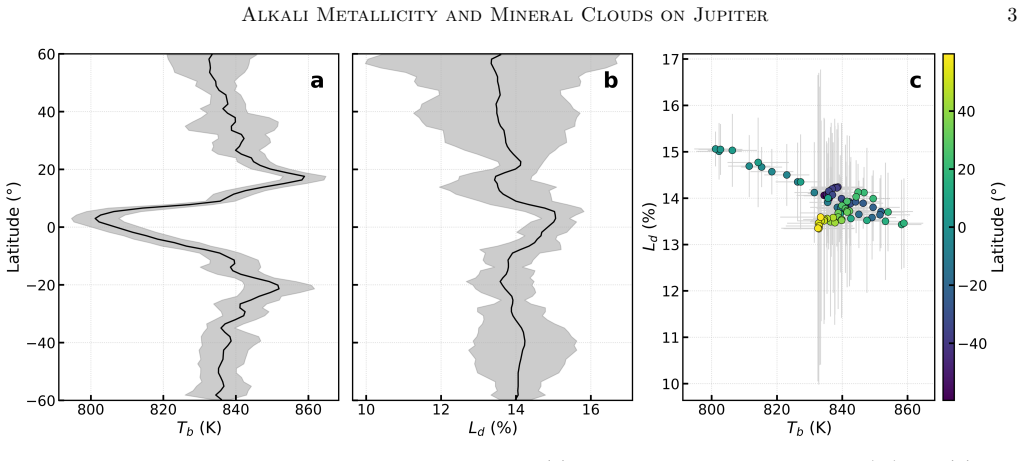
- [Sec. 5.1-5.2, Eqs. (40)-(42)] The inferred 'deep atmospheric variability' is the residual of a linear subtraction delta_Tb,0.6 - f12 delta_Tb,1.25, with f12 uncertain by roughly a factor of three (0.4 to 1.4) and chosen as 1.2 to minimize residual variance. This procedure assumes vertically coherent upper-level perturbations and does not propagate the f12 uncertainty or retrieval covariances; the residual could contain contributions from the 80-bar secondary peak of channel 1, from differing beam patterns, or from ammonia variations that do not scale linearly with channel 2. Hence the statement in Sec. 5.2 that the residual 'predominantly originates from the kilobar region' and the subsequent attribution to electron-density variations is not unique. A forward-model test of the difference method on synthetic atmospheres with known deep and shallow perturbations would be needed to support the deep-variability claim.
- [Sec. 2.2] The NH3 opacity at 0.6 GHz is reduced by 10% to improve the T_b fit, while the L_d constraint is said to be insensitive to this adjustment. Because the electron opacity and the NH3 opacity are partially degenerate in the 0.6 GHz weighting function, the paper should quantify the degree of degeneracy and justify the 10% scaling with laboratory or line-shape evidence; otherwise the reported T_b match includes an ad hoc tuning parameter.
minor comments (5)
- [Sec. 5.2] The text contains the typo 'banded pattens' and should read 'banded patterns'; the same paragraph also uses 'sub-micron particles' twice in a redundant phrase.
- [Table 1] The table groups KAlSi3O8 under 'F eldspar (Plagioclase)' with a leading space in the header, and potassium feldspar is not a plagioclase mineral; the grouping should be corrected to 'Feldspar' or split into alkali feldspar and plagioclase subgroups.
- [Sec. 6] There is an unmatched opening quotation mark in 'rainout scenario' in the caveats paragraph; it should be a closing quotation mark after 'scenario'.
- [Throughout] Code and model names are used inconsistently: 'GGchem' and 'GGChem', and 'ExoLyn' and 'Exolyn', should be standardized to single spellings.
- [Fig. 9 caption] The caption contains the fragment 'dashed ;ome' which appears to be a typo for 'dashed orange'; the figure also uses 'Exolyn' while the text uses 'ExoLyn'.
Circularity Check
No significant circularity; both proposed mechanisms rest on explicitly stated physical assumptions rather than on the MWR observables they are designed to match.
full rationale
The paper's central claim is that solar or supersolar Na/K abundances can be reconciled with Juno MWR electron depletion through one of two independent mechanisms. The chemical sequestration scenario is a direct GGchem equilibrium calculation under an explicitly stated no-rainout assumption; the feldspar/leucite sequestration and resulting electron-density reduction follow from the assumed elemental inventory and equilibrium thermodynamics, not from the MWR data. The dust-catalyzed recombination scenario couples ExoLyn microphysics to a Desch & Turner-style dust-charging model; the electron suppression scales with grain surface area, and the nominal/high/low nucleation rates are presented as a sensitivity study, with the low case shown to fail. The authors explicitly acknowledge in Section 6 that 'the primary uncertainty lies in the nucleation rate,' so the rate is an openly stated modeling uncertainty rather than a parameter inverted from the target data. No step fits a parameter to the Juno MWR observables and then re-predicts the same observables by construction. The MWR data, the Bhattacharya et al. (2023) opacity framework, and the Juno NH3/water retrievals are external benchmarks; self-citations (C. Li et al.) provide data and modeling tools, not the conclusion. The acknowledged limitations—speculative feldspar kinetics, unconstrained nucleation rate, and use of equatorial K_zz in a global limb-darkening comparison—are robustness concerns, not definitional circularity.
Assumptions & free parameters
free parameters (3)
- Column-integrated nucleation rate Sigma_n =
nominal 10^-4 g cm-2 s-1; high 10^-2; low 10^-6
- NH3 opacity scaling factor at 0.6 GHz =
0.9 (10% reduction)
- Nucleation peak pressure p_n and width sigma_n =
p_n = 2000 bar, sigma_n = 0.5
assumptions (5)
- ad hoc to paper Equilibrium (no-rainout) end-member assumption
- domain assumption Adiabatic T-P profile and vertically constant NH3/H2O below 200 bar
- domain assumption Dust-plasma charging framework of Desch and Turner (2015) applies at these densities
- domain assumption Vertical mixing K_zz ~10^7-10^8 cm2/s
- domain assumption Elemental enrichments: 2.7x solar for refractories, solar for Na and K
Cite this review
Pith. "Pith review of Alkali Metallicity, Mineral Clouds, and Deep Atmospheric Variability on Jupiter." pith.science (2026). https://pith.science/paper/QEFCI4MQ
@misc{pith2026260806600,
  author       = {Pith},
  title        = {Pith review of: Alkali Metallicity, Mineral Clouds, and Deep Atmospheric Variability on Jupiter},
  year         = {2026},
  howpublished = {\url{https://pith.science/paper/QEFCI4MQ}},
  note         = {Machine review of arXiv:2608.06600}
}
read the original abstract
The bulk elemental abundances of Jupiter provide critical insights into its formation history and interior structure. Recent observations by the Juno Microwave Radiometer (MWR) reveal a deep Jovian atmosphere significantly depleted in electrons, implying an alkali metal (Na, K) abundance of 10^-1 - 10^-5 times solar. This depletion stands in sharp contrast to the supersolar volatile enrichments measured by the Galileo probe. We propose that this apparent depletion arises from mineral cloud-induced processes deep in the atmosphere. We explore two physical mechanisms using thermochemical and microphysical modeling. In the "chemical sequestration" scenario, vigorous vertical mixing lofts deep refractory condensates (e.g., spinel) into the 1000-2000 bar region, where they react to form alkali feldspars (albite) and feldspathoids (leucite), efficiently sequestering gaseous Na and K. In the "dust-catalyzed recombination" scenario, the bulk alkali inventory remains gaseous, but the free electron density is suppressed by dust-plasma interactions. Thermally emitted alkali ions from the surfaces of micron-sized iron and silicate grains significantly increase the cation density, driving rapid recombination of free electrons. Both mechanisms allow for a bulk solar or even supersolar alkali inventory while suppressing the electron density to match Juno observations. Analyzing an extended dataset of MWR observations with 61 perijoves, we detect spatial variability in the deep atmosphere that suggests modulation by mineral clouds. Our findings challenge the traditional rainout framework, unveiling a deep "mineralogical zone" in Jupiter shaped by dynamics and heterogeneous chemistry, resembling the photospheres of hot exoplanets and brown dwarfs.
Figures


Figures from the paper (10 more)


Reference graph
Works this paper leans on
-
[1]
Ackerman, A. S., & Marley, M. S. 2001, title Precipitating Condensation Clouds in Substellar Atmospheres , The Astrophysical Journal, 556, 872, 10.1086/321540
doi:10.1086/321540 2001
-
[2]
Aglyamov, Y. S., Atreya, S. K., Bhattacharya, A., et al. 2025, title Alkali Metal Depletion in the Deep Jovian Atmosphere: The Role of Anions, Icarus, 425, 116334, 10.1016/j.icarus.2024.116334
arXiv 2025
-
[3]
Ashton, A. F., & Hayhurst, A. N. 1973, title Kinetics of Collisional Ionization of Alkali Metal Atoms and Recombination of Electrons with Alkali Metal Ions in Flames, Combustion and Flame, 21, 69, 10.1016/0010-2180(73)90008-4
-
[4]
Asplund, M., Amarsi, A. M., & Grevesse, N. 2021, title The Chemical Make-up of the Sun : A 2020 Vision, Astronomy and Astrophysics, 653, A141, 10.1051/0004-6361/202140445
-
[5]
Atreya, S. K., Hofstadter, M. H., In, J. H., et al. 2020, title Deep Atmosphere Composition , Structure , Origin , and Exploration , with Particular Focus on Critical in Situ Science at the Icy Giants , Space Science Reviews, 216, 18, 10.1007/s11214-020-0640-8
-
[6]
Bach-M ller , N., Helling, C., J rgensen, U. G., & Enghoff, M. B. 2024, title Aggregation and Charging of Mineral Cloud Particles under High-energy Irradiation , The Astrophysical Journal, 962, 87, 10.3847/1538-4357/ad13ef
-
[7]
Bai, X.-N. 2011, title MAGNETOROTATIONAL-INSTABILITY-DRIVEN ACCRETION IN PROTOPLANETARY DISKS , The Astrophysical Journal, 739, 50, 10.1088/0004-637X/739/1/50
-
[8]
W., B \'e lisle, E., Chartrand, P., et al
Bale, C. W., B \'e lisle, E., Chartrand, P., et al. 2009, title FactSage Thermochemical Software and Databases --- Recent Developments, Calphad, 33, 295, 10.1016/j.calphad.2008.09.009
Show all 103 references
-
[9]
S., & Lewis, J
Barshay, S. S., & Lewis, J. S. 1978, title Chemical Structure of the Deep Atmosphere of Jupiter , Icarus, 33, 593, 10.1016/0019-1035(78)90192-6
1978 doi
-
[10]
G., & Chinsomboom, G
Bellotti, A., Steffes, P. G., & Chinsomboom, G. 2016, title Laboratory Measurements of the 5-20 Cm Wavelength Opacity of Ammonia, Water Vapor, and Methane under Simulated Conditions for the Deep Jovian Atmosphere, Icarus, 280, 255, 10.1016/j.icarus.2016.07.013
2016 doi
-
[11]
G., & Chinsomboon, G
Bellotti, A., Steffes, P. G., & Chinsomboon, G. 2017, title Corrigendum to `` Laboratory Measurements of the 5--20 Cm Wavelength Opacity of Ammonia, Water Vapor, and Methane under Simulated Conditions for the Deep Jovian Atmosphere'' [ Icarus 280 (2016) 255--267], Icarus, 284,...
2016 doi
-
[12]
K., et al
Bhattacharya, A., Li, C., Atreya, S. K., et al. 2023, title Highly Depleted Alkali Metals in Jupiter 's Deep Atmosphere , The Astrophysical Journal Letters, 952, L27, 10.3847/2041-8213/ace115
2023 doi
-
[13]
2019, title A New Equation of State for Dense Hydrogen -- Helium Mixtures , The Astrophysical Journal, 872, 51, 10.3847/1538-4357/aaf99f
Chabrier, G., Mazevet, S., & Soubiran, F. 2019, title A New Equation of State for Dense Hydrogen -- Helium Mixtures , The Astrophysical Journal, 872, 51, 10.3847/1538-4357/aaf99f
2019 doi
-
[14]
W., & Force, J
Chase, M. W., & Force, J. A. N. A. 1998, title NIST-JANAF Thermochemical Tables,
1998
-
[15]
Clayton, D. D. 1968, Principles of Stellar Evolution and Nucleosynthesis (McGraw-Hill, New York)
1968
-
[16]
J., & Turner, N
Desch, S. J., & Turner, N. J. 2015, title HIGH-TEMPERATURE IONIZATION IN PROTOPLANETARY DISKS , The Astrophysical Journal, 811, 156, 10.1088/0004-637X/811/2/156
2015 doi
-
[17]
Draine, B. T. 2004, title Astrophysics of Dust in Cold Clouds , in The Cold Universe : Saas-Fee Advanced Course 32 2002 Swiss Society for Astrophysics and Astronomy , ed. A. W. Blain, F. Combes, B. T. Draine, D. Pfenniger, & Y. Revaz (Berlin, Heidelberg: Springer), 213--304, 1...
2004 doi
-
[18]
T., & Sutin, B
Draine, B. T., & Sutin, B. 1987, title Collisional Charging of Interstellar Grains , The Astrophysical Journal, 320, 803, 10.1086/165596
1987 doi
-
[19]
S., Ghiorso, M
Ebel, D. S., Ghiorso, M. S., Sack, R. O., & Grossman, L. 2000, title Gibbs Energy Minimization in Gas + Liquid + Solid Systems, Journal of Computational Chemistry, 21, 247, 10.1002/(SICI)1096-987X(200003)21:4<247::AID-JCC1>3.0.CO;2-J
2000 doi
-
[20]
J., & Lodders, K
Fegley, B. J., & Lodders, K. 1994, title Chemical Models of the Deep Atmospheres of Jupiter and Saturn , Icarus, 110, 117, 10.1006/icar.1994.1111
1994
-
[21]
S., & Samsonov, G
Fomenko, V. S., & Samsonov, G. V., eds. 1966, Handbook of Thermionic Properties (Boston, MA: Springer US), 10.1007/978-1-4684-7293-6
1966 doi
-
[22]
Fuchs, N. A. 1964, The Mechanics of Aerosols, by N . A . Fuchs . Translated from the Russian by R . E . Daisley and Marina Fuchs . Translation Edited by C . N . Davies ., rev. and enl. ed. edn. (Oxford: Pergamon Press; distributed in the Western Hemisphere by Macmillan, New York)
1964
-
[23]
I., Okuzumi, S., & Inutsuka, S.-i
Fujii, Y. I., Okuzumi, S., & Inutsuka, S.-i. 2011, title A FAST AND ACCURATE CALCULATION SCHEME FOR IONIZATION DEGREES IN PROTOPLANETARY AND CIRCUMPLANETARY DISKS WITH CHARGED DUST GRAINS , The Astrophysical Journal, 743, 53, 10.1088/0004-637X/743/1/53
2011 doi
-
[24]
2013, title Seed Particle Formation for Silicate Dust Condensation by SiO Nucleation, Astronomy & Astrophysics, 555, A119, 10.1051/0004-6361/201321807
Gail, H.-P., Wetzel, S., Pucci, A., & Tamanai, A. 2013, title Seed Particle Formation for Silicate Dust Condensation by SiO Nucleation, Astronomy & Astrophysics, 555, A119, 10.1051/0004-6361/201321807
2013 doi
-
[25]
R., Moran, S
Gao, P., Wakeford, H. R., Moran, S. E., & Parmentier, V. 2021, title Aerosols in Exoplanet Atmospheres , Journal of Geophysical Research: Planets, 126, e2020JE006655, 10.1029/2020JE006655
2021 doi
-
[26]
P., Lee, G
Gao, P., Thorngren, D. P., Lee, G. K. H., et al. 2020, title Aerosol Composition of Hot Giant Exoplanets Dominated by Silicates and Hydrocarbon Hazes, Nature Astronomy, 4, 1, 10.1038/s41550-020-1114-3
2020 doi
-
[27]
P., & Chen, S
Ge, H., Li, C., Zhang, X., Ingersoll, A. P., & Chen, S. 2025, title Nonuniform Water Distribution in Jupiter 's Midlatitudes: Influence of Precipitation and Planetary Rotation, Proceedings of the National Academy of Sciences, 122, e2419087122, 10.1073/pnas.2419087122
2025 doi
-
[28]
S., & Sack, R
Ghiorso, M. S., & Sack, R. O. 1995, title Chemical Mass Transfer in Magmatic Processes IV . A Revised and Internally Consistent Thermodynamic Model for the Interpolation and Extrapolation of Liquid-Solid Equilibria in Magmatic Systems at Elevated Temperatures and Pressures, Co...
1995 doi
-
[29]
Gioumousis, G., & Stevenson, D. P. 1958, title Reactions of Gaseous Molecule Ions with Gaseous Molecules . V . Theory , The Journal of Chemical Physics, 29, 294, 10.1063/1.1744477
1958 doi
-
[30]
Golitsyn, G. S. 1980, title Geostrophic Convection , Doklady Akademii Nauk SSSR, 251, 1356
1980
-
[31]
Golitsyn, G. S. 1981, title Convection Structure during Fast Rotation, Doklady Akademii Nauk SSSR, 261, 317
1981
-
[32]
K., Wakeford, H
Grant, D., Lewis, N. K., Wakeford, H. R., et al. 2023, title JWST-TST DREAMS : Quartz Clouds in the Atmosphere of WASP-17b , The Astrophysical Journal Letters, 956, L32, 10.3847/2041-8213/acfc3b
2023 doi
-
[33]
N., Helled, R., et al
Guillot, T., Fletcher, L. N., Helled, R., et al. 2023, title Giant Planets from the Inside-Out , in Protostars and Planets 7, ed. S.-I. Inutsuka (Astronomical Society of the Pacific), 10.26624/BHFW2605
2023 doi
-
[34]
2018, title A Suppression of Differential Rotation in Jupiter 's Deep Interior, Nature, 555, 227
Guillot, T., Miguel, Y., Militzer, B., et al. 2018, title A Suppression of Differential Rotation in Jupiter 's Deep Interior, Nature, 555, 227
2018
-
[35]
C., Thompson, A
Hack, A. C., Thompson, A. B., & Aerts, M. 2007, title Phase Relations Involving Hydrous Silicate Melts , Aqueous Fluids , and Minerals , Reviews in Mineralogy and Geochemistry, 65, 129, 10.2138/rmg.2007.65.5
2007 doi
-
[36]
Hagstr \"o m, M., Engvall, K., & Pettersson, J. B. C. 2000, title Desorption Kinetics at Atmospheric Pressure :\, Alkali Metal Ion Emission from Hot Platinum Surfaces , The Journal of Physical Chemistry B, 104, 4457, 10.1021/jp000311w
2000 doi
-
[37]
2020, title AQUA : A Collection of H2O Equations of State for Planetary Models, Astronomy & Astrophysics, 643, A105, 10.1051/0004-6361/202038367
Haldemann, J., Alibert, Y., Mordasini, C., & Benz, W. 2020, title AQUA : A Collection of H2O Equations of State for Planetary Models, Astronomy & Astrophysics, 643, A105, 10.1051/0004-6361/202038367
2020 doi
-
[38]
R., Steffes, P
Hanley, T. R., Steffes, P. G., & Karpowicz, B. M. 2009, title A New Model of the Hydrogen and Helium-Broadened Microwave Opacity of Ammonia Based on Extensive Laboratory Measurements, Icarus, 202, 316, 10.1016/j.icarus.2009.02.002
2009 doi
-
[39]
2019, title Exoplanet Clouds , Annual Review of Earth and Planetary Sciences, 47, 583, 10.1146/annurev-earth-053018-060401
Helling, C. 2019, title Exoplanet Clouds , Annual Review of Earth and Planetary Sciences, 47, 583, 10.1146/annurev-earth-053018-060401
2019 doi
-
[40]
B., Rodriguez-Barrera , I
Helling, C., Rimmer, P. B., Rodriguez-Barrera , I. M., et al. 2016, title Ionisation and Discharge in Cloud-Forming Atmospheres of Brown Dwarfs and Extrasolar Planets, Plasma Physics and Controlled Fusion, 58, 074003, 10.1088/0741-3335/58/7/074003
2016 doi
-
[41]
2008, title Dust in Brown Dwarfs and Extra-Solar Planets- I
Helling, C., Woitke, P., & Thi, W.-F. 2008, title Dust in Brown Dwarfs and Extra-Solar Planets- I . Chemical Composition and Spectral Appearance of Quasi-Static Cloud Layers, Astronomy & Astrophysics, 485, 547
2008
-
[42]
2013, title IONIZATION IN ATMOSPHERES OF BROWN DWARFS AND EXTRASOLAR PLANETS
Helling, Ch ., Jardine, M., Stark, C., & Diver, D. 2013, title IONIZATION IN ATMOSPHERES OF BROWN DWARFS AND EXTRASOLAR PLANETS . III . BREAKDOWN CONDITIONS FOR MINERAL CLOUDS , The Astrophysical Journal, 767, 136, 10.1088/0004-637X/767/2/136
2013 doi
-
[43]
Helliwell, R. A. 2014, Whistlers and Related Ionospheric Phenomena (Chelmsford, MA: Courier Corporation)
2014
-
[44]
2023, title Accounting for Non-Ideal Mixing Effects in the Hydrogen-Helium Equation of State, Astronomy & Astrophysics, 672, L1, 10.1051/0004-6361/202244851
Howard, S., & Guillot, T. 2023, title Accounting for Non-Ideal Mixing Effects in the Hydrogen-Helium Equation of State, Astronomy & Astrophysics, 672, L1, 10.1051/0004-6361/202244851
2023 doi
-
[45]
W., & Min, M
Huang, H., Ormel, C. W., & Min, M. 2024, title ExoLyn : A Golden Mean Approach to Multispecies Cloud Modeling in Atmospheric Retrieval, Astronomy & Astrophysics, 691, A291, 10.1051/0004-6361/202451112
2024 doi
-
[46]
Ilgner, M., & Nelson, R. P. 2006, title On the Ionisation Fraction in Protoplanetary Disks - I . Comparing Different Reaction Networks, Astronomy & Astrophysics, 445, 205, 10.1051/0004-6361:20053678
2006 doi
-
[47]
V., Akimkin, V
Ivlev, A. V., Akimkin, V. V., & Caselli, P. 2016, title IONIZATION AND DUST CHARGING IN PROTOPLANETARY DISKS , The Astrophysical Journal, 833, 92, 10.3847/1538-4357/833/1/92
2016 doi
-
[48]
A., Hofstadter, M
Janssen, M. A., Hofstadter, M. D., Gulkis, S., et al. 2005, title Microwave Remote Sensing of Jupiter 's Atmosphere from an Orbiting Spacecraft, Icarus, 173, 447, 10.1016/j.icarus.2004.08.012
2005 doi
-
[49]
A., Oswald, J
Janssen, M. A., Oswald, J. E., Brown, S. T., et al. 2017, title MWR : Microwave Radiometer for the Juno Mission to Jupiter , Space Science Reviews, 213, 139, 10.1007/s11214-017-0349-5
2017 doi
-
[50]
M., & Schober, H
Kargl, F., Meyer, A., Koza, M. M., & Schober, H. 2006, title Formation of channels for Fast-Ion Diffusion in Alkali Silicate Melts: A Quasielastic Neutron Scattering Study, Physical Review B, 74, 014304, 10.1103/PhysRevB.74.014304
2006 doi
-
[51]
B., et al
Kaspi, Y., Galanti, E., Hubbard, W. B., et al. 2018, title Jupiter's Atmospheric Jet Streams Extend Thousands of Kilometres Deep, Nature, 555, 223, 10.1038/nature25793
2018 doi
-
[52]
S., et al
Kaspi, Y., Galanti, E., Park, R. S., et al. 2023, title Observational Evidence for Cylindrically Oriented Zonal Flows on Jupiter , Nature Astronomy, 7, 1463, 10.1038/s41550-023-02077-8
2023 doi
-
[53]
1998, title The Electric Charging of Interstellar Dust in the Solar System and Consequences for Its Dynamics , The Astrophysical Journal, 499, 454, 10.1086/305613
Kimura, H., & Mann, I. 1998, title The Electric Charging of Interstellar Dust in the Solar System and Consequences for Its Dynamics , The Astrophysical Journal, 499, 454, 10.1086/305613
1998 doi
-
[54]
2005, title Calculation of the Surface Binding Energy for Ion Sputtered Particles, Applied Surface Science, 239, 273, 10.1016/j.apsusc.2004.06.014
Kudriavtsev, Y., Villegas, A., Godines, A., & Asomoza, R. 2005, title Calculation of the Surface Binding Energy for Ion Sputtered Particles, Applied Surface Science, 239, 273, 10.1016/j.apsusc.2004.06.014
2005 doi
-
[55]
1903, title Recombinaison et Mobilites Des Ions Dans Les Gaz, Ann
Langevin, P. 1903, title Recombinaison et Mobilites Des Ions Dans Les Gaz, Ann. Chim. Phys, 28, 122
1903
-
[56]
Lee, E., Helling, C., Giles, H., & Bromley, S. T. 2015, title Dust in Brown Dwarfs and Extra-Solar Planets - IV . Assessing TiO2 and SiO Nucleation for Cloud Formation Modelling, Astronomy & Astrophysics, 575, A11, 10.1051/0004-6361/201424621
2015 doi
-
[57]
2015, title Modelling the Local and Global Cloud Formation on HD 189733b, Astronomy & Astrophysics, 580, A12, 10.1051/0004-6361/201525982
Lee, G., Helling, C., Dobbs-Dixon , I., & Juncher, D. 2015, title Modelling the Local and Global Cloud Formation on HD 189733b, Astronomy & Astrophysics, 580, A12, 10.1051/0004-6361/201525982
2015 doi
-
[58]
Lewis, J. S. 1969, title Observability of Spectroscopically Active Compounds in the Atmosphere of Jupiter , Icarus, 10, 393, 10.1016/0019-1035(69)90094-3
1969 doi
-
[59]
2023, title Long-Lasting, Deep Effect of Saturn 's Giant Storms, Science Advances, 9, eadg9419, 10.1126/sciadv.adg9419
Li, C., de Pater , I., Moeckel, C., et al. 2023, title Long-Lasting, Deep Effect of Saturn 's Giant Storms, Science Advances, 9, eadg9419, 10.1126/sciadv.adg9419
2023 doi
-
[60]
Li, C., Le, T., Zhang, X., & Yung, Y. L. 2018, title A High-Performance Atmospheric Radiation Package: With Applications to the Radiative Energy Budgets of Giant Planets, Journal of Quantitative Spectroscopy and Radiative Transfer, 217, 353, 10.1016/j.jqsrt.2018.06.002
2018 doi
-
[61]
2017, title The Distribution of Ammonia on Jupiter from a Preliminary Inversion of Juno Microwave Radiometer Data, Geophysical Research Letters, 44, 5317, 10.1002/2017GL073159
Li, C., Ingersoll, A., Janssen, M., et al. 2017, title The Distribution of Ammonia on Jupiter from a Preliminary Inversion of Juno Microwave Radiometer Data, Geophysical Research Letters, 44, 5317, 10.1002/2017GL073159
2017 doi
-
[62]
2020, title The Water Abundance in Jupiter 's Equatorial Zone, Nature Astronomy, 4, 609, 10.1038/s41550-020-1009-3
Li, C., Ingersoll, A., Bolton, S., et al. 2020, title The Water Abundance in Jupiter 's Equatorial Zone, Nature Astronomy, 4, 609, 10.1038/s41550-020-1009-3
2020 doi
-
[63]
2024, title Super-Adiabatic Temperature Gradient at Jupiter 's Equatorial Zone and Implications for the Water Abundance, Icarus, 414, 116028, 10.1016/j.icarus.2024.116028
Li, C., Allison, M., Atreya, S., et al. 2024, title Super-Adiabatic Temperature Gradient at Jupiter 's Equatorial Zone and Implications for the Water Abundance, Icarus, 414, 116028, 10.1016/j.icarus.2024.116028
2024
-
[64]
A., et al
Li, L., Jiang, X., West, R. A., et al. 2018, title Less Absorbed Solar Energy and More Internal Heat for Jupiter , Nature Communications, 9, 3709, 10.1038/s41467-018-06107-2
2018 doi
-
[65]
R., Marley, M
Line, M. R., Marley, M. S., Liu, M. C., et al. 2017, title Uniform Atmospheric Retrieval Analysis of Ultracool Dwarfs . II . Properties of 11 T Dwarfs, The Astrophysical Journal, 848, 83, 10.3847/1538-4357/aa7ff0
2017 doi
-
[66]
2013, title Predictions of Thermal and Gravitational Signals of Jupiter 's Deep Zonal Winds, Icarus, 224, 114, 10.1016/j.icarus.2013.01.025
Liu, J., Schneider, T., & Kaspi, Y. 2013, title Predictions of Thermal and Gravitational Signals of Jupiter 's Deep Zonal Winds, Icarus, 224, 114, 10.1016/j.icarus.2013.01.025
2013 doi
-
[67]
1999, title Alkali Element Chemistry in Cool Dwarf Atmospheres , The Astrophysical Journal, 519, 793, 10.1086/307387
Lodders, K. 1999, title Alkali Element Chemistry in Cool Dwarf Atmospheres , The Astrophysical Journal, 519, 793, 10.1086/307387
1999 doi
-
[68]
2006, title Chemistry of Low Mass Substellar Objects , in Astrophysics Update 2, ed
Lodders, K., & Fegley, B. 2006, title Chemistry of Low Mass Substellar Objects , in Astrophysics Update 2, ed. J. W. Mason (Berlin, Heidelberg: Springer), 1--28, 10.1007/3-540-30313-8_1
2006 doi
-
[69]
I., Coradini, A., Gautier, D., Owen, T
Lunine, J. I., Coradini, A., Gautier, D., Owen, T. C., & Wuchterl, G. 2004, title The Origin of Jupiter , in Jupiter. The Planet , Satellites and Magnetosphere , Vol. 1 (Cambridge University Press), 19--34
2004
-
[70]
I., Hubbard, W
Lunine, J. I., Hubbard, W. B., & Marley, M. S. 1986, title Evolution and Infrared Spectra of Brown Dwarfs , The Astrophysical Journal, 310, 238, 10.1086/164678
1986 doi
-
[71]
Masel, R. I. 1996, Principles of Adsorption and Reaction on Solid Surfaces (New York: Wiley-Interscience)
1996
-
[72]
E., Biller, B
Miles, B. E., Biller, B. A., Patapis, P., et al. 2023, title The JWST Early-release Science Program for Direct Observations of Exoplanetary Systems II : A 1 to 20 m Spectrum of the Planetary-mass Companion VHS 1256--1257 b, The Astrophysical Journal Letters, 946, L6, 10.3847/2...
2023 doi
-
[73]
M., & Langmuir, I
Mott-Smith , H. M., & Langmuir, I. 1926, title The Theory of Collectors in Gaseous Discharges , Physical Review, 28, 727, 10.1103/PhysRev.28.727
1926 doi
-
[74]
Mousis, O., Ronnet, T., & Lunine, J. I. 2019, title Jupiter's Formation in the Vicinity of the Amorphous Ice Snowline , The Astrophysical Journal, 875, 9, 10.3847/1538-4357/ab0a72
2019 doi
-
[75]
Ohno, K., & Okuzumi, S. 2018, title Microphysical Modeling of Mineral Clouds in GJ1214 b and GJ436 b: Predicting Upper Limits on the Cloud-top Height , The Astrophysical Journal, 859, 34, 10.3847/1538-4357/aabee3
2018 doi
-
[76]
2009, title ELECTRIC CHARGING OF DUST AGGREGATES AND ITS EFFECT ON DUST COAGULATION IN PROTOPLANETARY DISKS , The Astrophysical Journal, 698, 1122, 10.1088/0004-637X/698/2/1122
Okuzumi, S. 2009, title ELECTRIC CHARGING OF DUST AGGREGATES AND ITS EFFECT ON DUST COAGULATION IN PROTOPLANETARY DISKS , The Astrophysical Journal, 698, 1122, 10.1088/0004-637X/698/2/1122
2009 doi
-
[77]
2009, title NUMERICAL MODELING OF THE COAGULATION AND POROSITY EVOLUTION OF DUST AGGREGATES , The Astrophysical Journal, 707, 1247, 10.1088/0004-637X/707/2/1247
Okuzumi, S., Tanaka, H., & Sakagami, M.-a. 2009, title NUMERICAL MODELING OF THE COAGULATION AND POROSITY EVOLUTION OF DUST AGGREGATES , The Astrophysical Journal, 707, 1247, 10.1088/0004-637X/707/2/1247
2009 doi
-
[78]
W., & Min, M
Ormel, C. W., & Min, M. 2019, title ARCiS Framework for Exoplanet Atmospheres - The Cloud Transport Model, Astronomy & Astrophysics, 622, A121, 10.1051/0004-6361/201833678
2019 doi
-
[79]
Oyafuso, F., Levin, S., Orton, G., et al. 2020, title Angular Dependence and Spatial Distribution of Jupiter 's Centimeter-Wave Thermal Emission From Juno 's Microwave Radiometer , Earth and Space Science, 7, e2020EA001254, 10.1029/2020EA001254
2020 doi
-
[80]
2022, title Depletion of Gaseous CO in Protoplanetary Disks by Surface-Energy-Regulated Ice Formation, Nature Astronomy, 6, 1147, 10.1038/s41550-022-01741-9
Powell, D., Gao, P., Murray-Clay , R., & Zhang, X. 2022, title Depletion of Gaseous CO in Protoplanetary Disks by Surface-Energy-Regulated Ice Formation, Nature Astronomy, 6, 1147, 10.1038/s41550-022-01741-9
2022 doi
-
[81]
2018, title Formation of Silicate and Titanium Clouds on Hot Jupiters , The Astrophysical Journal, 860, 18, 10.3847/1538-4357/aac215
Powell, D., Zhang, X., Gao, P., & Parmentier, V. 2018, title Formation of Silicate and Titanium Clouds on Hot Jupiters , The Astrophysical Journal, 860, 18, 10.3847/1538-4357/aac215
2018 doi
-
[82]
G., & Barshay, S
Prinn, R. G., & Barshay, S. S. 1977, title Carbon Monoxide on Jupiter and Implications for Atmospheric Convection , Science, 198, 1031, 10.1126/science.198.4321.1031
1977
-
[83]
Rossow, W. B. 1978, title Cloud Microphysics: Analysis of the Clouds of Earth , Venus , Mars and Jupiter , Icarus, 36, 1
1978
-
[84]
H., & Pandis, S
Seinfeld, J. H., & Pandis, S. N. 2016, Atmospheric Chemistry and Physics: From Air Pollution to Climate Change (John Wiley & Sons)
2016
-
[85]
P., Kaspi, Y., & Flierl, G
Showman, A. P., Kaspi, Y., & Flierl, G. R. 2011, title Scaling Laws for Convection and Jet Speeds in the Giant Planets, Icarus, 211, 1258, 10.1016/j.icarus.2010.11.004
2011 doi
-
[86]
R., Helling, C., & Diver, D
Stark, C. R., Helling, C., & Diver, D. A. 2015, title Inhomogeneous Cloud Coverage through the Coulomb Explosion of Dust in Substellar Atmospheres, Astronomy & Astrophysics, 579, A41, 10.1051/0004-6361/201526045
2015 doi
-
[87]
Tejada Arevalo, R., Su, Y., Sur, A., & Burrows, A. 2024, title Equations of State , Thermodynamics , and Miscibility Curves for Jovian Planet and Giant Exoplanet Evolutionary Models , The Astrophysical Journal Supplement Series, 274, 34, 10.3847/1538-4365/ad6cd7
2024 doi
-
[88]
A., & Besmann, T
Utlak, S. A., & Besmann, T. M. 2018, title Thermodynamic Assessment of the Pseudoternary Na2O -- Al2O3 -- SiO2 System, Journal of the American Ceramic Society, 101, 928, 10.1111/jace.15166
2018 doi
-
[89]
2010, title Atmospheric Chemistry in Giant Planets, Brown Dwarfs, and Low-Mass Dwarf Stars
Visscher, C., Lodders, K., & Fegley Jr, B. 2010, title Atmospheric Chemistry in Giant Planets, Brown Dwarfs, and Low-Mass Dwarf Stars. III . Iron , Magnesium, and Silicon, The Astrophysical Journal, 716, 1060
2010
-
[90]
Vogt, E., & Wannier, G. H. 1954, title Scattering of Ions by Polarization Forces , Physical Review, 95, 1190, 10.1103/PhysRev.95.1190
1954 doi
-
[91]
J., Lunine, J
Wang, D., Gierasch, P. J., Lunine, J. I., & Mousis, O. 2015, title New Insights on Jupiter 's Deep Water Abundance from Disequilibrium Species, Icarus, 250, 154, 10.1016/j.icarus.2014.11.026
2015 doi
-
[92]
C., & Draine, B
Weingartner, J. C., & Draine, B. T. 2001, title Photoelectric Emission from Interstellar Dust : Grain Charging andGas Heating , The Astrophysical Journal Supplement Series, 134, 263, 10.1086/320852
2001 doi
-
[93]
Whipple, E. C. 1981, title Potentials of Surfaces in Space, Reports on Progress in Physics, 44, 1197, 10.1088/0034-4885/44/11/002
1981 doi
-
[94]
H., et al
Woitke, P., Helling, C., Hunter, G. H., et al. 2018, title Equilibrium Chemistry down to 100 K - Impact of Silicates and Phyllosilicates on the Carbon to Oxygen Ratio,, Astronomy & Astrophysics, 614, A1, 10.1051/0004-6361/201732193
2018 doi
-
[95]
H., Mahaffy, P
Wong, M. H., Mahaffy, P. R., Atreya, S. K., Niemann, H. B., & Owen, T. C. 2004, title Updated Galileo Probe Mass Spectrometer Measurements of Carbon, Oxygen, Nitrogen, and Sulfur on Jupiter , Icarus, 171, 153, 10.1016/j.icarus.2004.04.010
2004 doi
-
[96]
V., & Madey, T
Yakshinskiy, B. V., & Madey, T. E. 2004, title Photon-Stimulated Desorption of Na from a Lunar Sample: Temperature-Dependent Effects, Icarus, 168, 53, 10.1016/j.icarus.2003.12.007
2004 doi
-
[97]
1995, title Condensation of CaOMgOAl2O3SiO2 Liquids from Cosmic Gases, Geochimica et Cosmochimica Acta, 59, 3413, 10.1016/0016-7037(95)00214-K
Yoneda, S., & Grossman, L. 1995, title Condensation of CaOMgOAl2O3SiO2 Liquids from Cosmic Gases, Geochimica et Cosmochimica Acta, 59, 3413, 10.1016/0016-7037(95)00214-K
1995 doi
-
[98]
2008, title Cross Sections for Electron Collisions with Hydrogen Molecules , Journal of Physical and Chemical Reference Data, 37, 913, 10.1063/1.2838023
Yoon, J.-S., Song, M.-Y., Han, J.-M., et al. 2008, title Cross Sections for Electron Collisions with Hydrogen Molecules , Journal of Physical and Chemical Reference Data, 37, 913, 10.1063/1.2838023
2008 doi
-
[99]
A., Saboi, K., Line, M
Zalesky, J. A., Saboi, K., Line, M. R., et al. 2022, title A Uniform Retrieval Analysis of Ultra-cool Dwarfs . IV . A Statistical Census from 50 Late-T Dwarfs , The Astrophysical Journal, 936, 44, 10.3847/1538-4357/ac786c
2022 doi
-
[100]
Zeldovich, Y. B. 1943, title On the Theory of New Phase Formation: Cavitation, Acta Physicochem., USSR, 18, 1
1943
-
[101]
2020, title Atmospheric Regimes and Trends on Exoplanets and Brown Dwarfs, Research in Astronomy and Astrophysics, 20, 099, 10.1088/1674-4527/20/7/99
Zhang, X. 2020, title Atmospheric Regimes and Trends on Exoplanets and Brown Dwarfs, Research in Astronomy and Astrophysics, 20, 099, 10.1088/1674-4527/20/7/99
2020 doi
-
[102]
2010, title Diffusion Data in Silicate Melts , Reviews in Mineralogy and Geochemistry, 72, 311, 10.2138/rmg.2010.72.8
Zhang, Y., Ni, H., & Chen, Y. 2010, title Diffusion Data in Silicate Melts , Reviews in Mineralogy and Geochemistry, 72, 311, 10.2138/rmg.2010.72.8
2010 doi
-
[103]
2020, title Residual Study: Testing Jupiter Atmosphere Models against Juno MWR Observations, Earth and Space Science, 7, e2020EA001229, 10.1029/2020EA001229
Zhang, Z., Adumitroaie, V., Allison, M., et al. 2020, title Residual Study: Testing Jupiter Atmosphere Models against Juno MWR Observations, Earth and Space Science, 7, e2020EA001229, 10.1029/2020EA001229
2020 doi
Reviewed August 10, 2026 · model on record in the stance chip above.
Discussion (0). Continue with ORCID to comment.