REVIEW 4 major objections 5 minor 19 references
Non-uniqueness of restitution coefficients in oblique impacts of discs, even in cases of unique normal restitution
T0 review · 4 major / 5 minor · reviewed 2026-08-10 · deepseek-v4-flash
Pith's one-line read For frictional disc impacts, the tangential and kinematic restitution coefficients are situational parameters, not material constants.
desk verdict Useful DEM evidence that eT/ekin are situational rather than material constants, but the unvalidated contact model and missing reproducibility details make the sweeping conclusions premature. read the letter →
The pith
A machine-rendered reading of the paper's core claim, the machinery that carries it, and where it could break.
The reading
What carries the argument
The argument is carried by a two-dimensional discrete-element collision model in which a disc strikes a horizontal plate: contact forces are proportional to the area of the overlap polygon, friction is Coulomb with coefficient $\mu$, the normal direction dissipates energy through a factor $\gamma$, and the bodies are rigid with no internal degrees of freedom such as vibration and no plastic deformation. This controlled setup lets the paper isolate how the three restitution coefficients depend on $\theta$, $\mu$, $\gamma$, and initial angular velocity $\omega_\mathrm{in}$. The second piece of machinery is the pre-rolling relation $e_T = 1-\mu(1+e_N)\cot(90^\circ-\theta)$, which the paper shows is valid only until the contact enters the rolling regime.
What would settle it
Take one disc material with a fixed, independently measured normal restitution $e_N$, and sweep the impact angle $\theta$ from near-grazing to near-normal while measuring $e_T$ and $e_\mathrm{kin}$ for controlled values of friction and initial spin. If for that material each value of $e_T$ or $e_\mathrm{kin}$ corresponds to exactly one $(\theta,\mu,\omega_\mathrm{in})$ configuration, the non-uniqueness claim is falsified; if identical values recur across widely different configurations, it is confirmed.
Extended reading notes
Core claim
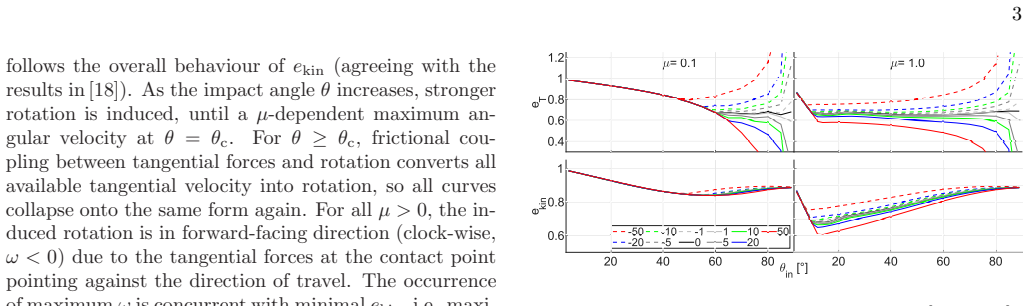
On its own terms, the paper's central discovery is that for oblique disc impacts, $e_T$ and $e_\mathrm{kin}$ are non-monotonic and non-unique functions of the impact angle $\theta$ and the friction coefficient $\mu$, bounded by the ideal cases of pure sliding ($\mu\to 0$) and pure rolling ($\mu\to\infty$). $e_T$ follows the literature relation $e_T = 1 - \mu(1+e_N)\cot(90^\circ-\theta)$ only until a critical angle $\theta_c$; beyond it, $e_T$ oscillates around a rolling value due to micro-slip events. $e_\mathrm{kin}$ dips to a $\mu$-dependent minimum and then rises to a $\gamma$-dependent plateau. Adding an initial angular velocity $\omega_\mathrm{in}$ moves the onset of rolling and, for steep impacts, pushes $e_T$ far outside the range $[0,1]$, from about $-4.17$ to $5.37$ in the simulations. From this the paper concludes that neither $e_T$ nor $e_\mathrm{kin}$ can serve as a unique material parameter for numerical simulations of oblique frictional impacts.
Load-bearing premise
The conclusion rests on whether the simulation's contact law represents real disc collisions: the model forbids internal vibration and plastic deformation, so if real discs lose energy through those channels, the particular pattern of non-uniqueness seen here could be an artifact of the contact law.
Editorial extensions
If this is right
- A fixed tangential or kinematic restitution coefficient cannot be transported from one measurement to another simulation as if it were a material constant.
- Event-driven and kinetic-theory calculations that use single restitution coefficients will misrepresent oblique frictional impacts, especially when rotation is present before contact.
- Reports of tangential restitution should specify impact angle, friction properties, and initial angular velocity, otherwise the number is ambiguous.
- The simple pre-rolling formula for the tangential coefficient fails once rolling begins, so attempts to derive a tangential from a normal restitution coefficient alone are not viable for steep impacts.
Reading between the lines
- If the non-uniqueness carries over to three-dimensional and non-spherical particles, as the author anticipates, then orientation adds yet another state variable, making restitution-coefficient descriptions even less tractable.
- A direct test would be to repeat the same parameter sweep with contact laws that include internal vibration or plastic deformation; if the curves collapse or become unique, the non-uniqueness is a property of the contact law rather than of granular collisions generally.
- The result suggests that scatter in published tangential-restitution measurements across laboratories may reflect undocumented differences in impact conditions rather than material variability.
Editorial analysis
A structured set of objections, weighed in public.
Referee Report
Summary. This Letter reports two-dimensional DEM simulations of a disc impacting a horizontal plate, with systematic variation of impact angle θ, friction coefficient μ, normal damping γ, and initial angular velocity ω. The paper defines normal, tangential, and kinematic restitution coefficients and shows that eT and ekin vary non-monotonically with θ, converge onto rolling/sliding bounds at large θ, exhibit micro-slip oscillations in the rolling regime, and are substantially altered by initial spin. The authors conclude that eT and ekin are not unique material parameters but highly situational quantities, and that prescribing single values of eT or ekin in event-driven simulations is problematic.
Significance. If the conclusions hold, the paper addresses a genuine gap in the granular-impact literature: most work focuses on the normal restitution coefficient, while tangential and kinematic coefficients are routinely used in event-driven simulations and kinetic theories despite being poorly characterized. The reported bounds by pure rolling and pure sliding, the θ-dependent minima, and the sensitivity to initial angular velocity are practically relevant observations that go beyond typical textbook treatments. The paper is, however, purely computational and currently lacks the parameter reporting, validation, and reproducibility details needed to establish that these patterns are generic properties of dissipative frictional collisions rather than artifacts of one contact model. With those additions the work could be a useful contribution, but in its present form the significance is conditional.
major comments (4)
- [Simulation section] The Simulation section does not report the numerical parameters needed to reproduce or judge the simulations: Young's modulus, normal damping γ values, disc radius and mass, time step, polygon discretization, and plate properties are all absent, and Fig. 2 refers to 'different γ' without giving any values. Without a parameter table and convergence checks, the quantitative curves and the central non-uniqueness claim cannot be verified, and the reader cannot distinguish physical behavior from numerical artifacts. Please provide a full parameter table, together with at least one time-step and mesh-refinement convergence test.
- [Results, rolling-regime oscillations] The claim that eT oscillates around a pure-rolling value by roughly 2% due to 'micro-slip events' is a key qualitative finding, but it is supported only by a visual reading of Fig. 2. There is no quantitative definition of oscillation amplitude, no statement of θ resolution, no error bars, and no test showing that the oscillations persist under refinement of the contact algorithm or time step. Since the non-uniqueness argument relies on these oscillations being physical, a quantitative and reproducible characterization is required.
- [Simulation section and Conclusions] The generalization from this specific contact model to real materials is too strong. The Simulation section explicitly states that 'no internal degrees of freedom (e.g. vibration) are allowed' and 'no internal degrees of freedom or plastic deformation are being considered.' If real discs dissipate or redistribute energy through internal vibration, plastic yield, or surface roughness, the reported collapse to rolling/sliding bounds and the extreme eT range (−4.17 to 5.37) under initial spin may be artifacts of the overlap-proportional rigid-body contact law. The Conclusions should either restrict the claim to this model class or add a test showing that a contact model including internal degrees of freedom or a validated elastoplastic contact law reproduces the same functional patterns.
- [Conclusions and Fig. 2a] The Conclusions state that 'the normal coefficient of restitution is essentially unique for each material,' but this is not supported by the paper's own results: Fig. 2a and the accompanying text report that eN decreases for steeper impact angles and shifts with γ. If 'essentially unique' is intended to mean only independence of μ, the term needs to be defined precisely; otherwise the contrast with eT and ekin is ambiguous and the uniqueness claim for eN is not quantitatively established.
minor comments (5)
- [Introduction, Simulation, Implications] Several citations are incomplete: the Introduction has 'well known []', the Simulation section has 'companion paper []', and the Implication section has 'impact kinematics []'. These empty references must be filled before submission.
- [Conclusions] The Conclusions refer to 'spherical particles', but the simulations are of two-dimensional discs; please correct the terminology.
- [Equation (1)] The sign convention in Eq. (1) is unclear: the text says the sign is negative for eN and positive for eT, but the relation Δν = ±e·Δν′ is not accompanied by explicit definitions of Δν and Δν′ in terms of pre- and post-collision normal and tangential velocity components. Define all symbols in one place.
- [Fig. 2 caption] The caption says 'The dotted lines represent μ = [0, 1] and different γ', which is not a complete description. Please specify line styles, parameter values, and whether the curves are raw data or averaged results.
- [Simulation section] The sentence 'Gravity is disabled during the simulation...' appears twice in consecutive paragraphs; please remove the duplicate.
Circularity Check
No significant circularity: the tangential and kinematic restitution coefficients are forward-simulation outputs, not fitted inputs, and the central claim does not reduce to any equation or self-citation.
full rationale
The paper's derivation chain is a parameter sweep of a DEM contact model; eN, eT and ekin are computed from post-separation velocities, not fitted. Equation (2) is a literature formula used only for comparison in the pre-rolling regime, and the paper explicitly states it fails in the rolling regime; the non-uniqueness conclusion is based on the measured eT and ekin curves, not on Eq. (2). Equation (3) is a descriptive exponential fit of theta_c and min(ekin) versus mu, with the caveat that 'the relationship is not strictly exponential'; it is not used to generate or justify the central claim. The simulation setup is attributed to a published book and the author's prior work ([15], [16]), so those self-citations are methodological pointers rather than load-bearing premises that force the result. Unresolved empty citations ('well known []', 'companion paper []') and the absence of a parameter table or experimental validation are reporting gaps, not circular reductions: the observed non-uniqueness would still be a forward-simulation result even if the contact model's physical fidelity is questioned. No fitted parameter is renamed as a prediction, no uniqueness theorem is imported from the authors' prior work, and no known result is repackaged as a derivation. Therefore no circular step can be exhibited, and the appropriate finding is no significant circularity.
Assumptions & free parameters
free parameters (1)
- Exponential fit coefficients for Eq. 3 (ae, be, ce, a_theta, b_theta, c_theta) =
ae=0.22 ± 0.03, be=4.07 ± 1.39, ce=0.68 ± 0.02, a_theta=73.45 ± 4.58, b_theta=5.44 ± 0.79, c_theta=16.26 ± 2.85
assumptions (3)
- domain assumption Rigid-particle DEM with overlap-polygon area-proportional forces and Coulomb friction (Matuttis and Chen [15], Krengel [16]) is a valid model of physical impacts.
- domain assumption The absence of internal degrees of freedom (vibration, plasticity) in the simulated particles does not change the qualitative conclusions.
- domain assumption Fixing only the ratio of normal to tangential velocity (constant v, variable theta) instead of fixing both components separately is representative of impact conditions.
Cite this review
Pith. "Pith review of Non-uniqueness of restitution coefficients in oblique impacts of discs, even in cases of unique normal restitution." pith.science (2026). https://pith.science/paper/CNFAS62Q
@misc{pith2026260806675,
  author       = {Pith},
  title        = {Pith review of: Non-uniqueness of restitution coefficients in oblique impacts of discs, even in cases of unique normal restitution},
  year         = {2026},
  howpublished = {\url{https://pith.science/paper/CNFAS62Q}},
  note         = {Machine review of arXiv:2608.06675}
}
abstract
We investigate the different coefficients of restitution $e$ of a dissipative, frictional disc as a function of the impact angle $\theta$ and the friction coefficient $\mu$. We observe a non-monotonic, non-linear behaviour of $e_{\mathrm{T}}$ and $e_{\mathrm{kin}}$ with a clear minimum at $\mu$-dependent values of $\theta$ and a convergence for all $\mu$ at large $\theta$, bounded by the cases of pure rolling and pure sliding. Changing the dissipative normal interaction affects the $\mu$ convergence at large $\theta$ and leads to a convergence at low $\theta$. The presence of initial angular velocity $\omega$ can significantly alter the functional behaviour of $e_{\mathrm{T}}$ at steep impacts and slightly change the magnitude of $e_{\mathrm{kin}}$, with friction playing only a minor role. Overall, our results indicate, that any value of $e_{\mathrm{T},\mathrm{kin}}$ is highly situational and can describe entirely different configurations.
Figures


Figures from the paper (1 more)

Reference graph
Works this paper leans on
-
[1]
T. Schwager and T. P¨ oschel, Coefficient of restitution and linear–dashpot model revisited, Granular Matter 9, 465 (2007)
work page 2007
- [2]
-
[3]
P. Asteriou, Effect of impact angle and rotational motion of spherical blocks on the coefficients of restitution for rockfalls, Geotechnical and Geological Engineering 37, 2523 (2018)
work page 2018
-
[4]
N. V. Brilliantov and T. P¨ oschel, Kinetic theory of gran- ular gases , 1st ed., Oxford graduate texts (Oxford Uni- versity Press, Oxford [u.a.], 2004)
work page 2004
-
[5]
N. V. Brilliantov, T. P¨ oschel, W. T. Kranz, and A. Zip- pelius, Translations and rotations are correlated in gran- ular gases, Physical Review Letters 98, 128001 (2007)
work page 2007
-
[6]
P¨ oschel,Computational Granular Dynamics, edited by T
T. P¨ oschel,Computational Granular Dynamics, edited by T. Schwager, SpringerLink (Springer Berlin Heidelberg, Berlin, Heidelberg, 2005)
work page 2005
- [7]
-
[8]
K. Chau, R. Wong, and J. Wu, Coefficient of restitution and rotational motions of rockfall impacts, International Journal of Rock Mechanics and Mining Sciences 39, 69 (2002)
work page 2002
Show all 19 references
-
[9]
J. Tang, X. Zhou, K. Liang, Y. Lai, G. Zhou, and J. Tan, Experimental study on the coefficient of restitution for the rotational sphere rockfall, Environmental Earth Sci- ences 80, 10.1007/s12665-021-09684-6 (2021)
2021 doi
-
[10]
Saitoh, A
K. Saitoh, A. Bodrova, H. Hayakawa, and N. V. Bril- liantov, Negative normal restitution coefficient found in simulation of nanocluster collisions, Physical Review Let - ters 105, 238001 (2010)
2010
-
[11]
M¨ uller, D
P. M¨ uller, D. Krengel, and T. P¨ oschel, Negative coeffi- cient of normal restitution, Physical Review E 85, 041306 (2012)
2012
-
[12]
M. Y. Louge and M. E. Adams, Anomalous behavior of normal kinematic restitution in the oblique impacts of a hard sphere on an elastoplastic plate, Physical Review E 65, 021303 (2002)
2002
-
[13]
Kuninaka and H
H. Kuninaka and H. Hayakawa, Anomalous behavior of the coefficient of normal restitution in oblique impact, Physical Review Letters 93, 154301 (2004)
2004
-
[14]
M¨ uller, M
P. M¨ uller, M. Heckel, A. Sack, and T. P¨ oschel, Com- plex velocity dependence of the coefficient of restitution of a bouncing ball, Physical Review Letters 110, 254301 5 (2013)
2013
-
[15]
Matuttis, H.-G. and J. Chen, Understanding the Discrete Element Method: Simulation of Non-Spherical Particles for Granular and Multi-body Systems , 1st ed. (Wiley, Sin- gapore, 2014)
2014
-
[16]
D. Krengel, The influence of particle shape on planar im- pacts and the correlation between impact angle and par- ticle orientation, Granular Matter 28, 10.1007/s10035- 026-01639-7 (2026)
2026 doi
-
[17]
Sondergaard, K
R. Sondergaard, K. Chaney, and C. E. Brennen, Measure- ments of solid spheres bouncing off flat plates, Journal of Applied Mechanics 57, 694 (1990)
1990
-
[18]
Gorham and A
D. Gorham and A. Kharaz, The measurement of parti- cle rebound characteristics, Powder Technology 112, 193 (2000)
2000
-
[19]
K. L. Johnson, Contact Mechanics (Cambridge Univer- sity Press, 1985)
1985
Reviewed August 10, 2026 · model on record in the stance chip above.
Discussion (0). Continue with ORCID to comment.