REVIEW 6 minor 131 references
Physics-Grounded Materials Artificial Intelligence for Reliable Materials Discovery
T0 review · 0 major / 6 minor · reviewed 2026-08-10 · deepseek-v4-flash
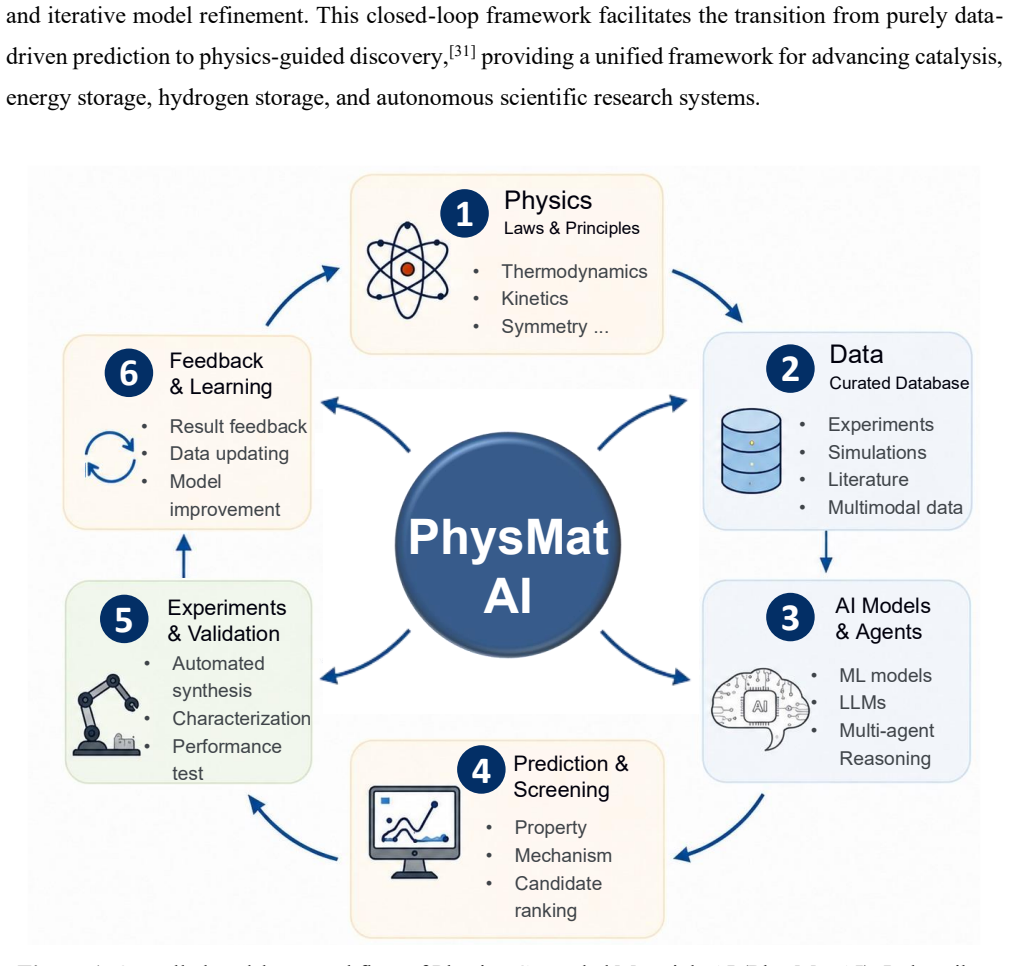
Pith's one-line read Physics should enter materials AI as prior, descriptor, constraint, verifier, and infrastructure.
desk verdict A well-organized perspective that gives the field a useful vocabulary, but its central reliability claim is programmatic rather than demonstrated. read the letter →
The pith
A machine-rendered reading of the paper's core claim, the machinery that carries it, and where it could break.
The reading
What carries the argument
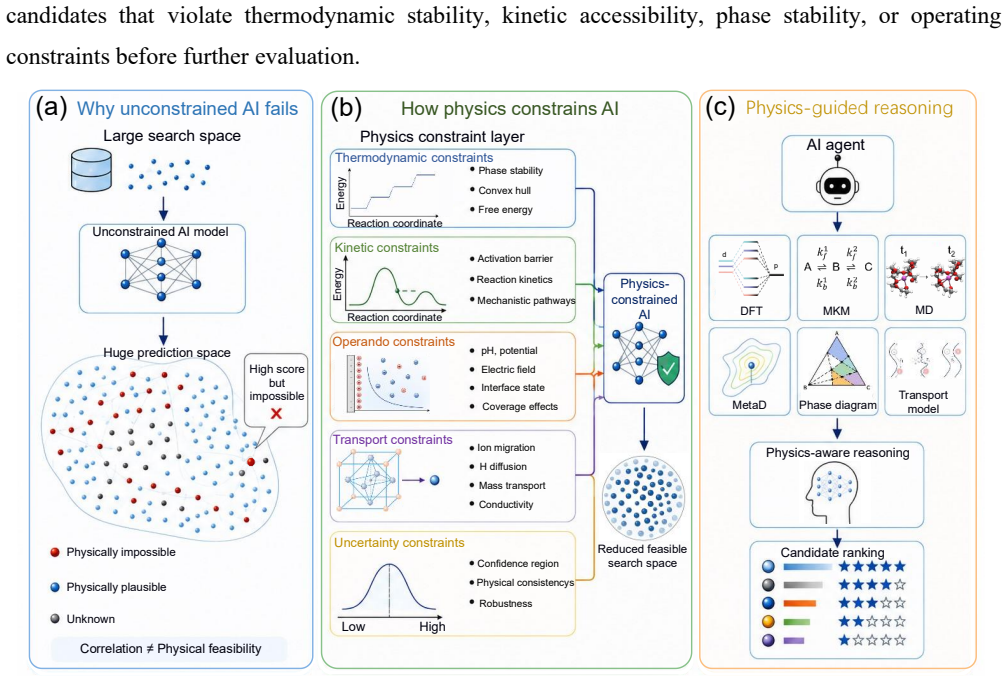
The organizing object is a five-layer taxonomy of physics roles in AI—prior, descriptor, constraint, verifier, and infrastructure—together with a closed-loop workflow connecting physical principles, curated databases, AI models and agents, prediction and screening, experimental validation, and feedback. This named 'physics as' architecture functions as a conceptual scaffold that assigns a physical role to every stage of materials discovery and lets AI agents invoke computational tools such as density-functional theory, microkinetic modeling, ab initio molecular dynamics, and metadynamics while reasoning. The taxonomy carries the argument: once the five roles are accepted, materials AI becomes an integration problem rather than only a modeling problem.
What would settle it
A head-to-head study in a new material family where a plain data-driven pipeline matches or beats a PhysMat AI-style pipeline in the fraction of experimentally validated working candidates, while also extrapolating better to out-of-distribution compositions, would refute the claim that physics grounding is necessary for reliable discovery. A systematic literature classification showing substantial physics-informed methods that fit none of the five roles would refute the taxonomy's completeness.
Extended reading notes
Core claim
The central claim is that purely data-driven materials AI fails at interpretability, extrapolation, and physical consistency, and that the remedy is a unified architecture in which physical knowledge is embedded throughout the discovery loop: as priors that constrain learning, as descriptors that give features mechanistic meaning, as constraints that restrict reasoning to feasible regions, as verifiers that check predictions with simulation and experiment, and as infrastructure that makes data traceable and condition-aware. On this view, physics is not auxiliary to AI but constitutive of it, transforming AI from an interpolative predictor into a mechanism-guided discovery system. The paper supports this with examples from catalysis, solid-state electrolytes, and hydrogen storage, including closed-loop workflows in which validated and failed results feed back into the model.
Load-bearing premise
The framework assumes that the five roles—prior, descriptor, constraint, verifier, and infrastructure—exhaustively cover the ways physics can enter materials AI, but the paper gives no completeness criterion or comparison with alternative partitionings.
Editorial extensions
If this is right
- Candidates that violate thermodynamic stability, kinetic accessibility, or operating-window constraints should be discarded before experimental testing even if they score well.
- Materials databases should record measurement conditions, provenance, and negative and failed results as first-class information, not only successful property values.
- AI agents should be judged by whether they invoke the right physical tool at the right time, not by prediction accuracy alone.
- The same five-role structure transfers across application domains, so methods developed for catalysis can be repurposed for battery or hydrogen-storage discovery.
- The end state is a self-improving closed-loop system in which AI, simulation, and experiment co-evolve into physics-autonomous discovery.
Reading between the lines
- The five-role taxonomy can be used as an audit checklist: classifying a corpus of physics-informed materials machine-learning papers by these roles would test the claimed completeness and likely expose boundary cases such as uncertainty quantification and synthesis-aware search.
- If the framework is adopted, database funding priorities would shift toward negative-result capture and condition-aware metadata, because infrastructure is one of the five load-bearing roles.
- Head-to-head benchmarks between physics-free and physics-grounded pipelines on out-of-distribution materials would quantify how much reliability the physics actually buys, a quantity the paper does not compute.
- The roadmap implies a natural graduation test: a system that proposes a material, validates it in silico and in the lab, and updates its own knowledge base would count as physics-autonomous AI.
Editorial analysis
A structured set of objections, weighed in public.
Referee Report
Summary. This Perspective proposes 'Physics-Grounded Materials AI' (PhysMat AI), a unifying framework in which physical knowledge enters materials AI through five roles: prior knowledge, descriptors, constraints, verifiers, and infrastructure. The authors illustrate each role with examples from electrocatalysis, solid-state electrolytes, and hydrogen storage, and they sketch a three-stage roadmap from physics-aware AI to physics-reasoning AI and ultimately physics-autonomous AI. The paper is explicitly programmatic: its aim is to organize existing work around a taxonomy and to motivate a closed-loop discovery workflow, not to introduce new data or models.
Significance. If taken as a programmatic Perspective, the paper makes a useful and timely contribution: it names a taxonomy that is easy to adopt, connects it to concrete databases and workflows (e.g., DigCat, DigBat/DDSE, DigHyd, DIVE), and is explicit about remaining obstacles. The figures and examples are drawn from real published results, and the discussion of failure feedback, provenance-aware data infrastructure, and physical verification is constructive. The main limitation is that the reliability and extrapolation claims are supported by illustrative case studies rather than by controlled comparisons; this weakens the evidential weight but does not invalidate a Perspective whose value lies in synthesis and agenda-setting.
minor comments (6)
- [Section 2 / Section 3.1.1] The statements 'PhysMat AI ... enables reliable, interpretable, and verifiable materials discovery' (Section 2) and 'enhanced extrapolation capability beyond the available data' (Section 3.1.1) are stronger than what Section 4.2 can support when it lists weak extrapolation, physical inconsistency, and uncertainty quantification as 'major obstacles.' I suggest wording them as design goals or as capabilities that the framework is intended to provide, which would remove an apparent internal tension without weakening the proposal.
- [Section 2] The sentence 'Together, these five layers collectively span the full lifecycle of materials intelligence' asserts a completeness property, but the manuscript gives no criterion for completeness and does not discuss alternative taxonomies (for example, uncertainty quantification or synthesis-aware search could arguably be additional roles). Please either add a rationale for why these five roles are sufficient or soften 'collectively span' to 'provide a practical decomposition of.'
- [References] Reference [41] and reference [63] are the same paper (Witman et al., Adv. Funct. Mater. 2024, 34, 2411763), as are references [38] and [61] (Hirscher et al., J. Alloys Compd. 2020, 827, 153548); these should be consolidated to avoid duplicate bibliography entries.
- [References] Reference [6] is attributed to 'J. Pablo'; this appears to be Juan de Pablo and should be spelled accordingly, and reference [101] gives 'Proc. Natl. Acad. Sci. 2002, 9, 12562,' which should be volume 99.
- [Section 3.5.2] The text states that the initial DDSE release contained 678 performance records and that the current DigBat platform integrates 3725 experimental records, while Figure 7d is captioned 'updated to May 2023'; please clarify which of these numbers corresponds to Figure 7d so that the reader does not conflate the two versions.
- [Section 3.4.2] The 5% agreement between predicted and measured LiScO2 activity is a strong illustrative result, but because no unconstrained baseline is shown, the sentence 'confirming that experimental verification is essential' should be phrased as an interpretation rather than as a controlled demonstration.
Circularity Check
No circularity: the five-role framework is an organizing taxonomy illustrated with the authors' prior case studies; no prediction or derivation in this Perspective reduces to its own inputs.
full rationale
This manuscript is a Perspective, not a derivation or a fitted-model paper. It proposes a five-layer taxonomy (Physics as Prior, Descriptor, Constraint, Verifier, Infrastructure) and illustrates each layer with published examples. The taxonomy is not defined in terms of a target quantity that is then 'predicted'; it is a classification scheme. The closest evidence pattern is the heavy use of the authors' own prior work (DigCat, DigBat/DDSE, DigHyd, DIVE, hydride SSE studies, the LiScO2 discovery, MgH2 models; refs [33, 36, 42, 65, 70, 99, 102, 112, 119] among others). However, these citations function as illustrative case studies selected to fit the five roles, not as a load-bearing theorem or as a fitted parameter renamed a prediction. The paper presents no equation in which an input is defined from an output; no 'uniqueness theorem' from the authors is invoked to forbid alternatives; and no ansatz is smuggled in through a self-citation. The claim that physics grounding 'enables reliable, interpretable, and verifiable materials discovery' (Section 2) is a perspective-level conjecture supported by examples and by independent external foundations (e.g., the Norskov computational hydrogen electrode, scaling relations, d-band theory, Materials Project, AFLOW, Open Catalyst). The paper itself concedes that 'weak extrapolation, physical inconsistency, uncertainty quantification, interpretability, and multiscale coupling remain major obstacles' (Section 4.2), which is a limitation on evidential force, not a marker of circularity. If one wanted to critique the paper, the right criticism is that no controlled comparison against unconstrained AI is provided within this manuscript; but that is a completeness or evidence concern, not one of the specific reduction patterns this pass is charged to detect. Because no derivation chain is present, there is no circular step to exhibit; the argument is a proposal whose support is illustrative rather than derivational.
Assumptions & free parameters
assumptions (4)
- domain assumption Materials behavior is fundamentally governed by thermodynamics, kinetics, electronic structure, transport processes, and operating environments.
- domain assumption Purely data-driven AI lacks extrapolative reliability and physical consistency.
- ad hoc to paper The five roles (prior, descriptor, constraint, verifier, infrastructure) are complementary and complete enough to span the full AI workflow.
- ad hoc to paper AI agents can invoke computational tools (DFT, MKM, AIMD, MetaD) reliably enough to perform mechanism-guided reasoning.
Cite this review
Pith. "Pith review of Physics-Grounded Materials Artificial Intelligence for Reliable Materials Discovery." pith.science (2026). https://pith.science/paper/O3ZCVF6B
@misc{pith2026260806680,
  author       = {Pith},
  title        = {Pith review of: Physics-Grounded Materials Artificial Intelligence for Reliable Materials Discovery},
  year         = {2026},
  howpublished = {\url{https://pith.science/paper/O3ZCVF6B}},
  note         = {Machine review of arXiv:2608.06680}
}
read the original abstract
Artificial intelligence (AI) is transforming materials discovery, yet conventional data-driven approaches often suffer from limited interpretability, poor extrapolation, and inconsistency with physical laws. Since materials behavior is fundamentally governed by thermodynamics, kinetics, electronic structure, transport processes, and operating environments, the next generation of materials intelligence must move beyond correlation-based prediction toward physics-grounded reasoning. In this Perspective, we systematically discuss Physics-Grounded Materials AI (PhysMat AI) as a unifying perspective for integrating physical knowledge into materials intelligence through five complementary roles: physics as prior knowledge, descriptors, constraints, verifiers, and infrastructure. Using representative examples from catalysis, solid-state electrolytes in solid-state battery, and hydrogen-storage materials, we illustrate how physical principles guide data representation, model reasoning, validation workflows, and knowledge management. We further present how AI agents can leverage these physics-aware components to perform mechanism-guided discovery within physically feasible search spaces. Finally, we outline a developmental roadmap from physics-aware AI to physics-reasoning AI and ultimately physics-autonomous AI. Looking forward, materials intelligence should evolve from predictive models toward autonomous scientific systems capable of integrating physical reasoning, multiscale simulations, experimental validation, and continuous knowledge updating for reliable materials discovery.
Figures

Figures from the paper (3 more)


Reference graph
Works this paper leans on
-
[1]
Y. Li, S. Wang, J. Wang, L. Qian, J. Zhang, Chem. Rev. 2026, 126, 6776
2026
-
[2]
Y. Wang, Q. Wang, S.-H. Jang, E. J. Cheng, H. Li, Chem. Commun. 2026, 62, 9536
2026
-
[3]
Zhang, X
D. Zhang, X. Jia, Y. Wang, H. Liu, Q. Wang, S.-H. Jang, D. Shah, S. Ye, H. B. Tran, H. Li, Chem. Sci. 2026, 17, 5782. 34
2026
-
[4]
Zhang, Y
D. Zhang, Y. Chen, C. Liu, Y. Liu, H. Xin, J. Peng, P. Ou, H. Li, Angew. Chem. Int. Ed. 2026, e26150
2026
-
[5]
Y. Liu, M. Jovanovic, K. Mallayya, W. J. Maddox, A. G. Wilson, S. Klemenz, L. M. Schoop, E.- A. Kim, Communications Materials 2025, 6, 212
2025
-
[6]
Pablo, N
J. Pablo, N. E. Jackson, M. A. Webb, L.-Q. Chen, J. E. Moore, D. Morgan, R. Jacobs, T. Pollock, D. G. Schlom, E. S. Toberer, J. Analytis, I. Dabo, D. M. DeLongchamp, G. A. Fiete, G. M. Grason, G. Hautier, Y. Mo, K. Rajan, E. J. Reed, E. Rodriguez, V. Stevanovic, J. Suntivich, K. Thornton, J.-C. Zhao, npj Comput. Mater. 2019, 5, 41
2019
-
[7]
Merchant, S
A. Merchant, S. Batzner, S. S. Schoenholz, M. Aykol, G. Cheon, E. D. Cubuk, Nature 2023, 624, 80
2023
-
[8]
Y. Ma, P. Xu, M. Li, X. Ji, W. Zhao, W. Lu, npj Comput. Mater. 2024, 10,141
2024
Show all 131 references
-
[9]
A. K. Cheetham, R. Seshadri, Chem. Mater. 2024, 36, 3490
2024
-
[10]
Ringe, N
S. Ringe, N. G. Hormann, H. Oberhofer, K. Reuter, Chem. Rev. 2022, 122, 10777
2022
-
[11]
Scarpati, E
G. Scarpati, E. Frasci, G. Di Ilio, E. Jannelli, J. Energy Storage 2024, 102, 113934
2024
-
[12]
Y. Xiao, Y. Wang, S.-H. Bo, J. C. Kim, L. J. Miara, G. Ceder, Nat. Rev. Mater. 2019, 5, 105
2019
-
[13]
Zhang, R
B. Zhang, R. Tan, L. Yang, J. Zheng, K. Zhang, S. Mo, Z. Lin, F. Pan, Energy Storage Mater. 2018, 10, 139
2018
-
[14]
Gupta, K
V. Gupta, K. Choudhary, F. Tavazza, C. Campbell, W. K. Liao, A. Choudhary, A. Agrawal, Nat. Commun. 2021, 12, 6595
2021
-
[15]
P. Xu, X. Ji, M. Li, W. Lu, npj Comput. Mater. 2023, 9, 42
2023
-
[16]
Y. Wang, Y. Wang, H. Li, EES Catalysis 2026, 4, 837
2026
-
[17]
Zhuang, X
Y. Zhuang, X. Yang, C. Zhang, X. Jia, D. Zhang, M. Li, T. Yao, J. Peng, Z. Gao, W. Yang, H. Li, Precision Chemistry 2026, DOI: 10.1021/prechem.5c00449
2026 doi
-
[18]
Scheffler, M
M. Scheffler, M. Aeschlimann, M. Albrecht, T. Bereau, H. J. Bungartz, C. Felser, M. Greiner, A. Gross, C. T. Koch, K. Kremer, W. E. Nagel, M. Scheidgen, C. Woll, C. Draxl, Nature 2022, 604, 635
2022
-
[19]
Govindarajan, A
N. Govindarajan, A. Xu, K. Chan, Science 2022, 375, 379
2022
-
[20]
X. Qin, T. Vegge, H. A. Hansen, ACS Catal. 2024, 14, 8168
2024
-
[21]
X. Qin, T. Vegge, H. A. Hansen, J. Am. Chem. Soc. 2023, 145, 1897
2023
-
[22]
X. Qin, H. A. Hansen, K. Honkala, M. M. Melander, Nat. Commun. 2023, 14, 7607. 35
2023
-
[23]
Y. Wang, Z. Wu, Y. Jiang, D. Zhang, Q. Wang, C. Wang, H. Li, X. Jia, J. Fan, H. Li, Adv. Funct. Mater. 2025, e06314
2025
-
[24]
J. W. Rodriguez-Acosta, A. Etxebarria, P. V. Sruthibhai, S. Barja, F. Calle -Vallejo, M. Garcia- Melchor, P. Rodriguez, ACS Electrochem. 2026, 2, 1055
2026
-
[25]
Nemukula, C
E. Nemukula, C. B. Mtshali, F. Nemangwele, S. Klyamkin, Int. J. Energy Res. 2025, 2025 , 6300225
2025
-
[26]
S. Orimo,Y. Nakamori, J. R. Eliseo, A. Zu¨ ttel , C. M. Jensen, Chem. Rev 2007, 107, 4111
2007
-
[27]
X. Qian, B. J. Yoon, R. Arroyave, X. Qian, E. R. Dougherty, Patterns 2023, 4, 100863
2023
-
[28]
Shimakawa, A
H. Shimakawa, A. Kumada, M. Sato, npj Comput. Mater. 2024, 10, 11
2024
-
[29]
K. Li, A. N. Rubungo, X. Lei, D. Persaud, K. Choudhary, B. DeCost, A. B. Dieng, J. Hattrick - Simpers, Communications Materials 2025, 6, 9
2025
-
[30]
Zhong, B
X. Zhong, B. Gallagher, S. Liu, B. Kailkhura, A. Hiszpanski, T. Y. -J. Han, npj Comput. Mater. 2022, 8, 204
2022
-
[31]
C. Ma, Y. Wang, D. Zhang, W. Du, Q. Gao, R. Su, K. Xu, H. Gu, L. Li, P. Ma, H. Li, Digital Discovery 2026, DOI: 10.1039/d6dd00218h
2026 doi
-
[32]
J. F. Joung, N. Casetti, P. Raghavan, C. W. Coley, Chem. Soc. Rev. 2026, DOI: 10.1039/d6cs00079g
2026 doi
-
[33]
H. Liu, D. Zhang, S. M. Holmes, C. D'Agostino, H. Li, Chem. Sci. 2023, 14, 9000
2023
-
[34]
J. K. Nø rskov, A. Logadottir, L. Lindqvist, J. Phys. Chem. B 2004, 108, 17886
2004
-
[35]
Zhang, F
D. Zhang, F. She, J. Chen, L. Wei, H. Li, J. Am. Chem. Soc. 2025, 147, 6076
2025
-
[36]
Q. Wang, F. Yang, Y. Wang, D. Zhang, R. Sato, L. Zhang, E. J. Cheng, Y. Yan, Y. Chen, K. Kisu, S. I. Orimo, H. Li, Angew. Chem. Int. Ed. 2025, 64, e202506573
2025
-
[37]
Campos dos Santos, R
E. Campos dos Santos, R. Sato, K. Kisu, K. Sau, X. Jia, F. Yang, S. Orimo, H. Li, Chem. Mater. 2023, 35, 5996
2023
-
[38]
Hirscher, V
M. Hirscher, V. A. Yartys, M. Baricco, J. Bellosta von Colbe, D. Blanchard, R. C. Bowman, D. P. Broom, C. E. Buckley, F. Chang, P. Chen, Y. W. Cho, J.-C. Crivello, F. Cuevas, W. I. F. David, P. E. de Jongh, R. V. Denys, M. Dornheim, M. Felderhoff, Y. Filinchuk, G. E. Froudakis...
2020
-
[39]
K. T. Møller, M. B. Ley, P. Schouwink, R. Černý, T. R. Jensen, Dalton Trans. 2016, 45, 831
2016
-
[40]
Yartys, R
V. Yartys, R. Denys, J. Alloys Compd. 2015, 645, S412
2015
-
[42]
S. Dong, C. Li, J. Wang, H. Liu, Z. Ding, Z. Gao, W. Yang, W. Lv, L. Wei, Y. Wu, H. Li, J. Mater. Chem. A 2022, 10, 22363
2022
-
[43]
W. Yang, Z. Jia, B. Zhou, L. Wei, Z. Gao, H. Li, Commun. Chem. 2023, 6, 6
2023
-
[44]
J. K. Nø rskov, T. Bligaard, A. Logadottir, S. Bahn, L. B. Hansen, M. Bollinger, H. Bengaard, B. Hammer, Z. Sljivancanin, M. Mavrikakis, Y. Xu, S. Dahl, C. J. H. Jacobsen, J. Catal. 2002, 209, 275
2002
-
[45]
Y. Wang, Y. Zhang, N. Ma, J. Zhao, Y. Xiong, S. Luo, J. Fan, Surf. Interfaces 2024, 50, 104498
2024
-
[46]
Calle-Vallejo, D
F. Calle-Vallejo, D. Loffreda, M. T. Koper, P. Sautet, Nat. Chem. 2015, 7, 403
2015
-
[47]
Famprikis, P
T. Famprikis, P. Canepa, J. A. Dawson, M. S. Islam, C. Masquelier, Nat. Mater. 2019, 18, 1278
2019
-
[48]
J. B. Goodenough, K.-S. Park, J. Am. Chem. Soc. 2013, 135, 1167
2013
-
[49]
E. J. Cheng, H. Duan, M. J. Wang, E. Kazyak, H. Munakata, R. Garcia-Mendez, B. Gao, H. Huo, T. Zhang, F. Chen, Energy Storage Mater. 2025, 75, 103970
2025
-
[50]
Q. Wang, H. Li, R. Zhang, Z. Liu, H. Deng, W. Cen, Y. Yan, Y. Chen, Energy Storage Mater. 2022, 51, 630
2022
-
[51]
Q. Wang, R. Sato, R. Garcí a-Mé ndez, W. Jang, P. Ou, A. Soon, J. Zhao, X. Wang, S.-i. Orimo, E. J. Cheng, AI Agent 2025, 1, 10
2025
-
[52]
A. C. Dutra, B. A. Goldmann, M. S. Islam, J. A. Dawson, Nat. Rev. Mater. 2025, 10, 566
2025
-
[53]
Q. Zhao, M. Avdeev, L. Chen, S. Shi, Sci. Bull. 2021, 66, 1401
2021
-
[54]
Wang, L.-J
D. Wang, L.-J. Jhang, R. Kou, M. Liao, S. Zheng, H. Jiang, P. Shi, G.-X. Li, K. Meng, D. Wang, Nat. Commun. 2023, 14, 1895
2023
-
[55]
E. J. Cheng, T. Yang, Y. Liu, L. Chai, R. Garcia-Mendez, E. Kazyak, Z. Fu, G. Luo, F. Chen, R. Inada, V. Badilita, H. Duan, Z. Wang, J. Qin, H. Li, S. -i. Orimo, H. Kato, Mater. Today Energy 2024, 44, 101644
2024
- [56]
-
[57]
Mohtadi, S.-i
R. Mohtadi, S.-i. Orimo, Nat. Rev. Mater. 2016, 2, 16091
2016
-
[58]
Schlapbach, A
L. Schlapbach, A. Zü ttel, Nature 2001, 414, 353
2001
-
[59]
Zü ttel, Mater
A. Zü ttel, Mater. Today 2003, 6, 24
2003
-
[60]
Bellosta von Colbe, J.-R
J. Bellosta von Colbe, J.-R. Ares, J. Barale, M. Baricco, C. Buckley, G. Capurso, N. Gallandat, D. M. Grant, M. N. Guzik, I. Jacob, E. H. Jensen, T. Jensen, J. Jepsen, T. Klassen, M. V. Lototskyy, K. Manickam, A. Montone, J. Puszkiel, S. Sartori, D. A. She ppard, A. Stuart, G....
2019
-
[61]
Hirscher, V
M. Hirscher, V. A. Yartys, M. Baricco, J. Bellosta von Colbe, D. Blanchard, R. C. Bowman, D. P. Broom, C. E. Buckley, F. Chang, P. Chen, Y. W. Cho, J.-C. Crivello, F. Cuevas, W. I. F. David, P. E. de Jongh, R. V. Denys, M. Dornheim, M. Felderhoff, Y. Filinchuk, G. E. Froudakis...
2020
-
[62]
I. P. Jain, C. Lal, A. Jain, Int. J. Hydrogen Energy 2010, 35, 5133
2010
-
[63]
M. D. Witman, K. P. Brooks, S. J. Sprik, B. C. Wood, T. W. Heo, K. G. Ray, L. E. Klebanoff, A. Acosta, V. Stavila, M. D. Allendorf, Adv. Funct. Mater. 2024, 34, 2411763
2024
-
[64]
D. P. Broom, M. Hirscher, ChemPhysChem 2021, 22, 2141
2021
-
[65]
S. H. Jang, D. Zhang, X. Jia, H. Tran, L. Zhang, R. Sato, Y. Hashimoto, T. Sato, K. Konno, S. Orimo, H. Li, arXiv:2603.14139 2026, DOI: 10.48550/arXiv.2603.14139
2026 doi
-
[66]
C. Li, W. Yang, H. Liu, X. Liu, X. Xing, Z. Gao, S. Dong, H. Li, Angew. Chem. Int. Ed. 2024, 63, e202320151. 38
2024
-
[67]
J. Cai, H. Wang, X. Tang, Z. Miao, T. Yao, Y. Liu, H. Wang, Z. Gao, W. Yang, J. Energy Storage 2025, 136, 118450
2025
-
[68]
H. Xin, S. Linic, J. Chem. Phys. 2010, 132, 221101
2010
-
[69]
Zhang, Z
D. Zhang, Z. Wang, F. Liu, P. Yi, L. Peng, Y. Chen, L. Wei, H. Li, J. Am. Chem. Soc. 2024, 146, 3210
2024
-
[70]
Z. Liu, Y. Liu, Y. Zhang, Y. Deng, Z. Zheng, R. Knibbe, T. Gao, M. Li, Z. Wang, B. Zhang, X. Jia, D. Zhang, H. Liu, X. Shao, Z. Gao, L. Wei, H. Li, W. Yang, Angew. Chem. Int. Ed. 2026, 65, e18027
2026
-
[71]
S. H. Jang, D. Zhang, X. Jia, H. B. Tran, L. Zhang, R. Sato, Y. Hashimoto, Y. Ohashi, T. Sato, K. Konno, S. I. Orimo, H. Li, Chem. Sci. 2026, DOI: 10.1039/d6sc03089k
2026 doi
-
[72]
Y. Lin, P. Ou, AI Agent 2025, 1, 3
2025
-
[73]
H. B. Tao, L. Fang, J. Chen, H. B. Yang, J. Gao, J. Miao, S. Chen, B. Liu, J. Am. Chem. Soc. 2016, 138, 9978
2016
-
[74]
Hammer, J
B. Hammer, J. K. Nø rskov, in Adv. Catal., 2000, 45, 71
2000
-
[75]
R. Ren, Y. Wang, B. Li, H. Fan, H. Li, J. Phys. Chem. Lett. 2026, 17, 5583
2026
-
[76]
H. Li, Z. Fu, Y. Yuan, D. Zhang, Y. Chen, H. Li, A. Cao, Chem. Sci. 2026, 17, 7947
2026
-
[77]
A. Cao, J. K. Nø rskov, ACS Catal. 2023, 13, 3456
2023
-
[78]
A. Cao, V. J. Bukas, V. Shadravan, Z. Wang, H. Li, J. Kibsgaard, I. Chorkendorff, J. K. Norskov, Nat. Commun. 2022, 13, 2382
2022
-
[79]
Y. You, D. Zhang, F. Wu, X. Cao, Y. Sun, Z.-Z. Zhu, S. Wu, npj Comput. Mater. 2024, 10, 57
2024
-
[80]
Z. Xu, H. Duan, Z. Dou, M. Zheng, Y. Lin, Y. Xia, H. Zhao, Y. Xia, npj Comput. Mater. 2023, 9, 105
2023
-
[81]
R. Wang, M. Guo, Y. Gao, X. Wang, Y. Zhang, B. Deng, M. Shi, L. Zhang, Z. Zhong, npj Comput. Mater. 2025, 11, 266
2025
-
[82]
J. Chen, M. Fang, Q. Wu, S. Tang, J. Zheng, C. Wei, X. Cao, Y. Shi, N. Xu, Y. He, Chem. Mater. 2025, 37, 591
2025
-
[83]
Z. Chen, T. Du, N. M. A. Krishnan, Y. Yue, M. M. Smedskjaer, Nat. Commun. 2025, 16, 1057
2025
-
[84]
Fukuda, Y
M. Fukuda, Y. Li, J. Wei, K. Harata, G. Luo, G. J. Snyder, Y. S. Sato, H. Kato, E. J. Cheng, Small 2025, 21, e06257
2025
-
[85]
Witman, S
M. Witman, S. Ling, D. M. Grant, G. S. Walker, S. Agarwal, V. Stavila, M. D. Allendorf, J. Phys. Chem. Lett. 2020, 11, 40. 39
2020
-
[86]
S. H. Jang, D. Zhang, H. B. Tran, X. Jia, K. Konno, R. Sato, S. I. Orimo, H. Li, Chem. Sci. 2025, 16, 23111
2025
-
[87]
S. H. Jang, arXiv:2510.18325 2025, DOI: 10.48550/arXiv.2510.18325
2025 doi
-
[88]
O. T. Unke, S. Chmiela, H. E. Sauceda, M. Gastegger, I. Poltavsky, K. T. Schutt, A. Tkatchenko, K. R. Muller, Chem. Rev. 2021, 121, 10142
2021
-
[89]
Angeletti, L
A. Angeletti, L. Leoni, D. Massa, L. Pasquini, S. Papanikolaou, C. Franchini, npj Comput. Mater. 2025, 11, 85
2025
-
[90]
H. Kwon, M. Shiga, H. Kimizuka, T. Oda, Acta Mater. 2023, 247, 118739
2023
-
[91]
W. Lin, L. Jin, Z. Jiang, M. Cai, Z. Lai, D. Yurchenko, B. Yan, S. Zhou, K. S. Novoselov, W. H. Liao, S. Fang, Adv. Funct. Mater. 2026, 36, e75070
2026
-
[92]
Liang, X
B. Liang, X. Huang, S. Tan, T. Wang, C. Ji, T. Si, X. Li, H. Chen, Y. Xie, L. Jiang, C. Zhao, J. Fan, T. Hou, Q. Zhang, Energy Environ. Sci. 2026, 19, 1616
2026
-
[93]
X. Jia, Z. Yu, F. Liu, H. Liu, D. Zhang, E. Campos Dos Santos, H. Zheng, Y. Hashimoto, Y. Chen, L. Wei, H. Li, Adv. Sci. 2024, 11, e2305630
2024
-
[94]
Zhang, H
D. Zhang, H. Li, J. Mater. Chem. A 2024, 12, 13742
2024
-
[95]
S. W. Ying, Y. Wang, P. Du, Q. Wang, C. Yue, D. Zhang, Z. C. Chen, J. W. Zheng, S. Y. Xie, H. Li, Angew. Chem. Int. Ed. 2025, 64, e202511924
2025
-
[96]
S. Ye, Y. Wang, H. Liu, D. Zhang, X. Jia, L. Zhang, Y. Zhang, A. Kumatani, H. Shiku, H. Li, J. Mater. Chem. A 2025, 13, 37821
2025
-
[97]
X. Guo, Z. Wang, J.-H. Yang, X.-G. Gong, J Mater. Chem. A 2024, 12, 10124
2024
-
[98]
A. D. Dembitskiy, I. S. Humonen, R. A. Eremin, D. A. Aksyonov, S. S. Fedotov, S. A. Budennyy, npj Comput. Mater. 2025, 11, 131
2025
-
[99]
Q. Wang, F. Yang, Y. Wang, D. Zhang, R. Sato, L. Zhang, E. J. Cheng, Y. Yan, Y. Chen, K. Kisu, S.-i. Orimo, H. Li, Angew. Chem. Int. Ed. 2025, 64, e202506573
2025
-
[100]
Zhang, J
J. Zhang, J. Li, G. Zhao, Q. Wang, Y.-G. Guo, C. Yang, J. Am. Chem. Soc. 2025, 147, 40496
2025
-
[101]
A. Laio, M. Parrinello, Proc. Natl. Acad. Sci. 2002, 9, 12562
2002
-
[102]
C. Li, W. Yang, H. Liu, X. Liu, X. Xing, Z. Gao, S. Dong, H. Li, Angew. Chem. Int. Ed. 2024, 63, e202320151
2024
-
[103]
Mishra, J
A. Mishra, J. Pascasio, J. Yang, W. Li, AI Agent 2026, 2, 6
2026
-
[104]
Zhang, X
D. Zhang, X. Jia, H. Liu, Y. Wang, S. Ye, Q. Jiang, Y. Wang, Z. Guo, L. Zhang, L. Wei, W. Yang, H. Liu, S. Zhao, H. Xu, D. Cheng, Y. Hashimoto, T. Tomai, H. Li, AI Agent 2025, 1, 2. 40
2025
-
[105]
Zhang, Z
D. Zhang, Z. Bao, Y. Chu, Z. Guo, X. Jia, Q. Jiang, H. Liu, T. Liu, T. Lu, Y. Lu, D. D. Shah, Y. Wang, Y. Wang, Y. Wang, S. Ye, S. Ying, Z. Yu, L. Zhang, S. Zhao, H. Li, Chem Catalysis 2026, 6, 101775
2026
-
[106]
Cheng, H.i Liu, J
Z. Cheng, H.i Liu, J. Du, P. Ma, H. Yin, D. Zhang, H. Li, Y. Chen, AI Agent 2026, 2, 8
2026
-
[107]
Chanussot, A
L. Chanussot, A. Das, S. Goyal, T. Lavril, M. Shuaibi, M. Riviere, K. Tran, J. Heras -Domingo, C. Ho, W. Hu, A. Palizhati, A. Sriram, B. Wood, J. Yoon, D. Parikh, C. L. Zitnick, Z. Ulissi, ACS Catal. 2021, 11, 6059
2021
-
[108]
R. Tran, J. Lan, M. Shuaibi, B. M. Wood, S. Goyal, A. Das, J. Heras -Domingo, A. Kolluru, A. Rizvi, N. Shoghi, A. Sriram, F. Therrien, J. Abed, O. Voznyy, E. H. Sargent, Z. Ulissi, C. L. Zitnick, ACS Catal. 2023, 13, 3066
2023
-
[109]
F. Yang, E. Campos dos Santos, X. Jia, R. Sato, K. Kisu, Y. Hashimoto, S.-i. Orimo, H. Li, Nano Mater. Sci. 2024, 6, 256
2024
-
[110]
Nakamura, N
K. Nakamura, N. Takenaka, M. Hanai, Y. Oikawa, R. Tamura, K. Tsuda, M. Nakayama, J. Shiomi, A. Yamada, npj Comput. Mater. 2026, 12
2026
-
[111]
Y. Hong, X. Mao, AI Agent 2026, 2, 2
2026
-
[112]
Zhang, X
D. Zhang, X. Jia, H. B. Tran, S. H. Jang, L. Zhang, R. Sato, Y. Hashimoto, T. Sato, K. Konno, S. I. Orimo, H. Li, Chem. Sci. 2026, 17, 3031
2026
-
[113]
Sandrock, G
G. Sandrock, G. Thomas, Appl. Phys. A: Mater. Sci. Process. 2001, 72, 153
2001
-
[114]
A. Jain, S. P. Ong, G. Hautier, W. Chen, W. D. Richards, S. Dacek, S. Cholia, D. Gunter, D. Skinner, G. Ceder, APL Mater. 2013, 1, 011002
2013
-
[115]
Curtarolo, W
S. Curtarolo, W. Setyawan, G. L. Hart, M. Jahnatek, R. V. Chepulskii, R. H. Taylor, S. Wang, J. Xue, K. Yang, O. Levy, Comput. Mater. Sci. 2012, 58, 218
2012
-
[116]
M. A. Akhound, T. M. Boland, M. O. Sauer, M. Batzill, B. M. Abraham, S. Canulescu, Y. Gogotsi, P. Hofmann, A. Kis, J. Lu, T. Michely, S. Raza, W. Ren, J. A. Robinson, Z. Sofer, J. Teng, S. Ulstrup, M. Zhao, X. Zhao, J. J. Mortensen, T. Olsen, K. S. Thygesen, ACS Nano 2026, 20, 12008
2026
-
[117]
Ishii, T
M. Ishii, T. Ito, H. Sado, I. Kuwajima, Sci. Technol. Adv. Mater.: Methods 2024, 4, 2354649
2024
-
[118]
Belsky, M
A. Belsky, M. Hellenbrandt, V. L. Karen, P. Luksch, Acta Crystallogr. B 2002, 58, 364
2002
-
[119]
X. Wang, Z. Li, D. Zhang, H. Li, H. Xu, D. Cheng, Angew. Chem. Int. Ed. 2026, 65, e24612
2026
-
[120]
H. X. Weijian Chen, Daojian Cheng, AI Agent 2026, 2, 12
2026
-
[121]
X. Hu, S. Chen, L. Chen, H. Wang, X. Zhang, Z. Zhou, Natl Sci Rev 2025, 12, nwaf372
2025
-
[122]
Yao, Y.Yan, Y
T. Yao, Y.Yan, Y. Yang, Z. Wang, X. Shao, Z. Gao, W. Yang, AI Agent 2025, 1. 41
2025
-
[123]
Q. Wang, R. Garcí a-Mé ndez, W. Jang, P. Ou, A. Soon, J. Zhao, X. Wang, S.-i. Orimo, E. J. Cheng, AI Agent 2025, 1, 10
2025
-
[124]
H. L. Chaoyue Zhao1 AI Agent 2026, 2
2026
-
[125]
Fortunelli, AI Agent 2026, 2
A. Fortunelli, AI Agent 2026, 2
2026
-
[126]
X. Jia , Y. Lu, Q. Wang , H. Li, AI Agent 2026, 2, 1
2026
-
[127]
F. Yang, R. Sato, E. J. Cheng, K. Kisu, Q. Wang, X. Jia, S.-i. Orimo, H. Li, J. Electrochem. 2024, 30, 2415001
2024
-
[128]
Z. Wang, X. Lin, Y. Han, J. Cai, S. Wu, X. Yu, J. Li, Nano Energy 2021, 89, 106337
2021
-
[129]
A. D. Sendek, G. Cheon, M. Pasta, E. J. Reed, J Phys. Chem. C 2020, 124, 8067
2020
-
[130]
A. G. Kusne, H. Yu, C. Wu, H. Zhang, J. Hattrick -Simpers, B. DeCost, S. Sarker, C. Oses, C. Toher, S. Curtarolo, A. V. Davydov, R. Agarwal, L. A. Bendersky, M. Li, A. Mehta, I. Takeuchi, Nat. Commun. 2020, 11, 5966
2020
-
[131]
Zhang, X
D. Zhang, X. Jia, Y. Wang, H. Liu, Q. Wang, S. H. Jang, D. Shah, S. Ye, H. B. Tran, H. Li, Chem Sci 2026, 17, 5782
2026
-
[132]
Department of R&D for Future Creation, Retrieved from https://www.jst.go.jp/gtex/en/field/hydrogen.html
Japan Science and Technology Agency. Department of R&D for Future Creation, Retrieved from https://www.jst.go.jp/gtex/en/field/hydrogen.html
Reviewed August 10, 2026 · model on record in the stance chip above.
Discussion (0). Continue with ORCID to comment.