REVIEW 2 major objections 4 minor
Sub-Vacuum Jamming for Secure Communication
T0 review · 2 major / 4 minor · reviewed 2026-08-10 · deepseek-v4-flash
Pith's one-line read A retained idler from a two-mode squeezed source lets a jammer cancel its own noise below the vacuum floor, preserving secrecy even when Eve's direct channel is stronger than Bob's.
desk verdict Solid, honest protocol paper: the sub-vacuum cancellation math checks out, and the security claim is carefully scoped to a bounded-collection, single-mode threat model that the authors themselves flag as incomplete. read the letter →
The pith
A machine-rendered reading of the paper's core claim, the machinery that carries it, and where it could break.
The reading
What carries the argument
The load-bearing object is the conditional variance $V_{S|I}$ of the broadcast jamming quadrature $X_S$ given Bob's retained idler quadrature $X_I$, together with the optimized linear estimator $X_{\mathrm{out}} = X_B - g X_I$ with $g^* = \langle X_B X_I\rangle/\mathrm{Var}(X_I)$ that realizes it. The paper shows that the post-cancellation residual is exactly $\eta_S(V_{S|I} - 1/2)$, so the entire protocol reduces to a single inequality: classical sources have $V_{S|I} \geq 1/2$, while the two-mode squeezed-vacuum source has $V_{S|I} < 1/2$. The classical bound follows from the Cauchy--Schwarz inequality applied to the $P$ function, and the quantum side from $V_{S|I} \geq 0$; imperfect idler storage enters through a threshold $\eta_I > (2N_{en}+1)/(2N_{en}+2)$, above which the entangled advantage survives.
What would settle it
Take a two-mode squeezed-vacuum source with brightness $N_S = 25$, retain the idler with efficiency above 50% on a cold line, and use Bob's optimized linear combiner; if his post-cancellation quadrature variance does not fall below the idler-optimized classical floor by $\eta_S N_S/(2N_S+1)$, the central sub-vacuum claim fails. A multimode variant would give Eve two apertures, one aimed at Alice and one able to null the jammer, and check whether her signal-to-noise ratio stops growing with the jamming brightness $N_J$.
Extended reading notes
Core claim
The paper's central discovery is a new resource relation: residual self-jamming noise is governed by the conditional variance $V_{S|I} = \mathrm{Var}(X_S) - \langle X_S X_I\rangle^2/\mathrm{Var}(X_I)$, with $\Delta V = \eta_S(V_{S|I} - 1/2)$ for ideal idler retention. For every source with a nonnegative Glauber--Sudarshan $P$ function, $V_{S|I} \geq 1/2$, so the best a classical jammer can do is restore Bob to his unjammed vacuum floor. A two-mode squeezed-vacuum source violates this bound, giving $V_{S|I} = 1/(4N_S+2)$ and hence $\Delta V_q = -\eta_S N_S/(2N_S+1)$, which saturates the absolute quantum bound $-\eta_S/2$ as the source brightens. This sub-vacuum conditional inference is the mechanism behind the paper's security claim: the jamming penalty at Eve grows with $N_S$, while Bob's residual noise stays bounded or falls below his unjammed floor, so the wiretap condition $\mathrm{SNR}_B > \mathrm{SNR}_E$ can hold even when $\eta_{ch,E} > \eta_{ch,B}$.
Load-bearing premise
The quantitative secrecy claim assumes that Eve collects exactly one spatial pattern of light per symbol in which Alice's signal and Bob's jamming overlap, and that the jamming she collects is set by the same single-parameter geometry as her signal transmissivity; if Eve can spatially separate the two fields and null the jammer with multiple apertures, the jamming penalty can be suppressed and the positive-secrecy claim may fail.
Editorial extensions
If this is right
- Secrecy capacity remains positive well past the usual wiretap cutoff $\eta_{ch,E} = \eta_{ch,B}$; in the paper's example the secure region extends from $\eta_{ch,E} \approx 0.30$ to roughly $0.71$ with classical jamming and $0.76$ with entangled jamming.
- In the bright-jamming limit the entanglement margin is a fixed receiver-noise improvement of $\eta_S/2$, independent of signal and jamming power, so the quantum advantage does not fade as the message is brightened.
- Upgrading Eve from homodyne detection to an optimal collective measurement costs less than 0.5% in the strongly jammed regime; correlated jamming nearly closes the gap between the two adversary models.
- Because Alice's signal is a bright coherent state, the protocol bypasses the repeaterless rate--loss bound that caps quantum key distribution and can coexist with classical traffic on the same link.
- Classical correlated jamming captures most of the secrecy gain, while the entangled source adds a bounded margin and removes the need to store a classical record of the jamming waveform.
Reading between the lines
- If the single-mode security model is the right one, the protocol should be most attractive in waveguides, where Eve cannot easily separate Alice's signal from Bob's jamming; in free space a multi-aperture Eve with spatial filtering is the natural threat, and the paper leaves that analysis open.
- The conditional-variance inequality is directly testable with existing two-mode-squeezed sources: a measurement of Bob's optimized residual below the classical floor would certify the effect before any security claim is invoked.
- One could extend the protocol to secret-key distillation by treating Bob's idler photocurrent as correlated side information; the paper's secrecy-rate expression is already a lower bound on the key rate, so this extension is a wiretap-channel exercise rather than new physics.
- The fixed $\eta_S/2$ noise-figure improvement suggests that in shot-noise-limited links the entanglement margin is best specified as a receiver requirement, such as idler storage above 50%, rather than as an operational rate gain.
Editorial analysis
A structured set of objections, weighed in public.
Referee Report
Summary. The paper proposes a correlated-jamming protocol for physical-layer security in which Bob broadcasts one mode of a correlated two-mode source as artificial noise while retaining the idler as a local reference. Alice sends a bright coherent signal, and Bob cancels the self-jamming contribution by optimal linear combination of his received quadrature with the retained idler quadrature. The central result is that the residual self-jamming noise is ΔV = η_S (V_{S|I} − 1/2) (Eq. 25), that every classically correlated source obeys V_{S|I} ≥ 1/2 (Eq. 27), and that a two-mode squeezed-vacuum source reaches ΔV_q = −η_S N_S/(2N_S + 1) → −η_S/2 (Eq. 30). The paper then evaluates the Gaussian wiretap secrecy capacity (Eq. 36), including a collective-attack analysis via Eve's Holevo information in Appendix D, and reports positive secrecy for a range of parameters in which Eve's direct channel transmissivity exceeds Bob's (Fig. 4).
Significance. If the stated bounded-collection, single-mode threat model is accepted, the paper gives a clean and largely parameter-free quantum advantage: the residual-noise formulas are exact, the classical lower bound is derived from the nonnegative-P representation, and Appendix D provides an exact closed-form Holevo information as well as a monotonicity argument showing that jamming suppresses collective Eve. These derivations are internally consistent and should be checked against standard Gaussian steering and wiretap-channel results, which they match. The experimental sections are cautious and identify realistic loss and storage constraints. The main limitation is not a technical inconsistency but the scope of the security claim: the positive-secrecy extension depends on Eve being unable to separate Alice's signal from Bob's jamming field in separate spatial modes, an attack the authors identify as the most significant one considered and explicitly defer.
major comments (2)
- [Sec. V C (and Sec. II A, abstract)] The positive-secrecy claim that correlated jamming preserves secrecy even when Eve's direct channel is stronger than Bob's is computed under a single-mode, collinear model in which Eve collects Alice's signal and Bob's jamming field in the same detected mode with η_E = η_n (1 − η_ch,E). The authors correctly state in Sec. V C that a multimode attacker could collect the two fields through separate apertures and null the localized jammer, and they explicitly defer a complete analysis. This attack is load-bearing for the central security claim: if Eve can reduce her effective jamming coupling η_E^eff well below η_n (1 − η_ch,E), the secrecy cutoff in Fig. 4 can revert to the conventional condition η_ch,E < η_ch,B. Because the manuscript itself labels this 'the most significant attack considered here,' I request either a two-mode analysis (even a simplified model with signal and jammer in different spatial modes and a beam-forming Eve) or a revised abstract and conclusions that state unambiguously that the positive-secrecy result applies only when signal–jammer mode overlap is enforced, e.g. in guided channels, and not to general free-space or wireless geometries.
- [Sec. V A (i) and Sec. V C] The bounded-collection assumption does more work than a standard collection-efficiency bound. A passive bound on η_ch,E and η_E is insufficient if Eve can actively separate the two fields; the required bound is on her ability to null the jamming mode, which depends on the spatial-mode structure that the paper does not model. The statement that 'the bounded-collection assumption must therefore apply to the total collection efficiency across all modes accessible to Eve' is a reformulation of the problem rather than a justification. I would like the paper to either prove that such a bound follows from the geometry or explicitly state that the security guarantee holds under this additional, non-derived assumption.
minor comments (4)
- [Abstract and title] The phrase 'sub-vacuum jamming' may mislead readers: the broadcast jamming field itself is a thermal state with positive photon number, and the sub-vacuum property applies to the conditional variance of Bob's residual noise. Please qualify this terminology in the abstract or introductory paragraphs.
- [Sec. IV C] The range conversions, including the statements '0.649 d_B', '54% farther', and '7.4 km', rely on the single-parameter relation η_E = η_n(1 − η_ch,E) and on a d ∝ η^{−1/2} propagation law. The text labels these as illustrative, but the numbers are presented as concrete operational results; please add an explicit caveat that they are not derived from a physical propagation model and therefore do not constitute a general eavesdropper-exclusion guarantee.
- [Sec. IV B, text after Eq. (38)] The sentence 'Since SNR_E cancels between the two capacities' is imprecise: SNR_E is common to both C_q and C_cl but does not numerically cancel in the difference of logarithms; it cancels only in the sense that the difference is independent of SNR_E when the two capacities are evaluated at the same Eve. Please rephrase.
- [Sec. II A] There is a typographical error in 'broadcast paltform'; it should read 'broadcast platform'.
Circularity Check
No significant circularity: the residual-noise and secrecy results are derived from standard Gaussian second moments and the P-function bound, with no fitted parameter or target-derived constant; self-citations are feasibility-only.
full rationale
The central quantity Delta V_q = -eta_S N_S/(2N_S + 1) (Eq. 30) is obtained by inserting the TMSV moments Var(X_S)=N_S+1/2 and <X_S X_I>=sqrt{N_S(N_S+1)} into the conditional-variance formula Delta V = eta_S(V_{S|I} - 1/2) (Eq. 25), which itself follows from the passive-network second moments in Appendix A and electronic optimal combining in Appendix B; no coefficient is fitted to Bob's residual noise or to Eve's SNR. The classical bound V_{S|I} >= 1/2 (Eq. 27) is derived from the nonnegative P-function decomposition and Cauchy-Schwarz rather than assumed. The positive-secrecy-beyond-eta_ch,E = eta_ch,B claim is computed from the separate Bob and Eve SNRs (Eqs. 10 and 17) under explicitly stated threat-model assumptions, including the single-parameter collinear relation eta_E = eta_n(1 - eta_ch,E) and single-mode collection; these are premises, not predictions recovered from themselves. The paper explicitly discloses the load-bearing limitations: Sec. V C states that multimode spatial filtering 'is the most significant attack considered here' and that 'a complete analysis of this attack requires a multimode channel model and lies beyond the present single-mode treatment,' and Appendix D notes the collective-attack analysis is not a coherent-attack proof. Those caveats concern the validity and scope of the security model, not circular derivation. Self-citations (e.g., Refs. 44, 45, 63) appear only in feasibility comparisons (Sec. VI) and do not support any uniqueness or derivation claim. The manuscript therefore exhibits no step in which a predicted result reduces by definition, fit, or self-citation chain to its own input.
Assumptions & free parameters
assumptions (6)
- standard math Wiretap secrecy capacity for Gaussian channels is the difference of capacities, Eq. (36).
- domain assumption Eve's collection coefficients eta_ch,E and eta_E are known or bounded, with eta_E = eta_n (1 - eta_ch,E) in the quantitative geometry.
- domain assumption The effective jamming coupling eta_n is the same for Bob and Eve, and each receiver detects a single spatiotemporal mode.
- domain assumption Eve is passive and has no access to the retained idler or any classical record of the entangled jamming waveform.
- domain assumption Bob can maintain phase coherence and mode matching between the retained idler and the returned jamming field, with storage efficiency eta_I above the threshold of Eq. (34).
- standard math Standard Gaussian quantum optics, including quadrature variance conventions, beam-splitter loss models, and P-function classicality.
Cite this review
Pith. "Pith review of Sub-Vacuum Jamming for Secure Communication." pith.science (2026). https://pith.science/paper/W4MBNDXS
@misc{pith2026260806720,
  author       = {Pith},
  title        = {Pith review of: Sub-Vacuum Jamming for Secure Communication},
  year         = {2026},
  howpublished = {\url{https://pith.science/paper/W4MBNDXS}},
  note         = {Machine review of arXiv:2608.06720}
}
read the original abstract
Artificial-noise jamming improves physical-layer security by degrading an eavesdropper's channel, but the injected noise also interferes with the legitimate receiver. We introduce a correlated-jamming protocol based on classical and quantum correlations that suppresses this self-interference while preserving the jamming penalty experienced by the eavesdropper. Bob broadcasts one mode of a correlated two-mode source and retains the second as a local reference. Eve, who has no access to the retained mode, receives the full thermal jamming field, whereas Bob uses an optimized joint measurement to cancel its correlated fluctuations. The residual self-jamming noise is governed by the conditional variance of the transmitted jamming quadrature given the retained reference. Any classically correlated source is bounded by the vacuum-noise floor and therefore restores Bob, at best, to his unjammed receiver noise. An entangled two-mode squeezed source surpasses this limit and produces sub-vacuum residual noise, with the maximum quantum advantage set by the transmissivity of the jamming path back to Bob. In the bright-source regime, this advantage becomes a fixed reduction in Bob's noise floor, independent of the signal and jamming powers. Within a bounded-collection wiretap model, correlated jamming preserves positive secrecy even when Eve has a stronger direct channel than Bob and remains effective against collective measurements on Eve's Gaussian output states. The protocol supports bright classical message transmission and requires no end-to-end quantum channel. Possible applications include shot-noise-limited optical communication, cryogenic microwave networks, and covert or power-constrained secure links.
Figures
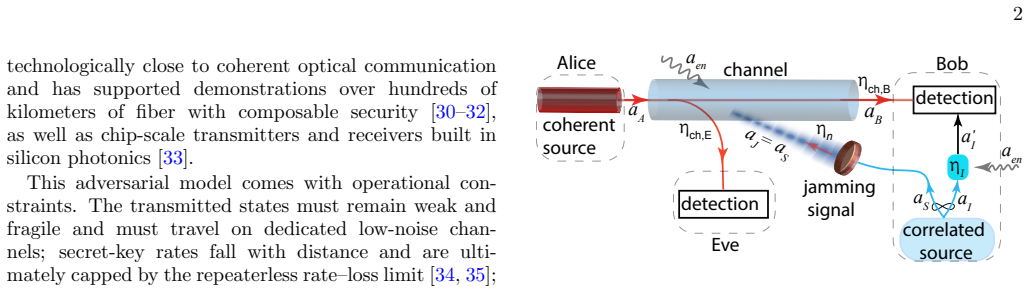


Figures from the paper (3 more)


Reviewed August 10, 2026 · model on record in the stance chip above.
Discussion (0). Continue with ORCID to comment.