REVIEW 4 major objections 5 minor 48 references
Floquet spintronics: tuning the current-induced spin polarization of topological surface states with light
T0 review · 4 major / 5 minor · reviewed 2026-08-10 · deepseek-v4-flash
Pith's one-line read This paper predicts that high-frequency circularly polarized light can reverse the current-induced spin polarization of topological surface states through Floquet topological phase transitions.
desk verdict A clean, coherent Floquet calculation of an amplitude-driven sign reversal in the Edelstein susceptibility of topological surface states, whose only real weakness is the load-bearing occupation ansatz imported from the authors' own unpublished work. read the letter →
The pith
A machine-rendered reading of the paper's core claim, the machinery that carries it, and where it could break.
The reading
What carries the argument
The central object is the electric spin susceptibility tensor $\chi^s_{\alpha\beta}$, defined by $\langle S_\alpha\rangle=\sum_\beta \chi^s_{\alpha\beta} E_\beta$ and computed in the Floquet representation through a Kubo formula built from retarded, advanced, and lesser Green's functions. The calculation is carried by the high-frequency effective Hamiltonian $H_{\mathrm{high}}(k)$ from the Floquet-Magnus expansion, whose spin Bloch vector $\tilde{\mathbf{h}}(k)$ fixes the conduction-band spin texture as $\mathbf{s}(k)=\tilde{\mathbf{h}}(k)/|\tilde{\mathbf{h}}(k)|$. The occupation of Floquet sidebands is set by the Floquet eigenstate-wise thermalization (FEWT) hypothesis, which shifts each sideband's chemical potential by the expectation value of the Floquet index operator; this rule converts the band-structure change into the specific sign-reversal prediction for the susceptibility.
What would settle it
Measure the current-induced spin polarization of an illuminated Bi2Se3 surface, for example by Kerr rotation or spin-sensitive optical detection, while sweeping the normalized field strength through $A\simeq 1.8$ and look for the predicted sign change; equivalently, replace the FEWT occupation rule by a kinetic or master-equation solution of the Floquet steady state and check whether $\chi^s_{xy}$ still crosses zero near the same field strength.
Extended reading notes
Core claim
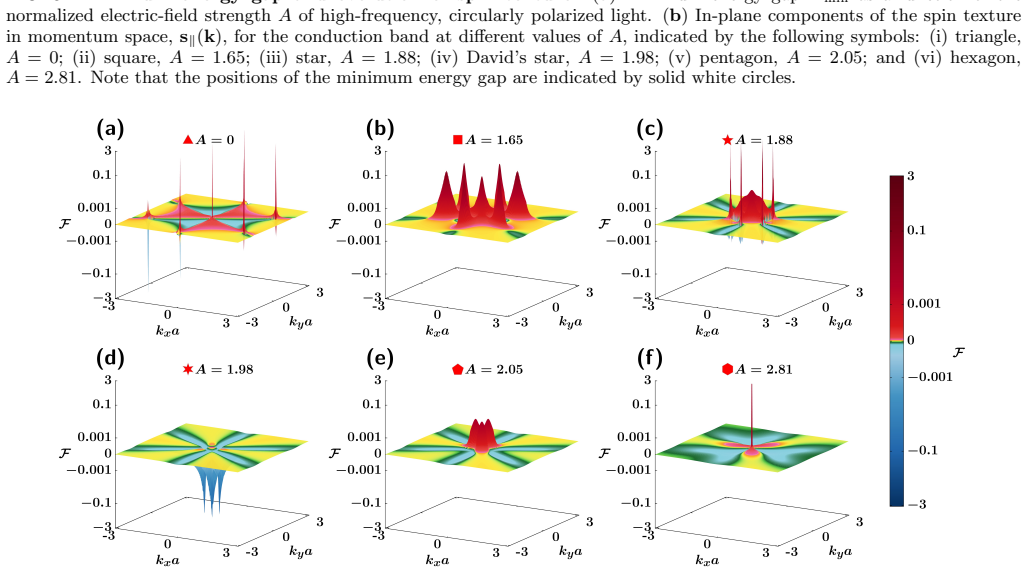
Starting from the effective surface Hamiltonian of Bi2Se3 and coupling it to circularly polarized light through Peierls substitution, the paper derives a high-frequency Floquet effective Hamiltonian and computes the linear-response electric spin susceptibility from nonequilibrium Green's functions with impurity scattering treated in the self-consistent Born approximation. The central result is that $\chi^s_{xy}$ and $\chi^s_{yx}$ are not merely renormalized by the light but change sign at $A\simeq 1.8$, while the longitudinal components $\chi^s_{xx}$ and $\chi^s_{yy}$ remain essentially zero. The sign change is explained by the momentum-space spin texture of the conduction band: the in-plane spin winds clockwise for $A\lesssim 1.65$ and counterclockwise for $A\gtrsim 2.05$, with the transition passing through two gap-closing events at $A=1.88$ and $A=1.98$ where the Berry curvature switches from predominantly positive to predominantly negative. The paper therefore identifies the reversal as a Floquet topological phase transition with a direct electric-transport signature.
Load-bearing premise
The load-bearing assumption is that electrons distribute among the light-dressed Floquet states according to the FEWT rule, which shifts each sideband's chemical potential by the Floquet index operator; if the true steady-state occupation is different, the computed magnitude and even the sign of the transverse susceptibility could change.
Editorial extensions
If this is right
- The sign of the current-induced spin polarization on a topological surface becomes switchable by light intensity at fixed current direction and fixed material.
- The two gap-closing events at $A=1.88$ and $A=1.98$ constitute Floquet topological phase transitions that should be observable as sharp changes in Berry-curvature-related response functions.
- The longitudinal spin susceptibility stays essentially zero across the whole range, so the predicted control is a purely transverse Hall-like effect.
- The sign change is obtained with impurity scattering included at $v_{\mathrm{imp}}=1$ in the self-consistent Born approximation, so the prediction is made for a disordered surface rather than only a clean one.
Reading between the lines
- A natural extension, not tested in the paper, is to compute the same $\chi^s_{xy}(A)$ curve with a microscopic kinetic equation for Floquet occupations; if the sign change persists, the effect would be a strong candidate for all-optical spintronic switching on ultrafast timescales.
- Because the mechanism is governed by the high-frequency effective Hamiltonian's spin Bloch vector, similar light-induced spin-texture reversals should appear in other spin-momentum-locked surfaces and possibly in Rashba two-dimensional electron gases.
- The prediction that the Berry curvature changes from predominantly positive to negative could be probed independently through the circular photogalvanic effect or the anomalous Hall response of the illuminated surface, giving a transport signature separate from the Edelstein spin polarization.
Editorial analysis
A structured set of objections, weighed in public.
Referee Report
Summary. The paper studies the current-induced spin polarization (Edelstein effect) in the surface states of a three-dimensional topological insulator (Bi2Se3) under illumination by high-frequency circularly polarized light. Using Floquet theory, the authors compute the electric spin susceptibility χ^s_{αβ} from a nonequilibrium Green's function formalism with impurity scattering in the self-consistent Born approximation, assuming the Floquet eigenstate-wise thermalization (FEWT) hypothesis for the occupation of Floquet sidebands. They find that the transverse susceptibility χ^s_{xy} and χ^s_{yx} change sign at normalized field strength A≈1.8, while the longitudinal components remain near zero. They attribute this sign reversal to a reversal of the in-plane spin texture of the high-frequency conduction band, driven by topological phase transitions at A=1.88 and A=1.98 where the quasienergy gap closes. The paper also provides an analytic high-frequency effective Hamiltonian via the Floquet-Magnus expansion, with the derivation given in Appendix A.
Significance. If the predicted sign reversal survives scrutiny of the occupation model, the result would be of genuine interest to the Floquet engineering and spintronics communities, as it offers an optical route to controlling the Edelstein effect in topological surface states. The paper's strengths include an explicit derivation of the high-frequency effective Hamiltonian (Appendix A) and a fixed-parameter calculation in which the sign change is not fitted to the target observable. However, the central calculation rests on the FEWT hypothesis from an unpublished preprint and on a Kubo formula also referenced to that preprint, so the significance is conditional on the validation of those ingredients. The spin-texture and Berry-curvature analysis provides a plausible microscopic mechanism, but the quantitative link to the susceptibility sign change is not fully demonstrated.
major comments (4)
- [Nonequilibrium Green's functions, Eqs. (10)-(11)] The FEWT hypothesis, which assigns each Floquet eigenstate a chemical potential shifted by ⟨N⟩_{μnk}Ω, is the sole non-equilibrium occupation rule in the calculation and is imported from the authors' unpublished arXiv:2512.01346 [36]. The sign reversal in Fig. 2(a) is computed from the lesser Green's function G^<, which depends entirely on this ansatz. No derivation or independent validation is provided. Because Eq. (16) assembles χ^s from spectral weights of G^<, the zero crossing at A≈1.8 is precisely the kind of observable that can move or disappear when the occupation rule changes. Please either derive FEWT from a microscopic coupling-to-reservoir model or benchmark it against an alternative steady-state scheme (e.g., Floquet-Born-Markov or a photon-assisted reservoir) and show that the sign reversal persists. Without such a test, the central claim remains conditional.
- [Kubo formula, Eq. (16)] The Floquet generalization of the Kubo formula is justified only by a reference to the same unpublished preprint [36] ('can be derived following the derivation of the similar nonequilibrium Kubo formula [36]'). Since Eq. (16) is the central response formula, the paper should include the derivation in an appendix or at least outline the key steps. As it stands, the calculation is not independently verifiable, and a reader cannot check whether the energy-derivative structure and the Floquet representation of the current operator are correct.
- [High-frequency condition, Fig. 3(a) and text near Eq. (11)] The statement that Ω=8 eV is '1,000 times the minimum energy gap of the quasienergy bands' appears inconsistent with the data shown. At A=0 the effective surface Hamiltonian is gapless at the Γ point (h_x=h_y=h_z=0 at k=0), so the minimum gap is zero; the ratio is then infinite, not 1,000. If a different definition of the gap is intended (e.g., the gap at the Fermi level or the gap for the range of A used), please specify it and give the numerical value. This matters because the high-frequency condition and the FEWT simplification (⟨N⟩≈n) are invoked to justify the occupation scheme.
- [Spin texture reversal and topological phase transitions] The causal connection between the spin-texture reversal and the susceptibility sign change is qualitative. The spin texture begins rotating counterclockwise between A=1.65 and A=1.88, while χ^s crosses zero at A≈1.8, i.e., before the topological transitions at A=1.88 and A=1.98. To substantiate the claim that the reversal of the spin texture causes the sign change, please provide a quantitative relation, for example by evaluating χ^s from the high-frequency spin texture alone and comparing with the full Kubo result, or by decomposing the k-resolved contributions to the Kubo integral and showing that they track the spin-texture orientation.
minor comments (5)
- [Fig. 3(b)] The symbol labeled "David's star" should be rendered as "Star of David" for clarity.
- [Eq. (14)] The notation for the self-energy is slightly ambiguous: the left-hand side has indices (an,bm) while the right-hand side has δ_{ab} and a Green's function with indices (an,am). Consider writing the expression as [Σ^{r,<}(ω)]_{an,am} after applying δ_{ab} to avoid confusion.
- [Text near Eq. (9)] The chemical potential is stated to be 0.28 eV above the Dirac point at A=0, and it is adjusted to maintain the same electron density under illumination. It would be helpful to give the corresponding density or Fermi wavevector, as this affects the physical interpretation of the filling.
- [Reference [44]] The author name "A. Echardt" appears to be a typo for "A. Eckardt" (A. Eckardt and E. Anisimovas, New J. Phys. 17, 093039 (2015)).
- [Abstract and Introduction] The sentence about controlling and reversing the electric spin susceptibility appears nearly verbatim in the abstract and again in the introduction and conclusion. Consider reducing the duplication in the introduction.
Circularity Check
The predicted sign reversal of χ^s_xy is inherited from the self-cited FEWT occupation ansatz (Eqs. 10–11), not from an independently derived nonequilibrium state.
-
ansatz smuggled in via citation
[Eqs. (10)–(11) and the note following Eq. (16)]
"The lesser Green’s function for the Floquet eigenstate can be obtained using the Floquet eigenstate-wise thermalization (FEWT) hypothesis [36]: G<F(k,ω)=(GaF(k,ω)−GrF(k,ω))FFD(k,ω), (10) ... [FFD(k,ω)]μn,νm=fFD(ω−μ0−⟨N⟩μnkΩ)δμνδnm, (11) ... Note that Equation (16) is a Floquet generalization of the equilibrium expression [42], which can be derived following the derivation of the similar nonequilibrium Kubo formula [36]."
The central prediction—the sign reversal of χ^s_xy and χ^s_yx at A≈1.8—is obtained from the Kubo formula (Eq. 16), whose nonequilibrium input is G^<. That lesser Green's function is not derived from the driven Hamiltonian alone; it is constructed by the FEWT ansatz in Eqs. (10)–(11), which assigns each Floquet sideband a chemical potential shifted by ⟨N⟩_{μnk}Ω. This ansatz is imported from the authors' own unpublished preprint [36] and is not independently validated here. Since G^< is the only carrier of steady-state occupation information in Eq. (16), the sign and location of the zero crossing are consequences of the self-cited FEWT occupation rule. With a different photon-assisted reservoir occupation scheme, G^< would differ and the predicted reversal could move or vanish.
full rationale
The paper performs a conventional Floquet–Kubo calculation on a fixed Bi2Se3 surface-state model with no parameter fitted to the target sign change; the model parameters, high-frequency Floquet–Magnus expansion, and SCBA impurity treatment are standard. The spin-texture and Berry-curvature analyses provide independent band-geometry evidence for the reversal. However, the computed electric spin susceptibility is directly built from the lesser Green's function, which is fixed by the FEWT occupation hypothesis imported from the authors' own unpublished arXiv:2512.01346. That hypothesis is load-bearing for the central claim: without independent derivation or validation, the sign reversal remains a consequence of the self-cited ansatz rather than a robust first-principles prediction. This warrants a circularity score of 3, reflecting one significant self-citation that is load-bearing, while the rest of the derivation retains independent content.
Assumptions & free parameters
free parameters (5)
- zeta, lambda, xi, eta (Bi2Se3 surface Hamiltonian parameters) =
-0.0546 eV, 0.0779 eV, 0.1653 eV, 0.0560 eV
- mu0 (chemical potential) =
0.28 eV above the Dirac point
- v_imp (impurity scattering strength) =
1.0
- Omega (light frequency) =
8 eV, with 4 eV mentioned as possible
- a (lattice constant) =
4.14 Angstrom
assumptions (4)
- ad hoc to paper FEWT hypothesis: each Floquet eigenstate thermalizes with chemical potential mu0 plus the Floquet index expectation value times Omega.
- domain assumption H(k) in Eqs. (1) to (4) is the correct low-energy model for Bi2Se3 surface states including hexagonal warping.
- domain assumption The high-frequency Floquet-Magnus expansion truncated at first order in 1/Omega is sufficient.
- domain assumption Delta-function impurity scattering in SCBA with spin-independent self-energy and no vertex correction in the Kubo formula.
Cite this review
Pith. "Pith review of Floquet spintronics: tuning the current-induced spin polarization of topological surface states with light." pith.science (2026). https://pith.science/paper/CV4YWBSM
@misc{pith2026260806786,
  author       = {Pith},
  title        = {Pith review of: Floquet spintronics: tuning the current-induced spin polarization of topological surface states with light},
  year         = {2026},
  howpublished = {\url{https://pith.science/paper/CV4YWBSM}},
  note         = {Machine review of arXiv:2608.06786}
}
read the original abstract
Topological surface states are a promising platform for spintronics due to spin-momentum locking. Spin-momentum locking can induce a net spin polarization in topological surface states via an electric current, a phenomenon known as the Edelstein effect. In this work, using Floquet theory, we show that the current-induced spin polarization of topological surface states can be tuned by illuminating them with light, thereby modifying their spin texture in momentum space. Specifically, the electric spin susceptibility of topological surface states can be controlled and even reversed by varying the electric-field strength of high-frequency, circularly polarized light.
Figures


Figures from the paper (1 more)
Reference graph
Works this paper leans on
- [36]
-
[1]
ˇZuti´ c, J
I. ˇZuti´ c, J. Fabian, and S. Das Sarma, Spintronics: Fun- damentals and applications, Rev. Mod. Phys.76, 323 (2004)
2004
-
[2]
Sinova, D
J. Sinova, D. Culcer, Q. Niu, N. A. Sinitsyn, T. Jung- wirth, and A. H. MacDonald, Universal intrinsic spin hall effect, Phys. Rev. Lett.92, 126603 (2004)
2004
-
[3]
Liu, C.-F
L. Liu, C.-F. Pai, Y. Li, H. W. Tseng, D. C. Ralph, and R. A. Buhrman, Spin-torque switching with the giant spin hall effect of tantalum, Science336, 555 (2012)
2012
-
[4]
Rojas-S´ anchez, S
J.-C. Rojas-S´ anchez, S. Oyarz´ un, Y. Fu, A. Marty, C. Vergnaud, S. Gambarelli, L. Vila, M. Jamet, Y. Oht- subo, A. Taleb-Ibrahimi, P. Le F` evre, F. Bertran, N. Reyren, J.-M. George, and A. Fert, Spin to charge conversion at room temperature by spin pumping into a new type of topological insulator:α-sn films, Phys. Rev. Lett.116, 096602 (2016)
2016
-
[5]
S. Manipatruni, D. E. Nikonov, and I. A. Young, Beyond cmos computing with spin and polarization, Nat. Physics 14, 338 (2018)
work page 2018
-
[6]
B. Dieny, I. L. Prejbeanu, K. Garello, P. Gambardella, P. Freitas, R. Lehndorff, W. Raberg, U. Ebels, S. O. Demokritov, J. Akerman, A. Deac, P. Pirro, C. Adel- mann, A. Anane, A. V. Chumak, A. Hirohata, S. Man- gin, S. O. Valenzuela, M. C. Onba¸ slı, M. d’Aquino, G. Prenat, G. Finocchio, L. Lopez-Diaz, R. Chantrell, O. Chubykalo-Fesenko, and P. Bortolotti...
work page 2020
-
[7]
L. Guo, S. Hu, X. Gu, R. Zhang, K. Wang, W. Yan, and X. Sun, Emerging spintronic materials and functionali- ties, Advanced Materials36, 2301854 (2024)
work page 2024
Show all 48 references
-
[8]
Y. Guo, X. Zhang, Z. Huang, J. Chen, Z. Luo, J. Zhang, J. Li, Z. Zhang, J. Zhao, X. Han, and H. Wu, Quantum materials for spintronic applications, npj Spintronics2, 36 (2024)
2024
-
[9]
Liu and L
Q. Liu and L. Zhu, Enhancing z spin generation in triv- ial spin hall materials for scalable, energy-efficient, field- free, complete spin-orbit torque switching applications, Advanced Science12, e07581 (2025)
2025
-
[10]
Sarkar, S
S. Sarkar, S. Oh, P. J. Newton, Y. Li, Y. Zhu, M. A. Ghani, H. Yan, H. Y. Jeong, Y. Wang, and M. Chhowalla, Spin injection in graphene using ferromagnetic van der waals contacts of indium and cobalt, Nat. Electron.8, 215 (2025)
2025
-
[11]
Z. Jia, M. Zhao, Q. Chen, Y. Tian, L. Liu, F. Zhang, D. Zhang, Y. Ji, B. Camargo, K. Ye, R. Sun, Z. Wang, and Y. Jiang, Spintronic devices upon 2d magnetic ma- terials and heterojunctions, ACS Nano19, 9452 (2025)
2025
-
[12]
Xie, S.-Y
Y. Xie, S.-Y. Zhang, Y. Yin, N. Zheng, A. Ali, M. Younis, S. Ruan, and Y.-J. Zeng, Emerging ferromagnetic mate- rials for electrical spin injection: towards semiconductor spintronics, npj Spintronics3, 10 (2025)
2025
-
[13]
Hsieh, Y
D. Hsieh, Y. Xia, L. Wray, D. Qian, A. Pal, J. H. Dil, J. Osterwalder, F. Meier, G. Bihlmayer, C. L. Kane, Y. S. Hor, R. J. Cava, and M. Z. Hasan, Observation of un- conventional quantum spin textures in topological insu- lators, Science323, 919 (2009)
2009
-
[14]
C. H. Li, O. M. J. van’t Erve, J. T. Robinson, Y. Liu, L. Li, and B. T. Jonker, Electrical detection of charge- current-induced spin polarization due to spin-momentum locking in bi 2se3, Nat. Nanotechnol.9, 218 (2014)
2014
-
[15]
L. Tai, H. He, S. K. Chong, H. Zhang, H. Huang, G. Qiu, Y. Ren, Y. Li, H.-Y. Yang, T.-H. Yang, X. Dong, B. Dai, T. Qu, Q. Shu, Q. Pan, P. Zhang, F. Xue, J. Li, A. V. Davydov, and K. L. Wang, Giant hall switching by surface-state-mediated spin-orbit torque in a hard ferro- magn...
2024
-
[16]
Edelstein, Spin polarization of conduction electrons induced by electric current in two-dimensional asymmet- ric electron systems, Solid State Communications73, 233 (1990)
V. Edelstein, Spin polarization of conduction electrons induced by electric current in two-dimensional asymmet- ric electron systems, Solid State Communications73, 233 (1990)
1990
-
[17]
A. R. Mellnik, J. S. Lee, A. Richardella, J. L. Grab, P. J. Mintun, M. H. Fischer, A. Vaezi, A. Manchon, E.-A. Kim, N. Samarth, and D. C. Ralph, Spin-transfer torque generated by a topological insulator, Nature511, 449 (2014)
2014
-
[18]
Johansson, B
A. Johansson, B. G¨ obel, J. Henk, M. Bibes, and I. Mertig, Spin and orbital edelstein effects in a two-dimensional electron gas: Theory and application to srtio 3 interfaces, Phys. Rev. Res.3, 013275 (2021)
2021
-
[19]
Johansson, Theory of spin and orbital edelstein effects, J
A. Johansson, Theory of spin and orbital edelstein effects, J. Phys.: Condens. Matt.36, 8529 (2025)
2025
-
[20]
M. Hu, O. Janson, C. Felser, P. McClarty, J. van den Brink, and M. G. Vergniory, Spin hall and edelstein ef- fects in chiral non-collinear altermagnets, Nat. Commun. 16, 8529 (2025)
2025
-
[21]
Oka and H
T. Oka and H. Aoki, Photovoltaic hall effect in graphene, Phys. Rev. B79, 081406(R) (2009)
2009
-
[22]
Mikami, S
T. Mikami, S. Kitamura, K. Yasuda, N. Tsuji, T. Oka, and H. Aoki, Brillouin-wigner theory for high-frequency expansion in periodically driven systems: Application to floquet topological insulators, Phys. Rev. B93, 144307 (2016)
2016
-
[23]
K. W. Kim, H. Kwon, and K. Park, Floquet topological semimetal with a helical nodal line in 2+1 dimensions, Phys. Rev. B99, 115136 (2019)
2019
-
[24]
J. W. McIver, B. Schulte, F.-U. Stein, T. Matsuyama, G. Jotzu, G. Meier, and A. Cavalleri, Light-induced anomalous hall effect in graphene, Nat. Phys.16, 38–41 (2020)
2020
-
[25]
Merboldt, M
M. Merboldt, M. Sch¨ uler, D. Schmitt, J. P. Bange, W. Bennecke, K. Gadge, K. Pierz, H. W. Schumacher, D. Momeni, D. Steil, S. R. Manmana, M. A. Sentef, 8 M. Reutzel, and S. Mathias, Observation of floquet states in graphene, Nat. Phys.21, 1093 (2025)
2025
-
[26]
Oka and S
T. Oka and S. Kitamura, Floquet engineering of quantum materials, Annu. Rev. Condens. Matter Phys.10, 387 (2019)
2019
-
[27]
M. S. Rudner and N. H. Lindner, Band structure engi- neering and non-equilibrium dynamics in floquet topo- logical insulators, Nat. Rev. Phys.2, 229–244 (2020)
2020
-
[28]
J.-Y. Shan, M. Ye, H. Chu, S. Lee, J.-G. Park, L. Balents, and D. Hsieh, Giant modulation of optical nonlinearity by floquet engineering, Nature600, 235–239 (2021)
2021
-
[29]
Sandholzer, A.-S
K. Sandholzer, A.-S. Walter, J. Minguzzi, Z. Zhu, K. Viebahn, and T. Esslinger, Floquet engineering of in- dividual band gaps in an optical lattice using a two-tone drive, Phys. Rev. Research4, 013056 (2022)
2022
-
[30]
Castro, U
A. Castro, U. D. Giovannini, S. A. Sato, H. H¨ ubener, and A. Rubio, Floquet engineering the band structure of ma- terials with optimal control theory, Phys. Rev. Research 4, 033213 (2022)
2022
-
[31]
S. Zhou, C. Bao, B. Fan, H. Zhou, Q. Gao, H. Zhong, T. Lin, H. Liu, P. Yu, P. Tang, S. Meng, W. Duan, and S. Zhou, Pseudospin-selective floquet band engineering in black phosphorus, Nature614, 75–80 (2023)
2023
-
[32]
Kobayashi, C
Y. Kobayashi, C. Heide, A. C. Johnson, V. Tiwari, F. Liu, D. A. Reis, T. F. Heinz, and S. Ghimire, Flo- quet engineering of strongly driven excitons in monolayer tungsten disulfide, Nat. Phys.19, 171–176 (2023)
2023
-
[33]
Takahashi, H
Y. Takahashi, H. Miyamoto, K. Kuroki, and T. Kaneko, Floquet engineering of effective pairing interactions in a doped band insulator, Phys. Rev. B111, 125104 (2025)
2025
-
[34]
Baykusheva, A
D. Baykusheva, A. Chac´ on, D. Kim, D. E. Kim, D. A. Reis, and S. Ghimire, Strong-field physics in three- dimensional topological insulators, Phys. Rev. A103, 023101 (2021)
2021
-
[35]
Bianchi, D
M. Bianchi, D. Guan, S. Bao, J. Mi, B. B. Iversen, P. D. C. King, and P. Hofmann, Coexistence of the topo- logical state and a two-dimensional electron gas on the surface of bi 2se3, Nat. Commun.1, 128 (2010)
2010
-
[37]
Shi and X
J. Shi and X. C. Xie, Radiation-induced ”zero-resistance state” and the photon-assisted transport, Phys. Rev. Lett.91, 086801 (2003)
2003
-
[38]
A. C. Durst, S. Sachdev, N. Read, and S. M. Girvin, Radiation-induced magnetoresistance oscillations in a 2d electron gas, Phys. Rev. Lett.91, 086803 (2003)
2003
-
[39]
Park, Radiation-induced zero-resistance state at low magnetic fields and near half-filling of the lowest landau level, Phys
K. Park, Radiation-induced zero-resistance state at low magnetic fields and near half-filling of the lowest landau level, Phys. Rev. B69, 201301(R) (2004)
2004
-
[40]
Lee and K
W.-R. Lee and K. Park, Dielectric breakdown via emer- gent nonequilibrium steady states of the electric-field- driven mott insulator, Phys. Rev. B89, 205126 (2014)
2014
-
[41]
Hwang, W.-R
K. Hwang, W.-R. Lee, and K. Park, Electric quantum oscillations in weyl semimetals, Phys. Rev. Research3, 033132 (2021)
2021
-
[42]
C.-X. Liu, B. Zhou, S.-Q. Shen, and B.-f. Zhu, Current- induced spin polarization in a two-dimensional hole gas, Phys. Rev. B77, 125345 (2008)
2008
-
[43]
Bukov, L
M. Bukov, L. D’Alessio, and A. Polkovnikov, Universal high-frequency behavior of periodically driven systems: from dynamical stabilization to floquet engineering, Ad- vances in Physics64, 139 (2015)
2015
-
[44]
Echardt and E
A. Echardt and E. Anisimovas, High-frequency approx- imation for periodically driven quantum systems from a floquet-space perspective, New J. Phys.17, 093039 (2015)
2015
-
[45]
Schiffrin, T
A. Schiffrin, T. Paasch-Colberg, N. Karpowicz, V. Apalkov, D. Gerster, S. M¨ uhlbrandt, M. Korb- man, J. Reichert, M. Schultze, S. Holzner, J. V. Barth, R. Kienberger, R. Ernstorfer, V. S. Yakovlev, M. I. Stockman, and F. Krausz, Optical-field-induced current in dielectrics, N...
2013
-
[46]
Mayer, C
B. Mayer, C. Schmidt, A. Grupp, J. B¨ uhler, J. Oel- mann, R. E. Marvel, J. R. F. Haglund, T. Oka, D. Brida, A. Leitenstorfer, and A. Pashkin, Tunneling breakdown of a strongly correlated insulating state in VO 2 induced by intense multiterahertz excitation, Phys. Rev. B91, 23...
2015
-
[47]
Higuchi, C
T. Higuchi, C. Heide, K. Ullmann, H. B. Weber, and P. Hommelhoff, Light-field-driven currents in graphene, Nature550, 224–228 (2017)
2017
-
[48]
Uchida, S
K. Uchida, S. Kusaba, K. Nagai, T. N. Ikeda, and K. Tanaka, Diabatic and adiabatic transitions between floquet states imprinted in coherent exciton emission in monolayer WSe2, Sci. Adv.8, eabq7281 (2022)
2022
Reviewed August 10, 2026 · model on record in the stance chip above.
Discussion (0). Continue with ORCID to comment.