REVIEW 4 major objections 4 minor 99 references
Unordered Landmark Visual Navigation
T0 review · 4 major / 4 minor · reviewed 2026-08-11 · deepseek-v4-flash
Pith's one-line read This paper argues that a robot can navigate to an image goal using only an unordered pile of RGB photos, with no odometry, depth, or temporal priors, by building a verified topological graph and tracking a belief over it.
desk verdict Genuinely new unordered-image navigation setting and a well-built system, but the paper's own ablation undercuts the 'temporal-free' headline: the local planners are trained with temporal distance, and removing it cuts success roughly in half. read the letter →
The pith
A machine-rendered reading of the paper's core claim, the machinery that carries it, and where it could break.
The reading
What carries the argument
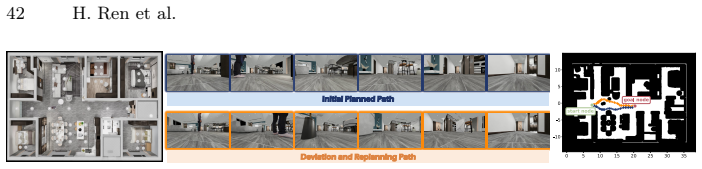
Three named components carry the argument. RAVEL (Robust Augmentation and Verification of Landmarks) builds the topological graph: each candidate edge from VPR retrieval is verified by LightGlue+RANSAC, with an inlier threshold $\tau$ and retrieval radius $d_{\text{VPR}}$ set by clustering the matching statistics of two anchor images, then the graph is pruned to a maximum spanning forest and strong loop edges are reinserted. BPL (Belief Propagation Localization) tracks the robot by row-normalizing the cumulative $K$-hop reachability matrix $C=\sum_{m=0}^{K} A^m$ into a transition matrix, and fusing predicted belief with an exponential observation likelihood through the normalized geometric mean with entropy-adaptive weights. BASS (Belief-Aware Subgoal Search) computes the widest path on the graph, i.e. the path maximizing the minimum inlier-count edge weight, and replans when the MAP node falls off the planned path. The connecting idea is that visual overlap between images is used as a proxy for spatial proximity at every stage, from edge weights to the transition model.
What would settle it
Collect unordered photos in a space with large mirrors, glass walls, or repeated identical offices, build the ULVN graph, and run navigation; if the graph contains edges that cross non-traversable boundaries, so that edge precision on these scenes is markedly below the reported 0.71 value, and navigation success falls accordingly, then the visual-overlap proxy is the failure point.
Extended reading notes
Core claim
On the paper's own terms, the discovery is that the hard problem of navigating from unordered images is not solved by better local control but by co-designing three modules so that errors do not accumulate: RAVEL turns the image set into a sparse, reliable graph by using VPR-specific global descriptors for recall, LightGlue+RANSAC inlier counts for geometric verification, a one-shot scene-calibrated threshold, a maximum spanning forest backbone, and selective reinsertion of strong loop closures; BPL localizes on that graph by diffusing a belief over multi-hop adjacency and fusing the observation likelihood with an entropy-dependent weight; and BASS plans the path whose minimum edge weight is maximized, then replans when the MAP node leaves the path. The paper claims this RGB-only, odometry-free pipeline outperforms prior topological navigation methods and end-to-end baselines in simulated and real-world deployments, and specifically that removing the temporal-distance signal from local planner training or replacing BPL with temporal-distance localization both degrade navigation success.
Load-bearing premise
Visual overlap between two images is treated as a proxy for physical traversability, so two photos that look alike, such as the same wall, a mirror reflection, or a repeating corridor, can be linked even when no path connects them.
Editorial extensions
If this is right
- A robot can close the loop with no temporal or metric priors: it can localize, plan, execute image-goal navigation, and recover from deviations using only RGB images and a topological graph.
- Unordered photo collections become a viable map source: on GRScenes, RAVEL reaches 0.7365 F1 for graph edges, versus 0.6043 to 0.3806 for retrieval-based Top-k adaptations used as baselines.
- Relying on a graph-based belief state is more robust than inferring position from temporal distance: BPL achieves 95.49% localization accuracy versus 91.09% for MegaLoc on GRScenes, and stays above 0.89 accuracy under rotation-plus-noise perturbations.
- The same topological backbone improves end-to-end navigation once paired with existing local planners: ULVN+NoMaD reaches 71.9% success and 0.798 SPL, outperforming Uni-Navid (32.0%, 0.239) and UniGoal (61.6%, 0.318), and beating the variant that uses temporal-distance localization (59.6%).
- If the claim holds, temporal order is not a prerequisite for visual navigation; it is one training signal that a belief-based topological state can partly replace.
Reading between the lines
- Because edges are kept when geometric inlier counts exceed a threshold, the same machinery will likely create false connections in spaces with mirrors, glass walls, or repeated identical textures; a targeted test on such scenes would reveal whether the visual-overlap proxy is the main failure boundary.
- A testable scaling claim is that using the same RAVEL+BPL+BASS stack on large crowd-sourced photo collections, such as property listings or tourist photos, and comparing success rates against a video-captured map would quantify how much of the remaining gap is caused by missing temporal structure rather than by image coverage.
- The paper's own numbers imply that, since localization accuracy sits near 95% while navigation success sits near 72%, the remaining bottleneck is the local planner's obstacle handling; improving that controller should transfer directly to higher end-to-end success without changing the topological modules.
- The entropy-adaptive fusion rule has a natural extension to active perception: when entropy is high, the robot could choose the next viewpoint that most reduces belief uncertainty rather than simply trusting the observation likelihood.
Editorial analysis
A structured set of objections, weighed in public.
Referee Report
Summary. The paper proposes ULVN, an RGB-only image-goal navigation framework that builds a topological graph from an unordered image collection (RAVEL), localizes a robot on that graph with a belief-propagation filter (BPL), and executes closed-loop navigation via belief-aware subgoal selection (BASS). The authors report strong quantitative results: RAVEL achieves an F1 of 0.7365 for topological mapping, BPL achieves 95.49% localization accuracy versus 91.09% for MegaLoc, and the full system reaches 71.9% navigation success with NoMaD on GRScenes, with a real-world deployment on a wheeled robot. The paper also releases a dataset and ablation studies for mapping, localization, and navigation.
Significance. If the results hold as stated, ULVN would be a valuable contribution: it demonstrates that a fully appearance-based topological pipeline can support closed-loop navigation without odometry or metric reconstruction, and its component-wise ablations (MSF, adaptive fusion, and local-planner integration) give useful insight into where performance comes from. The released dataset and the explicit comparison against retrieval-only and temporal-distance baselines are concrete strengths. However, the central 'free from temporal priors' claim is not supported as written, because the headline navigation results depend on local planners pretrained with temporal-distance supervision. The paper's value therefore depends on whether the authors can either reposition the claim or provide a genuinely temporal-free local planner; as written, the contribution is significant but overstated.
major comments (4)
- [Abstract, Sec. 1, Sec. 3.3, Sec. 4.5, Table 7] The central claim that ULVN is 'free from temporal and odometric priors' is internally inconsistent with the executed system. Section 3.3 delegates low-level control to ViNT or NoMaD, and Section 4.5's ablation (Table 7, rows 'ULVN+VINT-A' and 'ULVN+NoMaD-A') shows that removing the temporal-distance loss from local-planner training drops success rate from 68.1% to 31.0% for ViNT and from 71.9% to 54.3% for NoMaD. The paper itself calls temporal distance 'a crucial auxiliary training signal.' If 'temporal-free' means only that no temporal information is used at inference time, that scope is not stated in the abstract or introduction, and the claim as written is load-bearing for the paper's novelty. Please rephrase the claim to specify inference-time temporal-free operation and explicitly discuss that local planners are pretrained with temporal supervision, or provide a version of the system whose local control is trained without temporal signals.
- [Sec. 3.2, Sec. 4.1, Appendix D] The observation-likelihood scaling parameter lambda is reported inconsistently in three places. Section 3.2 defines L(vi|It) = exp(-lambda * ||zt - z_i||^2) and states lambda = 5; Section 4.1 (Implementation Details) states lambda = 10; Appendix D introduces an adaptive formula lambda = ln(delta) / (q0.975(d) - q0.025(d)) and derives the likelihood as proportional to exp(-lambda * d(zt, zi)), with no explanation of how these formulations relate. Since the BPL accuracy numbers in Tables 4-6 depend directly on this parameter, the manuscript must reconcile these definitions and state which value or formula produced each reported result.
- [Sec. 3.1, Sec. 4.1, Sec. 4.2, Table 2] Several key constants are hand-set or calibrated on the same data used for evaluation, and the manuscript does not quantify their sensitivity. The inlier threshold tau and retrieval radius d_VPR are calibrated from a single anchor pair (q0 and qf) chosen from the test set, the loop-reinsertion threshold is tau_add = 1.5*tau, the reachability depth is K = 3, the deviation trigger is D_thres = 3, and the fusion weights are determined by a piecewise function of entropy. Appendix F reports the distribution of calibrated thresholds but does not report how navigation success, localization accuracy, or mapping F1 change when these parameters are perturbed. Given that the one-shot calibration depends on the specific anchor pair, the paper should provide at least a sensitivity analysis or cross-validation over anchor choices, otherwise the reported gains could be partly attributable to in-sample parameter tuning.
- [Sec. 3, Sec. 3.1, Sec. 4.6] The framework's navigational correctness rests on the assumption that visual overlap (as measured by LightGlue+RANSAC inlier counts) is a valid proxy for spatial traversability, with edges retained only above a calibrated inlier threshold. The paper acknowledges this proxy in Section 3 but does not address environments where it breaks down: windows, mirrors, glass partitions, and repetitive commercial textures. The real-world evaluation in Section 4.6 is a single trial that does not contain such cases, and the reported F1 of 0.7365 means roughly a quarter of inferred edges are wrong or missing, which can produce shortcuts through walls in the topological graph and mislead the belief-transition matrix. Please add a discussion of these failure modes and, if possible, a controlled experiment (e.g., adding mirror or glass regions in simulation) to bound the effect of the proxy violation.
minor comments (4)
- [Sec. 4.1] The phrase 'if the high-confidence cluster Sh is valid (k=2)' is unclear, because Section 3.1 defines two-means clustering (k=2) for threshold calibration and separately k=10 for loop-reinsertion clustering; please clarify which k applies to which step and why the calibration cluster could be invalid.
- [Table 7] The label 'ULVN+VINT-A' uses an inconsistent capitalization and does not match the ViNT notation used elsewhere in the paper; please unify the naming in the table and in the surrounding text.
- [Sec. 5] The conclusion states that 'ULVN validates lightweight topological memory as a highly scalable, robust solution' but does not mention the local planners' reliance on temporal supervision, which is a key caveat from Section 4.5; please add a sentence summarizing the scope of the claim.
- [Sec. 4.1] The default values tau_default = 15 and d_VPR,default = 1.7 are given without explaining when the defaults are used or whether any reported result uses them; please state the frequency of fallback to defaults across the evaluated scenes.
Circularity Check
No definitional circularity; navigation outcomes are measured independently, though the 'temporal-free' claim is internally inconsistent.
full rationale
ULVN's central derivation is self-contained rather than circular. RAVEL's thresholds (τ and d_VPR) are calibrated from the same unordered image library used for evaluation, but the reported mapping F1 is scored against an independent geometric skeleton ground truth: 'the underlying skeletal structure provides the absolute ground-truth connectivity matrix used to evaluate the precision and recall of RAVEL's generated graphs' (Sec. 4.2), so the edge-quality numbers are not forced by the calibration. BPL is evaluated on held-out novel poses against external baselines; its belief update is a standard prediction-correction recursion and its reported accuracy is an externally compared outcome, not a refitted constant. BASS navigation is scored with 'standard Habitat ImageNav metrics' (Sec. 4.1), so success is a physical measure rather than simply the belief output. The only overlapping-author citation with any role in the evaluation is [33], used to extract the skeleton ground truth; this is evaluation infrastructure, not a premise from which the results are derived, and it does not make the results equivalent to the inputs. The paper's own Sec. 4.5 admits that 'temporal distance acts as a crucial auxiliary training signal' and Table 7 shows the -A ablation (removing temporal-distance supervision) drops SR from 68.1% to 31.0% with ViNT and from 71.9% to 54.3% with NoMaD; this contradicts the headline claim of being 'free from temporal and odometric priors' and is a serious claim-consistency and correctness problem, but it is a scope/overclaim issue rather than a circular derivation. Calibrating thresholds in-sample is also a generalization weakness, not a case where a prediction equals its fit by construction. The score of 2 reflects the minor overlapping-author citation in the evaluation pipeline and the in-sample calibration concern, neither of which rises to definitional circularity.
Assumptions & free parameters
free parameters (8)
- lambda (observation likelihood scale) =
5 (Sec 3.2), 10 (Sec 4.1), or adaptive quantile formula (App. D)
- K (reachability depth) =
3
- tau (inlier threshold) =
per-scene from k-means; fallback 15
- d_VPR (retrieval radius) =
per-scene from strongest cluster; fallback 1.7
- tau_add (loop reinsertion threshold) =
1.5 * tau
- D_thres (deviation trigger) =
3
- k for loop-reinsertion clustering =
10
- fusion-weight constants (Appendix D) =
wp(0.6/0.3 scheme with breakpoints 0.3, 0.7)
assumptions (6)
- domain assumption Visual overlap between images is a proxy for spatial proximity and traversability.
- ad hoc to paper A uniform multi-hop random walk over graph adjacency models robot motion between belief updates.
- domain assumption MegaLoc global descriptors provide reliable place identity for retrieval and observation likelihood.
- ad hoc to paper Two-means clustering on pooled anchor inlier counts separates valid from spurious geometric matches.
- ad hoc to paper Maximum spanning forest on inlier-count weights yields a correct navigational skeleton.
- domain assumption LightGlue+RANSAC inlier counts are a reliable geometric verification signal.
Cite this review
Pith. "Pith review of Unordered Landmark Visual Navigation." pith.science (2026). https://pith.science/paper/TUITPPBR
@misc{pith2026260806833,
  author       = {Pith},
  title        = {Pith review of: Unordered Landmark Visual Navigation},
  year         = {2026},
  howpublished = {\url{https://pith.science/paper/TUITPPBR}},
  note         = {Machine review of arXiv:2608.06833}
}
read the original abstract
Image-goal navigation is a fundamental capability for embodied AI, yet its practical deployment is strained by strong prior assumptions. Existing methods predominantly rely on temporally ordered video streams or auxiliary sensors (e.g., depth, LiDAR) to maintain spatial consistency. These sequential and multimodal dependencies severely restrict scalability, especially when deploying robots using crowd-sourced or pre-recorded unordered image collections. When temporal priors are removed, current methods struggle with severe perceptual aliasing, noisy associations, and catastrophic mapping failures. To address this underexplored challenge, we propose Unordered Landmark Visual Navigation (ULVN), a unified RGB-only framework free from temporal and odometric priors. ULVN systematically mitigates error accumulation by integrating mapping, localization, and planning. Specifically, it constructs a robust 2D topological map directly from unstructured images via calibrated geometric verification and maximum spanning forest refinement. For closed-loop execution, ULVN abandons sequential heuristics, utilizing a graph-based belief propagation filter with entropy-adaptive fusion for global localization and dynamic subgoal planning. Extensive experiments in simulation and real-world deployments demonstrate that ULVN significantly outperforms state-of-the-art methods.
Figures


Figures from the paper (20 more)




Reference graph
Works this paper leans on
-
[1]
arXiv preprint arXiv:1807.06757 (2018)
Anderson, P., Chang, A., Chaplot, D.S., Dosovitskiy, A., Gupta, S., Koltun, V., Kosecka, J., Malik, J., Mottaghi, R., Savva, M., et al.: On evaluation of embodied navigation agents. arXiv preprint arXiv:1807.06757 (2018)
arXiv 2018
-
[2]
In: European Conference on Computer Vision
Barath, D., Mishkin, D., Cavalli, L., Sarlin, P.E., Hruby, P., Pollefeys, M.: Stere- oglue: Robust estimation with single-point solvers. In: European Conference on Computer Vision. pp. 421–441. Springer (2024)
2024
-
[3]
In: Proceedings of the Computer Vision and Pattern Recognition Conference
Berton, G., Masone, C.: Megaloc: One retrieval to place them all. In: Proceedings of the Computer Vision and Pattern Recognition Conference. pp. 2861–2867 (2025)
2025
-
[4]
IEEE Robotics and Automation Letters9(2), 1310–1317 (2023)
Berton, G., Trivigno, G., Caputo, B., Masone, C.: Jist: Joint image and sequence training for sequential visual place recognition. IEEE Robotics and Automation Letters9(2), 1310–1317 (2023)
2023
-
[5]
In: 2018 IEEE International Conference on Robotics and Automation (ICRA)
Blochliger, F., Fehr, M., Dymczyk, M., Schneider, T., Siegwart, R.: Topomap: Topological mapping and navigation based on visual slam maps. In: 2018 IEEE International Conference on Robotics and Automation (ICRA). pp. 3818–3825. IEEE (2018)
2018
-
[6]
Journal of intelligent and robotic systems53, 263–296 (2008)
Bonin-Font, F., Ortiz, A., Oliver, G.: Visual navigation for mobile robots: A survey. Journal of intelligent and robotic systems53, 263–296 (2008)
2008
-
[7]
In: Proceedings 2007 IEEE International Conference on Robotics and Automation
Booij, O., Terwijn, B., Zivkovic, Z., Krose, B.: Navigation using an appearance based topological map. In: Proceedings 2007 IEEE International Conference on Robotics and Automation. pp. 3927–3932. IEEE (2007)
2007
-
[8]
IEEE Transactions on robotics32(6), 1309– 1332 (2016)
Cadena, C., Carlone, L., Carrillo, H., Latif, Y., Scaramuzza, D., Neira, J., Reid, I., Leonard, J.J.: Past, present, and future of simultaneous localization and mapping: Toward the robust-perception age. IEEE Transactions on robotics32(6), 1309– 1332 (2016)
2016
Show all 99 references
-
[9]
IEEE Robotics and Automation Letters (2024)
Claxton,O., Malone,C., Carson, H.,Ford,J.J., Bolton,G., Shames, I.,Milford, M.: Improving visual place recognition based robot navigation by verifying localization estimates. IEEE Robotics and Automation Letters (2024)
2024
-
[10]
In: European Con- ference on Computer Vision
Cui, X., Liu, Q., Liu, Z., Wang, H.: Frontier-enhanced topological memory with improved exploration awareness for embodied visual navigation. In: European Con- ference on Computer Vision. pp. 296–313. Springer (2024)
2024
-
[11]
The International journal of robotics research27(6), 647–665 (2008)
Cummins,M.,Newman,P.:Fab-map:Probabilisticlocalizationandmappinginthe space of appearance. The International journal of robotics research27(6), 647–665 (2008)
2008
-
[12]
In: Conference on robot learning
Dosovitskiy, A., Ros, G., Codevilla, F., Lopez, A., Koltun, V.: Carla: An open urban driving simulator. In: Conference on robot learning. pp. 1–16. PMLR (2017)
2017
-
[13]
IEEE Transactions on Big Data (2025)
Douze, M., Guzhva, A., Deng, C., Johnson, J., Szilvasy, G., Mazaré, P.E., Lomeli, M., Hosseini, L., Jégou, H.: The faiss library. IEEE Transactions on Big Data (2025)
2025
-
[14]
In: Pro- ceedings of the Computer Vision and Pattern Recognition Conference
Edstedt, J.: Less biased noise scale estimation for threshold-robust ransac. In: Pro- ceedings of the Computer Vision and Pattern Recognition Conference. pp. 2811– 2820 (2025) 16 H. Ren et al
2025
-
[15]
In: European Conference on Computer Vi- sion
Fan, S., Liu, R., Wang, W., Yang, Y.: Navigation instruction generation with bev perception and large language models. In: European Conference on Computer Vi- sion. pp. 368–387. Springer (2024)
2024
-
[16]
Journal of field robotics27(5), 534–560 (2010)
Furgale, P., Barfoot, T.D.: Visual teach and repeat for long-range rover autonomy. Journal of field robotics27(5), 534–560 (2010)
2010
-
[17]
IEEE Transactions on Pattern Analysis and Machine Intelligence46(2), 994–1010 (2023)
Gao, C., Liu, S., Chen, J., Wang, L., Wu, Q., Li, B., Tian, Q.: Room-object entity prompting and reasoning for embodied referring expression. IEEE Transactions on Pattern Analysis and Machine Intelligence46(2), 994–1010 (2023)
2023
-
[18]
Garg, S., Fischer, T., Milford, M.: Where is your place, visual place recognition? In: Proceedings of the Thirtieth International Joint Conference on Artificial In- telligence (IJCAI-21). pp. 4416–4425. International Joint Conferences on Artificial Intelligence (2021)
2021
-
[19]
In: 2024 IEEE International Conference on Robotics and Automation (ICRA)
Garg, S., Rana, K., Hosseinzadeh, M., Mares, L., Sünderhauf, N., Dayoub, F., Reid, I.: Robohop: Segment-based topological map representation for open-world visual navigation. In: 2024 IEEE International Conference on Robotics and Automation (ICRA). pp. 4090–4097. IEEE (2024)
2024
-
[20]
arXiv (2024)
Gode, S., et al.: Flownav: Learning efficient navigation policies via conditional flow matching. arXiv (2024)
2024
-
[21]
Nature Machine Intelligence6(7), 820–833 (2024)
Gornet, J., Thomson, M.: Automated construction of cognitive maps with visual predictive coding. Nature Machine Intelligence6(7), 820–833 (2024)
2024
-
[22]
Commu- nications of the ACM32(3), 359–373 (1989)
Guo, Z., Hall, R.W.: Parallel thinning with two-subiteration algorithms. Commu- nications of the ACM32(3), 359–373 (1989)
1989
-
[23]
He,K.,Zhang,X.,Ren,S.,Sun,J.:Deepresiduallearningforimagerecognition.In: Proceedings of the IEEE conference on computer vision and pattern recognition. pp. 770–778 (2016)
2016
-
[24]
IEEE Robotics and Automation Letters (2023)
Hirose, N., Shah, D., Sridhar, A., Levine, S.: Sacson: Scalable autonomous control for social navigation. IEEE Robotics and Automation Letters (2023)
2023
-
[25]
IEEE Robotics and Automation Letters4(4), 3184–3191 (2019)
Hirose, N., Xia, F., Martín-Martín, R., Sadeghian, A., Savarese, S.: Deep visual mpc-policy learning for navigation. IEEE Robotics and Automation Letters4(4), 3184–3191 (2019)
2019
-
[26]
In: 2024 IEEE/RSJ International Conference on Intelligent Robots and Systems (IROS)
Hossain, J., Faridee, A.Z., Roy, N., Freeman, J., Gregory, T., Trout, T.: Toponav: Topological navigation for efficient exploration in sparse reward environments. In: 2024 IEEE/RSJ International Conference on Intelligent Robots and Systems (IROS). pp. 693–700. IEEE (2024)
2024
-
[27]
In: 2009 IEEE Conference on Computer Vision and Pattern Recognition
Irschara, A., Zach, C., Frahm, J.M., Bischof, H.: From structure-from-motion point clouds to fast location recognition. In: 2009 IEEE Conference on Computer Vision and Pattern Recognition. pp. 2599–2606. IEEE (2009)
2009
-
[28]
In: The Thirteenth International Conference on Learning Representations (2025)
Jiang, Y., Liu, Q., Yang, Y., Ma, X., Zhong, D., Hu, H., Yang, J., Liang, B., XU, B., Zhang, C., et al.: Episodic novelty through temporal distance. In: The Thirteenth International Conference on Learning Representations (2025)
2025
-
[29]
IEEE Transactions on Big Data7(3), 535–547 (2019)
Johnson, J., Douze, M., Jégou, H.: Billion-scale similarity search with gpus. IEEE Transactions on Big Data7(3), 535–547 (2019)
2019
-
[30]
IEEE Transactions on Affective Computing13(2), 1086– 1097 (2020)
Kamila, S., Hasanuzzaman, M., Ekbal, A., Bhattacharyya, P.: Measuring tem- poral distance focus from tweets and investigating its association with psycho- demographic attributes. IEEE Transactions on Affective Computing13(2), 1086– 1097 (2020)
2020
-
[31]
IEEE Robotics and Automation Letters (2022) Unordered Landmark Visual Navigation 17
Karnan, H., Nair, A., Xiao, X., Warnell, G., Pirk, S., Toshev, A., Hart, J., Biswas, J., Stone, P.: Socially compliant navigation dataset (scand): A large-scale dataset of demonstrations for social navigation. IEEE Robotics and Automation Letters (2022) Unordered Landmark Visu...
2022
-
[32]
IEEE Robotics and Automation Letters (2025)
Li, H., Peng, G., Zhang, J., Wen, M., Ma, Y., Wang, D.: Casevpr: Correlation- aware sequential embedding for sequence-to-frame visual place recognition. IEEE Robotics and Automation Letters (2025)
2025
-
[33]
IEEE Robotics and Automation Letters (2025)
Li, Z., Zheng, K., Yuan, Y., Huang, J., Zhang, X., Wu, J., Cheng, H.: Learn- ing to explore efficiently: Heterogeneous topological graphs and lightweight global reasoning for robotic exploration. IEEE Robotics and Automation Letters (2025)
2025
-
[34]
In: Proceedings of the IEEE/CVF international conference on com- puter vision
Lindenberger, P., Sarlin, P.E., Pollefeys, M.: Lightglue: Local feature matching at light speed. In: Proceedings of the IEEE/CVF international conference on com- puter vision. pp. 17627–17638 (2023)
2023
-
[35]
Proceedings of Robotics: Science and Systems (RSS) (2024)
Liu, P., Orru, Y., Paxton, C., Shafiullah, N.M.M., Pinto, L.: Ok-robot: What re- ally matters in integrating open-knowledge models for robotics. Proceedings of Robotics: Science and Systems (RSS) (2024)
2024
-
[36]
arXiv preprint arXiv:2210.00030 (2022)
Ma, Y.J., Sodhani, S., Jayaraman, D., Bastani, O., Kumar, V., Zhang, A.: Vip: Towards universal visual reward and representation via value-implicit pre-training. arXiv preprint arXiv:2210.00030 (2022)
2022 arXiv
-
[37]
Advances in Neural Information Processing Systems35, 32340–32352 (2022)
Majumdar, A., Aggarwal, G., Devnani, B., Hoffman, J., Batra, D.: Zson: Zero- shot object-goal navigation using multimodal goal embeddings. Advances in Neural Information Processing Systems35, 32340–32352 (2022)
2022
-
[38]
Miao, J., Jiang, K., Wen, T., Wang, Y., Jia, P., Wijaya, B., Zhao, X., Cheng, Q., Xiao, Z., Huang, J., Zhong, Z., Yang, D.: A survey on monocular re-localization: Fromtheperspectiveofscenemaprepresentation.IEEETransactionsonIntelligent Vehicles10(4), 2519–2550 (2025)
2025
-
[39]
In: 2012 IEEE international conference on robotics and automation
Milford, M.J., Wyeth, G.F.: Seqslam: Visual route-based navigation for sunny sum- mer days and stormy winter nights. In: 2012 IEEE international conference on robotics and automation. pp. 1643–1649. IEEE (2012)
2012
-
[40]
IEEE Robotics and Automation Letters (2024)
Montano-Oliván, L., Placed, J.A., Montano, L., Lázaro, M.T.: G-loc: Tightly- coupled graph localization with prior topo-metric information. IEEE Robotics and Automation Letters (2024)
2024
-
[41]
IEEE Robotics and Automation Letters (2025)
Muravyev, K., Melekhin, A., Yudin, D., Yakovlev, K.: Prism-topomap: online topo- logical mapping with place recognition and scan matching. IEEE Robotics and Automation Letters (2025)
2025
-
[42]
In: International Conference on Machine Learning
Myers, V., Zheng, C., Dragan, A., Levine, S., Eysenbach, B.: Learning tempo- ral distances: Contrastive successor features can provide a metric structure for decision-making. In: International Conference on Machine Learning. pp. 37076– 37096. PMLR (2024)
2024
-
[43]
IEEE Robotics and Automation Letters 4(4), 3200–3207 (2019)
Neubert, P., Schubert, S., Protzel, P.: A neurologically inspired sequence processing model for mobile robot place recognition. IEEE Robotics and Automation Letters 4(4), 3200–3207 (2019)
2019
-
[44]
IEEE Robotics and Automation Letters9(1), 555–562 (2023)
Noël, T., Lehuger, A., Marchand, E., Chaumette, F.: Skeleton disk-graph roadmap: A sparse deterministic roadmap for safe 2d navigation and exploration. IEEE Robotics and Automation Letters9(1), 555–562 (2023)
2023
-
[45]
arXiv preprint arXiv:2304.07193 (2023)
Oquab, M., Darcet, T., Moutakanni, T., Vo, H., Szafraniec, M., Khalidov, V., Fernandez, P., Haziza, D., Massa, F., El-Nouby, A., et al.: Dinov2: Learning robust visual features without supervision. arXiv preprint arXiv:2304.07193 (2023)
2023 arXiv
-
[46]
In: Proceedings of the IEEE/CVF International Conference on Com- puter Vision
Piedade, V., Miraldo, P.: Bansac: A dynamic bayesian network for adaptive sample consensus. In: Proceedings of the IEEE/CVF International Conference on Com- puter Vision. pp. 3738–3747 (2023)
2023
-
[47]
In: Proceed- ings of the IEEE/CVF Conference on Computer Vision and Pattern Recognition
Ren, H., Bi, Z., Zeng, Y., Wan, Z., Qi, L., Cheng, H.: Strnet: Visual navigation with spatio-temporal representation through dynamic graph aggregation. In: Proceed- ings of the IEEE/CVF Conference on Computer Vision and Pattern Recognition. pp. 42464–42473 (2026) 18 H. Ren et al
2026
-
[48]
arXiv preprint arXiv:2605.29937 (2026)
Ren, H., Bi, Z., Zeng, Y., Zheng, L., Li, Z., Wan, Z., Qi, L., Cheng, H.: Fisher- preserving guidance: Training-free manifold constraints for safe diffusion control. arXiv preprint arXiv:2605.29937 (2026)
2026 arXiv
-
[49]
In: Proceedings of the Computer Vision and Pattern Recognition Conference
Ren, H., Zeng, Y., Bi, Z., Wan, Z., Huang, J., Cheng, H.: Prior does matter: Visual navigation via denoising diffusion bridge models. In: Proceedings of the Computer Vision and Pattern Recognition Conference. pp. 12100–12110 (2025)
2025
-
[50]
In: 2024 IEEE International Conference on Robotics and Automation (ICRA)
Roth, P., Nubert, J., Yang, F., Mittal, M., Hutter, M.: Viplanner: Visual semantic imperative learning for local navigation. In: 2024 IEEE International Conference on Robotics and Automation (ICRA). pp. 5243–5249. IEEE (2024)
2024
-
[51]
IEEE transactions on pattern analysis and machine intelligence39(9), 1744–1756 (2016)
Sattler, T., Leibe, B., Kobbelt, L.: Efficient & effective prioritized matching for large-scale image-based localization. IEEE transactions on pattern analysis and machine intelligence39(9), 1744–1756 (2016)
2016
-
[52]
In: International Conference on Learning Representations (2018)
Savinov, N., Dosovitskiy, A., Koltun, V.: Semi-parametric topological memory for navigation. In: International Conference on Learning Representations (2018)
2018
-
[53]
In: Proceedings of the IEEE/CVF international conference on computer vision
Savva, M., Kadian, A., Maksymets, O., Zhao, Y., Wijmans, E., Jain, B., Straub, J., Liu, J., Koltun, V., Malik, J., et al.: Habitat: A platform for embodied ai research. In: Proceedings of the IEEE/CVF international conference on computer vision. pp. 9339–9347 (2019)
2019
-
[54]
In: Proceedings of the IEEE conference on computer vision and pattern recognition
Schonberger, J.L., Frahm, J.M.: Structure-from-motion revisited. In: Proceedings of the IEEE conference on computer vision and pattern recognition. pp. 4104–4113 (2016)
2016
-
[55]
In: European conference on computer vision
Schönberger, J.L., Zheng, E., Frahm, J.M., Pollefeys, M.: Pixelwise view selection for unstructured multi-view stereo. In: European conference on computer vision. pp. 501–518. Springer (2016)
2016
-
[56]
arXiv preprint arXiv:2104.05859 (2021)
Shah,D.,Eysenbach,B.,Kahn,G.,Rhinehart,N.,Levine,S.:Rapidexplorationfor open-world navigation with latent goal models. arXiv preprint arXiv:2104.05859 (2021)
2021 arXiv
-
[57]
In: 2021 IEEE International Conference on Robotics and Automation (ICRA)
Shah, D., Eysenbach, B., Kahn, G., Rhinehart, N., Levine, S.: Ving: Learning open-world navigation with visual goals. In: 2021 IEEE International Conference on Robotics and Automation (ICRA). pp. 13215–13222. IEEE (2021)
2021
-
[58]
In: 2023 IEEE International Conference on Robotics and Automation (ICRA)
Shah, D., Sridhar, A., Bhorkar, A., Hirose, N., Levine, S.: Gnm: A general naviga- tion model to drive any robot. In: 2023 IEEE International Conference on Robotics and Automation (ICRA). pp. 7226–7233. IEEE (2023)
2023
-
[59]
Shah, D., Sridhar, A., Dashora, N., Stachowicz, K., Black, K., Hirose, N., Levine, S.:Vint:Afoundationmodelforvisualnavigation.arXivpreprintarXiv:2306.14846 (2023)
2023 arXiv
-
[60]
IEEE Robotics and Au- tomation Letters9(12), 11881–11888 (2024)
Shi, P., Yan, S., Xiao, Y., Liu, X., Zhang, Y., Li, J.: Ransac back to sota: A two-stage consensus filtering for real-time 3d registration. IEEE Robotics and Au- tomation Letters9(12), 11881–11888 (2024)
2024
-
[61]
arXiv preprint arXiv:2606.07514 (2026)
Song, M., Zhang, D., Ren, H., Zhang, R., Du, B., Yang, M.H., Qi, L.: Unisharp: Universal sharp monocular view synthesis. arXiv preprint arXiv:2606.07514 (2026)
2026 arXiv
-
[62]
In: 2024 IEEE International Conference on Robotics and Automation (ICRA)
Sridhar, A., Shah, D., Glossop, C., Levine, S.: Nomad: Goal masked diffusion poli- cies for navigation and exploration. In: 2024 IEEE International Conference on Robotics and Automation (ICRA). pp. 63–70. IEEE (2024)
2024
-
[63]
In: European Conference on Computer Vision
Sun, X., Liu, L., Zhi, H., Qiu, R., Liang, J.: Prioritized semantic learning for zero-shot instance navigation. In: European Conference on Computer Vision. pp. 161–178. Springer (2024)
2024
-
[64]
real training data for visual navigation
Suomela, L., Arachchige, S.K., Torres, G.F., Edelman, H., Kämäräinen, J.K.: Syn- thetic vs. real training data for visual navigation. arXiv preprint arXiv:2509.11791 (2025) Unordered Landmark Visual Navigation 19
2025
-
[65]
In: 2024 IEEE International Conference on Robotics and Automation (ICRA)
Suomela, L., Kalliola, J., Edelman, H., Kämäräinen, J.K.: Placenav: Topological navigation through place recognition. In: 2024 IEEE International Conference on Robotics and Automation (ICRA). pp. 5205–5213. IEEE (2024)
2024
-
[66]
In: Proceedings of the IEEE/CVF Conference on Computer Vision and Pattern Recognition
Thoma, J., Paudel, D.P., Chhatkuli, A., Probst, T., Gool, L.V.: Mapping, localiza- tion and path planning for image-based navigation using visual features and map. In: Proceedings of the IEEE/CVF Conference on Computer Vision and Pattern Recognition. pp. 7383–7391 (2019)
2019
-
[67]
Artificial intelligence99(1), 21–71 (1998)
Thrun, S.: Learning metric-topological maps for indoor mobile robot navigation. Artificial intelligence99(1), 21–71 (1998)
1998
-
[68]
Communications of the ACM45(3), 52–57 (2002)
Thrun, S.: Probabilistic robotics. Communications of the ACM45(3), 52–57 (2002)
2002
-
[69]
arXiv preprint arXiv:2506.07490 (2025)
Wan, Z., Bi, Z., Zhou, Z., Ren, H., Zeng, Y., Li, Y., Qi, L., Yang, X., Yang, M.H., Cheng, H.: Rapid hand: A robust, affordable, perception-integrated, dex- terous manipulation platform for generalist robot autonomy. arXiv preprint arXiv:2506.07490 (2025)
2025 arXiv
-
[70]
arXiv preprint arXiv:2407.10943 (2024)
Wang, H., Chen, J., Huang, W., Ben, Q., Wang, T., Mi, B., Huang, T., Zhao, S., Chen, Y., Yang, S., et al.: Grutopia: Dream general robots in a city at scale. arXiv preprint arXiv:2407.10943 (2024)
2024 arXiv
-
[71]
In: Proceedings of the Computer Vision and Pattern Recognition Conference
Wang, J., Chen, M., Karaev, N., Vedaldi, A., Rupprecht, C., Novotny, D.: Vggt: Visual geometry grounded transformer. In: Proceedings of the Computer Vision and Pattern Recognition Conference. pp. 5294–5306 (2025)
2025
-
[72]
In: Proceedings of the IEEE/CVF International Conference on Computer Vision
Wei, T., Patel, Y., Shekhovtsov, A., Matas, J., Barath, D.: Generalized differ- entiable ransac. In: Proceedings of the IEEE/CVF International Conference on Computer Vision. pp. 17649–17660 (2023)
2023
-
[73]
IEEE Robotics and Automation Letters6(4), 6985–6992 (2021)
Xu, M., Fischer, T., Sünderhauf, N., Milford, M.: Probabilistic appearance- invariant topometric localization with new place awareness. IEEE Robotics and Automation Letters6(4), 6985–6992 (2021)
2021
-
[74]
ACM Computing Surveys (CSUR)53(1), 1–34 (2020)
Yasuda, Y.D., Martins, L.E.G., Cappabianco, F.A.: Autonomous visual naviga- tion for mobile robots: A systematic literature review. ACM Computing Surveys (CSUR)53(1), 1–34 (2020)
2020
-
[75]
In: Proceedings of the Computer Vision and Pattern Recognition Conference
Yin, H., Xu, X., Zhao, L., Wang, Z., Zhou, J., Lu, J.: Unigoal: Towards universal zero-shot goal-oriented navigation. In: Proceedings of the Computer Vision and Pattern Recognition Conference. pp. 19057–19066 (2025)
2025
-
[76]
arXiv preprint (2025)
Zeng, Y., Ren, H., Wang, S., Huang, J., Cheng, H.: Navidiffusor: Cost-guided diffusion model for visual navigation. arXiv preprint (2025)
2025
-
[77]
arXiv preprint arXiv:2412.06224 (2024)
Zhang, J., Wang, K., Wang, S., Li, M., Liu, H., Wei, S., Wang, Z., Zhang, Z., Wang, H.: Uni-navid: A video-based vision-language-action model for unifying embodied navigation tasks. arXiv preprint arXiv:2412.06224 (2024)
2024 arXiv
-
[78]
Engineering Applications of Artificial Intelligence114, 105036 (2022)
Zhang, T., Hu, X., Xiao, J., Zhang, G.: A survey of visual navigation: From geome- try to embodied ai. Engineering Applications of Artificial Intelligence114, 105036 (2022)
2022
-
[79]
Communications of the ACM27(3), 236–239 (1984)
Zhang, T.Y., Suen, C.Y.: A fast parallel algorithm for thinning digital patterns. Communications of the ACM27(3), 236–239 (1984)
1984
-
[80]
In: 2025 IEEE 21st International Conference on Automation Science and Engineering (CASE)
Zhang, W., Hara, Y., Nakamura, S.: Topological mapping and navigation using a monocular camera based on anyloc. In: 2025 IEEE 21st International Conference on Automation Science and Engineering (CASE). pp. 3077–3083. IEEE (2025)
2025
-
[81]
Pattern Recognition113, 107760 (2021)
Zhang, X., Wang, L., Su, Y.: Visual place recognition: A survey from deep learning perspective. Pattern Recognition113, 107760 (2021)
2021
-
[82]
IEEE Robotics and Automation Letters9(3), 2351–2358 (2024) 20 H
Zhao, J., Zhang, F., Cai, Y., Tian, G., Mu, W., Ye, C., Feng, T.: Learning sequence descriptor based on spatio-temporal attention for visual place recognition. IEEE Robotics and Automation Letters9(3), 2351–2358 (2024) 20 H. Ren et al
2024
-
[83]
centerlines
Zhu, Y., Mottaghi, R., Kolve, E., Lim, J.J., Gupta, A., Fei-Fei, L., Farhadi, A.: Target-driven visual navigation in indoor scenes using deep reinforcement learning. In: 2017 IEEE international conference on robotics and automation (ICRA). pp. 3357–3364. IEEE (2017) Unordered ...
2017
-
[84]
Observation Likelihood:We compute the likelihoodL(vi|It)based on the Euclidean distanced(z t, zi)between the query embeddingz t and the node em- beddingsz i. To handle varying dynamic ranges in feature space, we calculate an adaptive scaling factorλ: λ= ln(δ) q0.975(d)−q 0.025...
-
[85]
Entropy-based Weighting:A core contribution of our method is the adap- tive weighting of prediction versus observation based on the uncertainty of the current belief. We quantify uncertainty using the normalized Shannon entropy ηof the belief distribution: η(b) = − P i b(vi) l...
-
[86]
Summary.Belief propagation localization provides an elegant solution for es- timating the robot’s position in a topological map without relying on tempo- ral or odometric data
Geometric Fusion Update:Finally, the updated posterior beliefbt is com- puted via the geometric weighted average of the prior belief and the likelihood: bt(vi)∝ ¯bt(vi)wp ·L(v i|It)wo .(41) This multiplicative fusion (equivalent to a weighted sum in log-space) is sharper than ...
-
[87]
Initial Localization: The robot’s belief is first updated using the Belief Propagation Localization (BPL) module to determine the initial probability dis- tribution over the topological graph
-
[88]
This goal node serves as the destination for the navigation task
Goal Identification: The goal is represented by a target image, and the robot’s belief state is updated to reflect the most likely node that corresponds to the goal. This goal node serves as the destination for the navigation task
-
[89]
, vgoal}is computed from the most likely starting node to the goal node
Global Path Planning: Before selecting immediate subgoals, a global topo- logical pathP={v 0, v1, . . . , vgoal}is computed from the most likely starting node to the goal node. This path consists of a sequence of visual landmarks (nodes) connected by traversable edges
-
[90]
look- ahead
Dynamic Subgoal Selection: As the robot navigates, BASS uses the current belief state to determine the robot’s progress along the pathP. It selects a "look- ahead" node on the path as the immediate subgoal to drive efficient movement
-
[91]
If the robot localizes itself off the path, the system triggers a replanning procedure
Deviation Check and Replanning: Crucially, BASS continuously verifies if the robot’s current belief state is consistent with the nodes contained in the global pathP. If the robot localizes itself off the path, the system triggers a replanning procedure. Path-Dependent Subgoal ...
-
[92]
At time stept, the robot estimates its location indexkon the path such that the beliefb t(vk)is maximized among all nodes inP
Localization on Path: Let the global path be defined as a sequence of nodes P. At time stept, the robot estimates its location indexkon the path such that the beliefb t(vk)is maximized among all nodes inP. k∗ = argmaxk bt(vk),wherev k ∈P(42) 34 H. Ren et al
-
[93]
The subgoalvsub is chosen as: vsub =v k∗+∆,(43) where∆represents a look-ahead window
Look-Ahead Selection: Once the robot’s current location indexk∗ on the path is identified, BASS selects a downstream node as the immediate subgoal to encourage forward progress. The subgoalvsub is chosen as: vsub =v k∗+∆,(43) where∆represents a look-ahead window. This ensures ...
-
[94]
This path is planned using a local planner that takes into account both the belief state and the topological graph
Path Execution: The robot follows the path from its current location to the selected subgoal. This path is planned using a local planner that takes into account both the belief state and the topological graph. As the robot moves, its belief about its position is updated using ...
-
[95]
This deviation is detected by com- paring the robot’s current belief state with the expected belief based on the planned path
Deviation Detection: If the robot deviates significantly from the planned path, BASS triggers a replanning mechanism. This deviation is detected by com- paring the robot’s current belief state with the expected belief based on the planned path. If the belief state shows that t...
-
[96]
This iterative process continues until the robot reaches the final goal or the belief state converges
Replanning and Adaptation: If a deviation occurs or if new information is obtained (e.g., through visual observations), the belief state is updated, and the path to the goal is recomputed. This iterative process continues until the robot reaches the final goal or the belief st...
-
[97]
Topological Mapping: We validate the robustness of the one-shot calibration mechanism in RAVEL through a sensitivity analysis. Additionally, we statistically evaluate the proper- ties of the constructed topological graphs across multiple dimensions, including the number of con...
-
[98]
Localization: We conducted simulated global localization experiments on time-series nav- igation datasets. For each image within a clip, we applied image processing techniques, including cropping, viewpoint modification, and noise injection, to simulate variations in position,...
-
[99]
top-k" limit. The clear peak in the distribution suggests that the method consistently identifies a
Navigation: We present visualizations of navigation paths in selected scenes. Additionally, we provide ablation studies for the navigation method, including experiments on the replanning mechanism and global localization. Detailed Results of Topological Mapping Performance.The...
Reviewed August 11, 2026 · model on record in the stance chip above.
Discussion (0). Continue with ORCID to comment.