REVIEW 3 major objections 4 minor 74 references
Gated-BEPO: Confidence-Gated Bellman Credit Assignment for Large Language Model Agents
T0 review · 3 major / 4 minor · reviewed 2026-08-10 · deepseek-v4-flash
Pith's one-line read Gated-BEPO turns rollout graphs into per-step credit for LLM agents.
desk verdict A genuinely new, cheap credit-assignment mechanism for LLM agents, honestly evaluated, with a real but non-fatal aliasing caveat and a tuning-selection concern on WebShop. read the letter →
The pith
A machine-rendered reading of the paper's core claim, the machinery that carries it, and where it could break.
The reading
What carries the argument
The central object is the empirical rollout graph, built per task-level rollout group by merging identical observations into a node while preserving transition multiplicities. State values are estimated without a critic by iterating the mean-backup Bellman operator $V(s) \leftarrow \frac{1}{|E(s)|}\sum_{(r,s')\in E(s)}[r+\gamma V(s')]$ to a fixed point; the paper uses the average over observed outgoing transitions because the operator is a contraction on the finite graph. From these values, each record gets a fixed-point TD residual $\delta_i = r_i + \gamma V(s'_i) - V(s_i)$, which is centered to zero at every state, and the residuals are accumulated along each original trajectory by GAE as $\hat{A}^{FP}_i = \delta_i + \gamma\lambda \hat{A}^{FP}_{\text{next}}$. The confidence gate $\rho(s) = \mathbf{1}[n(s)\ge n_{\min}\ \text{and}\ |\mathrm{Succ}(s)|\ge b_{\min}]$, with defaults $n_{\min}=b_{\min}=2$, certifies that a state has observed branching before fixed-point credit is activated; the final advantage is $\hat{A}_i = \eta_i\hat{A}^{\text{out}}_i + w\rho(s_i)\hat{A}^{FP}_i$, with the outcome weight $\eta_i$ lowered at gated states.
What would settle it
Build a synthetic environment where the same observation is produced from two hidden states whose optimal actions conflict, train Gated-BEPO with the default gate, and check whether the certified node's advantage ranks the locally correct action positively in both hidden states. A negative ranking for either hidden state's optimal action would refute the branching-certification assumption.
Extended reading notes
Core claim
The central claim is that a state-centered, fixed-point TD comparison on an empirical rollout graph supplies more accurate step-level credit than trajectory-level or pairwise state-matching credit, and that this credit should be fused with outcome credit only when the graph offers local branching evidence. Concretely, the paper shows that merging identical observations within each rollout group, evaluating the resulting graph with the mean-backup Bellman operator, and accumulating fixed-point residuals with GAE yields advantages that reflect both immediate and downstream effects of an action. The graph-confidence gate, requiring at least two observed successors, is the mechanism that decides when this signal is reliable enough to use. Experiments and ablations are offered as evidence that this combination improves success rates on WebShop, ALFWorld, and visual Sokoban and that the mean backup, the gate, and the post-GAE gating order each matter.
Load-bearing premise
The load-bearing premise is that merging identical observations into one graph node produces state values trustworthy enough for credit assignment, even though the same observation can hide different underlying states and each rollout group contains only eight trajectories.
Editorial extensions
If this is right
- Step-level credit should not be applied uniformly: the ablations show that adding fixed-point credit at every state helps less than restricting it to branch-supported states.
- Mean-backup evaluation over the empirical transition distribution is the right baseline; max and softmax backups sharply reduce success, suggesting planning-style backups amplify rare or aliased transitions.
- Delayed credit from downstream states is useful even when those states do not themselves pass the gate, since applying the gate after GAE propagation beats masking or stopping residuals.
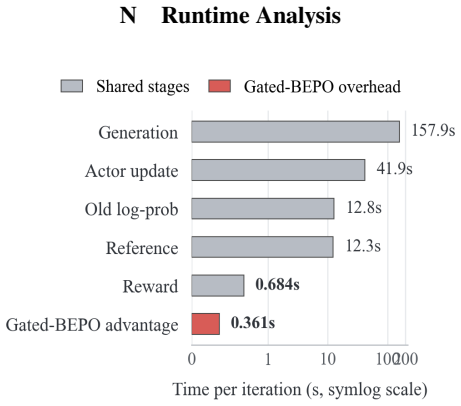
- The method transfers to vision-language agents and to a second model family, with the advantage computation costing about 0.361 seconds per update against roughly 225.7 seconds for the rest of the training step.
Reading between the lines
- An extension the paper leaves open is replacing the hard branching gate with a learned or metric-based confidence over state identity, because the gate certifies statistical support rather than semantic identity; the paper's own aliasing example shows why identity errors matter.
- The same gating rule improved GAGPO in the paper's controlled comparison, so the selective-mixing principle may transfer to other return-proxy step estimators beyond Bellman fixed-point credit.
- The reported gate-coverage curves suggest that shared-state structure changes over training, so the graph values could serve as a cheap, training-time diagnostic for policy concentration and a possible trigger for exploration schedules.
Editorial analysis
A structured set of objections, weighed in public.
Referee Report
Summary. The paper proposes Gated-BEPO, a critic-free advantage estimator for RL fine-tuning of LLM agents. For each rollout group it merges identical observations into an empirical graph, estimates node values through a mean-backup Bellman fixed point, computes per-transition TD residuals, propagates them with GAE, and mixes the resulting step advantage with a group-relative outcome advantage using a confidence gate that opens only at states with observed branching. Experiments on WebShop, ALFWorld, and visual Sokoban with Qwen2.5, Qwen2.5-VL, and Qwen3 backbones report improvements over GRPO, GiGPO, HGPO, GAGPO, and GraphGPO, and component ablations are used to support the design choices.
Significance. If the method's credit signal is reliable, this is a solid contribution: it replaces ad-hoc state matching or graph-distance heuristics with a Bellman evaluation of the empirical action distribution, and it introduces an evidence-gated fusion rule for step- and episode-level credit. The contraction argument around Eq. (4) is clean, the fixed-point residual centering in Eq. (6) is correct, the method ships with released code, and the empirical gains are consistent across three environments and multiple model families. The central premise, however, remains conditional on the merged observation graph being a faithful state abstraction. The paper's own Appendix D concedes that observed branching does not prove that two visits are the same Markov state, and no experiment directly measures whether the Bellman residual signs are correct under perceptual aliasing. The aggregate task-performance gains are encouraging but do not by themselves establish the accuracy of the step-level credit that the method claims.
major comments (3)
- [Empirical Graph and Bellman Fixed Point, Eqs. (3)-(5); Appendix D; Observation Aliasing] The central credit signal delta_i in Eq. (5) is defined on an observation-abstraction graph, but Eq. (3) merges all records with the same observation key regardless of latent state. When two hidden states map to the same observation, V(s) from Eq. (4) is the fixed point of a mixture of transition distributions, and delta_i can be positive for an action that is bad in one latent state and negative for a necessary action in another. Appendix D acknowledges this ('it does not prove that the two visits represent the same Markov state'), and the gate in Eq. (9) opens precisely on merged states with branching, where mixing is most severe; with eta_min=0.5 the wrong fixed-point term still enters the update. The matched-protocol result in Figure 4 shows that Gated-BEPO is more robust than GraphGPO, but it does not test whether the residual signs are correct. To support the central claim, the authors should report an experiment with observable latent state (e.g., a hidden-inventory environment or a POMDP wrapper) comparing the sign/rank of delta_i with the true latent-state advantage, or compare Gated-BEPO under raw observations versus alias-free augmented observations. Without such a test, the statement that Bellman fixed-point estimation provides 'more accurate step-level credit' is not established.
- [Experimental Setup; RQ3-RQ4; Appendix A; Tables 7, 9, 11] The final hyperparameters (lambda=0.8, w=1.5, eta_min=0.5, n_min=b_min=2, 20 Bellman iterations) were selected from ablations run on WebShop, and the ablations use a fixed training seed as stated before RQ1. The headline WebShop gains in Table 2 are therefore measured on the same benchmark used for model selection. The transfer to ALFWorld and Sokoban with the same settings is reassuring, but the one-seed ablation protocol does not allow the reader to quantify selection noise. The authors should either report multi-seed ablation curves for the main sensitive settings (at least lambda, w, and iteration budget), or present a WebShop result obtained under a pre-specified configuration not tuned on WebShop, or otherwise bound the selection effect.
- [Confidence-Gated Credit Mixing, Eq. (2); Eq. (10); Figure 8] The claim that the eta_i rule 'helps keep advantage scales comparable between gated and ungated states' is not supported by the definitions. At an ungated state A_hat = A_out, while at a gated state A_hat = 0.5 A_out + 1.5 A_FP; if A_out is approximately unit variance under Eq. (11) and A_FP is standardized to unit variance, the gated records will have larger variance, so PPO clipping acts differently on the two sets. The paper does not report the mean or standard deviation of the final mixed advantage separately for gated and ungated records; Figure 8 reports only global statistics. Please add this diagnostic or explicitly analyze the effect of the scale discontinuity, since it is otherwise confounded with the credit-accuracy benefit that the paper claims.
minor comments (4)
- [Observation Aliasing section] The explanation of why Gated-BEPO remains effective under aliasing—that different occurrences of the same observation can receive different credit via GAE when their successors and returns differ—appears in Appendix C but should be stated in the main text before Figure 4, since it is central to interpreting that figure.
- [Confidence-Gated Credit Mixing, Eq. (9)] The redundancy of n_min and b_min is explained, but the separate role of n_min would be clearer if the text stated explicitly that the default (2,2) setting makes the gate depend only on |Succ(s)| >= 2 and that n_min is only exercised by the strict-visit ablation in Table 5.
- [Table 2] For the ALFWorld 'All' column, the text says 'overall average' but does not specify whether it is a macro-average over the six subtasks or an average over all evaluated task instances; please state the aggregation rule.
- [Appendix A, Table 7] The entry 'KL loss low-variance, 0.01' is cryptic; please define the KL-loss form and its coefficient explicitly in the table or surrounding text.
Circularity Check
No significant circularity: the Bellman advantage estimates are direct functions of the empirical rollout graph, and the central claims are tested on external benchmarks.
full rationale
Gated-BEPO's step-level credit is computed from the empirical rollout graph by Eqs. (3)-(7): values are the mean-backup Bellman fixed point over observed transitions, residuals are TD errors, and advantages are GAE accumulations. These are estimates of the current policy's empirical return distribution, not quantities fitted to the reported outcome metrics. The only equality that is true by construction, Eq. (6) (residuals centered at each merged state), is presented as a property of the estimator, not as a predicted result. The paper never claims to derive benchmark accuracy from the Bellman equations; instead it uses the resulting advantages as a training signal and measures performance on WebShop, ALFWorld, and Sokoban against external baselines with matched protocols. The gate and mixing weights are ablated rather than derived from the target results, and Appendix D explicitly states that observed branching 'does not prove that the two visits represent the same Markov state,' treating aliasing as a residual limitation rather than a hidden premise. No load-bearing argument relies on a self-citation or on an imported uniqueness theorem. Hence no circular step is identifiable.
Assumptions & free parameters
free parameters (6)
- Discount factor gamma =
0.95
- GAE decay lambda =
0.8
- Step weight w =
1.5
- Trusted-state outcome weight eta_min =
0.5
- Gate thresholds n_min and b_min =
2, 2
- Bellman iteration budget =
20
assumptions (5)
- standard math With gamma < 1, the mean Bellman backup is a contraction on the finite empirical graph and has a unique fixed point (Equation 4).
- domain assumption The empirical transition multiset E(s) sampled from K=8 rollouts reflects the current policy's action distribution.
- domain assumption Merging identical observation hashes into a single node yields a state space on which a Markov value function is meaningful.
- standard math The GAE recursion (Equation 7) with gamma * lambda < 1 provides bounded advantage estimates.
- domain assumption Outcome-typed absorbing states with value zero correctly represent success, failure, and truncation.
Cite this review
Pith. "Pith review of Gated-BEPO: Confidence-Gated Bellman Credit Assignment for Large Language Model Agents." pith.science (2026). https://pith.science/paper/BRXCK4B6
@misc{pith2026260806861,
  author       = {Pith},
  title        = {Pith review of: Gated-BEPO: Confidence-Gated Bellman Credit Assignment for Large Language Model Agents},
  year         = {2026},
  howpublished = {\url{https://pith.science/paper/BRXCK4B6}},
  note         = {Machine review of arXiv:2608.06861}
}
read the original abstract
Training large language model agents in long-horizon environments requires assigning credit from sparse terminal outcomes to individual actions. Existing critic-free methods propagate trajectory-level rewards uniformly across steps, while recent approaches construct step-level groups by matching repeated states and compare actions within each group. The former cannot distinguish useful actions in failed trajectories from ineffective actions in successful ones. The latter rely on step credit derived directly from individual trajectory outcomes and fixed-weight fusion with episode-level credit. We propose Gated-BEPO, which derives step-level credit from empirical rollout graphs. For each rollout group, Gated-BEPO constructs an empirical graph and estimates node values through a mean-backup Bellman fixed point that reflects the empirical action distribution of the current policy. We then accumulate these temporal-difference residuals along each sampled trajectory using generalized advantage estimation, yielding step-level Bellman advantages that capture both immediate and downstream effects. To adaptively fuse episode- and step-level credit, a confidence gate incorporates Bellman credit only at states with multiple observed successors and otherwise uses episode-level credit. Experiments on WebShop, ALFWorld, and visual Sokoban show consistent improvements across language and vision-language models, while diagnostic ablations support the effectiveness of Bellman fixed-point value estimation and show that step-level credit should be incorporated selectively rather than uniformly into the final advantage.
Figures


Figures from the paper (7 more)


Reference graph
Works this paper leans on
-
[1]
International Conference on Learning Representations , year=
High-Dimensional Continuous Control Using Generalized Advantage Estimation , author=. International Conference on Learning Representations , year=
-
[2]
2017 , eprint=
Proximal Policy Optimization Algorithms , author=. 2017 , eprint=
2017
-
[3]
Yao, Shunyu and Chen, Howard and Yang, John and Narasimhan, Karthik , title =. Proceedings of the 36th International Conference on Neural Information Processing Systems , articleno =. 2022 , isbn =
work page 2022
-
[4]
International Conference on Learning Representations , year=
ALFWorld: Aligning Text and Embodied Environments for Interactive Learning , author=. International Conference on Learning Representations , year=
-
[5]
2025 , eprint=
Qwen2.5 Technical Report , author=. 2025 , eprint=
2025
-
[6]
Advances in Neural Information Processing Systems , volume=
Group-in-group policy optimization for llm agent training , author=. Advances in Neural Information Processing Systems , volume=
-
[7]
Forty-third International Conference on Machine Learning , year=
Beyond Trajectory-Level Attribution: Graph-Based Credit Assignment for Agentic Reinforcement Learning , author=. Forty-third International Conference on Machine Learning , year=
-
[8]
The Fourteenth International Conference on Learning Representations , year=
Hierarchy-of-Groups Policy Optimization for Long-Horizon Agentic Tasks , author=. The Fourteenth International Conference on Learning Representations , year=
Show all 74 references
-
[9]
2023 , html =
Yao, Shunyu and Zhao, Jeffrey and Yu, Dian and Du, Nan and Shafran, Izhak and Narasimhan, Karthik and Cao, Yuan , booktitle =. 2023 , html =
2023
-
[10]
2024 , eprint=
DeepSeekMath: Pushing the Limits of Mathematical Reasoning in Open Language Models , author=. 2024 , eprint=
2024
-
[11]
The Twelfth International Conference on Learning Representations , year=
Let's Verify Step by Step , author=. The Twelfth International Conference on Learning Representations , year=
-
[12]
Toolformer: language models can teach themselves to use tools , year =
Schick, Timo and Dwivedi-Yu, Jane and Dess\'. Toolformer: language models can teach themselves to use tools , year =. Proceedings of the 37th International Conference on Neural Information Processing Systems , articleno =
-
[13]
Proceedings of the 37th International Conference on Neural Information Processing Systems , articleno =
Shinn, Noah and Cassano, Federico and Gopinath, Ashwin and Narasimhan, Karthik and Yao, Shunyu , title =. Proceedings of the 37th International Conference on Neural Information Processing Systems , articleno =. 2023 , publisher =
2023
-
[14]
Transactions on Machine Learning Research , issn=
Voyager: An Open-Ended Embodied Agent with Large Language Models , author=. Transactions on Machine Learning Research , issn=. 2024 , url=
2024
-
[15]
and Leike, Jan and Brown, Tom B
Christiano, Paul F. and Leike, Jan and Brown, Tom B. and Martic, Miljan and Legg, Shane and Amodei, Dario , title =. Proceedings of the 31st International Conference on Neural Information Processing Systems , pages =. 2017 , isbn =
2017
-
[16]
and Lowe, Ryan and Voss, Chelsea and Radford, Alec and Amodei, Dario and Christiano, Paul , title =
Stiennon, Nisan and Ouyang, Long and Wu, Jeff and Ziegler, Daniel M. and Lowe, Ryan and Voss, Chelsea and Radford, Alec and Amodei, Dario and Christiano, Paul , title =. Proceedings of the 34th International Conference on Neural Information Processing Systems , articleno =. 20...
2020
-
[17]
Ouyang, Long and Wu, Jeff and Jiang, Xu and Almeida, Diogo and Wainwright, Carroll L. and Mishkin, Pamela and Zhang, Chong and Agarwal, Sandhini and Slama, Katarina and Ray, Alex and Schulman, John and Hilton, Jacob and Kelton, Fraser and Miller, Luke and Simens, Maddie and As...
2022
-
[18]
and Gillhofer, Michael and Widrich, Michael and Unterthiner, Thomas and Brandstetter, Johannes and Hochreiter, Sepp , title =
Arjona-Medina, Jose A. and Gillhofer, Michael and Widrich, Michael and Unterthiner, Thomas and Brandstetter, Johannes and Hochreiter, Sepp , title =. Proceedings of the 33rd International Conference on Neural Information Processing Systems , articleno =. 2019 , publisher =
2019
-
[19]
2026 , eprint=
From Reasoning to Agentic: Credit Assignment in Reinforcement Learning for Large Language Models , author=. 2026 , eprint=
2026
-
[21]
Yujia Qin and Shihao Liang and Yining Ye and Kunlun Zhu and Lan Yan and Yaxi Lu and Yankai Lin and Xin Cong and Xiangru Tang and Bill Qian and Sihan Zhao and Lauren Hong and Runchu Tian and Ruobing Xie and Jie Zhou and Mark Gerstein and dahai li and Zhiyuan Liu and Maosong Sun...
2024
-
[22]
AgentBench: Evaluating
Xiao Liu and Hao Yu and Hanchen Zhang and Yifan Xu and Xuanyu Lei and Hanyu Lai and Yu Gu and Hangliang Ding and Kaiwen Men and Kejuan Yang and Shudan Zhang and Xiang Deng and Aohan Zeng and Zhengxiao Du and Chenhui Zhang and Sheng Shen and Tianjun Zhang and Yu Su and Huan Sun...
2024
-
[23]
Reinforcement Learning for Long-Horizon Interactive
Chen, Kevin and Cusumano-Towner, Marco and Huval, Brody and Petrenko, Aleksei and Hamburger, Jackson and Koltun, Vladlen and Kr. Reinforcement Learning for Long-Horizon Interactive. 2025 , eprint=
2025
-
[24]
2024 , eprint=
Large Language Models Can Self-Improve At Web Agent Tasks , author=. 2024 , eprint=
2024
-
[25]
Zehan Qi and Xiao Liu and Iat Long Iong and Hanyu Lai and Xueqiao Sun and Jiadai Sun and Xinyue Yang and Yu Yang and Shuntian Yao and Wei Xu and Jie Tang and Yuxiao Dong , booktitle=. Web. 2025 , url=
2025
-
[29]
and Shani, Guy , title =
Brafman, Ronen I. and Shani, Guy , title =. Proceedings of the 18th International Conference on Neural Information Processing Systems , pages =. 2004 , publisher =
2004
-
[30]
Machine Learning , volume=
Learning to Predict by the Methods of Temporal Differences , author=. Machine Learning , volume=
-
[31]
Machine Learning , volume=
Simple Statistical Gradient-Following Algorithms for Connectionist Reinforcement Learning , author=. Machine Learning , volume=
-
[32]
and McAllester, David and Singh, Satinder and Mansour, Yishay , title =
Sutton, Richard S. and McAllester, David and Singh, Satinder and Mansour, Yishay , title =. Proceedings of the 13th International Conference on Neural Information Processing Systems , pages =. 1999 , publisher =
1999
-
[33]
Artificial Intelligence , volume=
Sokoban: Enhancing Single-Agent Search Using Domain Knowledge , author=. Artificial Intelligence , volume=
-
[34]
Transactions on Machine Learning Research , issn=
A Survey of Temporal Credit Assignment in Deep Reinforcement Learning , author=. Transactions on Machine Learning Research , issn=. 2024 , url=
2024
-
[35]
Proceedings of the 33rd International Conference on Neural Information Processing Systems , pages=
Hindsight Credit Assignment , author=. Proceedings of the 33rd International Conference on Neural Information Processing Systems , pages=
-
[36]
2025 , url=
Qiying Yu and Zheng Zhang and Ruofei Zhu and Yufeng Yuan and Xiaochen Zuo and YuYue and Weinan Dai and Tiantian Fan and Gaohong Liu and Juncai Liu and LingJun Liu and Xin Liu and Haibin Lin and Zhiqi Lin and Bole Ma and Guangming Sheng and Yuxuan Tong and Chi Zhang and Mofan Z...
2025
-
[37]
2025 , eprint=
VinePPO: Refining Credit Assignment in RL Training of LLMs , author=. 2025 , eprint=
2025
-
[38]
2025 , doi=
Wei, Zhepei and Yao, Wenlin and Liu, Yao and Zhang, Weizhi and Lu, Qin and Qiu, Liang and Yu, Changlong and Xu, Puyang and Zhang, Chao and Yin, Bing and Yun, Hyokun and Li, Lihong , booktitle=. 2025 , doi=
2025
-
[39]
Back to Basics: Revisiting
Ahmadian, Arash and Cremer, Chris and Gall. Back to Basics: Revisiting. Proceedings of the 62nd Annual Meeting of the Association for Computational Linguistics (Volume 1: Long Papers) , pages=. 2024 , address=. doi:10.18653/v1/2024.acl-long.662 , url=
2024 doi
-
[40]
Ahmadian, A.; Cremer, C.; Gall \'e , M.; Fadaee, M.; Kreutzer, J.; Pietquin, O.; \"U st \"u n, A.; and Hooker, S. 2024. Back to Basics: Revisiting REINFORCE -Style Optimization for Learning from Human Feedback in LLM s. In Proceedings of the 62nd Annual Meeting of the Associat...
2024
-
[41]
A.; Gillhofer, M.; Widrich, M.; Unterthiner, T.; Brandstetter, J.; and Hochreiter, S
Arjona-Medina, J. A.; Gillhofer, M.; Widrich, M.; Unterthiner, T.; Brandstetter, J.; and Hochreiter, S. 2019. RUDDER: return decomposition for delayed rewards. Red Hook, NY, USA: Curran Associates Inc
2019
-
[42]
I.; and Shani, G
Brafman, R. I.; and Shani, G. 2004. Resolving perceptual aliasing in the presence of noisy sensors. In Proceedings of the 18th International Conference on Neural Information Processing Systems, NIPS'04, 1249–1256. Cambridge, MA, USA: MIT Press
2004
-
[43]
a henb \
Chen, K.; Cusumano-Towner, M.; Huval, B.; Petrenko, A.; Hamburger, J.; Koltun, V.; and Kr \"a henb \"u hl, P. 2025. Reinforcement Learning for Long-Horizon Interactive LLM Agents. arXiv:2502.01600
2025 arXiv
-
[44]
Cheng, X.; He, S.; Feng, L.; Xu, H.; Yan, M.; Feng, L.; and An, B. 2026. Beyond Trajectory-Level Attribution: Graph-Based Credit Assignment for Agentic Reinforcement Learning. In Forty-third International Conference on Machine Learning
2026
-
[45]
F.; Leike, J.; Brown, T
Christiano, P. F.; Leike, J.; Brown, T. B.; Martic, M.; Legg, S.; and Amodei, D. 2017. Deep reinforcement learning from human preferences. In Proceedings of the 31st International Conference on Neural Information Processing Systems, NIPS'17, 4302–4310. Red Hook, NY, USA: Curra...
2017
-
[46]
Feng, L.; Xue, Z.; Liu, T.; and An, B. 2026. Group-in-group policy optimization for llm agent training. Advances in Neural Information Processing Systems, 38: 46375--46408
2026
-
[47]
G.; Piot, B.; Heess, N.; van Hasselt, H
Harutyunyan, A.; Dabney, W.; Mesnard, T.; Azar, M. G.; Piot, B.; Heess, N.; van Hasselt, H. P.; Wayne, G.; Singh, S.; Precup, D.; and Munos, R. 2019. Hindsight Credit Assignment. In Proceedings of the 33rd International Conference on Neural Information Processing Systems, 12498--12507
2019
-
[48]
He, S.; Feng, L.; Wei, Q.; Cheng, X.; Feng, L.; and An, B. 2026. Hierarchy-of-Groups Policy Optimization for Long-Horizon Agentic Tasks. In The Fourteenth International Conference on Learning Representations
2026
-
[49]
Junghanns, A.; and Schaeffer, J. 2001. Sokoban: Enhancing Single-Agent Search Using Domain Knowledge. Artificial Intelligence, 129(1--2): 219--251
2001
-
[50]
Kazemnejad, A.; Aghajohari, M.; Portelance, E.; Sordoni, A.; Reddy, S.; Courville, A.; and Roux, N. L. 2025. VinePPO: Refining Credit Assignment in RL Training of LLMs. arXiv:2410.01679
2025 arXiv
-
[51]
Lightman, H.; Kosaraju, V.; Burda, Y.; Edwards, H.; Baker, B.; Lee, T.; Leike, J.; Schulman, J.; Sutskever, I.; and Cobbe, K. 2024. Let's Verify Step by Step. In The Twelfth International Conference on Learning Representations
2024
-
[52]
Liu, X.; Yu, H.; Zhang, H.; Xu, Y.; Lei, X.; Lai, H.; Gu, Y.; Ding, H.; Men, K.; Yang, K.; Zhang, S.; Deng, X.; Zeng, A.; Du, Z.; Zhang, C.; Shen, S.; Zhang, T.; Su, Y.; Sun, H.; Huang, M.; Dong, Y.; and Tang, J. 2024. AgentBench: Evaluating LLM s as Agents. In The Twelfth Int...
2024
-
[53]
K.; and Yang, Y
Luo, X.; Zhang, Y.; He, Z.; Wang, Z.; Zhao, S.; Li, D.; Qiu, L. K.; and Yang, Y. 2025. Agent Lightning: Train Any AI Agents with Reinforcement Learning. arXiv:2508.03680
2025 arXiv
-
[54]
Ouyang, L.; Wu, J.; Jiang, X.; Almeida, D.; Wainwright, C. L.; Mishkin, P.; Zhang, C.; Agarwal, S.; Slama, K.; Ray, A.; Schulman, J.; Hilton, J.; Kelton, F.; Miller, L.; Simens, M.; Askell, A.; Welinder, P.; Christiano, P.; Leike, J.; and Lowe, R. 2022. Training language model...
2022
-
[55]
Patel, A.; Hofmarcher, M.; Leoveanu-Condrei, C.; Dinu, M.-C.; Callison-Burch, C.; and Hochreiter, S. 2024. Large Language Models Can Self-Improve At Web Agent Tasks. arXiv:2405.20309
2024 arXiv
-
[56]
Pignatelli, E.; Ferret, J.; Geist, M.; Mesnard, T.; van Hasselt, H.; and Toni, L. 2024. A Survey of Temporal Credit Assignment in Deep Reinforcement Learning. Transactions on Machine Learning Research. Survey Certification
2024
-
[57]
L.; Lai, H.; Sun, X.; Sun, J.; Yang, X.; Yang, Y.; Yao, S.; Xu, W.; Tang, J.; and Dong, Y
Qi, Z.; Liu, X.; Iong, I. L.; Lai, H.; Sun, X.; Sun, J.; Yang, X.; Yang, Y.; Yao, S.; Xu, W.; Tang, J.; and Dong, Y. 2025. Web RL : Training LLM Web Agents via Self-Evolving Online Curriculum Reinforcement Learning. In The Thirteenth International Conference on Learning Repres...
2025
-
[58]
Qin, Y.; Liang, S.; Ye, Y.; Zhu, K.; Yan, L.; Lu, Y.; Lin, Y.; Cong, X.; Tang, X.; Qian, B.; Zhao, S.; Hong, L.; Tian, R.; Xie, R.; Zhou, J.; Gerstein, M.; dahai li; Liu, Z.; and Sun, M. 2024. Tool LLM : Facilitating Large Language Models to Master 16000+ Real-world API s. In ...
2024
-
[59]
Qwen Team ; Yang, A.; Yang, B.; Zhang, B.; Hui, B.; Zheng, B.; Yu, B.; Li, C.; Liu, D.; Huang, F.; et al. 2025. Qwen2.5 Technical Report. arXiv:2412.15115
2025 arXiv
-
[60]
Schick, T.; Dwivedi-Yu, J.; Dess\' , R.; Raileanu, R.; Lomeli, M.; Hambro, E.; Zettlemoyer, L.; Cancedda, N.; and Scialom, T. 2023. Toolformer: language models can teach themselves to use tools. In Proceedings of the 37th International Conference on Neural Information Processi...
2023
-
[61]
Schulman, J.; Moritz, P.; Levine, S.; Jordan, M.; and Abbeel, P. 2016. High-Dimensional Continuous Control Using Generalized Advantage Estimation. International Conference on Learning Representations
2016
-
[62]
Schulman, J.; Wolski, F.; Dhariwal, P.; Radford, A.; and Klimov, O. 2017. Proximal Policy Optimization Algorithms. arXiv:1707.06347
2017 arXiv
-
[63]
K.; Wu, Y.; and Guo, D
Shao, Z.; Wang, P.; Zhu, Q.; Xu, R.; Song, J.; Bi, X.; Zhang, H.; Zhang, M.; Li, Y. K.; Wu, Y.; and Guo, D. 2024. DeepSeekMath: Pushing the Limits of Mathematical Reasoning in Open Language Models. arXiv:2402.03300
2024 arXiv
-
[64]
Shinn, N.; Cassano, F.; Gopinath, A.; Narasimhan, K.; and Yao, S. 2023. Reflexion: language agents with verbal reinforcement learning. In Proceedings of the 37th International Conference on Neural Information Processing Systems, NIPS '23. Red Hook, NY, USA: Curran Associates Inc
2023
-
[65]
Shridhar, M.; Yuan, X.; C \^o t \'e , M.-A.; Bisk, Y.; Trischler, A.; and Hausknecht, M. 2021. ALFWorld: Aligning Text and Embodied Environments for Interactive Learning. In International Conference on Learning Representations
2021
-
[66]
M.; Lowe, R.; Voss, C.; Radford, A.; Amodei, D.; and Christiano, P
Stiennon, N.; Ouyang, L.; Wu, J.; Ziegler, D. M.; Lowe, R.; Voss, C.; Radford, A.; Amodei, D.; and Christiano, P. 2020. Learning to summarize from human feedback. In Proceedings of the 34th International Conference on Neural Information Processing Systems, NIPS '20. Red Hook, ...
2020
-
[67]
Sutton, R. S. 1988. Learning to Predict by the Methods of Temporal Differences. Machine Learning, 3(1): 9--44
1988
-
[68]
S.; McAllester, D.; Singh, S.; and Mansour, Y
Sutton, R. S.; McAllester, D.; Singh, S.; and Mansour, Y. 1999. Policy gradient methods for reinforcement learning with function approximation. In Proceedings of the 13th International Conference on Neural Information Processing Systems, NIPS'99, 1057–1063. Cambridge, MA, USA:...
1999
-
[69]
Tan, H.-Z.; Yang, X.-W.; Chen, H.; Shao, J.-J.; Wen, Y.; Shen, Y.; Luo, W.; Du, X.; Guo, L.-Z.; and Li, Y.-F. 2026. Hindsight Credit Assignment for Long-Horizon LLM Agents. arXiv:2603.08754
2026
-
[70]
Wang, G.; Xie, Y.; Jiang, Y.; Mandlekar, A.; Xiao, C.; Zhu, Y.; Fan, L.; and Anandkumar, A. 2024. Voyager: An Open-Ended Embodied Agent with Large Language Models. Transactions on Machine Learning Research
2024
-
[71]
K.; Garcia, A.; and Hong, M
Wei, Q.; Zeng, S.; Li, C.; Brown, W.; Frunza, O.; Deng, W.; Schneider, A.; Nevmyvaka, Y.; Zhao, Y. K.; Garcia, A.; and Hong, M. 2025 a . Reinforcing Multi-Turn Reasoning in LLM Agents via Turn-Level Reward Design. arXiv:2505.11821
2025
-
[72]
Wei, Z.; Yao, W.; Liu, Y.; Zhang, W.; Lu, Q.; Qiu, L.; Yu, C.; Xu, P.; Zhang, C.; Yin, B.; Yun, H.; and Li, L. 2025 b . WebAgent-R1 : Training Web Agents via End-to-End Multi-Turn Reinforcement Learning. In Proceedings of the 2025 Conference on Empirical Methods in Natural Lan...
2025
-
[73]
Williams, R. J. 1992. Simple Statistical Gradient-Following Algorithms for Connectionist Reinforcement Learning. Machine Learning, 8(3--4): 229--256
1992
-
[74]
Yao, S.; Chen, H.; Yang, J.; and Narasimhan, K. 2022. WebShop: towards scalable real-world web interaction with grounded language agents. In Proceedings of the 36th International Conference on Neural Information Processing Systems, NIPS '22. Red Hook, NY, USA: Curran Associate...
2022
-
[75]
Yao, S.; Zhao, J.; Yu, D.; Du, N.; Shafran, I.; Narasimhan, K.; and Cao, Y. 2023. ReAct : Synergizing Reasoning and Acting in Language Models. In International Conference on Learning Representations (ICLR)
2023
-
[76]
Yu, Q.; Zhang, Z.; Zhu, R.; Yuan, Y.; Zuo, X.; YuYue; Dai, W.; Fan, T.; Liu, G.; Liu, J.; Liu, L.; Liu, X.; Lin, H.; Lin, Z.; Ma, B.; Sheng, G.; Tong, Y.; Zhang, C.; Zhang, M.; Zhang, R.; Zhang, W.; Zhu, H.; Zhu, J.; Chen, J.; Chen, J.; Wang, C.; Yu, H.; Song, Y.; Wei, X.; Zho...
2025
-
[77]
Zhang, C. 2026. From Reasoning to Agentic: Credit Assignment in Reinforcement Learning for Large Language Models. arXiv:2604.09459
2026 arXiv
-
[78]
Zhu, S.; Yu, C.; Yang, R.; Liu, Z.; Hu, J.; Chen, Q.; and Zhang, Y. 2026. GAGPO : Generalized Advantage Grouped Policy Optimization. arXiv:2605.13217
2026 arXiv
Reviewed August 10, 2026 · model on record in the stance chip above.
Discussion (0). Continue with ORCID to comment.